On a cold January morning in 1649, a king of England stepped out onto a scaffold outside his own palace in Whitehall, said a few quiet words, knelt down, and was beheaded in front of a crowd of his own subjects. A great groan is said to have gone up from the watching crowd — the sound of people who could scarcely believe what they were seeing. For the first time in its history, England had put its anointed king on trial, found him guilty, and executed him in the name of the people. How a country got to that point is one of the most dramatic stories in its history.
The man on the scaffold was Charles I, and to understand his fate you have to understand what he believed. Charles was utterly convinced of the divine right of kings — the idea that a monarch answered to God alone and to no earthly power. He was not a monster; he was, in private, a cultured and devoted family man with one of the finest art collections in Europe. But he was also rigid, aloof, and incapable of the compromise that politics demands. He believed bargaining with his subjects was beneath him, and that conviction would cost him everything.
The quarrel was, at bottom, about who held the ultimate power in England: the king or Parliament. Charles needed Parliament to grant him taxes, but Parliament wanted concessions in return, and Charles found this intolerable. For eleven years he simply governed without calling Parliament at all, raising money through old and resented loopholes. Layered on top of the political dispute was a religious one, with many in Parliament suspecting the king of leaning too close to Catholicism in a fiercely Protestant country. Trust evaporated. When Charles finally needed Parliament’s money to deal with a rebellion, the dam burst.
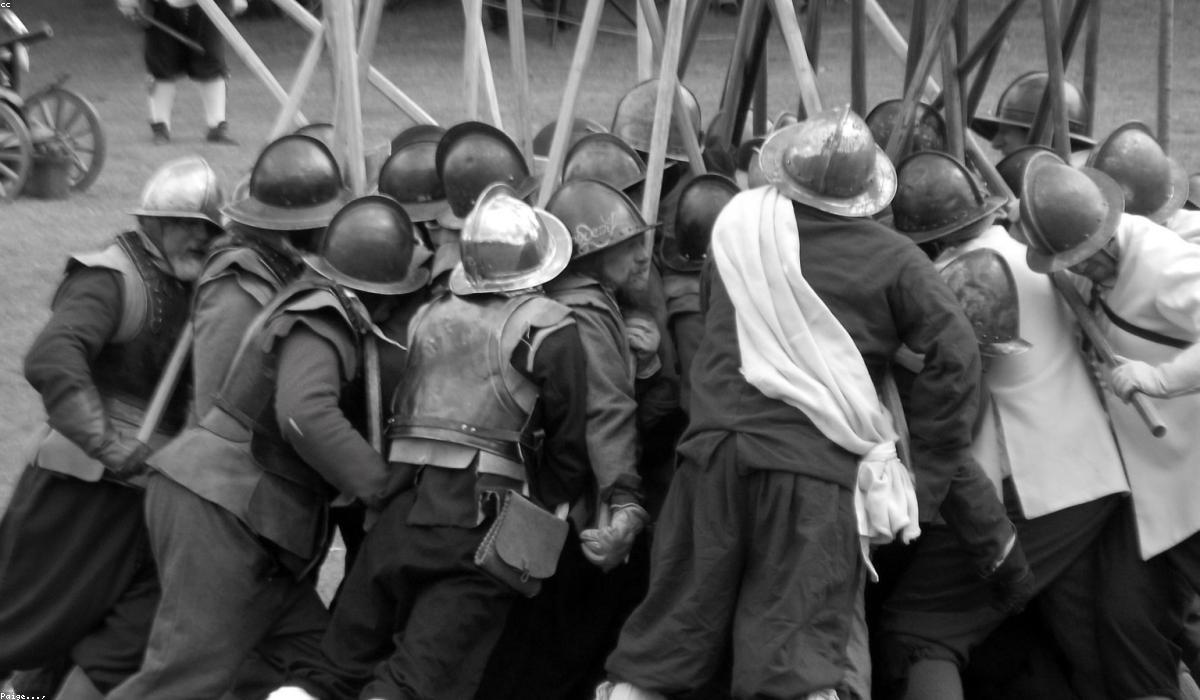
By 1642 the two sides had drifted beyond words. The king raised his standard at Nottingham and the country split. Broadly, the north and west rallied to the king — the Royalists, nicknamed Cavaliers — while London, the south-east and the navy went with Parliament, whose supporters were mocked as Roundheads for the close-cropped hair of some of their number. But the war cut through families and communities as much as regions, neighbour against neighbour, sometimes brother against brother.
The early fighting was inconclusive, but over time Parliament developed a war-winning weapon: a professional, disciplined, ideologically committed fighting force called the New Model Army. And out of that army rose the man who would dominate the next decade of English history — Oliver Cromwell. A country gentleman of no great importance before the war, Cromwell turned out to be a military genius and a leader of iron conviction, certain that God was guiding Parliament’s cause. Under his command the Royalist armies were ground down and finally crushed.
Defeated and captured, Charles still would not deal honestly. Even as a prisoner he schemed, intrigued and even managed to spark a second round of fighting by striking a secret bargain with the Scots. For Cromwell and the hardliners in the army, this was the final straw. A king who could not be trusted, who would plunge the country into bloodshed again and again rather than accept any limit on his power, was a king who had to be removed permanently. The radicals purged Parliament of moderates and put the king on trial for treason against his own people — a charge that, by its very logic, was revolutionary. Charles refused to recognise the court’s authority to the end, which only sealed his fate.
His execution left England in genuinely uncharted territory. The monarchy was abolished, the House of Lords swept away, and the country declared a republic, the Commonwealth. For a few years England was ruled without a king, eventually under Cromwell himself as Lord Protector — a position that was, awkwardly, a monarchy in all but name. It was a stern, godly regime that closed the theatres and frowned on frivolity, and it was held together largely by Cromwell’s own formidable personality.
That was its fatal weakness. When Cromwell died in 1658, there was no one of his stature to take his place. His son tried and quickly failed, the army squabbled, and the country, exhausted by years of instability, longed for a return to the familiar. In 1660 the dead king’s son was invited back from exile to take the throne as Charles II, and the monarchy was restored as though the republic had been a strange interruption. But nothing was truly the same. The execution of 1649 could never be unhappened, and every English monarch after it knew, somewhere deep down, that a king could lose his head. That uneasy new balance between crown and Parliament would be tested again within a single generation — in the strange, almost bloodless upheaval we’ll explore next time: the Glorious Revolution.
You May Like
Mafra, the Palace a King Built From a Vow