Deep in the Bavarian Alps, in a secluded valley surrounded by forested mountains, stands the smallest but perhaps the most perfect of the palaces built by King Ludwig II of Bavaria, the enigmatic monarch remembered as the Dream King or the Swan King. Schloss Linderhof, a jewel-like villa set amid formal gardens and fountains, was the only one of Ludwig’s great building projects to be completed in his lifetime, and it was the palace he loved best and lived in most.
Where the king’s famous castle of Neuschwanstein soars in medieval fantasy on its crag, Linderhof is something quite different, an intimate royal villa in the style of a French rococo pleasure palace, a private world of gilded splendor into which the reclusive king could retreat from the pressures of a reality he increasingly could not bear. It is a building conceived not for a court but for an audience of one, the king himself.
Linderhof was inspired above all by Ludwig’s passionate admiration for the absolute monarchy of France and for the Sun King, Louis XIV, whose image and emblems appear throughout the palace and its grounds. In this remote Alpine valley, Ludwig created a miniature Versailles, a stage for a fantasy of divine-right kingship that had long since vanished from the real world, and a refuge for a monarch out of step with his age.
Over the following pages you will explore the whole story of this remarkable place, from the troubled king who built it and the dream that inspired it, through the palace and its astonishing gardens, grottoes, and pavilions, to Ludwig’s tragic fate and the palace’s life today as one of the most visited sights in Bavaria. Come and discover the Dream King’s beloved Linderhof.

In This Article
- The Dream King
- From Hunting Lodge to Royal Villa
- A Miniature Versailles
- The Palace and Its Rooms
- The Gardens and Fountains
- The Venus Grotto
- The Moorish Kiosk and the Hunding Hut
- A Palace for a Solitary King
- The Tragic End of Ludwig II
- From Royal Refuge to Public Treasure
- The Meaning of the Dream King’s Palace
- See Linderhof for Yourself
- Visiting Linderhof Today
The Dream King
To understand Linderhof, you must first understand the extraordinary man who built it, King Ludwig II of Bavaria, one of the most romantic and tragic figures in the history of European royalty. Ascending the throne as a young man of remarkable beauty and sensitivity, Ludwig proved temperamentally unsuited to the practical business of ruling, and he retreated increasingly into a private world of art, music, and fantasy.
Ludwig was a passionate patron of the arts, above all of the composer Richard Wagner, whose operas, with their world of myth and legend, shaped the king’s imagination profoundly. He was also captivated by the history and image of absolute monarchy, particularly the France of Louis XIV, and by the medieval and chivalric past, and these passions found expression in his great building projects.
As the years passed, Ludwig withdrew further from public life and from the duties of kingship, increasingly nocturnal in his habits, shunning society, and pouring his energies and the resources of his personal fortune into the creation of the fantastical palaces that would become his enduring legacy. Linderhof, Neuschwanstein, and Herrenchiemsee were the products of this all-consuming passion.
The king’s building projects, and his growing detachment from reality, would ultimately lead to his downfall, but they left Bavaria and the world an extraordinary inheritance of romantic architecture. Of all these creations, Linderhof was the one Ludwig completed and inhabited, the palace most fully expressive of his dreams.
Ludwig’s reign coincided with momentous events, including the wars that led to the unification of Germany, in which Bavaria lost much of its independence and became part of the new German Empire under Prussian leadership. For a king who dreamed of absolute, sovereign majesty, this subordination was a bitter blow, and it deepened his retreat into a private world where he could still imagine himself a true monarch.
From Hunting Lodge to Royal Villa
The site of Linderhof had long been associated with the Bavarian royal family, for the valley contained a hunting lodge used by Ludwig’s father. It was here, in this remote and beautiful spot, that the young king chose to create his first great palace, beginning with modifications to the existing structures before conceiving something far more ambitious.

The project evolved over several years, growing from the enlargement of the old lodge into the creation of an entirely new royal villa. Ludwig worked closely with his architects and designers to realize his vision, and the palace was built and rebuilt as his ideas developed, until it emerged as the exquisite rococo villa that survives today.
The choice of this secluded Alpine valley was itself significant, reflecting Ludwig’s desire for privacy and his love of the mountains and forests of Bavaria. Far from the capital and the demands of court life, Linderhof offered the king a refuge where he could live according to his own solitary and nocturnal rhythms, surrounded by the beauty he had created.
By the time it was completed, Linderhof had become a fully realized work of art, a small but perfect palace set in elaborate gardens, the physical embodiment of the king’s dreams and the only one of his great projects that he would see brought to completion in his lifetime.
The gradual evolution of the design, from a modest enlargement of the old lodge to the exquisite villa that finally emerged, reflects the way Ludwig’s projects tended to grow in ambition as he worked on them, driven by the restless perfectionism of a man for whom no realization could ever quite match the dream in his mind.
A Miniature Versailles
The guiding inspiration behind Linderhof was Ludwig’s profound admiration for the absolute monarchy of France, and above all for Louis XIV, the Sun King, whose Palace of Versailles represented for Ludwig the supreme expression of royal splendor and divine-right kingship. Linderhof was conceived as a homage to this vanished world, a miniature Versailles in the Bavarian Alps.
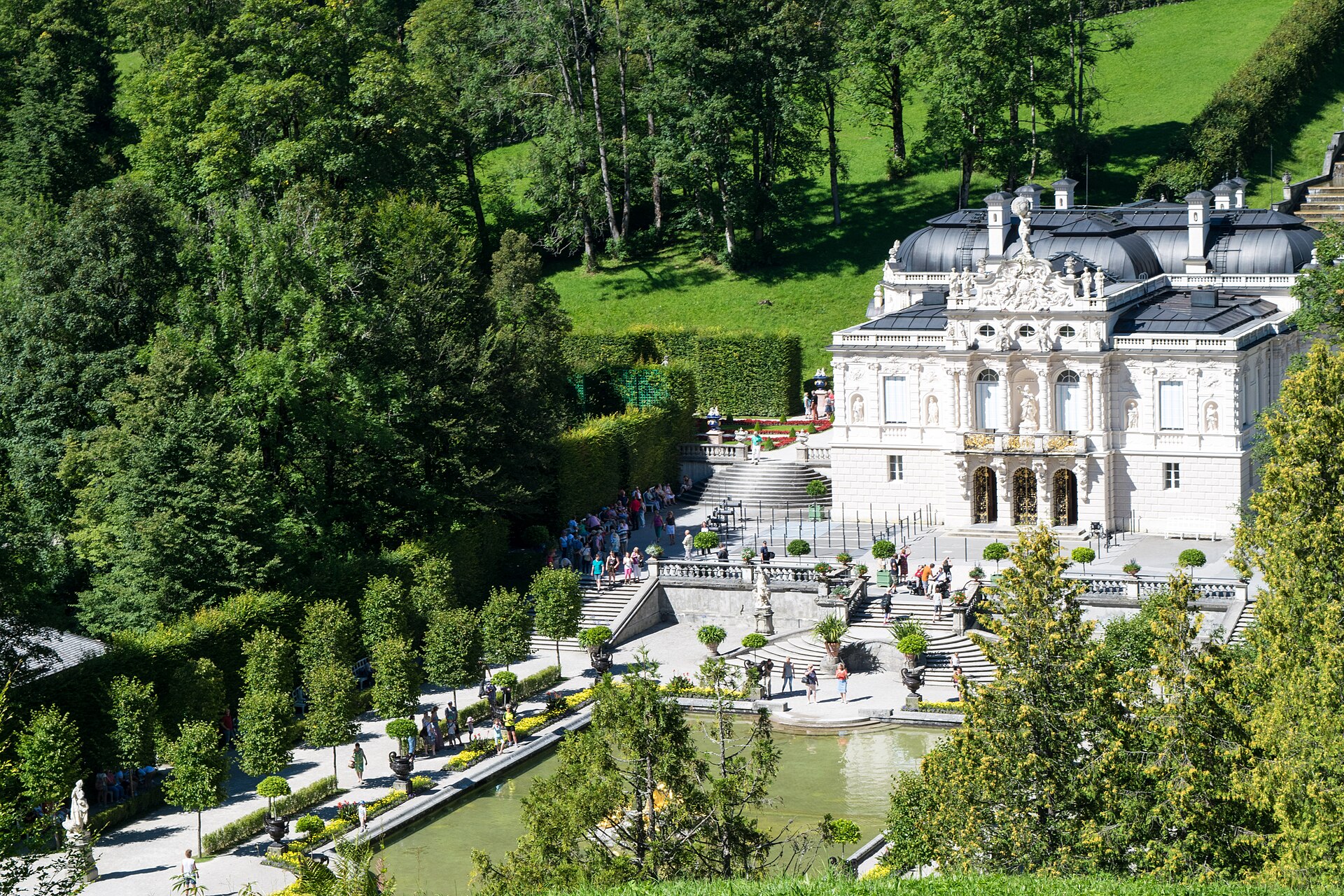
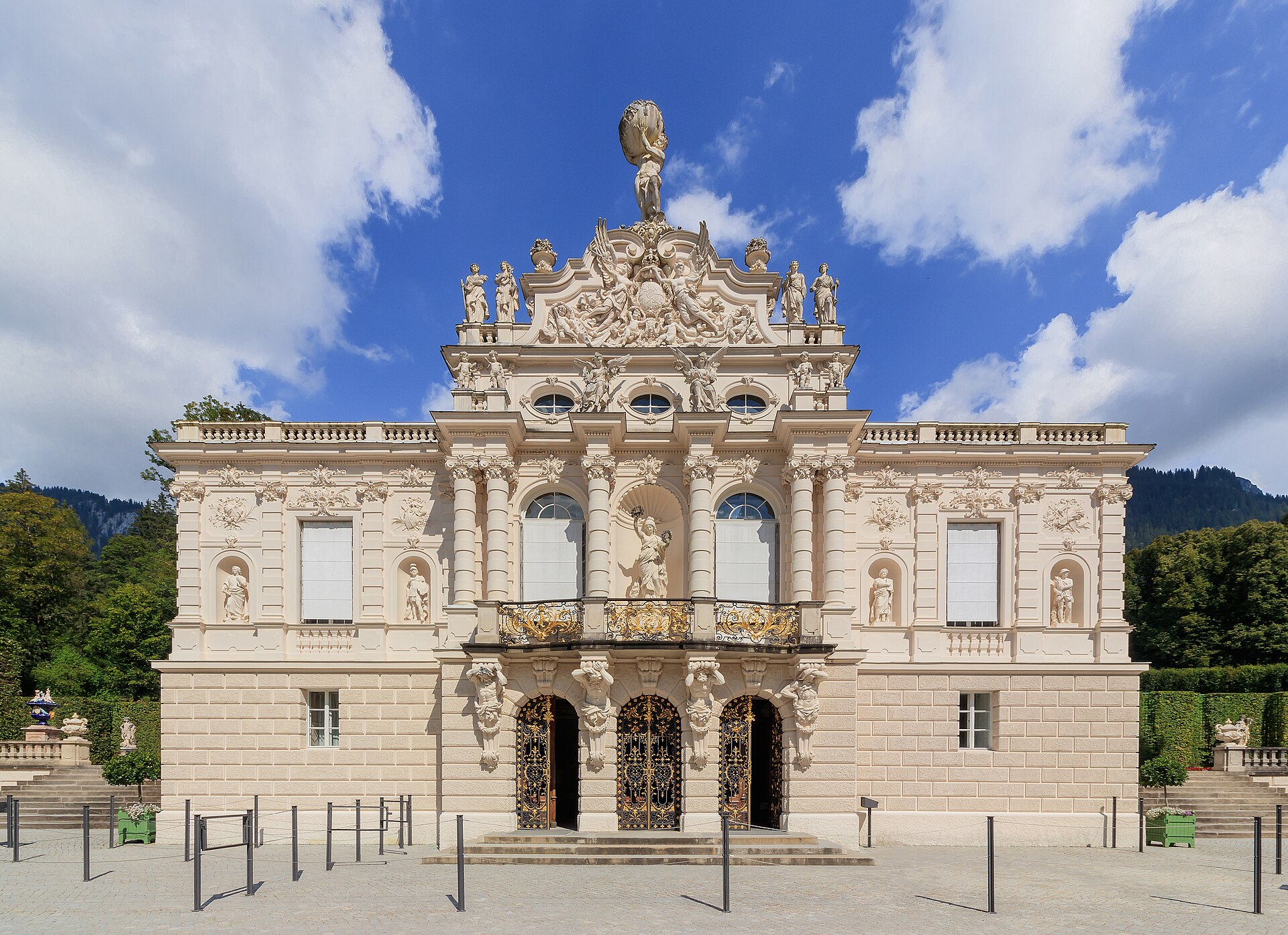
Throughout the palace and its grounds, references to Louis XIV and the French monarchy abound, from the sun emblems that recall the Sun King to the general style of the architecture and decoration, which draws on the French rococo of the eighteenth century. Ludwig immersed himself in the imagery and ideals of French absolutism, creating a private shrine to a form of kingship that had long since passed away.
This was more than mere decoration, for it reflected Ludwig’s deepest longings. In an age when the power of monarchs was being everywhere curtailed by constitutions and parliaments, and when Bavaria itself had become subordinate within a united Germany, Ludwig dreamed of the absolute, sacred kingship of an earlier era, and at Linderhof he built a stage on which he could inhabit that dream.
The result is a palace that is at once a masterpiece of rococo revival and a poignant expression of a king’s flight from his own time, a place where Ludwig could imagine himself a sovereign in the mold of the Sun King, ruling in solitary splendor over a realm of pure fantasy.
It is worth remembering that Ludwig never visited the real Versailles until relatively late, so that his vision of French absolutism was drawn largely from books, images, and imagination. This gives Linderhof a peculiarly dreamlike quality, for it is a recreation not so much of a real place as of an idea, a fantasy of kingship assembled from the king’s reading and longing.
The Palace and Its Rooms
Linderhof is small by the standards of royal palaces, but within its modest compass it achieves an intensity of decoration and splendor that few larger buildings can match. Every room is lavished with gilding, carving, painting, and rich materials, creating interiors of overwhelming richness that reflect the king’s taste for the opulence of the French rococo.
At the heart of the palace is the royal bedchamber, the largest and most magnificent room, decorated with extraordinary lavishness in a manner recalling the state bedchambers of the French kings. Around it are arranged the other rooms of the palace, including audience chambers, cabinets, and dining rooms, all decorated to the same standard of jewel-like richness.
The decoration draws on the full vocabulary of the rococo, with its curving forms, its gilded ornament, its mirrors and chandeliers, and its profusion of decorative detail. Mythological and allegorical subjects, references to the French monarchy, and symbols of kingship appear throughout, weaving the king’s obsessions into the very fabric of the palace.
One of the most famous features is a dining table that could be lowered through the floor to the kitchens below and raised again fully set, so that the solitary king could dine without the presence of servants, a device that reflects both the technical ingenuity of the age and Ludwig’s desire for solitude and his aversion to human company.
The intimacy of the palace is part of its charm, for unlike the vast, echoing state apartments of the great royal residences, Linderhof was built to be lived in by one man, and its rooms have a jewel-box quality, small enough to be fully inhabited yet decorated with a richness that rivals any palace in Europe. It is opulence on a human, even a private, scale.
The Gardens and Fountains
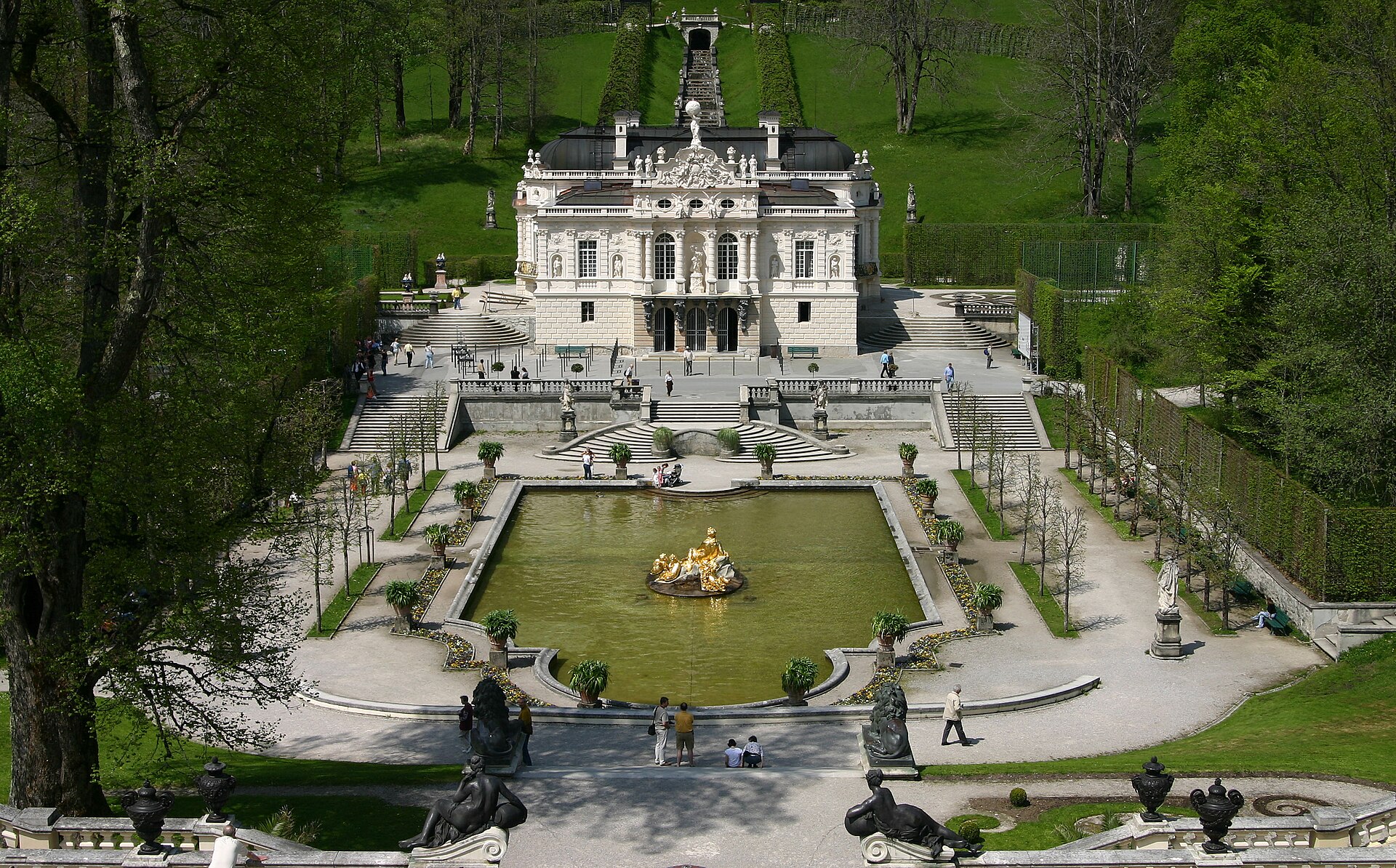
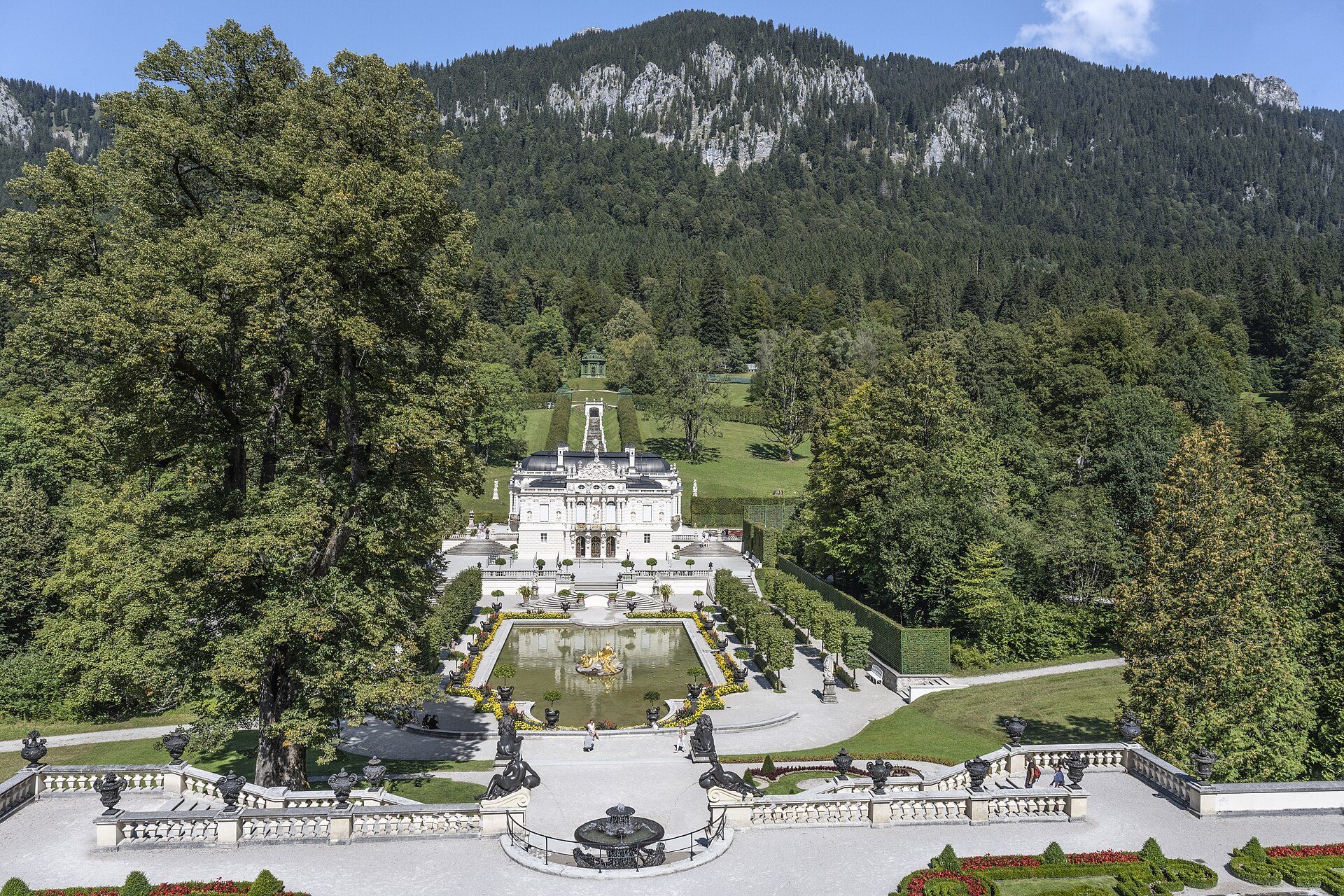
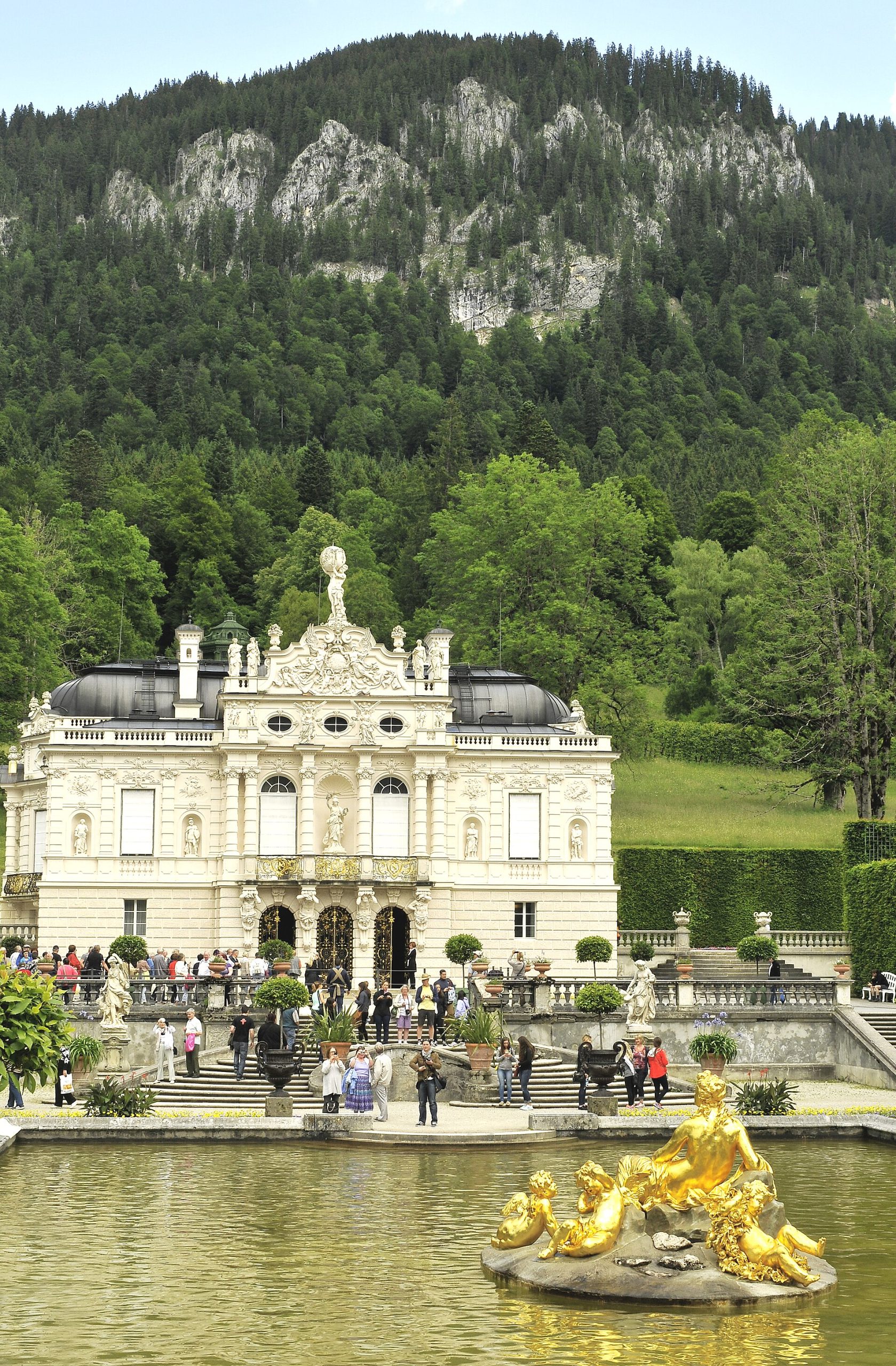
The gardens of Linderhof are among its greatest glories, a masterpiece of landscape design that combines formal French parterres with the natural beauty of the Alpine setting. The gardens rise up the slopes around the palace, blending the geometric order of the formal garden with the wilder landscape of the surrounding mountains and forests.

Directly before the palace lies a formal water parterre with a great fountain that shoots a jet of water high into the air at intervals, a spectacular feature that draws the eye and animates the garden. The fountains and water features throughout the grounds recall the great fountains of Versailles and add movement and life to the formal landscape.
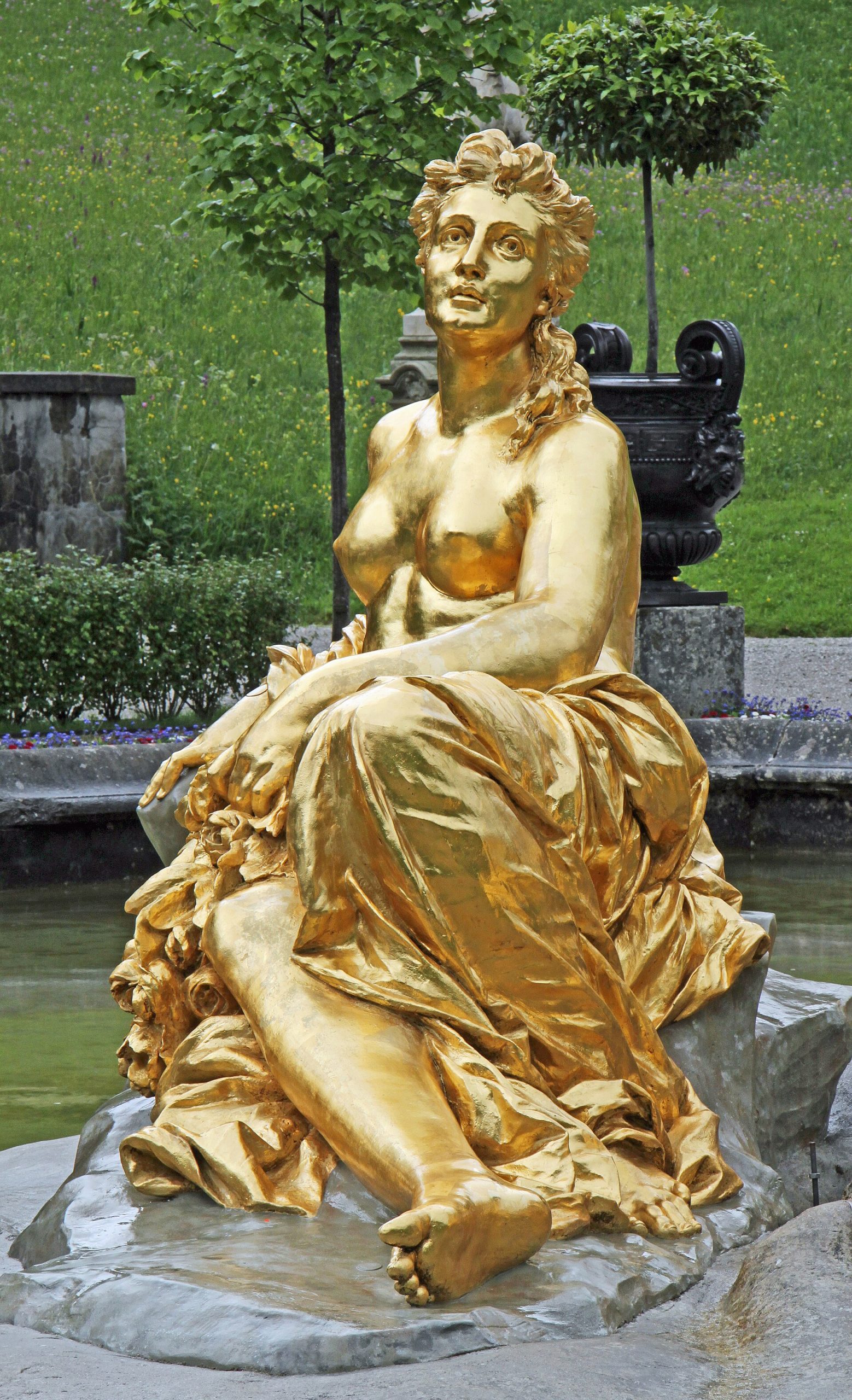
The gardens are adorned with terraces, staircases, sculptures, and pavilions, arranged to create a sequence of vistas and effects as one moves through them. Above the palace, a temple and other structures crown the slopes, while the formal elements give way to the natural landscape beyond, in a masterful blending of art and nature.
The whole composition of palace and garden is designed as a unified work of art, in which the building sits at the heart of an elaborately landscaped setting that enhances its beauty and expresses the king’s vision. The gardens of Linderhof are considered among the finest of their kind, a jewel of European garden design.
The gardens change character as they rise from the formal parterres near the palace to the wilder slopes above, mirroring the transition from the artifice of the rococo to the sublime nature of the Alps. This interplay between the ordered garden and the wild mountain landscape is one of the great achievements of the design, and it gives Linderhof its unique setting among royal palaces.
The Venus Grotto
Among the most extraordinary features of Linderhof is the Venus Grotto, an artificial cave in the palace grounds that ranks among the most remarkable creations of the whole estate. This grotto was built to evoke the world of Wagner’s opera Tannhauser, and it reflects Ludwig’s passion for the composer and his operas.

The grotto is an artificial cavern, illuminated by colored electric light, one of the earliest uses of such technology, and containing an underground lake on which the king could be rowed in a shell-shaped boat. The whole creation was designed to transport Ludwig into the magical, mythological world of Wagner’s opera, a private theater of fantasy hidden within the mountain.
The technical ingenuity of the grotto was remarkable for its time, with its artificial lighting that could change color, its heated water, and its wave machine to create ripples on the lake. It represented a fusion of the latest technology with the king’s romantic imagination, a place where engineering was pressed into the service of fantasy.
The Venus Grotto is perhaps the purest expression of Ludwig’s character and his dreams, a place created solely for the private enjoyment of a king who wished to escape into a world of art and legend. It remains one of the most fascinating and evocative features of Linderhof, a window into the extraordinary imagination of the Dream King.
That a nineteenth-century king should have commissioned an artificial grotto with colored electric lighting and a wave machine, purely to recreate the mood of an opera, tells us much about both the technical possibilities of the age and the boundless nature of Ludwig’s imagination. The Venus Grotto is a place where the newest technology served the most romantic of dreams.
The Moorish Kiosk and the Hunding Hut
Scattered through the grounds of Linderhof are several exotic pavilions that further express the range of Ludwig’s romantic imagination. Among the most striking is the Moorish Kiosk, an ornate structure in the oriental style that the king acquired and installed in his gardens, containing a magnificent peacock throne that fed his fantasies of exotic, eastern kingship.

Another pavilion, the Hunding Hut, was built to evoke a scene from Wagner’s operatic cycle, recreating the primitive dwelling described in the drama, complete with a great tree at its center. Like the Venus Grotto, it allowed the king to enter physically into the world of the operas he so loved, blurring the line between art and life.
There was also a hermitage evoking another Wagnerian scene, further extending the estate into a landscape of operatic and romantic fantasy. Each of these structures served the king’s desire to inhabit the imaginative worlds that captivated him, from the exotic east to the mythological past of Germanic legend.
Together these pavilions transform the grounds of Linderhof into a kind of theme park of the king’s obsessions, a landscape studded with structures that gave physical form to his dreams, and that reveal the extraordinary range and intensity of the romantic imagination that created the whole estate.
These structures also reveal the eclecticism of the romantic age, which delighted in evoking distant times and places, from the Islamic east to the Germanic past. Ludwig took this taste to an extreme, building not merely decorative follies but fully realized environments into which he could physically enter, blurring the boundary between the world of art and the world of life.
A Palace for a Solitary King
Linderhof was designed above all for solitude, for it was here that the reclusive Ludwig spent much of his time, living according to his own peculiar rhythms and shunning the company of others. The palace reflects this solitary purpose in its very design, from the intimate scale of its rooms to the ingenious devices that allowed the king to avoid human contact.

Ludwig lived increasingly by night, sleeping by day and rising in the evening to pursue his solitary pleasures, dining alone, reading, and wandering his gardens and grottoes under the stars. The palace and its grounds were arranged to accommodate this nocturnal existence, a private world in which the king could live out his fantasies undisturbed.
The famous disappearing dining table was only one of the devices designed to minimize the king’s contact with servants, reflecting his growing aversion to human company. Increasingly withdrawn and eccentric, Ludwig created at Linderhof a hermetic world in which he could be entirely alone with his dreams.
This solitude, which gives Linderhof much of its poignant character, was both the source of the palace’s unique beauty and a symptom of the king’s tragic detachment from the world. In creating a perfect refuge from reality, Ludwig also sealed himself off from the life around him, with consequences that would ultimately prove fatal.
The pathos of this solitude is inseparable from the beauty of the palace. Linderhof was a refuge, but it was also, in a sense, a gilded cage, a place where a lonely and troubled man sealed himself away from a world he found unbearable. The perfection of the setting only deepens the melancholy of the life that was lived within it.
The Tragic End of Ludwig II
The king’s obsessive building projects, and his ever-deepening withdrawal from the duties of kingship, could not continue indefinitely. The enormous cost of his palaces strained even his personal resources, and his ministers grew increasingly alarmed at his behavior and his neglect of affairs of state, until they resolved to remove him from power.

In a dramatic and controversial series of events, the king was declared unfit to rule on the grounds of mental incapacity, deposed, and taken into custody. The circumstances of his removal, based on a medical assessment made without a proper examination, remain the subject of debate, and many have questioned whether the king was truly insane or simply eccentric and inconvenient.
Shortly after his deposition, Ludwig was found dead in a lake, together with the doctor who had been attending him, in circumstances that have never been fully explained. Whether his death was suicide, accident, or something more sinister has been debated ever since, and it remains one of the enduring mysteries of European royal history.
The death of Ludwig II brought to an end the extraordinary career of the Dream King, but it also transformed his palaces from private extravagances into public treasures. The buildings that had contributed to his downfall would become, in time, among the most beloved and visited monuments in all of Germany, a lasting memorial to their tragic creator.
The mystery surrounding Ludwig’s death has only added to the romantic aura that surrounds his memory and his palaces. Was he mad, or merely a dreamer out of step with his practical age? Was his death an accident, a suicide, or a murder? These unanswered questions have made Ludwig a figure of enduring fascination, and his palaces places of pilgrimage.
From Royal Refuge to Public Treasure
After the death of Ludwig II, the palaces he had built passed to the state, and Linderhof, along with his other creations, was opened to the public. The buildings that had been created for the private enjoyment of a solitary king became accessible to all, and they quickly attracted the fascination of visitors drawn by their beauty and by the romantic and tragic story of their creator.

Linderhof, as the most complete and intimate of Ludwig’s palaces, and the one he had loved best, became a particular favorite, and it has remained one of the most visited sights in Bavaria. Its jewel-like interiors, its beautiful gardens, and its extraordinary grottoes and pavilions continue to enchant visitors from around the world.
The palace has been carefully preserved and maintained as a monument to Ludwig II and to the romantic imagination that created it. The fragile decorations, the gardens, the fountains, and the technical marvels of the grotto all require ongoing care, and the work of conservation ensures that this unique creation is preserved for future generations.
In death, the Dream King achieved a kind of immortality through his palaces, which have become symbols of Bavaria and of the romantic imagination itself. Linderhof, the palace of his heart, stands as the most personal and perhaps the most perfect expression of his extraordinary vision.
There is a profound irony in the fact that the building projects which helped to bring about Ludwig’s downfall, condemned in his lifetime as ruinous extravagances, have become one of the great economic assets of modern Bavaria, drawing millions of visitors and generating far more than they ever cost. The Dream King’s follies proved, in the end, to be a sound investment.
The Meaning of the Dream King’s Palace
Linderhof occupies a special place among the great palaces of Europe, for it is not the expression of a court or a dynasty but the creation of a single, solitary imagination. It is a palace built by a king for himself alone, the physical embodiment of one man’s dreams, and this gives it a unique and deeply personal character.
The palace can be read as a poignant commentary on its age, the creation of a monarch who longed for the absolute, sacred kingship of the past at the very moment when such kingship was vanishing from the world. In building his miniature Versailles, Ludwig was fleeing from the constitutional, industrial, modern age into a dream of a vanished order.
There is a tension at the heart of Linderhof between its exquisite beauty and the tragic circumstances of its creation, between the perfection of the king’s dream and the sad reality of his life and death. This tension gives the palace much of its haunting power, and it invites reflection on the relationship between art, fantasy, and reality.
For all its associations with a troubled and tragic king, Linderhof remains, above all, a work of extraordinary beauty, a perfect jewel of a palace set in a sublime Alpine landscape, and a lasting testament to the power of the human imagination to create beauty even out of a flight from the world.
In this sense Linderhof belongs to a select company of buildings that are valued not for their practical function or their dynastic significance but purely as expressions of a singular imagination. It is closer, in spirit, to a work of art than to a conventional palace, and it must be understood as such, as the realized dream of one extraordinary man.
See Linderhof for Yourself
The beauty of Linderhof, with its jewel-like interiors, its formal gardens and fountains, and its extraordinary grottoes and pavilions, is best appreciated by seeing the palace and its setting for yourself, in the sublime Alpine landscape that surrounds it. A video conveys the atmosphere of the place in a way that words and still images cannot fully capture.
The short video below explores Linderhof and the story of its creator, King Ludwig II, tracing the history of the palace and the tragic fate of the Dream King. It is an ideal companion to everything you have read here, deepening your understanding of this remarkable place and the extraordinary man who built it.
As you watch, consider the dreams and obsessions that gave rise to this perfect little palace, and the tension between its exquisite beauty and the tragic story of the king who created it. Then, when you visit Bavaria, you will recognize Linderhof not just as a beautiful palace but as the most personal expression of one of history’s most fascinating and tragic monarchs.
Visiting Linderhof Today
For the modern traveler, Linderhof is one of the essential sights of Bavaria, a palace whose beauty and romantic associations make it a highlight of any visit to the region. Located in a secluded Alpine valley, the palace is set in some of the most beautiful scenery in Germany, and reaching it is itself a pleasure, a journey into the mountains that Ludwig loved.
Visitors can tour the interior of the palace, admiring its jewel-like rooms and the famous disappearing dining table, and explore the extensive gardens with their fountains, terraces, and sculptures. The Venus Grotto, the Moorish Kiosk, and the other pavilions in the grounds are among the highlights, offering a glimpse into the extraordinary imagination of the Dream King.
Linderhof lies within reach of Ludwig’s other creations, including the famous castle of Neuschwanstein, and a tour of the king’s palaces makes for a memorable journey through the romantic landscape of Bavaria. As always, it is worth checking current opening arrangements before you go, as some features, such as the grotto, may be subject to restoration.
However you approach it, Linderhof rewards the visitor who understands its story. This is not merely a beautiful little palace but the beloved refuge of a tragic king, the most complete expression of his romantic dreams, and a jewel of European architecture and garden design set in a sublime Alpine landscape, a place where beauty and melancholy meet in perfect harmony.
The contrast between the crowds who now throng Linderhof and the profound solitude for which it was built is one of the poignant ironies of its afterlife, for the palace created as a refuge from all human company has become one of the most visited places in Germany, its intimate rooms filled daily with admiring strangers.
Palaces Nearby
If the Dream King’s beloved Linderhof has drawn you into the world of the Bavarian royal palaces, two more great residences of the Wittelsbach dynasty make natural companions to a visit here, each telling a different chapter of the story.
- Schloss Herrenchiemsee — Ludwig’s unfinished island recreation of Versailles on a lake in the Bavarian Alps.
- The Munich Residenz — the vast city palace that was the ancient seat of the Wittelsbach dynasty for more than seven centuries.
You May Like

The Bardo, a Palace of the Beys Filled With Roman Mosaics


2 thoughts on “The Only Palace the Dream King Ever Lived to Finish”