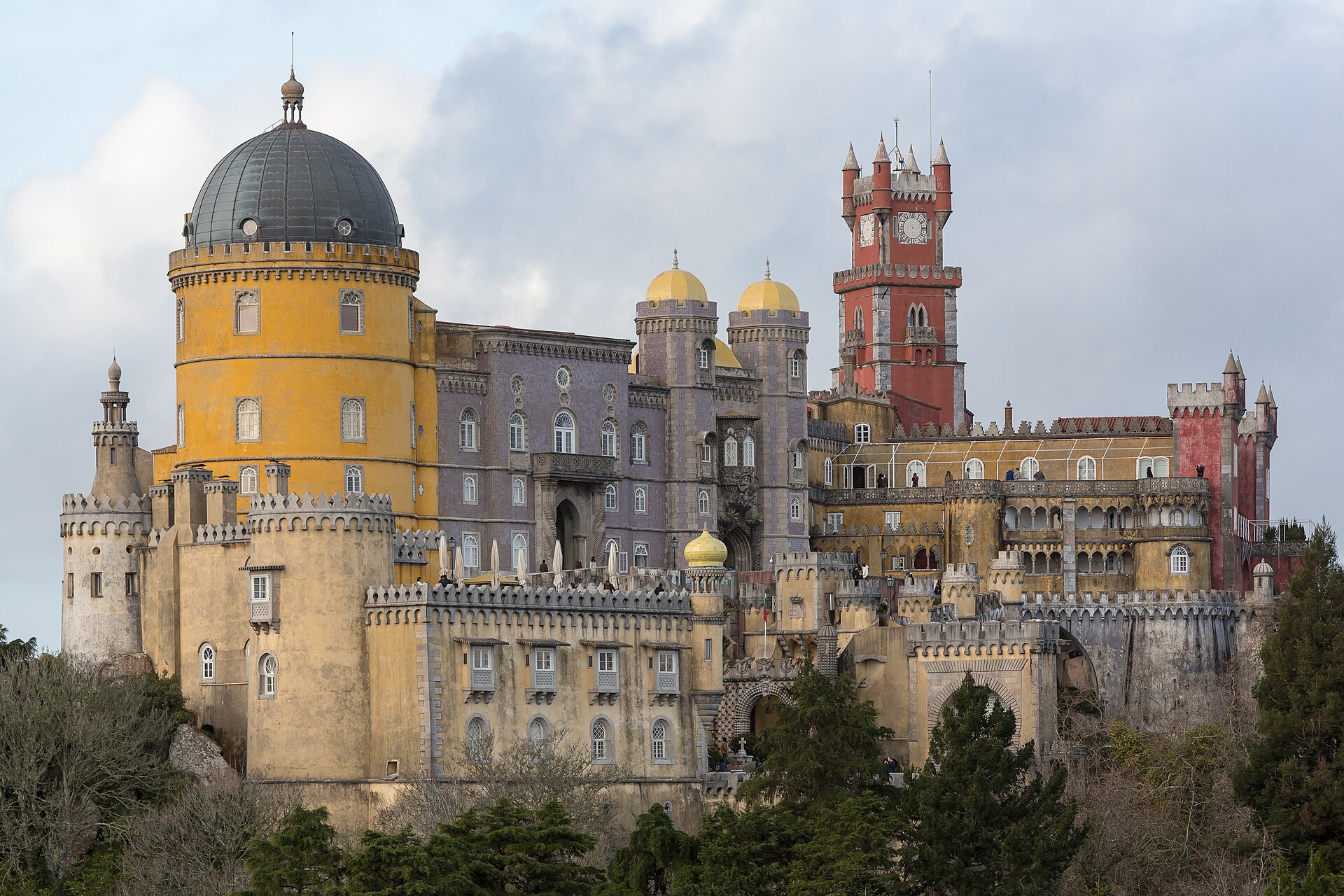
High on a wooded crag above the town of Sintra, wrapped for much of the year in the mists that roll off the Atlantic, stands one of the most extraordinary palaces in all of Europe. The Palace of Pena does not look quite like anything else. Painted in bold reds and yellows, bristling with towers, domes, drawbridges, and battlements, adorned with tiled walls and a monstrous stone guardian above one of its gates, it seems less a royal residence than a fairy tale conjured into stone on a Portuguese mountaintop.
Pena is the supreme monument of the Romantic movement in Portugal, a nineteenth-century fantasy that gathered together every style its creator loved, Gothic, Moorish, Renaissance, and the uniquely Portuguese Manueline, and fused them into a single exuberant whole. It was built not by an old dynasty of medieval kings but by an artistic prince who came from abroad and fell in love with the beauty of Sintra, and who set out to raise upon its heights a summer palace like no other.
The result is a building that delights and astonishes in equal measure. Its riot of colour and form, its dramatic hilltop setting, and its wild mixture of styles make it one of the most photographed and most beloved palaces in the world, the crowning jewel of a landscape so beautiful that it has been recognised as a cultural treasure of all humanity. To come upon Pena rising above the clouds is to feel that one has stepped into a storybook.
Yet behind the fantasy lies real history: an old monastery reduced to ruins, an art-loving king consort with a vision, a golden age of Portuguese Romanticism, and the last chapter of a monarchy that would fall in the early twentieth century. This is the story of how a ruined mountain sanctuary became the most magical of royal palaces, and of the artist king who dreamed it into being amid the enchanted hills of Sintra.
In This Article
- A Fairy Tale on a Portuguese Mountaintop
- Ferdinand, the Artist King
- From a Ruined Monastery to a Royal Palace
- Baron von Eschwege and Romantic Eclecticism
- The Red and Yellow Palace
- The Triton Gateway
- The Cloister and Chapel of the Old Sanctuary
- The Splendour of the Interiors
- The Royal Table and the Rooms of Daily Life
- The Private Apartments
- Tiles, Ceilings, and the Love of Ornament
- The Enchanted Park of Pena
- Pena Today: A World Heritage Wonder
A Fairy Tale on a Portuguese Mountaintop
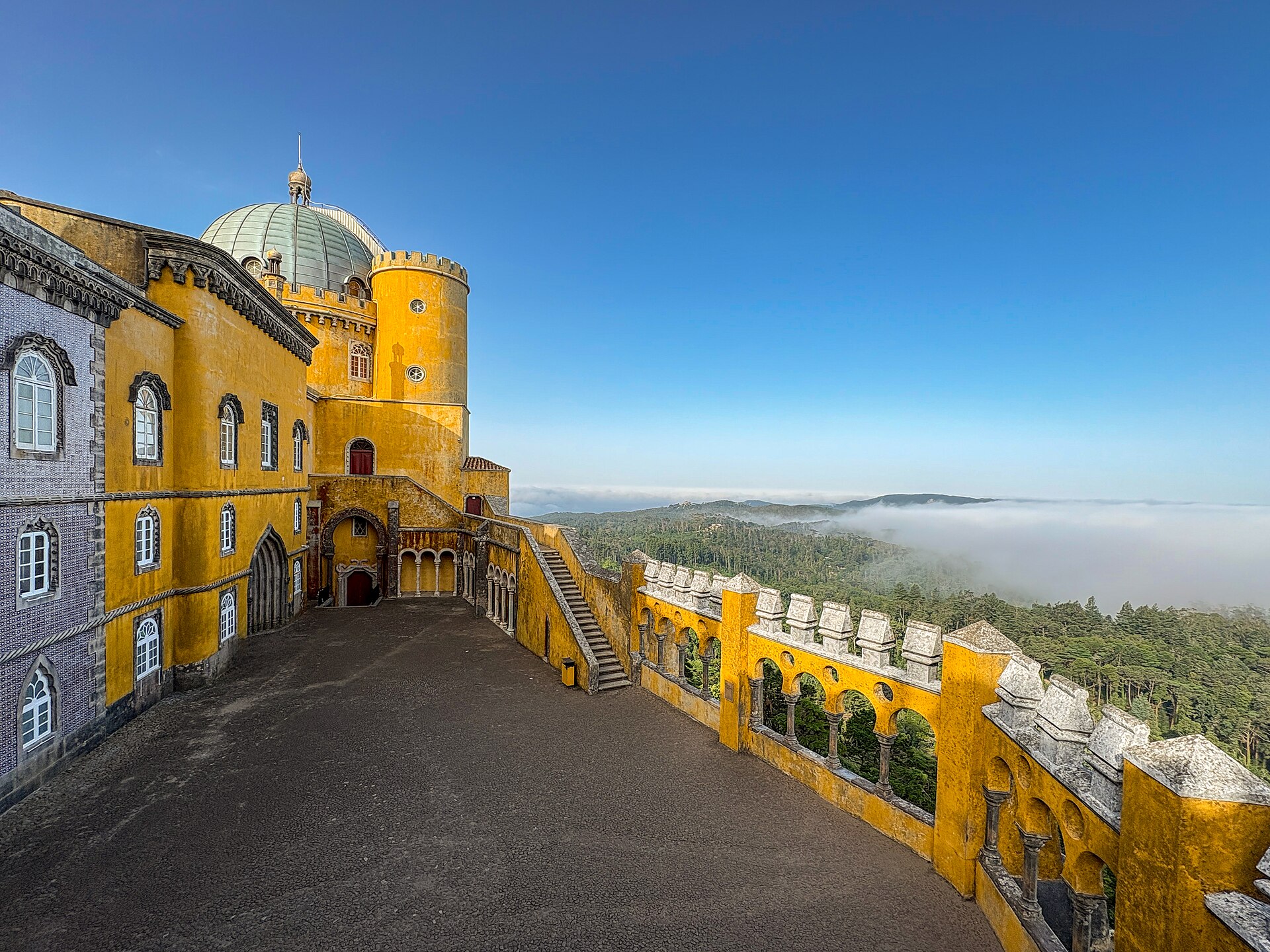
The Palace of Pena crowns one of the highest points of the Sintra hills, a range of green, mist-wreathed peaks rising close to the Atlantic coast a little way from Lisbon. From its terraces the view stretches across forests and hills to the distant sea, and on many days the palace floats above a sea of cloud, its bright towers catching the sun while the valleys below lie hidden in mist. The setting alone would make Pena remarkable.

But it is the palace itself that seizes the imagination. Unlike the sober classical residences of most European monarchies, Pena is a joyful explosion of colour and form. Its walls are painted in vivid red and yellow, its towers and domes rise in a fantastical silhouette, and its surfaces are encrusted with tiles, carvings, and ornament drawn from many different traditions. It looks, quite deliberately, like the castle of a romantic dream.
This was exactly the effect its creator intended. Pena was built in the age of Romanticism, when artists and dreamers turned away from the cool reason of the classical age toward emotion, imagination, and a love of the medieval, the exotic, and the picturesque. The palace was conceived as a Romantic fantasy, a place where history and legend, art and nature, could blend into a single enchanting whole, and it succeeds triumphantly.
Today Pena stands as the most famous building in Portugal and one of the icons of European Romanticism. Its image, rising colourful and dreamlike above the green hills of Sintra, is known around the world, and it draws vast numbers of visitors who climb to its heights to wander its towers and terraces. It is a palace that seems to belong as much to the world of fairy tales as to history, and that is precisely its magic.
The palace also holds an important place in the history of ideas, for it is one of the earliest and greatest examples of Romantic revivalism in Europe, predating and in some ways anticipating the famous fairy-tale castles later built elsewhere on the continent. In gathering historic styles into a single imaginative whole and marrying architecture so completely to a dramatic natural setting, Pena helped define what Romantic architecture could be, and it remains a touchstone of the movement to this day.
Ferdinand, the Artist King
The visionary behind Pena was King Ferdinand II of Portugal, a man remembered as the artist king. Born a German prince of the house of Saxe-Coburg and Gotha, the same cultivated family that produced consorts for several European thrones, he came to Portugal to marry the young Queen Maria II and became king consort. A lover of art, music, and nature, he devoted his life less to politics than to the pursuit of beauty.
Ferdinand fell deeply in love with the landscape of Sintra, whose romantic hills, lush vegetation, and misty atmosphere seemed to embody the very spirit of the age. He was a talented artist in his own right, a painter and a patron, steeped in the Romantic sensibility of his time, and he saw in the ruined sanctuary on the mountaintop the perfect canvas for a grand artistic vision. Pena would become his masterpiece.
He approached the project not as a mere builder but as an artist composing a work of art. Every element, from the wild mixture of architectural styles to the choice of colours, from the layout of the surrounding park to the smallest decorative detail, was considered as part of a total Romantic composition. Ferdinand poured his imagination and his resources into the palace over many years, shaping it according to his own personal dream.
In creating Pena, Ferdinand gave Portugal its supreme monument of Romanticism and left a legacy that would define the image of Sintra forever. He was that rare thing, a royal figure who was also a genuine artist, and the palace is the fullest expression of his sensibility. It stands as a portrait, in stone and colour, of a king who cared above all for beauty, and who found in the hills of Sintra the perfect setting for his dreams.
Ferdinand’s cultural connections ran throughout the royal houses of Europe, and he moved in a world of artists, musicians, and collectors. He was a cousin of figures who shaped the tastes of several courts, and he brought to Portugal the cosmopolitan sensibility of a cultivated German prince. This background helped shape Pena, which drew on ideas and influences from across Europe even as it grew from the particular soil of Sintra, making it at once deeply Portuguese and thoroughly European.
From a Ruined Monastery to a Royal Palace
Long before Ferdinand’s fantasy rose upon it, the mountaintop had been a place of religious retreat. In earlier centuries a monastery of the Hieronymite order had stood here, dedicated to Our Lady of Pena, a small and remote sanctuary perched high above Sintra. It was a place of solitude and devotion, its monks living amid the mists and forests of the mountain, far from the world below.

Over time the monastery suffered from the elements and from disaster. A great earthquake and lightning strikes damaged the buildings, and by the early nineteenth century, following the dissolution of the religious orders in Portugal, the sanctuary had fallen into ruin. The once-holy site lay abandoned on its peak, its walls crumbling, a picturesque ruin of exactly the kind that so appealed to the Romantic imagination.
It was this ruin that Ferdinand acquired and chose as the foundation of his new palace. Rather than sweeping the old buildings entirely away, he incorporated the surviving structures of the monastery, above all its cloister and chapel, into his new creation, preserving them at the heart of the fantastical palace that grew up around them. The old and the new were thus woven together in a single romantic composition.
This blending of a genuine historic ruin with a new work of Romantic imagination is central to the character of Pena. The palace is at once authentic and invented, a real medieval sanctuary embedded within a nineteenth-century dream. Ferdinand’s decision to preserve the monastery gave his fantasy a core of true history, and it allows the visitor today to move from the quiet, ancient cloister into the exuberant world of the Romantic palace.
Baron von Eschwege and Romantic Eclecticism
To realise his vision, Ferdinand turned to a fellow German, the soldier and mining engineer Baron Wilhelm Ludwig von Eschwege, who had spent time in Portugal and Brazil and shared the king’s Romantic tastes. Working closely with Ferdinand, who took an intense personal role in the design, Eschwege translated the royal dream into buildable architecture over the course of the mid-nineteenth century.

The style they created was one of deliberate and joyous eclecticism, drawing freely on many architectural traditions at once. Elements of the Gothic, with its towers and battlements, mingle with Moorish arches and tilework, Renaissance domes, and the distinctive Portuguese Manueline style, with its ropelike carvings and maritime motifs recalling the age of discovery. No single style rules; instead all are combined into a single fantastical whole.
This mixing of styles was not a failure of taste but the very point of the design. Romantic architecture delighted in evoking the past through a rich blend of historical references, and at Pena this approach was carried to its fullest and most exuberant expression. The palace is a kind of anthology of architecture, a celebration of many ages and cultures gathered into one dreamlike building on its mountain peak.
The influence of German Romanticism, with its castles rising above the Rhine, can be felt strongly at Pena, and the palace has often been compared to the fairy-tale castles built in the same era in the German lands. Ferdinand, drawing on his own cultural background and the ideas of his age, created in Portugal a monument that stands among the great achievements of Romantic architecture anywhere in Europe.
The Red and Yellow Palace
Perhaps the most immediately striking feature of Pena is its colour. The palace is painted in bold, saturated hues, with whole wings in brilliant red and others in warm yellow, so that against the green of the forest and the blue of the sky it blazes with an almost unreal vividness. This dramatic use of colour is one of the things that sets Pena apart from almost every other royal palace in Europe.

The colours were part of Ferdinand’s original Romantic conception, chosen to heighten the fairy-tale character of the building and to make it stand out against its natural setting. Over the years the palace was at times allowed to fade to a weathered grey, but restoration has returned it to the bright reds and yellows of its creator’s vision, so that today it appears once more as the vivid dream Ferdinand intended.
The colour works together with the fantastical forms of the architecture to create the palace’s storybook effect. The red and yellow towers, the tiled surfaces, the ornamental battlements and domes, all combine into a composition of extraordinary visual richness. There is a deliberate theatricality to it, a sense that the whole palace is a stage set for romance, and the colour is essential to that effect.
Seen from a distance, rising colourful above the wooded slopes or floating over a sea of morning cloud, the painted palace is one of the most memorable sights in Portugal. It is an image that has become the very symbol of Sintra and of Portuguese Romanticism, and it demonstrates how boldly Ferdinand broke with convention. Where other kings sought dignity through restraint, he sought enchantment through colour, and he succeeded completely.
The restoration of the colours was itself a considerable undertaking, requiring careful research into the original schemes so that the reds and yellows could be returned to their intended tones. The decision to restore the vivid colouring rather than leave the palace in its faded state was a bold one, but it has allowed modern visitors to experience Pena as Ferdinand meant it to be seen, and the blazing palace has become one of the most recognisable images in all of Portugal.
The Triton Gateway
Among the many wonders of Pena, one detail above all captures its strange and imaginative spirit: the Triton gateway. Over one of the ornamental archways of the palace crouches a monstrous stone figure, half sea creature and half man, its body emerging from a great shell, its features fierce and its form wreathed in coral and vegetation. It presides over the entrance like a guardian from a myth.

The figure is a triton, a sea god of classical mythology, and it is generally understood as an allegory of the creation of the world, representing the emergence of life from the primordial waters. Set above the archway amid a riot of carved ornament, it is one of the most celebrated and photographed features of the palace, a perfect emblem of the fantastical imagination that shaped the whole building.
The Triton gateway shows how Ferdinand and his architect delighted in fusing meaning, mythology, and pure visual invention. The figure is at once decorative, symbolic, and slightly unsettling, exactly the kind of romantic marvel that the age loved. It transforms a simple archway into a threshold between worlds, a passage guarded by a creature from the deep imagination of myth.
For visitors, the Triton is one of the unforgettable images of Pena, a moment where the palace’s fairy-tale character crystallises into a single extraordinary detail. It embodies the whole spirit of the place: learned yet playful, drawing on ancient myth yet wholly original, and utterly committed to wonder. To pass beneath it is to enter fully into the enchanted world that Ferdinand created upon his mountain.
The Cloister and Chapel of the Old Sanctuary
At the heart of the exuberant palace, preserved from the ruined monastery, lies a quiet and ancient core: the old cloister and chapel of the sanctuary of Our Lady of Pena. Ferdinand carefully retained these structures, and they provide a striking contrast to the fantastical architecture that surrounds them, a still centre of genuine history within the Romantic dream.
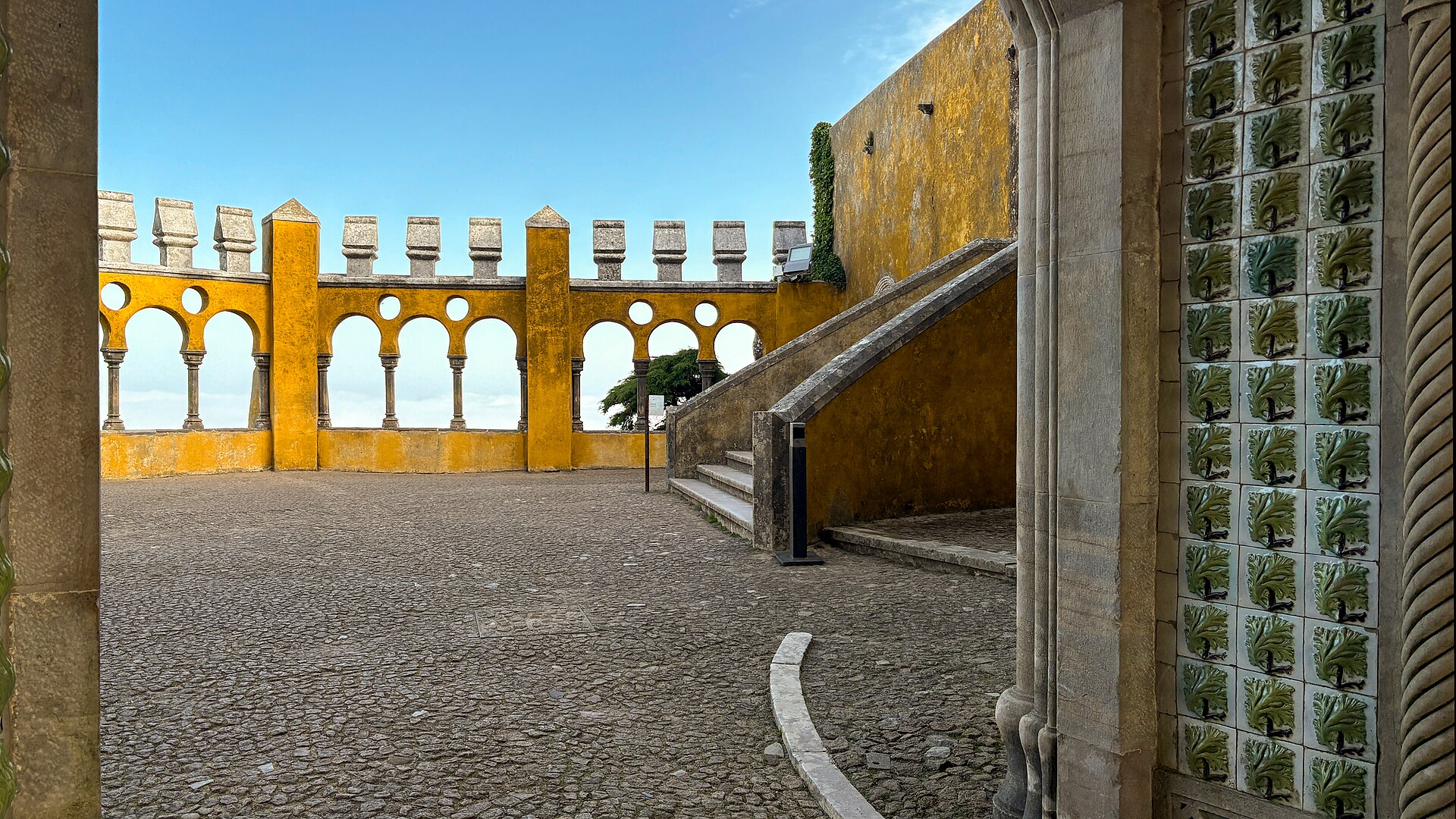
The cloister, with its arches and its tiled surfaces, retains the atmosphere of the monastic sanctuary it once was, a place of contemplation now embedded within a royal palace. Its walls are decorated with the beautiful glazed tiles for which Portugal is famous, and its intimate scale offers a moment of calm amid the drama of the palace, a reminder of the mountaintop’s earlier life as a place of prayer.
The chapel preserves treasures from the old monastery, including a fine altarpiece of alabaster and marble, a work of great artistry that survived the ruin of the sanctuary. Attributed to a master sculptor of the Renaissance, it is one of the most precious possessions of the palace and a link to the centuries of devotion that preceded Ferdinand’s transformation of the site.
These surviving fragments of the monastery give Pena a depth that a purely invented fantasy would lack. They root the Romantic palace in real history and real faith, and they allow the visitor to sense the layers of the mountaintop’s story, from remote religious retreat to ruined sanctuary to royal palace. In the quiet cloister, the long past of Pena speaks softly beneath the colourful splendour above.
The Splendour of the Interiors
The interiors of Pena are as rich and eclectic as its exterior, decorated to evoke the tastes and fantasies of the Romantic age. The rooms are filled with fine furniture, paintings, ceramics, and objects gathered from many places, and their walls and ceilings are adorned with elaborate ornament, painted decoration, and the beautiful tilework that runs throughout the palace.

The Great Hall was the principal reception room, a grand space richly furnished and lit by great chandeliers, its decoration reflecting the opulent taste of the nineteenth-century court. Here the royal family received guests and held their entertainments, surrounded by the splendour that Ferdinand and his successors had assembled. The room conveys vividly the luxurious life of the monarchy at its Romantic summer retreat.
Throughout the interiors, the same spirit of eclectic fantasy that shaped the exterior is at work. Moorish-inspired rooms with intricate patterns sit alongside chambers in other styles, and everywhere there is a delight in rich colour, elaborate detail, and exotic reference. The palace was conceived as a total environment, its interiors as carefully composed as its dramatic silhouette.
Many of the rooms are preserved with their original furnishings, giving an unusually complete picture of how the royal family lived here in the palace’s heyday. To walk through them is to experience the domestic world of the Portuguese monarchy in its final decades, a world of Romantic taste and comfortable luxury set amid the fantastical architecture of Ferdinand’s mountain dream.
The furnishing of the interiors drew on the wide-ranging tastes of the age, mingling objects of different origins and periods in the eclectic manner that the Romantics loved. Fine ceramics, sculptures, clocks, and paintings fill the rooms, and the overall effect is one of cultivated abundance, a domestic world assembled by collectors with a keen eye for beauty and a delight in variety, perfectly in keeping with the spirit of the palace as a whole.
The Royal Table and the Rooms of Daily Life
Beyond the grand reception rooms, Pena preserves the more intimate spaces of the royal household, above all the dining room where the family gathered for their meals. Richly decorated and furnished, it was set for the elaborate dining of the age, and it offers a glimpse of the daily rituals of the court amid the splendour of the palace, a place where royal life unfolded in its ordinary as well as its ceremonial forms.

The dining room, like the other rooms of the palace, is decorated with great care, its walls and ceiling adorned with ornament and its table laid with fine porcelain, glass, and silver. It reflects the comfortable, cultivated domesticity that the royal family enjoyed at their summer retreat, far removed from the formality of the great palaces of Lisbon, in the cool and beauty of the Sintra hills.
These rooms of daily life are among the most evocative in the palace, for they bring us close to the people who actually lived here. We can imagine the royal family at their table, or moving through their private apartments, enjoying the mountain air and the extraordinary surroundings that Ferdinand had created. The palace was, for all its fantasy, a real home, and these rooms preserve that human dimension.
The preservation of the palace’s furnishings and everyday spaces is one of the things that makes a visit so rewarding. Where many royal palaces present only grand empty state rooms, Pena allows the visitor to enter the intimate world of the household, to sense the presence of the royal family who summered here, and to understand the palace not merely as a monument but as a place where people lived, dined, and dreamed.
The Private Apartments
The private apartments of the royal family occupy some of the most charming rooms of the palace, decorated with a comfortable Romantic luxury and offering, from their windows, some of the most breathtaking views in Portugal. The bedchambers, sitting rooms, and studies where the king and queen spent their private hours are preserved with their furnishings, giving an intimate sense of royal domestic life.

These rooms reflect the personal tastes of their occupants, filled with the objects, pictures, and comforts that made the palace a home. The decoration is rich but livable, and the atmosphere is that of a much-loved family retreat rather than a cold seat of state. From their windows the royal family could gaze out over the forests and hills of Sintra to the distant Atlantic, a prospect of extraordinary beauty.
It was in these private apartments that the last generations of the Portuguese monarchy passed their summers, and the rooms carry the memory of that vanished world. The palace was among the favourite residences of the royal family in the final decades of the monarchy, and its private spaces preserve the intimate texture of their lives amid the beauty of Ferdinand’s creation.
The contrast between the grandeur of the palace’s exterior and the comfortable intimacy of these private rooms is one of the pleasures of a visit. Behind the fantastical towers and blazing colours lies a real family home, warm and personal, and the apartments allow the visitor to feel that human presence. They are the quiet heart of the palace, where the royal dream of Pena was actually lived.
Tiles, Ceilings, and the Love of Ornament
Everywhere in Pena, from the grandest halls to the humblest passages, the visitor encounters a passionate love of ornament and decoration. The palace is a treasury of the decorative arts, its surfaces enriched with carving, painting, stucco, and above all the glazed ceramic tiles, the azulejos, for which Portugal is renowned, used here in profusion to clad walls and vaults in shimmering colour and pattern.
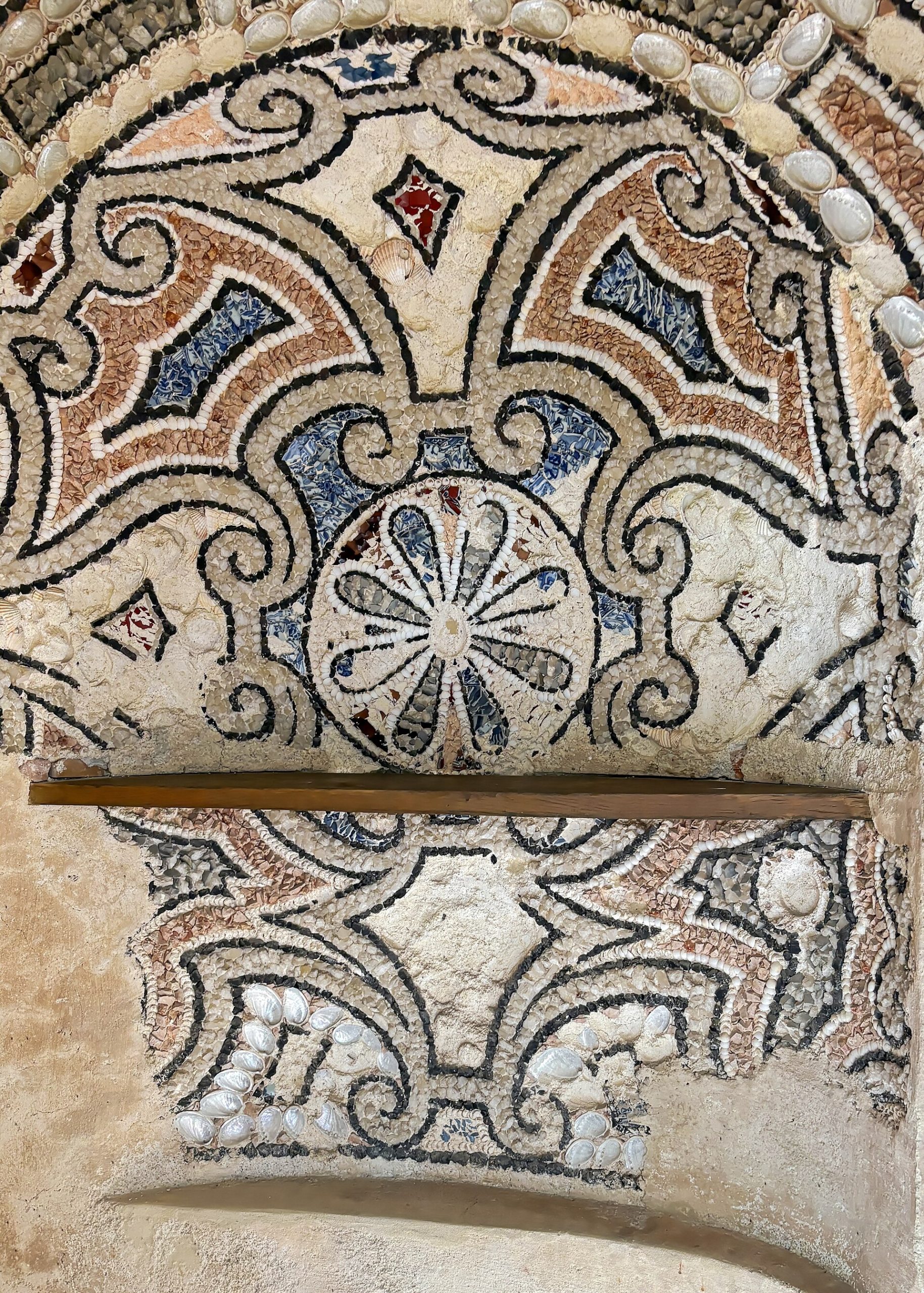
The ceilings of the palace are among its glories, worked in elaborate designs that draw on many traditions. Some evoke the intricate geometry of Moorish art, others the vaulting of the Gothic or the ornament of the Renaissance, and one remarkable ceiling is worked in a fantastical design suggesting shells and marine forms, in keeping with the palace’s romantic imagination. Each ceiling is a work of art in its own right.
The tilework is especially characteristic of Pena and of Portugal itself. The azulejos, in blue and white or in richer colours, cover many surfaces of the palace, their patterns adding to the sense of exotic richness that pervades the interiors. This distinctively Portuguese art form, itself a legacy of the country’s long contact with the Islamic world, finds one of its most exuberant settings in the palace of Pena.
This delight in ornament is essential to the character of the palace. Ferdinand and his craftsmen filled every corner with pattern, colour, and detail, refusing to leave any surface plain, in the spirit of the Romantic age’s love of richness and profusion. The result is an interior of overwhelming visual abundance, a feast for the eye that matches the fantastical exuberance of the palace’s exterior.
This profusion of ornament reflected a deliberate philosophy, for the Romantics believed that richness, variety, and historical association could stir the emotions and fire the imagination in a way that plain surfaces never could. At Pena every tile, carving, and painted ceiling was intended to transport the visitor into a world of wonder and reverie, and the cumulative effect of so much lovingly worked detail is precisely the enchantment that its creator sought.
The Enchanted Park of Pena
Surrounding the palace and covering the slopes of the mountain is the great Park of Pena, a vast romantic garden that is as much a work of Ferdinand’s imagination as the palace itself. Where the mountainside had once been largely bare, the king created a lush and exotic forest, planting thousands of trees and shrubs gathered from around the world to form a luxuriant and seemingly wild landscape.

The park was designed in the informal, naturalistic style beloved of the Romantic age, with winding paths leading through dense woodland, past lakes, fountains, follies, and hidden corners, each carefully composed to seem the work of nature rather than of design. Exotic species from distant continents mingle with native plants, creating a rich and varied forest that flourishes in the mild, misty climate of Sintra.
Scattered through the park are romantic features that reward the explorer: ornamental lakes with ducks and swans, a chalet built by the king for his companion, viewpoints offering spectacular vistas, and the highest point of the hills crowned by a monument. The park was conceived as a place of wandering and discovery, an extension of the palace’s Romantic fantasy into the surrounding landscape.
To walk in the Park of Pena is to move through an enchanted forest of Ferdinand’s making, a green and mysterious world that complements the fantastical palace at its heart. The union of the wild, luxuriant park with the colourful palace above it forms a single Romantic composition, and it is this fusion of architecture and nature that gives Pena and its setting their extraordinary and dreamlike beauty.
Ferdinand took as much care over the park as over the palace, regarding the two as inseparable parts of a single artistic creation. He studied botany and horticulture, corresponded about rare species, and oversaw the planting of the forest that would clothe the once-bare mountain in green. The park that resulted is not merely a setting for the palace but a masterpiece of Romantic landscape design in its own right, one of the finest of its kind in Europe.
Pena Today: A World Heritage Wonder
The Palace of Pena and the surrounding landscape of Sintra were recognised in 1995 as a UNESCO World Heritage Site, honoured as the Cultural Landscape of Sintra, a place where romantic architecture, exotic gardens, and dramatic natural scenery combine in a way of outstanding universal value. Pena stands at the heart of this landscape as its most famous and most beloved monument.

View the exact location on Google Maps
Today the palace is one of the most visited sites in Portugal, drawing enormous numbers of visitors who climb the mountain to wander its colourful towers and terraces, explore its richly decorated interiors, and walk in its enchanted park. The palace and park are carefully maintained, and the recent restoration of the vivid exterior colours has returned Pena to the full brilliance of Ferdinand’s original vision.
A visit is best combined with the wider wonders of Sintra, for the hills around the palace are dotted with other romantic marvels, from the ancient Moorish castle on a neighbouring peak to exotic gardens and country estates. Set a short journey from Lisbon, Sintra and its palace make an unforgettable excursion, especially when the mists part to reveal Pena blazing colourful above the clouds.
More than a century and a half after an artist king raised his fantasy upon a ruined mountain sanctuary, the Palace of Pena endures as the supreme monument of Portuguese Romanticism and one of the most magical buildings in the world. Colourful, eclectic, and dreamlike, rising above the enchanted hills of Sintra, it remains a fairy tale made real, and a lasting testament to the imagination of the king who dreamed it into being.
Palaces Nearby
If the Romantic magic of Pena has drawn you in, these fellow royal palaces of the Iberian Peninsula are well worth discovering:
You May Like


