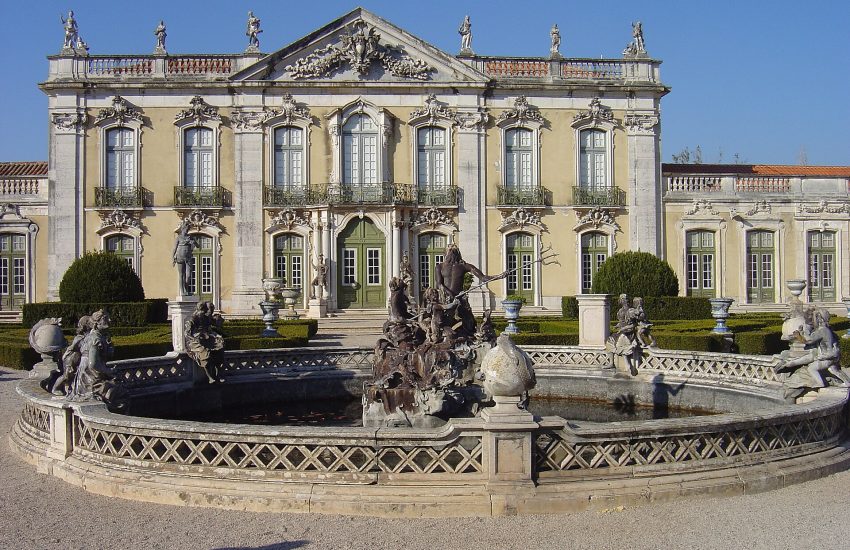
An hour or so south of Madrid, where the waters of the Tagus spread out to nourish a green and fertile plain, stands one of the most enchanting of all the Spanish royal palaces. Aranjuez was the spring residence of the kings of Spain, the place they came to when the capital grew too hot and dusty, and everything about it, from its rose-and-cream facades to its miles of shaded gardens, speaks of ease, water, and the pleasures of the countryside. It is a palace made not for the business of state but for the delight of a court at play.
For centuries this was a royal retreat set amid one of the great garden landscapes of Europe. Generations of monarchs lavished attention on Aranjuez, laying out avenues and parterres, channelling the river into fountains and canals, and planting the exotic trees that still shade its walks. The gardens became as famous as the palace itself, so beloved that they would one day inspire one of the most celebrated pieces of Spanish music ever written, and so remarkable that the whole ensemble is now honoured as a cultural landscape of worldwide importance.
The palace at the heart of it all is a building of graceful proportions rather than overwhelming scale, its warm-toned facades reflected in the surrounding greenery. Within lie state rooms of surprising richness, including a porcelain cabinet and an exotic chamber of dazzling intricacy that count among the finest interiors in Spain. Around it spread the great gardens and, hidden among them, a small palace of astonishing luxury built for a prince who wanted a private world of his own.
To visit Aranjuez is to understand a different face of Spanish monarchy from the grand ceremony of Madrid. Here the kings sought pleasure, retreat, and the company of nature, and the whole royal town was shaped around that desire. This is the story of how a fertile bend in the Tagus became a royal paradise of palace and garden, a place where power dissolved for a season into the scent of orange blossom and the sound of running water.
In This Article
- A Royal Paradise on the Tagus
- The Habsburg Foundations
- The Bourbons Complete the Dream
- The Rose-and-Cream Palace
- The State Apartments and the Throne Room
- The Porcelain Cabinet and the Exotic Rooms
- The Grand Staircase and the Royal Town
- The Island Garden
- The Prince’s Garden
- The Casa del Labrador: A Palace in Miniature
- Parterres, Fountains, and the Art of Water
- Mutiny, Music, and the Fame of Aranjuez
- Aranjuez Today: A World Heritage Landscape
A Royal Paradise on the Tagus
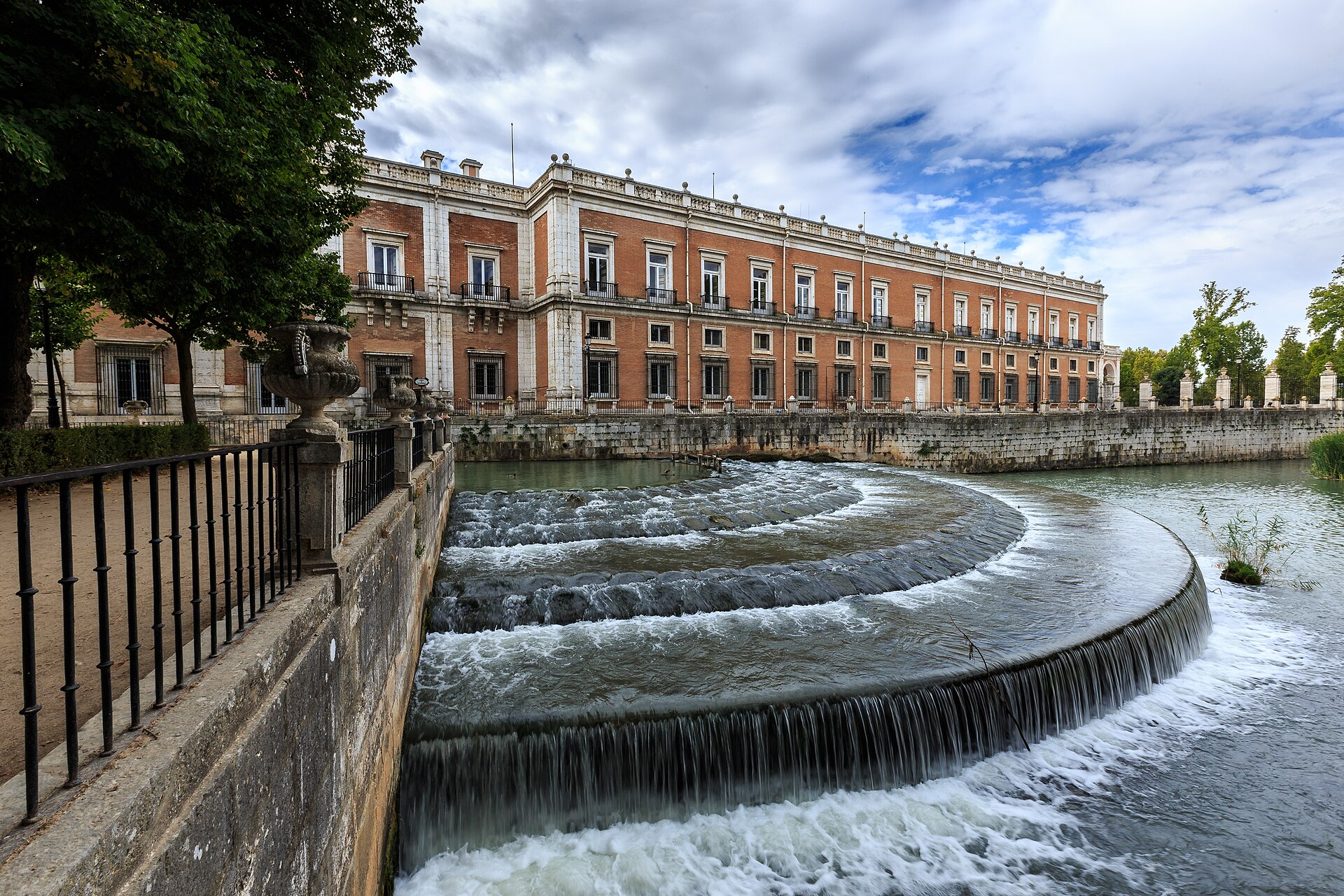
Aranjuez owes its very existence to water. The site lies where the Tagus, Spain’s longest river, and its tributary the Jarama water a broad and fertile plain in the midst of the dry Castilian tableland, creating an oasis of green in an often parched landscape. It was this abundance of water and fertility that first drew the Spanish crown to the spot, for here, unusually for central Spain, gardens could flourish and fountains could play.
The Spanish kings designated Aranjuez one of their Royal Sites, a place set aside for the use and pleasure of the monarchy, and over the centuries they transformed the river plain into an elaborate landscape of palace, gardens, avenues, and a planned town. Everything was arranged around the enjoyment of nature in its most cultivated form, with long tree-lined walks, ornamental waters, and carefully composed vistas that turned the whole area into a work of landscape art.
For much of the year the court did not come here, but in spring Aranjuez came alive as the monarch and his household descended upon it to escape the rigours of Madrid. The season at Aranjuez was a time of relaxation and outdoor pleasure, of promenades and boating and festivities amid the gardens, and the town was built to house the great retinue that accompanied the king on these annual sojourns.
The result is one of the most complete and harmonious royal landscapes in Europe, a place where architecture and nature were brought into a single grand design over the course of centuries. So exceptional is this fusion of palace and garden that Aranjuez has been recognised as a cultural landscape of outstanding universal value, a rare example of the ideal of a royal residence set within a masterfully shaped natural setting.
The very name of Aranjuez has come to stand, in Spanish culture, for a kind of earthly paradise, a place of gardens, water, and gentle pleasure set apart from the harshness of ordinary life. Poets and painters celebrated it, kings cherished it, and its reputation spread far beyond Spain. To grasp Aranjuez is to understand that a royal residence could be conceived not as a monument to power but as a work of art devoted entirely to beauty and delight, a green dream made real on the banks of a river.
The Habsburg Foundations
Although the palace we see today is largely the creation of the eighteenth-century Bourbon kings, the story of royal Aranjuez begins far earlier. The site had belonged to a military order before passing to the crown, and it was under the Habsburg monarchs of the sixteenth century that it first became a true royal residence. The decisive figure was King Philip II, the powerful ruler under whom Spain reached the height of its imperial might.
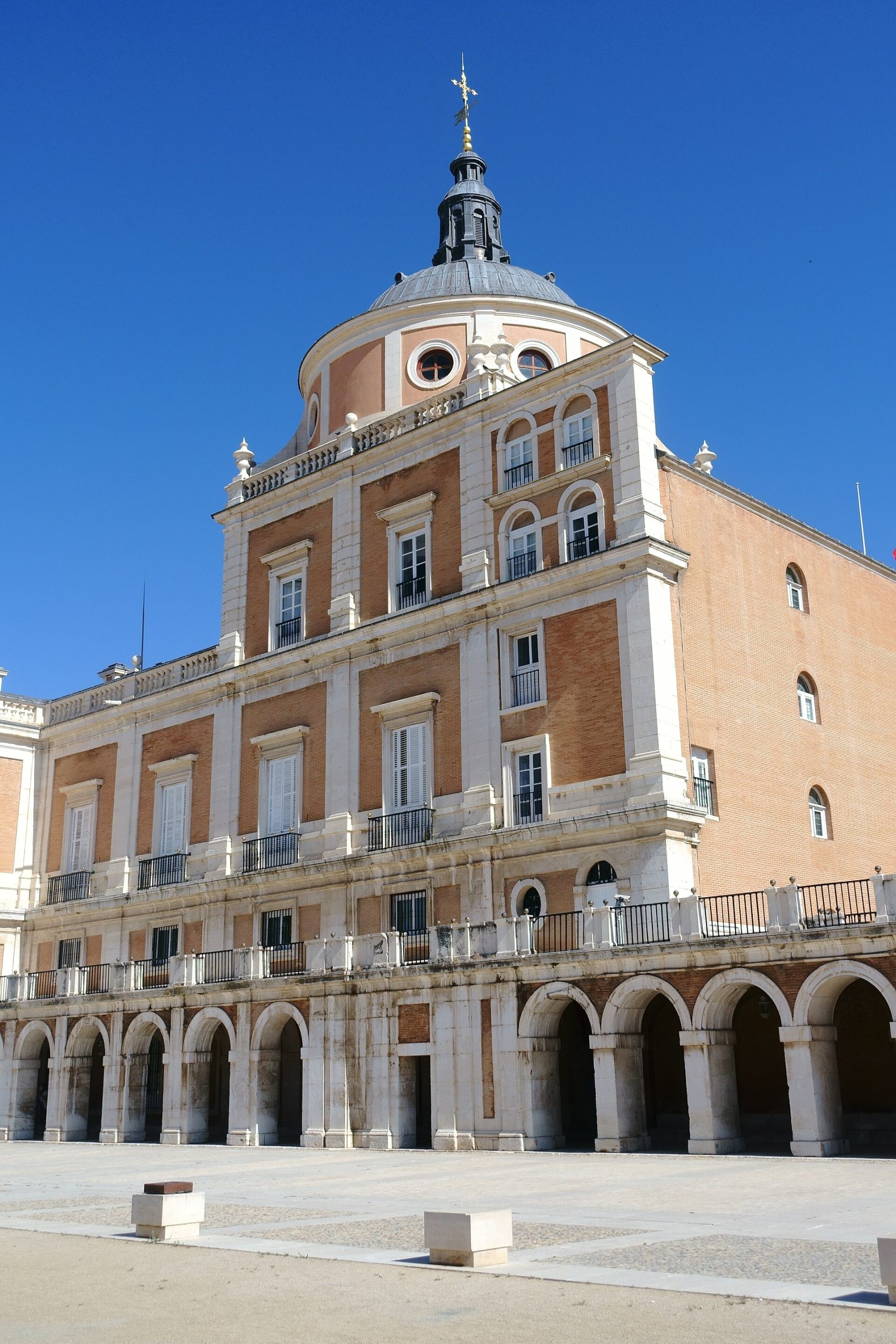
Philip II, who also built the vast monastery-palace of El Escorial, took a deep personal interest in Aranjuez and set about creating a royal seat there worthy of his dynasty. He entrusted the work to the leading architects of his reign, including Juan Bautista de Toledo and, most importantly, Juan de Herrera, the austere genius who gave Spanish architecture of the age its sober, monumental character. Their designs laid down the essential plan of the palace.
Under Philip and his immediate successors the foundations of the royal complex were established, and the first gardens were laid out along the river. The famous Island Garden, cradled in a bend of the Tagus, dates in its origins from this early period, and the taste for elaborate waterworks that would define Aranjuez was already taking hold. The Habsburgs thus set the pattern that later kings would so magnificently develop.
Progress was slow, however, and the palace remained incomplete for a very long time. Fires and the shifting priorities of successive reigns meant that the great building envisaged in the sixteenth century was not finished as first intended. It would take the arrival of a new dynasty, with new tastes and fresh ambition, to bring the palace of Aranjuez to the graceful completion we admire today, building upon the solid Habsburg foundations.
The Bourbons Complete the Dream
When the Bourbon dynasty came to the Spanish throne in the early eighteenth century, they brought with them a love of gardens and country palaces inherited from their French origins, and they embraced Aranjuez with enthusiasm. It was under these kings that the palace was at last completed and the gardens expanded into the vast and celebrated landscape that made the Royal Site famous throughout Europe.
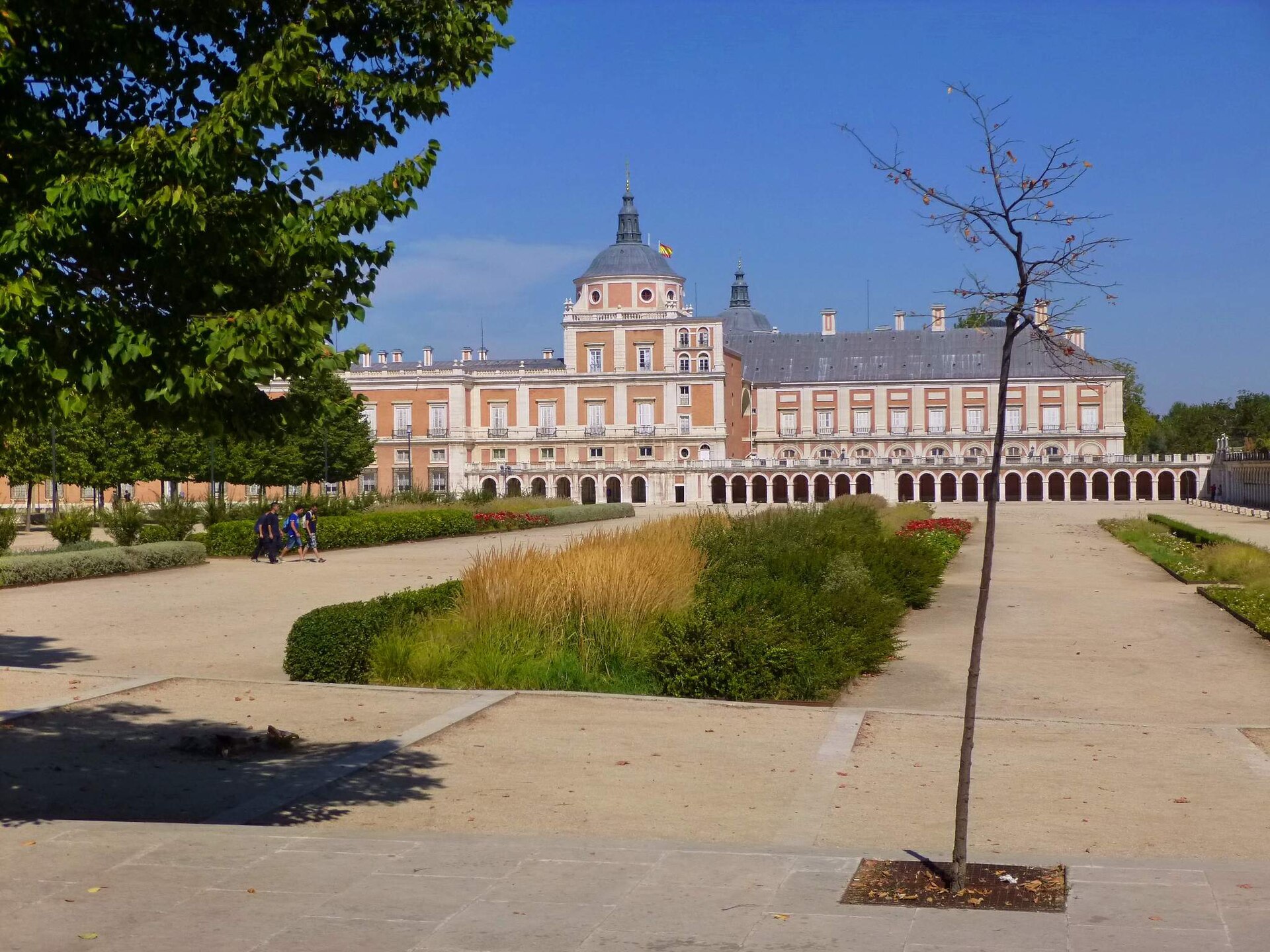
Successive Bourbon monarchs each left their mark. The palace was finished and enlarged, wings were added to embrace a grand forecourt, and a series of talented architects, including Santiago Bonavia and later Francesco Sabatini, gave the building its final form. The warm-coloured facades, the balanced proportions, and the elegant silhouette that so charm the visitor today are largely the achievement of this eighteenth-century campaign of building.
The Bourbons also transformed Aranjuez into a proper royal town. A planned settlement was laid out on a regular grid to house the court, the servants, and all who depended on the royal presence, with broad streets and dignified buildings arranged in harmony with the palace and its gardens. The whole town was conceived as part of a single grand composition, an early and remarkable example of comprehensive royal urban planning.
By the later eighteenth century Aranjuez had reached its full glory as one of the favourite residences of the Spanish crown. The spring court here was among the highlights of the royal calendar, and the palace and its gardens were maintained and embellished at great expense. It was a golden age for the Royal Site, and it produced the ensemble of palace, garden, and town that, despite the changes of later centuries, still defines Aranjuez.
The devotion of the Bourbons to Aranjuez reflected a wider change in the culture of European monarchy, a growing taste for country retreats and garden pleasures over the rigid ceremony of the great state palaces. In this the Spanish kings followed the example of their French relatives, who had created their own garden retreats, and Aranjuez became Spain’s supreme expression of this ideal, a place where the monarch could shed something of the burden of majesty and live, for a season, amid the beauties of cultivated nature.
The Rose-and-Cream Palace
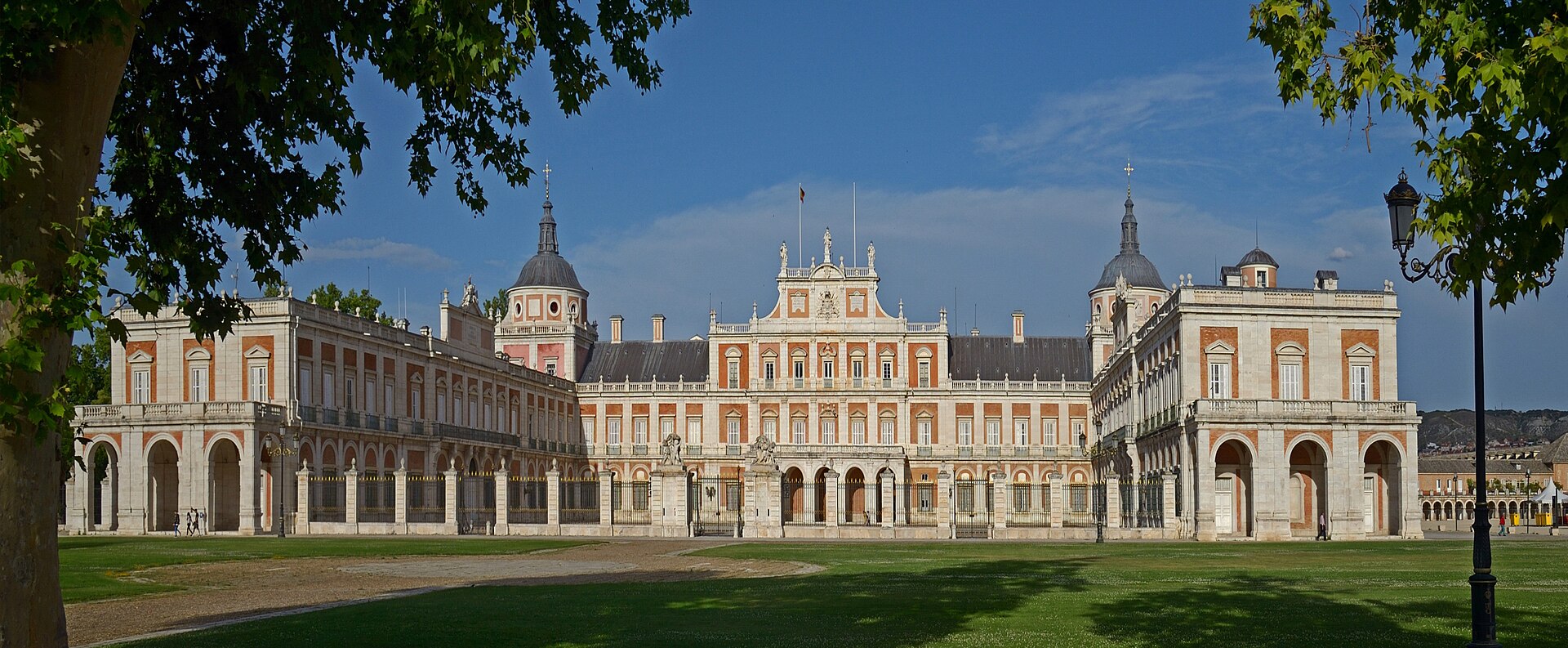
The palace of Aranjuez presents one of the most immediately appealing faces of any Spanish royal residence. Its facades, built of warm brick and pale stone, glow in soft tones of rose and cream that seem to change with the light, and its balanced composition, rising to a central block flanked by wings, has an elegance quite different from the severe grandeur of El Escorial or the vast monumentality of the Royal Palace of Madrid.

The building embraces a spacious forecourt, the great Plaza de Parejas, once the setting for equestrian games and courtly spectacles. From here the visitor takes in the full sweep of the principal facade, its rhythm of windows and pilasters, its sculptural ornament, and the crowning balustrade. The scale is grand but never crushing, human enough to feel like a country house of extraordinary refinement rather than a fortress of state.
The setting is inseparable from the architecture. The palace sits amid its gardens and avenues, its facades reflected in nearby water and framed by great trees, so that the building and its landscape form a single picture. Lamps, statues, and ornamental details enrich the exterior, and the whole composition is arranged to be enjoyed from the surrounding walks and terraces, seen through vistas of greenery.
This gentle, garden-loving character is the essence of Aranjuez. Where other palaces overwhelm, Aranjuez charms, its architecture pitched to the key of pleasure and repose rather than power and ceremony. It is a building designed to be lived in during the sweet weeks of spring, and everything about its warm facades and graceful proportions expresses that purpose. To arrive before it is to feel at once the relaxed spirit of the Royal Site.
The State Apartments and the Throne Room
Within its welcoming exterior, the palace of Aranjuez conceals a sequence of state apartments of considerable richness, decorated by generations of monarchs according to the changing fashions of their reigns. These rooms, hung with silks and tapestries and adorned with fine furniture, paintings, and clocks, trace the evolving taste of the Spanish court from the Baroque through the neoclassical and beyond, each chamber a complete and harmonious design.
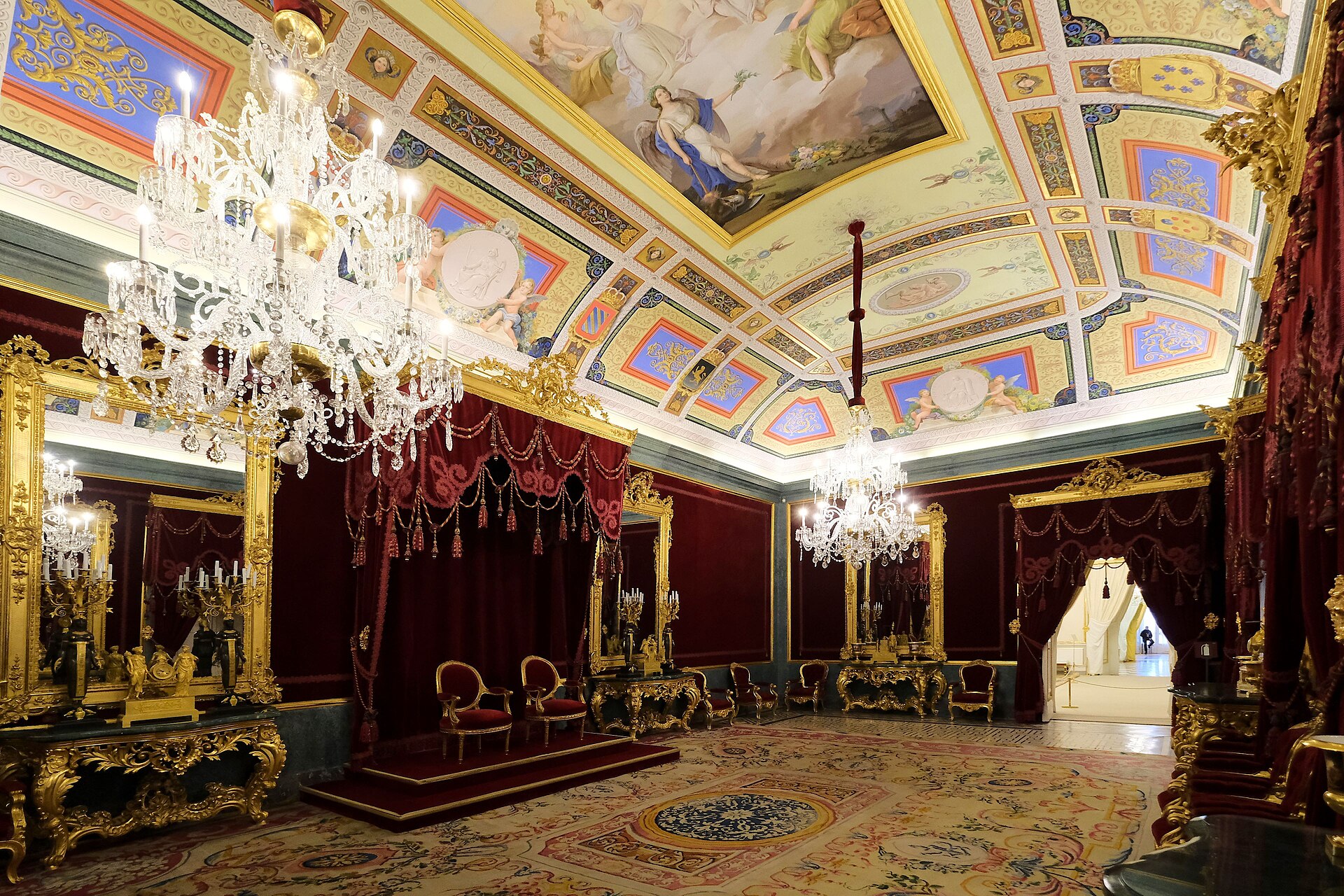
At the ceremonial heart of the apartments lies the Throne Room, a chamber of red and gold where the monarch would receive in appropriate state even during the relaxed spring season. Rich hangings, gilded furnishings, and a canopied throne create an atmosphere of royal dignity, and the room reminds the visitor that Aranjuez, for all its garden pleasures, remained a working seat of monarchy where the rituals of kingship were observed.
The apartments are notable for the quality of their decoration and the way each reflects the personality of the reign that shaped it. Some rooms preserve the exuberant ornament of the eighteenth century, others the cooler elegance of later fashions, and throughout there is a sense of intimacy suited to a residence of pleasure. The furnishings, many of them original, give an unusually vivid impression of how the royal family actually lived.
Moving through these rooms, the visitor senses the double character of Aranjuez as both a place of retreat and a genuine royal residence. The state apartments provided the setting for the formal life of the court, yet their scale and decoration are lighter and more graceful than the ponderous ceremony of the great city palaces. They are the perfect interiors for a spring palace, dignified yet designed above all for enjoyment.
The Porcelain Cabinet and the Exotic Rooms
Among the interiors of Aranjuez, one room stands out as a marvel of the decorative arts: the Porcelain Cabinet. Like its counterpart in the Royal Palace of Madrid, this small chamber has its walls and ceiling entirely covered in porcelain, moulded and painted with three-dimensional figures, garlands, and ornament that project from the surface in glittering profusion. It was produced at the royal Buen Retiro manufactory established by Charles III.
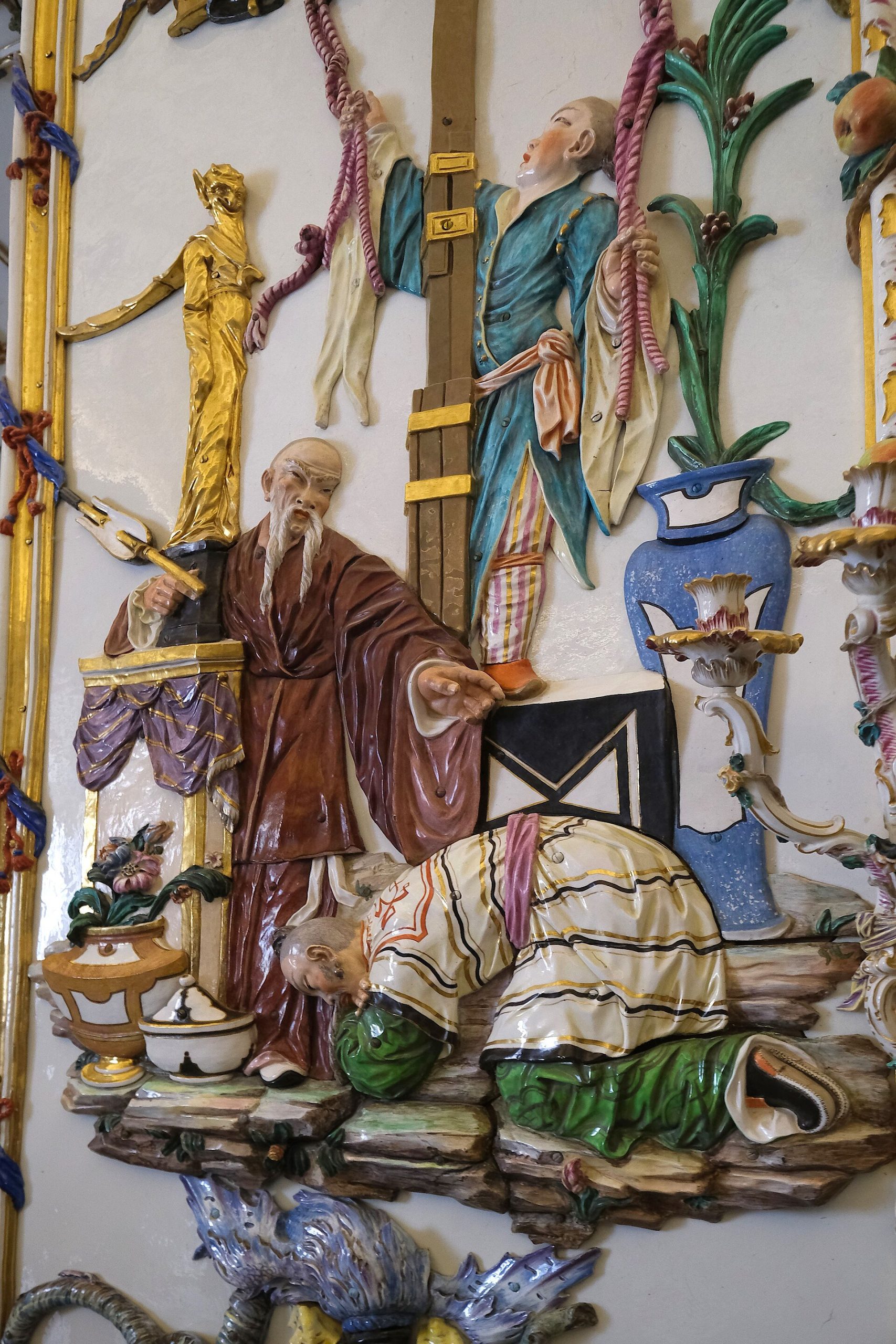
The cabinet is a dazzling display of both craftsmanship and royal patronage of Spanish manufacture. Its figures, worked in the round and richly coloured, transform the room into a jewel box of ceramic fantasy, an interior of extraordinary intricacy and delight. That such labour and luxury were lavished on a single small room speaks eloquently of the wealth and ambition of the eighteenth-century Spanish court.
Aranjuez is also famed for its exotic chambers, above all a richly decorated cabinet worked in the Islamic-inspired taste that became fashionable in the nineteenth century. Modelled on the celebrated halls of the Alhambra, this room is a fantasia of intricate stucco, colour, and pattern, a European dream of Moorish splendour executed with astonishing delicacy. It reflects the romantic fascination with Spain’s own Islamic heritage that gripped the age.
These rooms together reveal the palace’s role as a showcase for the finest decorative artistry. Where the state apartments impress through richness and dignity, the porcelain and exotic cabinets astonish through sheer virtuosity and imagination. They are among the most memorable spaces in the palace, and they demonstrate that Aranjuez, for all its garden-loving ease, could rival any residence in Europe for the brilliance of its interiors.
The Grand Staircase and the Royal Town
The interior sequence of the palace is introduced by a grand staircase, a dignified ascent that carries the visitor from the entrance to the state floor above. Handsomely designed with fine balustrades and sculptural ornament, it sets the tone for the apartments beyond, a moment of architectural theatre suited to a royal residence, though pitched to the graceful, human scale that characterises the whole of Aranjuez.
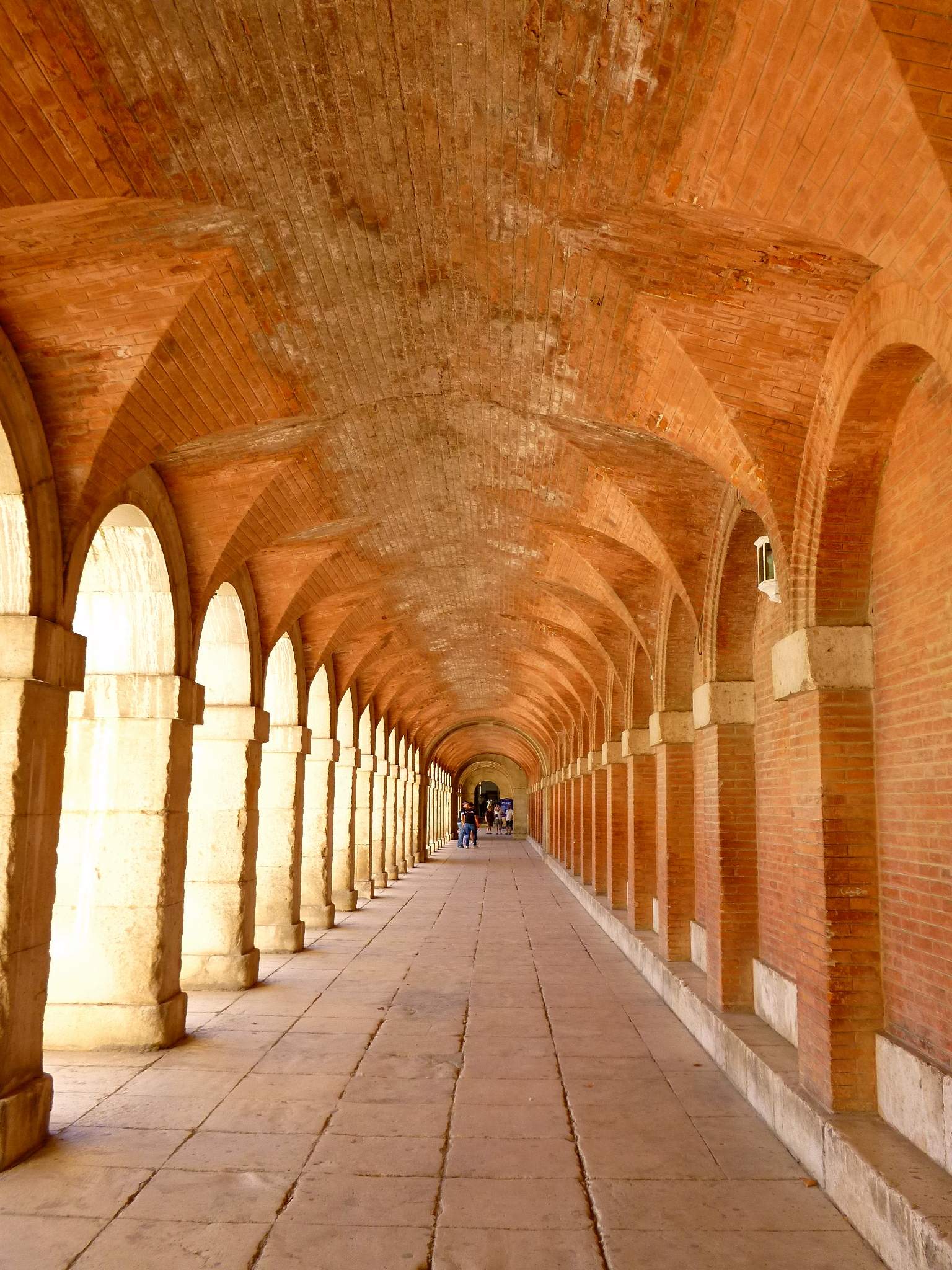
Beyond the palace itself, the Royal Site extends into the surrounding town, which was laid out as an integral part of the composition. The streets of Aranjuez were planned on a regular grid, lined with dignified buildings and punctuated by squares and avenues, all arranged in harmony with the palace and its gardens. This was one of the earliest examples of comprehensive planned urbanism in Spain, a whole town conceived as the setting for a royal residence.
The town was designed to serve the needs of the court during its spring sojourns, housing officials, servants, artisans, and all who depended on the royal presence. Its broad, tree-lined streets and elegant proportions echo the spirit of the palace and gardens, extending the ordered beauty of the Royal Site out into the everyday fabric of the settlement. Even the workaday parts of Aranjuez share in the grace of the whole.
This unity of palace, garden, and town is one of the things that makes Aranjuez so remarkable. It was not merely a building set in a landscape but a complete environment, planned and shaped over generations according to a single vision of royal pleasure and order. To walk from the palace forecourt out into the streets of the town is to remain, at every step, within the great composition that the Spanish kings created here.
The Island Garden
The oldest and one of the most beautiful of the gardens of Aranjuez is the Island Garden, the Jardin de la Isla, cradled in a loop of the Tagus so that it is almost entirely surrounded by water. Laid out in its origins under the Habsburg kings and developed over the following centuries, it is a shaded, intimate garden of tree-lined walks, clipped hedges, and a wonderful series of ornamental fountains fed by the encircling river.
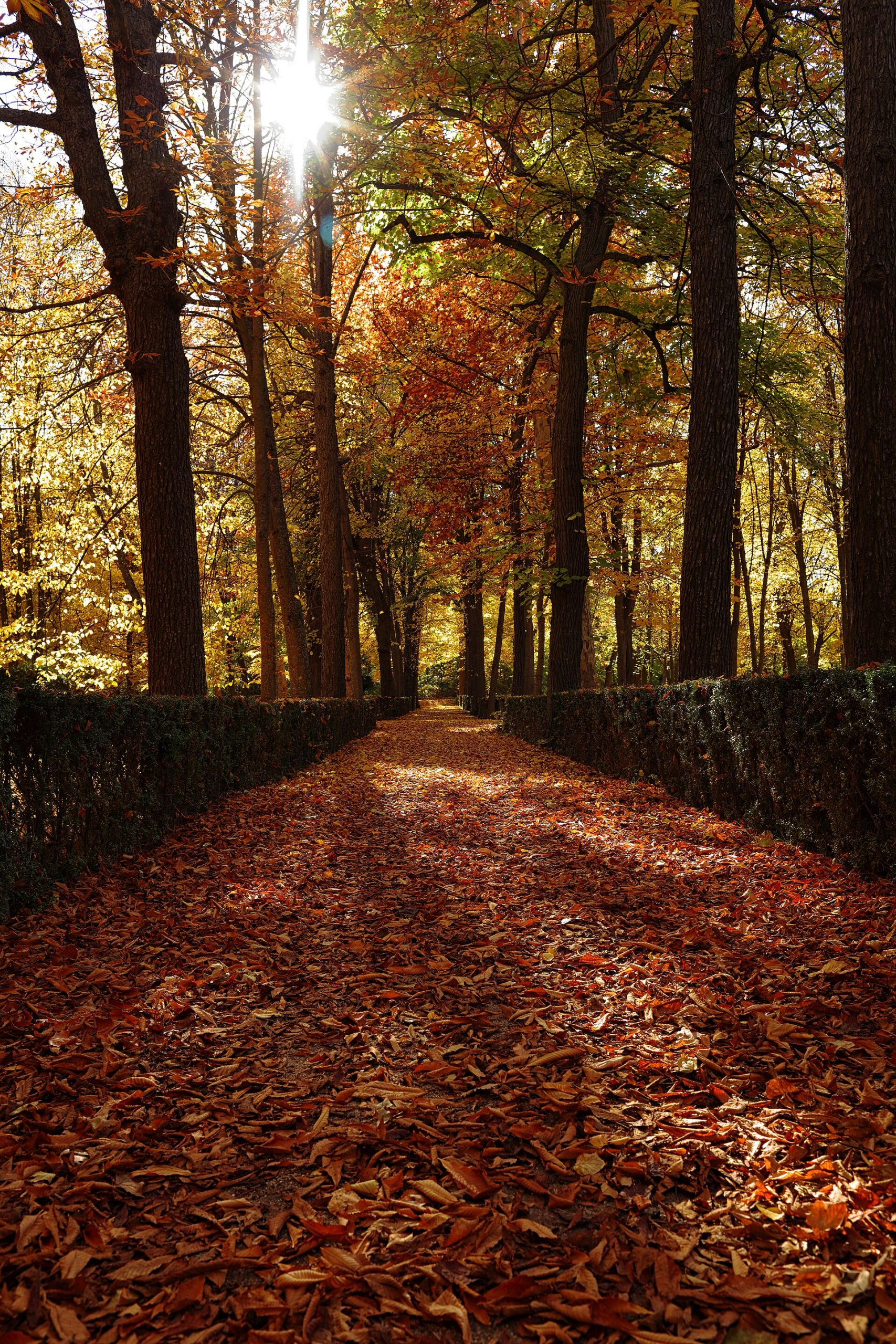
Water is everywhere in the Island Garden, murmuring in its fountains and channels and lending the whole place a coolness precious in the Spanish heat. The fountains, adorned with mythological figures and sculptural ornament, are among the garden’s chief glories, and the sound of falling water accompanies the visitor along every path. It is a garden designed for the senses, for shade, sound, and the play of light through leaves.
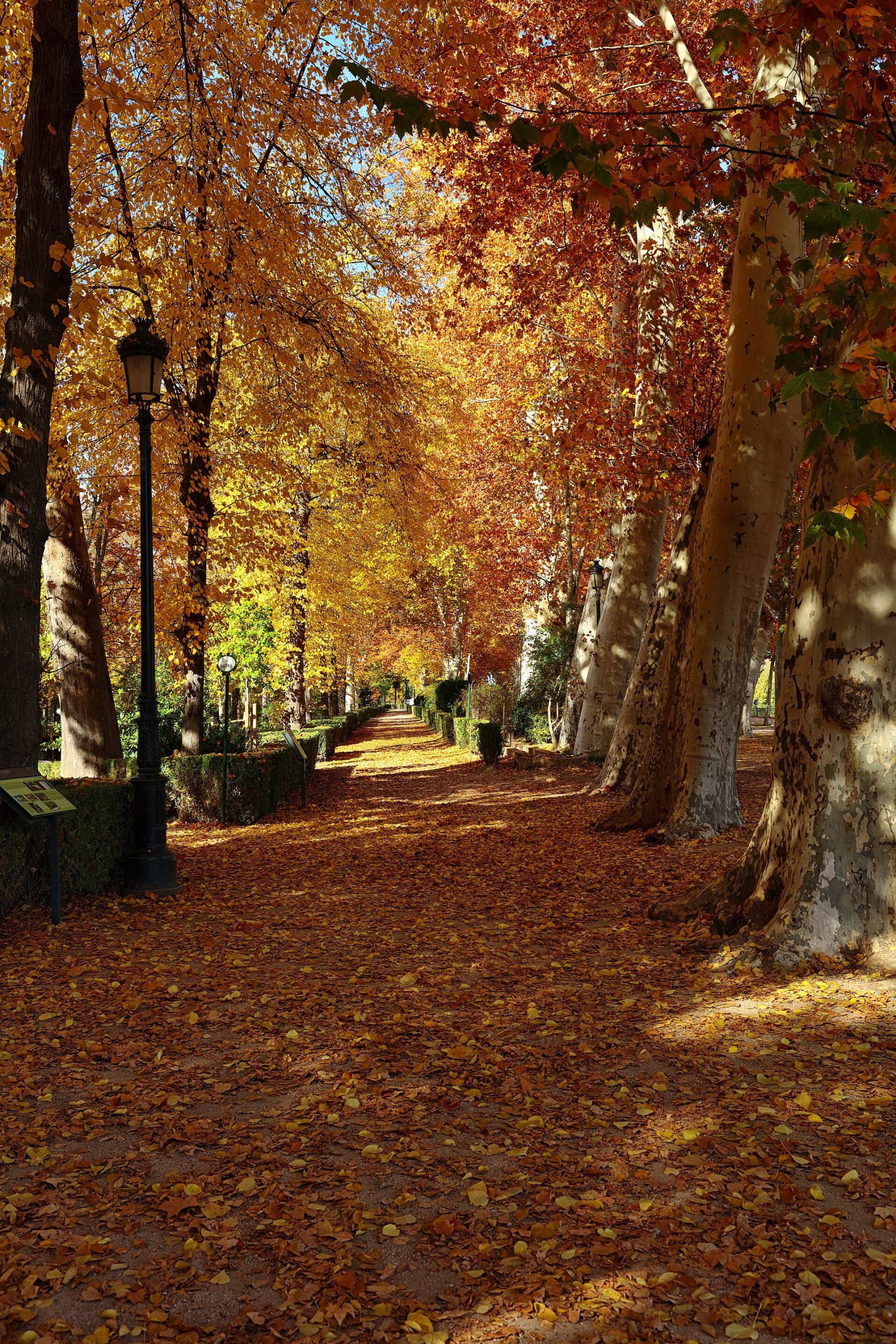
The garden’s position, ringed by the river, gives it a magical, secluded character, as though it were a green island set apart from the world. Great trees, some of them very old, arch over the walks, and the geometry of the paths and parterres is softened by the luxuriant growth that the abundant water encourages. It is a place made for unhurried wandering, for pausing by a fountain or resting in the shade.
For centuries the Island Garden was a favourite retreat of the royal family during the spring season, a cool and shaded refuge in which to walk and take the air. Its combination of formal design and abundant nature, of geometry and greenery and water, captures the very essence of what made Aranjuez so beloved. It remains one of the most enchanting garden spaces in all of Spain.
The Prince’s Garden
Far larger than the Island Garden, and laid out later, is the Prince’s Garden, the Jardin del Principe, an enormous landscape park stretching along the bank of the Tagus. Created in the late eighteenth and early nineteenth centuries, it reflects the changing taste of the age, blending formal elements with the freer, more naturalistic style of the English landscape garden that was then coming into fashion across Europe.
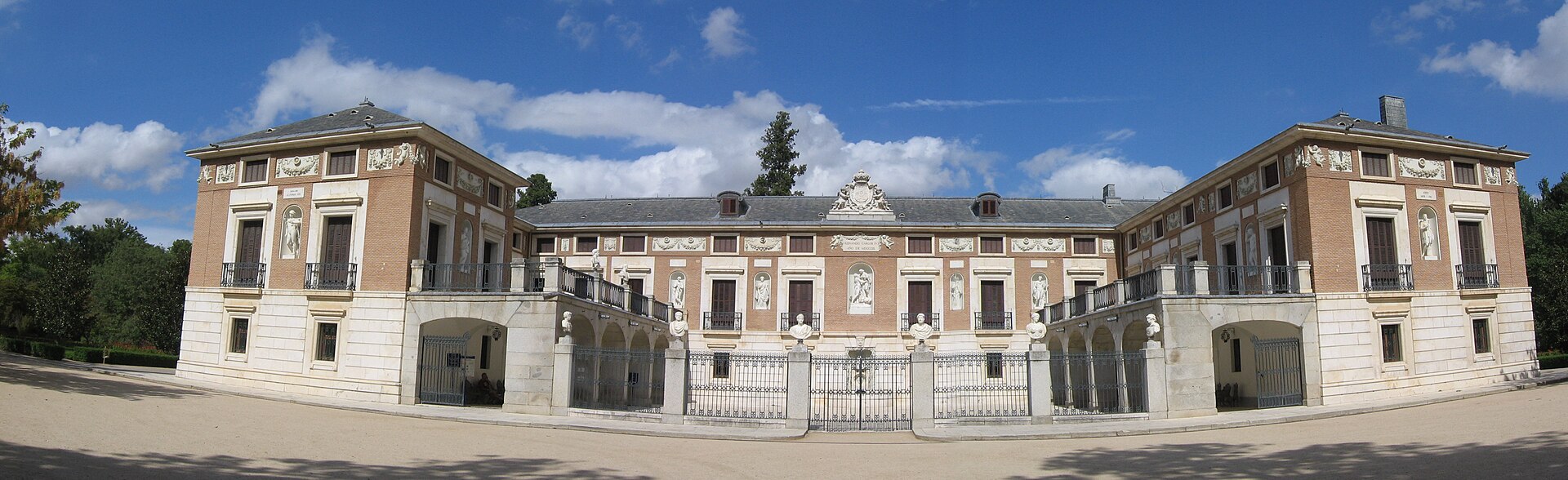
The Prince’s Garden is a place of great variety and surprise. Winding paths lead through groves of exotic trees gathered from around the world, past ornamental lakes and fountains, pavilions, and hidden corners, each carefully composed to delight the stroller. It was conceived as a garden of exploration and pleasure, a green world in which to wander and discover, quite different in spirit from the intimate geometry of the older gardens.
The garden was also a place of botanical ambition. The Spanish crown used it to cultivate rare and exotic species brought from the Americas and elsewhere, and its collection of trees became famous, some of them among the first of their kind grown in Spain. The garden thus combined pleasure with scientific curiosity, reflecting the enlightened interests of the eighteenth-century court.
Within the Prince’s Garden, tucked among its walks and waters, lies the most extraordinary of all the buildings of Aranjuez, a small palace of unbelievable luxury created for a prince who wished for a private retreat of his own. This jewel, set amid the greenery, is one of the great surprises of the Royal Site, and it deserves a closer look of its own, for it is a marvel quite unlike anything else at Aranjuez.
The scale of the Prince’s Garden is such that exploring it fully takes hours, and it rewards the visitor with a constantly changing succession of scenes, from open lawns to shady groves, from formal fountains to romantic, seemingly wild corners. Its creation represented an enormous investment of labour and imagination, transforming the riverbank into a vast pleasure ground that stands among the most ambitious garden projects of its age anywhere in Europe.
The Casa del Labrador: A Palace in Miniature
Hidden within the Prince’s Garden stands the Casa del Labrador, the Laborer’s Cottage, a name of almost comic modesty for what is in fact one of the most sumptuous small palaces in Europe. Built at the turn of the nineteenth century for King Charles IV when he was still heir to the throne, it began as a modest garden retreat and grew, through successive enlargements, into a jewel box of the most extravagant luxury imaginable.
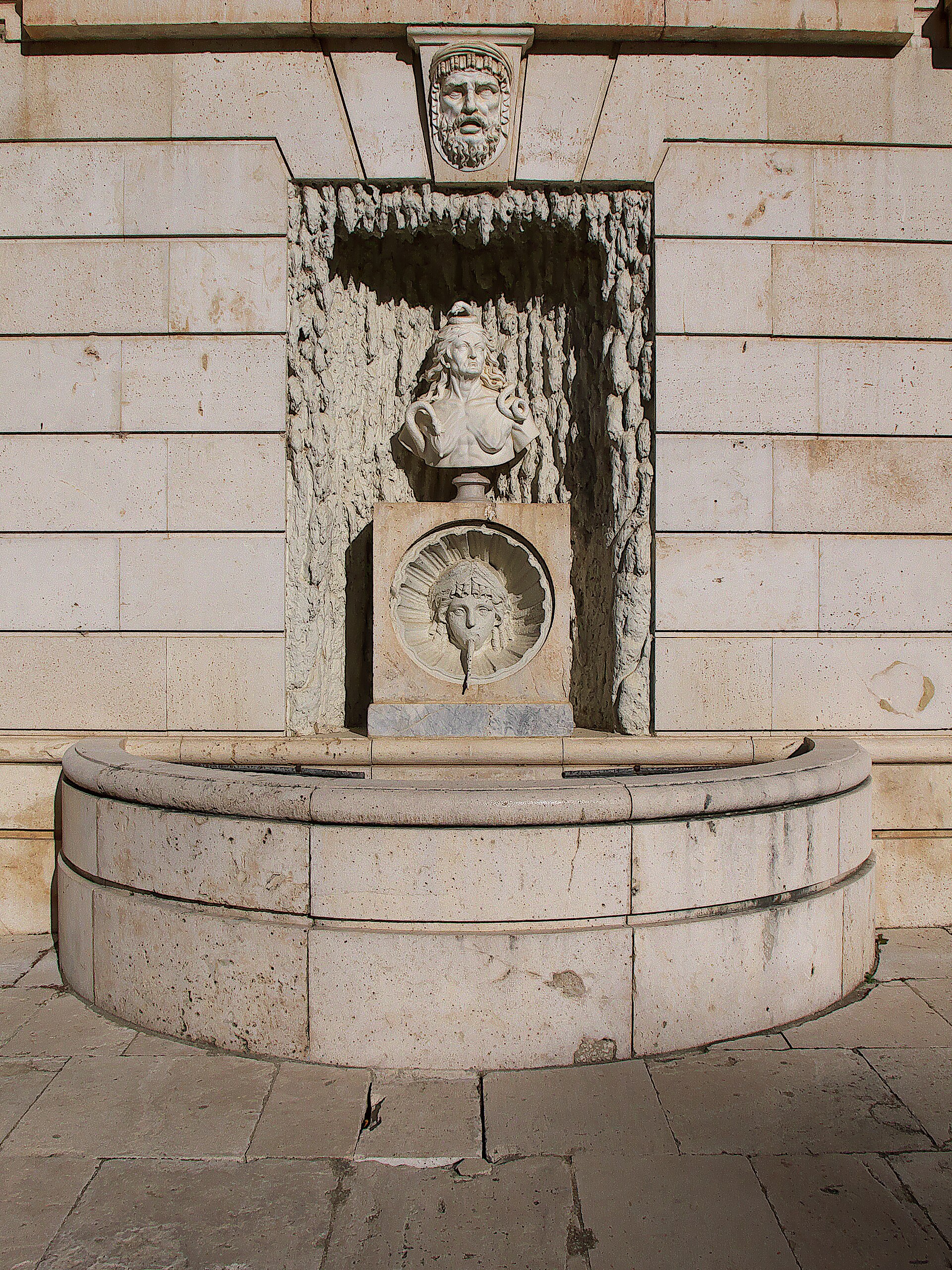
Despite its rustic name, the interior of the Casa del Labrador is a riot of opulence. Its small rooms are encrusted with gilding, silk, marble, fine paintings, clocks, and precious objects, decorated with a richness that rivals or even surpasses the main palace. Every surface is worked with the utmost care, and the effect, in so compact a building, is one of almost overwhelming concentration of wealth and artistry.
The building reflects the tastes of a court at the height of its refinement and, some would say, its extravagance. No expense was spared in its decoration, and the finest craftsmen and materials were employed to create a private world of luxury for the royal family. It stands as a perfect expression of the neoclassical taste of its moment, and of the desire of its royal owner for an intimate retreat of unparalleled splendour.
To come upon the Casa del Labrador amid the greenery of the Prince’s Garden is one of the great delights of Aranjuez. The contrast between its humble name, its garden setting, and its astonishing interior is part of its charm, and it embodies the whole spirit of the Royal Site, where the pursuit of pleasure and beauty was carried to the highest possible pitch. It is a miniature palace that no visitor should miss.
Parterres, Fountains, and the Art of Water
Closer to the palace itself lie the more formal gardens, above all the Parterre, a grand geometric garden laid out in the elegant French manner beside the eastern facade. Here clipped hedges, patterned flower beds, gravel walks, and ornamental fountains are arranged in strict symmetry, forming a living carpet of pattern to be admired from the windows of the state apartments and from the terraces of the palace.
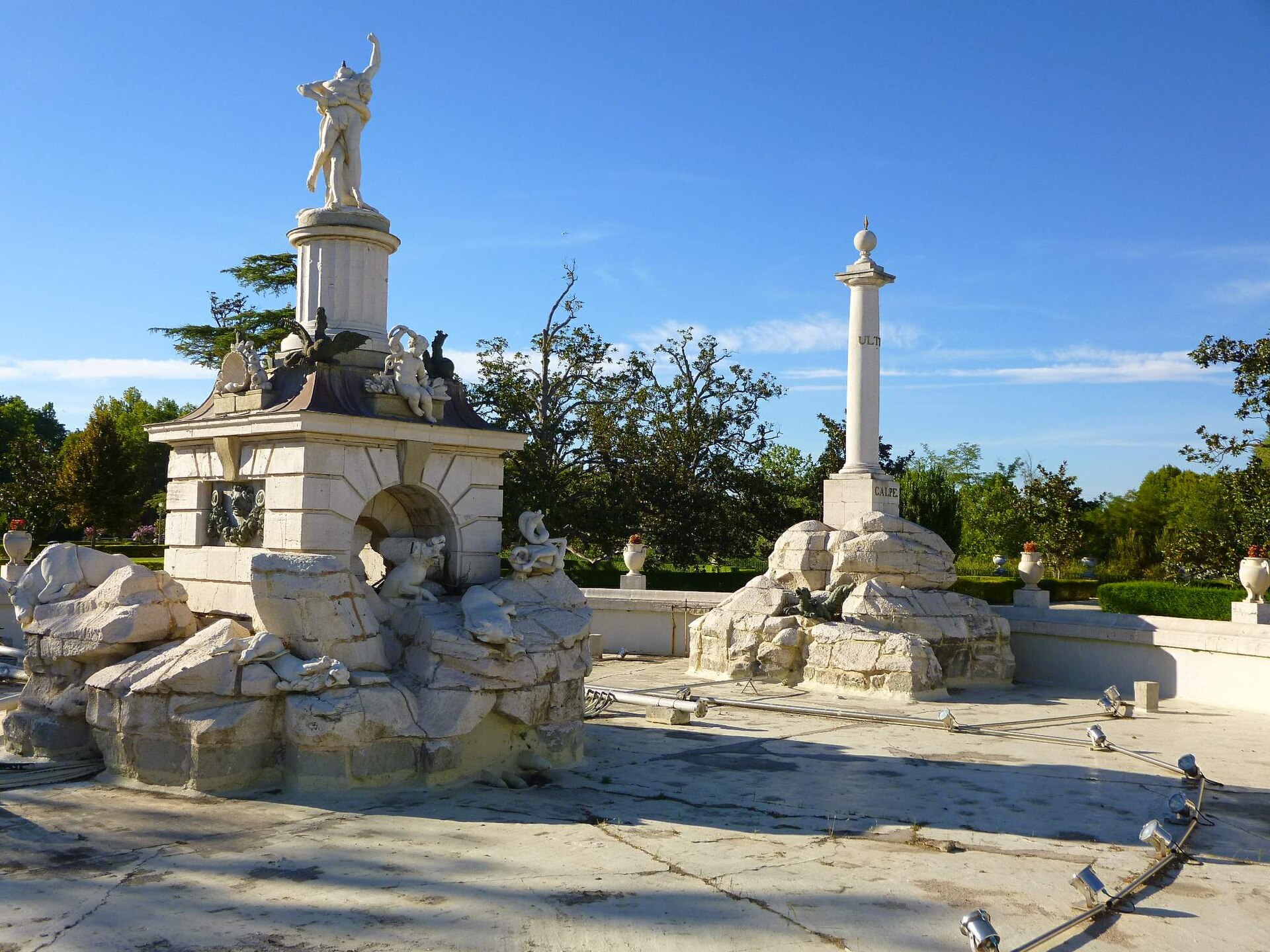
The fountains of the Parterre and the other formal gardens are among the great treasures of Aranjuez. Adorned with mythological figures cast in bronze or carved in stone, they are masterpieces of the sculptor’s and hydraulic engineer’s arts, and the abundant water of the Tagus allows them to play in a way impossible in the drier gardens of central Spain. Among them the great fountains depicting the labours of Hercules are especially admired.
Water was the true medium of the gardens of Aranjuez, and the whole landscape was shaped around its use. The river was channelled into canals, cascades, and fountains, cooling the air and delighting the eye and ear, and the mastery of water displayed here was one of the wonders of the Royal Site. In a country where water is often scarce, this abundance and artistry made Aranjuez seem a place of near-miraculous fertility and grace.
The formal gardens complete the range of landscape styles at Aranjuez, from the intimate, shaded Island Garden through the sweeping Prince’s Garden to the crisp geometry of the Parterre. Together they form one of the richest and most varied garden ensembles in Europe, a place where every taste in the art of the garden finds expression. It is this extraordinary landscape, as much as the palace, that has made Aranjuez immortal.
Mutiny, Music, and the Fame of Aranjuez
Aranjuez has played its part in the great events of Spanish history as well as in its pleasures. In the spring of 1808, as the armies of Napoleon pressed upon Spain, the Royal Site became the scene of the famous Mutiny of Aranjuez, a popular uprising that forced the fall of a hated royal favourite and led to the abdication of King Charles IV in favour of his son. It was a dramatic moment that helped set in motion the upheavals of the Peninsular War.
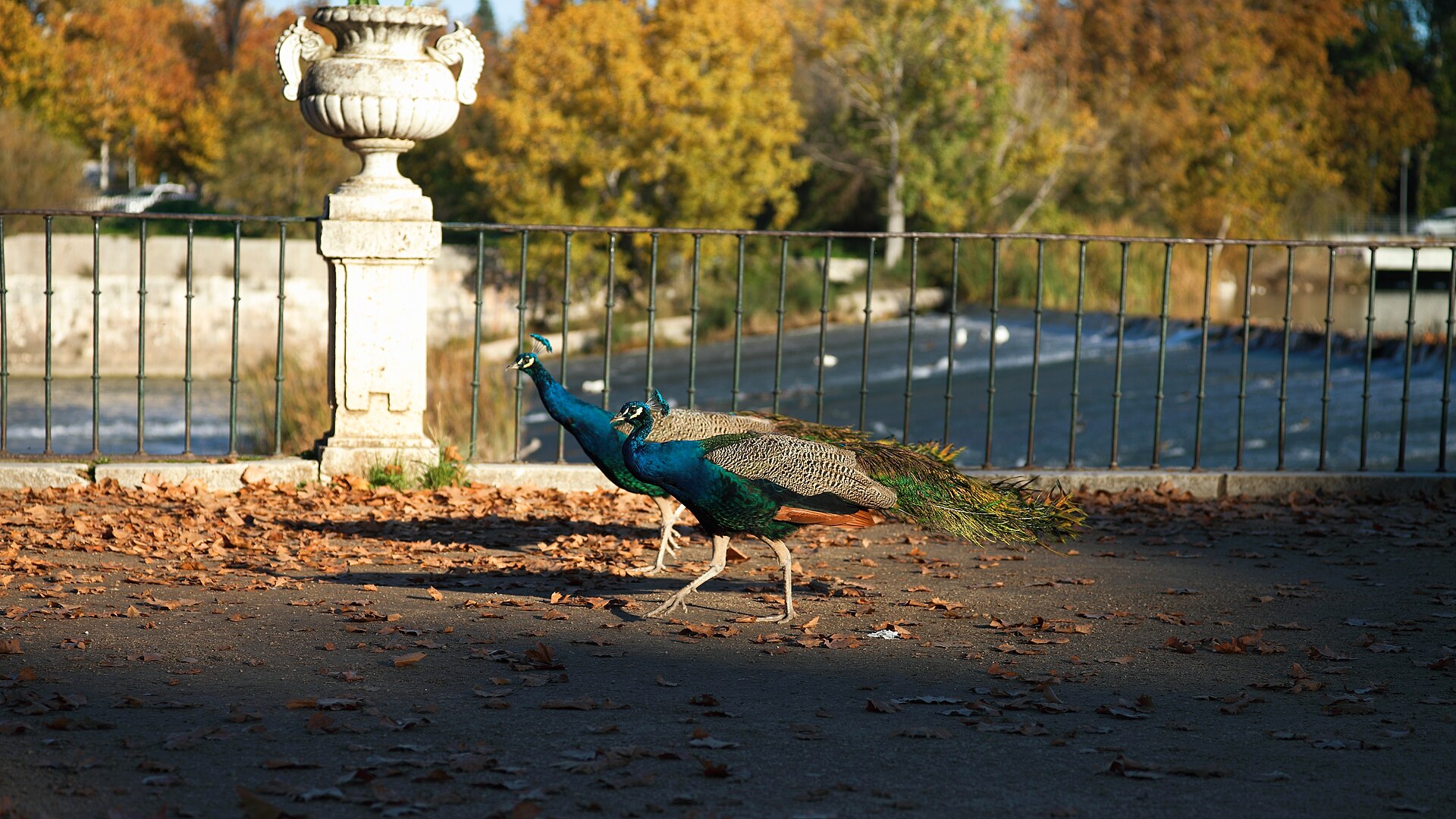
The gardens and palace have thus witnessed both the tranquillity of the spring court and the turbulence of revolution. That such momentous events unfolded amid these peaceful walks and fountains lends Aranjuez a historical resonance beyond its beauty, a reminder that even the most pleasurable of royal retreats could not stand entirely apart from the storms of the age. The Royal Site is woven into the fabric of Spain’s national story.
Yet it is for its beauty above all that Aranjuez is remembered, and that beauty found its most famous expression in music. The gardens inspired the composer Joaquin Rodrigo to write his Concierto de Aranjuez, a work for guitar and orchestra whose haunting melodies evoke the fountains, the trees, and the wistful atmosphere of the Royal Site. It became one of the best-loved of all Spanish compositions, carrying the name of Aranjuez around the world.
The town is also famous for the produce of its fertile plain, above all its strawberries and asparagus, long prized delicacies associated with the Royal Site. This combination of history, music, beauty, and abundance has made Aranjuez a place of powerful associations in the Spanish imagination, at once a royal paradise, a stage of national drama, and the muse of one of the country’s most cherished pieces of music.
Aranjuez continued to be cherished by the Spanish crown through the changing fortunes of the nineteenth and twentieth centuries, and though the monarchy’s use of it diminished with the passing of the age of court sojourns, the Royal Site was preserved as a treasure of the nation’s heritage. Its survival, with palace, gardens, and town so largely intact, allows us today to experience a complete royal landscape of a kind that has vanished almost everywhere else.
Aranjuez Today: A World Heritage Landscape
In recognition of its exceptional fusion of palace, garden, and town, the Cultural Landscape of Aranjuez was inscribed on the UNESCO World Heritage List in 2001. The designation honours not merely the palace or the gardens in isolation but the whole harmonious ensemble, the product of centuries of dialogue between human design and the natural setting of the river plain. It is celebrated as a supreme example of the ideal of a royal landscape.
View the exact location on Google Maps
Today the palace and its gardens are cared for by the body that manages the Spanish royal sites, and they are open to the public throughout the year. Visitors can tour the state apartments, the Throne Room, the Porcelain Cabinet, and the exotic chambers, and then wander the great gardens, from the shaded Island Garden to the sweeping Prince’s Garden with its hidden jewel, the Casa del Labrador. A small museum even preserves the royal barges that once glided on the Tagus.
The Royal Site is easily reached from Madrid, a short journey south to a town that still preserves the ordered elegance of its royal origins. Its broad avenues, its dignified squares, and above all its magnificent gardens make it a beloved destination for a day’s excursion from the capital, especially in spring when the fountains play and the blossom fills the air, just as the court once came to enjoy it.
Centuries after the Spanish kings first channelled the waters of the Tagus into fountains and laid out their walks beneath the trees, Aranjuez endures as a royal paradise. Palace and garden and town remain bound together in the single grand composition that the monarchs created, a place shaped by the pursuit of beauty and pleasure across generations. To visit it is to enter that vision still, and to understand why Aranjuez has enchanted all who have known it.
Palaces Nearby
If Aranjuez has drawn you into the world of the Spanish royal palaces, this neighbouring masterpiece in the capital is the natural next stop: