Rising above the western edge of old Madrid, its long pale facade looking out across a great paved square, stands the largest royal palace in Western Europe. The Royal Palace of Madrid, the Palacio Real, is a building of staggering scale, with more than three thousand rooms spread across a vast stone quadrangle, and yet what strikes you first is not its size but its serene, almost restrained dignity. This is a palace built to impress through proportion and permanence rather than through noise.
It is also, in a sense, a palace born from fire. The Spanish court had for centuries occupied an older fortress on this same commanding site, until a catastrophic blaze on Christmas Eve of 1734 reduced it to ashes. Out of that disaster came the resolve to build something grander and, above all, something that could never burn again, and the new Bourbon dynasty seized the chance to raise a palace worthy of comparison with Versailles itself.
What they created is a treasury of the European eighteenth century. Behind the sober exterior lie interiors of breathtaking richness: a ceremonial staircase of marble, a throne room crowned by one of Tiepolo’s greatest ceilings, rooms sheathed in silk and porcelain and gilded stucco, one of the finest armouries in the world, and a collection of art and instruments gathered by generations of Spanish kings. Few palaces pack so much splendor behind so calm a face.
Though Spain’s monarchs no longer live here, the palace remains the official royal residence, the setting for state ceremonies and the symbolic heart of the Spanish crown. To walk its halls today is to move through the ambitions of the Bourbon kings who built it and the long history of a monarchy that has endured revolutions, exiles, and restorations. This is the story of how a burned fortress became one of the great palaces of Europe.
In This Article
- The Largest Palace in Western Europe
- The Christmas Fire That Destroyed the Old Alcazar
- A Bourbon Vision: Juvarra and Sacchetti
- Built of Stone, So It Would Never Burn Again
- The Grand Staircase
- The Throne Room and Tiepolo’s Painted Heaven
- The Gasparini Room: Rococo Fantasy
- The Royal Chapel and the Royal Stradivari
- The Porcelain Room and the Decorative Arts
- The Gala Dining Hall and the Ceremony of State
- The Royal Armoury, One of the Finest in the World
- The Gardens: Sabatini and the Campo del Moro
- The Palace Today: A Living Symbol of the Crown
The Largest Palace in Western Europe
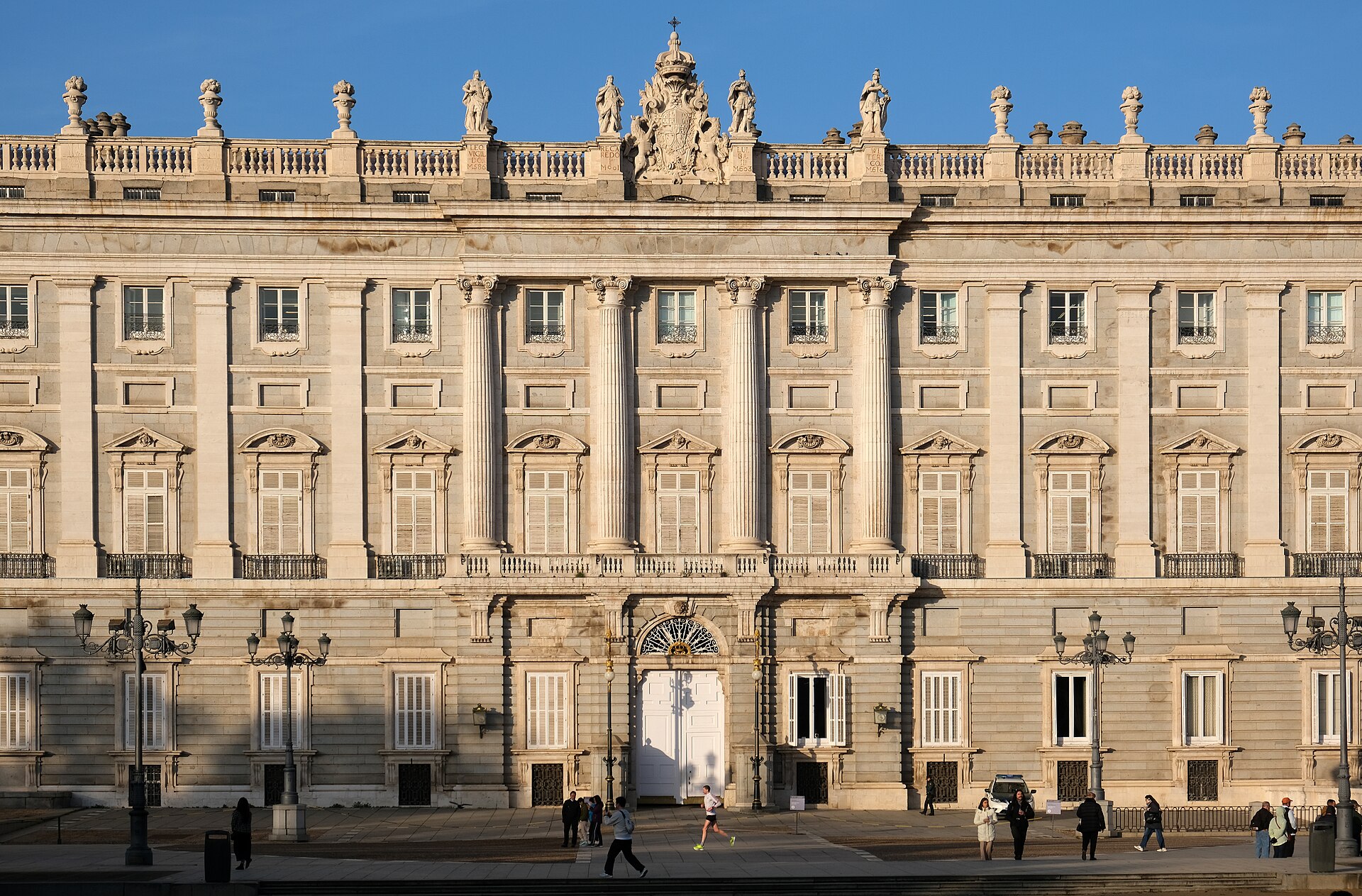
By floor area the Royal Palace of Madrid is the largest functioning royal palace on the continent, an immense square block built around a central courtyard and containing thousands of rooms. Standing before it, you take in a facade of white limestone and grey granite that runs on and on, rhythmic and dignified, crowned by a balustrade rather than a soaring roofline. The sheer horizontal extent of the building is its most immediate statement of power.
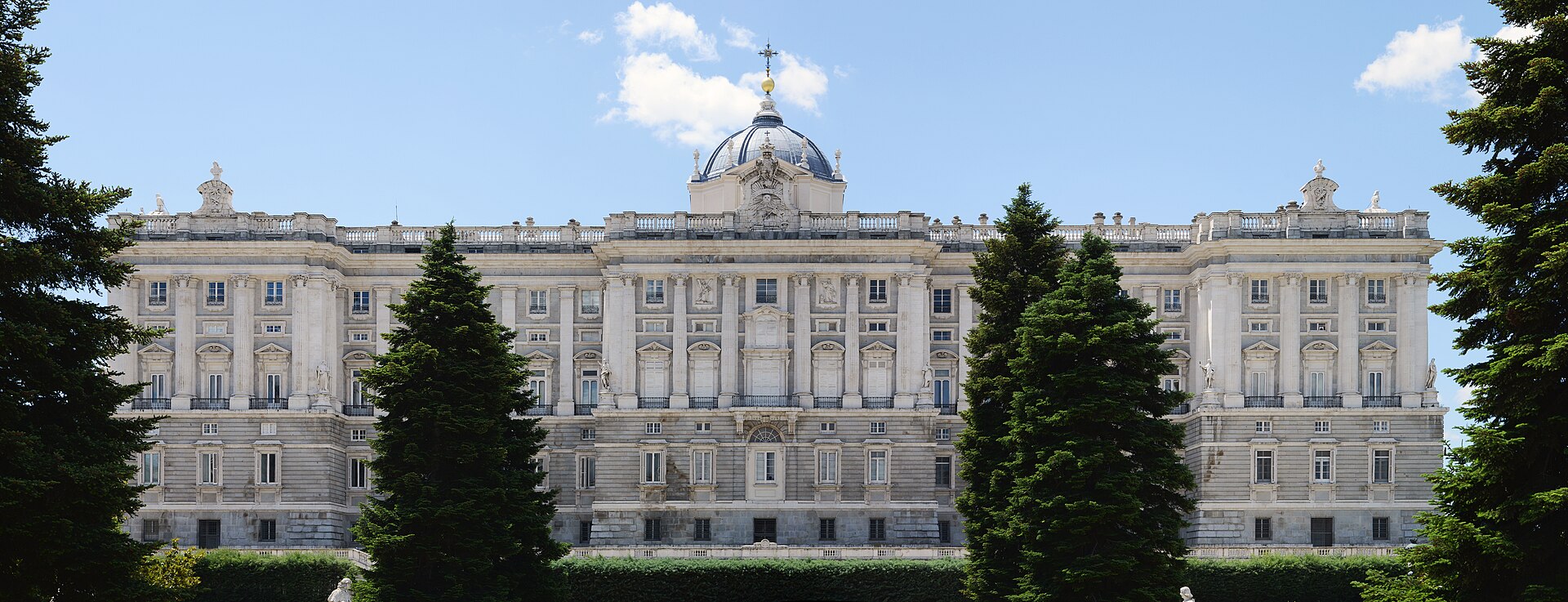
The palace occupies one of the most commanding positions in Madrid, set on a bluff above the Manzanares river valley on the western side of the historic city. This was no accident; the site had been the seat of royal power for centuries, and the new palace inherited both its strategic height and its symbolic weight. From its western windows the ground falls away toward gardens and open country, while to the east it faces the city it was built to govern.
Before it spreads the great Plaza de la Armeria, a vast ceremonial courtyard flanked on one side by the palace and on the other by the Almudena Cathedral, whose more recent silhouette now answers the palace across the square. This grand open space was designed as a setting for the pageantry of monarchy, a stage on which the power of the crown could be displayed to the people of the capital.
For all its scale, the palace wears its grandeur with a certain classical calm. There is little of the exuberant curving drama of some Baroque palaces here; instead the design favours order, symmetry, and a restrained monumentality drawn from Italian models. That measured dignity is very much the character of the building, and it reflects the taste of the age and the dynasty that raised it out of the ruins of what came before.
It is worth pausing on the numbers, for they are difficult to grasp. The palace contains thousands of rooms and covers a floor area that dwarfs many of the most famous royal residences in the world, larger than Versailles or Buckingham Palace. This immensity was not vanity alone; it reflected the need to house an entire apparatus of monarchy under one roof, from the private apartments of the royal family to the chapel, the armoury, the offices of government, and the quarters of a vast household, all gathered within a single mighty quadrangle of stone.
The Christmas Fire That Destroyed the Old Alcazar
For centuries the kings of Spain had lived not in this palace but in the old Alcazar of Madrid, a rambling royal fortress that had grown over generations from medieval origins into the sprawling seat of the Habsburg court. It was within those walls that the golden age of Spanish power had been governed, and its halls had held masterpieces by Velazquez and Titian and the accumulated treasures of a world empire.
On Christmas Eve of 1734, disaster struck. A fire broke out within the old Alcazar and, fed by the timber and furnishings of the ancient building, quickly grew beyond control. Through the night the flames consumed the royal fortress, and by the time the blaze had burned itself out the old palace was a gutted ruin. Many works of art were saved by being thrown from the windows, but a great deal was lost forever in the inferno.
The catastrophe was, for the reigning king, both a tragedy and an opportunity. Philip V, the first of the Bourbon dynasty in Spain and a grandson of the great builder Louis XIV of France, had grown up amid the splendors of Versailles and had long found the gloomy old Alcazar unworthy of a modern monarchy. The fire cleared the ground, quite literally, for the palace he had always wanted to build.
Rather than restore the old fortress, the king resolved to raise an entirely new palace on the same historic site, one that would embody the grandeur of his dynasty and the ambitions of a reinvigorated Spanish crown. The lesson of the fire was not forgotten, however, and it would shape the very fabric of the new building in a fundamental way, dictating the materials from which it would rise.
The loss of the old Alcazar was, in cultural terms, immense, for the fortress had housed one of the greatest art collections in Europe, assembled by the Habsburg kings across two centuries of empire. Paintings by Velazquez, Titian, and Rubens hung in its galleries, and though many canvases were saved by desperate rescuers who cut them from their frames or hurled them into the square below, others perished in the flames. The fire thus marked the end of one great chapter of Spanish royal history even as it opened another.
A Bourbon Vision: Juvarra and Sacchetti
To design his new palace, Philip V looked to Italy, then the great source of architectural talent, and summoned one of the most celebrated architects of the age, Filippo Juvarra. A designer of soaring imagination, Juvarra envisioned a palace of colossal ambition, and he set to work on grand plans for the royal residence. His involvement promised a building of the first European rank.

Fate intervened, for Juvarra died in 1736, only a short time after arriving in Spain and before his great design could be realized. The task passed to his talented pupil, Giovanni Battista Sacchetti, who took up the project and adapted it to the constraints of the site. It is Sacchetti’s revised design, more compact than his master’s original but still enormous, that was actually built and that we see today.
Construction began in 1738 and continued for well over a decade, a vast undertaking that drew on the resources of the crown and the labour of countless workers. The building rose steadily around its great central court, and though Philip V did not live to see it finished, the work carried on under his successors. The palace was substantially complete by the mid-1750s, and King Charles III became the first monarch to take up residence there.
Later architects continued to shape the palace and its surroundings. Francesco Sabatini, the favoured architect of Charles III, added the grand staircase and other elements, while the Spanish master Ventura Rodriguez contributed to the interiors. The palace was thus the work of many hands across several reigns, yet it retained a remarkable unity of style, a monument to the Italian-inspired classicism that the Bourbons brought to Spain.
The move to Italian architects was itself significant, for it marked the arrival in Spain of a new courtly style imported by the Bourbons from France and Italy. The heavy, austere manner of the Habsburg age gave way to a lighter, more classical and cosmopolitan taste, and the palace became the great monument of this cultural shift. In summoning Juvarra and then relying on Sacchetti, the Spanish crown deliberately aligned itself with the most advanced architectural currents of eighteenth-century Europe.
Built of Stone, So It Would Never Burn Again
The memory of the Christmas fire that had destroyed the old Alcazar was seared into the minds of those who built its replacement, and it left a decisive mark on the new palace. A conscious decision was made to construct the entire building of stone and brick, with vaulted ceilings throughout, and to use as little wood as possible in its structure. The palace was, in effect, engineered to be fireproof.

This determination shaped the whole character of the building. The great vaulted halls, the masonry construction, and the massive stone walls were not merely aesthetic choices but a direct response to the disaster that had cleared the site. The result is a building of extraordinary solidity, one that has stood for nearly three centuries and weathered the many upheavals of Spanish history without succumbing to the fate of its predecessor.
The scale of the construction was matched by the ambition of its planning. The palace was conceived as a self-contained world of monarchy, with hundreds upon hundreds of rooms to house the royal family, the court, the offices of government, the chapel, and all the machinery of a great household. Its floor area is so vast that it exceeds that of many of the most famous palaces in Europe, a fact in which the Spanish crown took considerable pride.
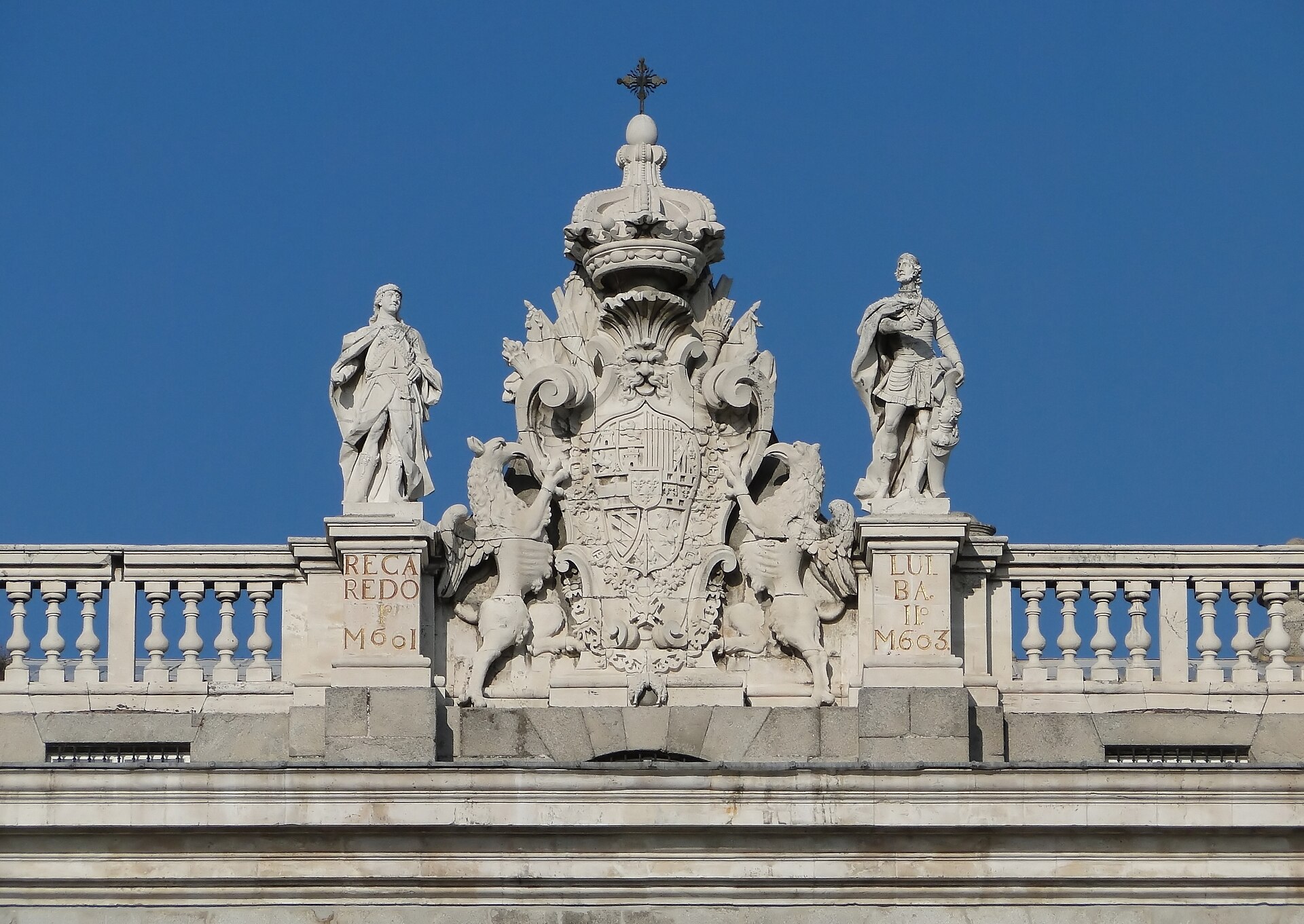
Yet the exterior remained deliberately restrained. Rather than covering the facades with riotous ornament, the designers relied on fine proportions, the interplay of white stone and grey granite, and a crowning balustrade lined with statues. The effect is one of monumental calm, a dignity born of solidity and order, perfectly suited to a palace built above all to endure. Only within do the interiors release the full splendor the sober walls conceal.
The Grand Staircase
The transition from the palace’s sober exterior to its dazzling interior is announced by the grand staircase, a ceremonial ascent of marble designed to overwhelm the arriving visitor. Added under Charles III by the architect Sabatini, the staircase rises in broad flights beneath a lofty vaulted ceiling adorned with fresco, drawing the eye upward as it carries the visitor toward the state apartments above.

Everything about the staircase is calculated for effect. Its steps of fine marble, its balustrades, its sculptures, and the painted ceiling overhead combine to create a sense of mounting grandeur, a processional route that prepares the visitor for the magnificence to come. Lions and allegorical figures preside over the ascent, and the whole ensemble glows with a cool, luminous elegance.
The staircase was more than mere decoration; it was an instrument of royal ceremony. The manner in which guests ascended, and were received, formed part of the elaborate theatre of court life, and the architecture was designed to frame these moments with appropriate splendor. To climb it was to feel oneself entering the presence of monarchy, step by deliberate step.
Today the grand staircase remains one of the most admired spaces in the palace, the perfect introduction to the riches beyond. Its blend of Italian classicism and courtly grandeur sets the tone for the entire visit, and it demonstrates how the palace, restrained without, unleashes its full artistic ambition within. From the top of the stairs, the great sequence of state rooms opens out, each more splendid than the last.
The Throne Room and Tiepolo’s Painted Heaven
Among the many magnificent rooms of the palace, none is more celebrated than the Throne Room, the Salon del Trono, the ceremonial heart of the Spanish monarchy. Its walls are hung with crimson velvet woven with silver, its furnishings gleam with gilding, and gilded bronze lions guard the twin thrones at its centre. It is a room designed to embody the majesty of the crown in every surface.

The room’s supreme glory is its ceiling, one of the last and greatest works of Giovanni Battista Tiepolo, the Venetian master who came to Madrid in his final years to work for the Spanish king. Across the vast vault he painted an allegory of the grandeur of the Spanish monarchy, a luminous vision in which the realms and provinces of the Spanish world are gathered in glory beneath an open, radiant sky.
Tiepolo’s fresco is a tour de force of illusion and colour, the ceiling seeming to dissolve into infinite space filled with soaring figures. It represents the culmination of the Baroque tradition of the painted heaven, executed by perhaps its greatest practitioner at the very end of his career. That such a work crowns the Throne Room binds the room’s political purpose to the highest achievements of European art.
The Throne Room remains in ceremonial use to this day, the setting for the reception of ambassadors and other solemn occasions of state. To stand within it, beneath Tiepolo’s painted sky and surrounded by crimson and gold, is to experience the theatre of monarchy exactly as its creators intended. It is the point at which the palace’s art and its purpose become one, and it ranks among the finest rooms in Europe.
The choice of subject for the ceiling was no accident. By depicting the glory and extent of the Spanish monarchy, with its many kingdoms and its dominions across the globe gathered in allegory, the fresco turned the room into a visual argument for the legitimacy and grandeur of Bourbon rule. Art and power were fused here as completely as anywhere in Europe, the beauty of Tiepolo’s painting placed entirely in the service of the crown that commissioned it.
The Gasparini Room: Rococo Fantasy
If the Throne Room represents the majesty of the crown, the Gasparini Room represents its capacity for pure delight. Named after the Italian artist Matteo Gasparini who designed it, this exquisite chamber served as the dressing room of King Charles III and is one of the most complete and dazzling Rococo interiors anywhere in Europe. Every surface of it is a marvel of coordinated artistry.

The room is a total work of art in which walls, ceiling, and floor were conceived as a single design. The ceiling is a fantasy of stucco worked into flowing, naturalistic forms, the walls are hung with embroidered silks in the chinoiserie taste then so fashionable, and the floor is inlaid with marbles echoing the patterns above. The effect is one of shimmering, jewel-like intensity, an interior of extraordinary refinement.
The chinoiserie theme, with its exotic motifs of foliage, figures, and fantastical creatures, reflects the eighteenth-century European fascination with an imagined Orient. In the Gasparini Room this taste is carried to a peak of sophistication, the whole chamber wrapped in a dream of elegance and exoticism that speaks of a court at the height of its cultural confidence.
The room is a reminder that the palace was not only a machine of state but a setting for the private, luxurious life of the royal family. Here the king was dressed and prepared amid surroundings of the utmost splendor, and the very act of dressing was framed as a kind of ceremony. The Gasparini Room stands today as one of the palace’s most beloved interiors, a perfect distillation of Rococo taste.
The Royal Chapel and the Royal Stradivari
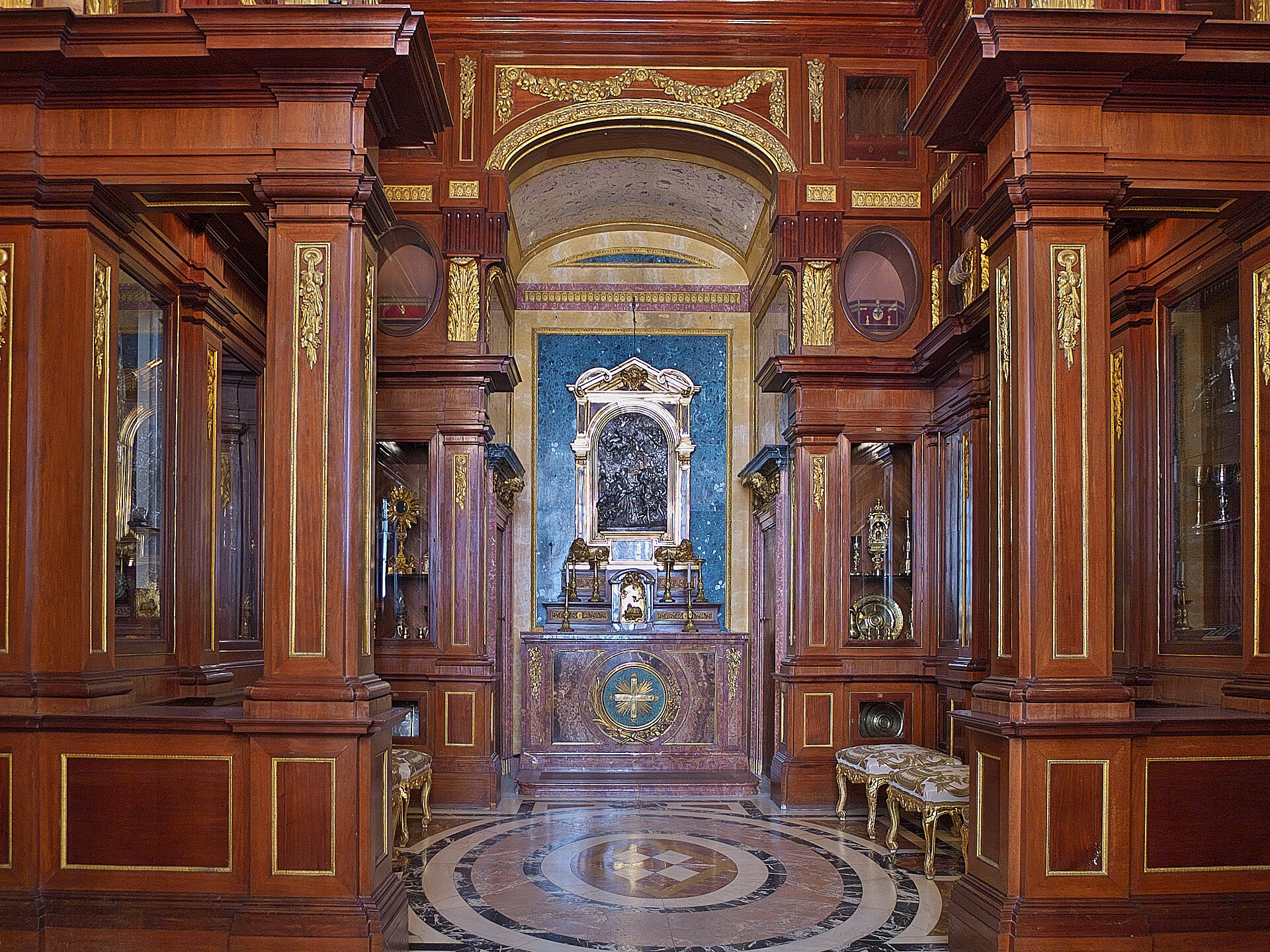
Within the palace lies the Royal Chapel, a richly decorated sacred space crowned by a dome and adorned with coloured marbles, gilding, and fine paintings. It served the devotional needs of the royal household, and its design, with columns of dark marble rising toward a frescoed dome, gives it an atmosphere of solemn magnificence in keeping with the piety of the Spanish crown.

The chapel is also home to one of the palace’s most extraordinary treasures: a unique collection of stringed instruments made by Antonio Stradivari, the greatest of all violin makers. Known as the Palatine or Royal Stradivari, this set of decorated instruments, including violins, violas, and cellos, is among the most precious musical collections in the world, and it has been preserved by the Spanish crown for generations.
That such instruments should belong to the palace speaks of the importance of music in court life. The Spanish Bourbons were great patrons of music, and these Stradivari instruments, some of them ornately decorated, were played in the royal chambers and chapel. To this day they are occasionally brought out and performed upon, allowing modern audiences to hear the unrivalled voice of Stradivari’s craftsmanship.
Together the chapel and its instruments reveal another dimension of the palace’s life, the spiritual and the artistic intertwined. The Spanish court was profoundly Catholic, and religious ceremony was woven into the daily rhythm of the household, while the patronage of the finest music and instruments reflected the crown’s cultivation. The Royal Chapel unites both, a place of worship graced by some of the greatest treasures of the musical world.
The Porcelain Room and the Decorative Arts
Among the most enchanting of the palace’s smaller rooms is the Porcelain Room, whose walls and ceiling are entirely covered in porcelain plaques moulded and painted with exuberant three-dimensional designs. Produced at the royal manufactory of Buen Retiro, established by Charles III, the porcelain forms a continuous decorative skin over the room, its figures, garlands, and ornaments projecting from the surface in glittering relief.

The room is a triumph of the decorative arts and a demonstration of the crown’s determination to foster fine manufacture within Spain itself. The Buen Retiro manufactory, modelled on the great porcelain works of Naples that Charles III had known before coming to the Spanish throne, produced wares of the highest quality, and the Porcelain Room is its most spectacular surviving showcase.
Throughout the palace, similar attention was lavished on the decorative arts. The state rooms are filled with fine furniture, clocks, tapestries, chandeliers, and mirrors, many produced by royal workshops or gathered from across Europe. Silk hangings, gilded bronze, and inlaid floors combine to create interiors of extraordinary richness, each room conceived as a complete and harmonious ensemble.
These rooms together form a museum of eighteenth and nineteenth century taste, a record of the successive styles favoured by the Spanish court. From Rococo fantasy through neoclassical restraint, the apartments trace the evolving fashions of the age, all deployed in the service of royal magnificence. The palace is, in this sense, as much a treasury of the decorative arts as it is a work of architecture.
The Gala Dining Hall and the Ceremony of State
For the grandest occasions of state, the palace offers its immense Gala Dining Hall, the Comedor de Gala, a room of overwhelming length created in the nineteenth century by combining several earlier chambers. Beneath a ceiling adorned with fresco, a single vast table can seat well over a hundred guests, laid with the finest porcelain, silver, and glass from the royal collections.
The hall is hung with tapestries and lit by great chandeliers, and its walls are lined with works of art. It was designed to accommodate the ceremonial banquets by which monarchy displays its magnificence and cements its alliances, and it remains in use for the most important state dinners hosted by the Spanish crown, when visiting heads of state are received with full royal honours.
Such occasions reveal the palace’s continuing role at the heart of Spanish public life. Though no longer a private residence, the Palacio Real is the stage on which the ceremonial functions of the monarchy are performed, and the Gala Dining Hall is among its most important settings. A state banquet here is an event of great pomp, drawing on centuries of courtly tradition.
The room also displays the wealth of the royal collections, for the tables are set with objects of the highest quality accumulated over generations. Fine tableware, gilded centrepieces, and historic silver transform the hall into a glittering spectacle on the great occasions for which it exists. It is a vivid reminder that the palace, for all its age, remains a living instrument of the Spanish state.
The Royal Armoury, One of the Finest in the World
Housed within the palace complex is the Royal Armoury, the Real Armeria, widely regarded as one of the two or three finest collections of arms and armour in the world. Its origins lie with the Habsburg emperors and kings of Spain, and it preserves an unrivalled array of armour, weapons, and equestrian equipment gathered over centuries, much of it belonging to the monarchs themselves.

The heart of the collection is the personal armour of the great Habsburg rulers, above all the Emperor Charles V and his son Philip II, at whose command Spain reached the height of its imperial power. Their magnificently decorated parade armours, some of them masterpieces of the armourer’s art, survive here in remarkable completeness, offering an intimate connection to the men who ruled a global empire.
Beyond the royal armours the collection holds a vast range of weapons, tournament equipment, shields, and horse armour, many of them richly worked and of the highest craftsmanship. Together they document not only the art of war but the art of display, for such armour was as much about magnificence and ceremony as about protection in battle. The parade pieces in particular are dazzling works of decorative metalwork.
For visitors, the Royal Armoury is one of the palace’s great highlights, a place where the abstract grandeur of monarchy takes tangible form in steel and gold. To stand before the very armour worn by Charles V is to feel the weight of Spanish history in a peculiarly direct way. Few collections anywhere unite such historical significance with such artistic splendor, and it forms a fitting complement to the palace that houses it.
The very survival of the armoury is itself remarkable, for such collections were often dispersed or destroyed in the upheavals of later centuries. That Spain preserved its royal armoury largely intact, through wars, revolutions, and changes of dynasty, is a measure of the value placed upon it as a treasure of national and dynastic memory. Each piece carries with it the identity of the ruler who bore it, making the collection a kind of portrait gallery rendered in steel rather than paint.
The Gardens: Sabatini and the Campo del Moro
A palace of such grandeur required gardens to match, and the Royal Palace of Madrid is set amid green spaces on two of its sides. To the north lie the Sabatini Gardens, a formal, neoclassical arrangement of clipped hedges, geometric parterres, a reflecting pool, and statuary, laid out in the twentieth century on the site of the former royal stables and named in honour of the architect Francesco Sabatini.

The Sabatini Gardens, though relatively modern, were designed in a formal style in keeping with the dignity of the palace, and they provide one of the finest views of its northern facade rising above the greenery. Symmetrical and serene, dotted with statues of Spanish monarchs, they offer a tranquil counterpoint to the monumental architecture and a popular retreat for the people of Madrid.
To the west of the palace, descending toward the river, lies the far larger Campo del Moro, a great landscaped park whose name recalls a medieval siege of the city. Laid out in a more romantic, English-influenced manner with winding paths, lawns, fountains, and stands of trees, it provides a green setting through which the palace can be admired from below, its long facade crowning the slope above.
Together these gardens frame the palace and soften its immense bulk, integrating it into a landscape of greenery and water. They extend the experience of the palace out of doors and offer some of the most memorable views of the building, whether the formal vistas of the Sabatini Gardens or the sweeping prospect from the Campo del Moro. They complete the composition of the royal residence as a work of art embracing both architecture and nature.
The relationship between the palace and its gardens also tells us something about the site’s long history. The Campo del Moro takes its name, meaning the field of the Moor, from a medieval episode when a Muslim commander is said to have camped there while besieging the fortress that once stood on this height. In this way even the gardens carry echoes of the deep past of the site, layering centuries of Madrid’s history around the great Bourbon palace that now crowns the hill.
The Palace Today: A Living Symbol of the Crown
Although the Spanish royal family no longer lives in the Palacio Real, having moved to a more modest residence outside the city, the palace remains the official royal residence and is used for the most important ceremonies of state. Here new ambassadors present their credentials, state banquets are held, and the great public rituals of the monarchy unfold amid the splendor of the historic apartments.

View the exact location on Google Maps
For most of the year, however, the palace belongs to the public. It is one of the most visited monuments in Spain, and visitors can tour the grand staircase, the Throne Room, the Gasparini Room, the Royal Chapel, the Royal Armoury, and a long sequence of state apartments filled with art and treasures. The palace also holds masterpieces by artists such as Velazquez, Goya, and Caravaggio among its vast collections.
The building sits at the very heart of historic Madrid, easily reached and forming, with the neighbouring Almudena Cathedral and the surrounding squares and gardens, one of the great architectural ensembles of the Spanish capital. Its central position makes it a natural focus for any visit to the city, and the changing of the guard and other ceremonies bring its living traditions before the public eye.
Nearly three centuries after a Christmas fire cleared the ground for its creation, the Royal Palace of Madrid endures as a symbol of the Spanish crown and a treasury of European art. Built of stone to outlast the ages, adorned by the finest artists of its day, and still serving the monarchy it was raised to glorify, it stands among the great palaces of the world, a monument to the enduring idea of Spanish kingship.
Palaces Nearby
Another of the great Spanish royal palaces lies a short journey south of the capital:


3 thoughts on “The Royal Palace of Madrid: The Fireproof Palace the Bourbons Raised From the Ashes”