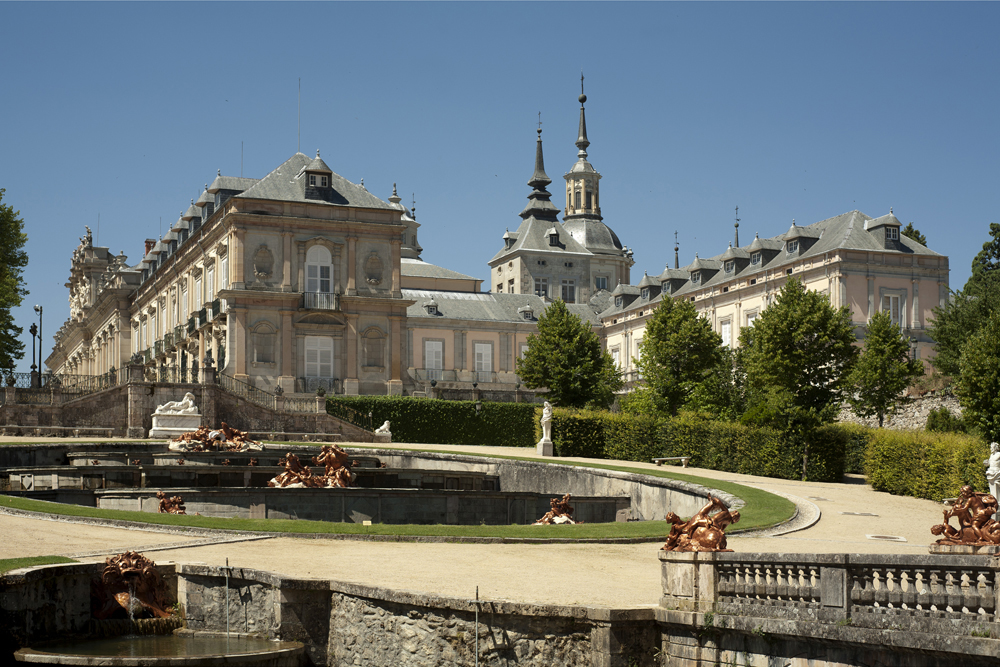
High in the pine-clad foothills of the Guadarrama mountains, above the city of Segovia and far from the dust of Madrid, an aging king built himself a mountain paradise meant to echo the greatest palace of his childhood. The Royal Palace of La Granja de San Ildefonso is often called the Spanish Versailles, and the comparison is no accident, for it was raised by a grandson of Louis XIV who longed, in the cool Castilian highlands, to recreate something of the splendour of the French court in which he had been born.
What he created is one of the most spectacular ensembles of palace and garden in Europe. Behind an elegant Baroque facade lie state rooms rich with marble, tapestry, and gilding, and a collegiate church that holds the tomb of the king himself. But it is the gardens that make La Granja unforgettable: a vast sloping landscape of clipped groves and terraces adorned with the most magnificent collection of monumental fountains in all of Spain, their gilded gods and monsters sending jets of water soaring into the mountain air.
The setting is everything here. Where the other Spanish royal sites sit amid plains and rivers, La Granja is a palace of the mountains, its gardens climbing the slope toward the forested heights and drawing their abundant water, by the simple force of gravity, from a reservoir high above. This union of Baroque artifice and dramatic natural setting gives the place a grandeur and a freshness quite its own, and it made La Granja the favourite retreat of the king who built it.
To visit La Granja is to encounter the homesickness of a king made visible in stone and water. Philip V, the first Bourbon to rule Spain, poured his heart and his fortune into this mountain retreat, and here he chose to be buried, apart from his ancestors, in the palace he loved above all others. This is the story of how a former monks’ farmstead in the mountains became a royal wonderland of fountains, and the final home of the king who dreamed it into being.
In This Article
- The Spanish Versailles in the Mountains
- Philip V, the Homesick King
- From a Monks’ Farm to a Royal Palace
- The Palace and Its Architects
- The State Apartments Within
- The Collegiate Church
- The Tomb of a King Who Would Not Leave
- Gardens That Rival Versailles
- The Monumental Fountains
- The Fountain of Fame and the Great Waterworks
- The Baths of Diana and the Spectacle of Water
- The Royal Glass Factory
- La Granja Today: A Mountain Paradise Preserved
The Spanish Versailles in the Mountains
La Granja stands apart from the other royal palaces of Spain by virtue of its setting and its inspiration. Perched at a considerable altitude in the Guadarrama mountains, surrounded by pine forests and cooled by mountain air, it was conceived from the start as a place of escape from the heat and formality of the capital. The very landscape, rugged and green and well watered, set it apart from the arid plains where so much of Castile lies.

The palace earned its nickname, the Spanish Versailles, because its creator consciously looked to the great French palace as his model. The layout of gardens descending from the palace, the axial vistas, the monumental fountains peopled with mythological figures, all recall the world of Versailles, transposed to a Spanish mountainside. Yet La Granja is no mere copy; it has a character all its own, shaped by its dramatic setting and by the particular tastes of the Spanish court.
The scale of the ambition is immediately apparent. The gardens spread across a vast area, rising toward the wooded heights, and they are studded with fountains, basins, statues, and architectural features arranged along grand avenues. The palace itself, elegant and richly decorated, sits at the heart of this composition, looking out over the terraces and waters that were the true glory of the Royal Site.
For the king who built it and for his successors, La Granja was above all a summer refuge, a place to escape the Castilian heat and to enjoy the pleasures of the mountains and the gardens. The cool climate, the forests full of game, and the spectacle of the fountains made it an ideal retreat, and it became one of the most cherished of all the residences of the Spanish crown, a mountain paradise created by royal will.
Philip V, the Homesick King
The creator of La Granja was Philip V, the first king of the Bourbon dynasty in Spain and a grandson of the great Louis XIV of France. Born and raised at Versailles amid the most magnificent court in Europe, he came to the Spanish throne at the opening of the eighteenth century after a long and bloody war of succession, and he never entirely lost his longing for the world of his childhood. La Granja was, in a sense, his attempt to recover it.

Philip’s reign was marked by melancholy as well as splendour. He suffered from bouts of deep depression and a profound weariness of the burdens of kingship, and he even abdicated the throne for a time before being compelled to resume it. In this restless and troubled king, the desire for a private retreat far from the machinery of state ran very deep, and La Granja answered that desire more completely than any other of his residences.
It was here, in the mountains, that Philip found the peace that eluded him elsewhere. He lavished attention and money on the palace and its gardens, personally involving himself in their creation, and he spent long periods here in the company of his forceful second wife, Isabella Farnese, who shared and encouraged his passion for building. Together they transformed the mountain site into a royal wonderland that reflected their tastes and their longings.
So attached was Philip to La Granja that he made a decision unusual for a Spanish monarch: rather than be interred with his predecessors in the great royal pantheon of El Escorial, he chose to be buried here, in the palace he loved. That choice, more than anything, reveals the depth of his attachment to this mountain retreat, and it gives La Granja a poignant significance as the final resting place of the homesick king who created it.
Isabella Farnese, his Italian second wife, played a decisive role in the life of the court and in the shaping of La Granja. A woman of strong will and cultivated taste, she brought Italian artists and ideas to Spain and shared her husband’s enthusiasm for the mountain retreat, encouraging its embellishment. After Philip’s death she continued to be associated with the palace, and in time she too was laid to rest beside him in the church, their shared tomb sealing their common devotion to the place.
From a Monks’ Farm to a Royal Palace
The name La Granja, meaning the farm or the grange, records the humble origins of the site. Long before it became a royal palace, the land here belonged to a religious community, the Hieronymite monks, who maintained a farm and a modest hermitage dedicated to Saint Ildefonsus in the mountain wilderness. It was a quiet, remote spot, valued for its pastures, its forests, and its abundant mountain waters.
Philip V acquired the property in the early eighteenth century, drawn by the beauty of the setting and its suitability as a retreat. What began as the acquisition of a farm and a hunting lodge soon grew, under the king’s enthusiasm, into a far grander project. The modest buildings were swept aside or absorbed, and in their place rose a royal palace and the beginnings of the great gardens, transforming the monastic estate beyond recognition.
The name, however, stuck, and so this most splendid of mountain palaces bears to this day the humble title of the farm. The full name, La Granja de San Ildefonso, unites the memory of the monks’ grange with that of the saint to whom their hermitage had been dedicated, and it is by this name that the Royal Site and the town that grew up around it are still known.
The transformation of the site was rapid and thorough. Within a few decades a working monastic farm in a mountain valley had become one of the principal residences of the Spanish crown, complete with palace, church, gardens, fountains, and a supporting town. It was a remarkable act of royal will, imposing upon the wild mountain landscape a vision of Baroque order and magnificence drawn from the great courts of Europe.
The Palace and Its Architects
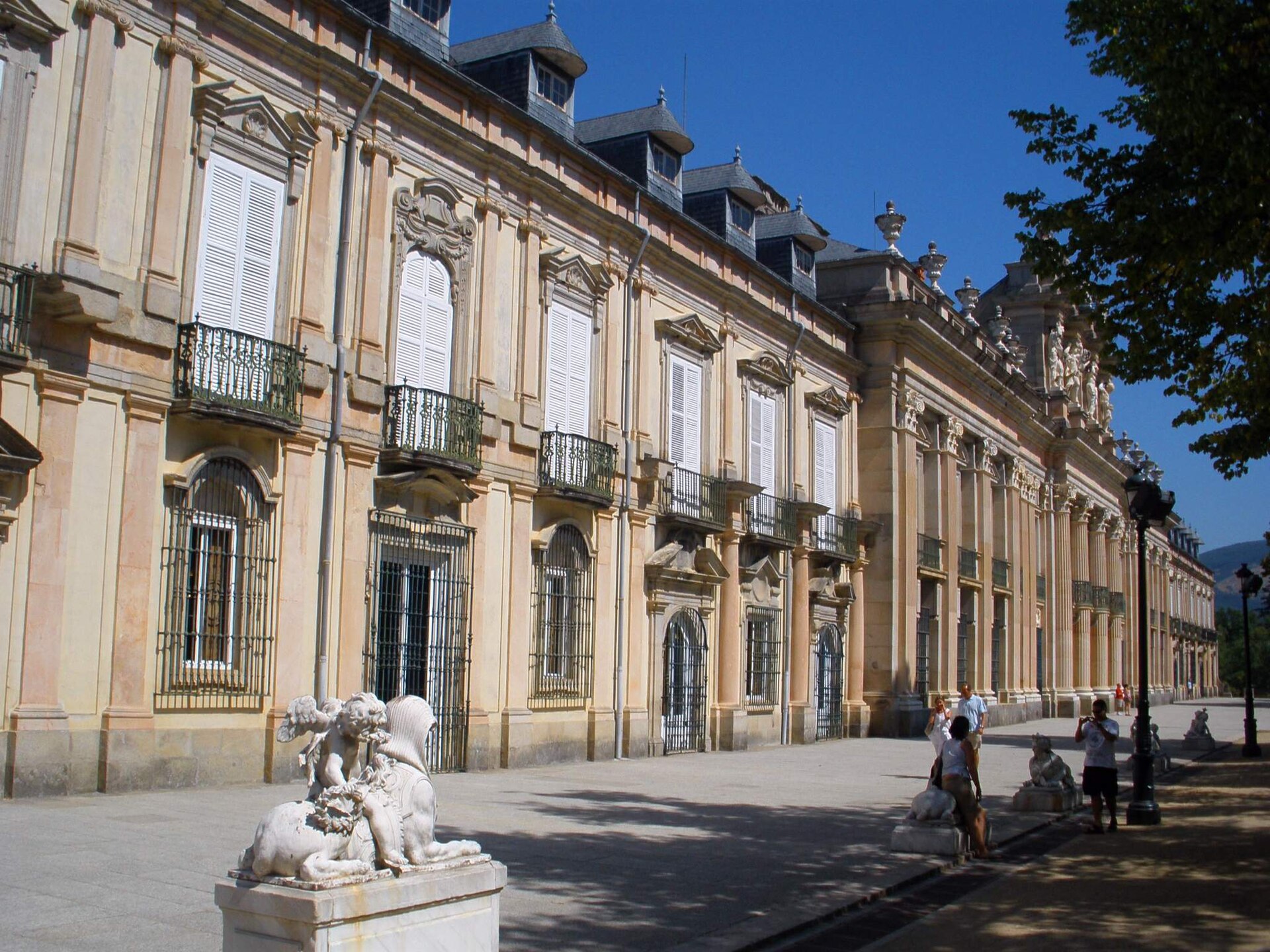
The palace of La Granja was the work of several hands over the course of its creation. The initial designs were entrusted to the Spanish architect Teodoro Ardemans, who laid out the core of the palace around a central court in the early phase of construction. His work established the essential form of the royal residence, adapted to its mountain setting and to the needs of the king who commissioned it.

As the project grew in ambition, further architects were brought in to embellish and extend the palace. The Italian masters Filippo Juvarra and, after his death, his pupil Giovanni Battista Sacchetti, both of whom would also work on the Royal Palace of Madrid, contributed to the design, most notably giving the palace its handsome principal facade overlooking the gardens. Their involvement brought the latest Italian taste to the mountain retreat.
The resulting building blends the sober traditions of Spanish architecture with the lighter, more decorative currents flowing from Italy and France. Its facades, richly articulated and crowned with statuary, present an elegant face to the gardens, while the interior was fitted out with the marble, stucco, and gilding appropriate to a royal residence. The palace was conceived throughout as the centrepiece of the great garden composition that surrounds it.
Over successive reigns the palace was maintained, altered, and embellished, and it suffered its share of misfortune, including a serious fire in the early twentieth century that damaged part of the building. Careful restoration has repaired the harm, and the palace stands today much as its royal builders intended, a graceful Baroque residence set amid its terraces and fountains, the still centre around which the spectacle of the gardens revolves.
The State Apartments Within
Within its elegant walls, the palace of La Granja contains a sequence of state apartments decorated with the richness expected of a royal residence. Marble floors, gilded ornament, painted ceilings, and fine furnishings create interiors of considerable splendour, and the rooms are hung with an important collection of tapestries and paintings gathered by the Spanish crown over the centuries.

The apartments reflect the tastes of the successive monarchs who used the palace, from the Baroque exuberance of its founders to the neoclassical restraint of later reigns. Each room was conceived as a harmonious ensemble of decoration and furnishing, and together they trace the evolving fashions of the eighteenth and nineteenth centuries, offering a vivid picture of courtly life in this mountain retreat.
Among the treasures of the palace is its remarkable collection of tapestries, one of the finest in Spain, which includes works of great beauty and historical importance. These woven masterpieces, displayed in the palace, add to the richness of the interiors and testify to the wealth and cultivation of the court that assembled them. They form one of the highlights of a visit to the palace.
The interiors, for all their splendour, retain a certain intimacy suited to a residence of retreat and pleasure rather than of grand state ceremony. This was a place where the royal family came to escape and to enjoy the mountain air and the spectacle of the gardens, and the apartments, though magnificent, are pitched to that more relaxed and personal use, a fitting complement to the paradise of fountains outside their windows.
The palace also served as a stage for important moments of Spanish history, for treaties were signed and momentous decisions taken within its walls during the reigns of the monarchs who favoured it. The mountain retreat, for all its air of pleasure and escape, remained a genuine seat of government whenever the king resided there, and its apartments witnessed affairs of state as well as the leisure of the court.
The Collegiate Church
Attached to the palace is the Collegiate Church of the Holy Trinity, an integral part of the royal complex and one of its most important buildings. Rising with its dome and towers beside the palace, the church served the religious needs of the court and provided a setting of appropriate dignity for the devotions of the royal family during their sojourns in the mountains.

The interior of the church is richly decorated in the Baroque manner, with marble, gilding, and fine altarpieces creating an atmosphere of solemn splendour. It reflects the deep piety of the Spanish crown and the importance of religious observance in the daily life of the court, and its decoration is of a quality worthy of its royal patrons, a jewel of sacred art within the Royal Site.
The church holds a special significance beyond its liturgical function, for it was chosen by the founder of La Granja as his place of burial. This decision transformed the church from a mere court chapel into a royal mausoleum, the final resting place of the king who had created the palace and gardens around it, and it gives the building a profound emotional weight.
To enter the church is thus to come to the very heart of what La Granja meant to its royal builder. Here, in the palace he loved above all others, Philip V chose to lie for eternity, and the church that holds his tomb stands as the spiritual and emotional climax of the whole Royal Site. It is a place of quiet solemnity amid the splendour of the palace and the exuberance of the gardens.
The Tomb of a King Who Would Not Leave
In a decision that set him apart from nearly every other Spanish monarch, Philip V chose not to be buried in the royal pantheon of El Escorial, where the kings of Spain traditionally lay together, but here at La Granja, in the palace he had built and loved. Within the Collegiate Church stands the magnificent tomb that holds his remains, together with those of his wife Isabella Farnese, the queen who had shared his passion for the mountain retreat.

The tomb is a work of considerable splendour, worked in fine marbles and adorned with sculpture, a fitting monument to the founder of the Royal Site. Its presence within the church transforms the whole palace into a kind of memorial to its creator, a place where the king’s love of his mountain paradise found its ultimate and permanent expression. In choosing to lie here, Philip bound himself to La Granja forever.
The decision speaks eloquently of the king’s attachment to the place and of his desire to remain, even in death, in the retreat that had given him such peace in life. It was an unusual and deeply personal choice, and it lends La Granja a significance that goes beyond its architecture and its gardens, making it not merely a royal residence but the chosen eternal home of the man who dreamed it into being.
For the visitor, the royal tomb adds a note of poignancy to the splendour of the Royal Site. Amid the gilded fountains and the elegant apartments, here is the quiet heart of the matter: a king so devoted to his mountain paradise that he would not leave it even for the great pantheon of his dynasty. The tomb is a reminder that La Granja was, above all, a work of the heart.
Gardens That Rival Versailles
If the palace is elegant, the gardens of La Granja are magnificent, and they are the true glory of the Royal Site. Descending and rising across the mountain slope, they were laid out in the grand French manner by designers trained in that tradition, with long axial avenues, clipped groves and hedges, terraces, parterres, and a wealth of sculpture, all arranged to create sweeping vistas and carefully composed scenes.
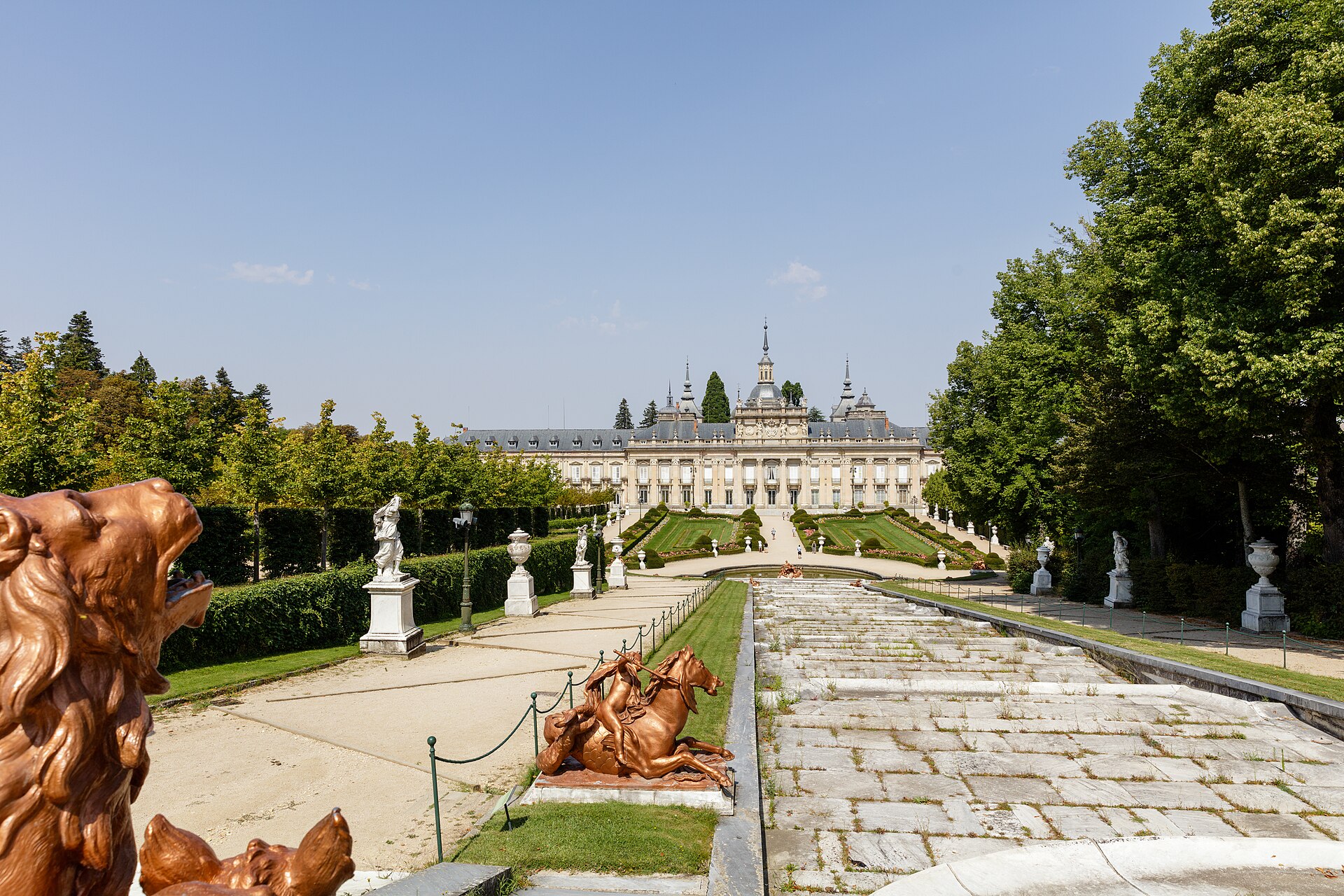
The gardens were conceived as a deliberate emulation of Versailles, and in their scale and ambition they succeed brilliantly. Great tree-lined walks lead the eye toward distant fountains and architectural features, and the whole landscape is organised around grand perspectives that draw the visitor onward from one spectacle to the next. The rising ground of the mountain slope adds a drama that even Versailles, on its flatter site, could not match.
Sculpture is everywhere in the gardens, peopling the avenues and fountains with gods, goddesses, nymphs, and mythological figures drawn from classical legend. These works, many of them gilded or of fine stone, transform the gardens into an open-air museum of Baroque sculpture, and they provide the cast of characters for the great drama of the waterworks that is the gardens’ supreme achievement.
The setting lifts the whole composition to a rare pitch of beauty. Framed by the pine forests and the mountain heights, watered by abundant streams, and cooled by the mountain air, the gardens of La Granja possess a freshness and grandeur that make them, by common consent, among the finest in Spain and worthy rivals to the great gardens of France. They are the reason many visitors make the journey into the mountains.
The designer chiefly responsible for laying out the gardens had trained in the French tradition, and he adapted its principles brilliantly to the sloping mountain terrain, using the natural fall of the land to create terraces, cascades, and dramatic perspectives that a flat site could never have offered. The result was a garden that observed the rules of French formal design while exploiting its Spanish mountain setting to achieve effects entirely its own.
The Monumental Fountains
The crowning glory of the gardens of La Granja is its extraordinary collection of monumental fountains, widely regarded as the most magnificent in Spain and among the finest anywhere in Europe. Scattered through the gardens along the great avenues, these fountains are vast architectural and sculptural compositions, peopled with gilded and stone figures from classical mythology, from which water rises in spectacular jets and cascades.

Each fountain tells a mythological story through its sculpture. Gods and goddesses, monsters and heroes, are arranged in elaborate tableaux, and when the waters play, the figures seem to come alive amid the leaping jets and falling spray. The fountains bear evocative names drawn from the myths they depict, and together they form a coherent programme of classical allegory spread across the gardens.
The engineering behind the fountains is as remarkable as their artistry. The water is supplied entirely by the force of gravity, drawn from a great reservoir high above the gardens in the mountains and channelled down through a system of pipes, so that no pumps are needed to drive even the tallest jets. This ingenious use of the mountain setting allows some of the fountains to throw water to astonishing heights.
Because of the way they are fed, the fountains do not play continuously but are set in motion only on certain special days of the year, when crowds gather to witness the spectacle. To see the fountains of La Granja in full play, their gilded gods streaming with water and their jets soaring against the backdrop of the mountains, is one of the great sights of Spain, a Baroque drama of water, sculpture, and landscape.
The programme of the fountains was carefully devised so that the sculptures and their myths related to one another across the gardens, creating a unified iconographic scheme in which the classical gods presided over the whole landscape. Walking the avenues from one fountain to the next, the eighteenth-century visitor would have read this procession of mythological scenes as a coherent celebration of royal power, virtue, and the abundance that water, so precious in Spain, symbolised.
The Fountain of Fame and the Great Waterworks
Among the many fountains of La Granja, several stand out as supreme achievements, and none more so than the Fountain of Fame. This towering composition sends a single jet of water to an extraordinary height, said to be among the tallest of any historic fountain, a feat made possible by the great head of pressure created by the reservoir high in the mountains above. When it plays, the column of water rises dramatically into the mountain sky.
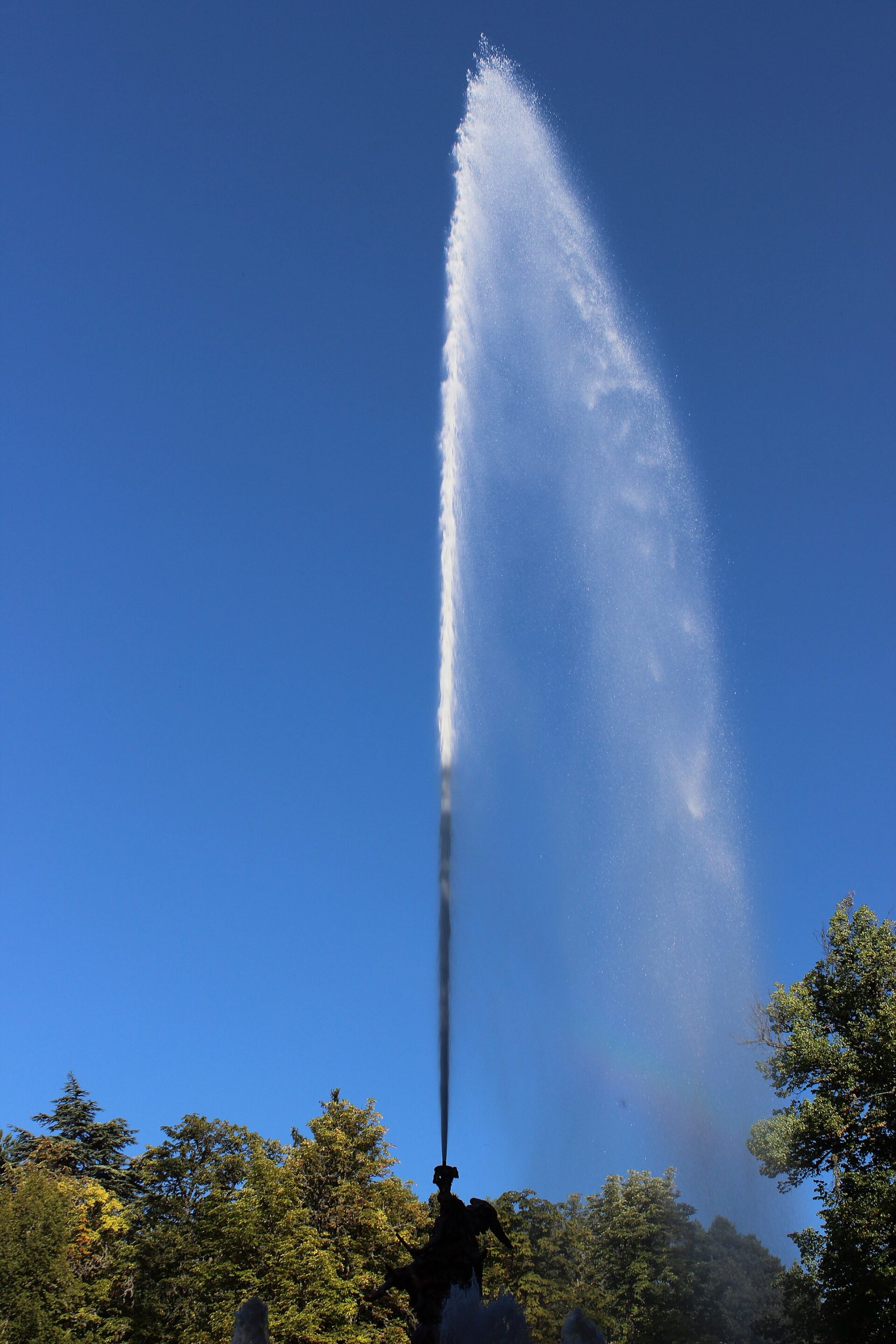
The Fountain of Fame is crowned by a figure representing Fame herself, and its great vertical jet makes it one of the most spectacular sights in the gardens. It demonstrates, more vividly than any other, the ingenuity of the hydraulic engineering that lies behind the whole system of fountains, harnessing the natural fall of the land to achieve effects that would elsewhere require powerful machinery.
The water that feeds all the fountains is gathered in a large reservoir known evocatively as the Sea, set high above the gardens, which stores the abundant mountain streams and releases them through the network of channels and pipes that supply the waterworks. This great artificial lake is the hidden engine of the whole spectacle, and without it the fountains could not perform their soaring displays.
The system as a whole is a marvel of Baroque engineering, integrating the natural resources of the mountain setting into the artistic design of the gardens. That the fountains still function today, driven by the same gravity-fed principle devised in the eighteenth century, is a testament to the skill of their creators. The great waterworks of La Granja remain one of the most impressive surviving achievements of the age.
The Baths of Diana and the Spectacle of Water
Of all the fountains at La Granja, the one most beloved of its royal builder was the Baths of Diana, an immense and richly sculpted composition depicting the goddess Diana and her nymphs at their bathing. A vast tableau of figures set against an architectural backdrop, with water cascading and spraying among the sculptures, it is one of the largest and most elaborate of all the fountains in the gardens.

A famous story attaches to this fountain and its founder. Philip V, on seeing the completed Baths of Diana play for the first time, is said to have remarked with weary disappointment that it had cost him much and amused him little, a comment that has come to stand for the melancholy that shadowed even this king’s greatest pleasures. Whether or not the tale is true, it captures something of the bittersweet spirit of the monarch and his mountain paradise.
The Baths of Diana remains among the most admired of the fountains, its sculptural richness and the scale of its water effects making it a centrepiece of the gardens. When it plays, on the special days when the fountains are set in motion, the great tableau of Diana and her nymphs comes alive amid the streaming water, a spectacle of Baroque artistry at its most exuberant.
The fountains, and this one above all, transform the gardens into a stage for the drama of water. The rarity of their performance only heightens the anticipation, and on the days when the crowds gather to watch them play, the gardens of La Granja recover something of the wonder they must have inspired in the eighteenth-century court. It is a spectacle that unites art, engineering, and the beauty of the mountain setting in a single unforgettable display.
The Royal Glass Factory
The royal presence at La Granja gave rise to another famous institution: the Royal Glass Factory, established in the town under the patronage of the crown. Founded in the eighteenth century, the factory became one of the most important centres of glassmaking in Spain, producing fine glass and crystal for the royal palaces, including chandeliers, mirrors, and tableware of the highest quality.

The factory was part of a wider Bourbon policy of fostering fine manufacture within Spain, reducing dependence on imported luxuries and stimulating native craftsmanship. At La Granja, the abundant local resources and the royal patronage combined to create an enterprise renowned for the quality and beauty of its products, and the name of La Granja became synonymous with fine Spanish glass.
The great glassworks building, an impressive structure in its own right, survives today and houses a museum and a technological centre devoted to glass, preserving the traditions of the craft and displaying examples of its historic production. Visitors can learn about the history of glassmaking at La Granja and admire the fine wares produced there over the centuries.
The Royal Glass Factory adds another dimension to the Royal Site, reminding us that La Granja was not only a palace of pleasure but also a centre of industry and craftsmanship under royal patronage. Together with the palace, the church, and the gardens, it forms part of the rich ensemble that makes the mountain town of San Ildefonso such a rewarding destination, a place where royal splendour and fine craft flourished side by side.
La Granja Today: A Mountain Paradise Preserved
Today the Royal Palace of La Granja de San Ildefonso is one of the treasures of the Spanish royal heritage, cared for by the body that manages the royal sites and open to visitors throughout the year. The palace apartments, the tapestry collection, and the Collegiate Church with its royal tomb can all be seen, while the great gardens, with their fountains and sculptures, spread out around the palace for all to enjoy.

View the exact location on Google Maps
The gardens are the principal draw, and a visit is best timed, if possible, to coincide with one of the special days when the fountains are set in motion, for to see them play is to witness the Royal Site at its most magnificent. Even when the fountains are still, the gardens reward the visitor with their grand vistas, their sculpture, and the beauty of their mountain setting amid the pines.
The town of San Ildefonso, which grew up around the palace, preserves the atmosphere of a royal site and offers the Royal Glass Factory among its attractions. Set in the cool of the mountains a short journey from Segovia and Madrid, it makes an ideal excursion, especially in the warmer months when the fountains play and the gardens are at their best, just as the court once came to enjoy them.
Three centuries after a homesick king built himself a paradise in the mountains, La Granja endures as one of the most beautiful of all the Spanish royal sites. Palace, church, gardens, and fountains together preserve the vision of Philip V, the Bourbon monarch who longed for the splendour of his childhood and created, on a Spanish mountainside, a wonderland of water and sculpture in which he chose to rest forever.
The preservation of La Granja, with its palace, church, gardens, and fountains so largely intact, allows the modern visitor to experience a complete Baroque royal site of a kind that has become rare. Restored after the damage of fire and the passage of time, it stands as a living monument to the ambitions of the Bourbon dynasty and to the enduring dream of creating, in the Spanish mountains, a paradise to rival the greatest gardens of Europe.
Palaces Nearby
If the mountain splendour of La Granja has captivated you, these fellow Spanish royal palaces are within easy reach and well worth a visit:
You May Like
Blenheim Palace: The Baroque Masterpiece a Nation Built to Reward a Victory


2 thoughts on “La Granja de San Ildefonso: The Spanish Versailles and the Homesick King’s Paradise”