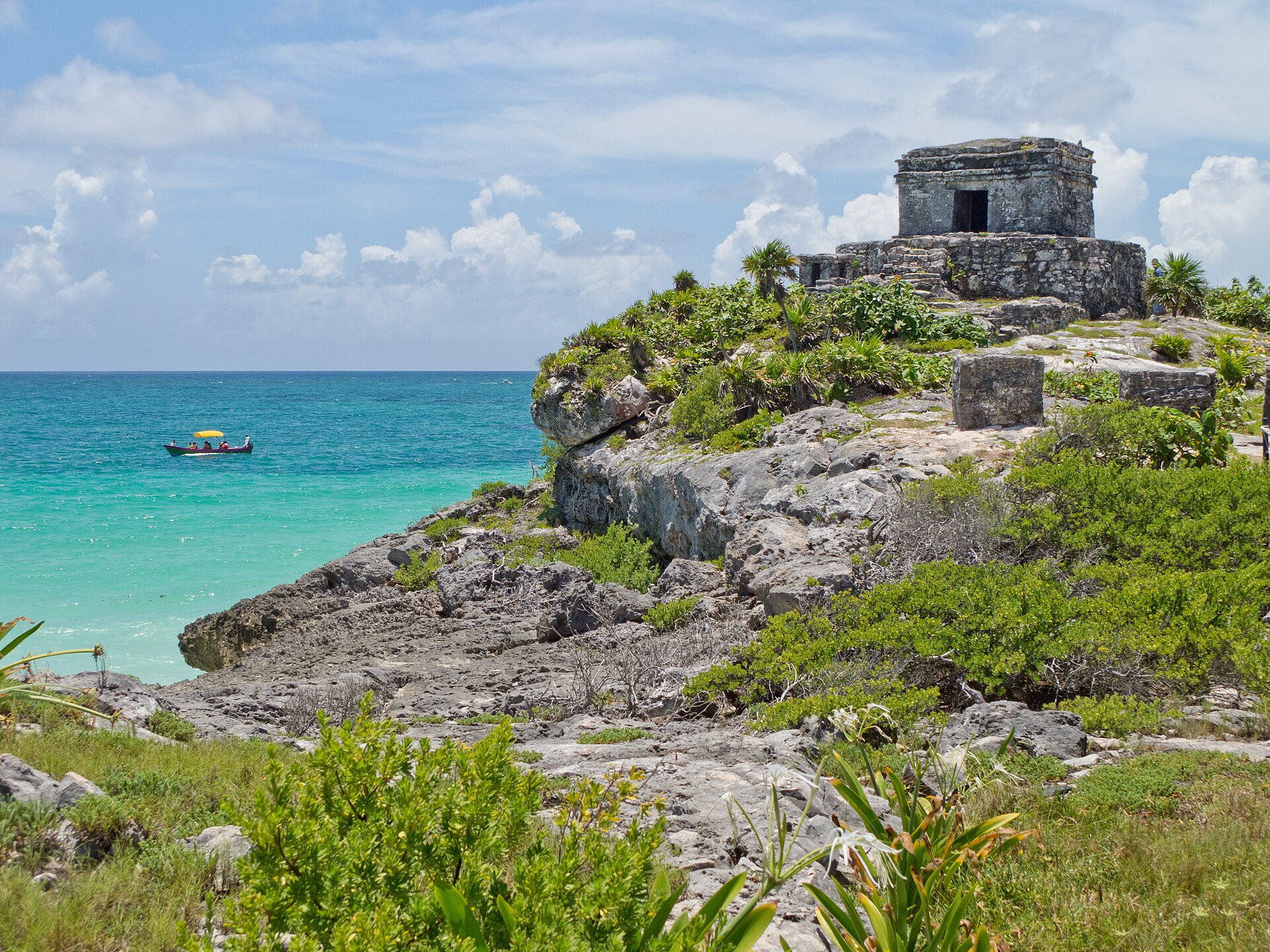
On a low limestone cliff above the turquoise waters of the Caribbean, on the eastern coast of Mexico’s Yucatán Peninsula, stands one of the most beautifully situated ancient sites in all the Americas. This is Tulum, a walled Maya city whose grey stone temples rise against the brilliant blue of the sea, a place where a great civilisation built its last coastal stronghold in a setting of extraordinary beauty.
Tulum was one of the final cities built by the Maya, flourishing in the centuries just before the arrival of the Europeans, and unlike most Maya sites, it was fortified, ringed on three sides by a great defensive wall while the fourth was guarded by the cliff and the sea. It was a thriving port, a hub of trade that connected the Maya world across land and water, and it was still inhabited when the first Spanish ships appeared on the horizon.
In this guide you will explore the whole story of this remarkable walled city: the Maya civilisation that built it, its role as a great trading port, the defensive walls that make it so unusual, its magnificent clifftop temple of El Castillo and other striking buildings, its dramatic first encounter with the Spanish, its decline, and its life today as one of the most visited and best-preserved of all Maya sites. It is a fortress-city where the Maya world met the sea.
A word before you begin: Tulum is a place where two things rarely found together are combined, the ruins of a great ancient civilisation and one of the most beautiful coastal settings on earth. To visit it is to encounter the late Maya world not in the depths of the jungle but on a sunlit clifftop above the turquoise Caribbean. Keeping that unique union of history and beauty in mind will enrich every moment of your exploration.
In This Article
- A City of the Maya
- The Walled City by the Sea
- The City of Walls
- A Great Trading Port
- El Castillo on the Cliff
- Temples of the Frescoes and the Descending God
- Life in the Coastal City
- The Coming of the Spanish
- The Fading of the City
- A Well-Preserved Ruin
- One of Mexico’s Most Visited Sites
- Why Tulum Matters
- Visiting Tulum
A City of the Maya
To understand Tulum, you must first understand the great civilisation that built it. The Maya were one of the most remarkable peoples of the ancient Americas, who over many centuries developed a sophisticated culture in the lands of southern Mexico and Central America, complete with a complex writing system, advanced mathematics and astronomy, monumental architecture, and a rich religious and artistic tradition.
The Maya are perhaps best known for the great cities they built during the height of their civilisation, sites of towering pyramids and elaborate palaces that flourished and then, mysteriously, declined in many areas. But Maya civilisation did not vanish; it continued in various forms, and in the later centuries new centres rose in different regions, including along the Caribbean coast of the Yucatán, where Tulum was built.
Tulum belongs to this later phase of Maya history, one of the cities that flourished in the period shortly before the coming of the Europeans. As such, it offers a window into the Maya world at the very end of its independent existence, a coastal city built and inhabited when the great classical era of the inland cities was already long past, showing the enduring vitality of Maya culture on the eve of the conquest.
The achievements of the Maya in astronomy, mathematics, and writing place them among the most sophisticated civilisations of the ancient world, and their legacy endures among the millions of Maya people who live in the region to this day. Tulum is one expression of this remarkable culture, and to visit it is to encounter the enduring genius of a people whose civilisation, far from being lost, took new forms across the centuries.
It is important to remember that the Maya were never a single unified empire but a civilisation of many cities and kingdoms, sharing a common culture while often competing with one another. Tulum was one such centre, part of the mosaic of the late Maya world, and its particular character, as a walled coastal port, reflects the specific circumstances of its time and place within that rich and varied civilisation.
The Walled City by the Sea
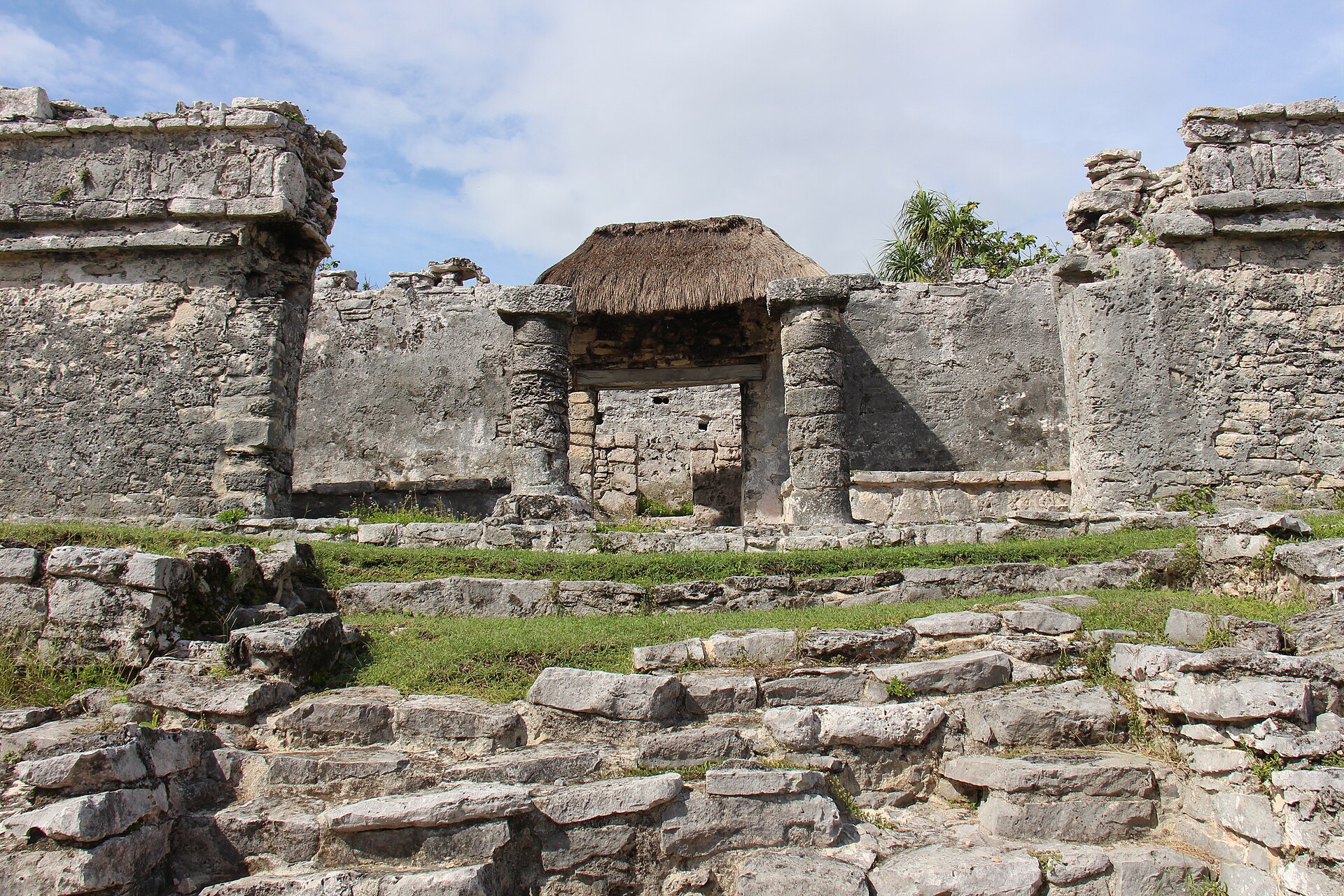
What makes Tulum so unusual among Maya sites is that it was a walled city, one of the relatively few Maya settlements to be enclosed by substantial fortifications. A great wall runs along three sides of the city, while the fourth side is protected by the natural barrier of the cliff dropping to the sea, so that the whole settlement was defended, a rare feature in the Maya world.
This defensive wall is a striking and substantial structure, several metres high and remarkably thick, running for hundreds of metres and pierced by a small number of narrow gateways that controlled access to the city. At the corners of the wall stood watchtowers, from which sentries could keep guard, and the whole arrangement gave Tulum the character of a genuine fortress, unusual for a Maya centre.
The presence of these fortifications tells us something important about the world in which Tulum flourished, a time when defence and control of access mattered, whether against rival groups, raiders, or for the protection of the valuable goods that passed through the port. The walled character of Tulum sets it apart from most Maya sites and gives it a special place among the ancient cities of the region.
The rarity of substantial fortifications in the Maya world makes Tulum’s walls all the more significant, marking it as a place built for a particular and perhaps troubled age. The scale of the wall, its thickness and length, represents a considerable investment of labour, a clear statement of the importance the city’s people placed on defence and on controlling who entered their clifftop stronghold.
The narrow gateways that pierced the wall not only controlled access but forced any entrant to pass single file through a confined space, an arrangement with clear defensive advantages. Together with the corner watchtowers, these features show that the wall was a serious piece of military engineering, designed by people with a genuine concern for the security of their city and its wealth.
The City of Walls
The very name by which we know the city speaks to its most distinctive feature. In the Maya language, the word tulum means wall or fence, or something enclosed, a name that perfectly captures the walled character that sets the site apart from most Maya cities. It is, quite literally, the city of the wall, its identity bound up with the great fortification that rings it.
This name, however, may not have been what the city’s own inhabitants called it, for evidence suggests that in its heyday the settlement bore a different name, one associated with the dawn or the rising sun, fitting for a city facing east toward the sea and the sunrise over the Caribbean. The name Tulum, describing its walls, appears to have come into use in later times.
Whatever it was called in its glory days, the modern name Tulum draws attention to exactly what makes the site so special and so unusual. The great wall is the defining characteristic of the city, the feature that transforms it from an ordinary Maya settlement into a genuine fortress, and it is fitting that the name by which the world knows the site should celebrate this remarkable defensive achievement.
The possible original name associated with the dawn is fitting for a city that faced the rising sun over the Caribbean, and it hints at the religious and cosmological significance that its position may have held for the Maya. The play between the ancient name of the dawn and the later name of the wall captures two essential aspects of the site: its sacred orientation toward the sea and sun, and its formidable defensive character.
A Great Trading Port
Beyond its walls, Tulum’s true importance lay in commerce, for it was a major trading port, one of the key hubs through which goods flowed across the Maya world. Positioned on the coast, it linked the maritime trade routes of the Caribbean with the land routes of the interior, serving as a gateway between sea and shore for the movement of valuable commodities.
An extraordinary range of goods passed through Tulum. The city was a centre for the trade in precious and useful materials such as jade, obsidian, turquoise, copper, textiles, and feathers, some of which came from astonishingly distant sources, testifying to the vast reach of the trading networks in which Tulum was enmeshed. Obsidian, for instance, was brought from hundreds of kilometres away.
This commercial role made Tulum a wealthy and important place, connected to the wider Maya world and beyond. It served as a port for the great inland city with which it was linked, funnelling seaborne goods to the interior and coastal products outward. The wealth generated by this trade is part of what the walls were built to protect, and it explains the city’s prominence in its final centuries.
The obsidian that reached Tulum from sources hundreds of kilometres away is powerful evidence of the extraordinary reach of the trading networks that the city served, networks that moved goods across vast distances by land and sea. Such commerce required organisation, knowledge, and the maintenance of relationships across great stretches of territory, testifying to the sophistication of the late Maya economic world.
The connection of Tulum to the great inland city it served as a port illustrates the sophisticated organisation of the late Maya world, in which coastal and interior centres were linked in networks of exchange and dependency. Tulum was the maritime window of this system, the point at which the goods of the sea and distant coasts entered the Maya heartland and the products of the interior went out to the wider world.
El Castillo on the Cliff
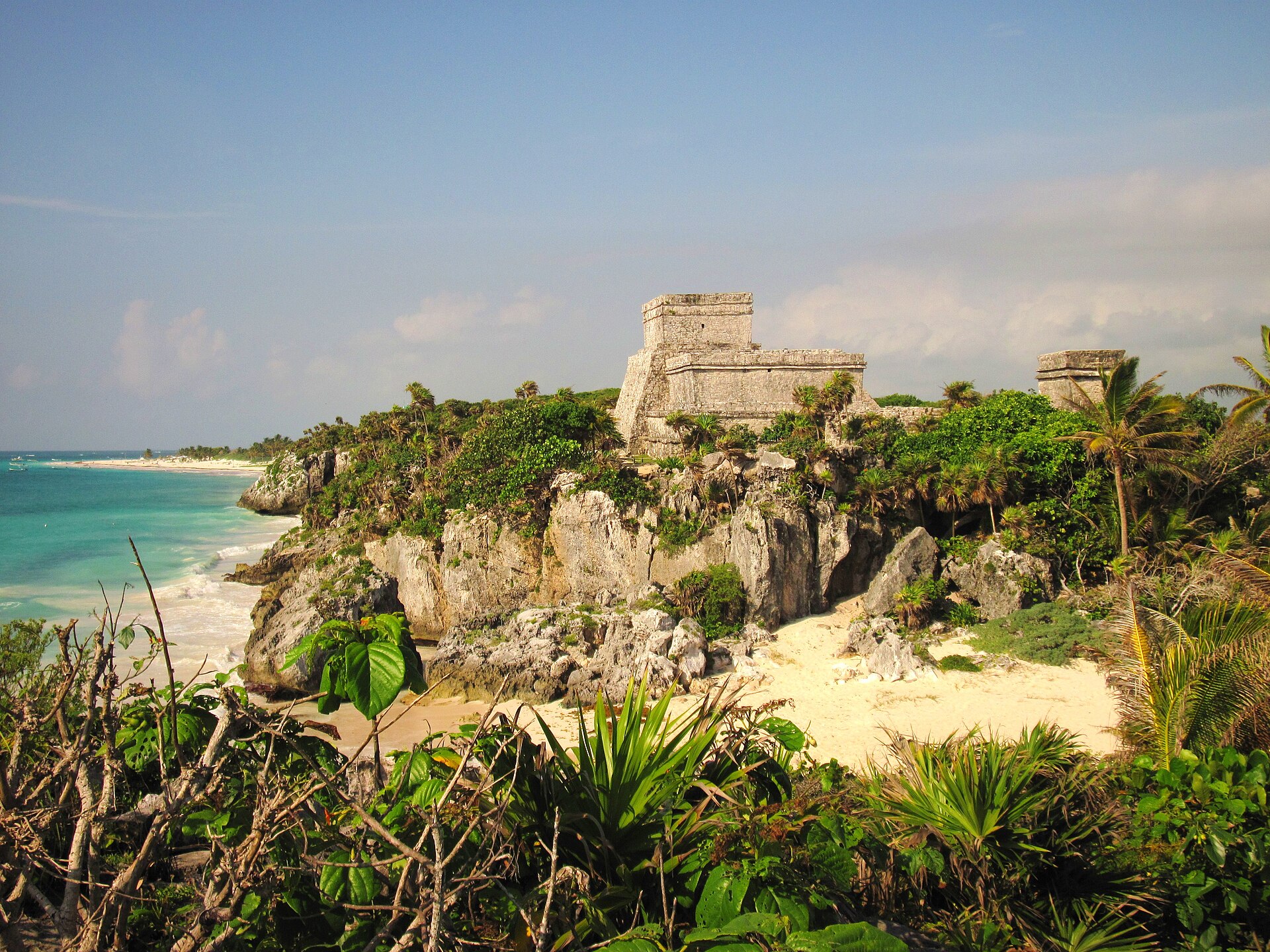
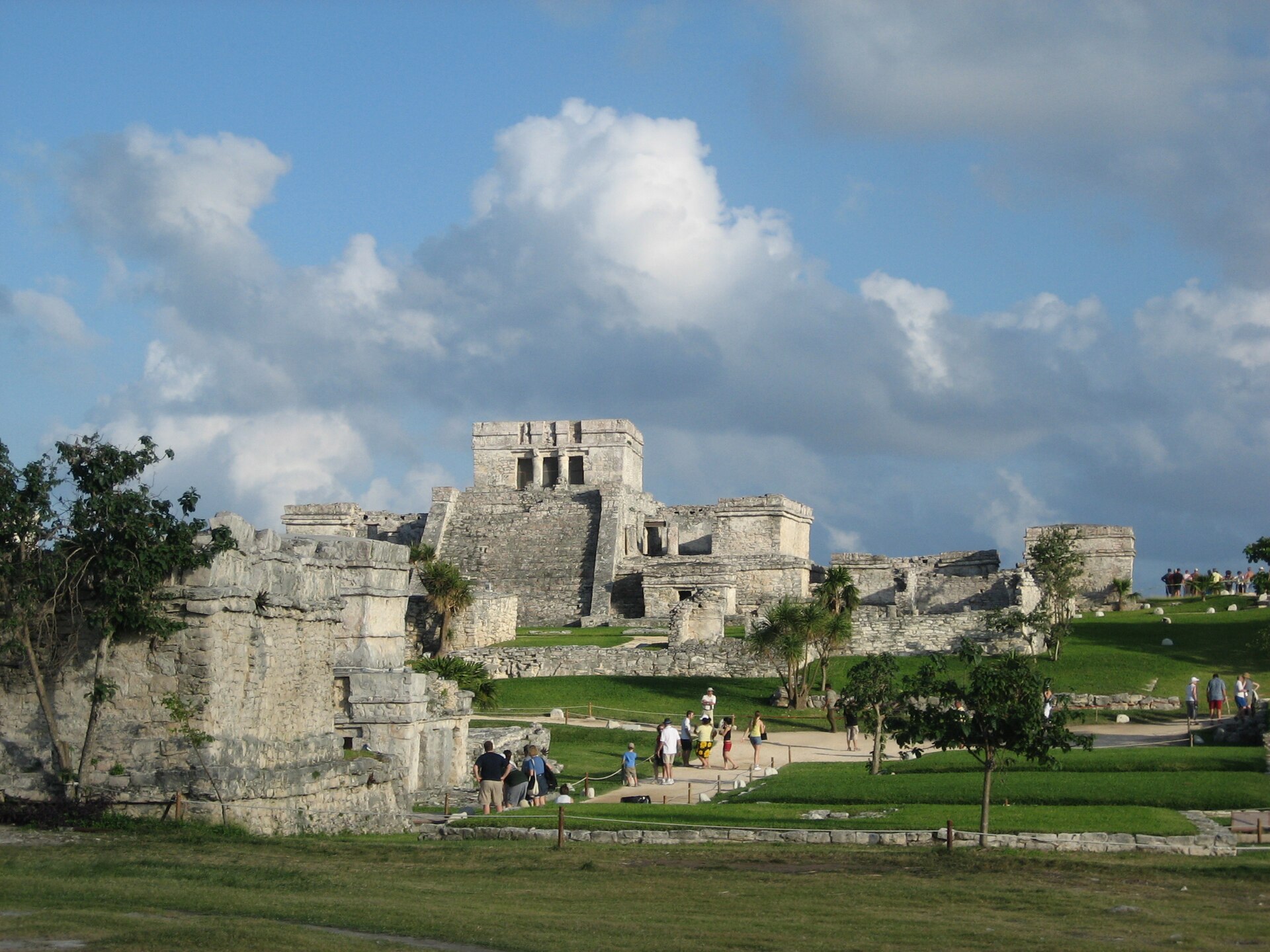
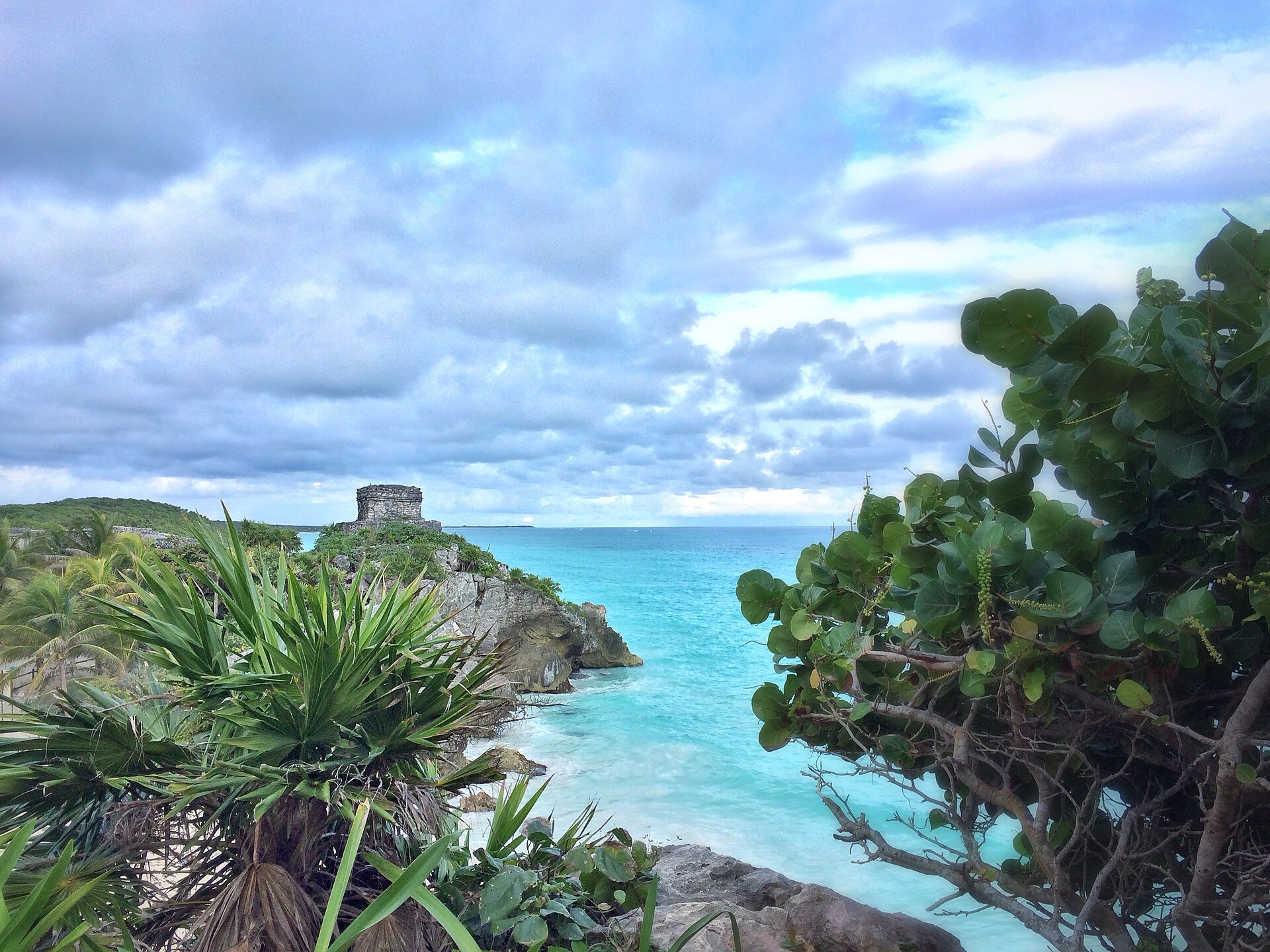
The most iconic building at Tulum, and the one that dominates every view of the site, is the structure known as El Castillo, the Castle. This is the largest and most prominent building in the city, a pyramid-temple standing dramatically on the very edge of the cliff, overlooking the sea, its grey stone bulk silhouetted against the brilliant blue of the Caribbean.
El Castillo was the principal temple of Tulum, a focus of the city’s religious life, and its commanding position at the cliff’s edge gave it both spiritual and practical significance. It is thought that the structure may also have served as a beacon or marker for seafarers, its position helping to guide canoes and traders toward the safe landing places along the otherwise treacherous, reef-fringed coast.
Though modest in scale compared with the towering pyramids of the great classical Maya cities, El Castillo more than makes up for it with its incomparable setting. The image of the temple perched on the cliff above the turquoise sea has become one of the most famous and beloved views in all of Mexico, an emblem of Tulum and of the Maya presence on the Caribbean coast.
The possible use of El Castillo as a navigational beacon reflects the practical maritime concerns of a coastal trading city, for the reef-fringed shore was dangerous and canoes needed guidance to reach safe landings. The idea that the great temple served both the gods and the seafarers captures the way that, in the Maya world, the sacred and the practical were often intertwined in a single monumental structure.
The enduring fame of El Castillo, reproduced in countless photographs and images of Mexico, has made it one of the most recognisable ancient monuments in the Americas. Yet no image quite prepares the visitor for the reality of standing before it, with the sea breeze and the sound of the waves and the brilliant colours of the Caribbean, an experience that fixes the great temple forever in the memory.
Temples of the Frescoes and the Descending God
Beyond El Castillo, Tulum contains several other remarkable buildings that reveal much about the beliefs and knowledge of its people. Among the most important is the Temple of the Frescoes, which preserves painted murals of great interest, offering a precious glimpse into the religious imagery and worldview of the late Maya, and which is thought to have served, among other purposes, as a kind of observatory.
This astronomical function reflects the deep Maya concern with the heavens, for the tracking of the movements of the sun, moon, and planets was central to their religion and their calendar. That a building at Tulum should have served to observe the sun underlines the sophistication of Maya astronomy and its intimate connection with the religious and ceremonial life of the city.
Another striking structure is the Temple of the Descending God, named for the distinctive sculpted figure that adorns it, a deity depicted as if diving or descending head-first from the sky. This enigmatic image, found at Tulum and a few other sites, is one of the most intriguing motifs of late Maya art, its precise meaning still debated, and it adds to the mysterious allure of the ancient city.
The murals of the Temple of the Frescoes are among the most important surviving examples of late Maya painting, preserving images of deities and cosmological scenes that illuminate the beliefs of the people who created them. That such fragile paintings should have survived the centuries is a piece of great fortune, and they are among the most precious treasures of the site, a direct link to the Maya religious imagination.
The recurring image of the descending or diving god at Tulum and a few related sites has fascinated scholars and visitors alike, its meaning bound up with Maya beliefs about the heavens, the gods, and perhaps the setting sun or a particular deity. Whatever its precise significance, the motif is a vivid reminder of the rich and complex religious imagination of the people who built and worshipped in the city.
Life in the Coastal City
Tulum was not only a place of temples and trade but a living city, home to a population that carried on the daily business of life within and around its walls. The site contains the remains of various buildings beyond the great temples, including structures that served as residences and other functions, giving a sense of the community that once thronged the clifftop city.
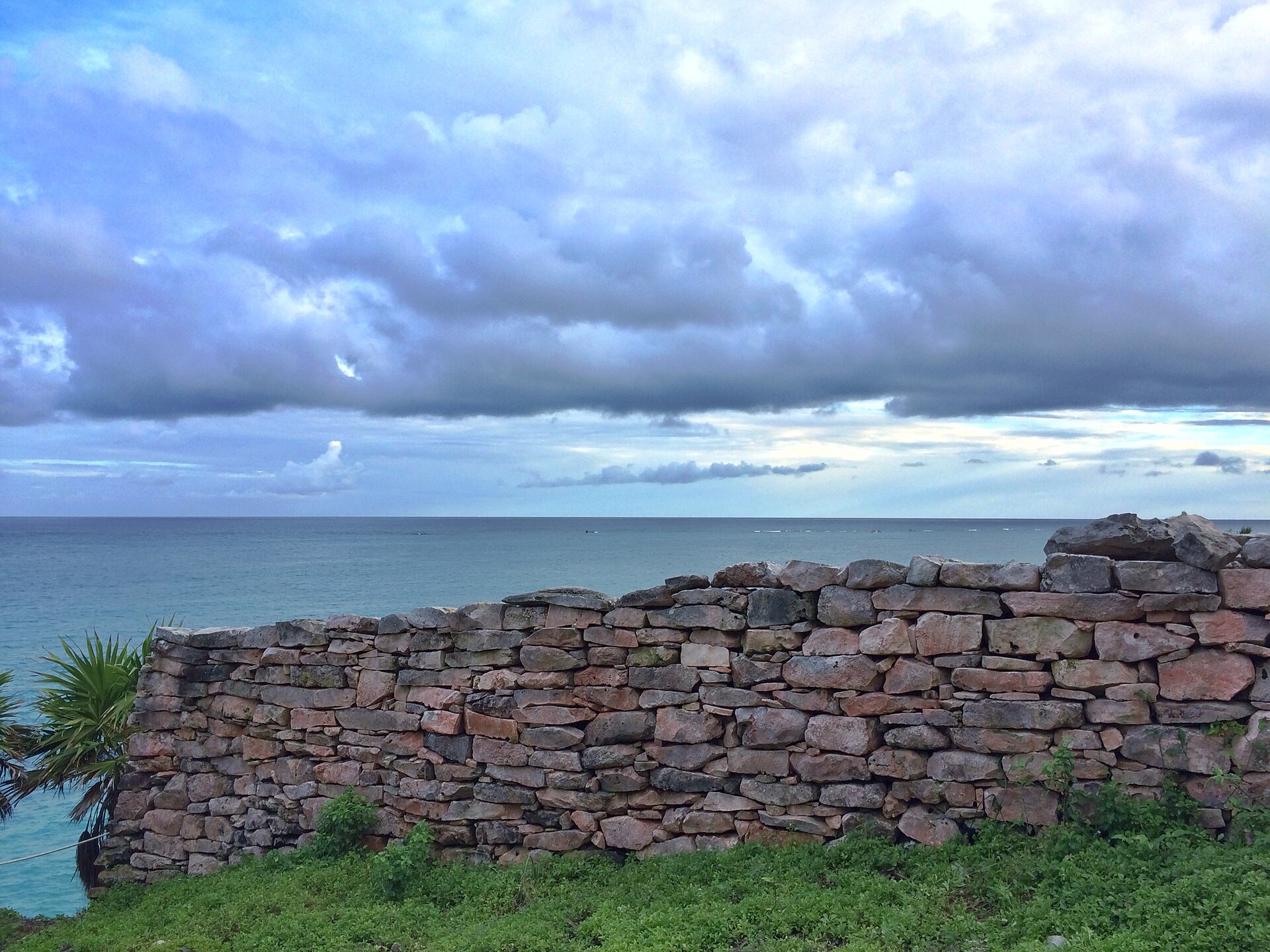
The people of Tulum lived by trade, fishing, and the produce of the surrounding land, sustained by the rich resources of the coast and the sea. As a port, the city would have been a busy place, with the coming and going of traders and goods, the loading and unloading of canoes, and the bustle of a commercial centre, all set against the backdrop of the temples and the shining sea.
Religion permeated the life of the city, as it did throughout the Maya world, with the temples serving as the focus of ceremonies and observances that structured the calendar and connected the people to their gods. To imagine Tulum in its heyday is to picture a vibrant coastal community, its life shaped by commerce, the sea, and the rhythms of Maya religious tradition, thriving in one of the loveliest settings imaginable.
The everyday reality of life at Tulum, with its fishing, trade, and craft, its households and its ceremonies, reminds us that the great temples were embedded in a living community, not isolated monuments. Recovering this dimension of ordinary life is part of what archaeology at the site seeks to do, filling out the picture of Tulum as a real, inhabited city rather than merely a collection of impressive ruins.
The rich resources of the Caribbean coast, from fish and shellfish to salt and the products of the sea, would have provided a comfortable living for the people of Tulum, complementing the wealth that flowed through the port. This abundance, combined with the city’s commercial importance, made Tulum a place of relative prosperity in its heyday, a thriving community set in one of the loveliest corners of the Maya world.
The Coming of the Spanish
Tulum has the poignant distinction of being one of the Maya cities that was still alive and thriving when the first Europeans arrived, and it played a part in the very first Spanish encounters with the mainland of the Americas. In the years before the great conquest, Spanish expeditions sailing along the coast of the Yucatán caught sight of the city from the sea.
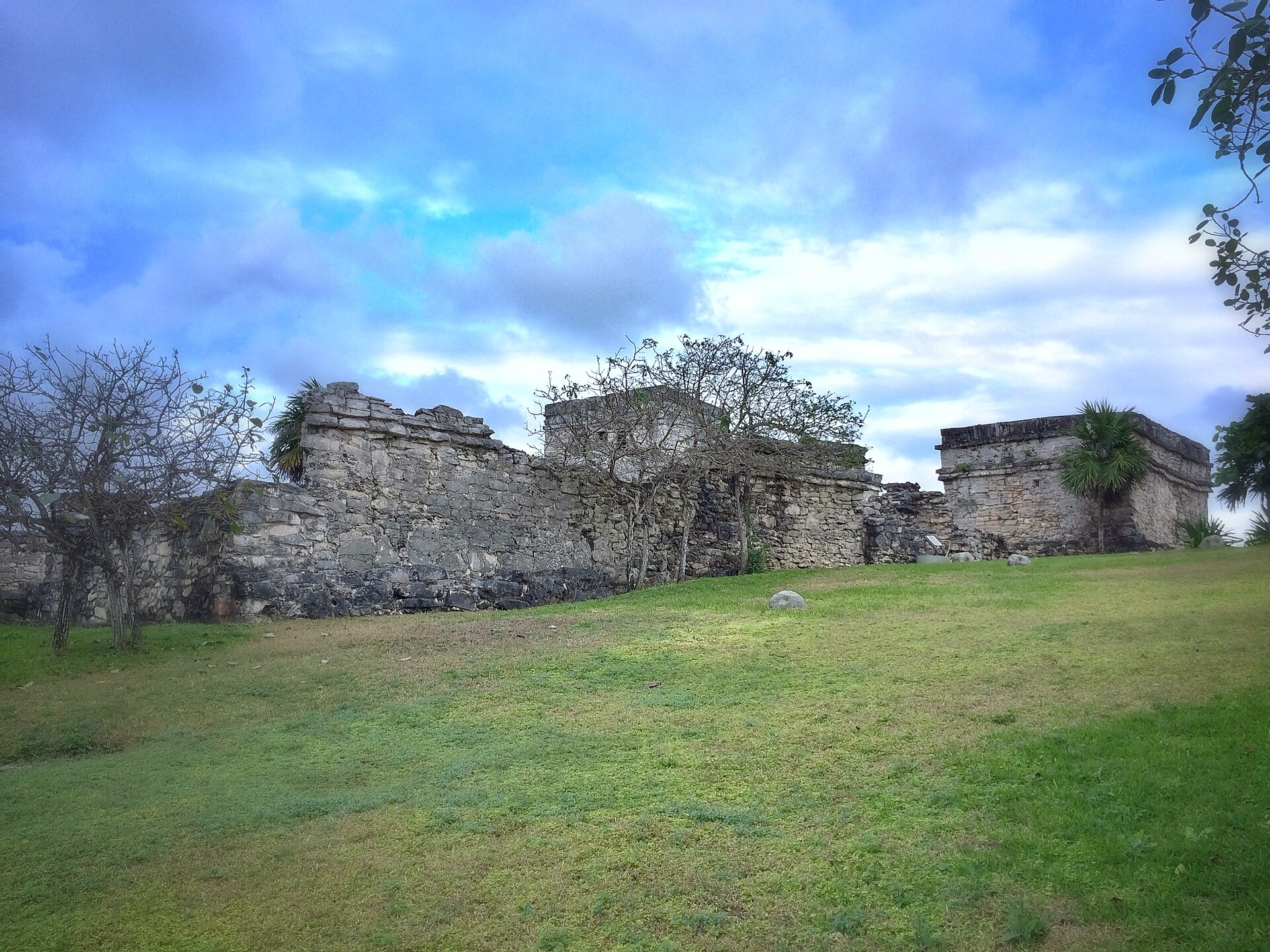
To the Spanish sailors, the walled city on its cliff, with its temples rising against the sky, made a striking impression, and accounts of these early sightings describe the settlement with wonder. Tulum was, for these first European observers, a vision of a flourishing and unfamiliar civilisation, glimpsed from the decks of their ships as they probed the edges of a new and unknown land.
These first contacts were the prelude to the catastrophe that would soon engulf the Maya world, as the Spanish conquest and, above all, the devastating diseases they brought swept through the region. Tulum thus stands at the very hinge of history, a living Maya city at the moment of the fateful encounter between the Old World and the New, glimpsed in its final flourishing before the storm.
The Spanish accounts of first sighting Tulum from the sea, comparing the walled city to towns of their own homeland, offer a rare and precious record of a Maya city seen at the very moment of contact, before the catastrophe of conquest. These descriptions capture the impression of a thriving, ordered settlement, and they lend the ruins an added poignancy as the physical remains of a city glimpsed alive by European eyes.
The timing of the first Spanish sightings of Tulum, in the very years before the great campaigns of conquest began, gives the site a unique place in the history of the encounter between Europe and the Americas. Here was a Maya city not yet touched by conquest, seen and described by Europeans while it still lived, a rare and precious moment captured just before the old world of the Maya was overwhelmed.
The Fading of the City
Like the rest of the Maya world, Tulum could not survive the impact of the European arrival. The Spanish conquest brought war, disruption, and, most devastatingly, epidemic diseases against which the native peoples had no immunity, and these afflictions caused a catastrophic collapse of population across the region in the decades following contact.
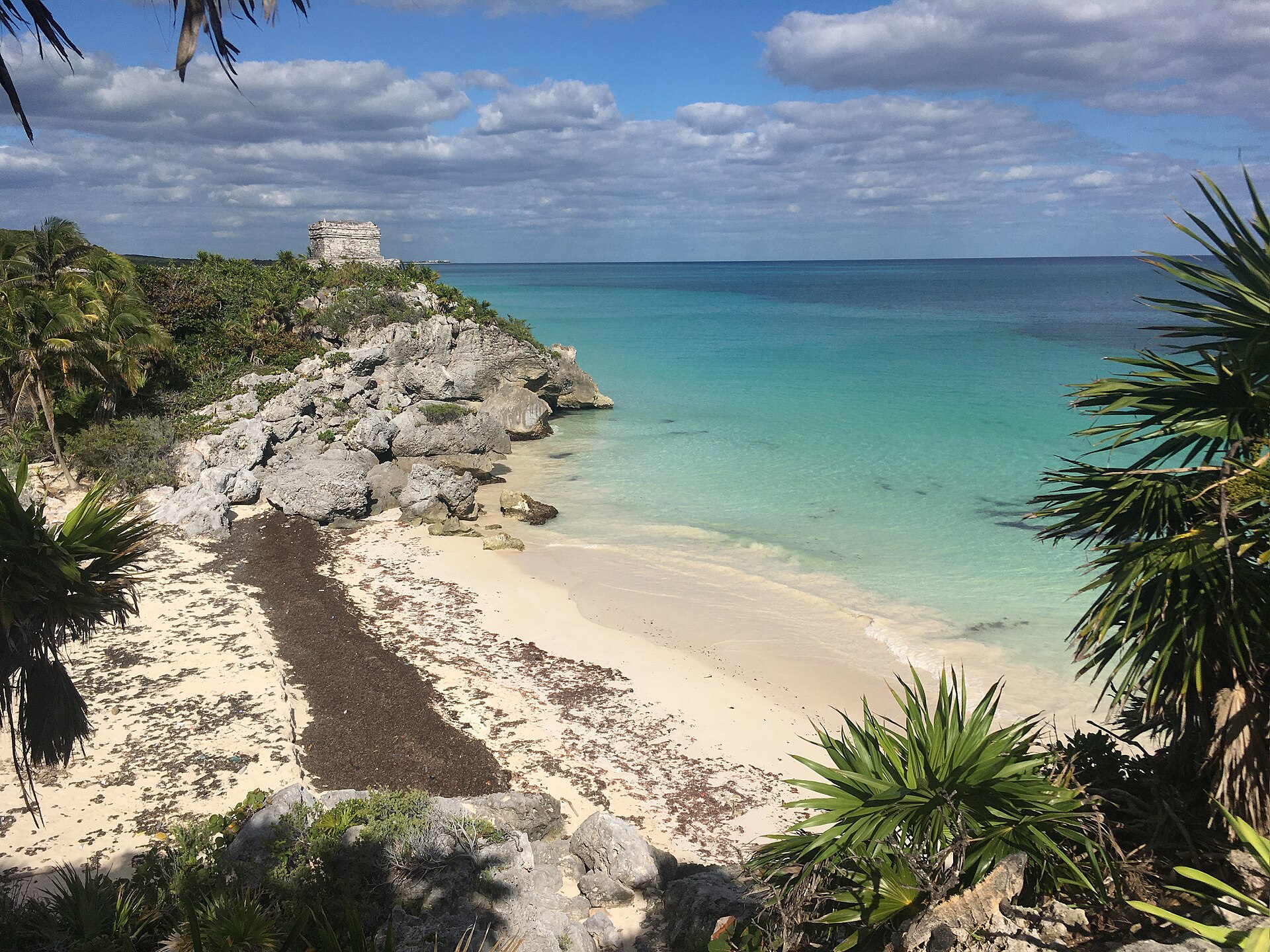
Under these pressures, Tulum, like many other settlements, was gradually abandoned. Within a few generations of the first Spanish sightings, the once-thriving port fell silent, its people gone, its temples left empty on the cliff above the sea. The great trading networks that had sustained it were shattered, and the walled city that had flourished for centuries slipped into ruin and desolation.
The abandonment of Tulum was part of the wider tragedy that befell the Maya and the other peoples of the Americas in the wake of the conquest, a demographic and cultural catastrophe of staggering scale. The silent ruins on the cliff are a memorial to that lost world, a place where a great civilisation came to the end of its independent existence, leaving behind only the beautiful, empty shell of its coastal stronghold.
The scale of the demographic collapse that followed the conquest is difficult to comprehend, with populations across the Americas falling catastrophically in the space of a few generations. The abandonment of Tulum was one small part of this vast tragedy, and the silent city on the cliff stands as a memorial not only to itself but to the countless communities that were swept away in the wake of the European arrival.
A Well-Preserved Ruin
For centuries after its abandonment, Tulum stood empty and largely forgotten by the wider world, its buildings weathering on the cliff but, thanks to their sturdy stone construction and the relatively dry coastal climate, surviving in remarkable condition. It came gradually to the attention of explorers and scholars, who documented and studied the site over the following generations.
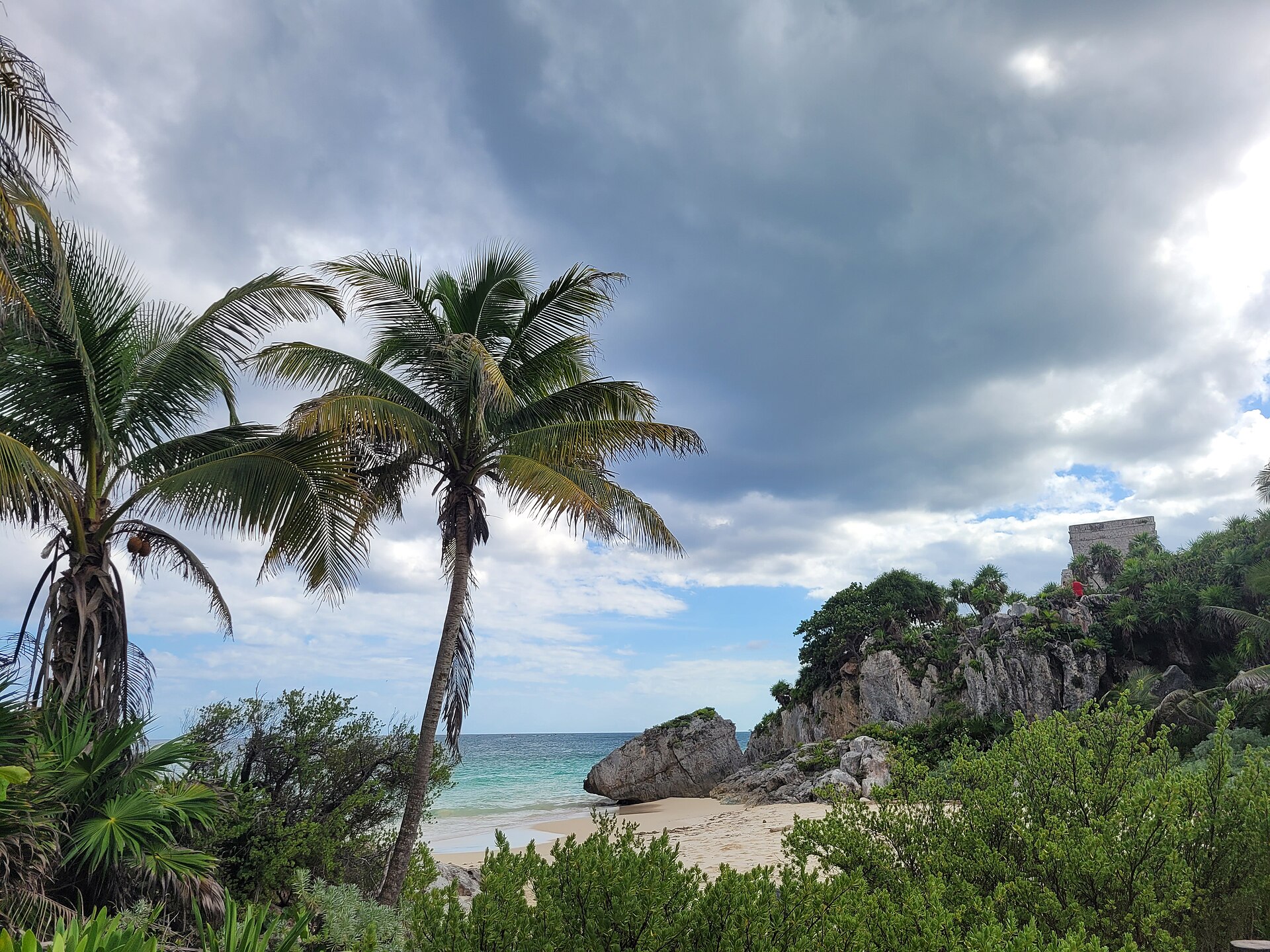
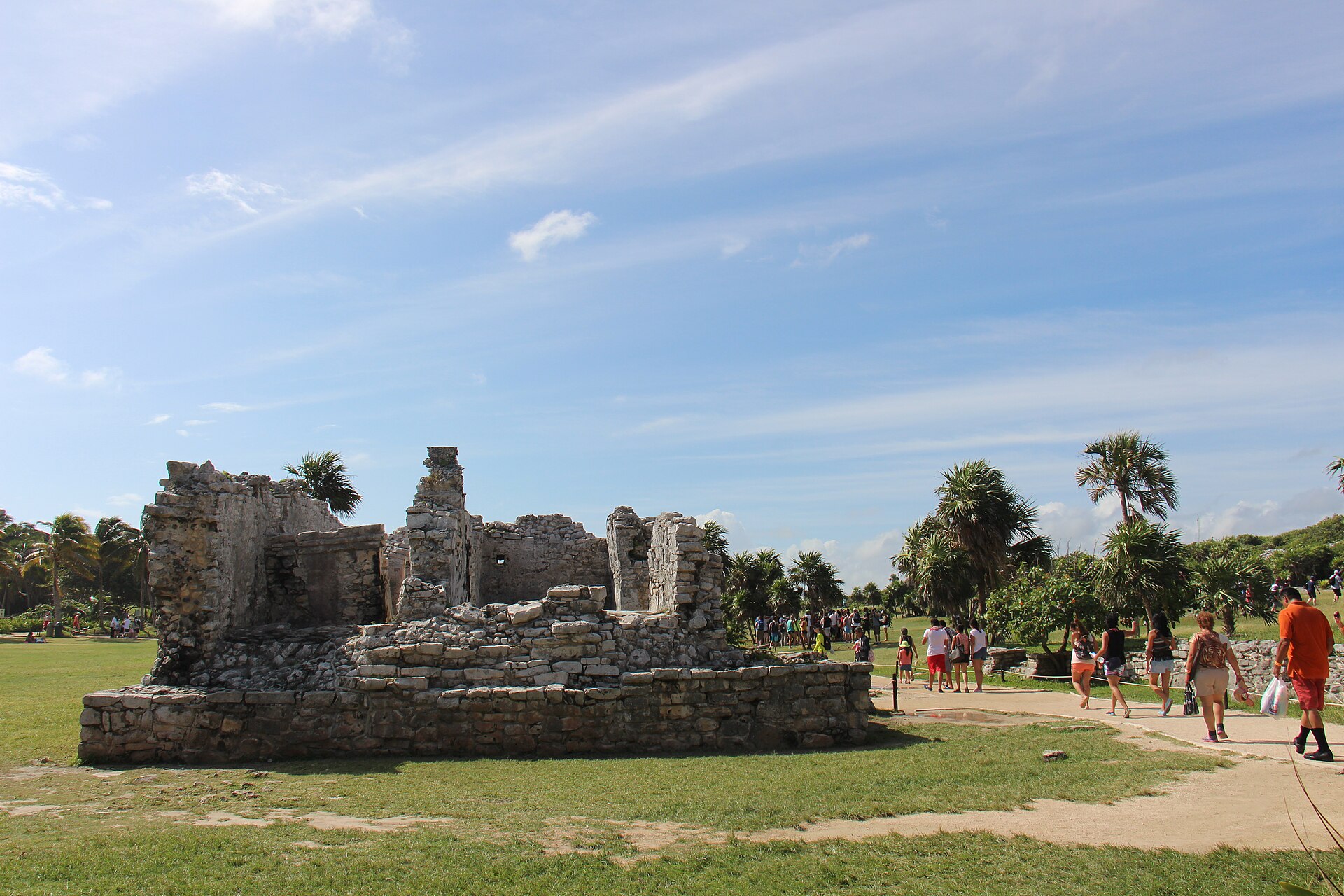
Today Tulum is recognised as one of the best-preserved of all the Maya coastal sites, its walls, temples, and other structures surviving in a state that allows the visitor to appreciate the layout and character of the ancient city with unusual clarity. This good preservation, combined with the incomparable setting, is a large part of what makes Tulum so rewarding and so popular a place to visit.
The site is protected and maintained as an archaeological zone, cared for so that its ancient structures endure and can be experienced by the great numbers of visitors who come each year. The preservation of Tulum ensures that this precious survivor of the late Maya world, and of the moment of first contact with Europe, will continue to tell its story for generations to come.
The good preservation of Tulum owes much to the durability of its stone construction and to the particular conditions of its coastal setting, which have been kinder to the ruins than the encroaching jungle has been to many inland Maya sites. This relative completeness allows the visitor to grasp the plan and character of the ancient city with a clarity that is rare among the ruins of the Maya world.
The clarity with which Tulum’s plan can be read, from its wall and gateways to its temples and residential structures, makes it an especially valuable site for understanding the layout of a late Maya coastal town. Visitors and scholars alike benefit from this legibility, which allows the ancient city to be experienced almost as a coherent whole rather than as a scatter of disconnected fragments.
One of Mexico’s Most Visited Sites
In modern times, Tulum has become one of the most famous and most visited archaeological sites in all of Mexico, drawing enormous numbers of visitors each year to its clifftop ruins. Its fame owes much to its extraordinary setting, for few ancient sites anywhere combine such evocative ruins with such a spectacular natural backdrop of sea and shore.
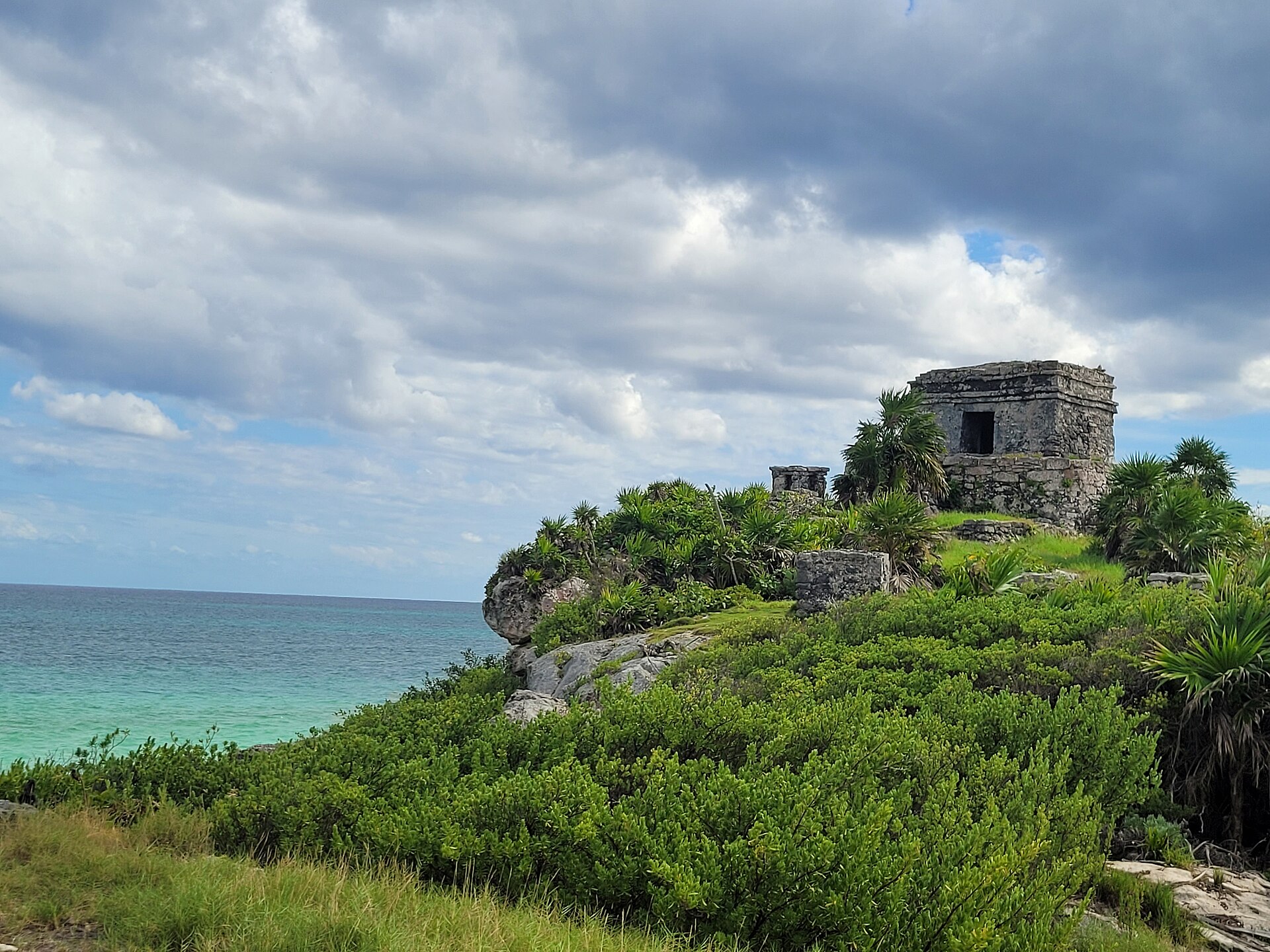
The site’s popularity has been boosted by its location in one of Mexico’s premier tourist regions, along the stretch of Caribbean coast famous for its beaches and resorts. Visitors come to marvel at the ancient city and its temples, and many descend to the beautiful beach below the cliff, where they can swim in the turquoise sea directly beneath the ancient walls, a unique and unforgettable experience.
This great popularity brings both benefits and challenges, providing the resources and attention that support the preservation of the site, but also placing pressure on the fragile ancient structures and their setting. Managing the balance between welcoming visitors and protecting the ruins is an ongoing task, essential to ensuring that Tulum can be enjoyed without being loved to destruction.
The sheer number of visitors who come to Tulum each year testifies to its extraordinary appeal, but it also underscores the importance of careful management to protect the fragile site. Balancing the desire to share this wonder with the world against the need to preserve it for the future is a delicate and continuing challenge, one faced by many of the great heritage sites of the modern age.
For many travellers, a visit to Tulum is a highlight of a journey to Mexico, combining the wonder of an ancient civilisation with the pleasures of the Caribbean coast. The site’s accessibility and its spectacular setting have made it an icon of Mexican tourism, and its image, the temple on the cliff above the turquoise sea, has come to symbolise the ancient heritage of the whole region.
Why Tulum Matters
Tulum holds a special place among the ancient sites of the Americas for several reasons. As one of the last cities built and inhabited by the Maya, it offers a precious window into the final phase of that great civilisation, a coastal counterpart to the more famous inland cities of the classical era, and evidence of the enduring vitality of Maya culture on the eve of the conquest.
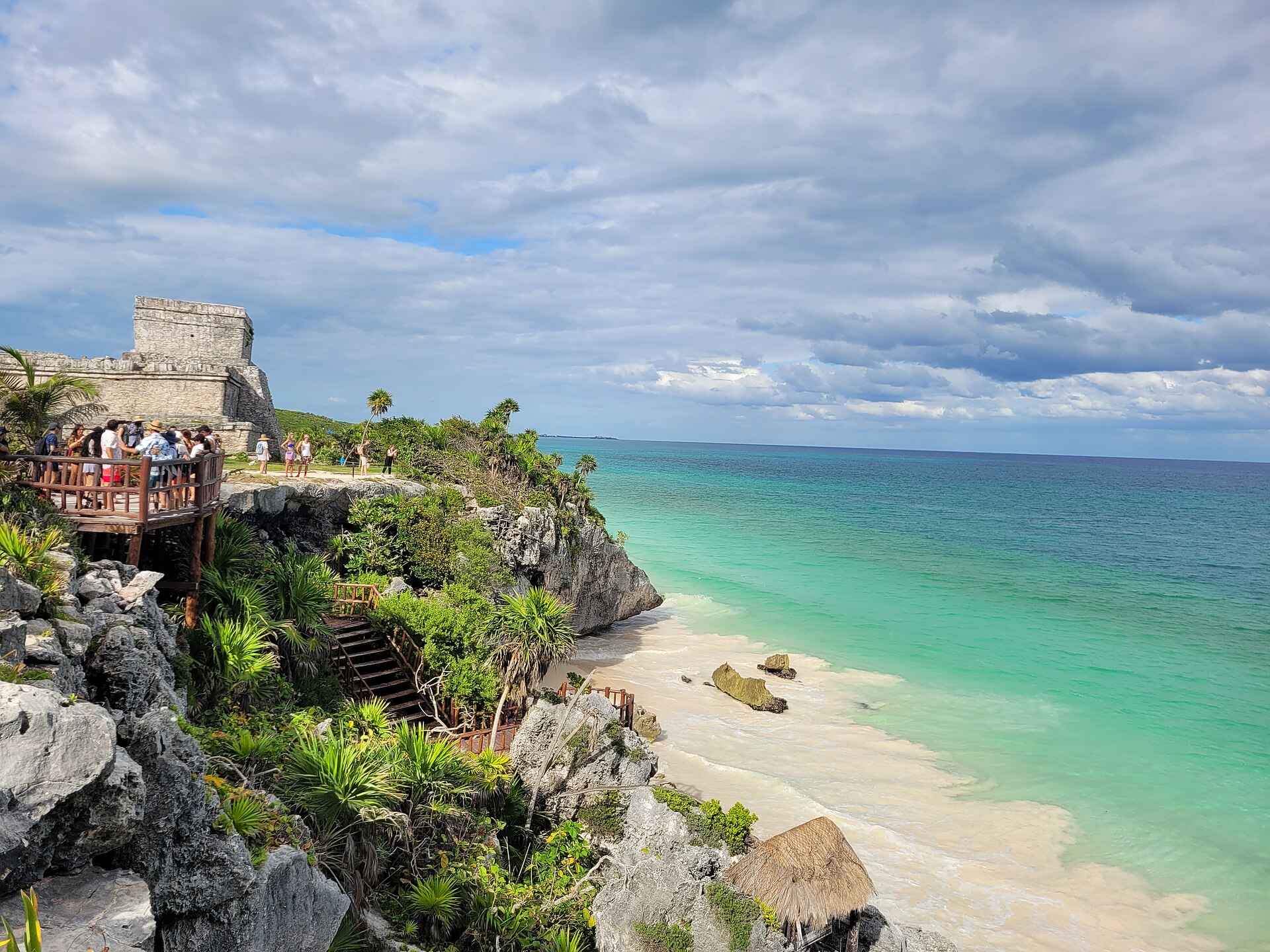
Its walled, fortified character sets it apart from most Maya sites and speaks to the concerns of its age, while its role as a great trading port illuminates the vast networks of commerce that bound the ancient Americas together. And its dramatic first encounter with the Spanish gives it a poignant significance as a living Maya city at the very moment of the fateful meeting of two worlds.
For all these reasons, and for the sheer beauty of its setting, Tulum is one of the most rewarding of all ancient sites to visit and to contemplate. To stand within its walls, with the temples on the cliff and the turquoise sea beyond, is to encounter the late Maya world at its most vivid and to feel the presence of a civilisation that flourished here, on this beautiful coast, until the coming of the Europeans.
The convergence at Tulum of so many strands of significance, the late Maya achievement, the rare fortifications, the great trade, and the first contact with Europe, makes it a site of exceptional richness, rewarding both the casual visitor and the serious student of the past. Few places offer so much history and meaning in so beautiful and accessible a form.
For the Maya people of today, sites like Tulum are not merely archaeological curiosities but part of a living heritage, tangible links to the achievements of their ancestors. Approaching the ruins with this in mind adds a further dimension to a visit, reminding us that the civilisation that built the clifftop city did not vanish but endures, its descendants still present in the lands where its cities once flourished.
Visiting Tulum
Tulum lies on the Caribbean coast of the Yucatán Peninsula, in one of Mexico’s most popular tourist regions, and it is easily reached and enormously rewarding to visit. The archaeological site is one of the great attractions of the area, and its combination of ancient ruins and stunning coastal scenery makes it a destination unlike any other in the country.
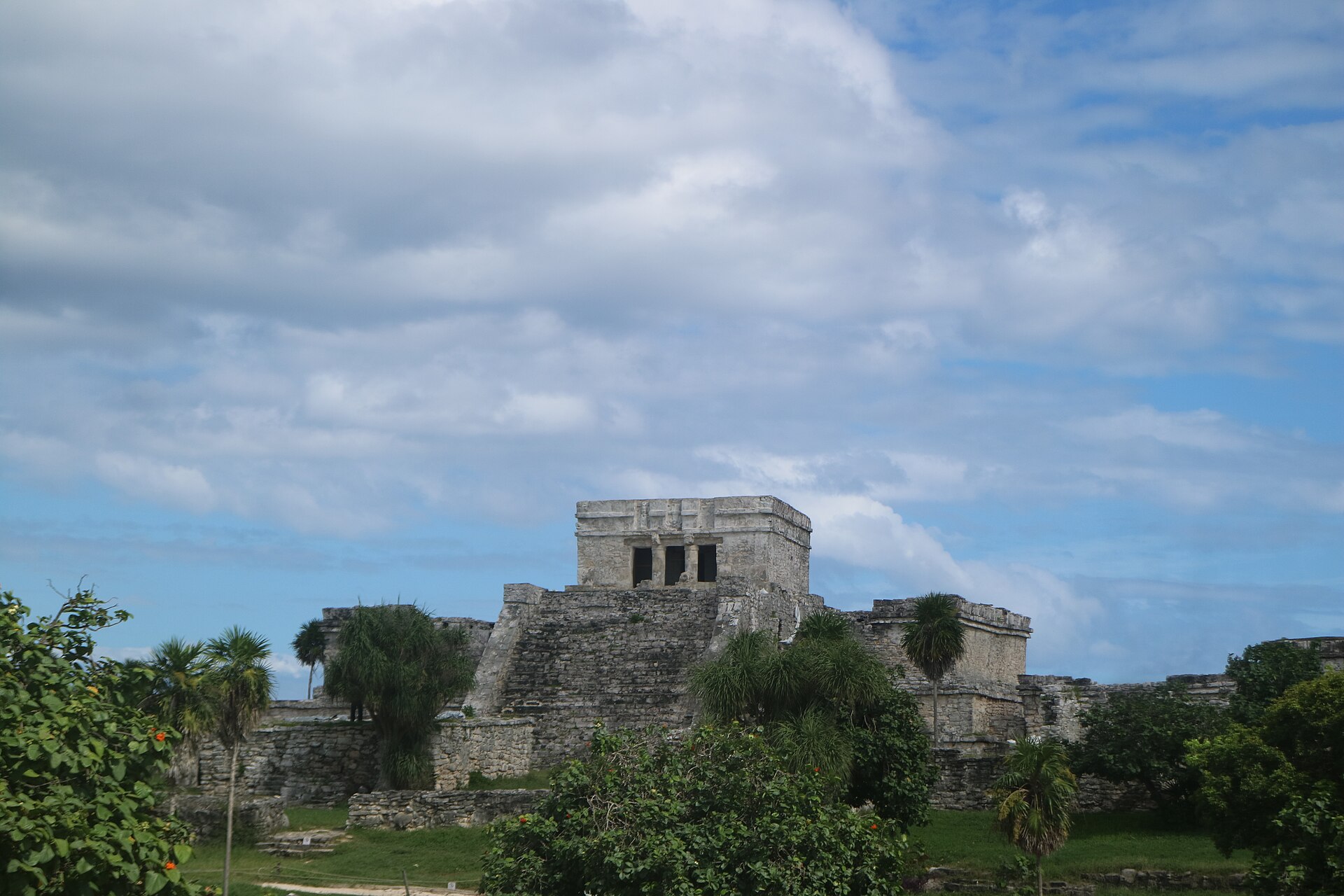
On a visit you can walk through the gateways in the ancient wall, explore the temples and buildings of the city, marvel at El Castillo on its cliff, and take in the breathtaking views over the turquoise sea. Below the ruins lies a beautiful beach, where visitors can cool off in the Caribbean beneath the ancient city, adding a memorable dimension to the experience of the site.
View 20.2147, -87.4292 on Google Maps
Come early to avoid the heat and the largest crowds, bring sun protection and water, and be prepared for the tropical climate. Combine your visit with the many other attractions of the region, from other Maya sites to the beaches and natural wonders of the coast. Tulum offers an unforgettable encounter with the late Maya world in one of the most beautiful settings of any ancient site on earth.
Many visitors find that the most magical moments at Tulum come when they pause to take in the view of El Castillo on its cliff above the shining sea, an image that captures the whole spirit of the place. In that vista, the achievements of the Maya, the beauty of the Caribbean coast, and the poignancy of a vanished world all come together in a single unforgettable scene.
The combination of a great archaeological site with a swimmable Caribbean beach directly below is almost unique, and it allows a visit to Tulum to blend the pleasures of history and nature in a single unforgettable outing. Few other ancient sites in the world offer the chance to explore the ruins of a lost civilisation and then cool off in a turquoise sea beneath its very walls.
Castles Nearby
You May Like
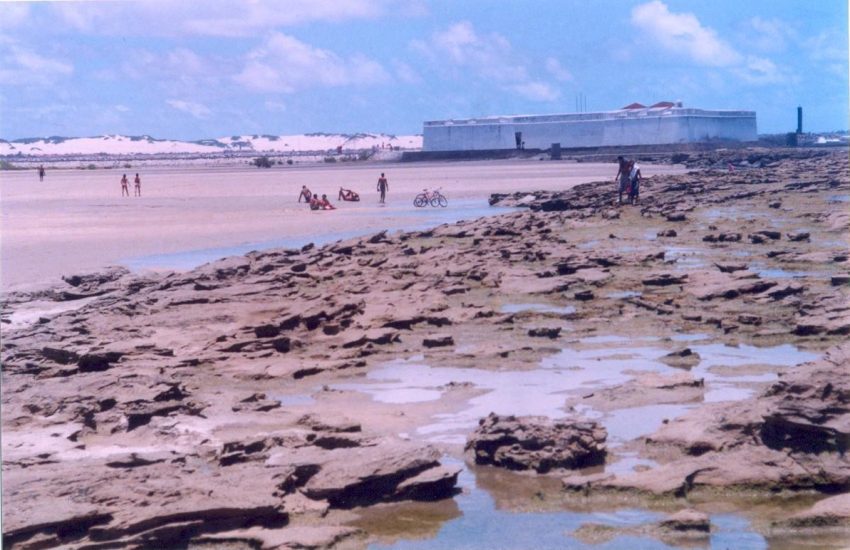
Forte dos Reis Magos: The Star Fort That Founded a Brazilian City