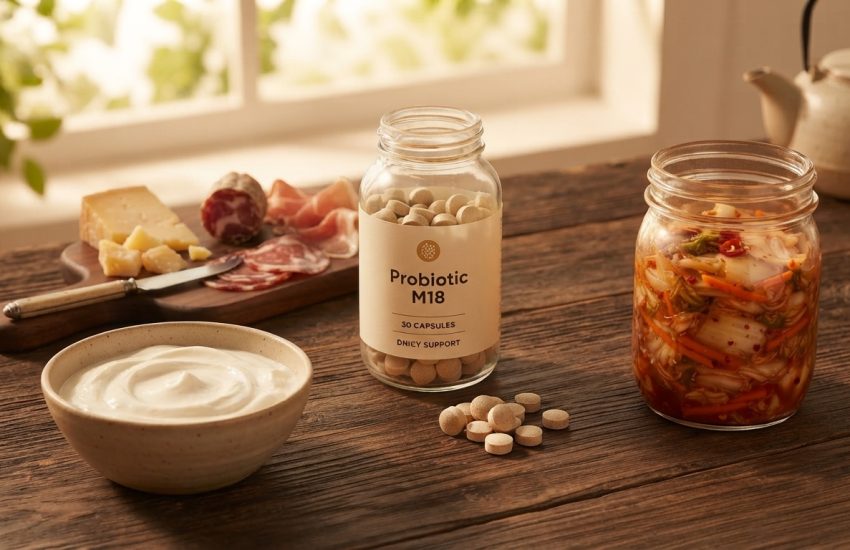
Streptococcus salivarius is a natural member of the human oral microbiome. It is commonly found in saliva, on the tongue, and around the upper throat, where it lives alongside many other microorganisms. In healthy people, it is generally considered part of the normal oral bacterial community rather than a harmful organism. Certain strains of S. salivarius, especially K12, M18, and 24SMB, have also been studied as oral probiotics.
What makes Streptococcus salivarius interesting is that it is not simply a bacterium people take as a digestive supplement. It naturally belongs to the mouth and upper throat, and selected probiotic strains are intended to interact with the existing oral microbiome. Researchers have studied these strains in areas such as oral health, throat health, bad breath, and the balance between different microorganisms in the mouth.
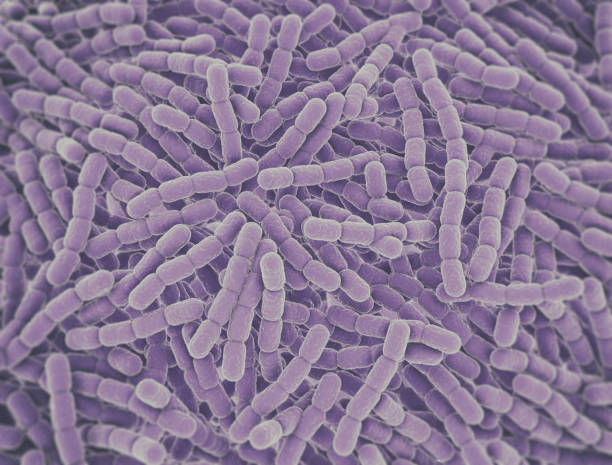
Contents
- What Is Streptococcus salivarius and Where Is It Found?
- Which Foods Naturally Contain It?
- How Does Streptococcus salivarius Enter the Body?
- What Helps It Grow and Survive?
- What Does It Do in the Body?
- Potential Health Benefits
- Can It Cause Problems?
- Who Should Be Careful?
- How Can We Support It Naturally?
- What Does the Science Say?
What Is Streptococcus salivarius and Where Is It Found?
Streptococcus salivarius is a bacterium that normally lives in the human mouth. It is commonly found in saliva, on the surface of the tongue, and around the throat. It is one of the microorganisms that can become established in the oral environment early in life.
The important point is that S. salivarius is a species containing different strains, and those strains do not necessarily behave in exactly the same way. K12 and M18 are among the best-known strains studied for probiotic use, while 24SMB has also been investigated in oral and respiratory research.
In other words, it is more accurate to talk about the properties of a particular S. salivarius strain than to assume that every member of the species has the same probiotic effect.
Which Foods Naturally Contain It?
Streptococcus salivarius is different from many of the bacteria commonly associated with fermented foods. It is primarily a human-associated oral microorganism rather than a standard food-borne probiotic species.
Some fermented dairy foods contain Streptococcus thermophilus, but S. thermophilus and S. salivarius are different species. Yogurt therefore should not be considered a reliable natural source of S. salivarius K12 or M18.
When a specific S. salivarius strain is used as a probiotic, it is normally delivered in products designed for oral use, such as dissolving tablets or lozenges. These formats allow the microorganism to spend time in the mouth rather than simply being swallowed immediately.
How Does Streptococcus salivarius Enter the Body?
The human body does not manufacture Streptococcus salivarius like it produces a hormone or vitamin. It is a living microorganism that becomes part of the oral microbiome through natural exposure and colonization.
Many people acquire S. salivarius naturally during childhood. Once established, it can become a regular part of the oral microbial community.
When a probiotic strain such as K12 or M18 is deliberately introduced, it is generally placed directly into the mouth. Lozenges and dissolving tablets are particularly suitable because they allow the bacteria to mix with saliva and contact the tongue and other oral surfaces.
What Helps It Grow and Survive?
S. salivarius is adapted to the conditions of the human mouth. Saliva provides water, minerals, proteins, and other substances that microorganisms can use, while the tongue and other oral surfaces provide places where bacteria can attach and interact with the surrounding microbiome.
A normal supply of saliva, suitable temperature, adequate moisture, and accessible nutrients all contribute to a favorable environment. At the same time, S. salivarius has to compete with many other microorganisms for food and space.
A balanced oral ecosystem is more important than trying to make one particular species grow as much as possible. A probiotic is generally intended to support a useful microbial interaction rather than produce unlimited bacterial growth.
Some S. salivarius strains also produce bacteriocin-like substances that can inhibit certain competing microorganisms. This property is one of the reasons the species has attracted interest as an oral probiotic.
What Does It Do in the Body?
Inside the mouth, S. salivarius is part of a large and constantly changing microbial ecosystem. It competes with other microorganisms for nutrients and attachment sites and can influence the local environment through the compounds it produces.
Some strains produce antimicrobial substances. The K12 strain, for example, is known for producing bacteriocin-like compounds called salivaricins, which have been studied for activity against selected microorganisms.
This does not mean that S. salivarius acts like a broad-spectrum antibiotic. Its effects are much more specific and depend on the strain, the surrounding microbiome, and the conditions in the mouth.
Potential Health Benefits
The main reason researchers are interested in S. salivarius is its potential role in oral and upper respiratory health. K12 and M18 are the most frequently discussed probiotic strains, while 24SMB has also been investigated.
Oral Microbial Balance
Some studies have investigated whether K12 and M18 can influence the balance of microorganisms in the mouth. The results vary depending on the strain, population, duration of use, and specific outcome being measured.
Throat and Upper Respiratory Health
K12 has received particular attention in studies involving recurrent throat and upper respiratory problems, including research in children. Clinical studies have explored whether regular use can influence the frequency or severity of certain throat-related conditions.
Dental and Oral Health
M18 has been studied in relation to oral hygiene and dental plaque, while K12 and M18 have also been evaluated for interactions with microorganisms such as Streptococcus mutans.
These probiotic strains should be considered a possible supporting approach rather than a replacement for brushing, fluoride, professional dental care, or appropriate treatment.
Bad Breath
S. salivarius K12 has also been investigated for halitosis. The interest comes partly from the ability of some strains to produce antimicrobial compounds that may affect microorganisms associated with unpleasant oral odors.
Can It Cause Problems?
Available research generally suggests a favorable safety profile for commonly studied probiotic strains such as K12 and M18 in healthy people.
However, the word “probiotic” should not be interpreted as “completely risk-free.” Streptococci are a large and diverse group, and individual strains can behave differently. People with serious underlying medical conditions may have a different risk profile from healthy individuals.
Some people may also experience temporary digestive or oral discomfort when starting a new probiotic product. Persistent or severe symptoms should be evaluated rather than automatically attributed to the probiotic.
Who Should Be Careful?
Healthy adults and children are the main populations in which oral S. salivarius probiotics have been studied. More caution is appropriate for people with severely weakened immune systems, serious chronic illnesses, complex medical conditions, or other factors that may increase the risks associated with live microorganisms.
People who are seriously ill or hospitalized should not assume that a probiotic product designed for healthy consumers is automatically appropriate for them.
For children, the product and dose should match the age group for which the particular strain has been studied or recommended.
How Can We Support It Naturally?
There is no single food that guarantees the permanent growth of a particular S. salivarius strain. Because this microorganism is primarily associated with the mouth, the most practical approach is to maintain a healthy oral environment.
Regular brushing, cleaning between the teeth, good hydration, adequate saliva production, sensible sugar intake, and regular dental care can all help maintain a healthier oral microbiome.
For someone specifically interested in an S. salivarius probiotic, a product containing a studied strain is a more direct method than trying to obtain that same strain from ordinary foods.
What Does the Science Say?
Streptococcus salivarius is a natural component of the human oral microbiome, and several specific strains have been developed and studied as probiotics. K12 and M18 have attracted particular attention, while 24SMB has also appeared in clinical research.
The key point is that probiotic evidence is usually strain-specific. A finding involving K12 should not automatically be applied to every S. salivarius strain. The same principle applies to health outcomes: evidence for one condition does not automatically prove an effect for another.
Research is also continuing into newer and modified strains. This means the scientific picture can evolve over time, and future studies may clarify which strains are most useful for particular oral or upper respiratory applications.
Overall, S. salivarius is best understood as a natural oral bacterium with certain strains that have been developed and studied for probiotic use. The most useful question is not simply whether S. salivarius is “good” or “bad,” but which strain is being discussed, how it is used, and what health outcome has actually been studied.
Note: The presence of a microorganism in the human microbiome does not automatically make every strain a probiotic. Probiotic effects are specific to the microorganism, strain, dosage, and demonstrated health outcome.