Andriake Ruins are located in the Demre (ancient Myra) district of Antalya, in the region known as Çayağzı. This place is known as a port of the city of Myra and a settlement formed by it. However, in 200 BC, there was a city named Andriake at the mouth of the Andriakos (Kokarçay) River, and in 197 BC, III. It is also known that Antiochus left Antioch, took the places held by the Ptolemies and came to Andriake with his fleet.
Photo: Servet Uygun
Andriake, which was an outskirt of Myra in ancient times, has been used extensively since the Classical period; It continued to be a central port of the region throughout the Hellenistic, Roman and Byzantine periods. In Livius, Andriake’s name is counted among the cities of southern Lycia. Traian, who planned the Parthian War and came to Asia and Lykia, stated that a beautiful port should be built in the south of Lykia when he stayed in Myra. But planning and implementation belong to Hadrian and his time. The visit of Germanicus and his wife Agrippa to Myra in 18 AD was honored with statues erected to Andriake. The fact that St. Paul, who set out to give account to Rome for causing unrest in Jerusalem in 60 AD, stopped here to change ships is among the colorful pages of Andriake history.
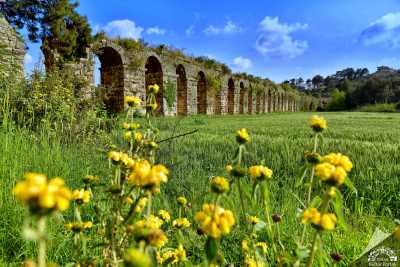
The ruins of ancient Andriake are largely spread out at the foot of the hill to the south of the harbour. The first structure encountered from the direction of Demre is the aqueduct that brings fresh water to Andriake. The nymphaion, a typical Roman period structure with its arched entrance and niched walls, is located in the east of the city.
Photo: Servet Uygun

In the area between the Granarium and the harbour, there is a harbor street, and in front of the street there are ship shelters with their tops half open. The largest structure of the city is the Marketplace or Agora called Plakoma. The Agora is surrounded by shops on three sides, except for the south side, and there is a cistern in the middle.
The most important ruin in Andriake is the granarium, that is, the granary, measuring 65 x 32 meters, eight rooms, rectangular in plan, dating back to the Hadrian period (117-138 AD). The building, also known as the Imperial Silo, has eight doors on its facade that provide entrance, and each door opens into a room. The windows above the doors on the front wall are made to illuminate the interior. On the front façade, on both sides of the terrace, there are rooms for the officers who take care of the warehouse. Right next to the large entrance door in the middle, there are two busts of the same size belonging to the Roman Emperor Hadrian and his wife Sabina. The relief of Serapis and Pluton, with a griffon between them, placed on the facade, was made based on the dream of the granarium officer, as explained in the inscription. The granarium, which is a very special structure that is intact and has survived up to its roof, today serves as the Lycian Civilizations Museum.
In the area between the Granarium and the harbour, there is a harbor street, and in front of the street there are ship shelters with half-open tops. The largest structure of the city is the marketplace or agora called placoma. The agora is surrounded by shops on three sides, except for the south, and there is a cistern in the middle. Andriake’s port, which remained functional until the 7th century AD, has today become a swamp and has cut off sea transportation.
There are house ruins on the elevation in front of the agora. The watchtower is on the west of the slope. The northern part of the port is a necropolis area where mostly Lycian sarcophagi are found and the remains of two Byzantine churches are found.
Andriake is among the “Ancient Cities of the Lycian Civilization” (2009) recommended to the UNESCO World Heritage List.
Source: “Andriake” Antalya from Past to Today [II. Volume], Antalya Provincial Directorate of Culture and Tourism, 2012, Antalya, 194.)
Places to visit in Antalya
Source: Antalya Provincial Culture and Tourism Directorate