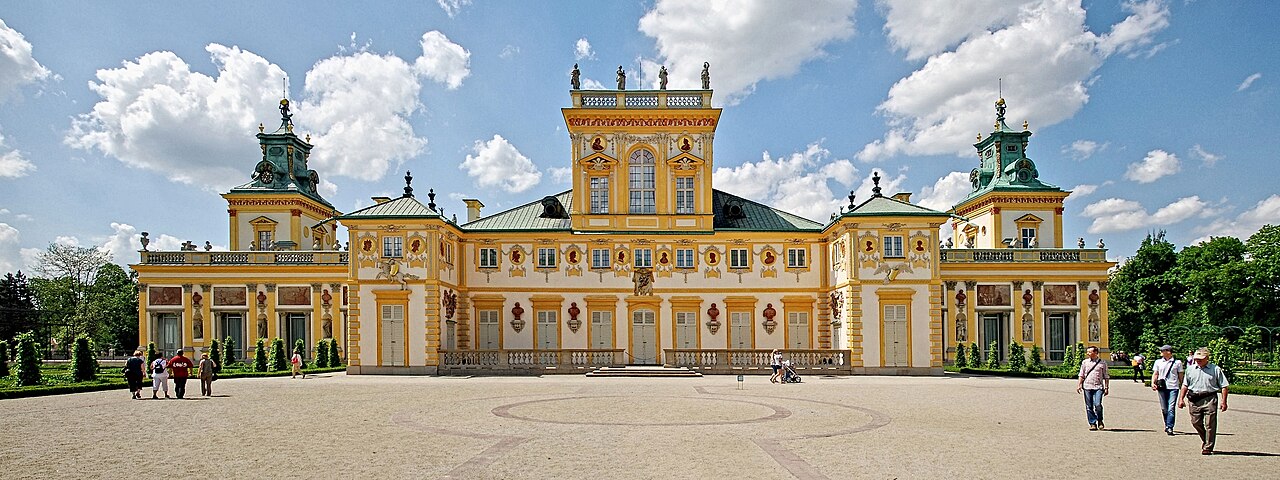
On the southern edge of Warsaw, set among formal gardens and a landscaped park, stands a golden Baroque palace often called the Versailles of Poland. Wilanow was built at the end of the seventeenth century for one of the most celebrated of all Polish kings, Jan III Sobieski, the warrior monarch who saved Vienna from the Ottoman siege, and it remains one of the most beautiful and important royal residences in the country.
Unlike so much of Warsaw, which was reduced to rubble in the terrible destruction of the Second World War, Wilanow survived, and with it survived the treasures, portraits, and interiors of centuries of Polish history. As one of the first public museums in Poland, opened long before most of Europe made its palaces accessible, Wilanow has been sharing its splendours with the public for well over two hundred years.
The palace is a masterpiece of the Polish Baroque, blending the traditions of the Italian villa, the French palace, and the Polish noble manor into a single harmonious and richly ornamented whole. Behind it lie magnificent gardens, and within it are the apartments of a king, the portraits of a nation, and the memory of one of Poland’s greatest monarchs. In the sections that follow you will get to know the palace, the king who built it, and its long life as a royal residence and museum.
In This Article
- The Golden Palace of Warsaw
- The King Who Saved Vienna
- Building a Royal Residence
- The Versailles of Poland
- A Baroque Blend of Traditions
- Gardens of Terrace and Park
- The Apartments of a King
- One of the First Museums in Poland
- Portraits and Treasures
- The Palace That Survived the War
- The Museum of King Jan III
- The Palace on Film
- Visiting Wilanow Today
The Golden Palace of Warsaw
Wilanow greets the visitor as a long, golden-hued Baroque palace, its central block flanked by wings and towers, richly ornamented with sculpture, pilasters, and gilded detail, set behind a forecourt and before magnificent gardens. It is at once grand and welcoming, a royal residence built for pleasure and display, glowing warmly in the light against the greenery of its park.

The palace is famous for the richness of its decoration. Its facades are adorned with sculptures, reliefs, and ornament celebrating the king who built it and the glories of his reign, so that the very walls proclaim the achievements of the monarch. This lavish decoration, combined with the palace’s warm colouring, gives Wilanow a splendour that has earned it comparison with the greatest palaces of Europe.
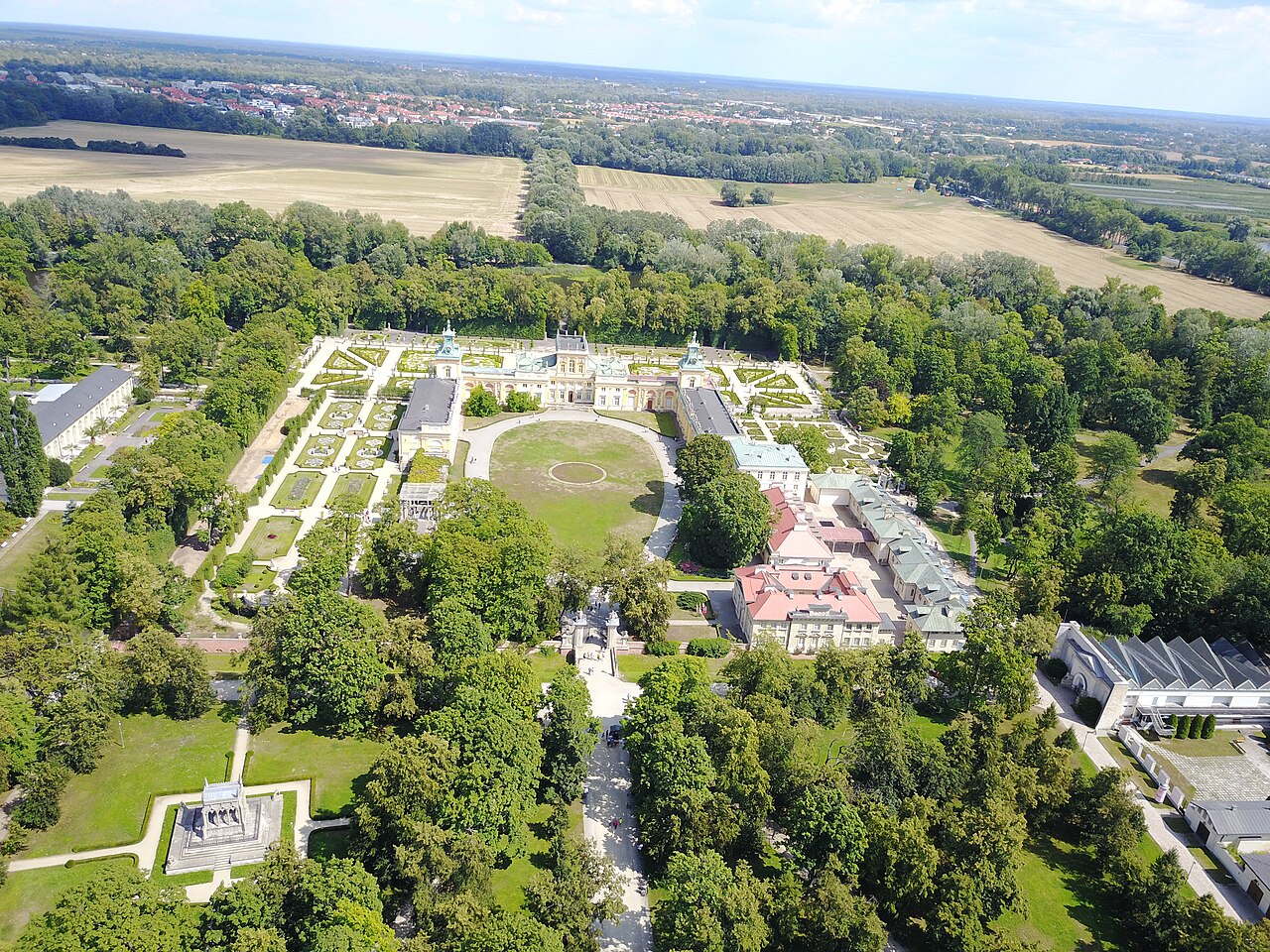
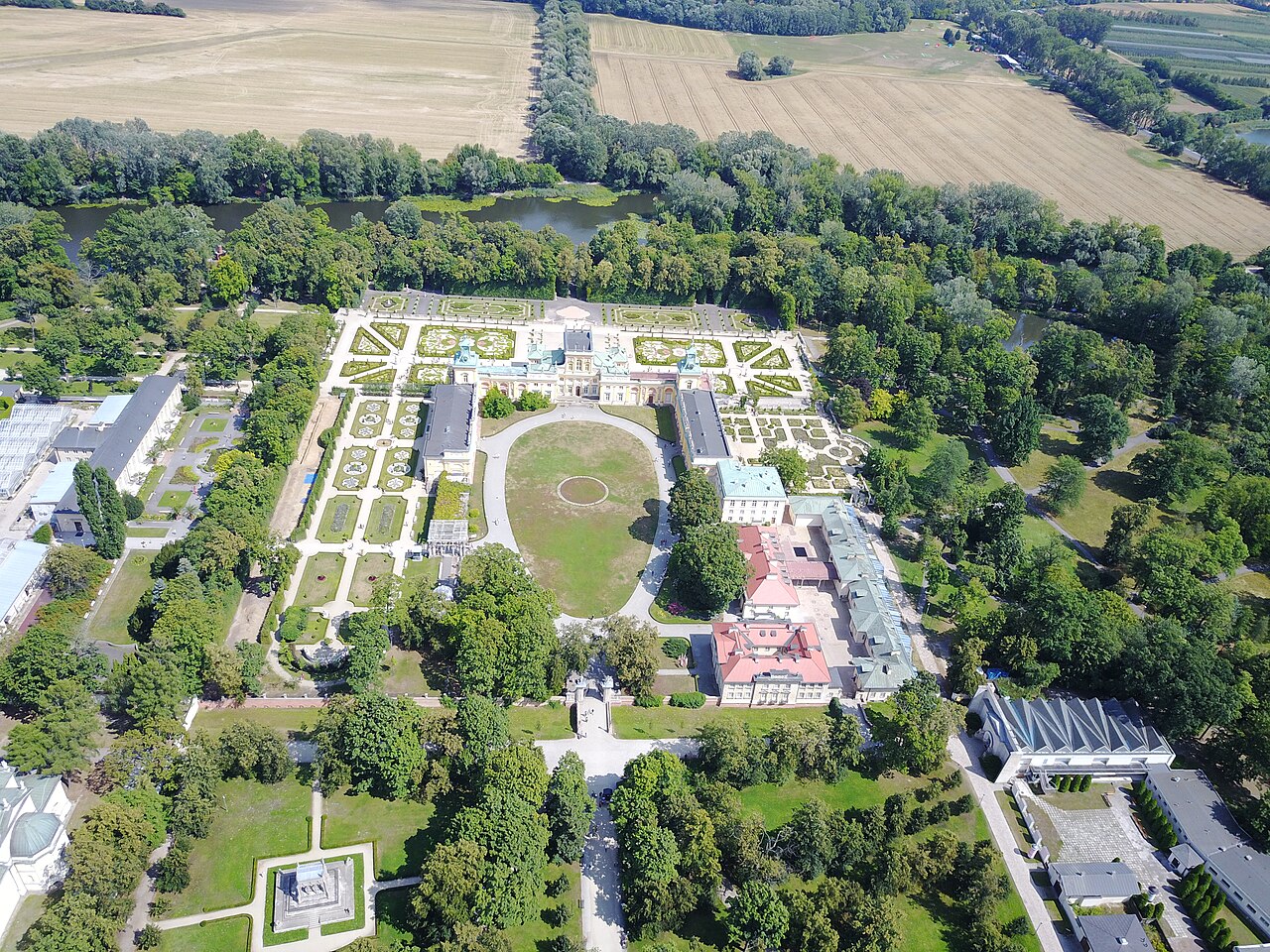
Behind the palace stretch the gardens, laid out in the formal Baroque manner on more than one level, with parterres, terraces, sculpture, and water, extending into a wider landscaped park. As at the great garden palaces of the age, the building and its grounds form a single composition, the architecture flowing out into the ordered beauty of the gardens.
To arrive at Wilanow is thus to encounter one of the finest Baroque ensembles in Poland, a golden palace amid its gardens on the edge of the capital. Built by a hero-king and cherished through the centuries, it offers a vision of royal splendour that survived the destruction of the surrounding city, and it remains one of the most beloved and beautiful monuments in the country.
Few first impressions in Warsaw are as warm as the sight of that golden facade above its forecourt.
The King Who Saved Vienna
Wilanow was built for one of the great heroes of Polish history, King Jan III Sobieski, a warrior monarch remembered above all for one of the most famous victories in European history. In the late seventeenth century, when a great Ottoman army besieged the city of Vienna and threatened the heart of Christian Europe, it was Sobieski who led the relieving force that broke the siege and turned back the invaders.

This victory made Sobieski a celebrated figure across Europe, hailed as the saviour of Christendom, and it stands as the defining moment of his reign. A skilled general and a cultivated ruler, he combined military glory with a love of the arts and learning, and he was one of the most admired kings of his age, his fame reaching far beyond the borders of Poland.
Wilanow was Sobieski’s beloved country residence, built and adorned during his reign as a retreat from the cares of state and as a monument to his glory. The palace celebrates the king throughout its decoration, with imagery evoking his victories and his virtues, so that Wilanow is not only a royal home but a monument to the achievements of one of Poland’s greatest monarchs.
The connection with Sobieski gives Wilanow much of its significance and its emotional resonance for Poles. It is the palace of the hero of Vienna, a place bound up with a moment of national and European triumph, and its rooms and gardens carry the memory of the warrior-king who created it. To visit is to encounter the world of one of the most celebrated figures in Polish history.
The relief of Vienna, sealed by the great charge of the Polish winged hussars, entered legend almost at once, and Sobieski became a household name across the continent. That a king so garlanded with military glory should also have devoted himself to building so refined and cultivated a palace says much about him: he was a soldier who loved books, art, and gardens, and Wilanow is the gentler face of a famous warrior.
For Poles he remains a figure of almost mythic stature, and his palace is a place of national pride.
Building a Royal Residence
Wilanow was built in the closing decades of the seventeenth century, rising over a period of years as the country residence of the king. It began as a relatively modest house and was progressively enlarged and enriched during Sobieski’s reign, growing into the splendid palace we see today, its expansion reflecting the rising glory and ambitions of the monarch.
The design was the work of a talented architect who served the king, and it drew on a range of influences to create a distinctive and harmonious whole. The palace combined elements of the Italian villa, the French palace, and the traditional Polish manor house, blending these into a Baroque residence that was at once cosmopolitan and characteristically Polish.
The construction and decoration drew on the skills of many artists and craftsmen, who adorned the palace with sculpture, painting, and ornament of great richness. The result was a building that expressed both the European sophistication and the national pride of Sobieski’s court, a royal residence worthy of a king who was celebrated across the continent.
Over the following centuries, later owners would add to and alter the palace, but the core created for Sobieski remained, and Wilanow retained its character as a Baroque masterpiece throughout. Built as the retreat of a hero-king and enriched by successive generations, the palace stands as one of the great achievements of Polish architecture, a golden monument to the age of Sobieski.
Each later owner in turn added a wing, a room, or a decorative scheme, so that the palace grew like a living thing across the generations, yet the guiding idea laid down for Sobieski held the whole together.
The Versailles of Poland
Wilanow is often called the Versailles of Poland, a comparison that captures its role as a magnificent royal garden palace in the Baroque manner. Like the great French palace, Wilanow unites a splendid residence with formal gardens in a single grand composition, expressing the glory of the monarch through architecture, decoration, and landscape alike.
The comparison, however, should not be taken to mean mere imitation. While Wilanow shares the ambitions and the Baroque language of the age, it has a character all its own, shaped by Polish traditions and by the personality of the king who built it. It is smaller and warmer than the vast palace of Versailles, and its blend of influences gives it a distinctive charm.
What Wilanow shares with the great palaces of the age is the idea of the residence as a total work of art, in which building and garden, architecture and sculpture, are united to celebrate the monarch and to create an environment of ordered splendour. In this sense it belongs to the same European family as Versailles and the other great Baroque garden palaces, a Polish member of that illustrious company.
The nickname thus honours Wilanow’s beauty and ambition while pointing to its place in the wider European Baroque. It is Poland’s answer to the great garden palaces of the age, a golden residence amid its gardens that expresses the glory of a celebrated king. To call it the Versailles of Poland is to recognise both its splendour and its distinctive national character.
If anything, the nickname undersells the palace’s individuality. Wilanow is not a would-be Versailles but a confident Polish creation that happens to share the ambitions of its age, and part of its charm lies precisely in the ways it departs from the French model, warmer, more intimate, and steeped in the imagery of its own hero-king.
It stands proudly among the great garden palaces of Europe.
A Baroque Blend of Traditions
Architecturally, Wilanow is a superb example of the Baroque, and it is especially interesting for the way it blends different traditions into a single harmonious design. At its core lies the plan of a Polish noble manor, but this is elaborated with the forms of the Italian villa and the French palace, producing a residence that is both rooted in Polish tradition and fully part of the European Baroque.

The palace is richly decorated, its facades adorned with pilasters, sculptures, reliefs, and gilded ornament, much of it celebrating the king and his achievements. This lavish external decoration is one of the palace’s defining features, turning the building itself into a monument of praise, with imagery drawn from classical mythology and from the glories of Sobieski’s reign.
The interiors continue this richness, with grand apartments decorated with frescoes, stucco, gilding, and fine furnishings in the Baroque and later styles. The palace grew and was redecorated over the centuries, so that its rooms reflect a range of periods, but the overall impression is one of sumptuous ornament and royal splendour throughout.
This blend of manor, villa, and palace, of Polish and European traditions, gives Wilanow its distinctive character. It is unmistakably Baroque, unmistakably royal, and unmistakably Polish, a building that expresses the meeting of national and European culture at the court of a cosmopolitan king. As a work of architecture it is one of the finest of its kind in the country, and one of the great monuments of the Polish Baroque.
The decorative programme repays close reading, for much of it is a coded hymn to the king, comparing him to the heroes and gods of antiquity and weaving his victories into allegory. A visitor who pauses over the reliefs and paintings finds not mere ornament but a sustained argument, in stone and paint, for the glory of Sobieski.
The whole is a triumph of the Polish Baroque.
Gardens of Terrace and Park
The gardens of Wilanow are an essential part of its beauty, extending the splendour of the palace out into the landscape. Directly behind the building lies a formal Baroque garden, laid out on more than one level, with terraces, parterres, sculpture, and water, in the grand geometric style of the age, designed to be admired from the palace and to provide a setting of ordered beauty.
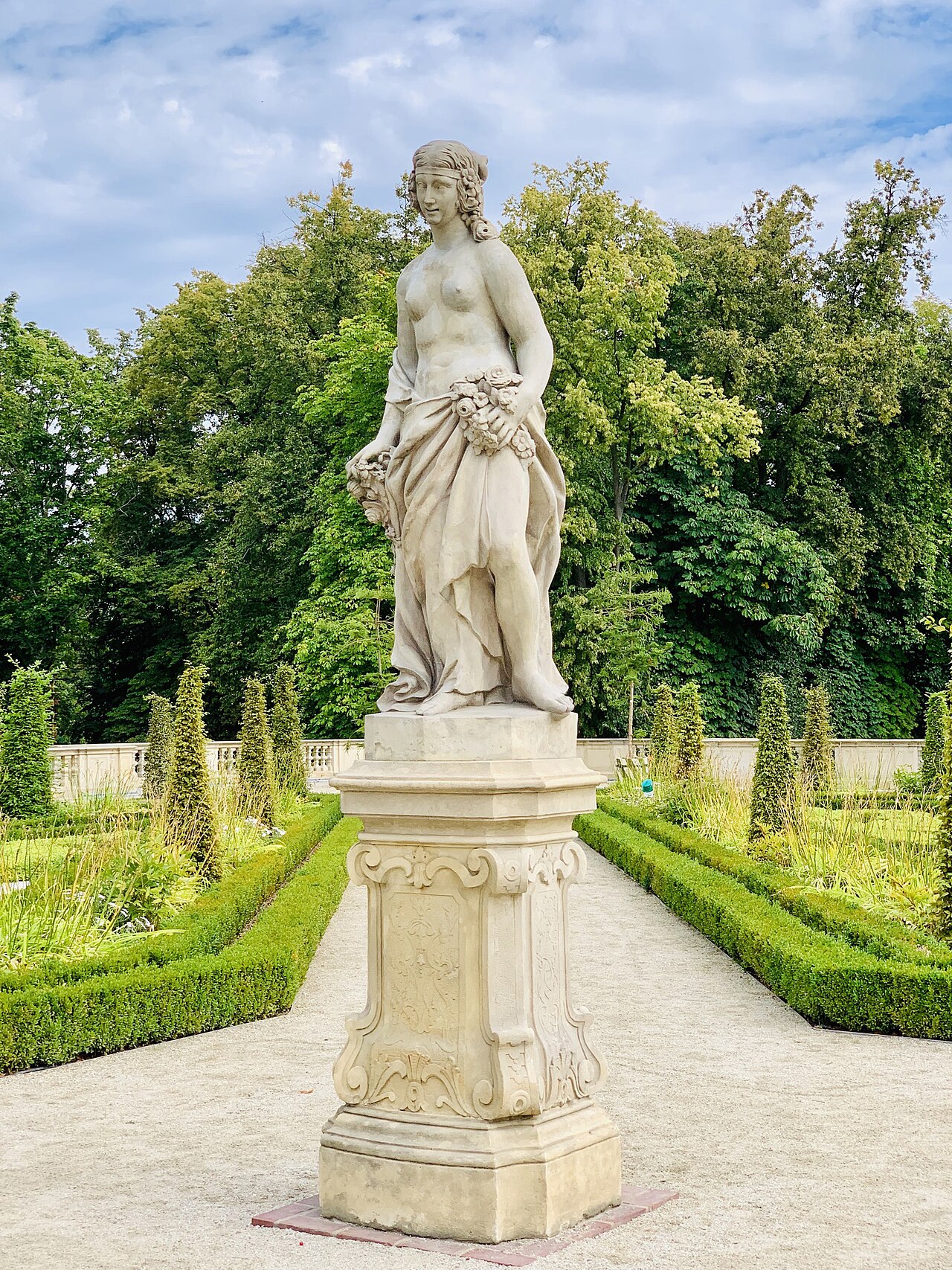
Beyond the formal garden, the grounds extend into a wider park, laid out in later times partly in the more naturalistic landscape style, so that Wilanow combines the formal Baroque garden near the palace with a more informal park beyond. This combination gives the grounds variety and richness, offering both the grandeur of the formal design and the pleasures of a landscaped park.
Sculpture and ornament punctuate the gardens, and water features add movement and reflection, in keeping with the Baroque love of combining architecture, nature, and art. The gardens were conceived, like the palace, as a celebration of the king and a place of pleasure, and they remain one of the great attractions of Wilanow, beautiful in every season.
For visitors, the gardens are among the highlights of a visit, offering both the formal splendour of the Baroque terraces and the tranquil beauty of the park. To walk from the golden palace out into the gardens, among the parterres, sculptures, and trees, is to experience the full Baroque vision of Wilanow, in which building and landscape together form a single magnificent whole.
The two-level Italian garden directly below the palace windows is the jewel of the grounds, its parterres and fountains best seen from the terrace above, while the wider park invites a slower wander among trees and water. Together they offer both the discipline of the formal garden and the ease of the landscape park in a single visit.
In autumn the park is especially beautiful, its avenues turning gold to match the palace.
They are among the finest historic gardens in Poland.
The Apartments of a King
Within the palace, Wilanow preserves a magnificent series of rooms that reflect its history as a royal residence and its later life as the home of noble families and a museum. The interiors include the state apartments and private rooms of the king and queen, decorated with frescoes, stucco, gilding, and fine furnishings, evoking the splendour of Sobieski’s court and of later ages.

Among the most celebrated rooms are the grand halls and the royal apartments, with their rich decoration and their painted ceilings, which express the Baroque taste for allegory and ornament. The decoration often celebrates the king and his virtues, weaving imagery of triumph, mythology, and majesty into the very fabric of the rooms, so that the interiors, like the facades, honour the monarch.
Because the palace was inhabited and enriched over several centuries, its interiors reflect a range of periods and tastes, from the Baroque of its founder to the styles of later owners, giving the rooms a rich and layered character. The palace thus tells the story of Polish decorative art across the centuries, within the setting of a royal residence.
For visitors, the interiors offer an intimate encounter with the world of the Polish court and aristocracy. To move through the apartments of the king and queen, richly decorated and furnished, is to step into the splendour of the Baroque age and to sense the life of the monarch who built the palace, as well as of the generations who lived there after him.
The contrast between the grand ceremonial rooms and the more intimate private apartments gives a rounded sense of royal life, the public magnificence on one hand and, on the other, the more human scale of the spaces where the king and queen actually lived.
Every room adds another chapter to the palace’s long story.
One of the First Museums in Poland
After the death of Sobieski, Wilanow passed through the hands of a succession of noble families, who cherished and enriched the palace and added their own collections and alterations. Under these later owners, the palace continued to be one of the most important residences in Poland, and its treasures grew, so that Wilanow accumulated the art and possessions of generations.

One of the most significant chapters in this history came when a cultivated owner opened part of the palace and its collections to the public, creating one of the very first museums in Poland, at a time when few palaces anywhere were accessible to ordinary people. This early opening made Wilanow a pioneer, a private palace that became a place of public education and enjoyment long before most.
The creation of this early museum reflected the Enlightenment ideals of the age and the desire to share art and history with the public. It established a tradition of public access at Wilanow that has continued ever since, so that the palace has been welcoming visitors for well over two centuries, one of the longest-running museums in the country.
This long history as a museum is an important part of Wilanow’s identity. It is not only a royal palace and a monument to Sobieski but a pioneering public institution, a place that has been sharing its beauty and its collections with the people for generations. This tradition of access, begun so early, makes Wilanow a landmark in the cultural history of Poland as well as a splendid royal residence.
The gesture belonged to a hopeful moment, when educated Poles, their statehood under threat from the partitioning powers, sought to preserve and share the nation’s heritage as a way of keeping its identity alive. In opening Wilanow to the public, its owner was making a quietly patriotic act as much as a cultural one, and the museum has carried that spirit ever since.
That pioneering openness is part of what makes Wilanow beloved today.
Portraits and Treasures
Wilanow is home to rich collections of art and historical treasures gathered over the centuries, and these are among the great attractions of the palace. The collections include paintings, sculpture, furniture, decorative arts, and objects connected with the history of the palace and its owners, offering a vivid picture of the culture of the Polish court and aristocracy.
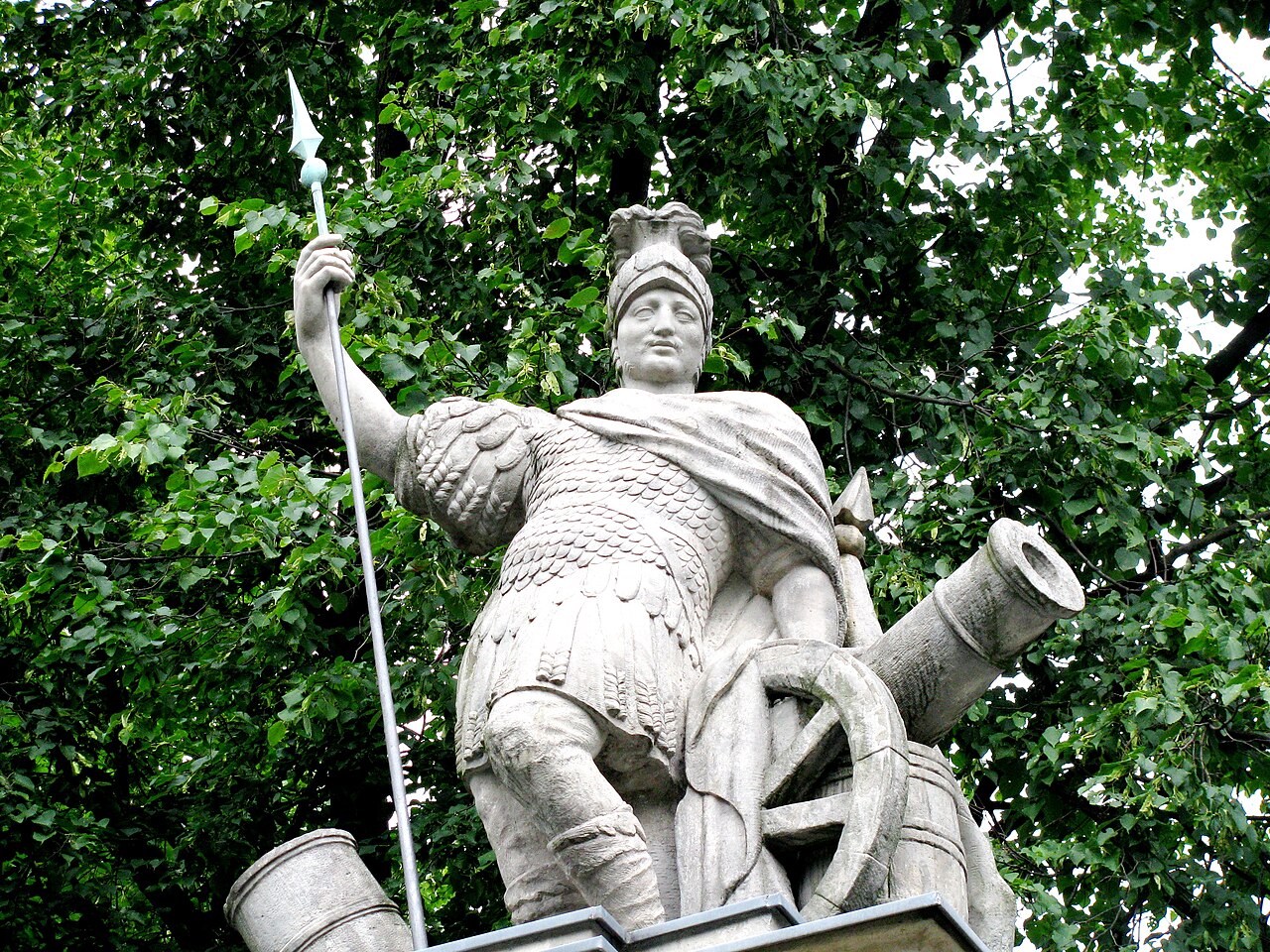
Among the most distinctive treasures is the collection of Polish portraits, including the remarkable tradition of funerary and coffin portraits and the grand portraits of kings, nobles, and their families that adorn the palace. These portraits are a fascinating record of Polish society across the centuries, and they give Wilanow a special importance as a repository of the nation’s visual heritage.
The palace also preserves objects connected with Sobieski himself and with the great events of his reign, along with the treasures accumulated by the later noble owners. Together these collections make Wilanow not only a beautiful building but a rich museum of Polish art and history, where the story of the nation can be traced through its portraits and treasures.
For visitors, the collections greatly enrich the experience of the palace, adding the fascination of the art and objects to the beauty of the architecture and gardens. From the grand portraits to the personal possessions of the king, these treasures bring the history of Wilanow and of Poland vividly to life, making a visit an encounter with the nation’s culture as well as its royal past.
The Polish tradition of the coffin portrait, in which the face of the deceased was painted on a metal plate fixed to the coffin for the funeral, is one of the most distinctive in European art, and to see such portraits gathered here is to encounter a way of remembering the dead found almost nowhere else. They stare out at the visitor with a startling immediacy across the centuries.
The collection continues to grow through study and acquisition.
The Palace That Survived the War
Perhaps the most remarkable fact about Wilanow is that it survived. During the Second World War, Warsaw suffered catastrophic destruction, much of the city deliberately reduced to ruins, and countless monuments and treasures were lost forever. Yet Wilanow, on the edge of the city, came through the war, its buildings standing when so much else had been destroyed.

The palace did not escape unscathed, for it was looted and its treasures were plundered during the occupation, but the building itself survived, and after the war great efforts were made to recover the stolen art and to restore the palace. Many of the lost treasures were tracked down and returned, and the palace was repaired, so that Wilanow could resume its life as a museum.
This survival gives Wilanow a special poignancy and importance. In a city where so much was lost and had to be rebuilt from nothing, Wilanow is a genuine survivor, a palace that preserves its original fabric and, in large part, its historic collections, offering an authentic link to the centuries before the war that few other places in Warsaw can match.
The story of Wilanow’s survival and recovery is a moving chapter in the history of Poland, a nation that suffered terribly in the war and worked heroically to preserve and restore its heritage. That the golden palace of Sobieski came through the destruction, and that its treasures were recovered and returned, makes it not only a monument to a hero-king but a symbol of the endurance and resilience of Polish culture.
To grasp what this survival means, one must picture the Warsaw around it, a city so thoroughly destroyed that its historic centre had to be rebuilt from paintings and photographs after the war. Against that background, a genuine seventeenth-century palace, standing with much of its fabric and many of its treasures intact, is almost miraculous, a rare window onto the Poland that existed before the catastrophe.
Its endurance has made it, for many Poles, a symbol of survival itself.
The Museum of King Jan III
Today Wilanow is a museum dedicated to the memory of its royal founder and to the history and art of the palace and the nation. It preserves the palace, its interiors, its collections, and its gardens, presenting them to the public much as generations of visitors have enjoyed them, and continuing the long tradition of access that began more than two centuries ago.

As a museum, Wilanow offers a rich programme of exhibitions, events, and activities alongside the permanent display of the palace and its collections, making it a lively cultural institution as well as a historic monument. It cares for its treasures, restores and studies its collections, and shares the story of Sobieski and of Wilanow with visitors from Poland and around the world.
The museum takes special care to honour the memory of the hero-king, celebrating his achievements and his legacy and presenting Wilanow as a monument to his glory and to the golden age of the Polish court. In doing so, it keeps alive the memory of one of the most celebrated figures in Polish history, within the palace he loved and built.
For the people of Poland, Wilanow is a treasured national monument, and for visitors it is one of the great sights of Warsaw. As a museum, it unites the beauty of the palace and gardens, the richness of the collections, and the memory of a hero-king, offering a full and rewarding encounter with the history and culture of Poland in one of its most beautiful and best-loved royal residences.
On summer evenings the palace and gardens sometimes host concerts and illuminations, when the golden facade glows against the dark and music drifts across the parterres, reviving something of the festive spirit of the court that built it.
It remains one of the most visited museums in Poland.
The Palace on Film
The splendour of Wilanow, its golden Baroque palace, its rich interiors, and its formal gardens, is wonderfully conveyed in film, and the short feature below offers a tour of the palace and its history. Watching it alongside this article helps bring the residence of King Sobieski to life, from its ornamented facades to its royal apartments and its gardens.

If you are planning a visit to Warsaw, a video like this is a fine way to prepare, helping you appreciate the highlights of the palace and gardens and to understand the history of Sobieski and the later owners of Wilanow. It sets the palace in the context of Polish history and of the Baroque age in which it was created.
And if a visit to Poland lies beyond your plans for now, the film lets you enjoy the Versailles of Poland from afar. Let it play, and picture yourself before the golden facade of Wilanow, amid its gardens on the edge of Warsaw, in the palace of the king who saved Vienna and one of the great monuments of the Polish Baroque.
Visiting Wilanow Today
For travellers to Warsaw, Wilanow is one of the essential sights of the city, set on its southern edge and easily reached from the centre. The palace and its gardens are open to the public as a museum, and visitors can explore the royal apartments and state rooms, the rich collections, and the beautiful formal gardens and park.

A visit rewards ample time, for there is much to see: the ornamented facades of the golden palace, the sumptuous interiors with their frescoes and portraits, the collections of art and treasures, and the gardens with their terraces, sculpture, and park. The gardens in particular deserve unhurried exploration, and they are lovely in every season.
As at any historic palace and museum, visitors should treat the rooms, collections, and gardens with care and follow the guidance provided. Taking the time to learn the story of Sobieski and of the palace, and to appreciate its remarkable survival through the destruction of the war, greatly enriches a visit and deepens the encounter with this national treasure.
However you come to it, Wilanow offers a superb encounter with the world of the Polish Baroque and with the memory of one of the nation’s greatest kings. To walk through its golden rooms and its gardens is to step into the age of Sobieski and to experience one of the most beautiful and historically significant royal palaces in Poland, a survivor of war and a monument to a hero, on the edge of the reborn capital of Warsaw.
A visit combines easily with the other great sights of Warsaw for those exploring the capital.
Palaces Nearby
If the Baroque splendour of Wilanow has drawn you in, these two other royal palaces of Northern Europe make a natural next stop.
- Amalienborg, the Four Palaces of the Danish Royal Family — the rococo Copenhagen square that is home to the Danish crown.
- Het Loo, the Versailles of the Netherlands and Its Baroque Gardens — the Dutch Baroque palace of the House of Orange.
You May Like
Konopiste the Bohemian Castle of a Doomed Archduke