In this article
- A fortress in the emptiness
- The man who walked into the desert
- The temptations and the legend that followed
- A monastery grown around a grave
- Who the Copts are, and why this place is theirs
- The claim to be the oldest monastery on earth
- What it means to a Coptic Christian
- A church set apart from the rest of Christianity
- Inside the walls, and up to the cave
- The desert fathers and their hard wisdom
- The other hermit on the mountain
- The paintings in the old church
- Survival against every odd
- If you make the journey
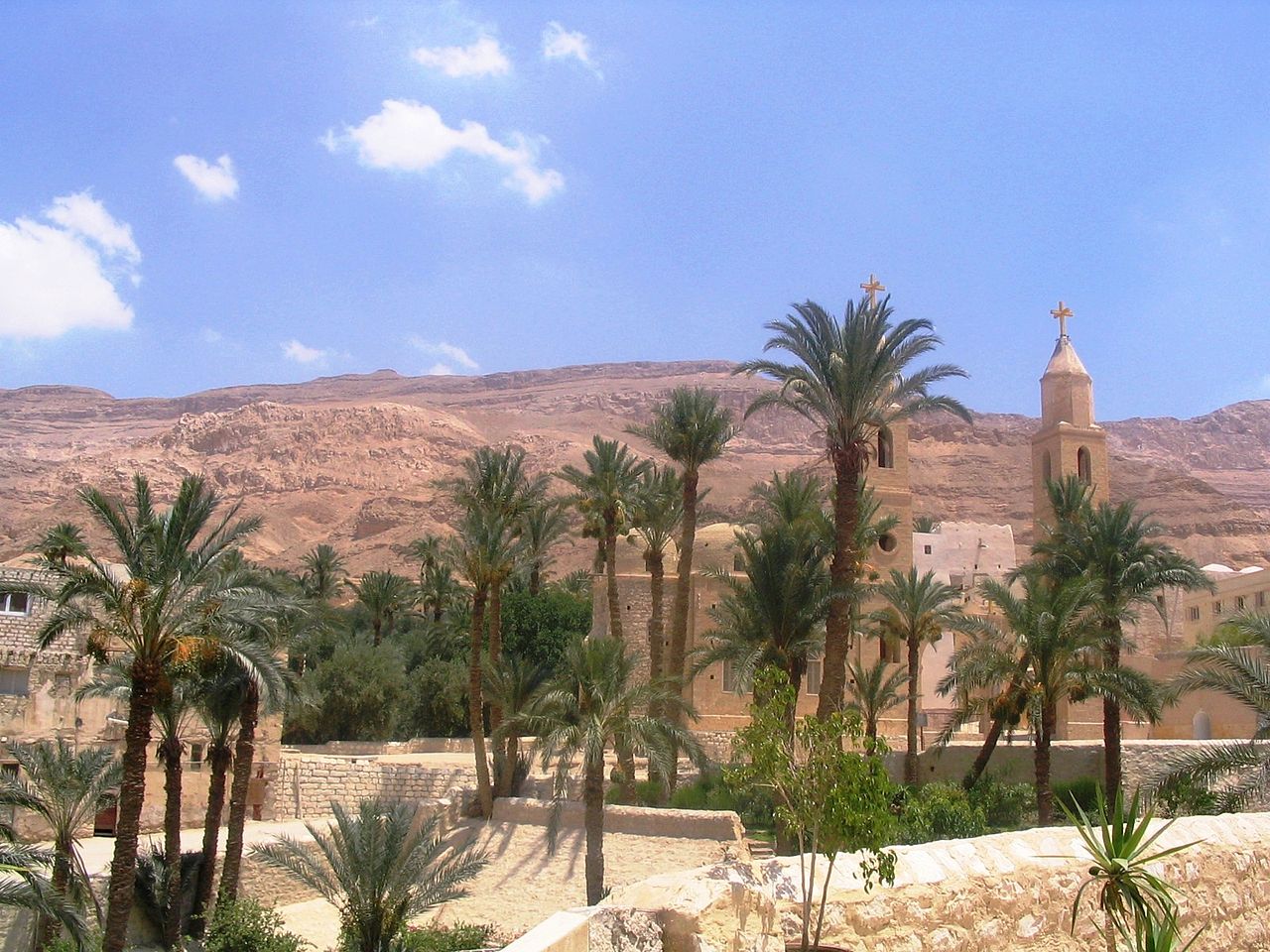
There is a place in the eastern desert of Egypt, between the Nile valley and the Red Sea, where the road runs for hours through nothing at all, just gravel and rock and the shimmering emptiness of the wilderness, until at last, against the foot of a barren mountain, a cluster of walls and domes and palm trees rises out of the waste like a mirage. This is the Monastery of Saint Anthony, and it is, by a strong and ancient claim, the oldest functioning Christian monastery in the world. More than that, it is the place where the very idea of the monastery, of men and women leaving the world to seek God in solitude and community, took the shape that would spread across the whole of Christendom and change it forever.
Everything that the word monastery brings to mind, the cloister, the cell, the rule of life, the abbot, the long centuries of monks at prayer behind high walls, can be traced back, through a thousand intermediate streams, to a single man who walked into this desert seventeen centuries ago to be alone with God. His name was Anthony, and the way of life he stumbled into and made famous was copied first by the deserts of Egypt, then by the whole Christian East, then by the West through figures who looked back to him as their father. To stand at his monastery is to stand at one of the true sources of a river that watered the entire history of Christian devotion.
This is the story of that man, of the desert that made him, of the monastery that grew up around his memory, and of the ancient and embattled Egyptian church, the Copts, who have kept the lamp burning here, against almost every odd, for the better part of two thousand years.
A fortress in the emptiness
The first thing that strikes a visitor is how much the monastery looks like a fortress, because for most of its history that is exactly what it had to be. High thick walls enclose a self-contained world of churches, chapels, monks cells, gardens, store-rooms, a mill, a bakery, and a spring of fresh water that has never failed, the spring that made life possible here in the first place. Within the walls there is greenery, palms and gardens fed by the spring, and the deep peace of a place built for prayer; outside them there is only the desert and the bare mountain rising behind.
The fortifications were not decorative. A rich and isolated monastery in the desert was a tempting target, and over the centuries Saint Anthony was raided, besieged, and at least once sacked with terrible loss of life. The walls, the keep where the monks could retreat and hold out, the careful self-sufficiency of the place, all of it was the architecture of survival, a Christian community learning how to endure in a hard land under often hostile rulers. That sense of a fortified ark of faith riding out the centuries in an ocean of desert is the deepest impression the place leaves, and it is the truest one.
The man who walked into the desert
The story begins around the middle of the third century, when a young Egyptian named Anthony, born to a reasonably prosperous Christian family, heard in church the Gospel words urging the rich young man to sell all he had, give to the poor, and follow Christ. Anthony took them literally. He gave away his inheritance, placed his sister in the care of a community of virgins, and went off to live as an ascetic, first on the edge of his village, then further out, and finally deep into the desert itself, seeking a solitude in which he could wrestle for his soul without distraction.
This was a radical and, at the time, a strange thing to do. Christianity was still an often-persecuted faith, and the heroes of the Church were the martyrs who died for it. Anthony invented, or at least made famous, a different kind of heroism: not the quick glory of dying for Christ but the long slow martyrdom of living for him, day after day, in hardship and solitude, doing battle not with Roman executioners but with his own appetites, his fears, and the demons he believed assailed him in the silence. He went, the tradition says, ever deeper into the wilderness, finally settling near the mountain and the spring where his monastery now stands, at what came to be called his Inner Mountain, to live out his very long life, for he is said to have reached the age of one hundred and five.

High on the mountain above the monastery, reached by a long climb of hundreds of steps, is the cave where Anthony is said to have lived in his deepest solitude, a small dark hollow in the rock that pilgrims still climb to and pray in. It is a humbling place. From the man who sat in that cave, alone with God and his demons, flowed a movement that would fill the deserts of Egypt with thousands of hermits and monks within a single generation, and would go on to shape the spiritual life of the entire Christian world.
The temptations and the legend that followed
Anthony might have lived and died in obscurity, one anonymous holy man among many, had it not been for a book. Not long after his death, the great bishop Athanasius of Alexandria, a towering figure in the early Church, wrote his Life of Anthony, a biography that became one of the most influential books in the history of Christianity. It told of Anthony withdrawal, his austerities, and above all his spiritual combat: the famous temptations, in which the devil assailed him in the desert with terrors, beasts, seductions, and despair, and the saint, by faith and prayer, overcame them all.
The book was a sensation. Copied and translated across the Roman world, it carried the ideal of the desert monk into every corner of Christendom and inspired countless others to take up the same life. It reached, famously, the future Saint Augustine far away in the Latin West, who recorded the powerful effect the story of Anthony had on his own conversion. The temptations of Saint Anthony would echo down the centuries in art and literature, painted by masters, retold by writers, until the desert hermit besieged by demons became one of the permanent images of the Western imagination. But behind the legend stood a real man and a real place, and the place is still here, still praying, at the foot of his mountain.
A monastery grown around a grave
Anthony himself did not found a monastery in the organised sense. He was a hermit, and the disciples who gathered near him to learn his way of life lived scattered in their own cells, coming together for worship and instruction, a loose community of solitaries rather than a single institution. The monastery as a walled and organised community grew up after his death, as monks settled permanently around the holy ground where he had lived and was buried, and built the churches, walls, and dwellings that became, over time, the great complex that stands today.

So the monastery is, in a sense, a grave that grew into a city of prayer. Generation after generation of monks came to live and die in the shadow of Anthony memory, raising new churches, decorating them with the vivid wall-paintings for which the place is famous, digging deeper into self-sufficiency, and weathering the storms of Egyptian history. The oldest church, the Church of Saint Anthony, is covered inside with medieval Coptic paintings of extraordinary richness, recovered in modern times from under centuries of soot and grime, a gallery of saints and biblical scenes that rank among the treasures of Coptic art. The buildings have been destroyed and rebuilt, the community has shrunk to almost nothing and revived again, but the thread has never been cut. There have been monks here, more or less continuously, since the fourth century.
Who the Copts are, and why this place is theirs
To understand the monastery you have to understand the Copts, the native Christians of Egypt, who are among the oldest Christian communities on earth and whose church guards this place as one of its holiest possessions. The word Copt simply means Egyptian, and the Coptic Orthodox Church traces its origins to the preaching of Saint Mark the Evangelist in Alexandria in the first century, making it one of the founding churches of Christianity, the church of a land that was once overwhelmingly Christian.
Egypt in the early Christian centuries was a powerhouse of the faith. Alexandria was one of the great intellectual capitals of Christendom, producing theologians, scholars, and saints; the Egyptian desert was the cradle of monasticism; and the Coptic church played a central role in the great doctrinal struggles of the early Church. After the Arab conquest in the seventh century, Egypt slowly became a majority-Muslim land, and the Copts became a minority in their own country, a position they have held, through long centuries of varying fortune, ever since. That they have survived at all, keeping their ancient liturgy, their language of worship descended from the speech of the pharaohs, and their unbroken line of monks and bishops, is one of the quiet epics of Christian history, and the desert monasteries like Saint Anthony are the strongholds where that survival was anchored.
The claim to be the oldest monastery on earth
Several places contend for the title of oldest monastery, and the claim depends on exactly what one means, but the Monastery of Saint Anthony has as strong a case as any and a stronger case than most. Founded in the years following Anthony death in the mid-fourth century, on the very ground he had sanctified, it has been inhabited by monks more or less continuously ever since, which is a span of some sixteen centuries. There may be older Christian foundations of other kinds, but as a living monastic community in continuous existence, Saint Anthony stands at or very near the very head of the line.
What gives the claim its weight is not just the age but the directness of the connection. This is not merely an old monastery; it is the monastery that grew up around the founder of monasticism himself, on the spot where he lived. Every monastery in the world, in a sense, is a descendant of what happened in this desert, and Saint Anthony is closest of all to the source. To walk through its gates is to walk into the headwaters of a way of life that has shaped Christianity, East and West, Catholic, Orthodox, and beyond, for seventeen hundred years.
What it means to a Coptic Christian
For a Coptic Christian, the Monastery of Saint Anthony is not a museum or a historical curiosity but a living heart of the faith, and the depth of devotion attached to it is hard for an outsider to grasp. The Copts venerate their desert fathers, the great monks and hermits of the early centuries, with an intensity that places them at the very centre of religious life, and Anthony is the father of them all, the first and greatest, the founder of the way. To make a pilgrimage to his monastery is, for a Copt, to return to the source of the spiritual tradition that defines the entire community.
Monasticism has never stopped being central to Coptic Christianity in the way it sometimes faded in parts of the West. The Coptic church draws its bishops from the monasteries; the monastic ideal of prayer, fasting, and withdrawal sets the tone for the devotion of ordinary believers; and in modern times there has been a remarkable revival of Coptic monasticism, with the ancient desert houses, Saint Anthony among them, filling again with young monks and drawing crowds of pilgrims. For a people who have lived as a minority under pressure for many centuries, these desert monasteries have been more than holy places. They have been the spiritual fortresses where Coptic identity, language, and faith were preserved when the wider world grew hostile, the deep wells from which the community has drawn its strength to endure.
A church set apart from the rest of Christianity
The Coptic Orthodox Church belongs to a distinct family within Christianity, and understanding its position helps make sense of the place. The Copts are part of what is called Oriental Orthodoxy, a group of ancient churches, including the Armenian, Ethiopian, and Syriac, that parted from the rest of Christendom after the Council of Chalcedon in the year 451, over a subtle but bitterly contested question about how the divine and human natures are united in Christ. This separation happened centuries before the more famous split between Catholic and Eastern Orthodox, and many centuries before the Protestant Reformation, which means the Coptic church represents one of the very oldest distinct branches on the whole tree of Christianity.
The old quarrel that divided them from the rest is, by the judgment of many modern theologians on all sides, largely a matter of words and misunderstanding rather than real disagreement about the substance of the faith, and there have been warm efforts at reconciliation in recent times. But the long centuries of separate existence have given the Copts a Christianity all their own, with its own ancient liturgy, its own saints and traditions, its own deep monastic culture, distinct from the Catholic West, from the Eastern Orthodox world of Greece and Russia, and from the Protestant churches alike. A visitor from any of those traditions will find at Saint Anthony something both recognisably Christian and strikingly other, a branch of the faith that grew up in the Egyptian desert and has kept its own character for sixteen hundred years.
Inside the walls, and up to the cave
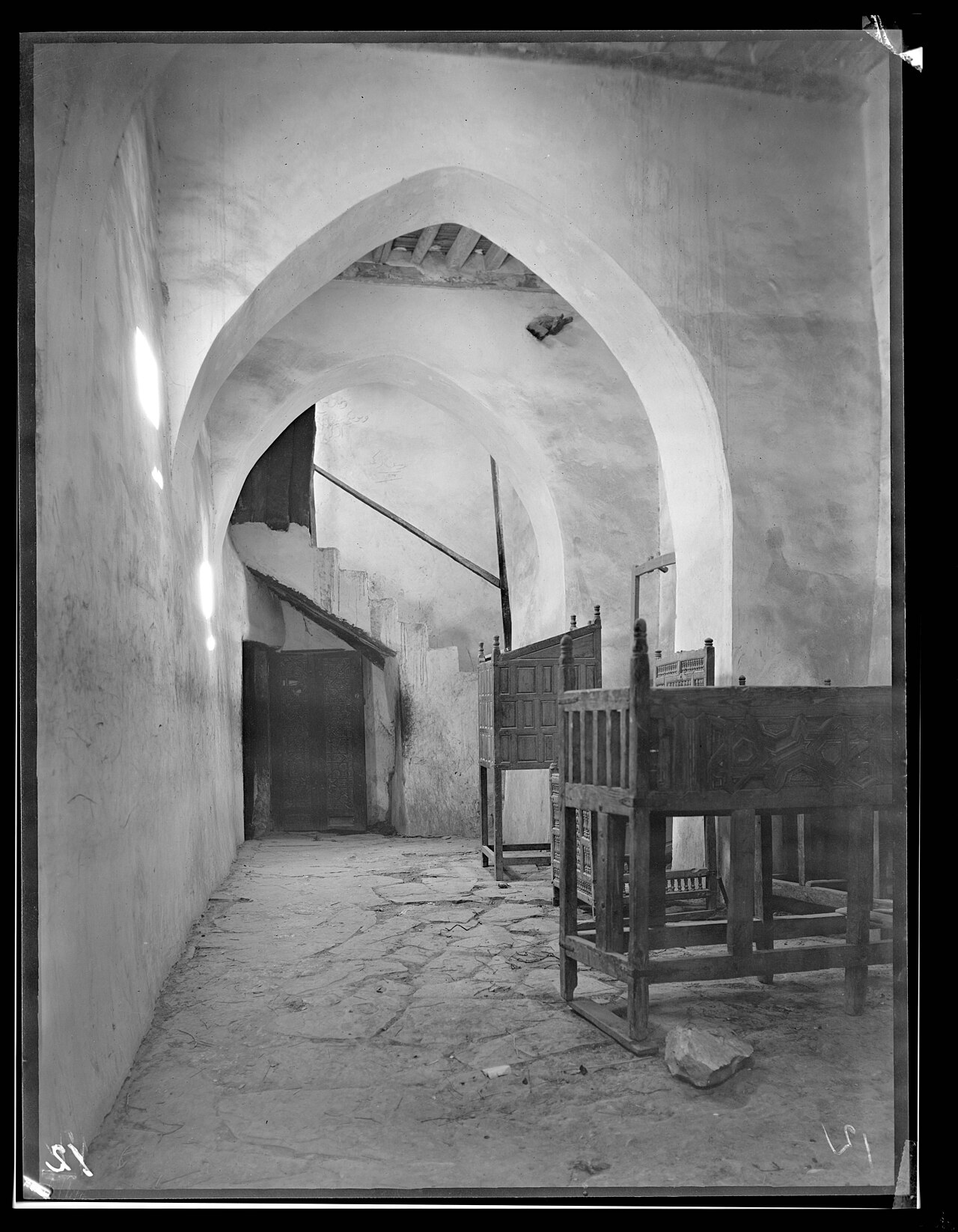
Step inside the walls and you enter a world that has changed remarkably little in its essentials for centuries. The monastery is a small self-contained settlement of churches, chapels, cells, and gardens, the buildings low and thick-walled and whitewashed, the lanes between them narrow and shaded, the whole watered by the ancient spring whose flow has sustained life here from the beginning. Several churches stand within the walls, the oldest of them, the Church of Saint Anthony, holding the famous medieval wall-paintings, dim and glowing, that cover its interior with saints and scenes in the bold flat style of Coptic art.
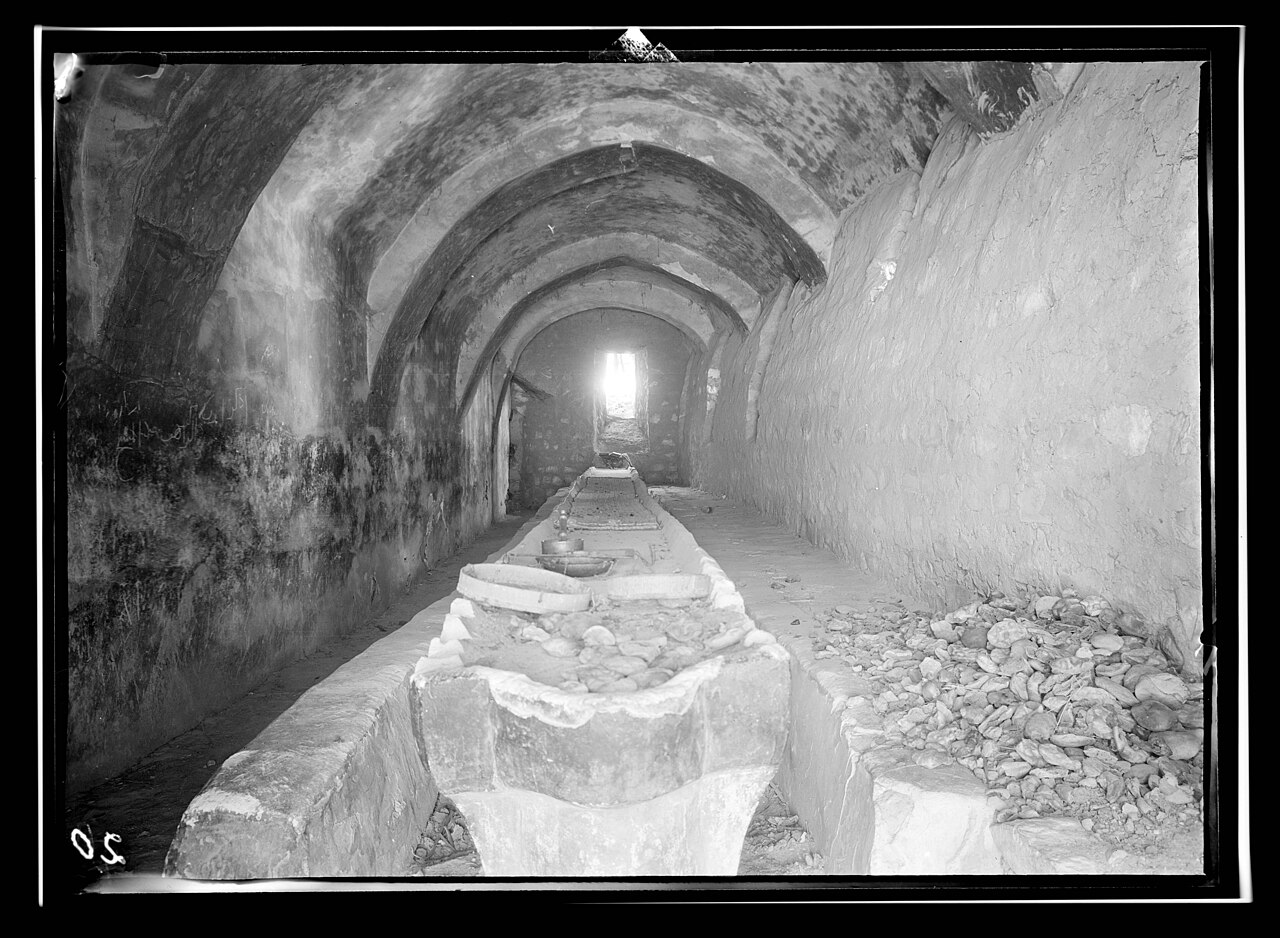
There is the old refectory where the monks ate in common, the keep where they sheltered from raiders, the mill and bakery and storerooms that made the community self-sufficient, the gardens green against the surrounding waste. And above it all, reached by a long and lung-bursting climb of hundreds of steps up the mountain face, is the cave of Saint Anthony himself, the small rock hollow where the founder withdrew into his deepest solitude. The climb is hard, especially in the desert heat, but pilgrims make it gladly, because at the top, in that cramped dark space with the immense silence of the desert spread out below, you are as close as it is possible to come to the man and the moment from which the whole monastic world was born.
The paintings in the old church
One of the great surprises waiting inside the walls is the art. The oldest church, dedicated to Saint Anthony himself, is covered within by a remarkable cycle of medieval wall-paintings, executed centuries ago by Coptic artists and ranking among the finest surviving examples of their tradition. For a long time these paintings were hidden, darkened almost to invisibility by centuries of candle smoke, incense, and grime, so that visitors barely knew they were there. Then, in a major modern conservation effort, the layers of soot were painstakingly cleaned away, and the images blazed back into view in their original colours, a revelation that transformed our understanding of Coptic medieval art.
What emerged is a gallery of saints, horsemen, biblical scenes, and holy figures rendered in the bold, frontal, large-eyed style that is the signature of Coptic painting, a style that descends in part from the art of late-antique Egypt and has a directness and intensity all its own. The mounted warrior-saints gaze out with enormous eyes; the monks and patriarchs stand in rows of solemn dignity; the whole interior glows with the particular reds, ochres, and earth tones of the desert tradition. To an eye trained on the gilded mosaics of Byzantium or the frescoes of Italy, this art looks different, plainer in some ways, fiercer in others, but it carries its own deep power, and it is among the treasures of the entire Christian East.
These paintings matter for more than their beauty. They are a window into the visual world of a Christian community that has often been overlooked in the standard histories of Christian art, which tend to run from Byzantium to Italy and on to the West. The Copts had their own continuous artistic tradition, reaching back to the very beginnings of Christian image-making, and the recovered paintings at Saint Anthony are one of the great surviving witnesses to it. To stand in that dim old church, surrounded by the cleaned and glowing faces of Coptic saints, is to glimpse a whole branch of Christian creativity that flowered quietly in the Egyptian desert while the more famous schools rose and fell elsewhere.
Survival against every odd
The continuous life of the monastery has not been peaceful. Across its sixteen centuries it has faced repeated catastrophe, raids by desert nomads, periods of decline when the community dwindled to a handful, and at least one terrible episode, remembered in the monastery own traditions, when attackers broke in and slaughtered the monks, leaving the place desolate for a time. Each time, somehow, it revived. New monks came, the walls were repaired, the lamps were relit, and the round of prayer resumed. The history of Saint Anthony is a long alternation of devastation and renewal, and the fact that it is still here, still full of monks, after everything, is itself a kind of testimony.
That endurance is bound up with the wider survival of the Copts as a people. To be a Christian minority in a land that became overwhelmingly Muslim, through long centuries of varying fortune, sometimes tolerant and sometimes harsh, demanded deep reserves of resilience, and the desert monasteries were where those reserves were stored. When times were hard in the towns and the Nile valley, the monasteries kept the faith alive in their remote strongholds, preserving the liturgy, the learning, and the spiritual fire of the community. The modern revival of Coptic monasticism, which has filled these ancient houses with new life, is the latest chapter in that long story of survival, and it means that a visitor to Saint Anthony today finds not a fading relic but a thriving community, ancient and alive at once.
The desert fathers and their hard wisdom
Anthony did not stay alone for long. Within a generation of his withdrawal, the deserts of Egypt were filling with men and women who had heard of his example and come to imitate it, until what had begun as one man solitude became a whole movement, thousands of hermits and monks scattered across the wilderness in cells and caves and loose communities. These are the people history remembers as the desert fathers and mothers, and the sayings attributed to them, terse, startling, often baffling scraps of spiritual wisdom, were collected and have been treasured ever since as one of the great inheritances of Christian devotion.
The wisdom of the desert is not gentle. It is the hard-won knowledge of people who went into the wilderness to strip their souls bare, and it speaks of the war against pride, anger, and judgment of others with a bluntness that can still cut. A young monk asks an old one how to be saved, and the answer is to sit in his cell and let the cell teach him everything. A brother sins, and the elder, asked to come and condemn him, instead carries a leaking bag of sand on his back, saying his own sins run out behind him where he cannot see them, and who is he to judge another. Story after story like this came out of the Egyptian desert, and Anthony stands at the head of them all, the father of the fathers, the first to show that the wilderness could be a school of the soul.
This is the spiritual tradition that the Monastery of Saint Anthony exists to guard and continue. The monks who live there today are the direct heirs of those desert fathers, keeping alive in the same desert the same austere pursuit of God through prayer, fasting, silence, and the patient daily labour of the cell. When you visit, you are not looking at a fossil of an extinct way of life. You are looking at the living continuation of one of the oldest and most influential spiritual disciplines on earth, practiced on the very ground where it was born.
The other hermit on the mountain
Anthony is not the only saint these mountains remember. The desert nearby holds a second great monastery, that of Saint Paul the Hermit, and the two are bound together by one of the most beloved stories of early Christian Egypt. Paul, the tradition says, had fled into the desert even before Anthony, living for decades in total solitude in a cave, unknown to the world, fed, the legend tells, by a raven that brought him bread each day. Anthony, late in his own long life and tempted to think himself the first and greatest of hermits, was shown in a vision that another had gone before him, and set out to find the aged Paul.
The meeting of the two old men in the desert, when Anthony finally found Paul cave, became one of the favourite scenes of Christian art and story: the two hermits embracing, the raven bringing a double portion of bread for the unexpected guest, the long conversation of two souls who had each spent a lifetime alone with God. When Paul died, the story goes, Anthony buried him, and afterward two lions are said to have come and dug the grave with their paws. It is a tale that captures everything the desert tradition loved, humility, solitude, the friendship of holy souls, and the gentleness of wild creation toward the truly holy.
The two monasteries, Saint Anthony and Saint Paul, stand to this day as a pair in the eastern desert, the twin cradles of the eremitic life, and many pilgrims visit both together. The pairing is a reminder that what happened here was never about a single hero but about a whole movement, a flowering of holiness in the harshest of landscapes, of which Anthony is simply the most famous flower. Together the two desert houses guard the memory of the moment when Christianity discovered that the wilderness could be the closest place to heaven.
If you make the journey
The monastery lies in the eastern desert of Egypt, a long drive from Cairo and reachable also from the Red Sea coast resorts, set back from the road at the foot of its mountain. The journey across the desert is part of the experience, hours of emptiness that prepare you, as the desert always has, for the sudden green oasis of the monastery when it finally appears. It is an active monastery, open to visitors and pilgrims who come in a steady stream, especially Copts making their devotions, and it receives them with the hospitality that has always been central to monastic life.
Dress modestly and respectfully, as the holiness of the place requires, and come prepared for desert conditions, heat, sun, and dryness, especially if you mean to climb to the cave, which is a serious effort best attempted in the cooler hours. Take your time inside the walls; let the quiet of the place work on you, look long at the ancient paintings in the old church, drink from the spring that has never failed, and if you can manage the climb, sit a while in the saint cave at the top of the mountain. From that small dark hollow in the rock, a single man set in motion a way of life that would shape the prayer of the whole Christian world, and the place where he did it is still here, still keeping watch in the desert, exactly as it has for sixteen hundred years. Few journeys in the Christian world carry you closer to a true beginning than this one.


