Rising from a great granite hill on the outskirts of the city of Hyderabad, in the Deccan plateau of southern India, the mighty ruined fortress of Golconda is one of the most magnificent and most storied of all the strongholds of the subcontinent. The capital of the Qutb Shahi sultans, it was for centuries a byword throughout the world for fabulous wealth, for it was here that the greatest diamonds in history, including the legendary Koh-i-Noor, were traded, and its very name became a synonym for a source of untold riches.
In this article you are invited to explore the history and the architecture of this extraordinary fortress, from its origins as a humble mud fort in the Middle Ages, through its transformation into a mighty granite citadel and its golden age as the seat of a diamond-rich sultanate, down to its dramatic fall to the great Mughal emperor Aurangzeb. Golconda is a fortress of colossal walls and ingenious defences, of acoustic marvels and ruined palaces, and it stands as one of the great monuments of the history of the Deccan.

In This Article
- The Shepherd’s Hill
- From Mud Fort to Stronghold
- The Qutb Shahi Dynasty
- Ten Kilometers of Walls
- The Eight Gates and the Iron Spikes
- The Acoustic Marvel of the Fateh Gate
- The Bala Hisar: The Citadel on the Hill
- The Palaces and the Durbar Hall
- The Ingenious Water System
- The Diamonds of Golconda
- The Rani Mahal and the Mosque
- The Siege of Aurangzeb
- Golconda Today
- Castles Nearby
- The Fortress of Diamonds
The Shepherd’s Hill
The great fortress of Golconda takes its name, according to tradition, from the Telugu words meaning the Shepherd’s Hill, for legend tells that the site was first discovered by a shepherd boy who found an idol upon the rocky hill, leading to the building of a fort upon the spot. Whatever the truth of the tale, the fortress rises upon a great hill of granite, a natural stronghold that commands the surrounding plain of the Deccan and that has been fortified since the Middle Ages.
The hill of Golconda, rising some hundred and thirty meters above the plain, provided a superb natural foundation for a fortress, and successive rulers built upon it over the centuries, transforming the modest hill fort into one of the mightiest strongholds in all of India. The great granite outcrop, crowned with walls and towers and palaces, dominates the landscape for miles around, and even in its ruined state it presents an aspect of tremendous power and grandeur, a fitting monument to the wealthy sultanate that raised it.
The granite of which the hill of Golconda is formed was itself the material from which the fortress was built, quarried on the spot and raised into the mighty walls and bastions that crown the hill. This unity of the fortress and the rock, the built walls rising seamlessly from the natural stone, is characteristic of the great hill fortresses of India, and it gives Golconda a powerful sense of belonging to its landscape. The grey granite of the walls, warmed by the sun of the Deccan, glows with a subtle beauty at dawn and dusk.
The strategic position of the hill, commanding the routes across the Deccan plateau, made it a natural site for a great fortress, and its possession was the key to the control of the region. From the summit, the rulers of Golconda could survey a vast expanse of country and watch for the approach of any threat, while the steep granite slopes made the hill exceptionally difficult to assault. Nature and human art combined at Golconda to create one of the most formidable strongholds in the whole of southern India.

From Mud Fort to Stronghold
The origins of Golconda reach back to the medieval period, when a humble mud fort was raised upon the hill by the rulers of the Kakatiya dynasty, one of the great powers of the medieval Deccan. Under the Kakatiyas, the modest earthen fort was gradually developed into a stone hilltop outpost, guarding the western approaches to their kingdom. From these small beginnings would grow one of the greatest fortresses in the history of India.
In the turbulent centuries that followed, the fortress passed through various hands as the great powers of the Deccan rose and fell, coming eventually under the control of the Bahmani sultans, one of the leading Muslim dynasties of southern India. The strategic value of the hill of Golconda ensured that it would always be prized and contested, and each successive ruler added to its defences. But the fortress reached its full greatness only with the coming of the dynasty that would make it their capital, the Qutb Shahis.
The long history of the site before the coming of the Qutb Shahis, passing through the hands of the Kakatiyas and the Bahmanis, illustrates the turbulent and contested nature of the medieval Deccan, a region fought over by a succession of great powers. Each ruler recognized the strategic value of the hill and added to its defences, so that the great fortress of the Qutb Shahis was built upon foundations laid by earlier dynasties. The continuity of fortification on the site, across many centuries, is one of the recurring themes in the history of the great Indian strongholds.

The Qutb Shahi Dynasty
The greatest chapter in the history of Golconda began around the year 1501, when Sultan Quli Qutb-ul-Mulk, the governor of the region for the Bahmani sultans, made the fortress his seat of power, and, as the Bahmani kingdom declined, established his own independent dynasty, the Qutb Shahis, in the year 1518. Under Quli Qutb-ul-Mulk and his successors, Golconda was transformed from a modest hill fort into a mighty fortress of granite, the capital of a rich and powerful sultanate.
Over the course of some sixty years, the first three Qutb Shahi sultans rebuilt and vastly expanded the fortress, raising the massive granite walls and bastions whose remains still astonish the visitor today. Golconda became the seat of a brilliant court and the center of a flourishing kingdom, famed above all for the diamonds that came from the mines of the region. Though the Qutb Shahis later moved their capital to the newly built city of Hyderabad, Golconda remained a great stronghold and a symbol of their power and wealth.
The Qutb Shahi dynasty presided over one of the great golden ages of the Deccan, a period of remarkable cultural flourishing in which Persian, Turkish, and Indian influences blended to produce a rich and distinctive civilization. The sultans were great patrons of poetry, architecture, and the arts, and their court was one of the most brilliant in India. The founding of the city of Hyderabad, with its famous Charminar, was another of their great achievements, and Golconda, as their original capital, was the cradle of this whole splendid civilization.
The move of the capital to the new city of Hyderabad in 1590, undertaken because Golconda had become overcrowded and short of water, did not diminish the importance of the old fortress, which remained the great stronghold and treasury of the kingdom. The two cities, the new capital of Hyderabad and the old fortress of Golconda, together formed the twin centers of Qutb Shahi power, and the fortress continued to guard the wealth and the security of the sultanate until its fall to the Mughals nearly a century later.

Ten Kilometers of Walls
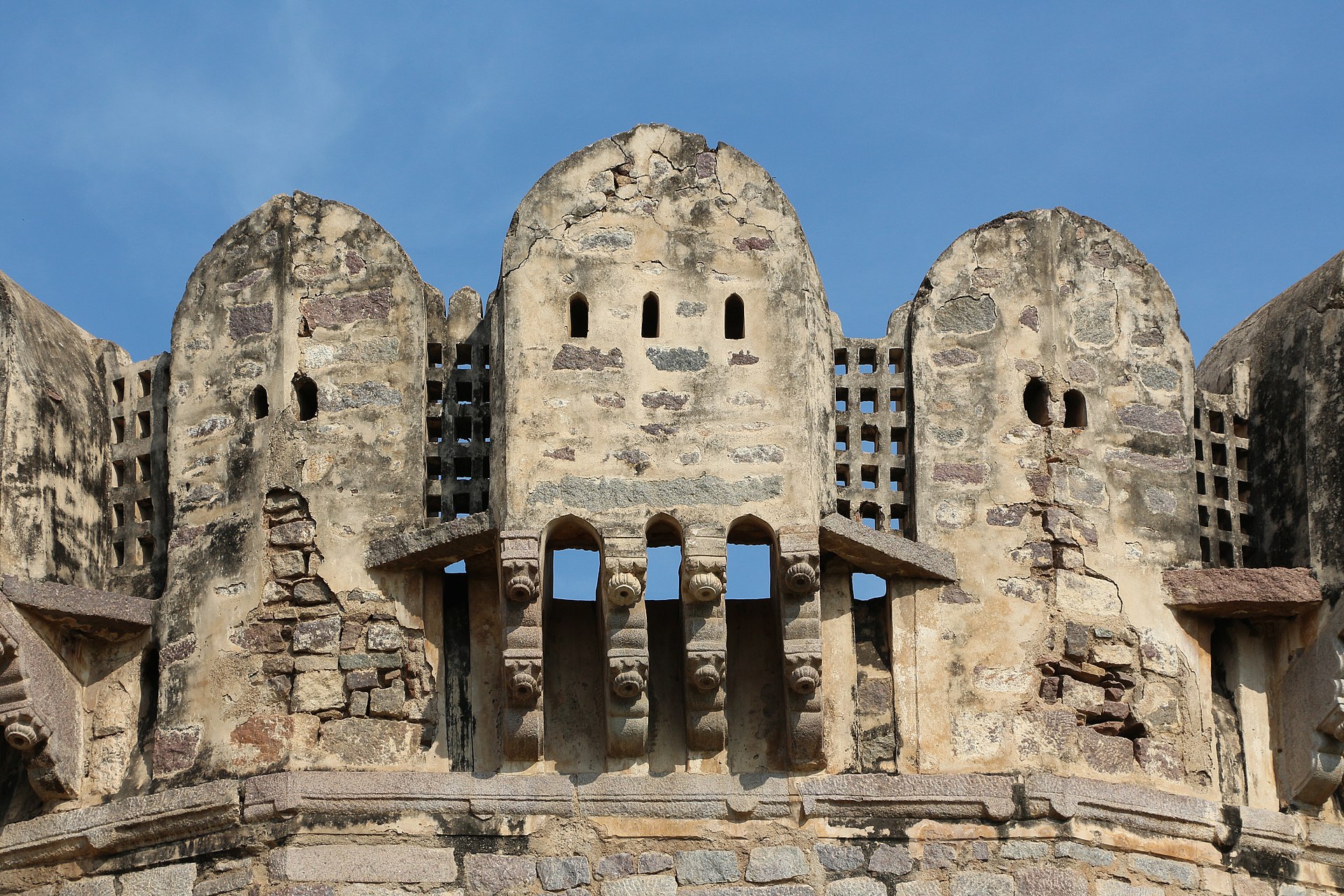
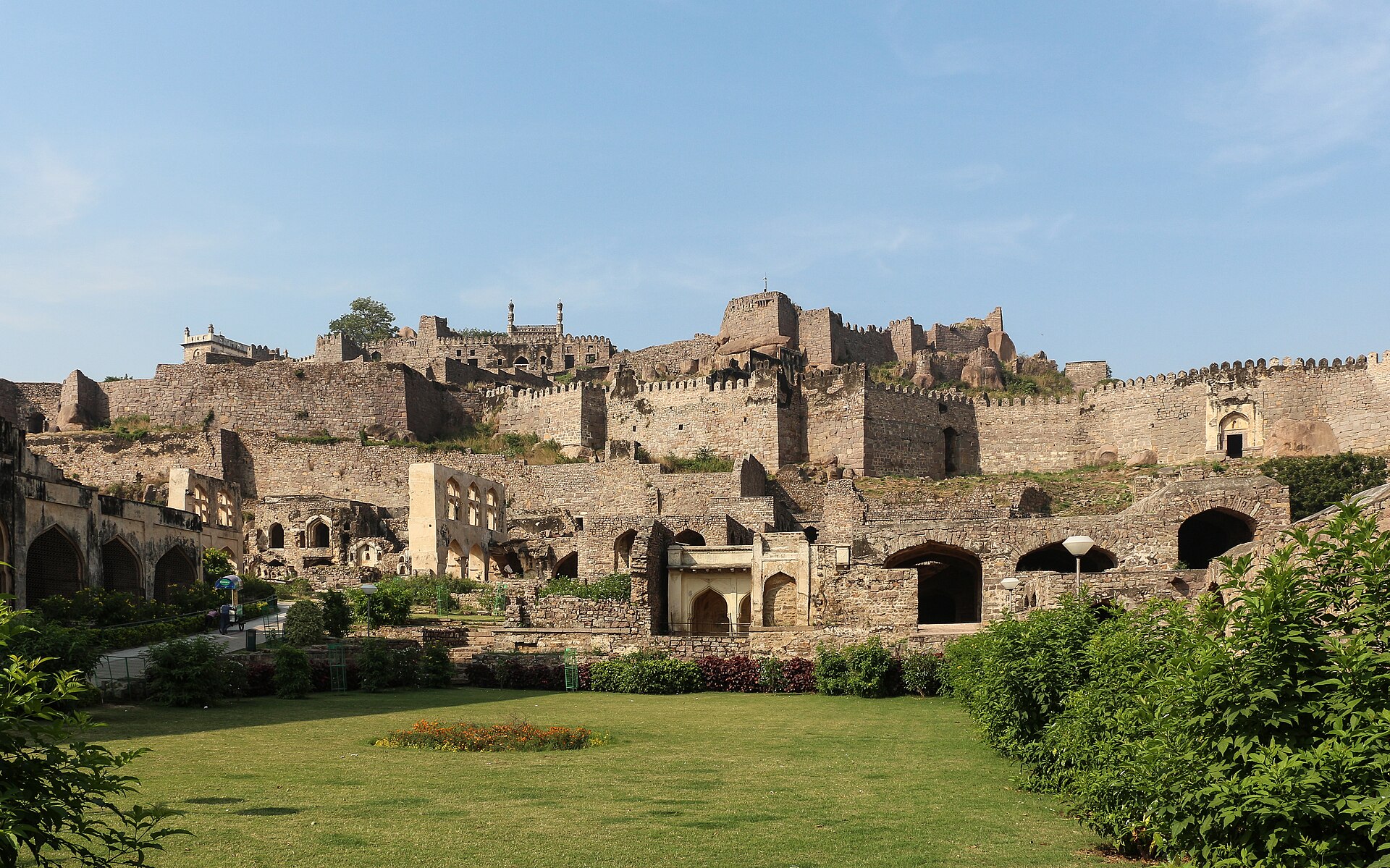
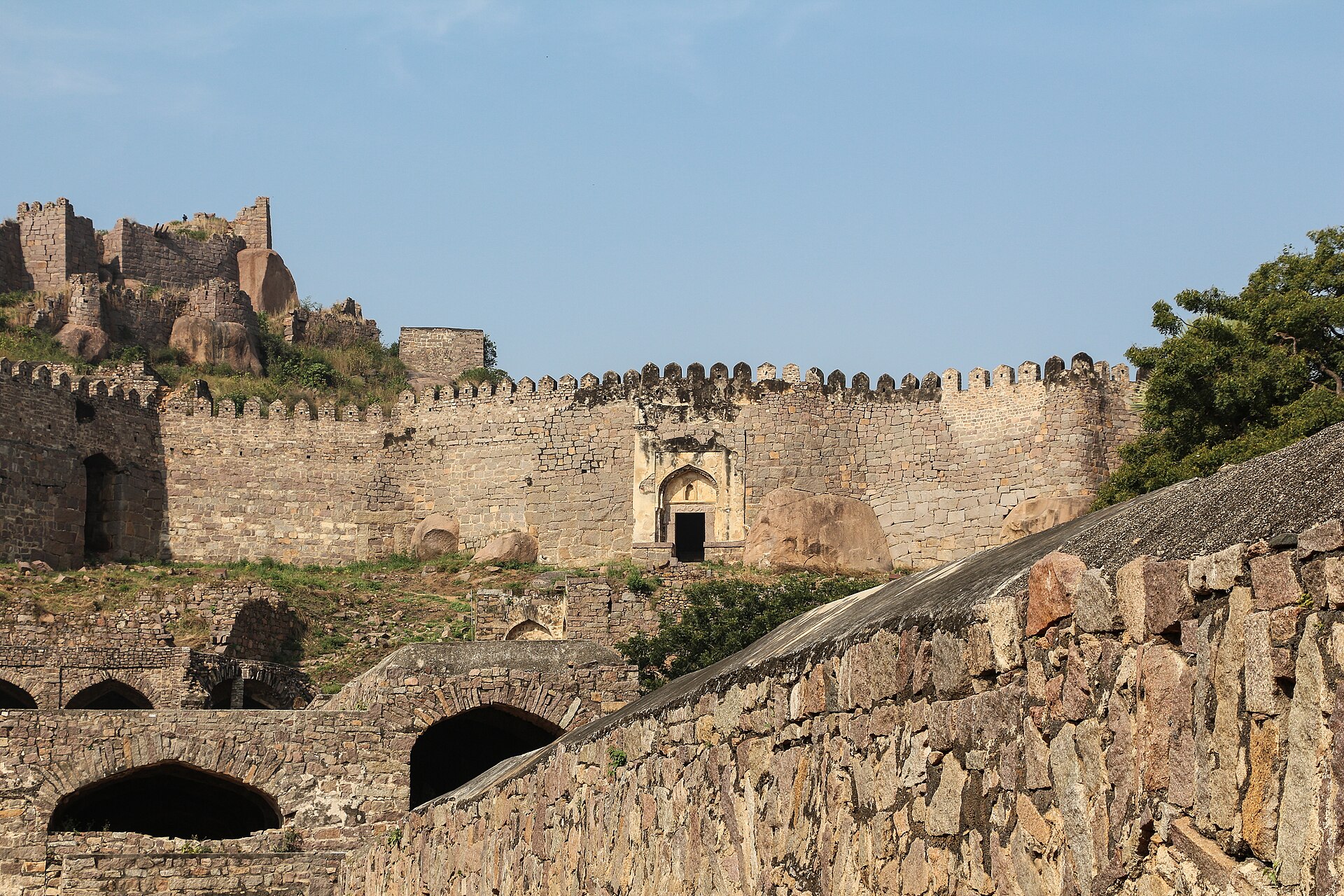
The scale of the fortifications of Golconda is staggering, for the great fortress was defended by a series of walls, the outermost of which extended for some ten kilometers around the hill and the city at its foot, studded with no fewer than eighty-seven great semicircular bastions. Within this vast outer circuit lay further lines of walls, dividing the fortress into distinct fortified sections, so that an attacker who breached one line found himself faced with another.
These mighty granite walls, built with massive blocks of stone fitted together with great skill, made Golconda one of the strongest fortresses in all of India. The eighty-seven bastions provided platforms for cannon and archers, covering every approach with their fire, and the successive lines of walls created a defence in depth of formidable strength. To walk the length of these enormous fortifications, climbing from the outer walls to the citadel on the summit, is to appreciate the immense power and wealth of the sultanate that raised them.
The defence in depth provided by the successive lines of walls was one of the great strengths of Golconda, for it meant that the fall of the outer wall did not mean the fall of the fortress, but only the beginning of a new struggle for the inner defences. An attacker had to fight his way through line after line of fortifications, each strongly held, before he could reach the citadel at the summit. This layered system, combined with the natural strength of the hill and the great height of the Bala Hisar, made Golconda a fortress of formidable and daunting strength.
The four distinct fortified sections into which the walls divided the fortress each served a different purpose and could be defended independently, adding to the resilience of the whole. This modular arrangement, in which the fortress was composed of a series of interlocking strongholds rather than a single enclosure, was a sophisticated response to the challenge of defending so large an area, and it reflects the mature military thinking of the engineers of the Qutb Shahis. Golconda was less a single castle than a whole fortified landscape.
The Eight Gates and the Iron Spikes
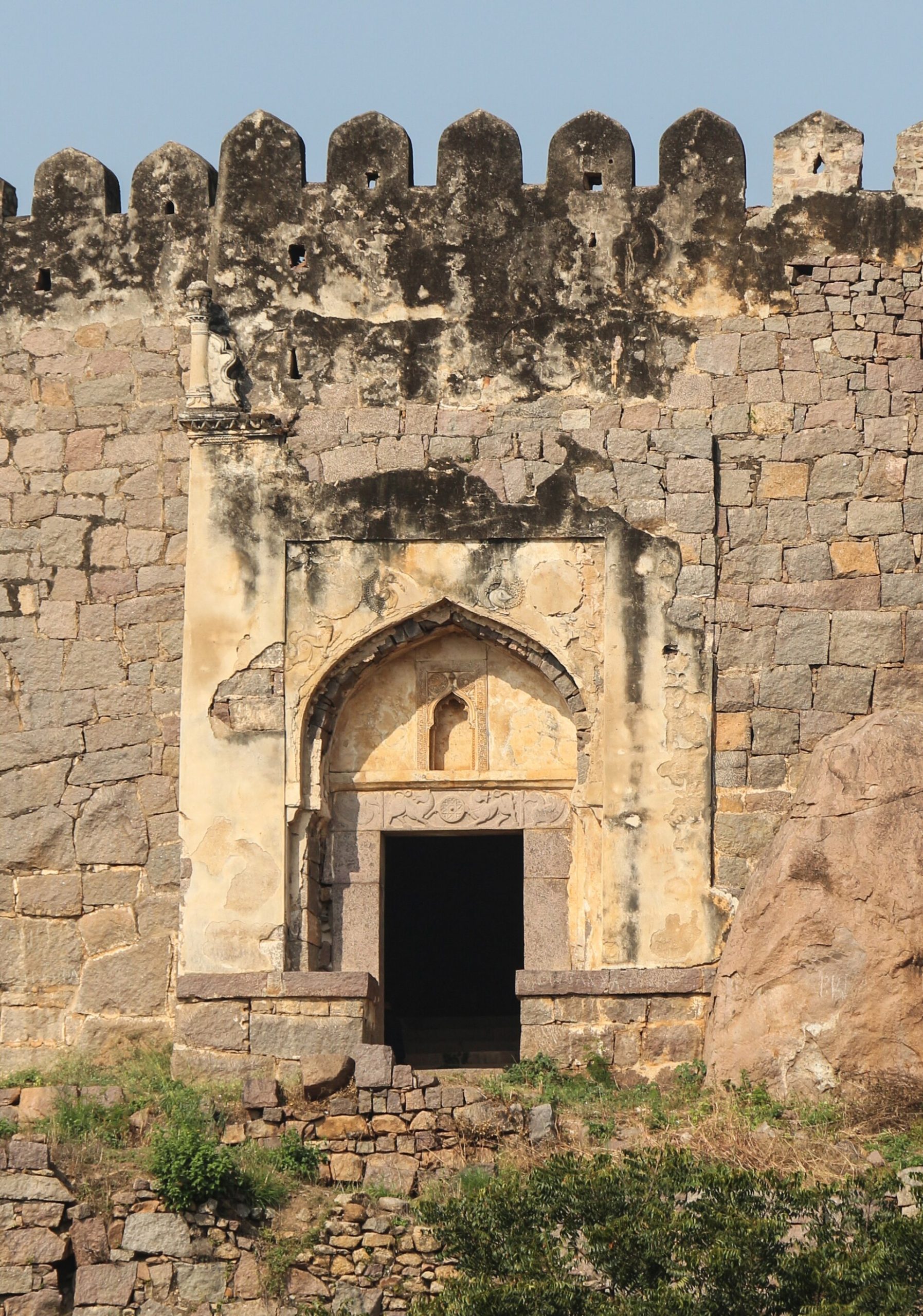
The great outer wall of Golconda was pierced by eight massive gateways, each a formidable stronghold in its own right, guarding the entrances to the fortress. These gates were built to withstand the most determined assault, and they were studded with great iron spikes, set at the height of an elephant’s forehead, to prevent the enemy from using war elephants as living battering rams to break down the doors, a common tactic in the warfare of medieval India.
The most famous of the gates is the Fateh Darwaza, the Victory Gate, at the southeastern corner of the fortress, a mighty structure that was not only a formidable defence but also, as we shall see, the site of one of the most remarkable acoustic phenomena of any fortress in the world. The great gates of Golconda, with their iron spikes and their massive doors, are among the most impressive features of the fortress, and they bear vivid witness to the realities of siege warfare in the age when Golconda was built.
The use of iron spikes upon the gates to counter war elephants was a widespread feature of the fortress architecture of medieval India, where the elephant was a formidable engine of war, used to smash down gates and to trample the enemy. The great doors of Golconda, reinforced and spiked, were designed to defeat this terrible weapon, and they bear witness to the particular character of Indian warfare in the age when the fortress was built. Every element of the gates was considered with an eye to the realities of the siege warfare of the Deccan.
Beyond the Fateh Darwaza, the other great gates of Golconda each guarded a different approach to the fortress, and each was a formidable structure in its own right, with its own defences and its own history. The names of the gates, and the stories attached to them, form part of the rich lore of the fortress, and passing through them today, the visitor follows in the footsteps of the sultans, the soldiers, the merchants, and the diamond-traders who thronged the great fortress in the days of its glory. The gates are the thresholds of the whole dramatic story of Golconda.
The Acoustic Marvel of the Fateh Gate
One of the most extraordinary features of Golconda, and one that continues to amaze visitors to this day, is the remarkable acoustic phenomenon at the Fateh Darwaza, the Victory Gate. Beneath the dome of the gateway there is a particular spot where a single hand-clap produces a sound that, through the ingenious design of the structure, is carried and amplified so that it can be heard clearly at the Bala Hisar pavilion, the highest point of the fortress, almost a kilometer away.
This astonishing acoustic effect was no accident but a deliberate feature of the design, serving as an early-warning system by which the guards at the gate could signal the approach of danger to the citadel high above, without the need for any messenger. It is a striking testament to the sophistication of the engineers who built Golconda, who understood the science of sound so well that they could incorporate it into the very defences of the fortress. The clapping point at the Fateh Gate remains one of the great wonders of Golconda, demonstrated to every visitor.
The acoustic engineering of the Fateh Gate is all the more remarkable when one considers that it was achieved without any of the modern science of sound, purely through the careful shaping of the dome and the surrounding structures by builders who had learned, through observation and experience, how to control and direct the echoes. That so subtle and so precise an effect could be built into the very fabric of a fortress gate is a striking demonstration of the sophistication of the architects of Golconda, and it remains one of the most celebrated features of the fortress.
Visitors to Golconda today never tire of testing the acoustic marvel of the Fateh Gate for themselves, clapping their hands at the marked spot and marveling as the sound is carried up to the distant citadel, and the demonstration has become one of the highlights of any visit. It is a wonderful thing to encounter, across the centuries, so vivid and so playful a demonstration of the ingenuity of the fortress’s builders, and it forges a direct and delightful connection between the modern visitor and the vanished world of the Qutb Shahis.

The Bala Hisar: The Citadel on the Hill
At the very summit of the great granite hill stands the Bala Hisar, the upper citadel, the highest and strongest point of the whole fortress and the ultimate stronghold in time of danger. Reached by a long climb up hundreds of steps, through gates and past ruined palaces, the Bala Hisar crowns the fortress and commands a tremendous view over the whole complex, the city of Hyderabad, and the surrounding country of the Deccan.
At the top of the Bala Hisar stands a pavilion, the very spot to which the sound of a hand-clap at the distant Fateh Gate is carried by the acoustic marvel of the fortress. From this commanding height the rulers and defenders of Golconda could survey their whole domain and watch for the approach of any enemy. The climb to the Bala Hisar, though strenuous, is richly rewarded by the magnificent views and by the sense of standing at the very pinnacle of one of the great fortresses of India.
The long climb to the Bala Hisar, up hundreds of granite steps and through the successive gates and ruined buildings of the fortress, is a journey through the whole history of Golconda, passing the palaces, mosques, and defences of the great citadel. At the summit, the ruined pavilion and the panoramic view reward the effort of the ascent, and the visitor stands at the very apex of one of the great fortresses of India, at the point to which, across the centuries, the sound of a distant hand-clap has been faithfully carried by the marvel of the fortress’s acoustics.
The pavilion at the summit of the Bala Hisar, though now ruined, was once a place of pleasure and of command, where the sultans could enjoy the cool breezes and the magnificent views while keeping watch over their domain. It was the culmination of the whole ascending sequence of the fortress, from the outer walls at the foot of the hill to this highest point at the summit, and it embodied the hierarchy of the fortress in physical form, with the seat of ultimate power and refuge crowning the whole great complex of walls and palaces below.
The Palaces and the Durbar Hall
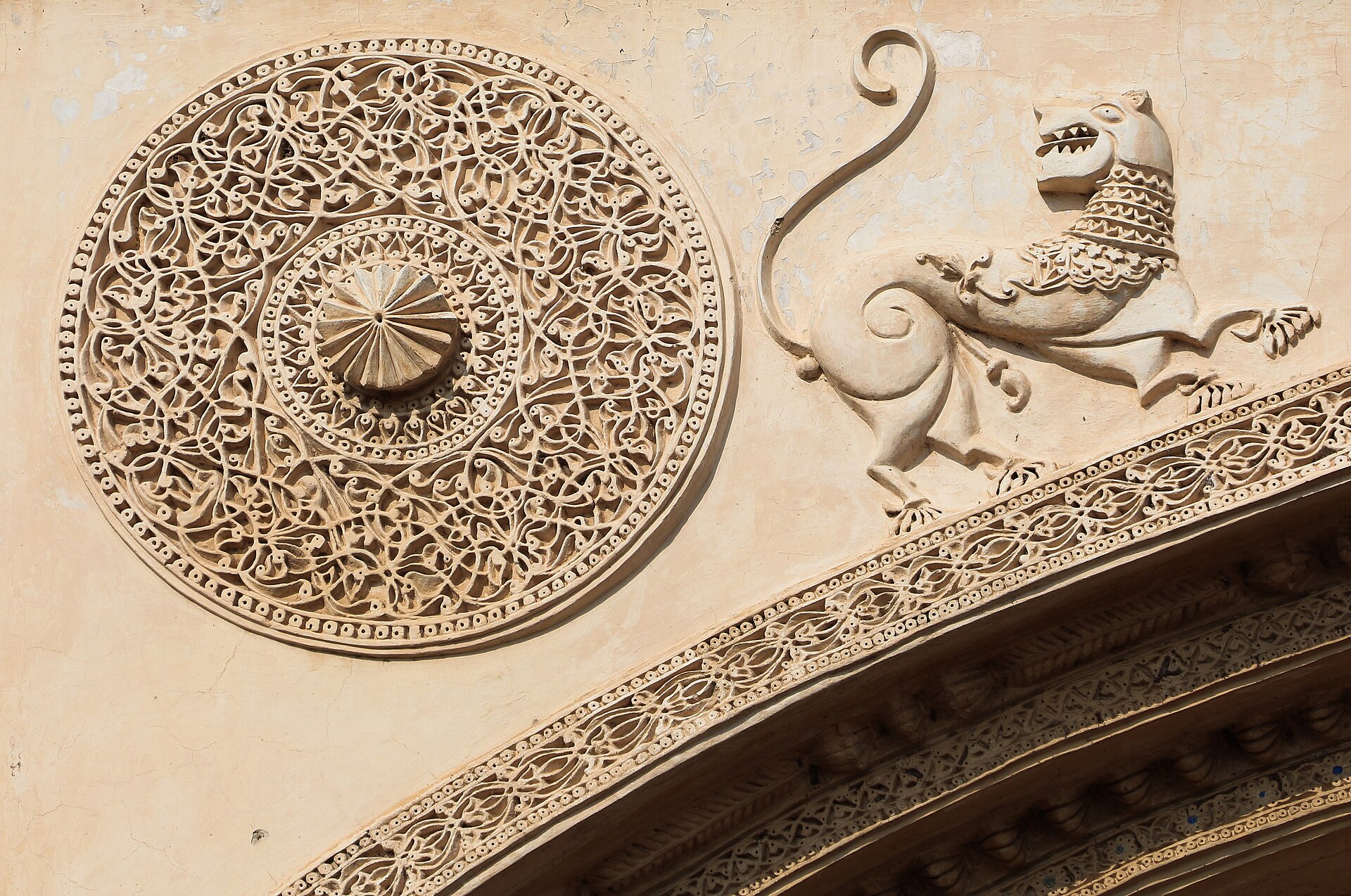
Within the walls of Golconda lay a whole city, containing the palaces of the sultans, the halls of state, temples, mosques, stables, and all the buildings needed to house the court and the garrison of a great capital. Among the most important of these was the Durbar Hall, the great hall of audience where the Qutb Shahi sultans held their court and received the ambassadors and petitioners who came to the fortress from far and wide.
The fortress also contained temples, including an ancient Hindu shrine to the goddess Jagadamba, reflecting the diverse religious life of the Deccan, where Hindu and Muslim traditions existed side by side. Though most of these buildings now stand in ruins, enough survives to convey the scale and the splendor of the city that once flourished within the walls. To wander among the ruined palaces and halls of Golconda is to sense the vanished glory of the Qutb Shahi court, one of the most brilliant in the India of its age.
The coexistence of Hindu temples and Muslim mosques within the walls of Golconda reflects the composite culture of the Qutb Shahi kingdom, which, though ruled by a Muslim dynasty, governed a largely Hindu population and drew upon both traditions in its art, its administration, and its daily life. This relative tolerance and blending of cultures was one of the hallmarks of the Deccan sultanates, and it produced a civilization of great richness and originality. The ruins of Golconda, with their temples and mosques side by side, are a monument to this distinctive world.
The Durbar Hall, set high in the fortress, was the ceremonial heart of the Qutb Shahi state, the place where the sultan sat in majesty to conduct the business of his kingdom, to receive homage, and to dispense justice and favor. Here the pomp and ceremony of one of the great courts of India was displayed in all its splendor, amid surroundings of the utmost magnificence. Though now ruined and open to the sky, the hall still commands a magnificent prospect, and it is easy to imagine the scenes of state that once unfolded within its walls.
The Ingenious Water System
A fortress the size of Golconda, housing a great garrison and a whole city, required an abundant and reliable supply of water, and the engineers of the Qutb Shahis met this challenge with remarkable ingenuity. They devised an elaborate system of water supply, using a series of Persian wheels, driven by oxen, to raise water from great tanks and wells and to carry it, through a network of clay pipes and channels, up the hill to the highest points of the fortress, even to the citadel of the Bala Hisar.
This sophisticated hydraulic system, which brought running water to the palaces, gardens, and fountains of the fortress, was one of the marvels of Golconda, and it reflects the high level of engineering skill in the Qutb Shahi kingdom. The ability to supply water to every part of so large and so elevated a fortress was essential both to the comfort of daily life and to the ability of the garrison to withstand a long siege. The remains of the water system, with its channels and tanks, can still be traced throughout the ruins of the fortress.
The Persian wheel, or saqiya, used to raise the water of Golconda, was an ancient and ingenious device, in which a chain of buckets, driven by animal power through a system of gears, lifted water from a well or tank and poured it into a channel. The use of such devices on a large scale, combined with an elaborate network of pipes and channels, allowed the engineers of Golconda to overcome the great challenge of supplying water to a fortress set high upon a hill. It was a triumph of medieval hydraulic engineering, and one of the keys to the greatness of the fortress.
The great tanks and reservoirs that stored the water of Golconda, some of them of considerable size, were an essential part of the system, holding the reserves that allowed the fortress to withstand a long siege even in the dry season of the Deccan. The combination of storage and distribution, of tanks, wells, wheels, and channels, formed an integrated water system of great sophistication, and it stands as one of the finest examples of the hydraulic engineering of medieval India. Without it, the great fortress upon its waterless hill could never have existed.
The Diamonds of Golconda
The name of Golconda is forever linked with diamonds, for the fortress was the great center of the diamond trade of the medieval world, and the mines of the surrounding region, above all the famous Kollur mine, produced some of the most celebrated gemstones in all of history. The rough diamonds were brought to Golconda to be cut, traded, and sold, and the fortress became a byword for fabulous wealth, its markets thronged with merchants from across the world.
Among the legendary diamonds that passed through Golconda were some of the most famous stones ever known, including the Koh-i-Noor, now among the British Crown Jewels, the Hope Diamond, and the Regent, each with its own extraordinary history. So great was the fame of Golconda as a source of riches that its very name entered the English language as a synonym for a mine of untold wealth. The diamond trade was the foundation of the prosperity of the Qutb Shahi kingdom, and it made Golconda one of the richest places on earth.
It is a remarkable fact that, for centuries, virtually all the great diamonds of the world came from the mines around Golconda, for until the discovery of diamonds in Brazil and later in South Africa, India was the sole source of these precious stones. The very word Golconda thus came to signify a source of inexhaustible wealth, and the diamonds that bear its name, scattered now among the treasuries and crowns of the world, carry with them the memory of the great fortress from which they came. Few places have given so much to the treasure-houses of the earth.
The great diamond market of Golconda drew merchants and travelers from across the world, among them the famous French jeweler and traveler Jean-Baptiste Tavernier, who visited the diamond mines and the fortress in the seventeenth century and left a vivid account of the fabulous wealth he saw. Through such accounts, the fame of Golconda spread throughout Europe, and its name became legendary. The diamonds of Golconda adorned the crowns and treasuries of kings and emperors around the world, spreading the fame of the fortress far beyond the borders of India.
The legacy of the Golconda diamonds endures to this day in the great gemstones scattered among the crown jewels and museums of the world, each a fragment of the fabulous wealth that once flowed through the fortress. To hold or to behold one of these stones is to touch, in a very direct way, the history of Golconda, for these are the actual treasures that made the fortress famous. In the diamonds that bear its name, the memory of the great fortress of the Deccan lives on, imperishable and brilliant, long after the walls themselves have fallen into ruin.

The Rani Mahal and the Mosque
Among the many buildings of the fortress was the Rani Mahal, the palace of the queen, one of the finest of the royal residences of Golconda, where the women of the court lived amid beauty and seclusion. Though now ruined, the Rani Mahal still displays traces of its former splendor, with the remains of fine decoration and elegant architecture that speak of the refined life of the Qutb Shahi court. It was one of the jewels of the fortress in its heyday.
The fortress also contained mosques, for the Qutb Shahi sultans were Muslims, and the religious life of the court centered upon the daily round of prayer. These mosques, together with the Hindu temples that also stood within the walls, reflect the religious diversity of the Deccan and the relative tolerance of the Qutb Shahi rulers, who governed a mixed population of Hindus and Muslims. The palaces, mosques, and temples of Golconda together made up a complete and splendid capital, sheltered within the mighty granite walls.
The seclusion of the royal women in the Rani Mahal and the other palaces of the zenana followed the customs of the age, common to both the Hindu and Muslim traditions of India, and the architecture of these palaces was designed to combine privacy with comfort and beauty. Behind their screens and lattices, the women of the Qutb Shahi court lived lives of luxury and refinement, and some among them, the mothers and chief queens of the sultans, could exercise considerable influence over the affairs of the kingdom. The ruined palaces still whisper of this hidden world.
The Siege of Aurangzeb
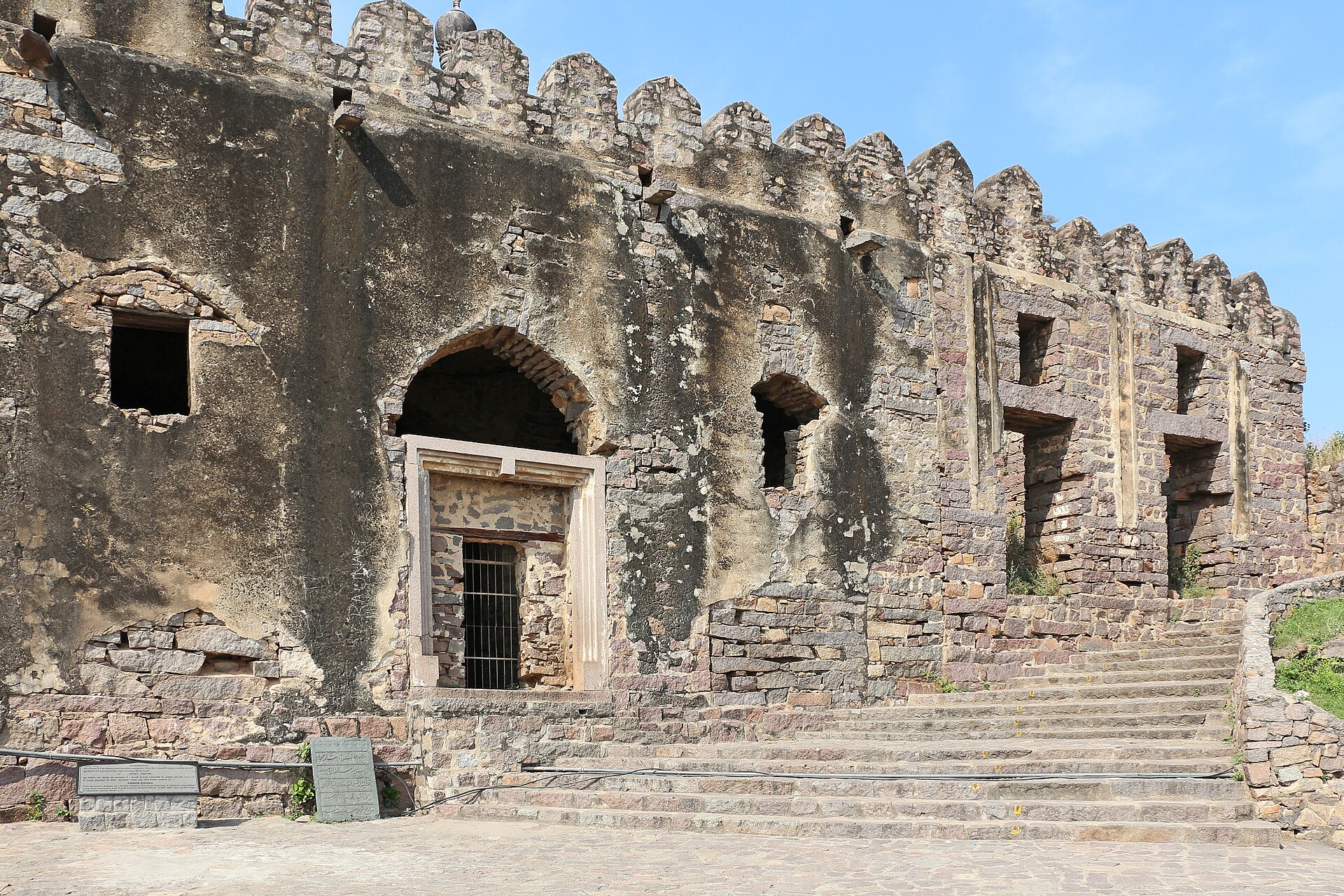
The independence and the glory of Golconda came to an end in the year 1687, when the great Mughal emperor Aurangzeb, in his relentless campaign to conquer the sultanates of the Deccan, brought his mighty army against the fortress. The siege that followed was one of the most famous in the history of India, for the great granite walls of Golconda defied the Mughal army for a full eight months, resisting every assault and every stratagem.
In the end, however, the fortress fell not to force but to treachery, when a traitor is said to have opened one of the gates to the Mughals, allowing them to enter and take the citadel. The last of the Qutb Shahi sultans, Abul Hasan Tana Shah, was captured and imprisoned, and his kingdom was absorbed into the Mughal empire. With the fall of Golconda, the great age of the fortress came to an end, and it gradually declined into the ruin in which it stands today, a monument to a vanished sultanate.
The eight-month resistance of Golconda to the might of the Mughal empire, the greatest power in India, is a striking testament to the strength of the fortress, for few strongholds could have held out so long against so formidable a foe. That it fell in the end to treachery rather than to force only underlines the impregnability of its walls, which the Mughals, for all their power, could not overcome by assault. The siege of Golconda was one of the last great acts in the long struggle of the Deccan sultanates against the northern empire.
The fall of Golconda in 1687 was part of the great southern campaign of Aurangzeb, the last of the powerful Mughal emperors, who devoted the final decades of his long reign to the conquest of the Deccan sultanates. The absorption of Golconda and its sister sultanate of Bijapur brought the whole of the Deccan under Mughal rule, marking the greatest territorial extent of the empire. Yet the effort exhausted the Mughal state, and the fall of Golconda, a triumph in the short term, was part of the overreach that would soon contribute to the decline of the empire itself.
Golconda Today
Today the great fortress of Golconda, though in ruins, is one of the most important and most visited historic monuments in southern India, protected and maintained by the Archaeological Survey of India. Visitors come from all over the world to climb its walls, to marvel at the acoustic wonder of the Fateh Gate, and to explore the ruins of the palaces and halls of the vanished Qutb Shahi court, all the while imagining the fabulous wealth that once flowed through the fortress.
In the evenings, a sound and light show brings the history of the fortress vividly to life, telling the story of its rise and fall against the dramatic backdrop of the ruined walls. As one of the great monuments of the Deccan, and as the fortress whose name became a byword for the riches of the diamond trade, Golconda holds a special place among the historic sites of India, and it is proposed for recognition as a World Heritage Site.
The sound and light show that now brings the history of Golconda to life for evening visitors is a fitting tribute to a fortress whose most famous feature is itself an acoustic marvel, and it has introduced the dramatic story of the Qutb Shahis to countless visitors. The careful preservation of the ruins by the Archaeological Survey ensures that this great monument, and the memory of the fabled kingdom of diamonds, will endure for future generations, a lasting reminder of one of the most brilliant chapters in the history of the Deccan.
If you would like to see exactly where this mighty fortress stands upon the map, you can find it here:
View on Google Maps: 17.3833, 78.4011
From its granite hill above Hyderabad, Golconda has watched over the Deccan for many centuries, and its ruined walls stand there yet, a monument to the fabled fortress of diamonds.

Castles Nearby
If the grandeur of Golconda has moved you, you may enjoy these other magnificent forts of India:
- Mehrangarh Fort: The Mighty Fort of the Sun above Jodhpur
- Amber Fort: The Golden Palace-Fortress of Rajasthan
The Fortress of Diamonds
Golconda is one of the great fortresses of India, the mighty stronghold of the Qutb Shahi sultans, whose very name became a byword for the fabulous wealth of the diamond trade. Its colossal granite walls, its ingenious acoustic defences, its ruined palaces and its commanding citadel combine to make it one of the most impressive and most romantic of all the monuments of the Deccan, a fortress steeped in the history of one of the great diamond kingdoms of the world.
If you should travel to southern India, Golconda is one of the essential sights of Hyderabad, a fortress of overwhelming scale and haunting atmosphere. To climb through its gates to the citadel on the hill, to marvel at the acoustic wonder of the Victory Gate, and to gaze out over the ruins of a once-fabulous city is an unforgettable experience. Golconda is a monument to a vanished age of splendor, and it deserves its place among the greatest fortresses of the world.
Whether you come for the deep history of the Qutb Shahis, for the acoustic marvel of the Fateh Gate, or for the romance of the fabled fortress of diamonds, Golconda will reward your journey, and you will carry away the memory of this mighty granite stronghold, standing in majestic ruin above the Deccan, as one of the great experiences of any journey to southern India.
You May Like

Mafra, the Palace a King Built From a Vow