Towering over the blue-washed houses of the old city of Jodhpur, rising sheer from a great cliff of rock in the desert of Rajasthan, Mehrangarh is one of the mightiest and most magnificent fortresses in all of India. The stronghold of the Rathore rulers of Marwar, it is a place of colossal walls and soaring gates, of exquisite painted palaces and grim reminders of war, a fortress so vast and so imposing that the writer Rudyard Kipling declared it a palace that might have been built by giants and colored by the morning sun.
In this article you are invited to explore the history and the architecture of this stupendous fortress, from its founding by a great Rajput king in the fifteenth century, through its role as the seat of a proud warrior dynasty, to the magnificent palaces and the poignant memorials that it contains. Mehrangarh is a fortress of superlatives, one of the largest and best preserved in India, and it stands, high above the Blue City, as one of the supreme achievements of the martial and artistic culture of Rajasthan.

In This Article
- A Fortress on the Mountain of Birds
- Rao Jodha and the Founding
- The Rathores of Marwar
- The Mighty Walls
- The Seven Gates
- The Iron Gate and the Sati Handprints
- The Cannonball Scars
- The Flower Palace and the Pearl Palace
- The Mirror Palace
- The Armoury and the Museum
- The Temple of Chamunda
- The Blue City Below
- Mehrangarh Today
- Castles Nearby
- The Fort of the Sun
A Fortress on the Mountain of Birds
The setting of Mehrangarh is one of tremendous drama, for the great fortress rises upon a steep and rocky hill, once known as the Bhakurcheeria, the Mountain of Birds, that lifts it some hundred and twenty meters above the plain and the city of Jodhpur below. From this commanding height the fortress dominates the whole surrounding country, its massive walls seeming to grow directly out of the living rock of the cliff, so that fortress and mountain appear as one.
The effect, seen from the city below, is overwhelming, for the great mass of the fortress towers over the blue-washed houses like a mountain of masonry, a colossal presence that dominates every view. Rudyard Kipling, who saw it in the nineteenth century, was moved to describe it as the work of giants, and the description is apt, for there is something almost superhuman about the scale and the boldness of Mehrangarh. It is a fortress that seems to belong to the world of legend as much as to that of history.
The fortress covers an enormous area, spreading over the top of the great rock for some distance, and its scale is best appreciated by walking its length and gazing out over the sheer drops that fall away on every side. The natural strength of the site, combined with the artificial strength of the walls, made Mehrangarh one of the most formidable fortresses in all of India, a stronghold that could defy almost any attacker. Its position, dominating the city and the surrounding desert, was the key to the power of the Rathores over the kingdom of Marwar.
The comparison drawn by Kipling, of a palace built by giants and colored by the morning sun, captures perfectly the quality of Mehrangarh at dawn, when the rising sun sets the golden-brown stone of the walls aglow and the whole vast fortress seems to catch fire with light. It is a sight that has moved travelers for generations, and it lends a peculiar aptness to the name of the fortress, the Fort of the Sun. Few buildings anywhere respond so magnificently to the changing light of day.

Rao Jodha and the Founding
The great fortress was founded in the year 1459 by Rao Jodha, the fifteenth ruler of the Rathore dynasty of Marwar, who decided to move his capital from the old fort of Mandore to a new and more defensible site upon the Mountain of Birds. The foundation of the fort is said to have been laid on the twelfth of May in that year, and the new stronghold, and the city that grew up around it, took their name from the great king, becoming Jodhpur, the city of Jodha.
A famous and rather grim legend attaches to the founding of the fortress. The hill chosen by Rao Jodha was the home of a hermit, who was obliged to leave to make way for the fort, and who cursed the site with a perpetual shortage of water. To counter the curse and to ensure the prosperity of the fortress, a man is said to have volunteered, or been persuaded, to be buried alive in the foundations, a sacrifice considered auspicious in the beliefs of the age. His descendants, it is said, were rewarded with land and live in the area to this day.
The move of the capital from Mandore to the new fortress of Mehrangarh was a decision of great strategic wisdom, for the old fort had become inadequate to the needs and the ambitions of the growing Rathore kingdom, while the new site offered a far stronger and more defensible position. In founding Jodhpur, Rao Jodha laid the foundations of a great city and a powerful state that would endure for centuries, and his name lives on in the city he created, a lasting monument to a king of vision and determination.
The curse of the hermit, condemning the fortress to a shortage of water, is said to have troubled Mehrangarh from time to time over the centuries, and it adds a note of the uncanny to the founding legend. The dark tale of the man buried alive in the foundations, meanwhile, reflects beliefs about sacrifice and prosperity that were widespread in the age, however disturbing they may seem to modern sensibilities. These legends, whatever their truth, are woven deep into the story of the fortress and the city it protects.

The Rathores of Marwar
Mehrangarh was the great stronghold of the Rathores, one of the most powerful of the Rajput warrior clans, who ruled the desert kingdom of Marwar from this fortress for centuries. The Rathores were famed, like all the Rajputs, for their courage, their pride, and their fierce devotion to the code of honor of their caste, and their rulers, bearing the proud titles of Rao and Maharaja, were among the leading princes of Rajasthan.
The name of the fortress, Mehrangarh, is derived from the Sanskrit words for the sun and for a fort, meaning the Fort of the Sun, a reference to the mythical descent of the Rathore clan from the sun god Surya. This solar symbolism was central to the identity of the dynasty, reinforcing their claim to a divine and royal lineage. As the seat of the Rathores and the symbol of their power, Mehrangarh was the heart of the kingdom of Marwar and one of the great centers of Rajput civilization.
The Rathores of Marwar, like the other great Rajput dynasties, traced their history back through many centuries of warfare and heroism, and their code of honor, known as Rajput dharma, placed the highest value upon courage in battle and death before dishonor. This warrior ethos shaped every aspect of their culture, and it is written into the very fabric of Mehrangarh, in its mighty walls, its victory gates, and the poignant handprints of the widows who died by sati. The fortress is a monument to a proud and unyielding martial tradition.
Marwar, the desert kingdom ruled from Mehrangarh, was one of the most important of the Rajput states, and its rulers played a significant role in the wider history of India, alternately fighting against and allying with the Mughal emperors, and later resisting and negotiating with the rising power of the Marathas and the British. Through all these changes, Mehrangarh remained the anchor of the kingdom and the symbol of the Rathore dynasty, whose descendants, the Maharajas of Jodhpur, retain their connection with the fortress to this day.
The Mighty Walls
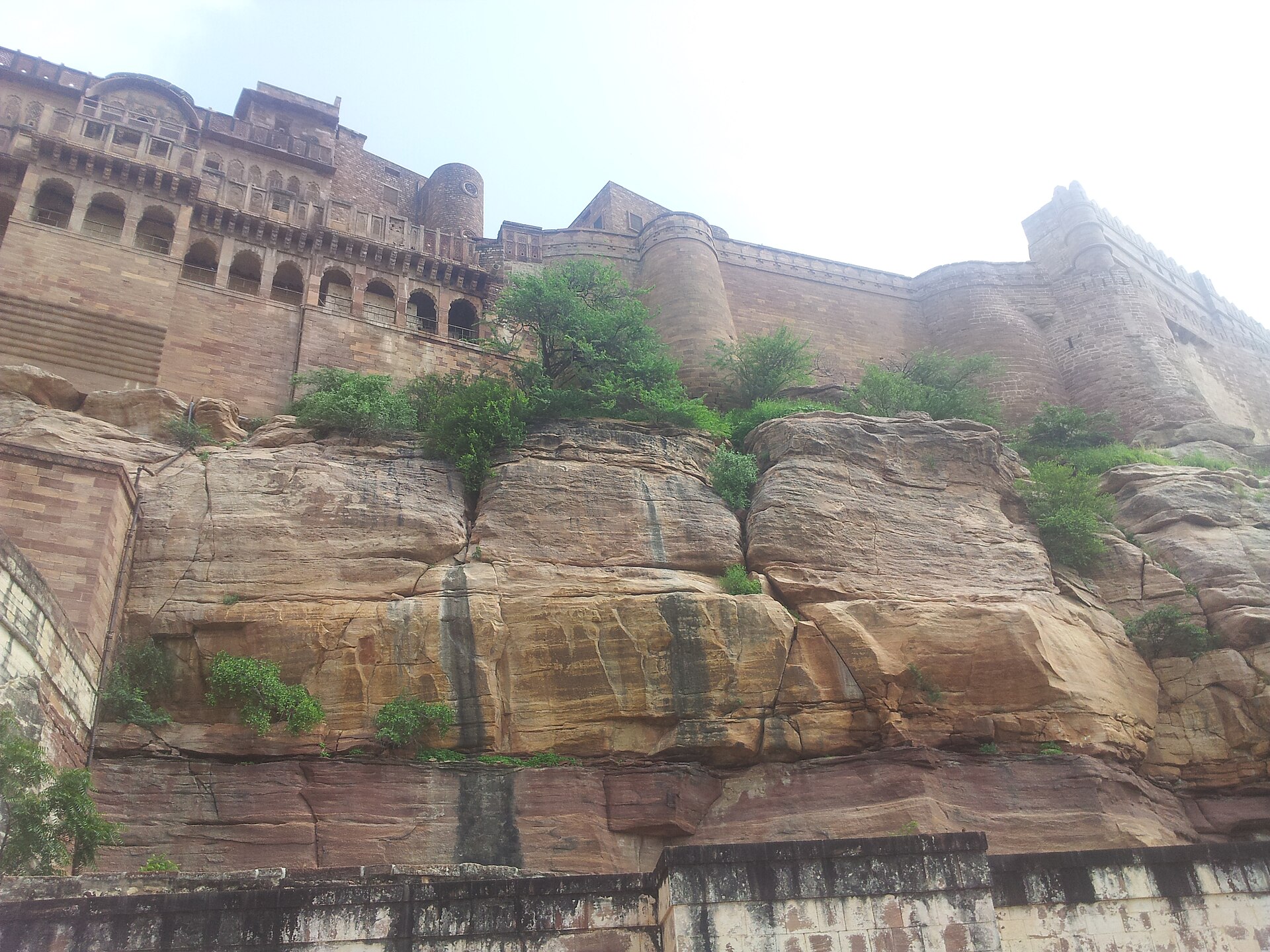
The most overwhelming feature of Mehrangarh is the sheer scale of its walls, which are among the mightiest of any fortress in the world. In places these colossal ramparts rise to a height of some thirty-six meters and reach a thickness of twenty-one meters, forming a barrier of almost unimaginable strength. Built of the golden-brown stone of the region, quarried from the very hill on which the fortress stands, they present an aspect of tremendous power and solidity.
These enormous walls, following the contours of the rocky hill, enclose a vast area within which lie the palaces, temples, and other buildings of the fortress. Their scale reflects both the military needs of an age of constant warfare and the desire of the Rathore rulers to proclaim their power and their permanence in the most emphatic possible terms. To stand at the foot of these mighty ramparts, or to walk along their summit, is to feel the full force of the ambition and the might of the dynasty that raised them.
The construction of walls on such a scale, from stone quarried on the site itself, was an enormous undertaking, and it is said that the rock removed in the building of the fortress was so extensive that it left the hilltop transformed. The seamless way in which the walls rise from the natural rock, so that it is often impossible to tell where the cliff ends and the masonry begins, is one of the most striking features of Mehrangarh, and it contributes greatly to the impression of overwhelming strength that the fortress conveys.
From the summit of the walls, the drop to the plain below is dizzying, and the defensive advantage this gave to the garrison can hardly be overstated, for no siege engine could be brought against such a position and no escalade attempted up such cliffs. The mighty ramparts were less a barrier to be defended than a declaration that the fortress was, quite simply, impregnable, a statement of invulnerability written in stone on the grandest possible scale. In their sheer, overwhelming mass, the walls of Mehrangarh have few rivals anywhere in the world.

The Seven Gates
The approach to the heart of Mehrangarh leads through a series of seven great gates, each one a formidable obstacle and each commemorating some victory or event in the long history of the dynasty. The visitor must pass through gate after gate, winding up the steep approach, each threshold marking a stage in the ascent to the palaces at the summit. This succession of gates was a key element of the fortress’s defences, forcing any attacker to overcome one barrier after another.
Among the most notable of the gates is the Jai Pol, the Victory Gate, built by Maharaja Man Singh in the early nineteenth century to celebrate his triumphs over the armies of Jaipur and Bikaner, and the Fateh Pol, which commemorates a victory over the Mughals. Each gate has its own story to tell, and together they form a kind of processional record of the martial history of the Rathores, a history written in stone upon the very approach to their great fortress.
The winding, uphill approach through the seven gates was a masterpiece of defensive design, for it forced any attacking force to advance slowly and in single file, exposed at every turn to the fire of the defenders on the walls above, and to overcome one heavily fortified gate after another. Some of the gates were set at angles to prevent the use of battering rams, and all were designed to break up and slow any assault. The approach to Mehrangarh was, in itself, a deadly gauntlet that few enemies would have dared to run.
The Fateh Pol, which commemorates the victory of Maharaja Ajit Singh over the forces of the Mughal empire in the early eighteenth century, marks a particularly proud moment in the history of Marwar, when the Rathores threw off Mughal domination and reasserted their independence. Each of the victory gates of Mehrangarh thus commemorates a specific triumph, and together they form a monument to the martial achievements of the dynasty, a record of victories written in the very gates through which all who entered the fortress had to pass.

The Iron Gate and the Sati Handprints
The last of the outer gates, the Loha Pol or Iron Gate, bears one of the most poignant and moving features of the whole fortress, a series of small handprints carved into the stone beside the gateway. These are the handprints of the widows of the Maharajas, who, in accordance with the ancient and now-abolished custom of sati, cast themselves upon the funeral pyres of their husbands, and who left the marks of their hands upon the gate as they passed out of the fortress for the last time on their way to death.
These handprints are a haunting reminder of the harsh and often tragic realities that lay behind the splendor of the Rajput court, and of the terrible fate that could await the women of the royal house. The custom of sati, in which a widow was expected, and often compelled, to die with her husband, was one of the darkest aspects of the culture of the age, and the small handprints upon the Iron Gate speak with a mute eloquence of the human cost of the world that built Mehrangarh.
The custom of sati, though now long abolished and universally condemned, was in the age of the Rajputs regarded as the supreme expression of a wife’s devotion to her husband, and the widows who committed it were honored as heroines and even worshipped as goddesses. The handprints upon the Iron Gate were made by these women as they went to their deaths, and they became objects of veneration, marked with red and honored by the people. They remain among the most affecting sights in all of Mehrangarh, a window into a vanished and often tragic world.
The number of handprints upon the gate, each representing a woman who went to her death, gives a sobering sense of the scale of the practice among the royal house, and each mark is a memorial to an individual life sacrificed to a terrible custom. Visitors today often pause in silence before these handprints, reflecting upon the human stories they represent. In preserving them, the fortress preserves not only its triumphs but also its tragedies, and it does not shrink from confronting the darker aspects of the world that produced it.

The Cannonball Scars
The great fortress of Mehrangarh was not merely a symbol of power but a working stronghold, and it bears upon its walls and gates the scars of the wars in which it was involved. On one of the gates, the Dedh Kangra Pol, the visitor can still see the marks left by cannonballs fired during a bombardment by the armies of Jaipur, a vivid and tangible reminder of the conflicts of the age. These scars, preserved rather than repaired, bring the martial history of the fortress vividly to life.
The wars between the Rajput kingdoms, and between the Rajputs and their various enemies, were a constant feature of the history of Rajasthan, and Mehrangarh, as one of the great strongholds of the region, saw its share of conflict. The cannonball marks upon its gates are a reminder that the beautiful palaces within the fortress were protected by these mighty walls precisely because the danger of attack was ever present. In the scars of Mehrangarh, the reality of war is written for all to see.
The bombardment that left its marks upon the gate of Mehrangarh was part of the endless wars between the Rajput states, which, for all their shared culture and their common code of honor, fought one another as fiercely as they fought any foreign enemy. The rivalry between Jodhpur and Jaipur, the two great Rajput powers, was particularly intense, and the cannonball scars upon the gate are a memento of one episode in this long and bitter struggle. They remind us that the beauty of Mehrangarh was born in an age of blood and iron.

The Flower Palace and the Pearl Palace
Within the mighty walls of Mehrangarh lie a series of magnificent palaces, exquisitely decorated, which formed the residence of the Rathore rulers and the setting for the life of their court. Among the most beautiful are the Phool Mahal, the Flower Palace, and the Moti Mahal, the Pearl Palace, both adorned with sumptuous decoration and reflecting the wealth and the refined taste of the Maharajas of Jodhpur.
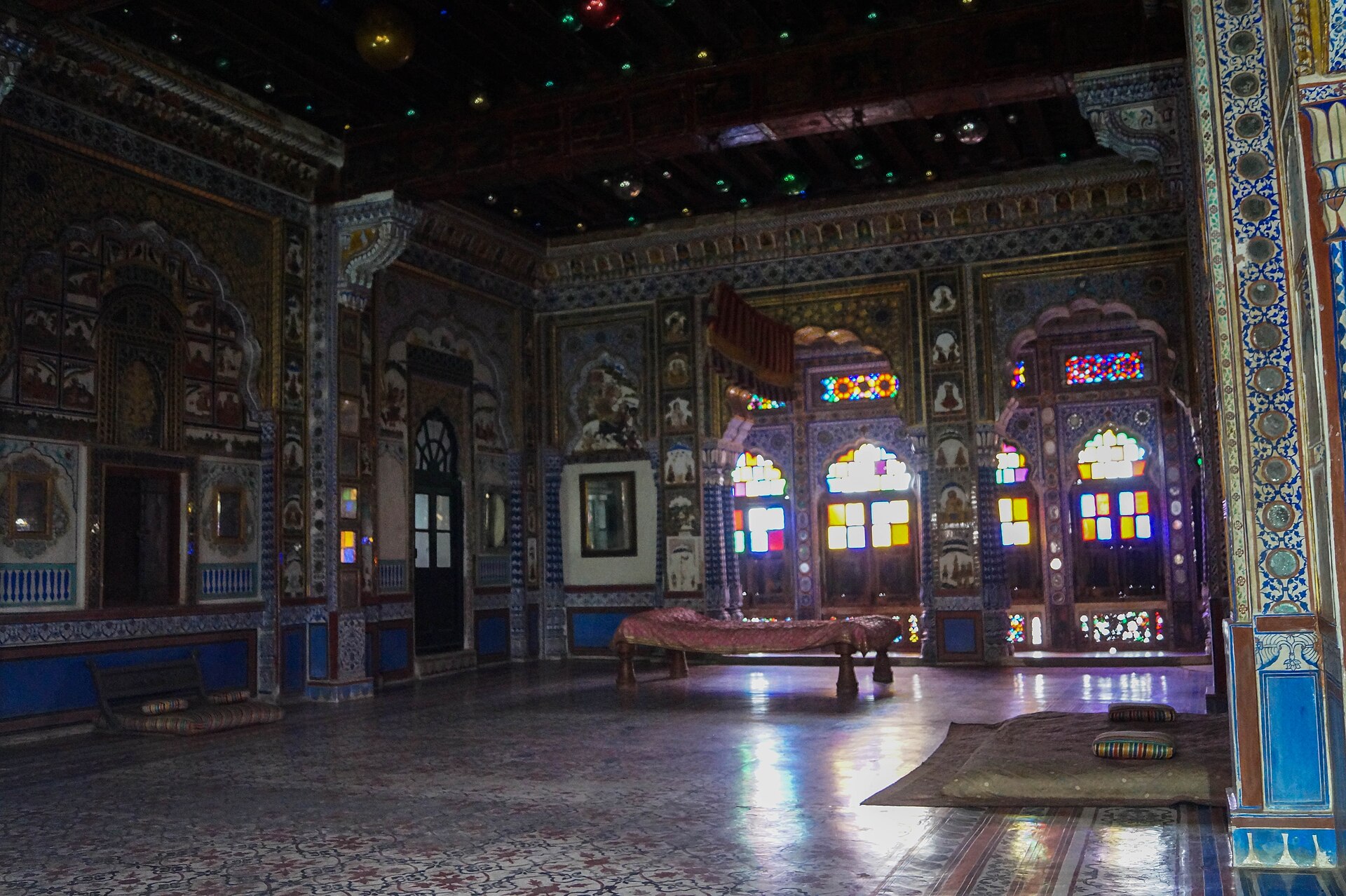
The Phool Mahal, or Flower Palace, is a chamber of great splendor, its walls and ceiling adorned with gold leaf, brilliant colors, and intricate designs, a hall fit for the pleasures and entertainments of the court. The Moti Mahal, or Pearl Palace, is another of the great state rooms of the fortress, where the ruler would hold audience amid surroundings of the utmost magnificence. These palaces, hidden within the grim exterior of the fortress, reveal the other face of Mehrangarh, a world of art and luxury sheltered behind the mighty walls.
The palaces of Mehrangarh, with their gold leaf and their brilliant colors, their fine paintings and their delicate stone-carving, reflect the immense wealth of the Rathore rulers and their patronage of the arts, which made their court one of the great centers of culture in Rajasthan. Behind the grim, martial exterior of the fortress lay a world of refinement and luxury, of music and poetry and painting, and the great palaces were the setting for this cultivated life. In them, the warrior kings of Marwar revealed themselves also as great patrons and connoisseurs of beauty.
The Daulat Khana and the other state rooms of the fortress complete the ensemble of the royal apartments, spaces where the formal business of the court was conducted amid surroundings of great splendor. Together, the palaces of Mehrangarh form one of the finest surviving groups of Rajput royal architecture, and they allow the visitor to trace the development of the decorative arts of Marwar across the centuries, from the earlier, more restrained work to the exuberant richness of the later palaces. They are among the great treasures of the fortress.

The Mirror Palace
Like the great fortress-palace of Amber, Mehrangarh possesses its own Sheesha Mahal, or Mirror Palace, a chamber adorned with the intricate mirror-work that was one of the glories of Rajput decorative art. The walls and ceiling of the hall are inlaid with countless pieces of mirrored glass, set into elaborate patterns, so that the whole chamber glitters and shimmers with reflected light, creating an effect of dazzling beauty.
The Mirror Palace was one of the private apartments of the ruler, a place of retreat and pleasure, where the play of light upon the mirrors produced an atmosphere of enchantment. The art of the mirror inlay, combined with fine painting and colored glass, was brought to a high pitch of perfection in the palaces of Rajasthan, and the Sheesha Mahal of Mehrangarh is a superb example of this exquisite craft. It is one of the many treasures that lie hidden within the walls of the great fortress.
The mirror-work of the Sheesha Mahal, like that of Amber, was created by setting countless small pieces of mirrored and colored glass into intricate designs upon the walls and ceiling, a technique that required great skill and patience. The effect, when the chamber was lit, was of a space that seemed to dissolve into a shimmering field of light, an environment of magical beauty designed for the private pleasure of the ruler. It is one of the many hidden jewels of Mehrangarh, a chamber of enchantment concealed within the mighty fortress.

The Armoury and the Museum
Mehrangarh today houses one of the finest palace museums in all of India, a treasure-house of the art and the history of the Rathore dynasty and the kingdom of Marwar. Among its many collections is a superb armoury, the Sileh Khana, displaying the weapons and armor of the Rajput warriors, including jade-hilted swords, jewel-studded shields, and historic weapons of great value, among them a sword said to have belonged to the great Mughal emperor Akbar and the massive war-sword of Rao Jodha himself.
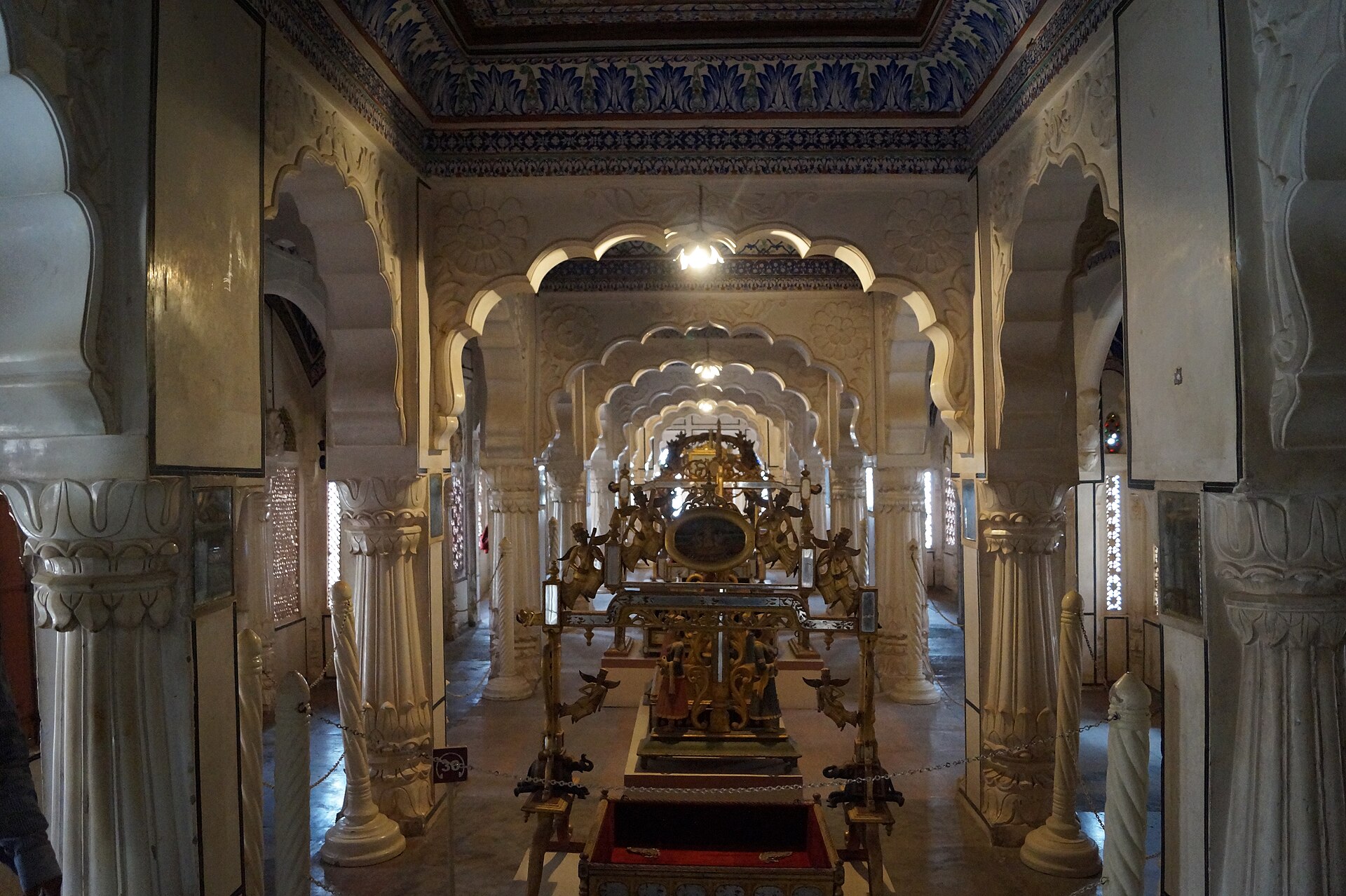
Beyond the armoury, the museum displays a rich array of the treasures of the court, including magnificent palanquins and elephant-howdahs in which the rulers traveled in state, royal cradles, fine miniature paintings, musical instruments, costumes, and a remarkable gallery of the turbans of the different communities of Rajasthan. Together these collections offer a vivid and comprehensive picture of the life and the culture of one of the great courts of India, preserved within the walls of the fortress that was its home.
The collection of the Mehrangarh museum is widely regarded as one of the finest of its kind in India, and its Mughal gallery in particular preserves an outstanding collection of the fine and applied arts of the Mughal period, a legacy of the close relations between the Rathores and the imperial court. The museum offers an unrivaled window into the material culture of the Rajput courts, from the weapons of war to the finery of peace, and it makes a visit to Mehrangarh a journey into the whole rich world of the princes of Marwar.
Among the most treasured items in the collection is the great war-sword of Rao Jodha himself, the founder of the fortress, a weapon of prodigious size and weight that speaks of the strength and prowess of the Rajput warriors of old. To see such objects, the actual weapons and possessions of the great figures of the dynasty, is to feel a direct and powerful connection with the history of Mehrangarh, and it brings the martial world of the Rathores vividly to life within the very walls that they built and defended.
The Temple of Chamunda
Within the walls of Mehrangarh stands a temple dedicated to the goddess Chamunda, a fierce form of the great Hindu mother goddess, who was the favored deity of the founder of the fortress, Rao Jodha. The king is said to have brought the image of the goddess to Mehrangarh from the old capital of Mandore in the year 1460, and she has been worshipped as the protector of the fortress and the dynasty ever since.
The temple of Chamunda is a place of deep devotion, drawing worshippers from the city and beyond, and it is especially thronged during the great festival of Dussehra, when the goddess is honored with particular fervor. The presence of the temple at the heart of the fortress reflects the deep religious faith of the Rathore rulers, for whom the favor of the goddess was essential to their success in war and their prosperity in peace. The worship of Chamunda remains a living tradition, a link to the spiritual life of the old court of Marwar.
The tragic events of a stampede at the temple during a festival in modern times, in which many worshippers lost their lives, are a reminder of the enduring intensity of the devotion that draws great crowds to the shrine of Chamunda. For the people of Jodhpur, the goddess remains a powerful and beloved protector, and her temple within the fortress is one of the most important religious sites of the city. The continuity of her worship, across more than five centuries, is a testament to the deep and living faith that centers upon the great fortress.
The Blue City Below
One of the most enchanting sights from the ramparts of Mehrangarh is the view down upon the old city of Jodhpur, famous throughout the world as the Blue City for the striking blue color of so many of its houses. Seen from the heights of the fortress, the old town appears as a sea of blue, the flat-roofed houses washed in shades of indigo and azure that create one of the most distinctive and beautiful urban landscapes in all of India.
The origin of the blue color is variously explained, some saying it marked the houses of the Brahmins, the priestly caste, others that the blue wash helped to keep the houses cool or to repel insects. Whatever its origin, the sea of blue houses spread beneath the golden fortress is one of the great sights of Rajasthan, and it forms an unforgettable contrast with the mighty ramparts above. The Blue City and the great fortress together create a scene of extraordinary beauty and character.
The tradition of the blue houses has become one of the great attractions of Jodhpur, drawing visitors who wander the narrow lanes of the old city admiring the endless variations of blue, and the view of the Blue City from the fortress above is one of the iconic images of India. Whether the color began as a mark of caste, a means of keeping cool, or a way of repelling insects, it has given the city a unique and unforgettable character, and it forms, with the golden fortress above, one of the most beautiful compositions in all of Rajasthan.
Wandering the blue lanes of the old city, beneath the shadow of the great fortress, is one of the essential experiences of a visit to Jodhpur, for the Blue City is a living community, full of the color and the bustle of Indian life, and not merely a spectacle to be viewed from above. The relationship between the fortress and the city, the one towering over the other, is the defining feature of Jodhpur, and it embodies the ancient bond between the ruler upon his rock and the people who lived and worked in his shadow below.
The city of Jodhpur, founded together with the fortress by Rao Jodha, grew into one of the great cities of Rajasthan, a center of trade on the routes across the desert and a place of considerable wealth and importance. The intimate relationship between the great fortress on its rock and the blue city at its foot is the essence of Jodhpur, and it has endured for more than five centuries, the fortress protecting and dominating the city, the city serving and supporting the fortress, the two bound together in a single organic whole.

Mehrangarh Today
Today Mehrangarh is maintained by the Mehrangarh Museum Trust, and it is one of the best preserved and most visited fortresses in all of India, drawing travelers from around the world to marvel at its mighty walls, its magnificent gates, and its exquisite palaces and collections. The careful stewardship of the trust has ensured that the great fortress remains in superb condition, a living monument to the history and culture of Marwar.
The fortress has also become famous around the world as a filming location, appearing in international productions including a celebrated Batman film and adaptations of the Jungle Book, as well as in numerous Indian films, its dramatic architecture providing an unforgettable backdrop. Nearby, a desert rock park showcases the restored natural vegetation and the striking volcanic rock formations of the region, adding a natural wonder to the man-made marvel of the fortress.
The transformation of Mehrangarh from a royal residence into a museum and a cultural center, while preserving its magnificent fabric intact, is a model of how a great historic monument can be given new life while honoring its past. The Mehrangarh Museum Trust has not only conserved the fortress but made it a living center of the culture of Rajasthan, hosting festivals of music and other events that keep the traditions of the region alive. In this way the great Fort of the Sun continues to serve the people of Jodhpur, as it has done for more than five centuries.
To visit Mehrangarh is to encounter the whole world of the Rajputs in a single overwhelming monument, from the martial grandeur of the walls and gates to the refined beauty of the palaces, from the poignant memorials of the sati widows to the living devotion of the temple of Chamunda. Few fortresses anywhere offer so complete and so vivid a picture of the civilization that created them, and few command so magnificent a setting. Mehrangarh is a monument that stays with the visitor long after the journey is over, one of the truly unforgettable places of the world.
If you would like to see exactly where this stupendous fortress stands upon the map, you can find it here:
View on Google Maps: 26.2979, 73.0186
From its rock high above the Blue City, Mehrangarh has watched over the desert kingdom of Marwar for more than five centuries, and it stands there yet, the mighty Fort of the Sun.

Castles Nearby
If the grandeur of Mehrangarh has moved you, you may enjoy these other magnificent forts and palaces:
The Fort of the Sun
Mehrangarh is one of the great fortresses of the world, the Fort of the Sun, the mighty stronghold of the Rathores of Marwar, rising in colossal grandeur above the Blue City of Jodhpur. Its enormous walls, its magnificent gates, its exquisite palaces, and its poignant memorials combine to make it one of the most impressive and most moving of all the monuments of Rajasthan, a fortress that fully lives up to Kipling’s vision of a palace built by giants.
If you should travel to India, Mehrangarh is one of the essential sights of Rajasthan, a fortress of overwhelming power and beauty that no visitor should miss. To climb through its seven gates, to walk its mighty ramparts, and to explore its painted palaces, all the while gazing down upon the blue houses of the city far below, is an unforgettable experience. Mehrangarh is a monument worthy of the proud warriors who built it, and it deserves its place among the greatest fortresses on earth.
Whether you come for the overwhelming grandeur of the walls, for the exquisite beauty of the palaces, or for the unforgettable view over the Blue City, Mehrangarh will reward your journey beyond all expectation, and you will carry away the memory of the mighty Fort of the Sun, towering above the desert kingdom of Marwar, as one of the great experiences of any journey to India.
You May Like

Mafra, the Palace a King Built From a Vow