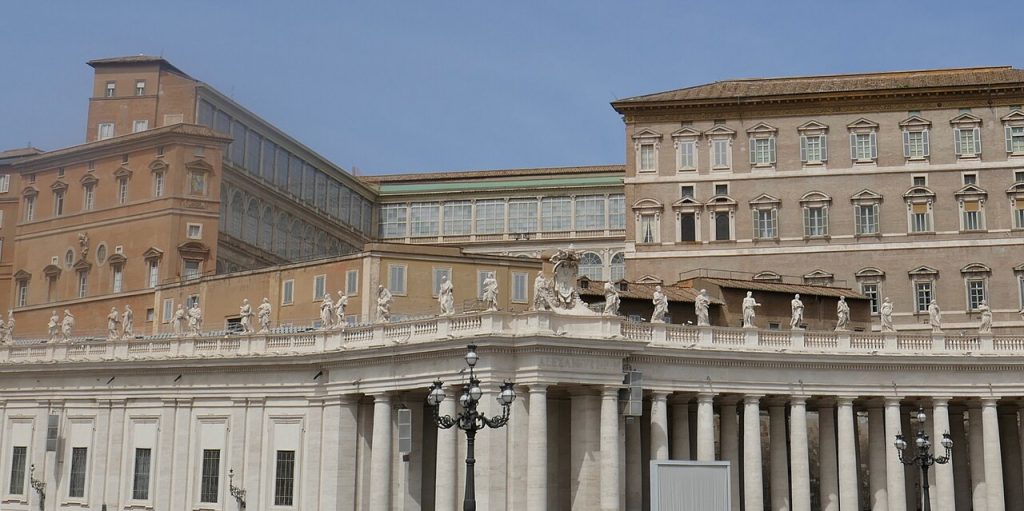
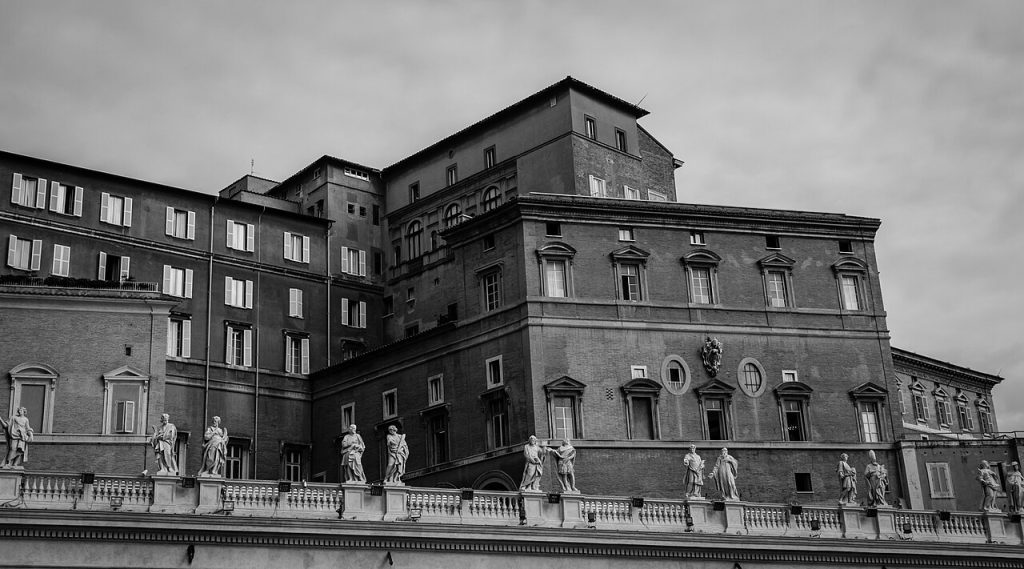
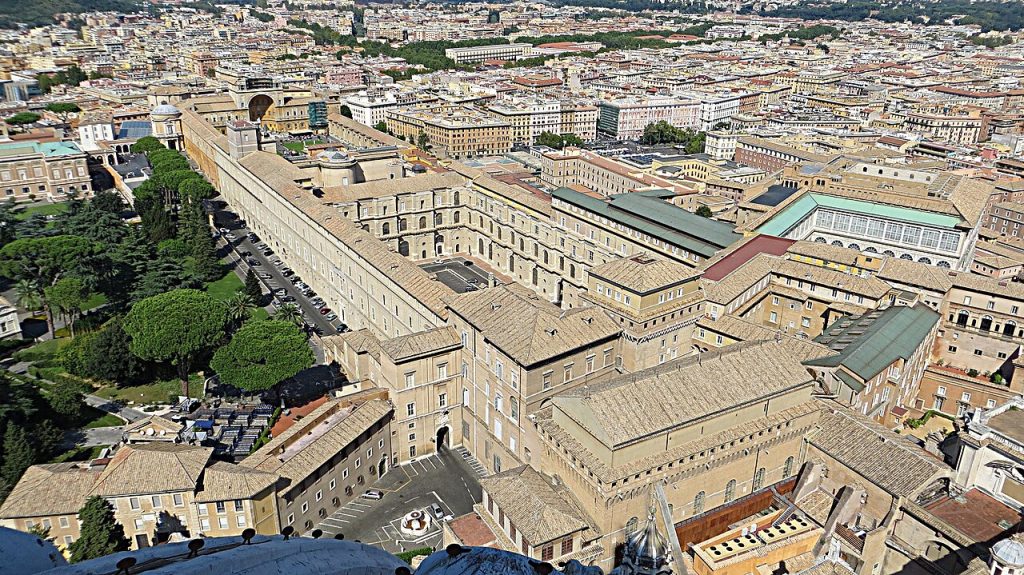
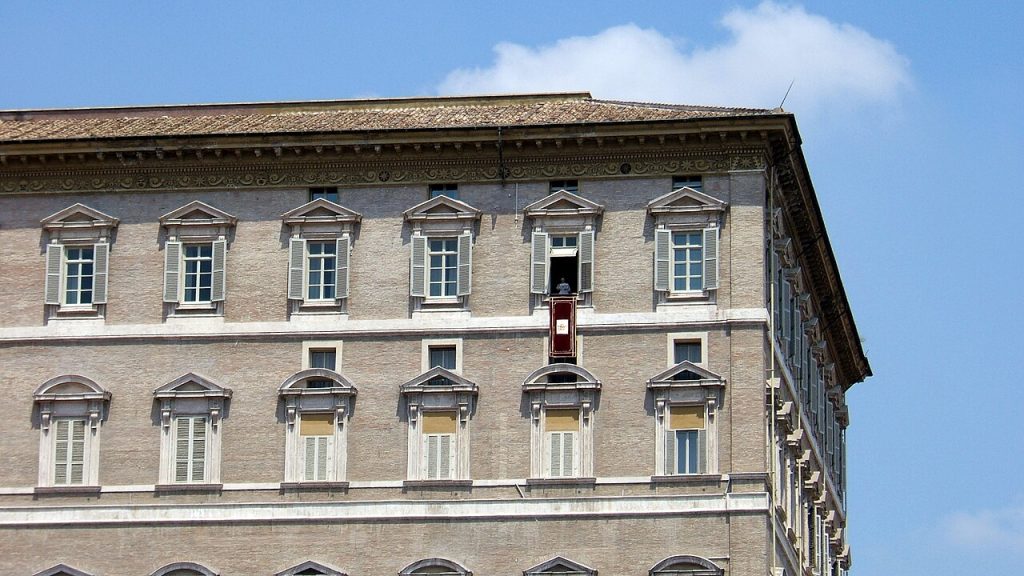
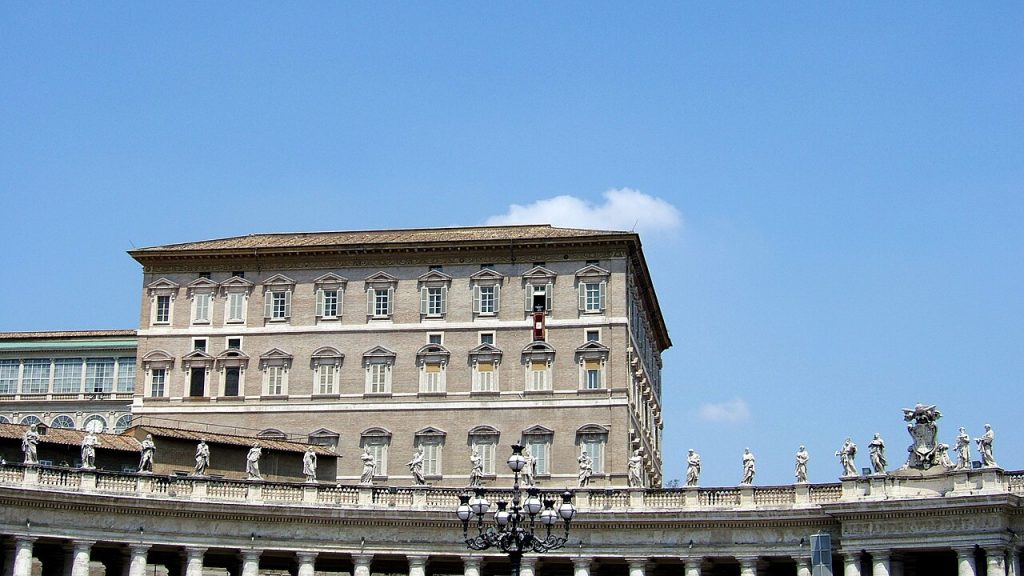
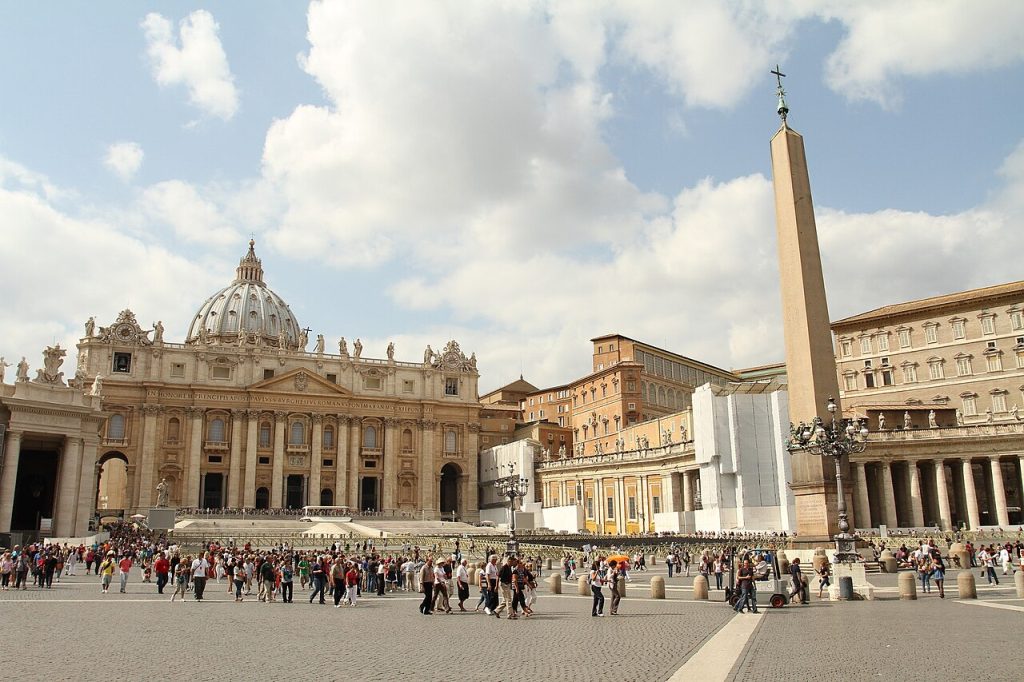
To the right of St Peter’s Basilica, as you stand in the square, a long block of ochre brick and pale stone rises five storeys above the colonnade, with regular windows and a plain roofline, and at the top right corner, the second window from the end, is the one from which the pope appears at noon on Sundays to bless the crowd. It is the Apostolic Palace, Palazzo Apostolico, the official residence of the popes since 1377, a complex of some one thousand four hundred rooms, chapels, courtyards, galleries and gardens built by thirty pontiffs over six centuries, which contains the Sistine Chapel, Raphael’s Stanze, the Borgia Apartment, the papal apartments, the Secretariat of State, the Vatican Library and most of the Vatican Museums.
It is the largest palace in this series and the least like any other: not a dynasty’s house but an institution’s, built by elected old men who each added a wing, a chapel or a loggia in the style of their time and left it to successors who were often their enemies, so that the palace is a history of European art from Fra Angelico to the twentieth century in one building. Most of it is open to anyone with a museum ticket, the papal apartments to almost no one, and the whole is the seat of a sovereign state of forty-four hectares that has had more influence on the world than most empires.
Walk with me from the square under the Bronze Door, up the Scala Regia and through the Sistine Chapel to the Stanze, the loggias and the window, with Nicholas V, Sixtus IV, Julius II and the popes of our time in order. The contents are below.
In This Article
- The Window Above the Square
- From the Lateran to the Vatican
- Nicholas V and the Palace of the Renaissance
- Sixtus IV and the Chapel That Bears His Name
- The Borgia Apartment of Alexander VI
- Julius II, Bramante and the Belvedere
- Raphael’s Stanze
- Michelangelo’s Ceiling and Last Judgement
- Sixtus V and the Palace Where the Popes Live
- Bernini’s Scala Regia and the Baroque Popes
- 1870 to 1929: The Prisoners of the Vatican
- The Papal Apartments and the Pope Who Left Them
- Museums, Conclaves and the Noon Blessing
- The Vatican on Video
- Visiting the Apostolic Palace Today
- Palaces Nearby
The Window Above the Square
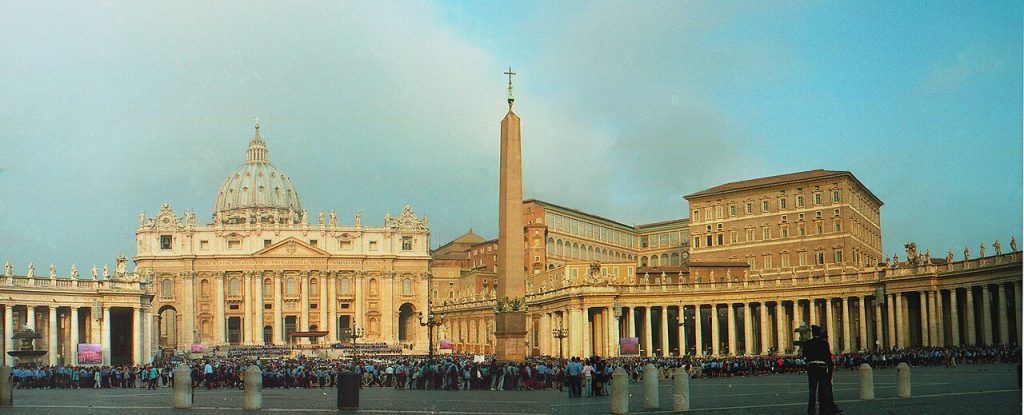
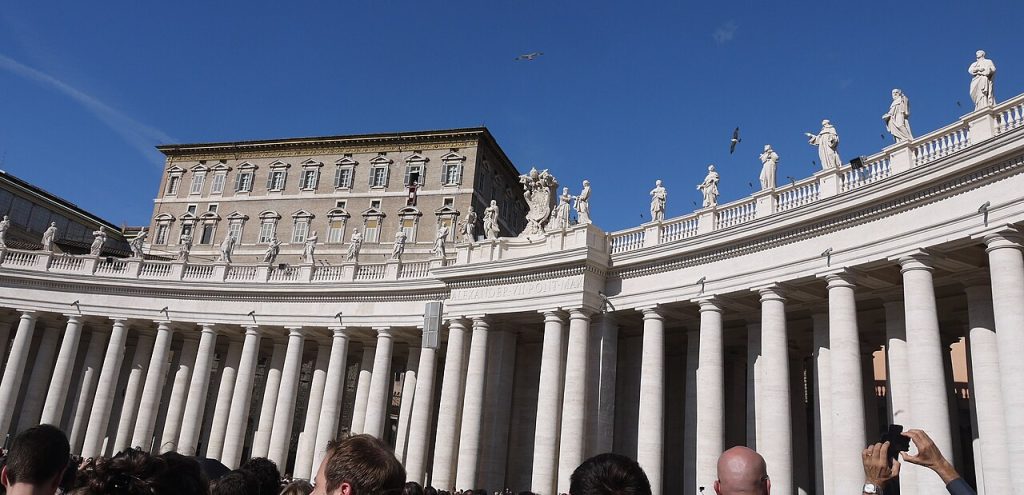
St Peter’s Square is Bernini’s oval of colonnades leading to Maderno’s facade of the basilica, and the palace stands at its north-east corner, a block of plain Renaissance brick rising above Bernini’s colonnade with its top floor, the papal apartments, lit at night when the pope is in residence. The window of the pope’s study, from which he says the Angelus at noon on Sundays, is the second from the right on the top floor, and a tapestry is hung from it for the occasion; below it the Bronze Door, guarded by Swiss Guards in their striped uniforms, is the palace’s official entrance from the square. The palace is the only part of the Vatican, apart from the basilica, that most visitors ever see, and most see only this facade.
Now, stop here at the obelisk at noon on a Sunday, with the square full, and look up at the window. The man who appears there is the two hundred and sixty-seventh in a line that claims to run back to the fisherman buried under the basilica’s dome, and the building he appears from was built to say exactly that.
From the Lateran to the Vatican
For the first thousand years of the papacy the popes lived not at the Vatican but at the Lateran, the palace beside the cathedral of Rome on the other side of the city, and the Vatican hill, with Constantine’s basilica over St Peter’s tomb, had only a modest residence for the pope’s visits and a fortification, the Leonine walls, built against the Saracens in the ninth century. Popes stayed here occasionally, Eugenius III and Innocent III built apartments beside the basilica in the twelfth and thirteenth centuries, and Nicholas III enlarged them in the 1270s and bought the land for the gardens. When Gregory XI brought the papacy back from its seventy years at Avignon in 1377 he found the Lateran burned and ruinous and settled at the Vatican, and the popes have lived here, with exceptions, ever since.
The mediaeval palace survives in fragments inside the Renaissance one, in the thick walls of the lower floors, and the Vatican’s choice as the papal seat was made by a fire, not by design.
Nicholas V and the Palace of the Renaissance
Nicholas V, pope from 1447 to 1455, a humanist scholar who founded the Vatican Library, planned to rebuild the Vatican as the capital of a Christian Rome with a new basilica and a new palace, and though he achieved only a fraction of it, his palace is the core of what stands: the block north of the basilica with the Cortile dei Pappagalli, the papal apartments on three floors that later popes decorated, the tower and the chapel that Fra Angelico painted for him in 1448 with the lives of St Stephen and St Lawrence, the earliest great fresco cycle in the palace and one of the quietest and most beautiful. Nicholas also began the Vatican Library, which Sixtus IV would house in the palace’s ground floor.
Nicholas’s rooms were later redecorated by the Borgias and by Raphael, so that the same walls carry three generations of Renaissance painting one above the other.
Sixtus IV and the Chapel That Bears His Name
Sixtus IV della Rovere, pope from 1471 to 1484, a Franciscan theologian and a ruthless politician, built the palace’s great chapel between 1473 and 1481 on the site of the mediaeval Cappella Magna, a plain brick box forty metres long with the proportions, it was said, of Solomon’s Temple, fortified on the outside and painted on the inside by the best painters of the day: Perugino, Botticelli, Ghirlandaio, Rosselli and Signorelli covered the walls in 1481 and 1482 with the lives of Moses and Christ in parallel, and the ceiling was painted blue with gold stars. The chapel was for the papal court’s liturgy and for the conclaves that elect the popes, and it has served both for five centuries.
Sixtus also built the Vatican Library’s first rooms, founded the Sistine choir and gave the Capitoline bronzes to Rome; his nephew Julius II would hire the man who made his chapel the most famous room in the world.
The Borgia Apartment of Alexander VI
Rodrigo Borgia, Alexander VI, pope from 1492 to 1503 and the most notorious of the Renaissance popes, father of Cesare and Lucrezia, took the first floor of Nicholas V’s wing as his apartment and had Pinturicchio and his workshop paint its six rooms between 1492 and 1494 with saints, sibyls, the liberal arts, the legend of Isis and Osiris and, everywhere, the Borgia bull and the pope’s own portrait kneeling before the risen Christ. The rooms, with their gilded stucco, their blue and gold ceilings and their Spanish tiles, are the richest surviving interiors of the fifteenth-century palace, and after Alexander’s death they were shut up by his enemy Julius II, who would not live in the Borgia’s rooms, and not used again by a pope for three centuries.
They now hold part of the museums’ collection of modern religious art, which makes a strange companion to Pinturicchio. Now, stop here in the Hall of the Saints and find the bull in the frieze: the Borgias signed everything.
Julius II, Bramante and the Belvedere
Giuliano della Rovere, Julius II, pope from 1503 to 1513, Sixtus IV’s nephew, a warrior and a builder, transformed the Vatican. He hired Bramante to link the palace with Innocent VIII’s Belvedere villa on the hill to the north by two long corridors three hundred metres long enclosing a vast terraced courtyard, the Cortile del Belvedere, for tournaments and spectacles; to build the spiral staircase up which horses could ride; to lay out the sculpture court where the Laocoön and the Apollo Belvedere, the beginnings of the Vatican’s collection, were displayed; and in 1506 to tear down Constantine’s basilica and begin the new St Peter’s. He also hired two young men to paint his rooms and his uncle’s ceiling.
Bramante’s corridors were later cut by the library and the Braccio Nuovo into the three courtyards the museums occupy today, and the museums’ route runs along them, so that every visitor walks Julius’s plan.
Raphael’s Stanze
Julius refused the Borgia Apartment and took the floor above, Nicholas V’s old rooms, and in 1508 he gave their decoration to Raphael, a twenty-five-year-old from Urbino, who painted them with his workshop until his death in 1520 and whose pupils finished them in 1524. The Stanza della Segnatura, the pope’s library, has the School of Athens, the Disputation of the Sacrament and Parnassus; the Stanza di Eliodoro the Expulsion of Heliodorus, the Mass at Bolsena and the Liberation of St Peter with its night light; the Stanza dell’Incendio the Fire in the Borgo; and the Sala di Costantino, by the pupils, the Donation of Constantine. They are, with the Sistine ceiling being painted a hundred metres away in the same years, the summit of the Roman High Renaissance.
Now, stop here before the School of Athens and find the painters: Raphael himself at the right edge in a black cap, Michelangelo as Heraclitus brooding on the steps, Bramante as Euclid with his compass and Leonardo as Plato. The palace’s builders painted themselves into it.
Michelangelo’s Ceiling and Last Judgement
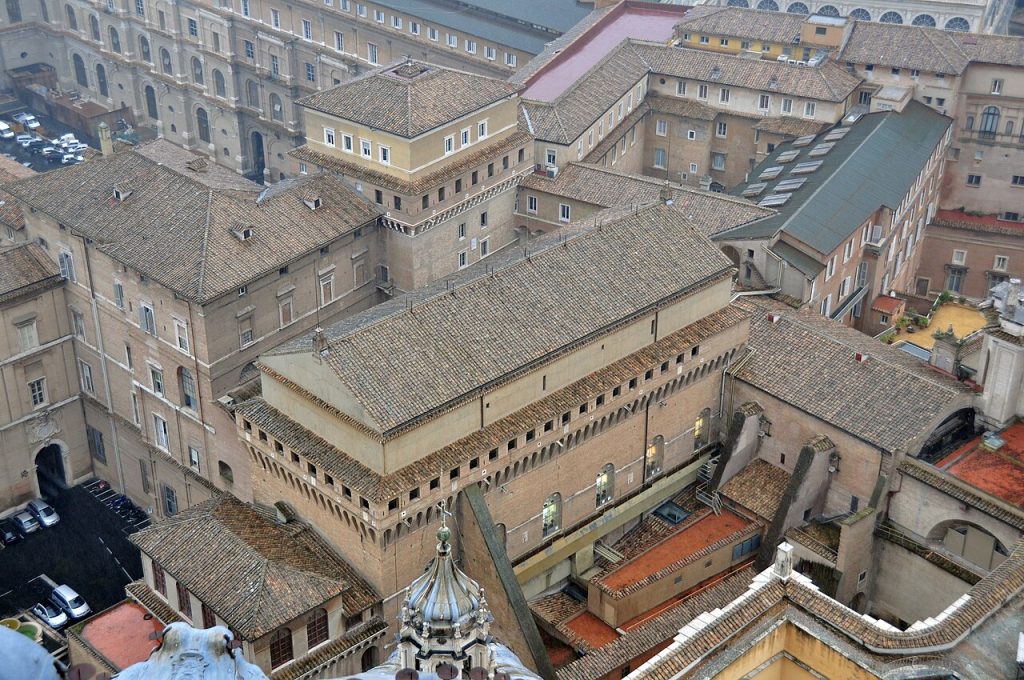
In 1508 Julius ordered Michelangelo, who considered himself a sculptor and resisted, to repaint the Sistine ceiling, and for four years the Florentine worked on a scaffold of his own design, standing with his head thrown back, covering five hundred square metres with the Creation, the Fall, the Flood, the prophets, the sibyls and the ancestors of Christ, three hundred figures in a painted architecture, finished in October 1512 to the astonishment of Rome. Twenty-four years later Paul III called him back to paint the altar wall, and between 1536 and 1541 he covered it with the Last Judgement, Christ as judge among the saved and the damned, with his own face on the flayed skin held by St Bartholomew, which scandalised the court with its nudity and was partly draped after his death.
The chapel’s frescoes were cleaned between 1980 and 1994 in the most debated restoration of the century, and their colours, long thought to be dark, turned out to be bright.
Sixtus V and the Palace Where the Popes Live
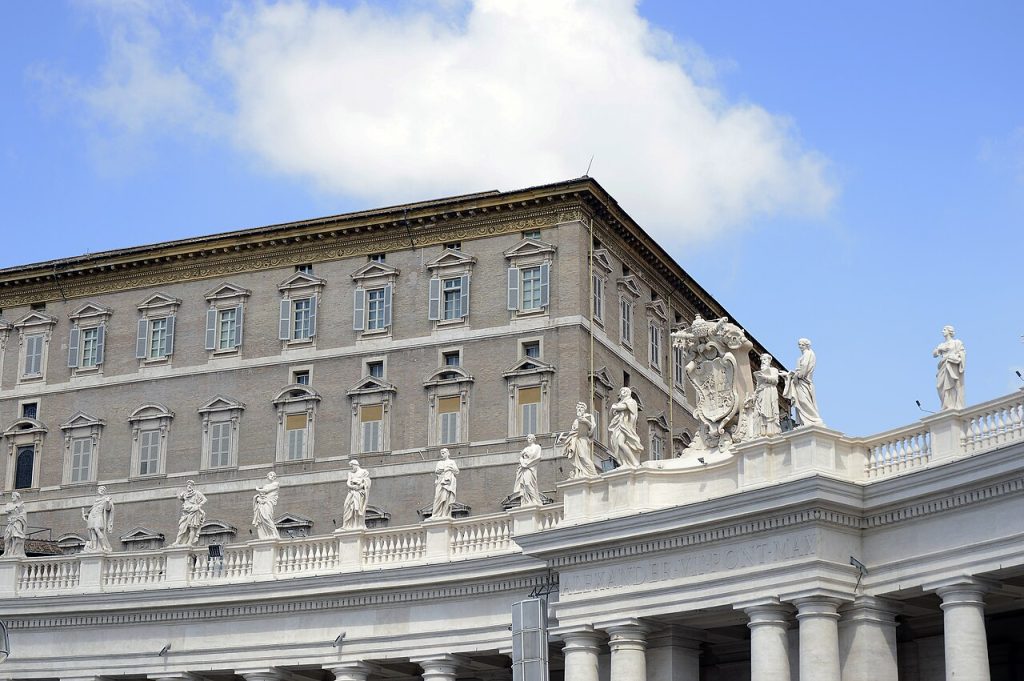
The building the crowd looks at from the square is the work of Sixtus V, pope from 1585 to 1590, who in five years rebuilt Rome with aqueducts, obelisks and straight streets and at the Vatican added the block on the east side of the Cortile di San Damaso, facing the square, designed by Domenico Fontana, as a new residence with the papal apartments on the top floor, the Secretariat of State below, the Sala Clementina for receptions and the loggias that Raphael had begun for Leo X. Sixtus also built the Vatican Library’s great hall across Bramante’s courtyard, moved the obelisk to the square and finished the dome of St Peter’s. The popes have lived in his block, with its window over the square, for four centuries.
The palace was essentially complete with Sixtus V; what followed was decoration, the Scala Regia, the museums and the slow adaptation of a Renaissance palace to the needs of a modern state.
Bernini’s Scala Regia and the Baroque Popes
The Baroque popes added ceremony rather than rooms. Urban VIII built the Pauline Chapel’s decoration and the palace’s armoury; Alexander VII had Bernini, who had just finished the square’s colonnades, build the Scala Regia between 1663 and 1666, the royal stair from the Bronze Door up to the Sala Regia and the Sistine Chapel, a narrowing barrel-vaulted tunnel of columns that Bernini made to seem longer and grander than it is, with his equestrian Constantine at its foot seeing the Cross; and the eighteenth-century popes, Clement XIV and Pius VI, built the Pio-Clementino museum around the Belvedere’s sculpture court, the first public museum in the palace, with its octagonal court and its round hall of ancient gods.
Now, stop here at the foot of the Scala Regia, if the Swiss Guard lets you, and look up the stair. It leads to the rooms where the Church’s rulers have been elected for five hundred years, and Bernini designed it to make a man feel small.
1870 to 1929: The Prisoners of the Vatican
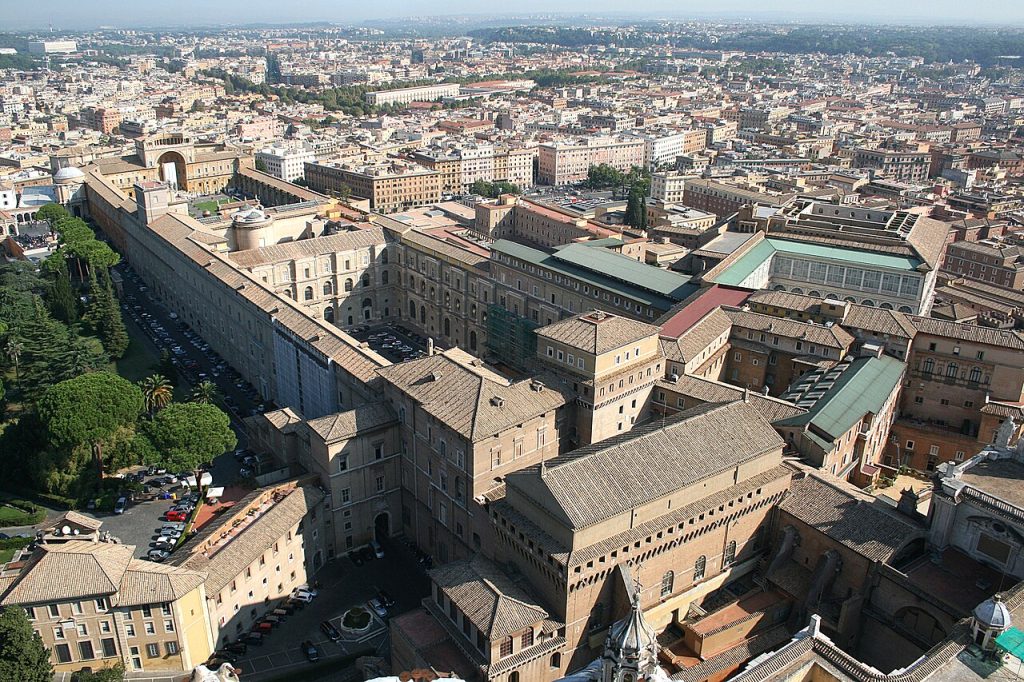
On 20 September 1870 the army of the Kingdom of Italy entered Rome, the Papal States ceased to exist and Pius IX, who had ruled a kingdom of three million people from the palace, withdrew into it and declared himself a prisoner of the Vatican. He and his three successors, Leo XIII, Pius X and Benedict XV, never left the palace and its gardens for fifty-nine years, refusing to recognise the Italian state or to set foot in a Rome they regarded as stolen, and the palace became a sovereign enclave in practice before it was one in law. The Lateran Treaty of 11 February 1929 between Pius XI and Mussolini created the Vatican City State, forty-four hectares of basilica, palace, museums and gardens, and the pope walked out into the square for the first time in six decades.
The state’s constitution, its railway station, its radio and its governor’s palace date from Pius XI, who gave the prisoners’ palace a country.
The Papal Apartments and the Pope Who Left Them
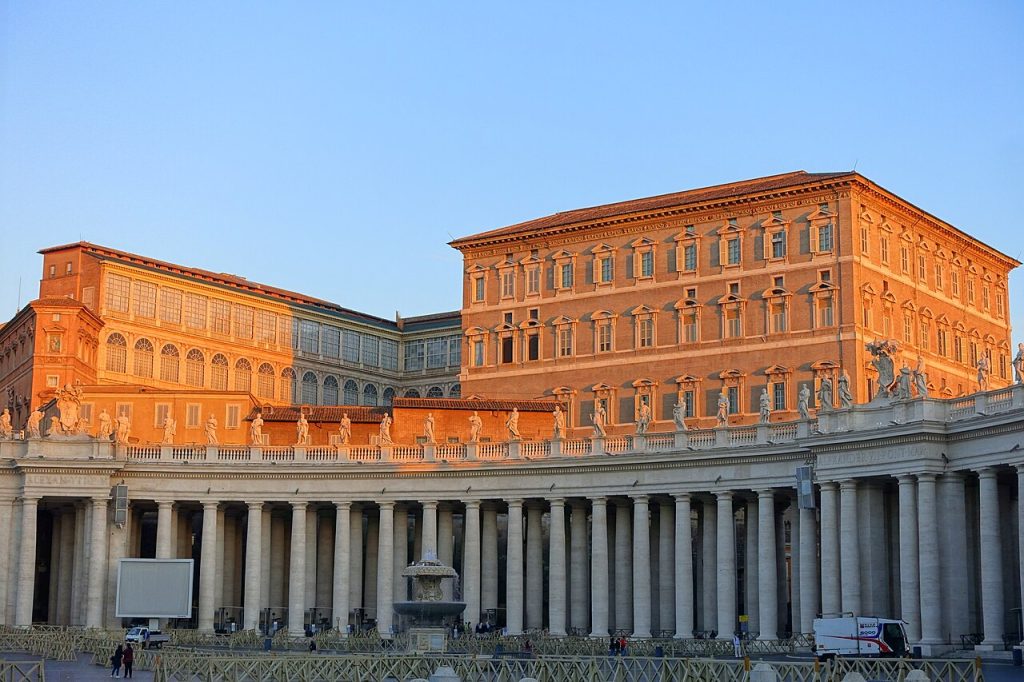
The papal apartment on the top floor of Sixtus V’s block has ten rooms: a chapel, a study with the window, a bedroom, a dining room, a library, offices for the secretaries and rooms for the household, furnished plainly and redecorated by each pope. John Paul II lived here for twenty-six years and died here in 2005; Benedict XVI lived here until his resignation in 2013; and Francis, elected that year, looked at it, said that it could hold three hundred people, and chose instead to live in the Casa Santa Marta, the Vatican guesthouse behind the basilica, using the palace apartment only for the Sunday Angelus from the window and for official audiences in the library below. The apartment has been empty of a resident pope since, the first time in four centuries.
The palace remains the seat of the Secretariat of State and of the pope’s official audiences, in the Sala Clementina, the library and the Sala Regia, and the Swiss Guards keep its doors.
Museums, Conclaves and the Noon Blessing
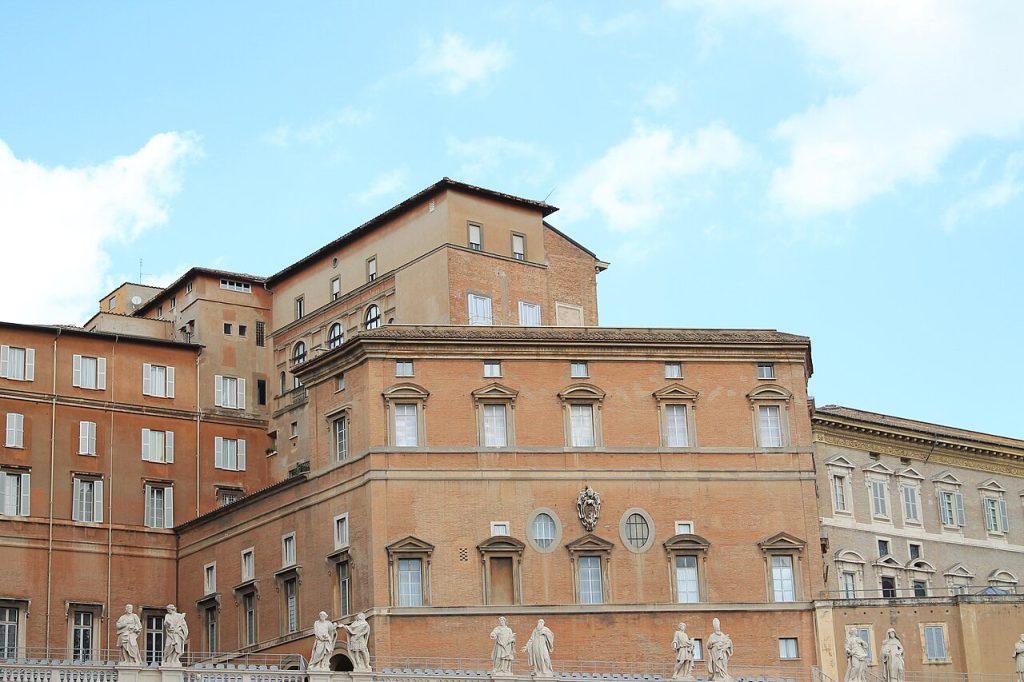
The Apostolic Palace today is three things. It is the Vatican Museums, seven kilometres of galleries through Bramante’s courtyards, the Pio-Clementino, the Egyptian and Etruscan rooms, the Gallery of Maps, the Stanze, the Borgia Apartment and the Sistine Chapel, which receive about seven million visitors a year and are the most crowded museum in the world. It is the seat of the Church’s government, with the Secretariat of State, the papal audiences and, in the Sistine Chapel, the conclaves that elect the popes, as in 2005, 2013 and 2025, when the world watched the chimney for white smoke. And it is the window over the square, from which the pope speaks on Sundays to whoever has come.
Now, stop here in the Sistine Chapel, if you can find a square metre of floor, and look up. Thirty popes built this palace over six centuries and most of them are forgotten; the building remembers them in a room where a Florentine sculptor, who did not want the job, painted the beginning and the end of the world.
The Vatican on Video
Visiting the Apostolic Palace Today
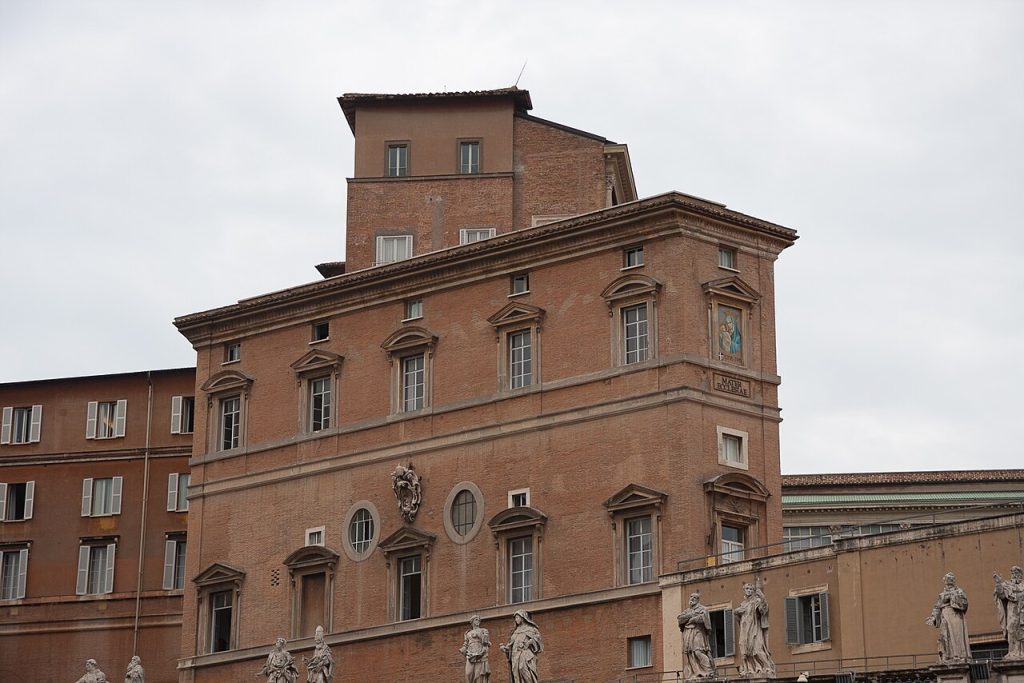
The Apostolic Palace is visited through the Vatican Museums, whose entrance is on Viale Vaticano on the north side of the Vatican, a fifteen-minute walk round the walls from St Peter’s Square; the museums are open Monday to Saturday, with timed tickets that must be booked online weeks ahead in high season, and the route through the galleries, the Stanze and the Borgia Apartment ends in the Sistine Chapel, from which a door for groups leads directly into St Peter’s. Allow three to four hours, come at opening or after two in the afternoon, and dress with covered shoulders and knees for the chapel and the basilica. The papal apartments, the Sala Regia and the Scala Regia are not open except on rare occasions; the Sunday Angelus at noon and the Wednesday general audience in the square are free. The Vatican Gardens can be visited on a separate guided tour.
The Vatican is reached by metro line A to Ottaviano or Cipro, by bus 40 or 64 to St Peter’s or on foot across the Tiber from the centre of Rome. The Doge’s Palace in Venice is four hours away by train, the Ducal Palace of Mantua three. Here is the exact spot: Apostolic Palace on Google Maps.
Palaces Nearby
You May Like
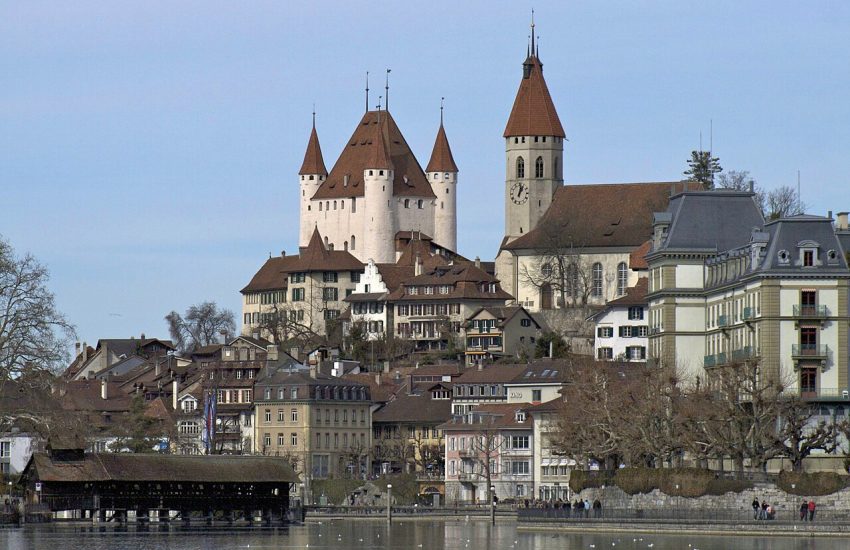
Thun Castle and the Zähringen Tower Above the Aare