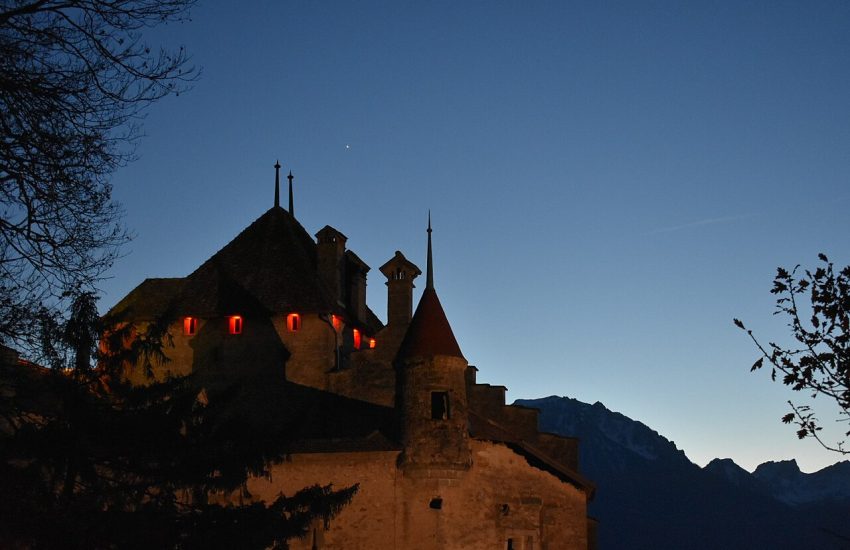
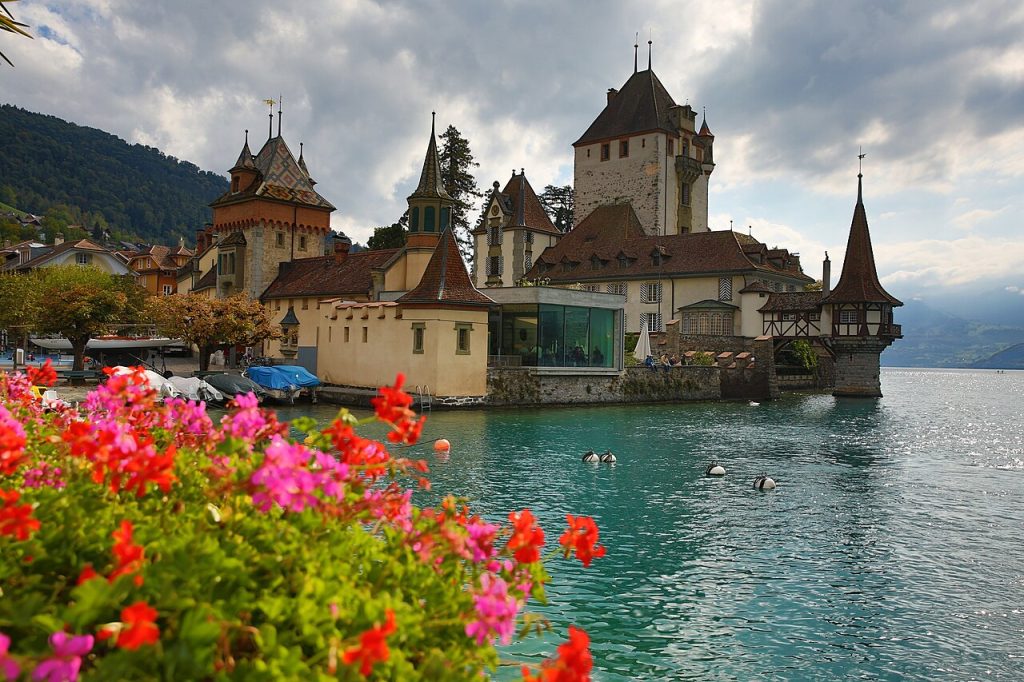
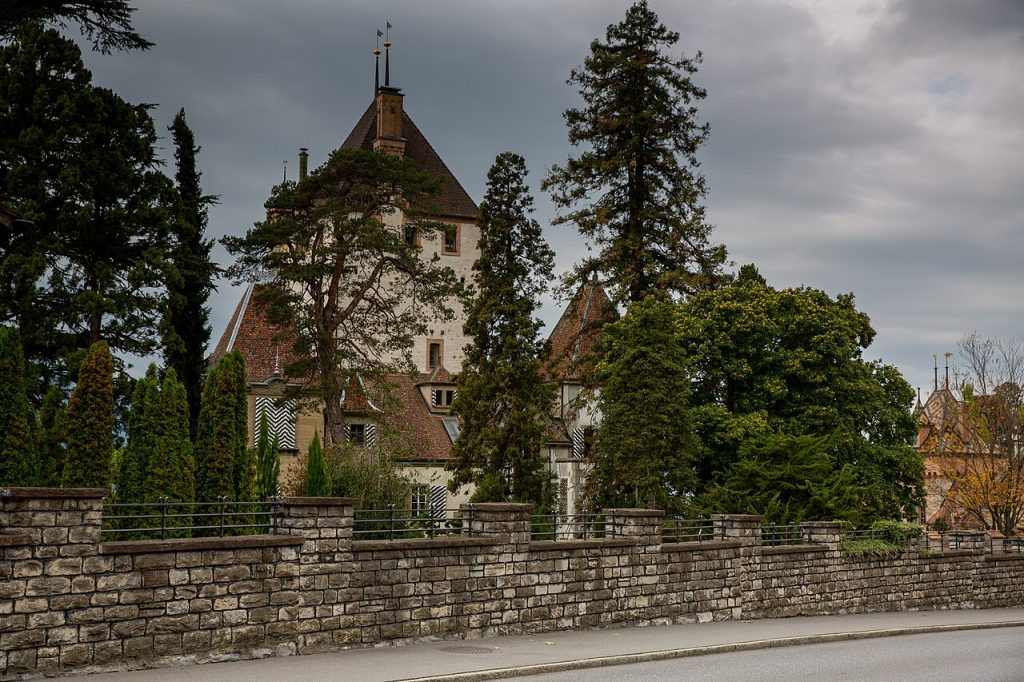
On the north shore of Lake Thun, where the lake road from Thun runs toward Interlaken under the slopes of the Bernese Oberland, a castle stands with its feet in the water: a mediaeval keep with a steep roof and turrets, a round tower rising from the lake itself, a cluster of wings and gables in every style of the nineteenth century, and a park of great trees running up the hillside behind. It is Schloss Oberhofen, a thirteenth-century stronghold of the Habsburgs and the Bernese patricians that became, between 1849 and 1925, the summer palace of the Pourtalès and Harrach families, Prussian and Austrian aristocrats of Neuchâtel origin who turned a Swiss castle into a Romantic dream of a castle, with a Turkish smoking room at the top of the lake tower and the Niesen and the Eiger across the water.
The castle was given to the canton of Bern in 1940 by its last owner, the American William Maul Measey, and it has been a museum since 1954, showing the rooms as the Pourtalès and Harrach left them, from the mediaeval chapel with its frescoes to the Victorian nursery, with one of the finest parks in Switzerland around it. It is the second of the three Swiss houses in this series, between Chillon on Lake Geneva and its neighbour Thun Castle at the head of the lake.
Walk the park with me from the gate to the shore, through the rooms and up the lake tower to the smoking room, with the knights, the patricians, the count and the American in order. The contents are below.
In This Article
- A Castle With Its Feet in the Lake
- The Keep of the Eschenbach and the Habsburgs
- Bernese Bailiffs and Patrician Owners
- The Erlach Family and the Baroque Castle
- 1844: Count Albert de Pourtalès Buys a Ruin
- A Romantic Castle on a Mediaeval Core
- The Turkish Smoking Room in the Lake Tower
- The Park and the Exotic Trees
- The Harrachs and the Belle Époque Summers
- The Chapel and Its Painted Walls
- 1925: An American Buys the Castle
- 1954: The Museum of Living
- Oberhofen Today
- Oberhofen on Video
- Visiting Oberhofen Castle Today
- Palaces Nearby
A Castle With Its Feet in the Lake
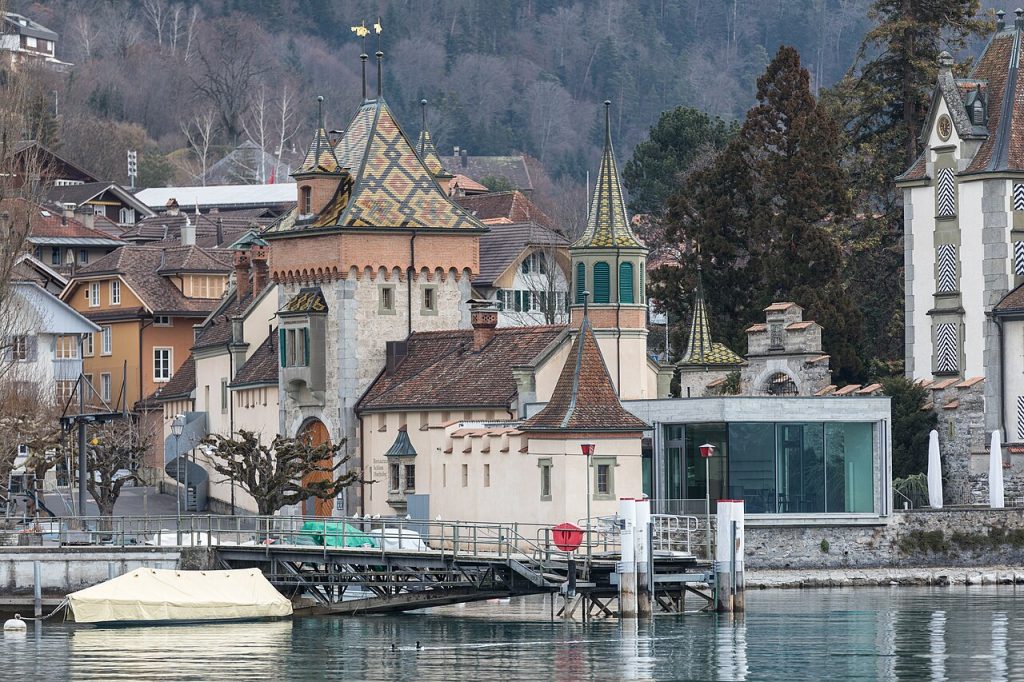
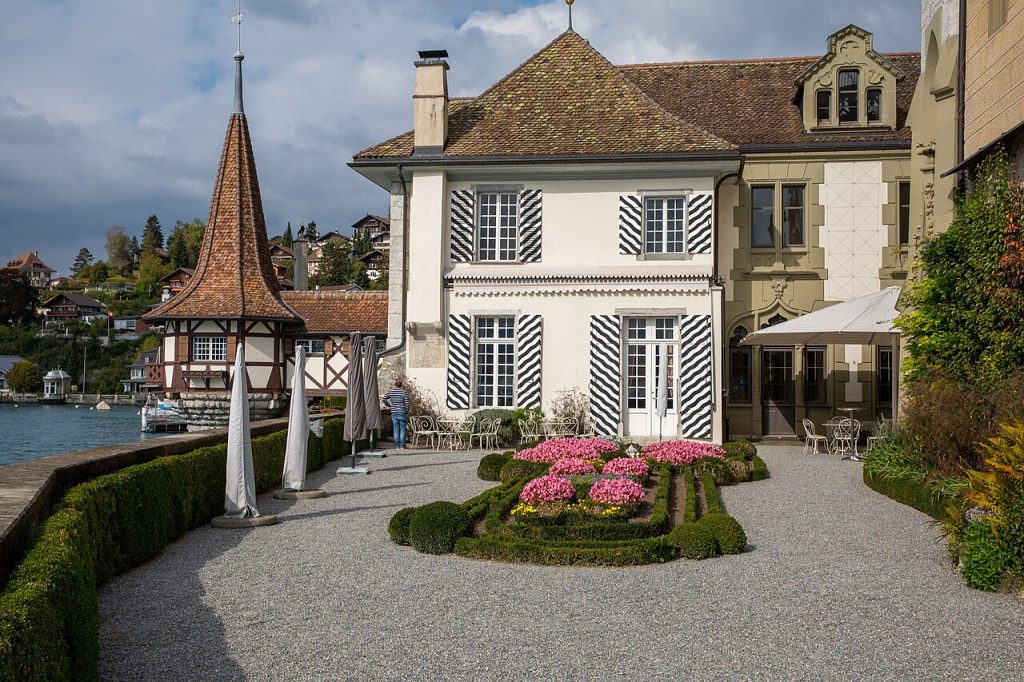
Lake Thun lies at the foot of the Bernese Oberland, a long blue lake between Thun and Interlaken with the Niesen’s pyramid and the Stockhorn on its south shore and, beyond them, the Eiger, Mönch and Jungfrau, and its north shore is a string of villages, vineyards and villas facing the mountains across the water. Oberhofen is six kilometres from Thun, and the castle stands at the water’s edge in the middle of the village, with the lake road behind it, the park rising up the slope and its round tower built out into the lake on a foundation of piles, so that the waves wash its base.
Now, stop here on the landing stage and look at the castle from the water. The keep and the tower are mediaeval, the wings and the gables are nineteenth-century, the park is English and the view is the Alps; the whole is the most romantic composition on the lake, which is exactly what its builders intended.
The Keep of the Eschenbach and the Habsburgs
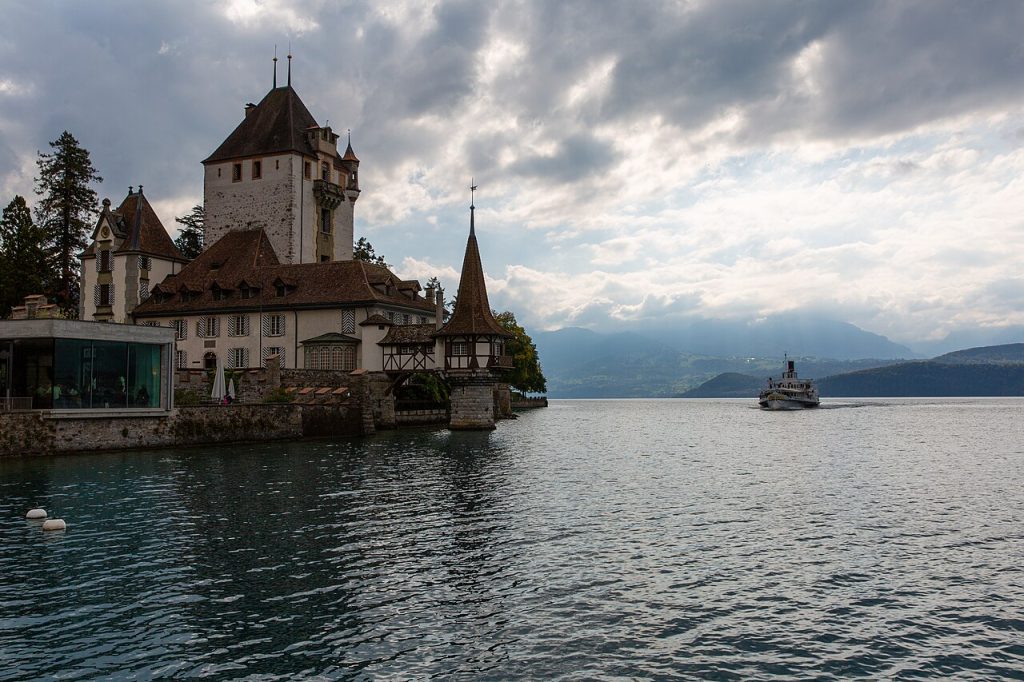
The keep, a square tower of rough stone with walls two metres thick, was built around 1200 by the lords of Oberhofen, a knightly family who held the north shore of the lake, and passed by inheritance to the barons of Eschenbach, one of whom, Walter of Eschenbach, took part in the murder of King Albert I of Habsburg at Windisch in 1308. The Habsburgs confiscated the castle in revenge and held it as an outpost of their Swiss territories against the rising power of Bern, until Bern took it in 1386 after the battle of Sempach, where the Habsburg army was destroyed by the Swiss confederates.
The keep survives at the heart of the castle, with a hall and a chapel added in the fifteenth century, and its masonry can be seen in the cellars and the courtyard.
Bernese Bailiffs and Patrician Owners
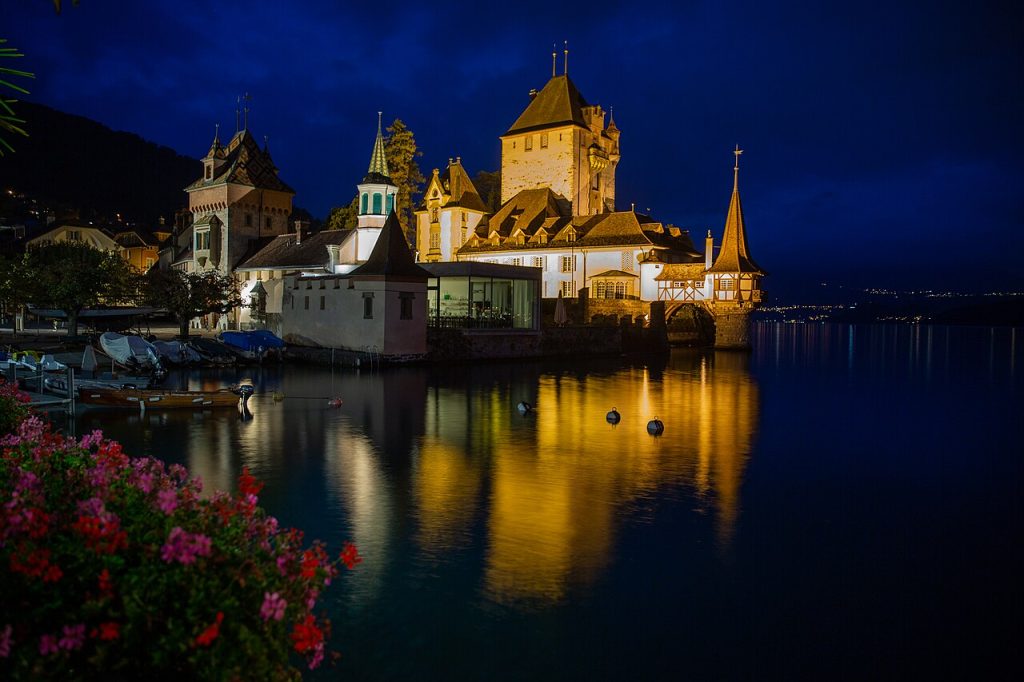
Bern sold the castle in 1397 to the Scharnachtal family, patricians of the city, and for the next four and a half centuries Oberhofen was the country seat of a succession of Bernese patrician families, the Scharnachtal, the May and, from 1652, the Erlach, who used it as a summer house, a wine estate and the seat of a small jurisdiction over the villages of the shore. The Bernese patricians were an urban aristocracy who governed the canton and its subject territories and spent their summers in country castles like this one, and Oberhofen with its vineyards and its lake was among the most desirable.
The castle was altered in the sixteenth and seventeenth centuries with a new residential wing, a Baroque garden and the first lakeside tower, and the Erlach gave it the form that the nineteenth century would transform.
The Erlach Family and the Baroque Castle
The Erlach were the most powerful of the Bernese patrician families, generals in French and Dutch service, bailiffs and mayors, and they held Oberhofen for a century and a half, adding a wing with a Baroque facade on the lake, a terraced garden and the chapel’s furnishings. The French invasion of 1798 ended the Bernese patrician regime, the Erlach lost their offices and much of their income and in 1801 they sold Oberhofen; the castle passed through several hands in the early nineteenth century, fell into disrepair and was by the 1840s a half-empty house with a leaking roof, admired by the English tourists who were beginning to discover Lake Thun.
In 1844 a buyer appeared who had the money and the imagination to make the castle what the tourists already thought it should be.
1844: Count Albert de Pourtalès Buys a Ruin
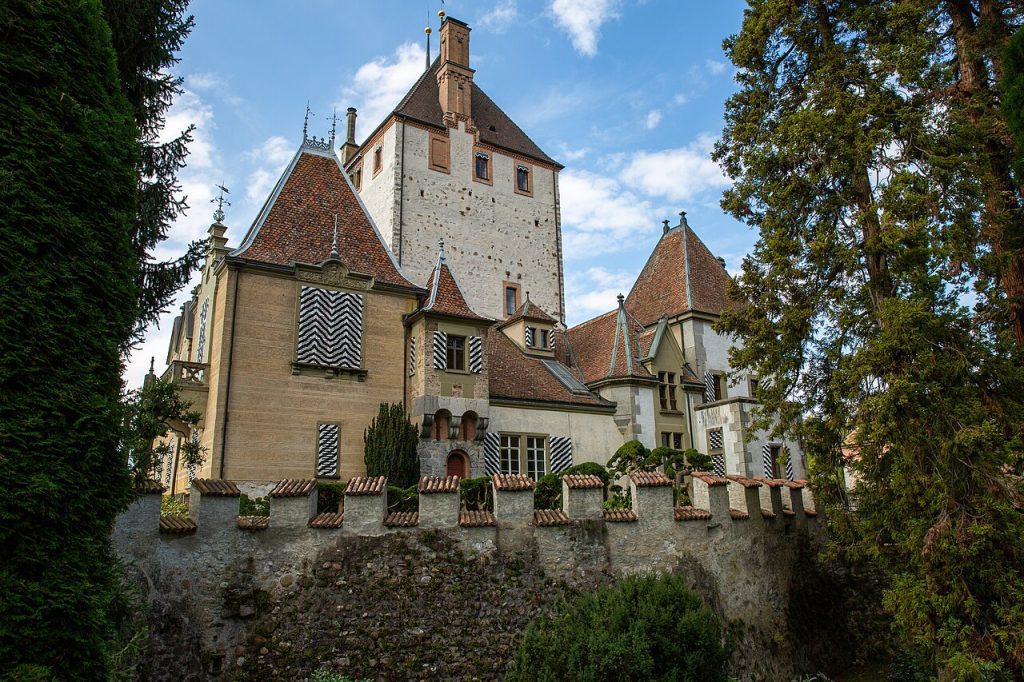
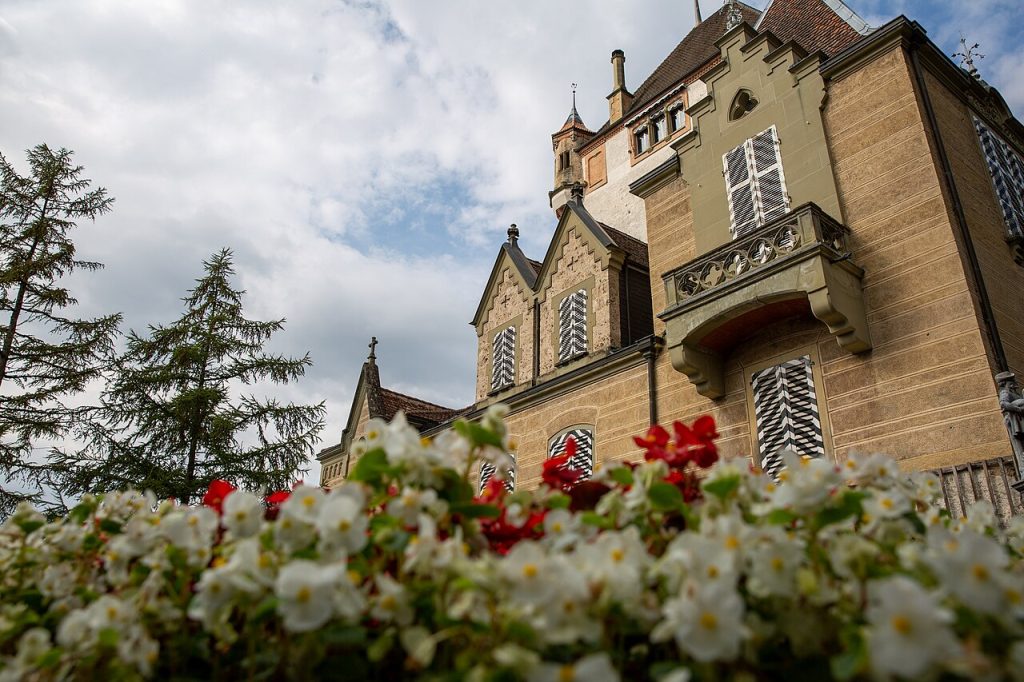
Albert de Pourtalès was a count of the Prussian nobility from a family of Neuchâtel Huguenot bankers, raised to the nobility by Frederick the Great, a diplomat in the Prussian service who was later ambassador in Constantinople and Paris, and a connoisseur with a taste for the Middle Ages, the Orient and lakes. He bought Oberhofen in 1844 as a summer residence for his family and over the next decade transformed it, with the Berlin architect Theodor Zeerleder and the Bernese Jakob Friedrich Studer, into a Romantic castle in the manner of the Rhine and the Loire: the mediaeval keep and chapel were kept and restored, the Baroque wing was given Gothic windows and gables, new wings with towers and turrets were added, and the lake tower was raised and given its conical roof.
Pourtalès wanted a castle that looked as a castle should, and he had the taste to keep the real mediaeval fabric at its heart. Now, stop here in the courtyard and try to separate the thirteenth century from the nineteenth; it is harder than it sounds, and that was the point.
A Romantic Castle on a Mediaeval Core
The interiors are the Pourtalès family’s taste made solid: a Gothic Revival dining room with carved panelling and stained glass, a Renaissance-style library, a Biedermeier salon with Swiss furniture, the countess’s rooms in the French manner, a billiard room, bedrooms with tiled stoves and the family’s collections of Swiss glass, pewter and portraits. The rooms were arranged for a summer household of family, guests and a dozen servants, and they have been kept as they were furnished in the 1850s and 1860s, with later additions by the next generation. The castle is a complete document of how a rich European family lived in a Swiss summer in the middle of the nineteenth century.
Look for the dining room’s stained glass with the Pourtalès arms, for the Bernese stoves and for the children’s rooms upstairs with their toys and schoolbooks.
The Turkish Smoking Room in the Lake Tower
The castle’s most famous room is at the top of the lake tower: a Turkish smoking room, a fumoir, fitted out in the 1850s by Count Albert in memory of his years as Prussian ambassador at Constantinople, with painted and gilded woodwork in the Ottoman manner, low divans, a fountain, lattice windows, hanging lamps and a ceiling of stars, where the count and his guests smoked their pipes after dinner and looked at the Alps through Oriental windows. It is one of the earliest Orientalist interiors in Switzerland and one of the best preserved anywhere, and the climb up the tower’s narrow stair to reach it is part of the experience.
Now, stop here on the divan and look through the lattice at the lake and the Niesen. A Prussian count’s Constantinople, on a Bernese lake, in a mediaeval tower: the nineteenth century believed that a man could have everything he had loved in one house, and here he did.
The Park and the Exotic Trees
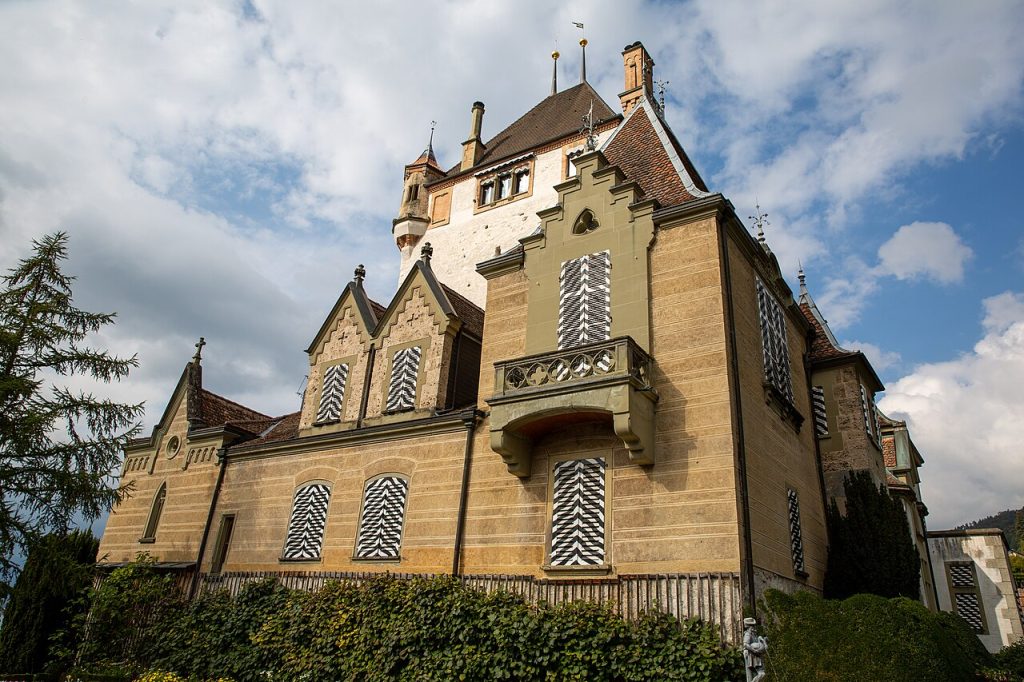
The park was laid out by Pourtalès and his heirs from the 1840s on the slope above the lake in the English landscape manner, with lawns running down to the water, groves of exotic trees, sequoias, cedars, tulip trees, magnolias and a ginkgo, now among the largest in Switzerland, winding paths, a Victorian garden pavilion, a boathouse and an orangery. The mild lake climate lets Mediterranean plants grow, and the gardeners of three generations made the park one of the finest in the country. It is open free of charge, and the walk from the gate down through the trees to the castle on the shore is the proper approach.
The park also holds the family’s small cemetery and a monument to the last Pourtalès owners, and it is the best place on the lake for the view of the Alps across the water.
The Harrachs and the Belle Époque Summers
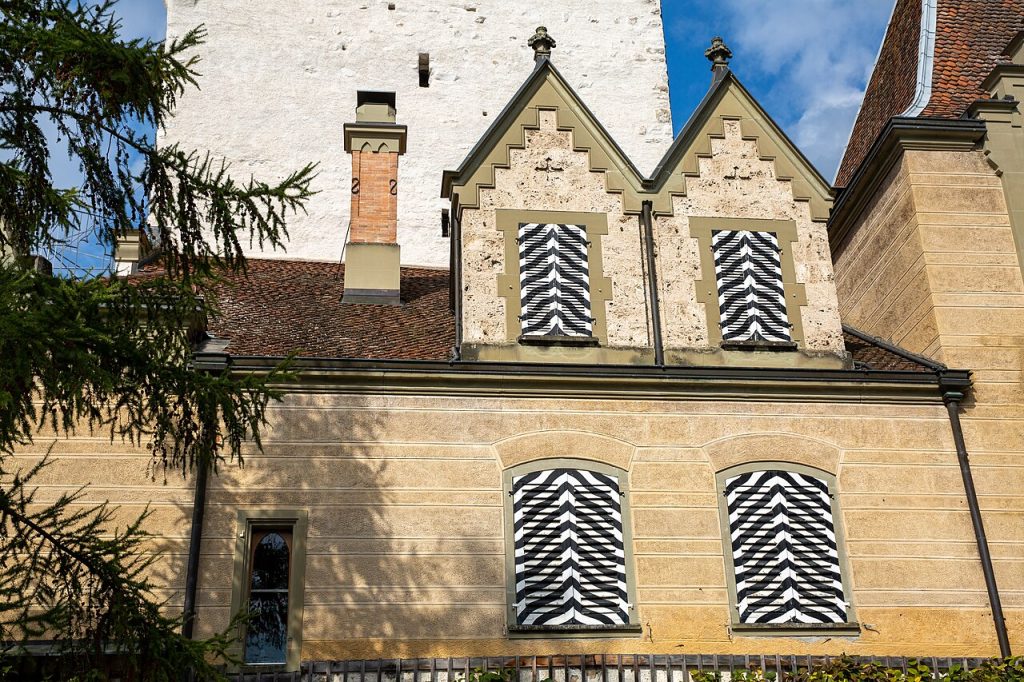
Count Albert died in 1861 and the castle passed to his daughter Hélène, who married Count Ferdinand von Harrach, an Austrian aristocrat and painter, and the Harrachs kept the summers at Oberhofen going for sixty years, adding the last wing, the nursery floor and the garden pavilion, and filling the house with the painting, music and guests of the Belle Époque. Ferdinand von Harrach painted in the castle and in the park, the family entertained the Bernese and the foreign visitors to Interlaken and the castle’s summer was a fixed point of the lake’s social season until the First World War.
The war ended the Harrachs’ Austrian fortunes, and in 1925 Hélène’s heirs sold the castle. The buyer this time was not a European count but an American lawyer.
The Chapel and Its Painted Walls
The chapel, built against the keep in the fifteenth century, is the castle’s oldest decorated room, with Gothic frescoes of about 1470 showing saints, the Passion and the arms of the Scharnachtal, uncovered and restored in the nineteenth century when Pourtalès reopened the chapel for Catholic use; the Pourtalès and Harrach were Protestant and Catholic by turns, and the chapel served both. The windows have nineteenth-century stained glass, the altar is Gothic Revival and the vaults are painted, and the room is the quiet centre of a house that is otherwise all nineteenth-century display.
The Harrachs also commissioned a Bernese artist to paint the chapel’s entrance and the stair with scenes of Swiss history, and these too survive.
1925: An American Buys the Castle
William Maul Measey was a Philadelphia lawyer and philanthropist who had fallen in love with Lake Thun on his travels, and in 1925 he bought Oberhofen from the Harrach heirs, restored the castle, the park and the furnishings with care and without changing the Pourtalès character, and lived here in summer until the Second World War. In 1940, with the war closing in, Measey gave the castle, its contents and the park to a foundation for the benefit of the canton of Bern, on condition that it be preserved and opened to the public, and he returned to America, where he died in 1941. The gift saved the castle from the fate of most of the lake’s villas, which were divided, sold or demolished.
Measey’s rooms, with his American furniture and books, are kept in one wing, so that the castle’s last private owner is part of its display.
1954: The Museum of Living
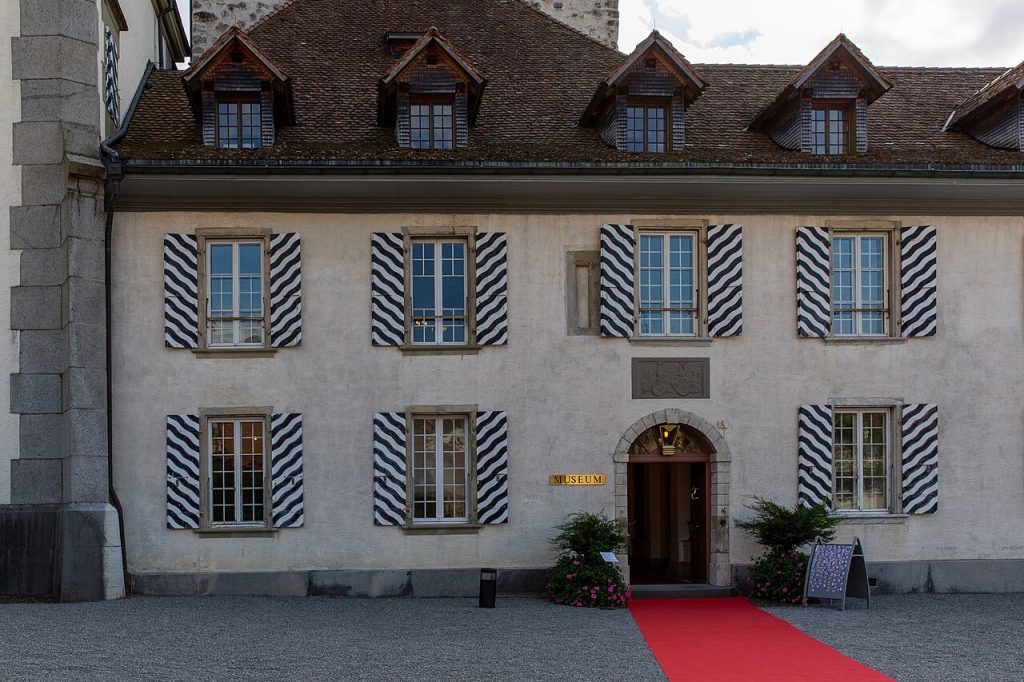
The castle opened as a museum in 1954, run by the Bernese Historical Museum as a branch showing the living culture of the Bernese upper classes from the sixteenth to the nineteenth century, with the Pourtalès and Harrach rooms as period interiors and the castle’s collections of furniture, glass, portraits and costume. Since 2009 it has been managed by an independent foundation, which has restored the roofs, the lake tower and the smoking room, modernised the displays, added a café and children’s programmes and made the park and the castle one of the most visited attractions of the Bernese Oberland.
The museum’s theme is domestic life rather than power, and the castle is the best place in Switzerland to see how a nineteenth-century aristocratic household actually lived, from the kitchen to the nursery to the smoking room.
Oberhofen Today
Oberhofen today is a museum, a public park and a popular wedding venue, with the castle chapel and the garden pavilion booked for ceremonies every summer weekend, and it hosts concerts, exhibitions and the lake’s autumn festival. The lake steamers from Thun and Interlaken stop at its landing stage, the lake road brings coaches from the Jungfrau resorts and the park is full of families on Sunday afternoons. The castle is the most visited on the lake, and with Thun Castle at the lake’s head and Spiez and Hünegg on the south shore it forms one of the richest castle landscapes in Switzerland.
Now, stop here on the terrace below the keep as a steamer comes in and look at the whole: a Habsburg tower, a Bernese wing, a Prussian count’s dream and an American’s gift, with the Alps across the lake making all of it look as if it had always been there.
Oberhofen on Video
Visiting Oberhofen Castle Today
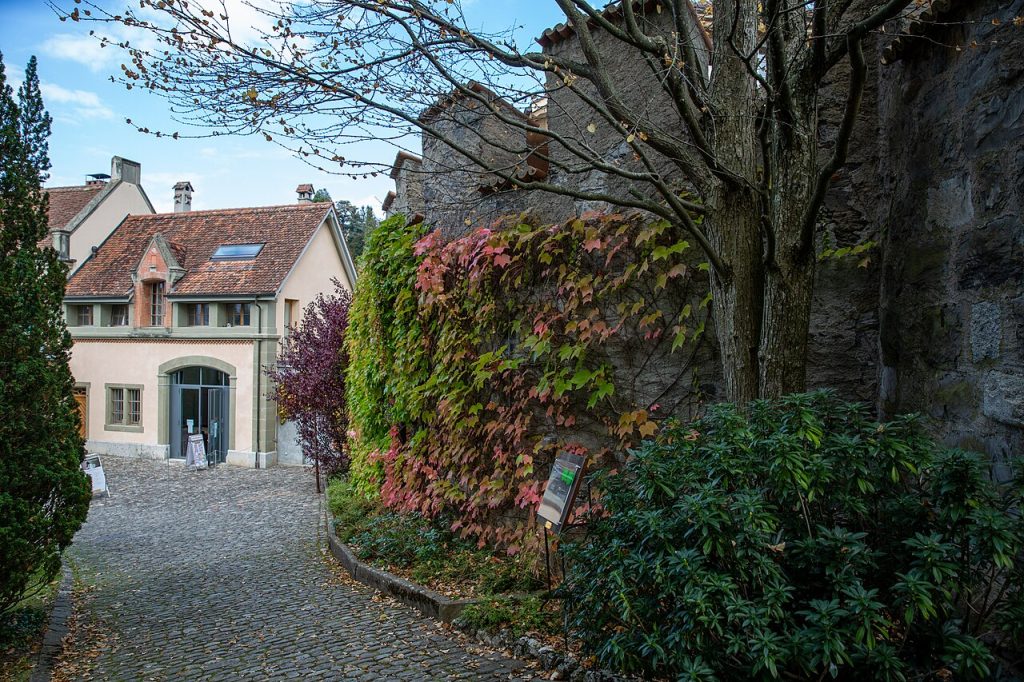
Oberhofen Castle is open from mid-May to late October, Tuesday to Sunday, with a ticket that covers the castle’s rooms on four floors, the chapel and the lake tower with the smoking room; the park is open daily year-round and free. Allow ninety minutes for the castle and an hour for the park, and come by steamer from Thun, which lands at the castle’s own pier; the café in the park serves lunch. Combine it with Thun Castle at the head of the lake and with Spiez or Hünegg across the water.
Oberhofen is twenty minutes from Thun by bus 21 or forty minutes by lake steamer, and Thun is twenty minutes from Bern by train; Interlaken is thirty minutes along the lake. Chillon on Lake Geneva is two hours away via Bern. Here is the exact spot: Oberhofen Castle on Google Maps.
Palaces Nearby
You May Like
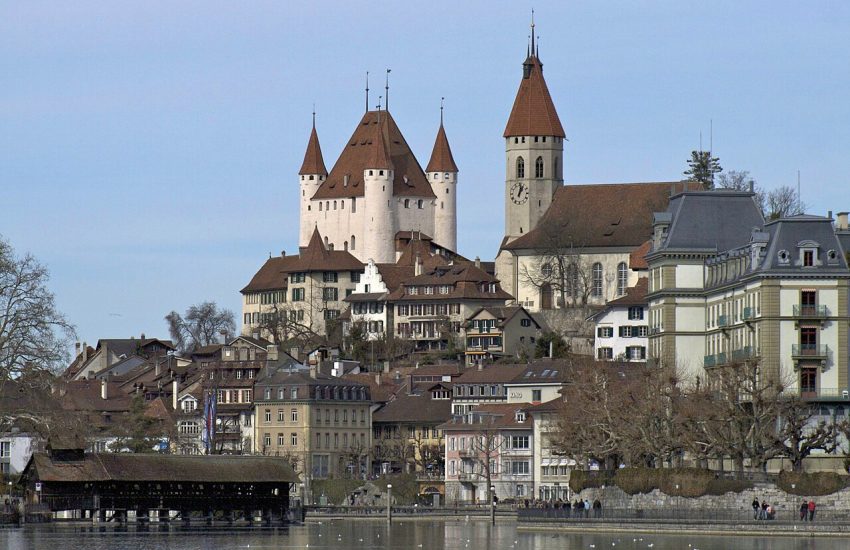
Thun Castle and the Zähringen Tower Above the Aare