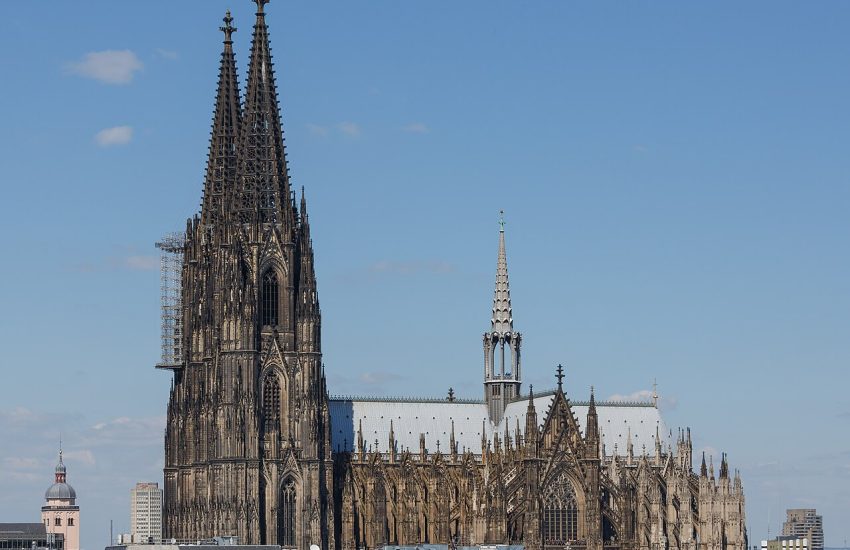
There are places whose importance to a people far outstrips their size, and Studenica is one of them. Tucked into a green river valley in the mountains of central Serbia, ringed by a low circular wall, it does not overwhelm you the way a great cathedral does. It is intimate, almost gentle. And yet for Serbs this modest cluster of buildings is something close to the cradle of their entire identity, the place where their medieval state, their independent church, and their sense of themselves as a nation were all, in a sense, born together. To understand Serbia, people here will tell you, you must come to Studenica.

The whole story turns on a single extraordinary family, and on a ruler who gave up his crown to become a monk.
The king who became a monk
In the late twelfth century, a powerful Serbian ruler named Stefan Nemanja united the Serbian lands and founded the dynasty that would govern them through their medieval golden age. Toward the end of his life he did something remarkable: he abdicated, gave up worldly power entirely, and withdrew to become a humble monk, eventually retiring to the great monastic community of Mount Athos in Greece, where his youngest son had already gone before him. Studenica was the monastery he founded as his own spiritual home and intended resting place, and he built it with extraordinary care.
That youngest son became the most beloved figure in all of Serbian history, known as Saint Sava. He would go on to secure independence for the Serbian Orthodox Church, becoming its first archbishop, and to shape the religious and cultural life of his people so profoundly that he is remembered as the father of Serbian spirituality and education alike. Father and son, the ruler-turned-monk and the prince-turned-saint, are both honoured as saints, and Studenica is bound up with both of them. It was here that Saint Sava brought his father’s body back from Athos and laid it to rest, and here that the family at the root of the Serbian nation is most closely remembered.

White marble and a new beginning
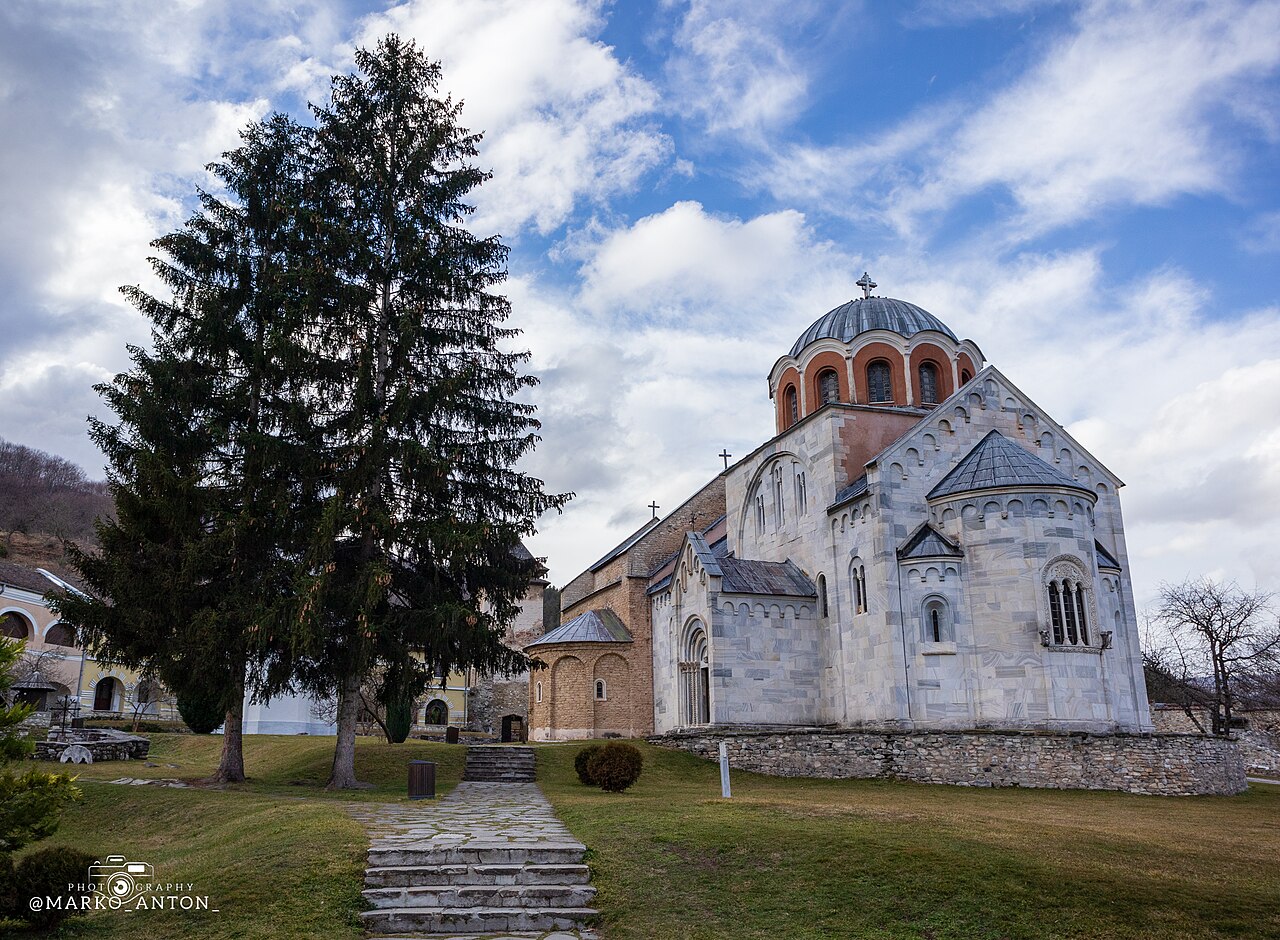
The centrepiece of the monastery is the Church of the Virgin, and it is unlike most of the Orthodox churches of the region in one striking respect: it is built of gleaming white marble. The choice was deliberate and significant. Its design blends the Byzantine tradition of the Orthodox East with Romanesque elements from the Italian and Adriatic West, the carved marble portals and windows recalling the churches of the western Mediterranean, while the form and the interior belong wholly to the world of Eastern Christianity.

That fusion was not an accident but an expression of Serbia’s position at the meeting point of two great Christian worlds, drawing on both yet belonging firmly to the Orthodox East. The white marble church became the model for a whole school of Serbian religious architecture that followed, so that Studenica stands at the head of a great tradition, the first and finest of a line of royal monasteries that the medieval Serbian rulers would go on to build. To stand before its bright facade is to look at the prototype of Serbian sacred art.
Its place in the Orthodox world
Studenica belongs to the Serbian Orthodox Church, another of the ancient self-governing national churches of Eastern Orthodox Christianity, and it holds within that church a place of unique honour as the burial place of the dynasty’s founder and a foundation of its most revered saint. As with the Bulgarian, Georgian, Russian, and Greek Orthodox traditions, the faith here is expressed through icons, sung liturgy, the veneration of saints and relics, and the monastic ideal of withdrawal into a life of prayer, all reaching back unbroken to the early centuries of Christianity.
What gives Studenica its particular weight within that wider Orthodox family is the way it fuses faith and nationhood at the very moment both were taking shape. For Serbs, Orthodoxy and national identity have long been deeply intertwined, and that bond was forged in large part here, by this family, in this place. The monastery functioned not only as a centre of worship but as a centre of learning, culture, and the writing of the nation’s history, much as Rila did for Bulgaria. Like those other great Orthodox houses, it became a vessel in which a people preserved its soul through later centuries of foreign domination, when the medieval kingdom had fallen and the faith was one of the few things holding the nation together.
The frescoes that changed an art
If the white marble is the body of Studenica, its frescoes are its glory. The interior of the Church of the Virgin holds paintings of astonishing quality, and one in particular, a great Crucifixion scene, is celebrated as one of the supreme achievements of medieval European painting. Set against a deep blue background once rich with gold, the figures have a grace, emotion, and humanity that feel centuries ahead of their time, a tenderness in the grief of the mourners that still moves visitors today.

These frescoes matter not only as religious images but as a turning point in the history of art, part of a flowering of expressive, humane painting in the Orthodox world. Within the complex stands a second, smaller church, often called the King’s Church, whose own frescoes are equally treasured, a jewel box of medieval painting tucked beside the great marble church. Together they make Studenica one of the richest surviving collections of medieval Serbian art, which is why the monastery is recognised as a site of world heritage and why art historians, as much as pilgrims, make the journey to this remote valley.
Coming to the valley
Studenica lies off the main roads, deep in the hills of central Serbia, and reaching it takes a little effort, which is part of why it has kept its atmosphere of peace. It is a working monastery still, home to a community of monks who keep the ancient round of prayer, so visitors are asked to come with the quiet respect due to a living holy place rather than a museum. The setting, beside the clear mountain river that gives the monastery its name, is itself part of the experience, green and hushed and far from the noise of the modern world.
For a visitor with no connection to Serbia, the reward is partly the art, those luminous frescoes glowing in the candlelit dark, and partly the chance to stand at the source of a national story, in the very place where a ruler laid down his crown and his son founded a church that would carry a people through eight centuries. For Serbs themselves, it is something deeper still, a homecoming to the spot where everything they are is felt to have begun. Either way, you leave the little walled monastery in its quiet valley with the sense of having touched something that an entire nation has spent its whole existence holding close.