According to the Sumerians’ own king list, kingship itself first descended from heaven at a city called Eridu, but it was Ur, a little further down the Euphrates, that rose to become the most famous royal city of ancient Mesopotamia, the reputed birthplace of the biblical Abraham, and the site of one of archaeology’s most stunning discoveries: a set of royal tombs whose occupants had gone into the afterlife accompanied by dozens of attendants, still in their finery, arranged as if a court ceremony had simply been buried in place.
Table of Contents
- A port city on a river that has since moved
- Ur’s place in the Mesopotamian floodplain
- A staircase built for the moon god
- Restoration across two thousand years
- Attendants who followed their king in death
- The Standard of Ur
- A city of merchants, scribes, and clay contracts
- Houses, schools, and daily routine
- The city the Bible remembers as “Ur of the Chaldees”
- The Third Dynasty and a short-lived empire
- Empire, conquest, and slow abandonment
- Leonard Woolley and the excavation
- Debates over the mass burials
- Nanna, the moon god who owned the city
- Ships from Dilmun and Meluhha
- Law codes before Hammurabi
- Feeding a city from a difficult floodplain
- Women’s lives beyond the royal tombs
- The Elamite sack and the lament for Ur
- A city remembered long after it mattered
- Inside a merchant’s house at Ur
- Learning to write cuneiform as a child in Ur
- Metalwork, lyres, and the artistry buried with the dead
- What Ur means to Iraq and to the world today
- Nearby in Mesopotamia’s ancient story
- Closing thoughts

A port city on a river that has since moved
Ur once sat on the banks of the Euphrates and had direct access to the Persian Gulf, making it a major trading port for copper, timber, and stone that Mesopotamia’s flat, resource-poor floodplain could not supply on its own. Centuries of silt have since pushed the coastline far to the south and shifted the river’s course entirely, leaving Ur’s ruins stranded in dry desert today.
At its height, Ur likely controlled river traffic moving goods between the Gulf and cities further upstream such as Uruk and Nippur, a position that made it wealthy but also a frequent target for rival powers seeking to control the same trade.
Ur’s place in the Mesopotamian floodplain
Southern Mesopotamia offered fertile soil once irrigated but almost no stone, metal, or timber of its own, forcing cities like Ur to import nearly every raw material used in monumental construction from regions as far away as Oman, Anatolia, and the Indus Valley, exchanged for the region’s abundant grain, wool, and manufactured textiles.
This resource imbalance is part of why Ur’s port function mattered so much to its wealth and status, since control of trade, rather than local raw material production, was the foundation of the city’s economic power throughout most of its history.
A staircase built for the moon god
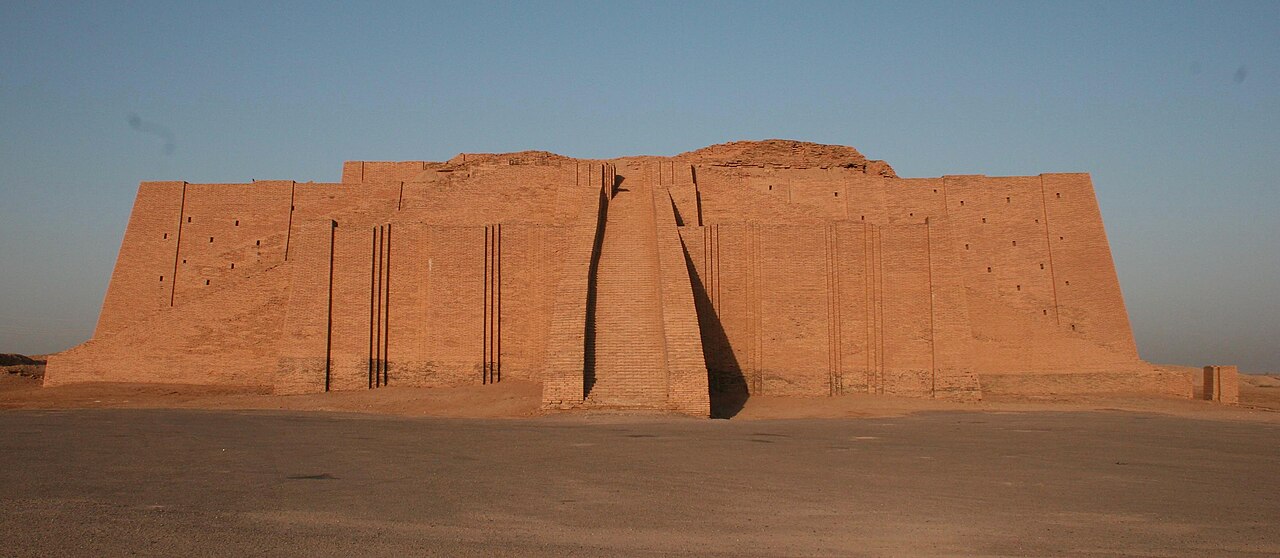
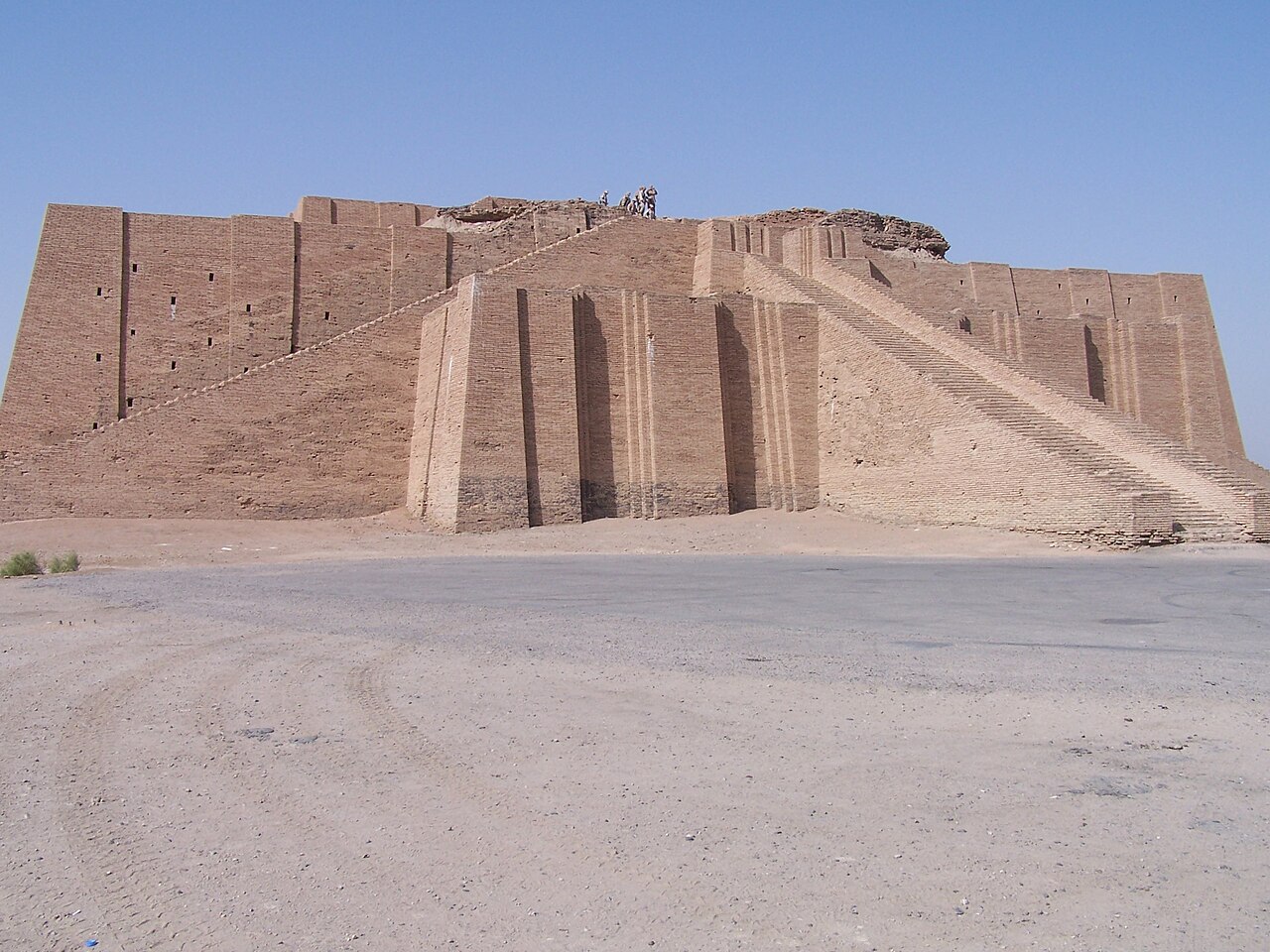
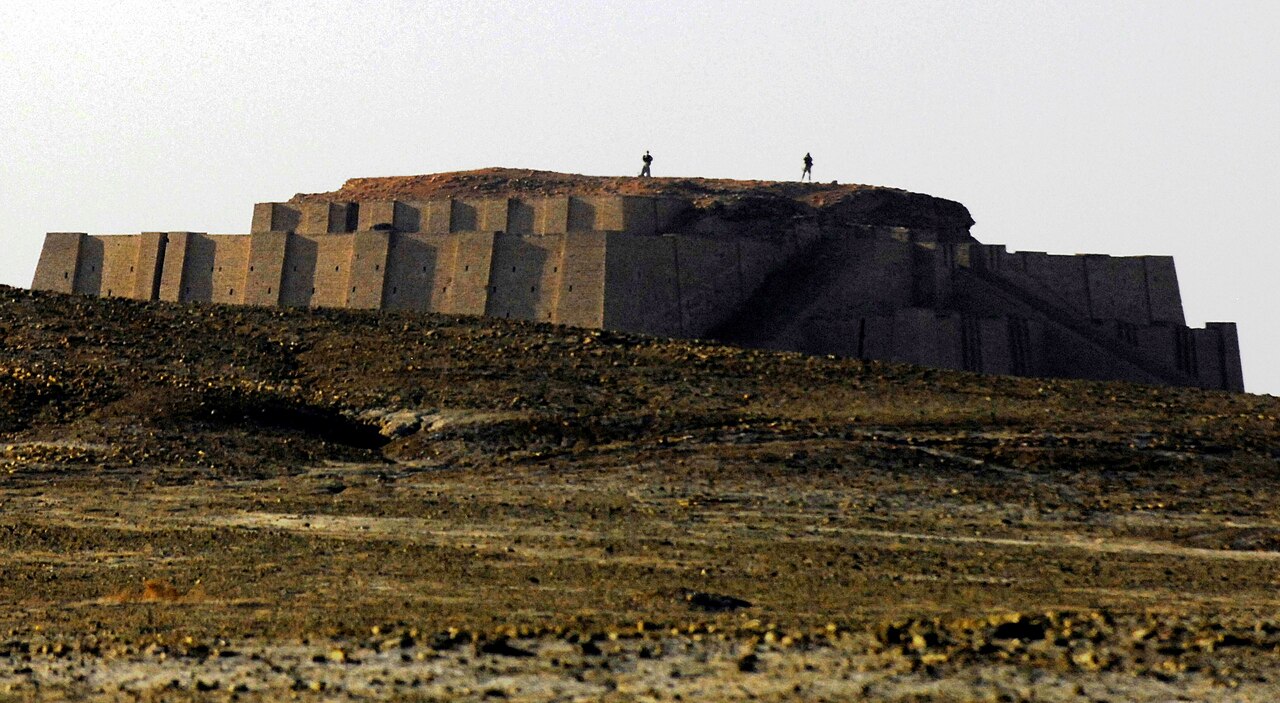
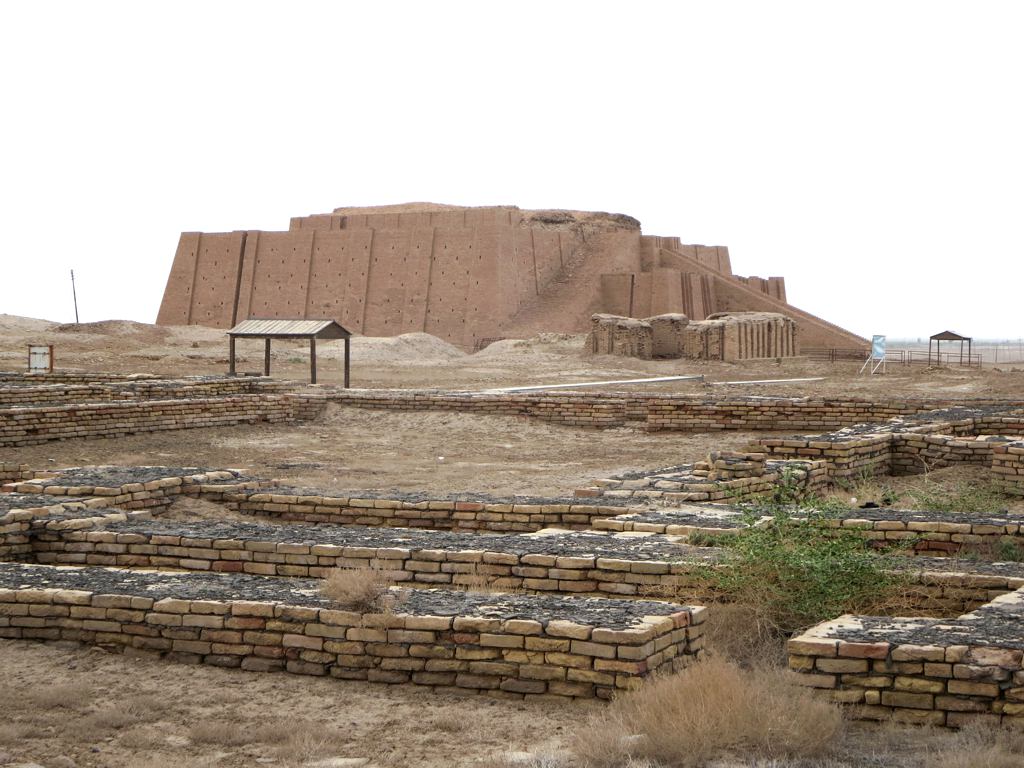
The city’s most recognizable monument is its great ziggurat, a stepped mudbrick tower dedicated to the moon god Nanna, built up by King Ur-Nammu around 2100 BCE and restored more than once in later centuries, including by the Babylonian king Nabonidus over a thousand years later. Its lowest stage still stands today, partly reconstructed, one of the best preserved ziggurats anywhere in Iraq.
The ziggurat’s core was built from sun-dried mudbrick, with an outer skin of fired brick set in bitumen mortar to protect against weathering, a construction technique that allowed the structure to survive far better than many contemporary Mesopotamian buildings built entirely from unfired brick.
Restoration across two thousand years
Nabonidus, the last king of the Neo-Babylonian empire and something of an antiquarian in his own right, ordered extensive restoration of Ur’s ziggurat in the sixth century BCE, over fifteen hundred years after its original construction, driven partly by genuine religious devotion to Nanna and partly by a broader interest in reviving and honoring Mesopotamia’s ancient past.
Further restoration took place in the twentieth century under Iraqi authorities, followed by reconstruction of the lower facade during the era of Saddam Hussein’s government, whose additions are today distinguishable from the ancient core by their more uniform, modern brickwork.
Attendants who followed their king in death
In the 1920s, the British archaeologist Leonard Woolley uncovered a set of “Royal Tombs” at Ur containing spectacular gold headdresses, lyres inlaid with lapis lazuli, and a famous mosaic panel known as the Standard of Ur, alongside the remains of dozens of soldiers, musicians, and attendants who appear to have entered the grave pits already dressed for the funeral, likely as part of a ritual mass burial accompanying their rulers.
Woolley’s excavation identified sixteen tombs of this “royal” character among a much larger cemetery of over two thousand burials, and the scale of wealth and human sacrifice found within the royal examples remains unmatched by anything else so far uncovered from this period of Mesopotamian history.
The Standard of Ur
Among the tomb’s most celebrated finds is a small wooden box inlaid with shell, lapis lazuli, and red limestone, showing scenes of war on one face and peaceful banqueting on the other, nicknamed the Standard of Ur even though its actual original function remains uncertain, since no direct evidence confirms it was ever carried as a military standard as its modern name suggests.
The two contrasting scenes, war and peace, are often read as a deliberate pairing representing the full scope of royal responsibility, protecting the city through conflict while also presiding over its prosperity and feasting during peacetime.
A city of merchants, scribes, and clay contracts
Thousands of cuneiform tablets recovered from Ur’s houses record ordinary transactions, from wool shipments to marriage contracts, giving historians an unusually intimate view of daily commercial life in a Bronze Age Mesopotamian city, not just its kings and gods.
These archives show a surprisingly sophisticated legal and commercial culture, including loan agreements with defined interest rates, formal marriage and inheritance contracts, and court records documenting disputes brought before local officials for resolution.
Houses, schools, and daily routine
Excavated residential quarters at Ur reveal two-story mudbrick houses built around central courtyards, some containing small private chapels for household worship, alongside evidence of scribal schools where children practiced cuneiform by copying standard texts onto clay tablets, some of which still bear a teacher’s corrections alongside a student’s error.
This picture of domestic life, complete with private religious practice and formal education for at least some portion of the population, paints Ur as a genuinely urban society with social structures recognizable well beyond its royal court and temple elite.
The city the Bible remembers as “Ur of the Chaldees”
The Book of Genesis names “Ur of the Chaldees” as the hometown of Abraham before his family migrated toward Canaan, and while the identification with this particular Ur is debated among scholars, the tradition has made the site a point of pilgrimage and fascination well beyond archaeology circles.
Some historians argue the biblical reference may actually point to a different, more northern site given the “Chaldees” designation, which more properly refers to a much later population group associated with the region only after Ur’s own political importance had already faded, adding a layer of chronological complexity to the traditional identification.
The Third Dynasty and a short-lived empire
Ur briefly became the capital of its own empire under the Third Dynasty of Ur around 2100 to 2000 BCE, a period known to historians as the Ur III period, during which its kings implemented an unusually centralized bureaucracy, standardizing weights, calendars, and tax collection across a wide swath of southern Mesopotamia.
Surviving administrative archives from this period are so extensive that some scholars consider Ur III one of the best documented bureaucratic states anywhere in the ancient world, offering month by month records of grain distribution, labor assignments, and livestock counts across the kingdom.
Empire, conquest, and slow abandonment
Ur’s Third Dynasty empire was sacked by Elamite invaders soon after its administrative peak, an event Sumerian scribes mourned in a text known as the Lament for Ur, describing the city’s destruction in vivid, grief-stricken poetic language that survives among the best known works of Sumerian literature. The city struggled on under later Babylonian and Persian rule before the shifting river finally made it unlivable by around 500 BCE.
Even after losing political independence, Ur remained an important religious center for centuries under Babylonian and Persian control, its ziggurat still tended and its temple estates still functioning long after its days as an imperial capital had ended.
Leonard Woolley and the excavation
Leonard Woolley’s excavations at Ur between 1922 and 1934, conducted jointly for the British Museum and the University of Pennsylvania, were among the most influential archaeological projects of the early twentieth century, both for their finds and for Woolley’s relatively careful documentation methods, advanced for his era though still falling short of modern standards.
Woolley’s wife, Katharine, played a significant if less publicly credited role in the excavation’s artistic recording and object conservation, and the couple’s work at Ur helped shape public fascination with Mesopotamian archaeology across Britain and America during the interwar period.
Debates over the mass burials
The exact nature of the mass deaths accompanying Ur’s royal burials remains debated: some researchers argue for voluntary ritual suicide by loyal retainers, while more recent forensic analysis of skulls from the tombs has suggested at least some individuals may have been killed by blunt trauma before burial, raising uncomfortable questions about how voluntary these “accompanying” deaths really were.
Whatever the precise mechanism, the scale of the practice, dozens of individuals accompanying a single royal burial, remains without clear parallel elsewhere in Mesopotamian archaeology, making Ur’s royal cemetery a uniquely important and uniquely troubling window into early state power over human life.
Nanna, the moon god who owned the city
Every major Sumerian city had a patron deity, and Ur’s was Nanna (also known as Sin), god of the moon. This was not a distant, abstract relationship. Nanna was considered the literal owner of Ur, its fields, its canals, and its people, with the king acting as a steward managing the god’s estate on his behalf. The ziggurat and its surrounding temple complex, the E-kishnugal, functioned as Nanna’s household in a very concrete sense, complete with storerooms, workshops, and a domestic staff of priests and priestesses who cooked, cleaned, dressed cult statues, and cared for the god each day exactly as a household staff would care for a living ruler.
The high priestess of Nanna held one of the most powerful religious offices in Sumer, and kings frequently installed their own daughters in the role to bind the crown more closely to the temple. The most famous holder of this office, Enheduanna, daughter of Sargon of Akkad, is credited with hymns that survive today and is sometimes called the first author in world history known to us by name, a distinction that ties Ur directly to the very beginning of personal authorship in literature.
Ships from Dilmun and Meluhha
Ur’s location near the head of the Persian Gulf made it Mesopotamia’s gateway to a maritime trade network stretching remarkably far for the third millennium BCE. Cuneiform economic texts from the city record shipments of copper, ivory, carnelian beads, and exotic woods arriving from a place called Meluhha, which most scholars now identify with the Indus Valley Civilization, along with goods routed through the intermediary trading hub of Dilmun, likely centered on the island of Bahrain. This means Ur, Harappa, and the smaller Gulf ports formed one of the earliest documented long-distance trade circuits in human history, connecting two of the world’s first urban civilizations without either ever needing to know much about the other beyond the value of the goods changing hands.
Merchants operating out of Ur organized these voyages through partnerships not unlike early forms of commercial contract, with investors fronting capital for a voyage and sharing in the profit or loss on its return, arrangements recorded on clay tablets in enough detail that economic historians have used them to reconstruct interest rates and risk-sharing practices nearly four thousand years old.
Law codes before Hammurabi
Long before Babylon’s King Hammurabi carved his famous law code into a stone stela, a king of Ur named Ur-Nammu, founder of the Third Dynasty, issued what is now recognized as the oldest surviving law code in the world. Its surviving fragments cover compensation for physical injury, marriage and divorce, and the treatment of slaves, and notably favor monetary fines over the harsher physical punishments that would later appear in Hammurabi’s code, suggesting a somewhat different philosophy of justice at Ur three centuries earlier.
Ur-Nammu also undertook the standardization of weights and measures across the territory his dynasty controlled, a bureaucratic achievement that is easy to overlook next to monumental architecture but was essential to running a state that taxed agricultural surplus, tracked temple inventories, and paid workers in rations of barley, oil, and wool measured against a common standard.
Feeding a city from a difficult floodplain
None of Ur’s political or religious achievements would have been possible without an intensive irrigation system that turned the unpredictable Tigris-Euphrates floodplain into reliably productive farmland. Canals radiating out from the river had to be dug, maintained, and periodically dredged of silt by organized labor gangs, work that appears repeatedly in administrative tablets as a state-managed obligation rather than something left to individual farmers.
The same irrigation that made Ur rich eventually contributed to its long-term agricultural decline. Centuries of irrigating fields without adequate drainage gradually drew salt up into the topsoil, a process modern soil scientists call salinization. Texts from the later Sumerian period increasingly complain about fields no longer able to grow wheat and being switched to more salt-tolerant barley, a slow-motion environmental crisis that likely weakened the economic base of southern Mesopotamian cities including Ur long before any army ever breached their walls.
Women’s lives beyond the royal tombs
The royal women buried in Ur’s death pits tend to dominate popular accounts of the city, but ordinary women at Ur held recognized legal standing largely absent in many other ancient societies. Cuneiform contracts show women at Ur buying and selling property, lending grain and silver at interest, and appearing as independent parties in legal disputes without needing a male relative to represent them. Some women ran taverns, a profession significant enough that Ur-Nammu’s law code contains specific provisions regulating the trade.
Temple archives also record women serving as scribes, a skill that required years of training in the city’s schools, and priestesses managing significant temple estates including land, herds, and workshops staffed by dozens of dependents, evidence that Ur’s economic life relied on female administrators as much as it did on the male officials more commonly emphasized in traditional histories.
The Elamite sack and the lament for Ur
Around 2004 BCE, Ur’s Third Dynasty collapsed under pressure from Elamite forces from the east combined with waves of Amorite pastoralist groups pressing in from the west. The sack of the city was severe enough that it produced one of the most remarkable literary works to survive from ancient Mesopotamia, the Lament for Ur, a Sumerian poem written in the voice of the city’s own goddess mourning the destruction of her temples, the slaughter of her people, and the abandonment of her streets. It reads less like a historical chronicle than a genuine expression of civic grief, copied and recopied by scribal students for centuries afterward as a set text.
The last king of Ur’s Third Dynasty, Ibbi-Sin, was reportedly carried off into captivity in Elam, and the empire he had inherited fragmented into competing city-states, a pattern of rise and collapse that would repeat itself across Mesopotamian history for another two thousand years, with Ur itself never again reaching the political dominance it held under Ur-Nammu and his successors.
A city remembered long after it mattered
Ur did not disappear after the fall of its empire. The city continued to be inhabited and its temples maintained and rebuilt for another fifteen centuries, patronized by later Babylonian and even Persian rulers who saw value in supporting one of the oldest and most sacred religious centers in the region. The last known ruler to renovate Ur’s ziggurat was Nabonidus, the final king of the Neo-Babylonian Empire in the sixth century BCE, who installed his own daughter as high priestess of Nanna in a conscious revival of a role dating back nearly two thousand years by that point.
Eventually the Euphrates shifted its course away from the city, cutting off the water supply that had sustained it since its founding, and Ur was gradually abandoned to the desert sands that would bury and preserve it until Leonard Woolley’s excavation teams arrived in the twentieth century to bring it back into the light.
Inside a merchant’s house at Ur
Woolley’s excavations did not stop at temples and tombs; they also uncovered an entire residential quarter of Old Babylonian-period Ur, giving an unusually detailed look at ordinary domestic life. The houses were built around a central courtyard, two stories tall, with a stairway leading to upper rooms used for sleeping and storage while the ground floor courtyard handled cooking, craft work, and daily chores. Many houses had a small private chapel built into a corner, where the family kept figurines and made offerings to household gods and to deceased ancestors, whose remains were sometimes interred beneath the floor of the very room where the family continued to live and eat.
Streets in this quarter were narrow and irregular, winding between houses that had clearly been built, rebuilt, and subdivided over generations rather than laid out according to any centrally planned grid, a contrast with the more rigidly planned streets found at contemporary Indus Valley cities like Mohenjo-daro, and a reminder that even within the category of early urban civilization, cities organized their physical space according to very different logics.
Learning to write cuneiform as a child in Ur
Attached to some of these houses, Woolley’s team found what appear to be small scribal schools, rooms filled with practice tablets covered in repeated signs, mathematical exercises, and copied literary texts, evidence of children being drilled in the demanding skill of cuneiform writing. Students began by learning to press a reed stylus into wet clay to form basic wedge strokes, gradually progressing from simple sign lists to copying entire literary compositions including hymns, proverbs, and the Sumerian King List, a text that traced kingship back to a time before a great flood.
This education was not universal. It was reserved mostly for boys from families wealthy enough to spare a child’s labor for years of training, preparing them for careers as temple administrators, merchants’ clerks, or legal scribes, professions that gave Ur’s economy the detailed written record-keeping that makes it possible for historians today to reconstruct so much about the city’s daily commercial and legal life.
Metalwork, lyres, and the artistry buried with the dead
Beyond the Standard of Ur, the royal tombs yielded an extraordinary range of finely worked objects that reveal just how skilled Ur’s craftspeople had become by the mid third millennium BCE. Gold helmets beaten from a single sheet of metal, headdresses of gold leaves and lapis lazuli beads, and dagger blades of gold with sheaths of lapis and gold granulation work all point to metalworking traditions that combined technical mastery with materials imported from hundreds of miles away, lapis lazuli in particular having traveled overland from mines in what is now Afghanistan.
Among the most celebrated finds were several lyres and a harp, their sound boxes decorated with gold and lapis inlay and, in the most famous example, a bearded bull’s head crafted from gold and lapis lazuli. Woolley’s team found the collapsed remains of these instruments still in place beside the musicians who had apparently played them in the tomb’s final ceremony, and painstaking conservation work allowed replicas to be built that let modern audiences hear an approximation of music last played over four thousand years ago.
What Ur means to Iraq and to the world today
Ur’s ziggurat remains one of the most recognizable monuments of ancient Iraq, its restored lower stages having survived wars, sanctions, and decades of political upheaval that limited archaeological access to the site for long stretches after Woolley’s original excavation ended in 1934. The site sits near what became Tallil Air Base, used by foreign militaries in more recent conflicts, a juxtaposition of four-thousand-year-old religious architecture and twenty-first-century military infrastructure that has drawn criticism from heritage organizations concerned about vibration damage and looting risk during periods of instability.
Despite these pressures, Ur remains a source of national pride in Iraq, presented in school curricula as tangible proof that some of humanity’s very first cities, laws, and literature originated in Iraqi soil. International conservation partnerships in recent years have worked to stabilize the ziggurat’s brickwork and improve visitor access, treating the site as both an active archaeological resource and a monument whose meaning extends well beyond archaeology into questions of modern identity and heritage protection in a country that has seen more than its share of both.
Nearby in Mesopotamia’s Ancient Story
Ur was one voice in a chorus of early Mesopotamian cities, and its neighbors’ stories fill in the rest of the picture.
- Uruk and Sumer: The First Cities and the Birth of Writing
- Tell Brak: The Syrian Mound That May Rewrite Where Cities Began



Closing thoughts
The river that made Ur great has long since abandoned it, but the gold, the lyres, and the clay tablets it left behind still speak for a city that once ruled the mouth of the Gulf.
You May Like

Mafra, the Palace a King Built From a Vow


2 thoughts on “The City Where Kingship Descended From Heaven, Almost: The Story of Ur”