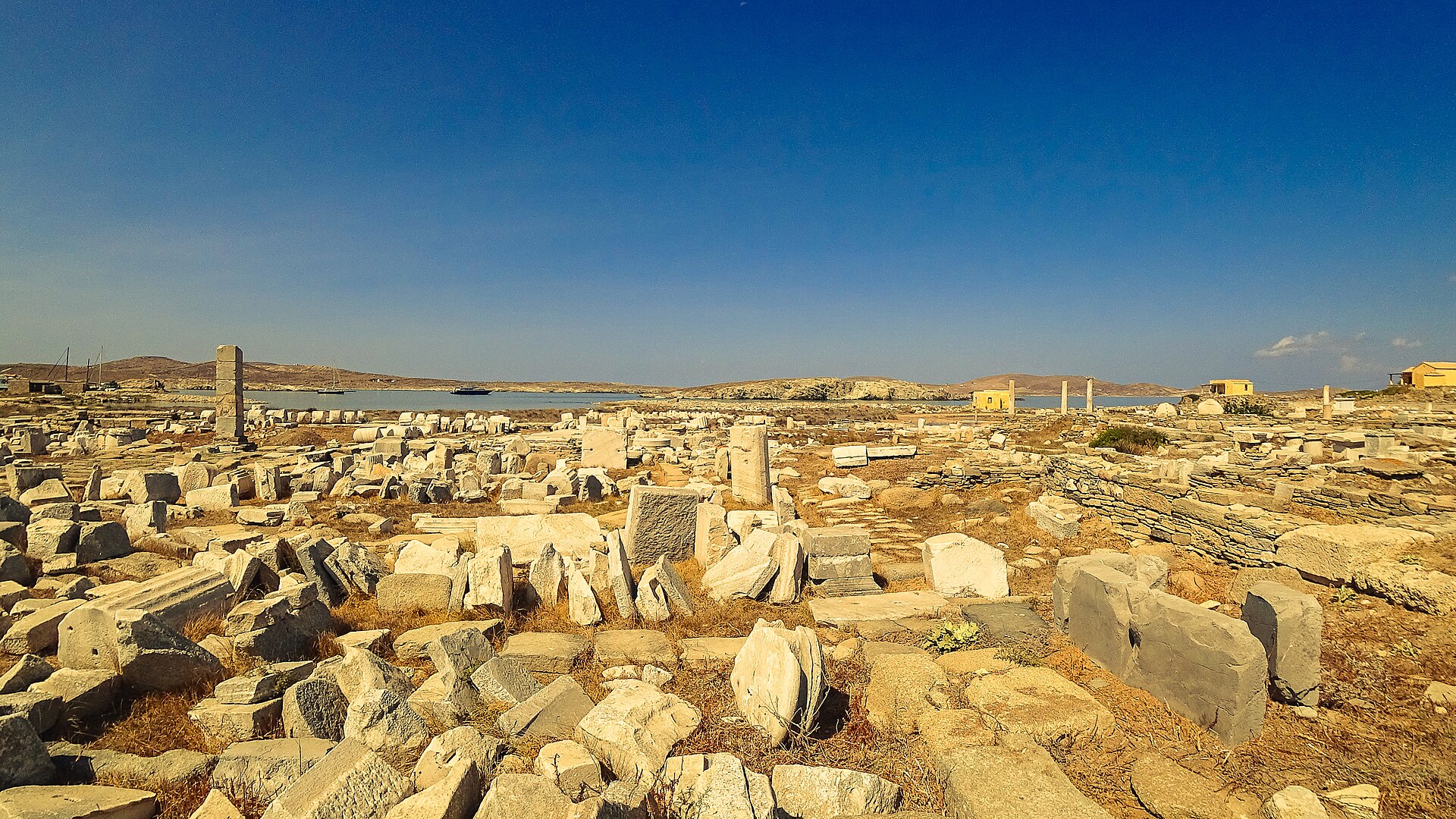
In the middle of the Aegean, ringed by the scattered islands of the Cyclades, lies a small, dry, almost barren island that the ancient Greeks held to be one of the holiest places on earth. Delos is little more than three kilometres long, waterless and windswept, with no obvious reason to matter, and yet for the better part of a thousand years it was a sanctuary of pan-Hellenic importance, the mythical birthplace of the god Apollo and his sister Artemis, a gathering place for the peoples of the islands, and, in its final centuries, one of the busiest trading ports and most cosmopolitan cities of the entire Mediterranean world.
The paradox of Delos is that so tiny and infertile an island became so rich and so revered. The answer lies partly in myth and partly in geography. As the fabled place where Leto gave birth to Apollo, Delos possessed a sanctity that drew worshippers and wealth from across the Greek world; as an island at the crossroads of Aegean sea routes, it became a natural hub of commerce once the ancient world’s trade expanded. Sacred island and international marketplace, holy ground and slave market, Delos combined roles that seem contradictory to us but coexisted for centuries, and the ruins that cover the island today, among the most extensive and best preserved anywhere in Greece, still testify to both.

Contents
- A Barren Island Full of Gods
- The Birthplace of Apollo
- The Sanctuary and the Sacred Precinct
- The Terrace of the Lions
- The Delian League and Athenian Control
- The Purifications of a Sacred Island
- Free Port and Crossroads of the World
- A City of Mansions and Mosaics
- A Meeting of Many Peoples
- Sack, Decline, and Abandonment
- The Open-Air Museum of the Aegean
- Nearby Places
- Final Word
A Barren Island Full of Gods
Delos sits near the geographic center of the Cyclades, the ring of islands that the ancients believed circled around it, which is where the group’s name comes from. The island itself is unpromising: low, rocky, and short of fresh water, dominated by the modest peak of Mount Kynthos from which, on a clear day, a great swathe of the Aegean and its islands can be seen. There is no natural wealth here, no fertile plain, no metal, no forest. Everything that made Delos great came from outside, drawn to it by its sacred status and its position on the sea lanes.
Yet people have valued this small island since deep antiquity. Excavation has shown occupation stretching back into the third millennium BC, and by the early Iron Age Delos had become a religious center for the surrounding islanders. Its importance grew steadily through the archaic period, and by classical times it stood alongside Delphi and Olympia as one of the great pan-Hellenic sanctuaries, places that belonged to the whole Greek world rather than to any single city. Pilgrims came from across the Aegean and beyond to honor Apollo on the island of his birth, bringing offerings that enriched the sanctuary and its guardians.
The whole character of Delos flowed from this sacred status. Because it was holy, it was treated as neutral ground, a place where the islanders could gather in festival regardless of their quarrels. Because it was holy, it accumulated wealth in the form of dedications and, later, the treasury of a great alliance. And because it was holy, it was subjected to extraordinary religious rules, culminating in the astonishing decree that no one should be allowed to be born or to die on the entire island, so that its purity might never be defiled. Few places in the ancient world had their destiny so completely shaped by the idea of the sacred.
The Birthplace of Apollo
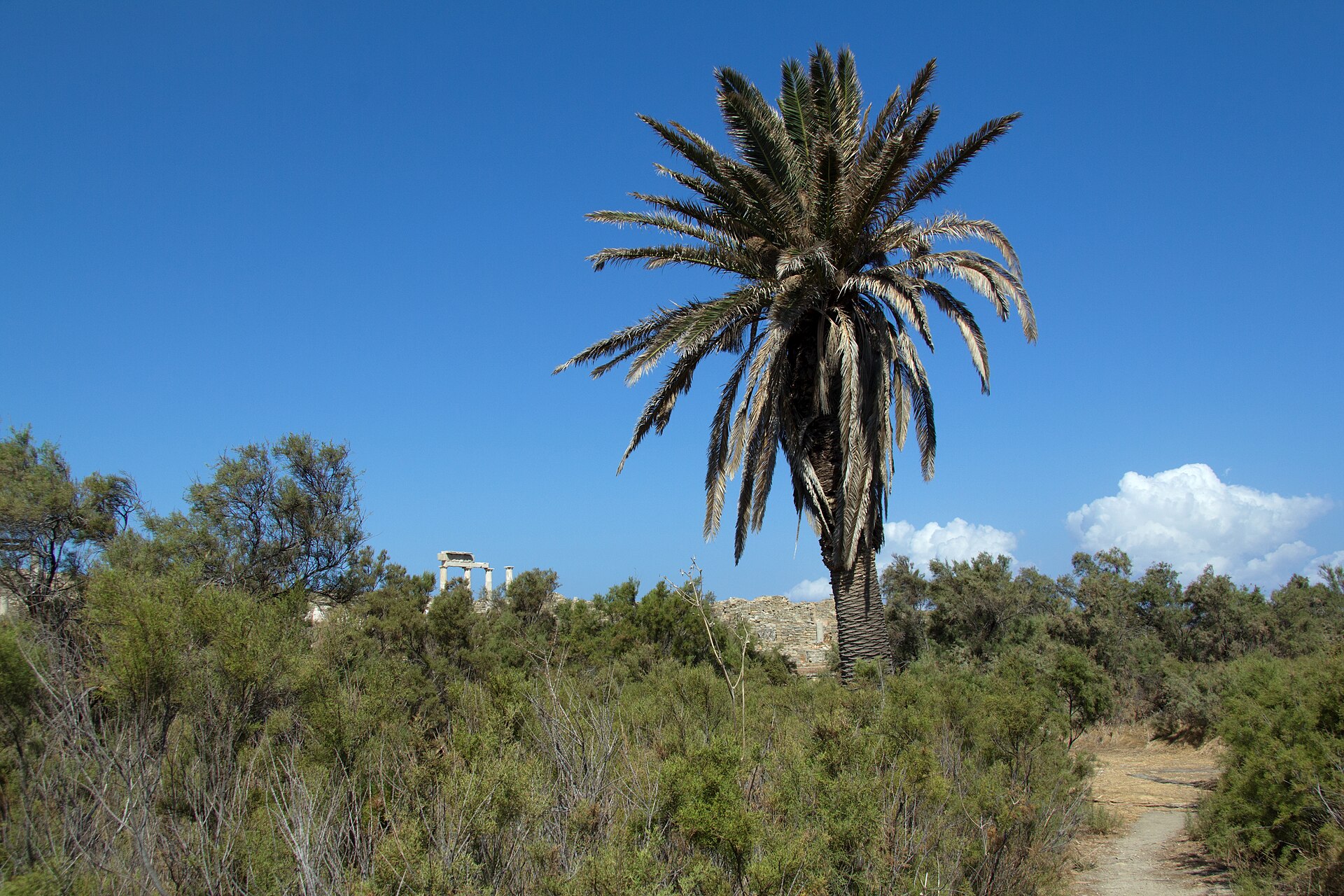
The sanctity of Delos rested on a myth known across the Greek world. Leto, pregnant by Zeus with twins, was pursued by the jealous wrath of Hera and could find no place willing to give her refuge, for every land feared Hera’s anger. Only Delos, according to the story a barren, floating island of no value, dared to receive her, and there, clinging to a palm tree beside a small lake, Leto gave birth first to Artemis and then to Apollo. In gratitude and in reward, the once-floating island was anchored fast to the sea floor and became forever sacred, and Apollo made it one of his chief homes.
This story explained everything the Greeks needed to know about Delos. It accounted for the island’s holiness, its special relationship with Apollo and Artemis, and even the physical features pilgrims were shown: the palm tree, the sacred lake, the low round hill where the birth was said to have happened. A palm still grows on the site today, marking the traditional spot, and though it is a modern planting the tradition it honors is ancient. The Homeric Hymn to Apollo, one of the oldest Greek poems about the god, celebrates Delos as his birthplace and describes the great festival the Ionians held there in his honor, with singing, dancing, and athletic contests.
Because Apollo was born here, Delos became the focus of an ancient Ionian festival that drew the Greek-speaking peoples of the islands and the Anatolian coast together in worship. Later, the Athenians revived and magnified this festival, the Delia, held every four years, turning it into a grand celebration that reinforced their claim to leadership over the Ionian world. The myth of the birth, in other words, was not just a pretty story; it was the foundation of the island’s whole religious and political importance, the source of the sanctity that everything else at Delos was built upon.
The Sanctuary and the Sacred Precinct
At the heart of ancient Delos lay the sanctuary of Apollo, a walled precinct crowded over the centuries with temples, altars, statues, and offerings. Three temples to Apollo himself stood here, built in succession as the sanctuary grew, along with a temple to Artemis, treasuries, and long colonnaded halls, or stoas, where pilgrims could shelter and business could be conducted. Today these buildings survive mostly as foundations and scattered columns, but their sheer number and density convey how thickly the sacred ground was built up over the generations of the sanctuary’s importance.
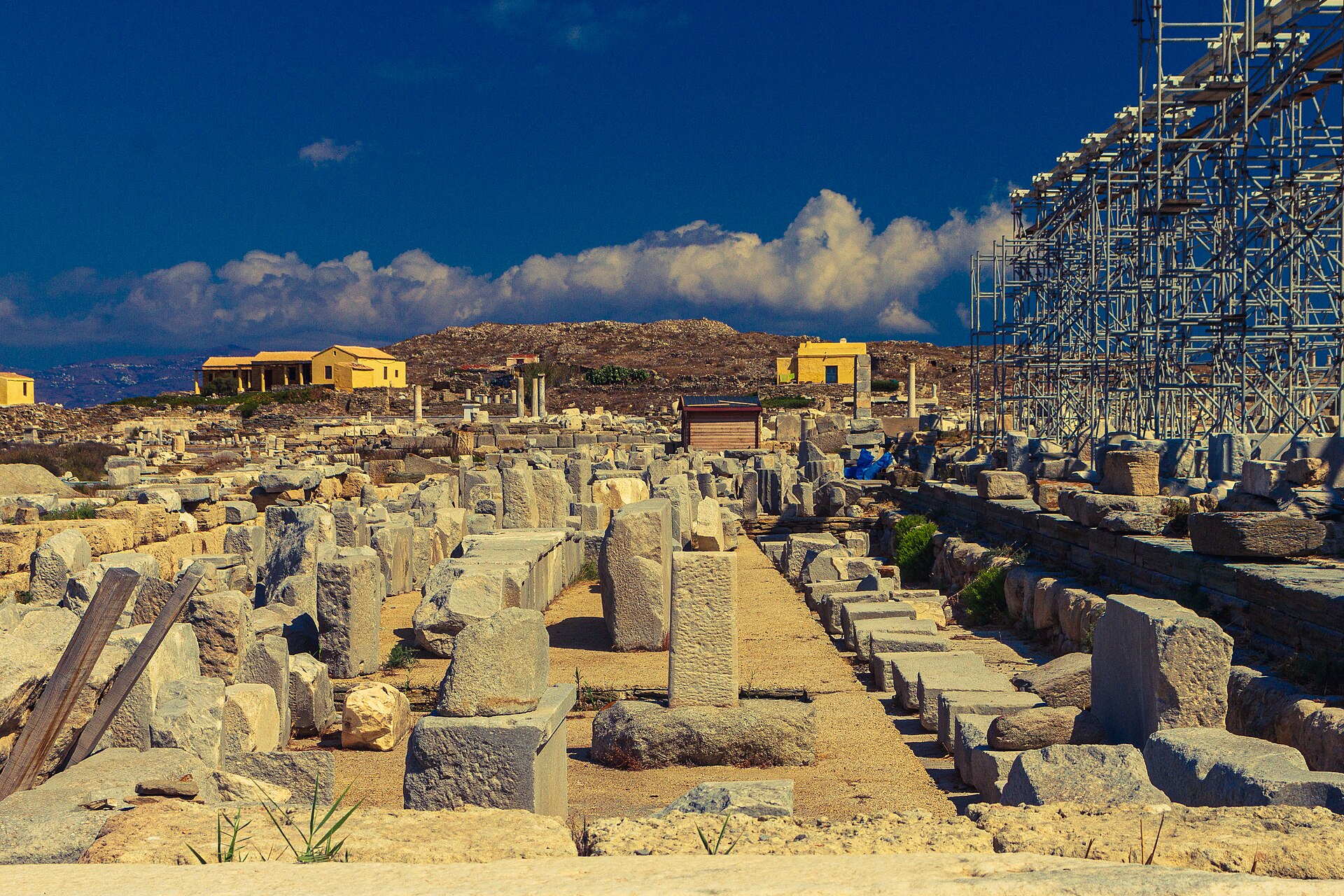
One of the most famous features of the sanctuary was the great horned altar said to have been built by Apollo himself entirely out of the left horns of sacrificial goats, counted among the wonders of the ancient world for its ingenuity. Near it stood a colossal statue of Apollo, a marble giant several times life-size, dedicated by the people of Naxos in the archaic period; fragments of it, including parts of the torso and a huge hand, still lie on the site, giving a sense of its original scale. A magnificent avenue of marble lions, the island’s most iconic monument, guarded the approach to the sacred lake nearby.
The sanctuary was administered with great care, its treasures inventoried in detailed records that have partly survived, listing the dedications item by item, from precious metal vessels to statues to stranger offerings accumulated over centuries. These inventories are a goldmine for historians, offering a rare, itemized glimpse into the material life of a Greek sanctuary: what people gave, what it was worth, how it was stored and maintained. Through them we can reconstruct something of the sheer accumulated wealth that made Delos, for all its physical barrenness, one of the richest sacred sites in the Greek world.
The Terrace of the Lions
If Delos has a single emblem, it is the Terrace of the Lions. Sometime in the seventh century BC the people of Naxos, then among the wealthiest and most powerful of the island states, dedicated a row of marble lions overlooking the Sacred Lake, the small body of water beside which Apollo was said to have been born. The lions crouched or sat in a line along the terrace, lean and alert, their mouths open as if roaring, forming a ceremonial avenue that framed the approach to the most sacred ground on the island. There may originally have been as many as a dozen or more; several survive on the island today, weathered by twenty-six centuries of sea wind.

The lions are masterpieces of archaic Greek sculpture, carved with a stylized power that is instantly recognizable. Their taut, muscular bodies and fierce expressions embody the archaic sculptor’s genius for suggesting living energy within a formal, almost geometric design. To protect the originals from further erosion, the lions now standing on the terrace are replicas, while the surviving ancient ones are kept in the island’s museum. The visual effect of the terrace, even reconstructed, is unforgettable: a file of stone beasts standing guard over the dry basin of the sacred lake, keeping their watch as they have since before the classical age began.

The lions had a long afterlife. Centuries later, when Venice ruled much of the Aegean, one of the Delian lions was carried off to guard the entrance of the Venetian Arsenal, where a Delos lion still stands today, far from its island home. The dispersal of these ancient guardians is a small emblem of the way the treasures of the Greek world scattered across later centuries. But the terrace itself remains where the Naxians set it, and it is still the image most people carry away from Delos: austere, powerful, and unmistakably ancient.
The Delian League and Athenian Control
Delos’s neutrality and sanctity made it the natural seat for one of the most important political institutions of classical Greece. After the Greek victory over Persia in 479 BC, the cities of the Aegean and Ionia formed an alliance to continue the war and guard against a Persian return, and they chose Delos as its headquarters. The allies met on the sacred island, and the common treasury of the alliance, funded by contributions from every member, was kept in the sanctuary of Apollo. From this base the alliance takes the name history gives it: the Delian League.
In principle the league was a partnership of equals under Athenian leadership, but in practice Athens dominated it from the start and steadily tightened its grip. Members who tried to leave were forced back in; contributions became something closer to tribute; and the league gradually turned into an Athenian empire in all but name. The symbolic turning point came in 454 BC, when the treasury was moved from Delos to Athens, ostensibly for safety but in reality to place the allies’ money under direct Athenian control. From then on the wealth of the alliance funded the great building program on the Athenian Acropolis, including the Parthenon itself, raised in part with money once meant for the common defense.
Delos thus stood at the birth of Athenian power. The island’s neutral sanctity had made it the ideal meeting ground for a voluntary alliance, and the transformation of that alliance into an empire is written into the history of the treasury that once sat in Apollo’s sanctuary. Even after the money left, Athens kept a close and jealous interest in Delos, and much of what happened on the island over the following century, including some of its most extraordinary religious episodes, was driven by Athenian concern to control and purify the sacred ground it regarded as peculiarly its own.

The Purifications of a Sacred Island
The sanctity of Delos led to some of the most striking religious measures in Greek history. Because the island was Apollo’s birthplace, it was held that it should never be polluted by birth or death, the two events Greek religion regarded as sources of ritual impurity. To enforce this, the Athenians carried out a series of purifications of the island. In an early stage, all the graves within sight of the sanctuary were opened and their contents removed. Then, in 426 BC, during the Peloponnesian War, Athens carried out a total purification: every remaining grave on the whole island was dug up and the bones transferred to a neighboring island, and it was decreed that henceforth no one might die or give birth on Delos at all.
The practical consequences were extraordinary. Anyone who fell dangerously ill or a woman who went into labor had to be ferried across the strait to the nearby island of Rheneia to die or give birth there, so that Delos itself remained forever untouched by either event. An island that was home to a busy population and, later, a bustling port thus maintained the fiction, and to a degree the reality, that no human being was ever born or died upon it. It is one of the most remarkable examples anywhere of a whole community’s life being reshaped around a religious ideal of purity.
To mark the completion of the great purification, the Athenians also revived the ancient Delian festival on a magnificent new scale, reasserting the old pan-Ionian celebration in honor of Apollo. Thucydides, our main source, records the whole episode as part of the story of the war, and it shows how religion and politics intertwined at Delos: the purification demonstrated Athenian piety and Athenian power at the same time, honoring the god while advertising Athens’s special guardianship of his sacred island.
Free Port and Crossroads of the World
The final and in some ways most spectacular chapter of Delos’s history came not from religion but from trade. In 166 BC, Rome, then the rising power in the Mediterranean, handed control of Delos to its ally Athens and declared the island a free port, exempt from the customs duties that burdened commerce elsewhere. The effect was electric. Merchants and traders flooded to the island, and Delos was transformed within a generation from a quiet sanctuary into one of the greatest commercial centers of the Mediterranean, a booming, crowded, cosmopolitan port where goods and people from three continents changed hands.
Much of what passed through Delos was ordinary commerce, grain, wine, oil, luxury goods, and the products of the eastern Mediterranean, but the island also became notorious as one of the ancient world’s great slave markets. Ancient sources claim, with likely exaggeration, that tens of thousands of slaves could be bought and sold there in a single day. Whatever the true figure, Delos was a major hub of the Roman-era slave trade, its wealth built in significant part on the traffic in human beings, a grim reality that sat alongside its ancient sanctity in a way that says much about the economy of the classical world.
The commercial boom left its mark all over the island. Warehouses lined the harbor; a whole new residential quarter of fine houses spread up the slopes; sanctuaries to foreign gods sprang up alongside the temples of Apollo. For roughly a century, from the mid-second to the early first century BC, Delos was one of the busiest and richest places in the Mediterranean, its population swollen far beyond anything the barren island could ever have fed on its own, sustained entirely by the flow of trade through its tax-free port.
A City of Mansions and Mosaics
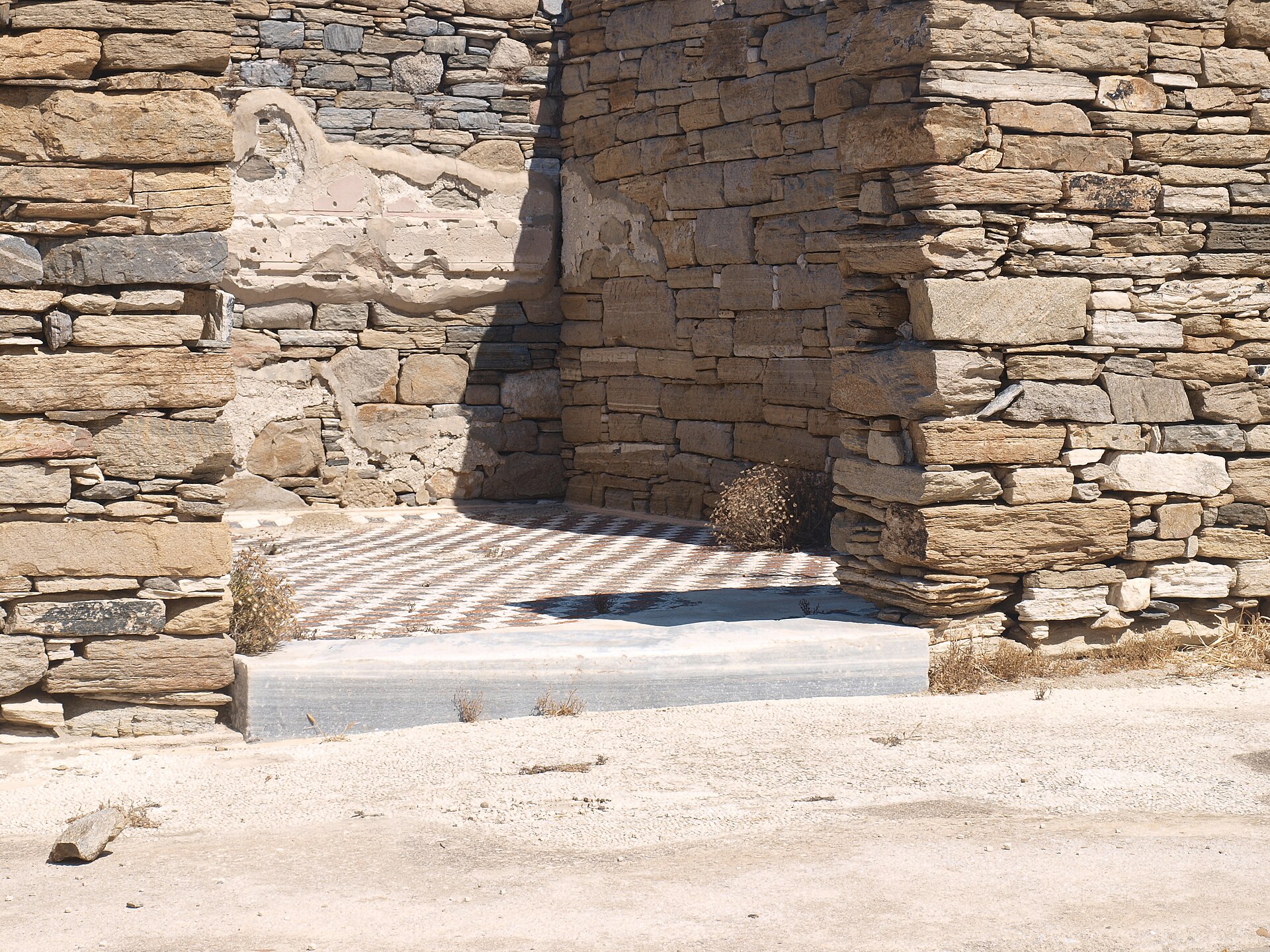
The wealth of the free-port era built a city, and it is this city, more than the ancient sanctuary, that gives Delos its extraordinary archaeological richness today. On the slopes above the harbor spread a dense residential quarter of Hellenistic houses, some of them substantial mansions built around central courtyards in the manner that would later become standard in the Roman world. The finest of them had upper storeys, cisterns to collect the precious rainwater, and rooms decorated with wall paintings and, above all, mosaic floors of remarkable quality.

The mosaics of Delos are among the best-preserved of their age anywhere. Laid in tiny cubes of colored stone and glass, they depict mythological scenes, geometric patterns, and vivid images: the House of Dionysus is named for its mosaic of the god riding a panther; the House of the Masks preserves a scene of Dionysus on a tiger and a series of theatrical masks; the House of the Dolphins takes its name from its floor. Because they were sealed under collapse and abandonment relatively soon after they were made, and never overbuilt, these floors survived where those of most ancient cities were destroyed, giving us an almost unique window onto the domestic art of the late Hellenistic world.
To walk through the residential quarter of Delos is to walk through a real ancient neighborhood, with its streets, drains, shops, and houses still legible in the ground. Many of the buildings retain their walls to a good height and their courtyards, columns, and floors, so that the visitor can move from room to room as an inhabitant once did. Few sites in the Greek world convey so directly the texture of everyday urban life, precisely because Delos was frozen at the peak of its prosperity and then abandoned, leaving its city preserved as a snapshot of a single vanished moment.
A Meeting of Many Peoples
The free port made Delos one of the most cosmopolitan places in the ancient Mediterranean, and the evidence for its mixed population is everywhere on the island. Alongside Greeks came Romans and Italians, drawn by the commercial opportunities, along with traders from Syria, Egypt, and across the eastern Mediterranean. Each community brought its own gods, and the island filled with sanctuaries to deities from far beyond the Greek pantheon: shrines to the Egyptian gods Isis and Serapis, to the Syrian goddess Atargatis, to Phoenician and other eastern divinities, standing not far from the ancient precinct of Apollo.
This religious diversity is one of the most fascinating aspects of late Delos. The sanctuary of the Egyptian gods, with its temple to Serapis and Isis, is well preserved and can still be visited; nearby stood the sanctuary of the Syrian gods. Associations of foreign merchants, such as the Poseidoniasts of Berytus, traders from the Phoenician city of Beirut, built their own clubhouses and shrines, combining business, worship, and social life in a single institution. Delos in this period was a genuine melting pot, a place where the religions and peoples of three continents met and mingled around the engine of Mediterranean trade.
That mingling included one of the earliest known Jewish and Samaritan communities in the Aegean, attested by inscriptions and by a building on the shore that many scholars interpret as a synagogue, possibly among the oldest yet identified. The presence of these communities on Delos, alongside worshippers of Greek, Roman, Egyptian, and Syrian gods, makes the island a remarkable microcosm of the interconnected, multicultural world of the Hellenistic and early Roman Mediterranean, a world in which a tiny sacred island could become a crossroads for the faiths and peoples of half the known earth.
Sack, Decline, and Abandonment
Delos’s prosperity ended almost as suddenly as it had begun, and it ended in violence. In 88 BC, during the war between Rome and King Mithridates of Pontus, forces allied to Mithridates fell upon the island, which was firmly in the Roman commercial orbit. The attack was devastating: ancient sources describe a massacre of the island’s largely Italian and Roman population, said to number in the tens of thousands, and the plundering of its wealth. A second damaging raid by pirates followed a few decades later. Delos, undefended and crowded with riches, was catastrophically exposed, and these blows shattered the booming port.
The island never recovered. Trade routes shifted, the security that had allowed the free port to flourish was gone, and the causes of its prosperity evaporated. The population dwindled, the great houses fell empty, and over the following centuries Delos slid into decline and finally into abandonment. Where tens of thousands had once thronged the harbor and the markets, only ruins remained, and the sacred island of Apollo, having briefly been one of the richest places in the world, returned to the silence and emptiness that had preceded its greatness.
In a sense the disaster preserved Delos for us. Because the city was struck down at its peak and then largely abandoned rather than rebuilt, its streets and houses, mosaics and sanctuaries were left much as they had been, gradually collapsing but never overbuilt by a later town. Where continuously inhabited ancient cities have been buried under their own successors, Delos was frozen and forgotten, which is exactly why so much of it survives, and why it can offer the modern visitor so complete a picture of a Hellenistic city and sanctuary.
The Open-Air Museum of the Aegean
Today Delos is uninhabited except for the archaeologists and guardians who care for it, and it is reached by boat from the nearby island of Mykonos, whose glittering modern tourism could hardly stand in greater contrast to its silent, sacred neighbor. Visitors come for the day, disembark at the ancient harbor, and walk out into one of the most extensive archaeological sites in the Mediterranean, a whole ancient island preserved as an open-air museum. The rules of antiquity, in their way, still hold: no one is permitted to stay overnight, and the island empties again each evening as the last boats leave.
The site rewards the effort. Within a single visit one can see the sanctuary of Apollo with its temples and giant statue fragments, the iconic Terrace of the Lions above the dry Sacred Lake, the residential quarter with its mansions and celebrated mosaics, the theatre, the sanctuaries of the foreign gods, and, for those who climb Mount Kynthos, a panorama over the whole of the Cyclades that explains at a glance why the ancients placed the center of their island world here. The island’s museum houses the finest finds, including the original archaic lions and a wealth of sculpture and everyday objects.
Delos was recognized as a UNESCO World Heritage site in 1990, honored as an exceptionally extensive and complete example of a great Mediterranean sanctuary and port. Its combination of religious, political, and commercial significance, all compressed onto a single small and barren island, makes it one of the most illuminating archaeological sites in Greece. To stand among its ruins is to grasp, in one place, the sacred imagination of the ancient Greeks, the political machinery of Athenian power, and the restless, cosmopolitan commerce of the Hellenistic Mediterranean, all bound together on the island where a god was said to have been born.
Nearby Places
- Delphi: The Mountain Sanctuary of the Oracle
- Mycenae: The Golden Citadel of Agamemnon
- Knossos: The Palace Behind the Myth of the Minotaur
Final Word
Delos is the great paradox of the Aegean: a tiny, waterless, barren island that the Greeks made one of the holiest and, for a time, one of the richest places in their world. As the mythical birthplace of Apollo it drew worshippers and treasure for a thousand years; as the seat of the Delian League it stood at the birth of Athenian empire; and as a Roman-era free port it became a booming, cosmopolitan crossroads where the peoples and gods of three continents met. Struck down at its height and then abandoned, it survived as an almost complete ancient city and sanctuary, and today it stands empty and silent, an open-air museum where the sacred, the political, and the commercial histories of the ancient Mediterranean all lie preserved on a single sunlit island in the middle of the sea.
You May Like
Mafra, the Palace a King Built From a Vow


One thought on “Delos: The Sacred Island Where a God Was Born and Traders Met”