39 km to the east of Antalya. Then you reach Serik District, and after 7 km you reach the Eurymedon River. Aspendos, located next to the Köprüçay (Eurymedon) river, is world-renowned for its magnificent ancient amphitheater. B.C. It was founded by the Achaeans in the 10th century and is one of the prosperous and rich cities of the ancient period. Theater here M.S. It was built by the Romans in the 2nd century.
The city was built on two hills, one large and one small.
Geographer Strabon and Pamponrus Mela write that the city was founded by the Agrusids. BC to the region There were Greek migrations after 1200, but the source of the name Aspendos is the native Anatolian language before the Greeks. Since it is on an important trade route and connected to the port by the Köprüçay River, Aspendos has been among the cities that have been wanted to be captured in every age. Aspendos is one of the first cities in the region to have coins minted in its name. Historical M.Ö.V.
and IV. On these silver coins dating back to the 16th century, the name of the city is written as Estwediiys in the local script. Found in the Karatepe excavations near Adana in 1947, M.S. VIII. The bilingual inscription, excavated in both Hittite hieroglyphs and Phoenician alphabets at the end of the century, states that King Asitawada of Danunum (Adana) founded a city named Azitawadda, derived from his name, and that he was a member of the Muksas or Mopsus dynasty.
This surprising similarity between the names “Estwediiys” and “azitawaddi” indicates that the city of Aspendos may have been the city founded by Asitawada.
Aspendos did not play an important role as a political power in ancient times. The political history of Aspendos during the colonization period is compatible with the trends in the Pamphylia region. With this tendency, Aspendos remained under Lycian rule for a while after the colonization period. City, B.C. It came under Persian rule in 546. During this period, Aspendos continued to mint its own coins. B.C.
In 467, statesman and military commander Cimon and his fleet of 200 ships destroyed the Persian fleet stationed at the mouth of the Eurymedon (Köprüçay) River with a sudden attack. After that, Aspendos became a member of the Attica-Delos Naval League. B.C. In 411, the Persians captured the city again and used it as a base. The Athenian commander, who was trying to regain some of the prestige the city had lost in the Peloponnesian Wars, B.C.
In 389, he anchored on the shores of Aspendos to guarantee the surrender of the city. The people of Aspendos, who did not want a new war, collected money among themselves and gave the money they collected to the Athenian commander, begging him to withdraw without causing any damage. Although the commander received the money, his men trampled the crops in all the fields, causing damage to the people of Aspendos. After Alexander the Great captured Perge, B.C.
When he entered Aspendos in 333, the people who had previously given many horses and paid taxes to the Persian king sent an envoy to him to ask Alexander not to demand these as well. After the agreement was reached, Alexander went to Side, leaving a garrison in the surrendered city.
While returning via Sillyon, Alexander learned that the people of Aspendos did not approve the agreement proposed by their ambassadors and were preparing to defend themselves, and immediately advanced towards the city. When they saw Alexander returning with his troops, the people of Aspendos retreated to the acropolis and sent an envoy to establish peace again. However, this time they had to accept very harsh conditions.
According to this agreement, a Macedonian garrison would remain in the city and they would pay 100 talents as well as 4000 horses as an annual tax. The city, which came under the control of the Ptolemies and Seleucids alternately in the wars that continued after the death of Alexander, later B.C. It was taken over by the Kingdom of Pergamum until 133. B.C.
We know that before Cicero presented the case to the Roman senate in 79 BC, Cilicia deputy council Gaius Verres plundered Aspendos, just like he did in Perge. Verres took the statues from temples and squares in front of the public and loaded them onto horse-drawn carriages. So much so that Verres even took the famous harpist statue of Aspendos, which was in his own house.
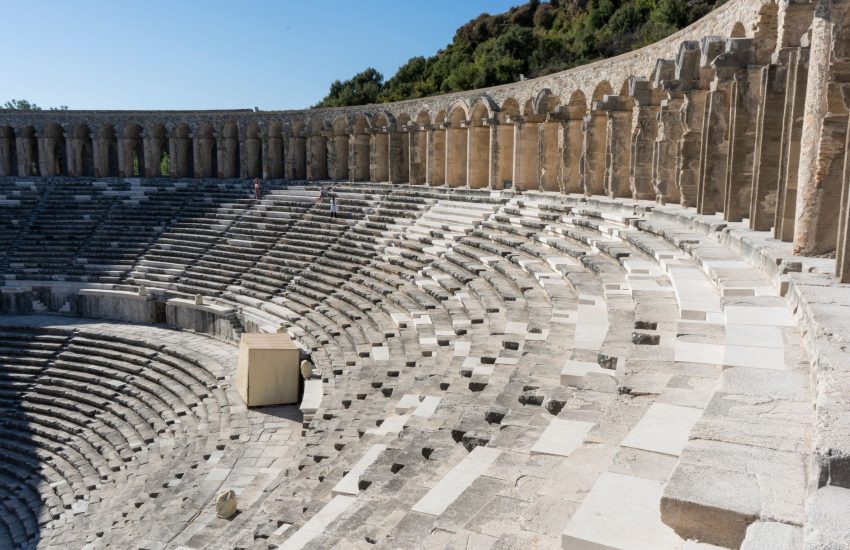
The most important structure of Aspendos is its theatre. It is the best preserved open-air theater among the ancient theatres. This theater is the oldest and most intact example of the Roman Theaters in Anatolia that has survived to the present day with its stage. Its architect is Zenon, son of Theodorus of Aspendos. It was built during the time of Antonius Piu (138-164).
The theater was presented to the local gods of the city and the imperial family. Aspendos is visited by thousands of local and foreign tourists every year and was used for concerts and activities until a few years ago. The structure was built on a hillside in accordance with the Greek tradition. Today, visitors enter the building through the door on the front façade, which was built much later.
In fact, the original entrance is from the vaulted parados at both ends of the stage building. The caeva is semicircular in shape and is divided into two by a wide diazoma. There are 21 rows of seating above and 20 rows below.
In order to provide ease of circulation so that the audience can take their seats without difficulty, gradually spreading stairs have been built. While the number of stairs starting from the orchestra level in the lower section is 10, this number is 21 at the upper beginning of the diazoma. The 59-arched gallery, thought to have been built at a later date, extends from one end of the upper caeva to the other.
From an architectural perspective, the vaulted gallery of the diazoma is a substructure that supports the upper caeva. As a general rule of protocol, the lodges located above the entrances on both sides of the caeva are reserved for the imperial family and the holy virgins devoted to Vesta, the Roman god of the heart. Starting from the orchestra and moving up, the first row is reserved for senators, judges and ambassadors, and the second row is reserved for other notables of the city.
Other parts are open to all citizens. Women usually sat in the upper rows below the gallery. It is clearly understood from the names carved in certain places to sit on the upper part of the cavea that these places are reserved for certain people.
The most striking element of the theater is the stage building. There are five doors on the lower floor of this two-storey building made of masonry stone, allowing artists to enter the stage. There is a large door in the middle, known as porta regia, and two smaller doors, known as porta hospitales, on either side. The small doors at the level of the orchestra belong to long corridors opening to places where wild animals are kept.
From the remaining pieces, it is understood that the statues were placed in niches on the walls and in small buildings in the form of buildings, under small triangular and semicircular ornamental roofs (pediments). In the pediment in the middle of the columned upper floor, there is a relief of Dionysus, the god of wine and the founder and protector of theatres.
The red zigzag motifs on the white plaster that can be seen in some parts of the stage building facade belong to the Seljuk period. The upper part of the stage building is covered with a highly decorated wooden roof. The theater in Aspendos is also very famous for its extraordinary acoustics. Even the slightest sound made in the middle of the orchestra can be easily heard from the galleries in the top row.
Anatolian nobles, living in the midst of a rich cultural heritage, created stories about the cities and the monuments around them. One of these stories passed down from generation to generation is about the Aspendos Theatre. Accordingly; The King of Aspendos announces that he will hold a competition to see who can provide the most service to the city and that the winner can marry his daughter. Hearing this, the artisans set to work at full speed.
When the decision day finally comes, the king examines everyone’s efforts one by one and chooses two candidates. The first of these candidates succeeded in establishing a system that brought water to the city from long distances via aqueducts. The second candidate built the theatre. While the king is about to decide in favor of the first candidate, he is asked to look at the theater again.
While wandering around the top gallery of the theatre, I heard a voice from an unknown source saying deeply and repeatedly: “The king’s daughter must be given to me.” he hears you say. The king, who was greatly surprised, looked for where the sound was coming from, but could not find anyone. This person, of course, is the architect of the theater himself, who boasts about the acoustics of the masterpiece he created and speaks in a very low voice on stage. In the end, the architect wins the beautiful girl and the wedding ceremony is held in this theater.
We know from an inscription in the southern parados that the theater was built by the architect Zeno, the son of an Aspendian named Theodoros, during the reign of Emperor Marcus Aurelius (AD 161-180). According to this inscription, the people of Aspendos appreciated Zeno and rewarded him with a large garden next to the stadium.
Greek and Latin inscriptions on the entrances on both sides of the stage building tell that the stage building was put into service by two brothers named Curtius Crispinus and Curtius Auspicatus and that they dedicated the building to the gods and the Emperor’s family.
The other main ruins of Aspendos are behind the theater, above the acropolis. The first building encountered in the acropolis, which can be reached from a path that starts next to the theater, is the basilica measuring 27×105 meters. Basilica is an architectural structure invented by the Romans. Roman basilicas were used for different purposes, but all of them were social matters. Courts and shopping markets were established in these buildings.
The plan of the basilica consists of a large central hall surrounded by rooms. The central hall is separated from the other parts of the building by the columns on its sides and its roof is higher. There is a judge’s bench inside the basilica. During the Byzantine period, major changes were made to the building and it lost its original structure.
There is also a small story of Aspendos Ancient Theatre. The king of Aspendos had a very beautiful daughter at that time and everyone wanted to marry her. But since the king did not know who to decide on, he announced to the people: I will give my daughter to whoever does the most useful and beautiful thing for our people and our city. Based on this situation, two great works come out and these two works are written by two twin brothers.
One of these works is the aqueducts that bring water to the town, which were discovered and built as a result of a magnificent geometric calculation, many kilometers away from the city; The other one is the best acoustically sound theater in the world at that time and today, where when a coin is thrown on the ground in its orchestra, the sound can be heard even from the top. Its architect is Zenon.
After seeing the aqueducts, the king wants to give his daughter to the architect who built the aqueducts, but when he enters the theater, he hears a voice while walking around the upper part of the theater. The voice says, “I should take the king’s daughter and give her to me.” Admired by this acoustics, the king decides to give his daughter to the architect Zenon.
Aspendos, like other Pamphylia cities, had its heyday in AD. reached in the second and third centuries. Most of the monumental architecture that can still be seen in this region today was built during this golden age. Although the city is not on the coast, its location on the edge of the Eurymedon (Köprüçay) River made it possible for ships to reach the city.
This transportation facility, together with the fertile plains behind Aspendos and the mountains covered with dense forests, have been the determining factors in the development of the city. Gold and silver embroidered tapestries woven in the city, furniture and figurines made of lemon wood, salt and wine obtained from the nearby Lake Kapria, and especially the famous horses of Aspendos are the main products exported by the people of Aspendos.
Even though they were known for growing grapes and trading wine, the people of Aspendos did not offer wine to their gods in their religious ceremonies and explained the reason for this by saying, “If wine belonged only to the gods, birds would not dare to eat the grapes.” From the beginning of the 13th century, Aspendos begins to bear traces of the settlements of the Seljuk Turks. Especially I.
The theater, which was completely restored during the reign of Alaeddin Keykubat, was decorated with elegant tiles in the Seljuk style and was used as a palace. To the south of the basilica is the agora, surrounded by houses on three sides, which is the center of commercial, social and political activities in the city. As you go west, just ahead, behind the stoa, there are twelve shops of equal size, all in a row.
To the north of the agora, there is a nymphaeum, of which only the front wall remains standing today. This two-storey façade, which is 32.5 meters wide and 15 meters high, has five niches on each floor. The niche in the middle on the lower floor is wider than the others and is thought to have been used as a door. From the marble floor at the bottom of the wall, it is understood that the building originally had a facade with columns.
Behind the nymphaeum is a building with an unusual plan, used either as a bouleterion or an odeon where council members gather.
Another ruin of Aspendos is the aqueducts. This one-kilometer-long series of arches that bring water to the city from the mountains in the north reveals an extraordinary engineering skill and is one of the rare examples that have survived from ancient times. Water was brought to the city from its source through a channel made of carved stone blocks on 15-meter high arches.
Water was collected in 30 meter high towers on both sides of the end point of the arch and distributed to the city from here.
An inscription found in Aspendos tells that the aqueduct was built by Tiberius Claudius Italicus and put at the service of the city. Its architectural features and construction techniques indicate that the aqueduct dates back to the mid-2nd century AD.
You May Like
Aspendos Ancient Theater Travel Guide