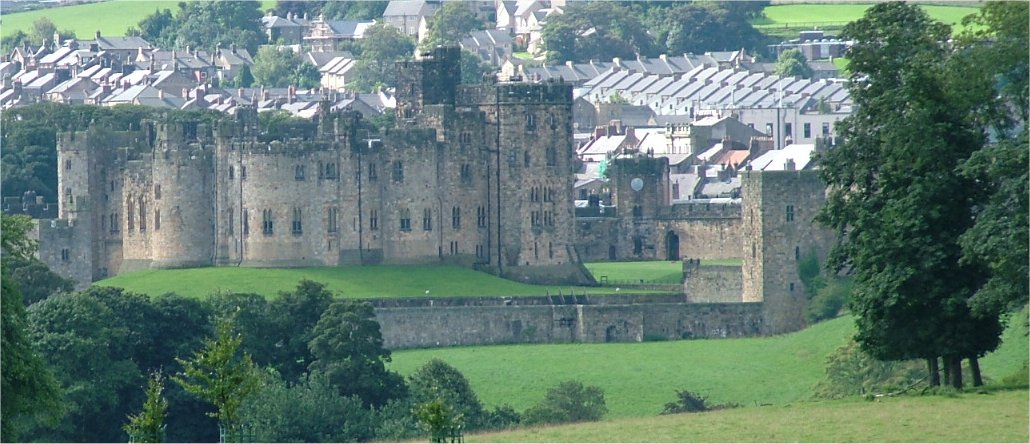
There is a good chance you have already seen Alnwick Castle, even if you have never been to Northumberland. When the young wizards of Hogwarts had their first flying lesson, or when the camera swept across the school’s great grey towers, they were often looking at Alnwick, which stood in for Harry Potter’s magical school in the films. But long before it enchanted cinema audiences, this vast fortress in the far north of England was doing something far more serious: guarding the wild and bloody border between England and Scotland, as the stronghold of one of the most powerful noble families the country has ever known.
Alnwick is the second-largest inhabited castle in England, after Windsor, and it is still very much a family home, the seat of the Dukes of Northumberland, the mighty Percy dynasty. For centuries the Percys were the great lords of the north, the shield of England against Scottish invasion, and their name runs like a thread of iron through the wars, rebellions, and legends of the border country. Their castle is huge, grand, and steeped in history, wrapped around a medieval core and filled with treasures.
So Alnwick is really two things at once: a grim and genuine border fortress with a fierce military past, and a splendid stately home with world-famous gardens and a starring role on screen. Let’s cross the River Aln and explore both sides of it, from Harry Hotspur to Harry Potter.
We will trace both threads together, the fortress and the family, because at Alnwick the two are really one story. The Percys made the castle and the castle made the Percys, and their fortunes rose and fell together through seven centuries of war, rebellion, and eventual grandeur. Keep the family in mind as we go, and the great grey walls will fill up with the people who fought, feasted, and schemed behind them.

Table of Contents
- Guarding a Dangerous Border
- Two Scottish Kings Undone
- The Mighty House of Percy
- Harry Hotspur, the Border Hero
- A Fortress Rebuilt for Comfort
- Reading the Walls
- Inside a Ducal Palace
- The Alnwick Garden
- A Castle That Went to the Movies
- Jewel of a Castle Coast
- Planning a Trip to Alnwick
- Nearby Castles
- Before You Go
Guarding a Dangerous Border
To understand Alnwick you have to understand where it stands. Northumberland is the far north-eastern corner of England, and for centuries it was frontier country, the debatable land where England met Scotland and the two kingdoms fought, raided, and feuded almost without pause. This was a violent, unstable world of cross-border raids, cattle-thieving reivers, and full-scale royal invasions, and it needed strong castles to hold it.
Alnwick was one of the greatest of those border strongholds. Founded around the end of the eleventh century, soon after the Norman Conquest, it guarded an important crossing of the River Aln and the main road running north toward Scotland. Whoever held Alnwick held one of the keys to the defence of northern England, and the castle grew steadily into a formidable fortress as the border wars raged on.
That frontier position shaped everything about Alnwick’s early history. This was not a comfortable castle in a peaceful shire but a working military base on a dangerous edge, expected to withstand and repel real invasions. Two Scottish kings, as we shall see, came to grief beneath its walls, and the castle’s story is inseparable from the long, grinding struggle between the two nations.
Two Scottish Kings Undone
Alnwick can claim a remarkable double distinction: it was the undoing of not one but two Scottish kings. In 1093, King Malcolm III of Scotland, a warlike ruler who had invaded England repeatedly, was killed near Alnwick during one of his raids, along with his son. His death threw Scotland into turmoil and is one of the great early dramas of the border.
Then, in 1174, an even more spectacular event unfolded. King William the Lion of Scotland was besieging Alnwick when he was surprised by an English force in the morning mist. In the confusion his horse was killed under him and the king himself was captured, a stunning reversal that saw a reigning Scottish monarch taken prisoner beneath the castle walls. His capture was a humiliation for Scotland and forced a treaty highly favourable to England.
Few castles anywhere can boast of having brought down two kings of a neighbouring realm. These episodes cemented Alnwick’s reputation as a fortress of real strategic weight, a place where the fate of nations could turn, and they set the tone for centuries of Anglo-Scottish conflict in which the castle would play a leading role.
Stories like these gave rise to a whole culture of border legend, preserved in the old ballads that were sung and recited across Northumberland and the Scottish Lowlands for centuries. The endless raids, the feuds, the famous fights and captures all became the raw material of song, and Alnwick, at the centre of so much of it, features in the background of that rich and violent folk tradition.
The Mighty House of Percy
In 1309 Alnwick was bought by the Percy family, and it has been their home ever since, for over seven hundred years. The Percys became the Earls and later Dukes of Northumberland, and they were, for much of the Middle Ages, the greatest power in the north of England, so mighty that they were sometimes almost a law unto themselves, kings of the border in all but name.
As lords of the frontier, the Percys carried a huge responsibility: the defence of northern England against the Scots. They led armies, fought battles, and held the line for the crown, and their power and prestige grew accordingly. But such over-mighty subjects were also dangerous, and the Percys had a long and stormy relationship with the kings they served, repeatedly rising in rebellion when they felt their interests threatened.
That mixture of loyalty and defiance runs right through the family’s history. The Percys made and unmade royal fortunes, backed and betrayed kings, and paid for it again and again with the blood of their leaders. Alnwick, their great northern seat, was the beating heart of this turbulent dynasty, and its walls have watched the family rise, fall, and rise again across the centuries.
The Percys also played a leading part in the Wars of the Roses, the dynastic bloodbath of the fifteenth century, and paid a fearful price for it. Successive heads of the family were killed in its battles, one generation after another cut down in the fighting, so that the dukedom repeatedly passed to sons who had lost their fathers to war. Few families gave so much blood to the quarrels of the crown, and Alnwick mourned each loss in turn.

Harry Hotspur, the Border Hero
The most famous of all the Percys is Sir Henry Percy, better known by his thrilling nickname, Harry Hotspur. Born in the fourteenth century, Hotspur earned his name through his fiery temper and his headlong courage in battle, becoming a celebrated warrior renowned across the border country and beyond. He fought the Scots in the endless frontier wars, most famously at the Battle of Otterburn, and became a legend in his own lifetime.
Hotspur’s fame was sealed forever by William Shakespeare, who made him a leading character in his play about Henry IV, portraying him as the very embodiment of reckless chivalric valour, a brilliant, hot-headed soldier too impatient for the cold games of politics. It is largely thanks to Shakespeare that Hotspur is remembered today as one of the great figures of English history and drama.
His end was tragic and dramatic. The Percys, feeling betrayed by the very king they had helped put on the throne, rose in rebellion, and Hotspur was killed at the Battle of Shrewsbury in 1403, cut down while leading the charge. His death was a catastrophe for the family, but it turned him into an immortal legend, and his name is still proudly associated with Alnwick and the Percys to this day.
There is a nice footnote to Hotspur’s fame far from the border. The great London football club Tottenham Hotspur takes its name, indirectly, from Harry Percy, whose family held land in that part of London, so that a fourteenth-century Northumberland warrior is remembered every week by millions of sports fans who have no idea their team is named after a medieval border hero. Few knights can claim so unexpected a form of immortality.

A Fortress Rebuilt for Comfort
Over the centuries the fortunes of the Percys, and of their castle, rose and fell with the endless dramas of northern politics. Alnwick was besieged, changed hands, was damaged and repaired, and at times fell into decay when the family was out of favour or absent. But it always came back, and from the eighteenth century onward it was transformed from a rugged border fortress into a magnificent aristocratic home.
The great landscape designer Capability Brown, who was born in Northumberland, was employed to soften the setting, sweeping away older formal gardens and shaping the parkland and the valley of the Aln into the naturalistic landscape so admired in the period. Later, in the nineteenth century, the fourth Duke undertook a lavish remodelling of the interiors, importing Italian craftsmen to create a series of sumptuous state rooms in a rich Renaissance style.
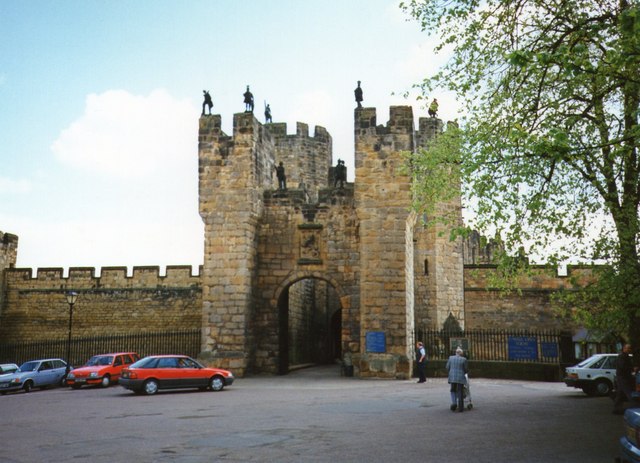
The result is a fascinating contrast. From outside, Alnwick still looks every inch the mighty medieval fortress, all grey stone, battlements, and towers, complete with carved stone figures standing guard along the walls. But step inside and you find opulent, palatial interiors, filled with a superb art collection including works by great masters, that speak of centuries of aristocratic wealth and taste.
Those carved stone figures on the battlements are one of Alnwick’s most charming quirks. Placed there to give the impression, from a distance, of a garrison forever standing guard, they have watched over the castle for centuries, weathering into characterful silhouettes against the northern sky. They are a reminder that even a serious fortress liked, now and then, to put on a bit of a show.

Reading the Walls
For all its later grandeur, Alnwick keeps its medieval bones on full display, and they repay a close look. At its heart is the inner bailey, clustered around a strong keep, the original core of the fortress, wrapped in circuits of curtain wall studded with towers and entered through a heavily defended gatehouse and barbican. The barbican in particular, a fortified outwork guarding the main gate, is one of the finest surviving in England.
These defences were not decorative. On this violent frontier a castle had to be able to withstand a real Scottish army, and Alnwick was built and rebuilt over the centuries to do exactly that, its walls thickened, its towers raised, its gates strengthened as the threat demanded. The grim practicality of a working border fortress is written into every line of the older stonework.
Walking the walls today, you can trace this military logic even beneath the later comforts: the commanding position above the river, the layered defences an attacker would have to fight through, the towers set to cover every approach. It is a reminder that, whatever Hollywood has since made of it, Alnwick was first and foremost a machine for war, and a very effective one.
Inside a Ducal Palace
The state rooms of Alnwick are among the grandest in any English castle. Created during the nineteenth-century remodelling, they blend the scale of a fortress with the luxury of an Italian palace, with richly carved ceilings, fine furniture, and walls hung with paintings by artists such as Titian, Canaletto, and Turner. This is one of the finest private art collections in the country, gathered by the family over generations.
Moving through these rooms, you get a vivid sense of the wealth and cultivation of the Dukes of Northumberland at their height, when they were among the richest and most powerful families in Britain. Libraries, drawing rooms, and dining rooms of great splendour follow one another, each a showcase of aristocratic living on the grandest scale.
Yet this is no museum. Alnwick remains a genuine family home, still lived in by the Percys, which gives it a warmth and life that a preserved monument can lack. That combination, of a real, inhabited home of extraordinary grandeur set within a genuine medieval fortress, is a large part of what makes Alnwick so special.
The Alnwick Garden
In recent decades Alnwick has gained a spectacular new attraction quite separate from the castle: the Alnwick Garden, a bold and imaginative modern garden created largely through the vision and energy of the present Duchess of Northumberland. Rather than restore an old formal garden, she chose to build something entirely new and dramatic, and the result has become one of the most talked-about gardens in Britain.
Its centrepiece is the Grand Cascade, a huge, tumbling water feature down which thousands of litres of water pour in choreographed displays, surrounded by fountains where children play and crowds gather. Around it are themed gardens of great beauty and invention, including a serpent garden of water sculptures and an ornamental cherry orchard.
Most famous, and most talked-about, is the Poison Garden, a walled enclosure filled entirely with deadly and dangerous plants, kept behind locked gates and shown only on guided tours, where visitors learn the dark histories of poisons, drugs, and killer plants. It is a wonderfully theatrical idea, and it captures the spirit of the whole Alnwick Garden: bold, dramatic, and unafraid to entertain.
What makes the Alnwick Garden so striking is that it was a genuine act of creation rather than restoration, a huge and controversial modern project built almost from nothing in the twenty-first century. It has drawn millions of visitors and given the whole estate a new lease of life, proving that a great historic castle can still generate something bold and new rather than simply preserving the past. It has become a destination in its own right, quite apart from the castle beside it.

A Castle That Went to the Movies
Alnwick’s most modern claim to fame is its starring role on screen. Its dramatic medieval exterior has made it a favourite of film and television makers, and it is best known around the world as a stand-in for Hogwarts in the early Harry Potter films. It was here, in the castle grounds, that the young wizards learned to fly their broomsticks, and the castle’s towers and courtyards appear in some of the most memorable scenes of the series.
But Harry Potter is far from the only production to have used Alnwick. It has appeared in the hugely popular series Downton Abbey, in the comedy Blackadder, in the classic film Becket, and in many others, its grey stone and grand setting making it endlessly useful as a ready-made historical backdrop. For many visitors, spotting the locations from favourite films and shows is a big part of the fun.
This screen fame has brought a whole new audience to Alnwick, especially families and younger visitors drawn by the magic of the films. The castle embraces it, offering broomstick-flying lessons and other themed activities, so that a place with a thousand years of blood-soaked border history now also rings with the laughter of children pretending to be wizards. It is a delightful, and very modern, twist in the castle’s long story.
There is a pleasing symmetry in a real fortress lending itself to fantasy. Alnwick spent centuries being exactly the kind of dramatic, brooding castle that storytellers imagine, so it is only fitting that it should now supply the backdrop for so many of them. When millions of people picture a great castle, whether a wizard’s school or a stately home, there is a fair chance the image in their minds is really Alnwick, doing on screen what it did for real for a thousand years: looking magnificently, unmistakably like a castle.

Jewel of a Castle Coast
Alnwick does not stand alone. It is the greatest inland stronghold of a region positively studded with castles, for the same border wars that shaped Alnwick left Northumberland with more castles than almost anywhere else in England. Along the nearby coast rise a string of dramatic fortresses, from the mighty island stronghold of Lindisfarne to the vast bulk of Bamburgh on its rock above the sea, each a monument to centuries of frontier warfare.
This concentration of castles tells its own story. In a land raided and fought over for so long, the great lords and the crown alike poured resources into fortification, so that today the traveller can move from one magnificent castle to the next across a landscape of wide skies, empty beaches, and grey stone strongholds. Alnwick, as the seat of the Percys, sat at the centre of this network of power and defence.
For visitors, that makes Alnwick the perfect base for exploring one of the finest castle landscapes in Britain. It is grand and complete enough to be a destination in itself, yet it also opens the door to a whole region where the drama of the Anglo-Scottish border is written across the land in stone.
Planning a Trip to Alnwick
Alnwick sits in Northumberland in the far north-east of England, not far from the beautiful Northumberland coast with its own string of dramatic castles. It is reached by road up the main route toward Scotland, and the nearest railway stations connect to the wider network, making it a rewarding, if far-flung, destination. The handsome market town of Alnwick, famous also for its enormous secondhand bookshop in a former railway station, is well worth exploring.
Give yourself a full day, and ideally buy a ticket that covers both the castle and the Alnwick Garden, which are run separately but sit side by side. Explore the state rooms and the medieval walls, seek out the Harry Potter filming spots, and leave plenty of time for the garden, especially the Grand Cascade and, if you dare, the Poison Garden. It makes a superb centrepiece for a wider tour of Northumberland’s magnificent castles and coast.
The castle sits at roughly 55.4157, -1.7060. Punch that into Google Maps and it will take you straight to Alnwick Castle in Northumberland.
Nearby Castles
Where History and Hogwarts Meet
Alnwick is a castle of wonderful contradictions. It is a grim border fortress that brought down two Scottish kings, and a palace filled with Titians and Canalettos. It is the ancient seat of a family that made and broke kings, and a playground where children learn to fly broomsticks. It is history at its bloodiest and magic at its most charming, all wrapped inside the same great grey walls.
That is the pleasure of it. Cross the Aln and walk beneath those battlements, and you can feel the whole long story of the north pressing in: the reivers and the raids, Harry Hotspur charging to his death, the Percys rising and falling through centuries of war, and then, lightly laid on top of it all, the film magic that has made these towers famous to a new generation. Few castles carry their thousand years quite so proudly, or wear them quite so lightly.
You May Like

Mafra, the Palace a King Built From a Vow


One thought on “Alnwick Castle: The Percy Stronghold from Harry Hotspur to Harry Potter”