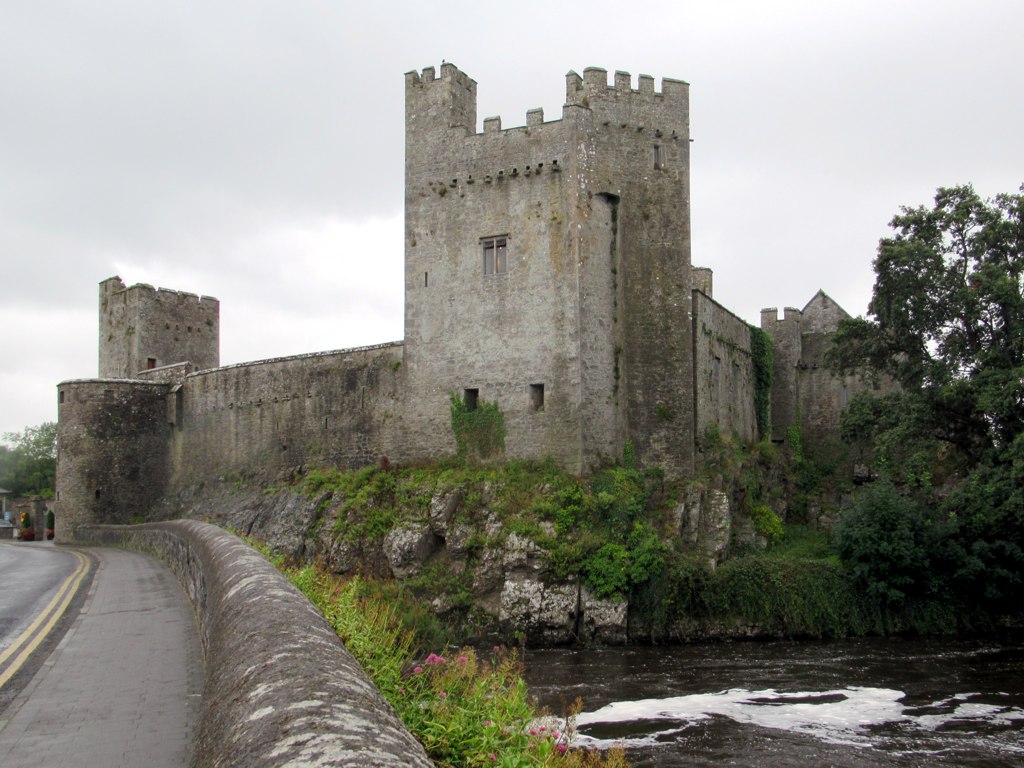
Rising from a rocky island in the middle of the River Suir, in the green county of Tipperary, Cahir Castle is one of the largest, strongest, and best-preserved medieval castles in all of Ireland. Where so many Irish castles survive only as broken fragments, Cahir stands almost complete: a great cluster of towers, walls, and battlements, with its keep, its courtyards, its great hall, and even its original portcullis still in place. To walk through its gates is to step almost intact into the world of the medieval Irish fortress, and it is little wonder that film-makers have used it again and again as a ready-made stage for the Middle Ages.
But Cahir is far more than a well-preserved film set. This was the mighty stronghold of the Butlers, one of the most powerful families in Ireland, and it stood at the centre of the country’s turbulent history. Guarded on every side by the waters of the Suir, it was long considered all but impregnable, until one of the most famous sieges in Irish history proved that even the strongest walls could not stand against the new power of gunpowder artillery. A cannonball fired in that siege is still lodged in the castle wall today.
So Cahir offers a rare and wonderful thing: a great medieval Irish castle that has come down to us almost whole, rich in history and drama, from its powerful Butler lords to its famous siege. Let’s cross the river to the island and explore one of Ireland’s finest surviving fortresses.

Table of Contents
- An Island Fortress on the Suir
- The River That Made the Castle
- The Powerful Butlers
- A Castle That Survives Almost Whole
- The Famous Portcullis
- The Great Siege of 1599
- The Cannonball in the Wall
- Later Wars and a Peaceful Surrender
- Inside the Great Hall
- Life Behind the Walls
- A Star of the Screen
- Exploring Cahir Castle
- The Castle and Its Town
- Planning Your Visit
- Nearby Castles
- One of Ireland’s Great Survivors
An Island Fortress on the Suir
Cahir Castle owes much of its strength to its position. It stands on a rocky island in the River Suir, so that the river flows around it on every side, forming a natural moat that made the castle extremely difficult to attack. The very name Cahir comes from an Irish word meaning a stone fort, and there has been a fortification on this defensible rock in the river since ancient times, long before the medieval castle rose.
The island setting gave the castle a formidable natural defence. An attacker had to cross the water to reach the walls, with no dry ground on which to bring up siege engines or to mine beneath the defences, and the river provided both protection and a supply of water. Combined with strong stone walls and towers, the site made Cahir one of the most secure fortresses in the region.
The river also placed the castle at a strategic point, controlling a crossing of the Suir and the routes through this part of Ireland. Whoever held Cahir commanded an important passage, and the castle’s location gave it real value as a stronghold guarding the surrounding country.
So Cahir, like so many great castles, was shaped by its site. The rocky island in the river offered a defensible position that people had used since ancient times, and on it the medieval builders raised a fortress whose strength lay as much in the surrounding water as in its walls of stone.
The word cahir, from the Irish cathair, is found in place names all across Ireland, a sign of just how many stone forts once dotted the land. That this particular Cahir should have grown into so great and so complete a castle, and given its name to a thriving town, makes it one of the most notable of them all, a stone fort that became a mighty fortress and endured where countless others fell.

The River That Made the Castle
The River Suir is not just a scenic backdrop to Cahir but the very reason the castle exists and survived so long. One of the great rivers of the south of Ireland, the Suir flows down from the mountains through a rich and fertile landscape, and at Cahir it divides around the rocky island on which the castle stands, wrapping the fortress in protective water.
For the castle’s builders, the river was a gift. It provided a natural moat far more effective than any dug by hand, kept enemies and their engines at a distance, and supplied fresh water to the garrison. The island in the river was a defensive position of real strength, and it is no accident that people had fortified it since ancient times, long before the medieval Butlers raised their great castle here.
The river also gave the castle its strategic value, for it controlled a crossing point and the routes that ran along and across the Suir. To hold Cahir was to command an important passage through this part of Ireland, adding to the castle’s importance as a stronghold.
Even today, the sight and sound of the Suir flowing around the castle are inseparable from the experience of a visit. The river that made Cahir strong still embraces its walls, and it remains, as it has always been, the key to understanding this great island fortress.

The Powerful Butlers
For most of its history, Cahir was the great stronghold of the Butler family, one of the most powerful dynasties in medieval and early modern Ireland. The Butlers were an Anglo-Norman family who rose to enormous power and wealth, most famously as the Earls of Ormond, and the branch of the family that held Cahir became lords, and later barons, of Cahir in their own right, ruling this part of Tipperary from their island fortress.
The present castle was largely built and developed by the Butlers in the later Middle Ages, from around the fifteenth century, though there had been earlier fortifications on the site. Under the Butlers, Cahir grew into a great and imposing stronghold, a fitting seat for a powerful noble family and a formidable base from which to dominate the region.
The Butlers were deeply involved in the great events and conflicts of Irish history, and their fortunes rose and fell with the turbulent times. As one of the leading families of the country, they played their part in the struggles between the great dynasties, in the shifting relations with the English crown, and in the wars that repeatedly convulsed Ireland.
Cahir was the heart of the Butlers’ power in this region, and the castle’s long history is inseparable from that of the family who built and held it. Their strength and status are written into its mighty walls and towers, and it remained in Butler hands, through many trials, for centuries.
The Butlers as a whole were one of the two or three most powerful families in all of Ireland, rivals and sometimes enemies of the great Fitzgerald dynasty, and their influence reached to the very top of Irish and even English politics. The Cahir branch, though junior to the Earls of Ormond, shared in this prestige, and their castle reflected their standing as major players in the affairs of the country. To hold Cahir was to be a person of real consequence in Ireland.

A Castle That Survives Almost Whole
What makes Cahir so special among Irish castles is how completely it survives. Where the great majority of medieval Irish castles are now ruins, often reduced to a single fragment of wall or a lonely tower, Cahir stands almost intact, with its keep, its towers, its curtain walls, its courtyards, and much of its interior still in place. It is one of the largest and best-preserved castles in the whole country.
This remarkable survival means that Cahir offers an unusually complete picture of a medieval Irish fortress. Visitors can explore its various parts, from the great keep to the outer defences, and gain a real sense of how such a castle was laid out, defended, and lived in. Few places in Ireland allow you to experience a medieval castle so fully.
The castle is arranged around several courtyards, or wards, at different levels, each protected by its own walls and towers, so that an attacker who breached the outer defences still faced further obstacles within. This layered design, combined with the island setting, made Cahir a genuinely strong fortress, and its survival lets us appreciate that strength directly.
To walk through Cahir today is thus a rare privilege, a chance to move through a great medieval Irish castle much as it was, rather than to imagine a vanished building from scattered ruins. It is this completeness, above all, that makes Cahir such a rewarding place to visit and such an important survival.
Its survival is all the more valuable because it allows scholars, as well as ordinary visitors, to study a great Irish castle in its entirety, rather than piecing one together from ruins. Details of construction, defence, and daily arrangement that are lost elsewhere can be seen intact at Cahir, making it not only a delight to visit but an important document of medieval Irish architecture and life.

The Famous Portcullis
Among Cahir’s many well-preserved features, one is especially rare and remarkable: its portcullis. A portcullis was a heavy grille of wood and iron that could be dropped down to block a castle’s gateway, one of the key defensive features of a medieval fortress, and while the slots for portcullises survive in many castles, the actual grilles almost never do. At Cahir, astonishingly, an original portcullis still survives, hanging in its gateway.
This makes Cahir one of the very few places in Ireland, or indeed anywhere, where you can see a genuine medieval portcullis in position, a direct link to the defensive arrangements of the Middle Ages. It is a wonderful survival, and it adds greatly to the sense of stepping into a real, working medieval castle.
The portcullis is a reminder of just how seriously the defence of the gateway was taken, for the entrance was always a castle’s most vulnerable point. To breach it, an attacker would have to overcome the portcullis, along with doors, and defenders firing from above, a formidable set of obstacles guarding the way in.
Standing beneath the surviving portcullis at Cahir, you can appreciate the ingenuity and the menace of medieval castle defences in a way that few other places allow. It is one of the great treasures of the castle, and one of the many features that make Cahir so complete and so evocative.
Reconstructions and working demonstrations of the portcullis help visitors understand how these great defensive grilles actually functioned, raised and lowered by ropes and counterweights to seal the gateway in an instant. To see the mechanism, and the massive grille itself, is to grasp the reality of medieval castle defence far more clearly than any description could convey, and it is one of the reasons Cahir is such a rewarding place to learn how a fortress really worked.

The Great Siege of 1599
For all its strength, Cahir met its match in one of the most famous sieges in Irish history. In 1599, during the Nine Years’ War, when much of Ireland rose against English rule, the castle was besieged by an English army led by the Earl of Essex, one of Queen Elizabeth I’s most prominent, and ultimately most ill-fated, favourites. Cahir was reputed to be all but impregnable, and its capture was a significant prize.
Essex, however, had something the castle’s builders had not fully reckoned with: powerful siege artillery. His guns were brought up and battered the walls, and against this new firepower even Cahir’s mighty defences could not hold for long. After a bombardment lasting only a few days, the supposedly impregnable castle was taken, a dramatic demonstration of how gunpowder artillery had transformed the nature of siege warfare.
The siege was one of the few notable successes of Essex’s troubled Irish campaign, which otherwise ended in failure and contributed to his eventual downfall and execution. For Cahir, it was proof that no wall, however strong, could stand indefinitely against cannon, and it marked a turning point in the story of the castle and of Irish fortification.
The fall of Cahir in 1599 is remembered as a landmark in the history of siege warfare in Ireland, and it left a very tangible mark on the castle itself, a mark that visitors can still see today, embedded in the ancient stone.
The siege also had a curious diplomatic aftermath, for it was one of the few clear victories Essex could show for a hugely expensive and largely unsuccessful campaign. His failure to crush the wider rebellion, despite taking Cahir, helped bring about his fall from the queen’s favour, and within a couple of years he had been executed for treason. In this way the siege of a Tipperary castle became entangled with the downfall of one of the great figures of the Elizabethan court.

The Cannonball in the Wall
One of the most striking things to see at Cahir is a genuine relic of that famous siege: a cannonball, fired by the Earl of Essex’s artillery in 1599, still lodged in the castle wall where it struck more than four centuries ago. This remarkable survival is a direct, physical link to the dramatic events of the siege, and it never fails to fascinate visitors.
There is something powerfully immediate about seeing the very cannonball that helped bring down the walls of an impregnable castle, fixed forever in the stone it struck. It brings the history of the siege vividly to life, turning a distant historical event into a tangible, visible reality. The violence of 1599 is not just recorded in books but written into the fabric of the castle itself.
The cannonball is also a symbol of the wider change it represents, the moment when the age of the great stone castle began to give way to the age of gunpowder, when walls that had stood for centuries were suddenly vulnerable to the new artillery. Cahir’s cannonball is a small but eloquent monument to that transformation.
For visitors, seeking out the cannonball is one of the highlights of a visit, a chance to touch history and to stand where, long ago, the guns of the Earl of Essex battered one of Ireland’s strongest castles into submission. It is one of the many features that make Cahir’s history feel so present and so real.
Small details like this are what turn a visit to a castle from a lesson into an experience. You can read about the siege of 1599 in any history book, but to stand before the actual cannonball, lodged in the very wall it struck, is to feel the past reach out and touch you. It is one of those rare, tangible connections to a distant event that lodge in the memory long after the visit is over.

Later Wars and a Peaceful Surrender
Cahir’s involvement in Ireland’s wars did not end in 1599. In the mid-seventeenth century, during the Cromwellian conquest of Ireland, the castle was again in the firing line, as Oliver Cromwell’s forces swept through the country crushing resistance. This time, however, the story ended very differently.
Faced with the overwhelming might of Cromwell’s army, and doubtless mindful of what had happened in 1599, the defenders of Cahir chose to surrender the castle without a fight, and so it was spared the destruction that befell so many other strongholds. This peaceful surrender is one of the reasons the castle survives so completely today, for it escaped the slighting and battering that ruined many Irish castles during these wars.
So while its neighbours were blown up and left in ruins, Cahir came through the wars of the seventeenth century largely intact, its walls and towers preserved. Its survival owes much to this prudent decision to yield rather than resist, sparing the great fortress the fate of so many others.
In this way, the very completeness that makes Cahir so remarkable is partly a result of the choices made in its history, above all the decision to surrender to Cromwell. The castle’s good fortune in escaping destruction has given us one of the finest surviving medieval fortresses in all of Ireland.
The contrast between 1599 and 1650 is instructive. In the first case, defiance led to bombardment and capture, though the castle survived; in the second, prudence led to a bloodless surrender that preserved the fortress intact. That Cahir came through both, and stands so complete today, is a piece of good fortune for which everyone who loves Irish history and architecture can be grateful, for it has left us one of the country’s finest medieval buildings.

Inside the Great Hall
Beyond its defences, Cahir preserves much of its domestic life, above all its great hall, the heart of the castle as a residence. Restored and furnished to evoke its former grandeur, the hall gives a vivid sense of how the Butler lords lived, feasted, and held court within their island stronghold. This was where the social and ceremonial life of the castle unfolded, where the lord entertained his guests and displayed his status.
The interior of Cahir, with its hall, chambers, and other rooms, allows visitors to appreciate the castle not just as a fortress but as a home, a place where a great family actually lived. The combination of strong defences and comfortable, even grand, living spaces was typical of a great medieval castle, and Cahir preserves both sides of that life.
Displays and furnishings within the castle help bring these interiors to life, illustrating how the various rooms were used and what daily life was like for the lord, his family, and their household. It is this human dimension, alongside the military strength, that makes a visit to Cahir so rich and rewarding.
To stand in the great hall of Cahir, imagining the feasts and the gatherings of the Butler lords, is to complete the picture of the castle as a living place, not just a machine of war. Together with the defences and the history, these interiors make Cahir a wonderfully complete and evocative medieval castle.

Life Behind the Walls
A great castle like Cahir was far more than a set of defences; it was a busy, crowded community, home to the lord and his family, their servants and retainers, soldiers, craftsmen, and all the people needed to run a great household and estate. Behind the strong walls, daily life went on much as it did in any large medieval household, with its routines of work, worship, and feasting.
The various rooms and spaces of the castle, from the great hall to the kitchens, the chambers, and the stores, reflect this busy life. Food had to be prepared and served, guests entertained, business conducted, and the many practical needs of a large community met, all within the confines of the island fortress. The castle was a self-contained world.
The windows, fireplaces, and other domestic features that survive at Cahir give a real sense of this everyday life, reminding us that behind the military might of the castle lay the ordinary human business of living. It is easy, amid the towers and battlements, to forget that these were people’s homes, but Cahir’s well-preserved interiors bring that reality vividly back.
Understanding this domestic dimension deepens any visit to Cahir. The castle was a machine of war, yes, but it was also a home, a centre of hospitality and household life, and its survival allows us to appreciate both sides of its existence, the warlike and the everyday, in unusual and rewarding detail.

A Star of the Screen
Cahir’s remarkable state of preservation, combined with its dramatic setting and complete medieval appearance, has made it a favourite location for film and television. Its towers, walls, courtyards, and river setting provide a ready-made, authentic backdrop for stories set in the Middle Ages and beyond, and it has appeared in a string of well-known productions over the years.
Among the films shot at Cahir are a famous epic retelling of the legend of King Arthur, whose scenes made memorable use of the castle’s medieval character, and other historical films and television series have used it too, drawn by its unspoiled, atmospheric appearance. For a place to serve as such a convincing stage for the past, it must look genuinely old and complete, and Cahir does exactly that.
This screen fame has brought the castle to a wide audience and drawn many visitors eager to see the real place behind the films. It is a modern chapter in Cahir’s long story, and one that testifies to the castle’s exceptional survival, for only a fortress as complete and authentic as this could serve so convincingly as a window into the medieval world.
For visitors, spotting the locations from favourite films can add an extra layer of pleasure to a visit, but the castle needs no such associations to impress. Its own history and its own dramatic presence are more than enough, and the films are simply a sign of just how special a survival Cahir really is.
The castle’s authenticity is the key to its screen career. Film-makers seeking a convincing medieval setting cannot easily fake the weight and texture of centuries-old stone, and at Cahir they find the real thing, complete and unspoiled. That the castle can stand in so convincingly for the fortresses of legend and history is the surest possible testament to how remarkably it has survived.

Exploring Cahir Castle
For the visitor, Cahir is one of the most rewarding castles in Ireland to explore, precisely because so much survives. You can walk through its gates, past the famous portcullis, into its courtyards, climb its towers, explore its great hall, and seek out the cannonball in the wall, gaining a full and vivid sense of a great medieval fortress. Displays and information help bring its long history to life.
The castle’s compact but complex layout, with its wards, towers, and defences, makes it a fascinating place to wander, and its river setting adds greatly to its charm. From the battlements, there are fine views over the River Suir and the town of Cahir, and the sound of the water flowing around the island is a constant reminder of the castle’s natural strength.
Because it is so complete, Cahir is also an excellent place to understand how a medieval castle actually worked, from its layered defences to its domestic arrangements. It rewards a slow and curious visit, in which the various features, from the portcullis to the great hall to the marks of the siege, combine to tell the full story of the fortress.
All of this makes Cahir not just a beautiful and historic castle but a genuinely educational one, a place where the medieval world comes alive in unusual detail. It is one of the great survivors among Irish castles, and one of the most enjoyable to visit.
Guided tours at the castle bring out the many stories embedded in its stones, from the rise of the Butlers to the drama of the siege, and they help visitors make sense of the castle’s complex layout of wards, towers, and defences. Whether you tour with a guide or explore at your own pace, Cahir offers one of the richest and most complete castle experiences to be found anywhere in Ireland, well worth the time it takes to see it properly.

The Castle and Its Town
Cahir Castle does not stand in isolation but at the heart of the town of Cahir, which grew up in its shadow and shares its name and much of its history. The relationship between castle and town was close, for the presence of a great fortress and a powerful lord drew people to settle nearby, and the town developed as a centre of trade and life under the protection of the Butlers.
This close connection between fortress and settlement was typical of the medieval world, where a castle was often the nucleus around which a town grew. At Cahir, the castle and the town developed together over the centuries, and the fortress remained the dominant feature and the focus of the town’s identity.
Today the town of Cahir is a pleasant place in its own right, and its close association with the castle adds to the appeal of a visit. The fortress rises right at the centre of the town, easily reached and impossible to miss, a constant reminder of the long history that castle and community share.
The pairing of the great island castle with its surrounding town makes Cahir a particularly satisfying place to visit, for you can experience not just an isolated monument but a living town shaped by its fortress. It is a fine example of the enduring bond between a castle and the community that grew up around it.
Planning Your Visit
Cahir Castle stands in the town of Cahir, in County Tipperary, in the south of Ireland, and it is very easy to reach, sitting right in the town beside the River Suir, close to the main roads through the region. Its central location and its position on the tourist routes of the south make it a popular and accessible destination, and it is often visited alongside other attractions in the area.
Allow an hour or two to explore the castle thoroughly, taking in the defences, the portcullis, the great hall, and the cannonball, and to enjoy the views over the river. The castle is generally open to visitors for much of the year, and guided tours help bring its history to life. Wear comfortable footwear for the steps and uneven surfaces, and take time to walk around the outside as well, to appreciate the castle’s island setting. Cahir combines well with the nearby Rock of Cashel and a wider tour of the castles and heritage of Tipperary, and it offers one of the finest and most complete medieval castle experiences in all of Ireland.
The castle sits at roughly 52.3760, -7.9260. Punch that into Google Maps and it will take you straight to Cahir Castle in County Tipperary.
Nearby Castles
One of Ireland’s Great Survivors
Cahir is one of Ireland’s great survivors. Where so many medieval castles have crumbled to fragments, this mighty Butler fortress on its island in the Suir has come down to us almost whole, with its towers, its walls, its great hall, and even its ancient portcullis still in place. To explore it is to walk into the medieval world with unusual completeness, and to feel, as few other castles allow, the real strength and life of a great Irish stronghold.
And running through it all is a vivid thread of history: the powerful Butlers who built and held it, the famous siege of 1599 when the Earl of Essex’s cannon shattered its reputation for impregnability, and the cannonball still lodged in its wall as a witness to that day. Cross the river to the island, pass beneath the portcullis, and seek out that cannonball in the ancient stone, and you will understand why Cahir is treasured as one of the finest and most complete medieval castles in all of Ireland.
Few castles anywhere let you feel the medieval world as directly as this one. Cross the bridge to the island, pass beneath the great portcullis, climb the towers, stand in the hall, and find the cannonball fixed in the wall, and the centuries seem to fall away. Cahir is not a ruin to be imagined back into life but a real, complete, living fortress that has survived against all the odds, and that is precisely what makes it one of the treasures of Ireland.
You May Like

Mafra, the Palace a King Built From a Vow


2 thoughts on “Cahir Castle: Ireland’s Great Survivor on the River Suir”