Some places feel almost too dramatic to be real, and the Rock of Cashel is one of them. Rising straight out of the flat green farmland of County Tipperary, this great outcrop of limestone carries a crown of grey towers, a broken cathedral, a perfect little Romanesque chapel and a round tower that has stood for the better part of a thousand years. From miles away you can see it floating above the plain, and the closer you get the more impossible it seems that so much history could be piled onto one lonely hill.
For all its churches and gravestones, the Rock began its life as a fortress. Its very name comes from the Irish caiseal, meaning a stone fort, and for centuries this was the seat of the kings of Munster, one of the most powerful royal dynasties in early medieval Ireland. Long before the first stone chapel was built, warriors and kings held this high ground because whoever controlled the Rock controlled the road to the south. It is a castle in the oldest and truest sense: a stronghold raised on the strongest natural position for many miles around.
So this is a story of kings and bishops, of saints and soldiers, of a famous massacre and a quiet, centuries-long decline. It is also the story of one of the most photographed and most loved ruins in all of Ireland. Let’s climb the Rock together and find out how a windswept crag became the spiritual and royal heart of a whole province.
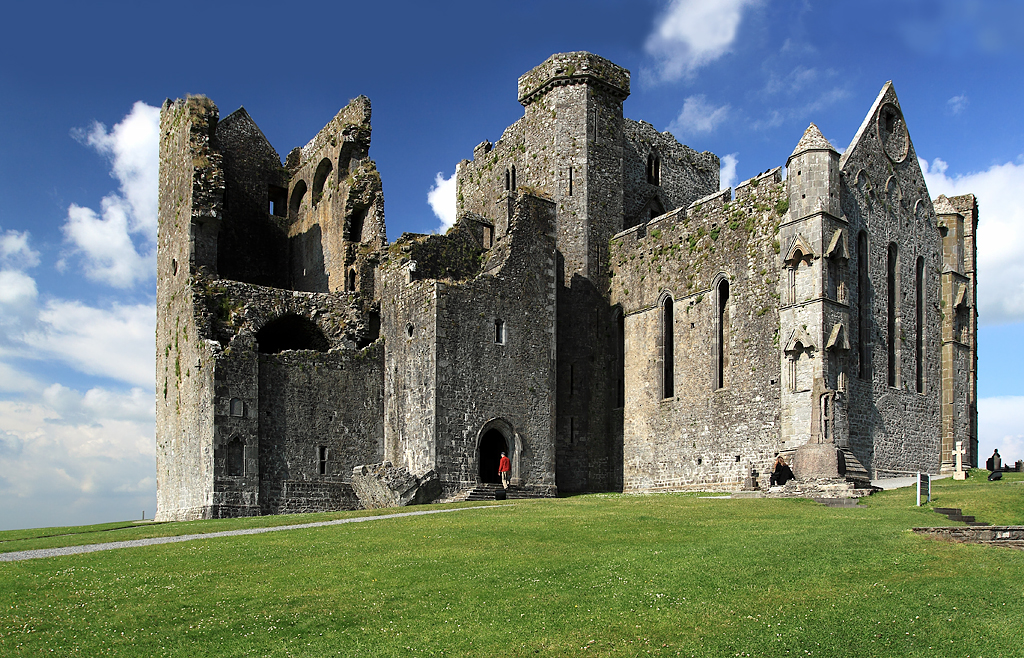
Table of Contents
- A Stone Fort of Kings
- Where Saint Patrick Lit a Fire
- Brian Boru and the High Kings
- The Gift That Changed Everything
- Cormac’s Chapel, a Jewel in Stone
- Inside the Painted Chapel
- The Round Tower’s Long Watch
- The Great Cathedral
- Walls Open to the Sky
- The Day the Rock Ran Red
- The Hall of the Vicars Choral
- A City of the Dead
- The Rock on Screen and in Song
- Standing on the Rock Today
- Nearby Castles
- A Rock Like No Other
A Stone Fort of Kings
Before there were saints or cathedrals here, there were warriors. The Rock of Cashel takes its name from the Irish word caiseal, a stone ringfort, and that is exactly what crowned this hill in the earliest days. From somewhere around the fourth or fifth century, the Eóganachta dynasty made this their royal capital, ruling the province of Munster from the top of the crag. It was a shrewd choice. The limestone outcrop gives commanding views in every direction, and any army approaching across the plain could be seen long before it arrived.
In an age when power rested on cattle, land and the ability to defend both, a natural fortress like this was worth more than gold. The kings who sat here did not need to build towering walls, because the Rock itself did most of the work. Steep on almost every side, it turned a modest garrison into a formidable one. For close to six hundred years the Eóganachta reigned from Cashel, and the place became so closely tied to Munster kingship that to hold the Rock was to hold the south of Ireland.
Almost nothing survives of those first royal buildings. They were made of timber and earth, and time has swept them away as surely as it swept away the kings themselves. But the aura of that early power never quite left the hill. Everything that came afterwards, every chapel and tomb and tower, was built on ground that was already ancient and already sacred, a place people had looked up to for as long as anyone could remember.
It helps to picture Ireland in those early centuries as a patchwork of small kingdoms, each with its own royal family, its own cattle herds and its own fierce sense of independence. There was no single capital, no one crown, only a shifting hierarchy of over-kings and under-kings bound together by alliance, tribute and frequent war. In that world, a stronghold like Cashel was not just a house for a king; it was the physical proof of his right to rule, a throne you could see from the horizon.
The Eóganachta understood the theatre of power as well as its substance. To be inaugurated as king of Munster on the Rock was to be lifted, quite literally, above everyone else in the province. The ceremonies that took place here, now lost to us in their details, would have bound the new king to the land and to his people in rituals far older than Christianity, on a hill that seemed to belong as much to the gods as to men.

Where Saint Patrick Lit a Fire
No Irish hill of this importance could go without its legends, and Cashel has one of the best. The story goes that Saint Patrick himself came here in the fifth century to convert Aengus, the king of Munster. As Patrick baptised the king, he is said to have accidentally driven the sharp point of his crozier straight through Aengus’s foot. The king, thinking it was part of the ceremony, bore the pain in silence and never cried out, believing that suffering was simply what conversion required.
There is a second legend, wilder still, that explains the very existence of the Rock. According to folklore, the Devil, flying over Ireland in a fury, took a great bite out of a mountain in the nearby range now known as the Devil’s Bit. Finding the rock not to his taste, he spat it out, and where it landed on the plain of Tipperary it became the Rock of Cashel. Stand on the hill and look toward the mountains and you will indeed see a gap in the ridge that fits the story rather neatly.
Whether or not you believe a word of it, these tales tell us something true: that people have always felt this place to be charged with meaning. A hill that inspires stories about saints and devils is a hill that has always mattered. The legends are part of the mortar that holds Cashel together in the imagination, every bit as real to visitors as the stones themselves.
Brian Boru and the High Kings
The Eóganachta did not hold Cashel forever. In the tenth century a rival dynasty from the west, the Dál gCais, began to rise, and from their ranks came the most famous Irishman of the age: Brian Boru. In 978 Brian took the kingship of Cashel, and from this Rock he built the power base that would eventually make him High King of all Ireland, the first man in generations to come close to ruling the whole island.
Brian’s story ended in triumph and tragedy at the Battle of Clontarf in 1014, where his forces broke the power of the Norse-Irish alliance but where he himself was killed in his tent as the battle turned. For a moment, though, Cashel had been the seat of the closest thing early medieval Ireland had to a national monarch. The Rock’s prestige soared, and the memory of Brian gave the place a glamour that outlasted his dynasty.
That royal glamour is important for understanding what came next. Because Cashel was so bound up with kingship and prestige, it became a prize that every ambitious ruler wanted, and a place too valuable to leave purely in secular hands. The tension between the old Eóganachta, the new Dál gCais and the growing power of the church would soon reshape the Rock entirely, turning a fortress of kings into a citadel of God.
The bond between Brian and Cashel ran deep enough that his descendants, the Ua Briain kings, went on shaping the Rock for generations. It was one of them who would make the momentous gift to the church, and so the line of Brian Boru left its mark on Cashel not once but twice, first in conquest and then in a spectacular act of royal piety.
The Gift That Changed Everything
The single most important decision in the history of the Rock was made in the year 1101, and it was a masterstroke of medieval politics. Muirchertach Ua Briain, a great-grandson of Brian Boru and king of Munster, formally handed the Rock of Cashel over to the church. On the surface it looked like an act of pure piety, a king giving his greatest stronghold to God. Underneath, it was as cunning a move as any general ever made.
By donating the Rock to the church, Muirchertach made it impossible for his old rivals, the Eóganachta, ever to reclaim their ancestral seat. You cannot take back by force what has been solemnly given to God without becoming an enemy of the church itself. In one stroke he removed the Rock from the game of dynastic warfare and turned a military liability into a spiritual triumph. It was the kind of move that wins wars without a single sword being drawn.
From that moment the character of Cashel changed forever. The kings stepped back and the bishops stepped forward. Over the following centuries the Rock filled with the buildings we admire today, raised not to repel armies but to glorify heaven. Yet the old fortress spirit never entirely faded, and one day, in the seventeenth century, the Rock would remember with terrible clarity that it had once been a place of war.
The timing of the gift was no accident either. The early twelfth century was a period of sweeping reform in the Irish church, when synods were redrawing the map of dioceses and bringing Irish practice into line with the rest of Latin Christendom. Handing over the Rock of Cashel, the most prestigious royal site in the south, gave that reforming movement a spectacular new headquarters and announced to the world that Munster was at the very centre of the changes.
For Muirchertach Ua Briain it was also a way of casting himself as a pious, modern, European-minded monarch rather than a mere warlord. Kings across Europe were competing to be seen as patrons of the church, and a donation on this scale put him in exalted company. The Rock, once a symbol of raw dynastic muscle, became a symbol of a king who could command both swords and souls.
Cormac’s Chapel, a Jewel in Stone
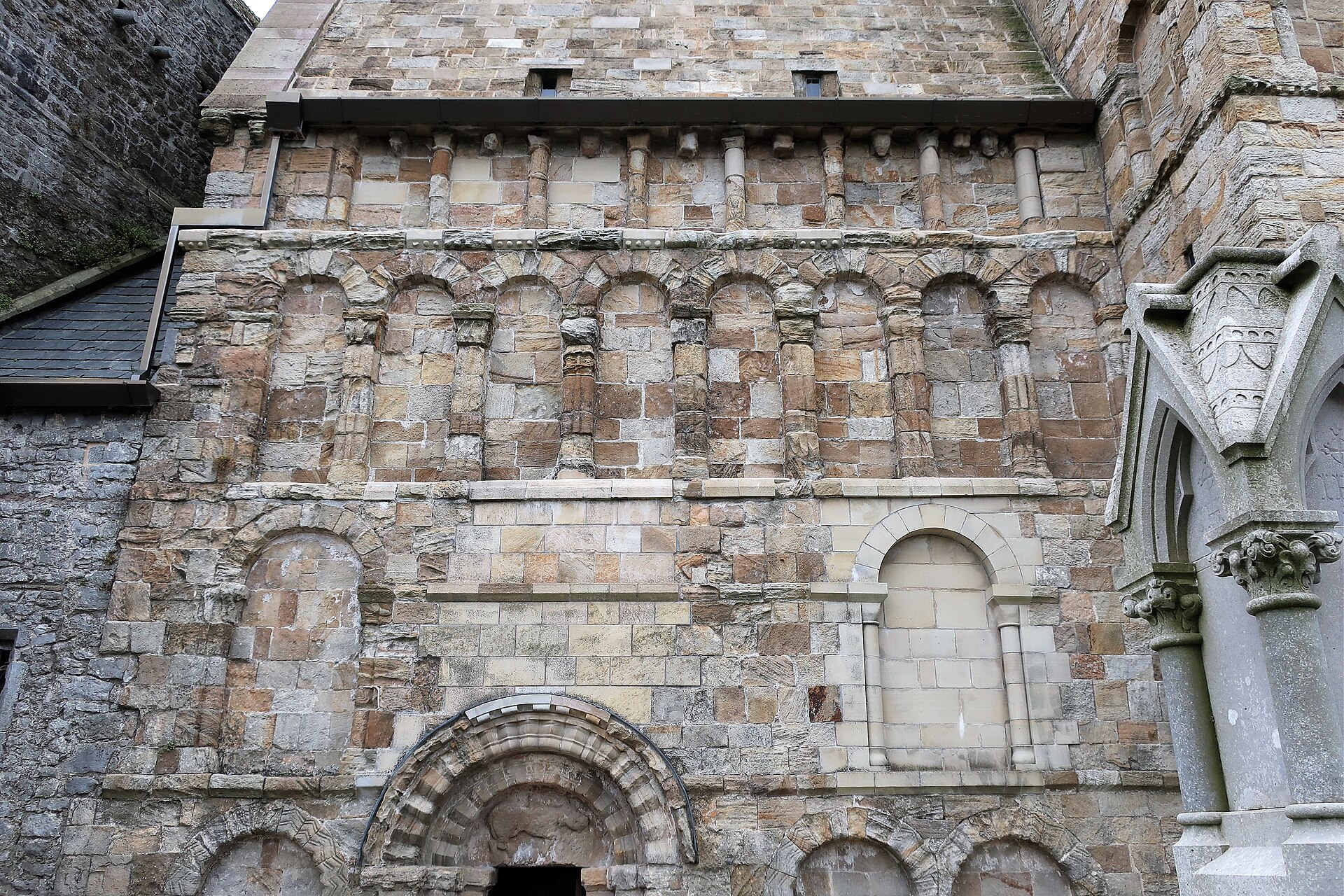
If the Rock of Cashel has a single treasure, it is Cormac’s Chapel. Consecrated in 1134 and built under King Cormac Mac Cárthaigh, this is one of the finest surviving examples of Hiberno-Romanesque architecture anywhere in Ireland, and one of the most important early medieval buildings in the whole country. Where later Gothic builders reached for height and light, the makers of Cormac’s Chapel worked in a rounder, heavier, more intimate style that feels almost warm.
The chapel is unusual in a dozen ways. It has two square towers, one on each side, which is highly unusual for an Irish church of the period and hints at influences from continental Europe and perhaps from the great Romanesque churches of Germany. Its stone roof is steeply pitched and astonishingly solid, engineered to carry its own enormous weight across the centuries. Every doorway and arch is carved with the geometric energy of the age, chevrons and beasts and human heads worked into the pale stone.
To step toward it is to step back nearly nine hundred years. This chapel was already old when the great Gothic cathedral beside it was merely a plan in a bishop’s mind. It has survived fire, war, weather and neglect, and it stands today as a reminder that Irish builders of the twelfth century were the equals of any in Europe. Small, dark and richly carved, it is the beating heart of the Rock.

Inside the Painted Chapel
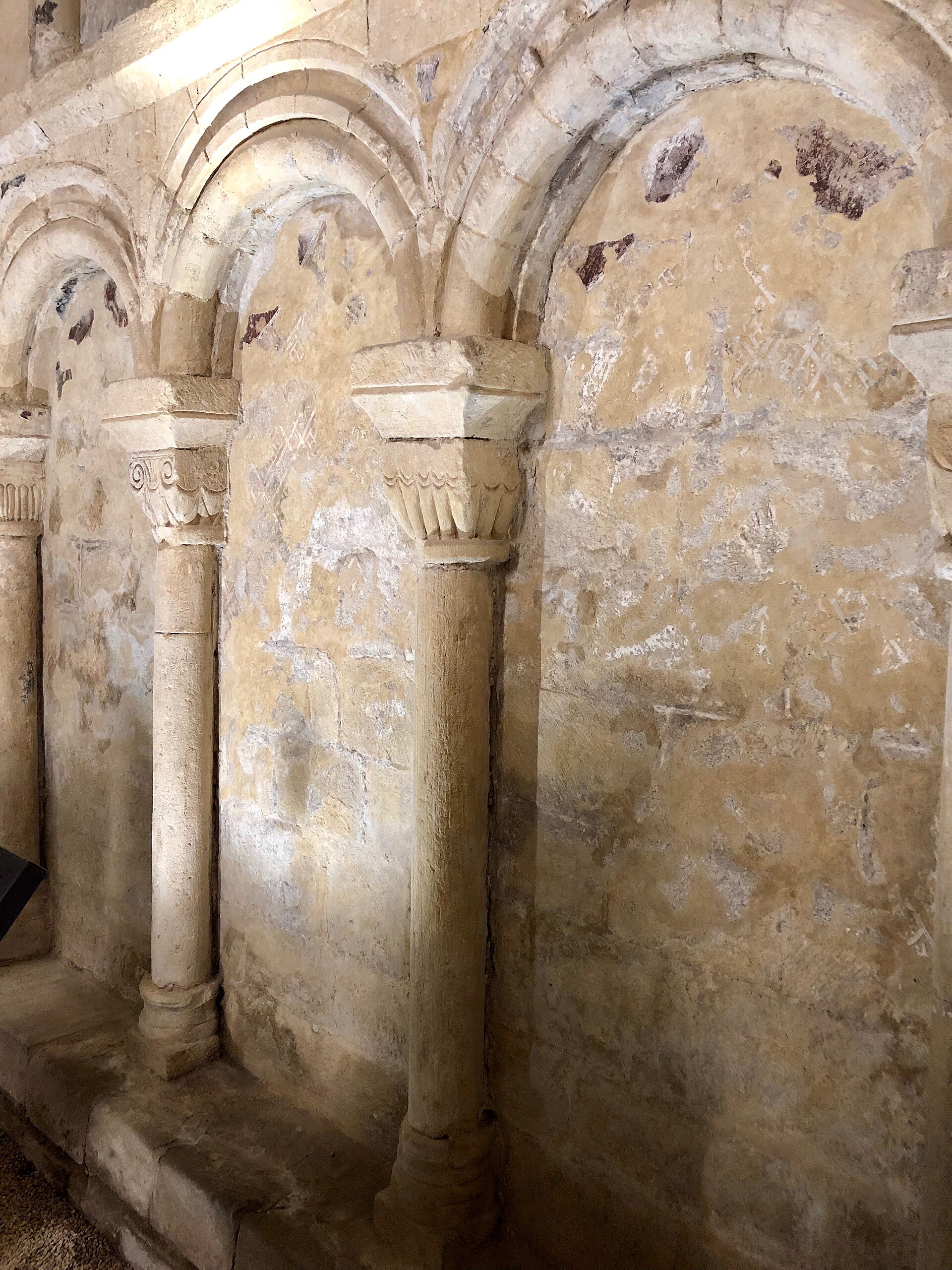
The real wonder of Cormac’s Chapel is hidden inside, and it is easy to miss if you do not know to look. When the chapel was new, its walls were not bare grey stone but a blaze of colour. The interior was covered in frescoes painted with some of the most expensive pigments of the medieval world, including lapis lazuli, a blue so precious it had to be ground from stone carried all the way from the mountains of Afghanistan. Traces of those paintings survive, ghostly but real, among the oldest wall paintings in Ireland.
Under the dim light you can still make out fragments of the original scheme, figures and patterns that once glowed in candlelight for the eyes of kings and bishops. For centuries the frescoes were hidden beneath layers of soot and later plaster, and only careful conservation work has coaxed them back into view. They are fragile things, and the chapel is now climate-controlled to protect what remains, a rare concession to modernity on this ancient hill.
The chapel also holds a magnificent stone sarcophagus, carved in a swirling style that blends Irish and Scandinavian influence, its surface alive with interlacing beasts. Nobody knows for certain who was meant to lie within it, though tradition links it to the kings of the Mac Cárthaigh line. Standing in the cool gloom, surrounded by faded blue and twisting stonework, you feel the strange intimacy of a space built to bring heaven very close.
It is worth pausing on just how extraordinary that blue pigment was. Lapis lazuli in the twelfth century was worth more by weight than gold, mined in a single remote region of central Asia and traded across half the world before it reached a small chapel on an Irish rock. To spend it on the walls here was a statement of almost dizzying ambition and wealth, proof that the patrons of Cormac’s Chapel meant it to rival anything in Christendom.

The Round Tower’s Long Watch
The oldest surviving building on the Rock is not the chapel or the cathedral but the tall, slender round tower that rises from the northeast corner. Built shortly after the church took possession in 1101, it stands around twenty-eight metres high, its smooth conical cap pointing at the sky like a stone finger. Round towers are one of the most distinctive features of early Irish Christianity, and this is a particularly fine one.
For years people assumed these towers were built purely as refuges, places where monks could hide from Viking raiders, hauling up a ladder behind them through the doorway set high above the ground. Modern historians are more cautious. The high door was probably as much about structural strength as defence, and the towers served as bell-towers and as landmarks, visible symbols of a Christian community proclaiming its presence across the countryside for miles.
Whatever its original purpose, the tower has done its job of catching the eye for nine centuries and counting. It survived the fire and slaughter that engulfed the rest of the Rock, standing calm above the chaos, and it survives still, weathered but unbowed. Of all the buildings on Cashel it is perhaps the purest, a single clean line of Irish stonework that has watched over the plain since before the Normans ever set foot in Ireland.
The craftsmanship of the tower deserves a closer look. It is built of carefully fitted sandstone, tapering very slightly as it rises so that the eye reads it as taller and more graceful than its true height. The doorway sits several metres above the ground, reached in its day by a wooden ladder, and small windows near the top would once have let watchers look out in every direction, or let the sound of a hand-bell carry across the fields below.
That such a slender structure has stood for nine hundred years, through storms, fires and the sack of 1647, is a quiet miracle of early engineering. Many round towers across Ireland have fallen or been struck by lightning and lost their caps, but Cashel’s stands complete, its conical roof still crowning the shaft exactly as its builders intended. It is the oldest thing on the Rock and, in some ways, the most eloquent.

The Great Cathedral
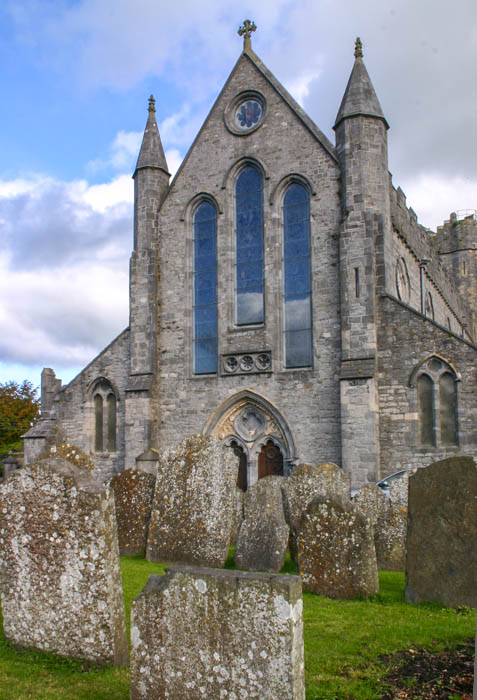
The largest building on the Rock is the cathedral, a soaring cruciform church built mainly in the thirteenth century in the Gothic style that had by then swept across Europe. Where Cormac’s Chapel is small and warm, the cathedral is vast and austere, its tall lancet windows and high walls designed to lift the eye and the spirit toward heaven. Even roofless and ruined, it is a commanding presence.
The cathedral was the working heart of the medieval church on Cashel, the seat of an archbishop and a place of worship, ceremony and burial for the powerful families of the region. Its central tower rises where the arms of the cross meet, and at the western end a tall residential tower was later added, a fortified house where the archbishop could live in a measure of comfort and safety, a reminder that even churchmen in medieval Ireland kept one eye on the possibility of violence.
Walking through the cathedral today you pass beneath arches open to the sky, over worn flagstones and past the tombs of long-dead notables. The scale of it is genuinely impressive, and it takes an effort of imagination to picture it roofed, glazed and filled with the sound of chanting. That it fell silent at all is down to the disasters of the seventeenth century, when the peace of the Rock was shattered in the most brutal way imaginable.
The fortified tower at the western end is a telling detail. That an archbishop felt the need to live in what amounts to a small castle, with thick walls and defensible rooms, says a great deal about the insecurity of late medieval Ireland. Faith and force were never far apart here, and the men who ran the church on Cashel knew that prayer alone would not always keep them safe.
Walls Open to the Sky
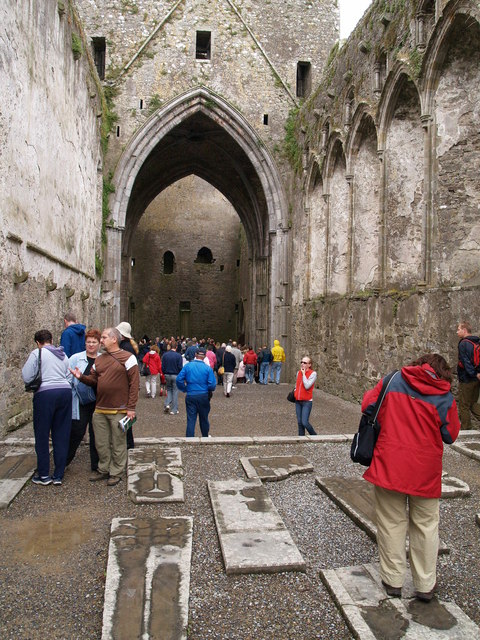
One of the most haunting things about the Rock of Cashel is that its greatest church has no roof. The cathedral stands open to the weather, its windows framing clouds instead of stained glass, its interior floored with grass and stone. This is not simply the slow work of decay. The roof was removed deliberately in the eighteenth century, and that single act tells you a great deal about how the fortunes of the Rock had fallen.
By the 1740s the archbishop of the day, a man named Arthur Price, decided that hauling himself up the Rock for services was too much trouble, and he arranged for the cathedral’s roof to be stripped and worship moved to a more convenient church down in the town. It was an unglamorous end for a building that had stood at the summit of Irish church life for five hundred years, and later generations have not always forgiven him for it.
Yet there is a strange beauty in the result. The roofless cathedral has a openness and a melancholy that a complete building could never match. Light pours in from every side, the walls glow at sunset, and the whole structure feels like a bridge between the earth and the enormous Irish sky. What was meant as an act of neglect has, over the centuries, become part of what makes the Rock unforgettable.

The Day the Rock Ran Red
For all its holiness, the Rock of Cashel saw one of the most savage episodes of the Irish Confederate Wars, and it is a story that must be told. In September 1647, during the vicious fighting that followed the rebellion of the 1640s, a Parliamentarian army led by Murrough O’Brien, Baron of Inchiquin, a man whose ruthlessness earned him the nickname Murrough of the Burnings, marched on Cashel. The Catholic Confederate garrison, six companies of soldiers under Lieutenant-Colonel Butler, took refuge on the Rock along with hundreds of townspeople, priests and civilians.
On the fifteenth of September, Inchiquin gave the defenders one hour to surrender. When they refused, his troops stormed the hill. Around a hundred and fifty dismounted cavalry officers led the assault, supported by infantry, hurling firebrands into the compound while the defenders fought back with pikes and stones. The attackers breached the walls, drove the survivors into the cathedral itself, and used ladders to climb in through the windows. When the last sixty soldiers finally surrendered and threw down their swords, they were killed anyway.
By the end close to a thousand people lay dead, soldiers and civilians alike, cut down in and around the sacred buildings. Lieutenant-Colonel Butler was among the slain, as were a number of priests. The churches were plundered and burned, statues smashed, vestments and valuables carried off, and the town below set alight. The massacre at Cashel became one of the notorious atrocities of the war, remembered with bitterness for generations, and the scorch marks of that day are woven into the story of every stone on the Rock.
The wider war gives the massacre its terrible context. Ireland in the 1640s was torn apart by overlapping conflicts, religious, political and ethnic, that fed into the larger struggle of the Wars of the Three Kingdoms convulsing England, Scotland and Ireland at the same time. Inchiquin, himself an Irish aristocrat who had thrown in his lot with the Parliamentarian side, was fighting the Catholic Confederation that had made Cashel one of its strongholds in the south.
For the people who crowded onto the Rock that September, the great churches must have seemed the safest place on earth, high, holy and strong. Instead the very buildings that promised sanctuary became a trap, and the sacredness of the site did nothing to stay the attackers’ hands. The horror of what happened at Cashel, the killing of the surrendered, the slaughter of civilians and clergy, sent a shock through the country and hardened the bitterness of a war that still had years to run.
The Hall of the Vicars Choral
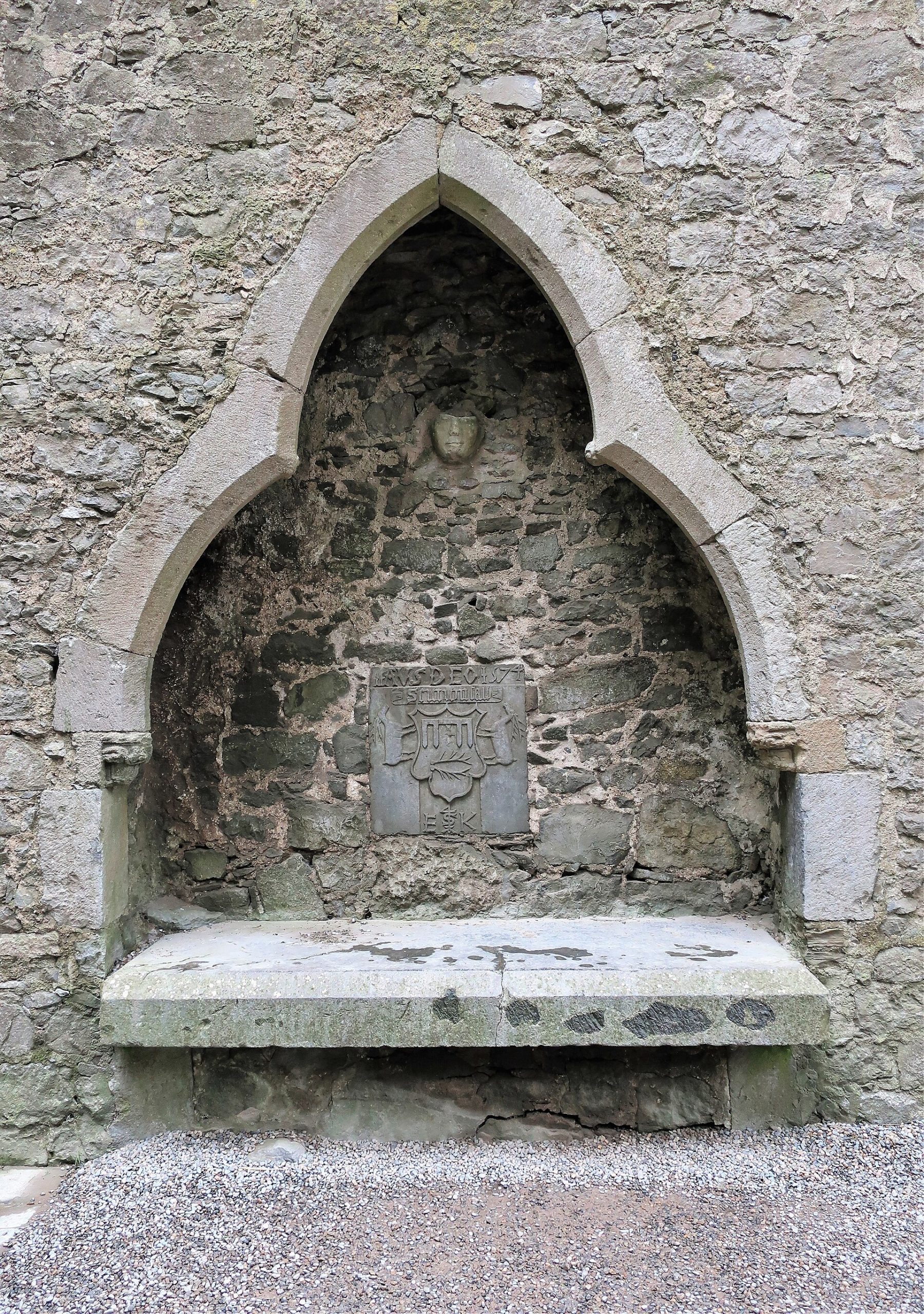
Not everything on the Rock is a church or a tower. Near the entrance stands the Hall of the Vicars Choral, the last major building added to the summit, dating from the fifteenth century. The vicars choral were laymen and minor clergy appointed to sing the daily services in the cathedral, and this hall was where they lived, ate and conducted their business. It has been carefully restored, and it now houses the visitor exhibition and some of the Rock’s most precious objects.
Inside you can see the original Saint Patrick’s Cross, or at least what survives of it, a weathered high cross that once stood outside and has been brought in to protect it from the Irish weather. A replica now marks its old position on the Rock. The cross is unusual in form, and tradition holds that its base was once the coronation stone of the kings of Munster, linking it back to the very oldest layer of Cashel’s royal history.
The hall gives a welcome sense of the human, everyday life of the Rock. Amid all the grand talk of kings, saints and battles, here were ordinary men going about the daily round of singing psalms, keeping accounts and warming themselves by the fire. Restored to something like its medieval appearance, with its timber roof and furnishings, it offers a rare, intimate window into how the great religious machine of Cashel actually worked day by day.
A City of the Dead
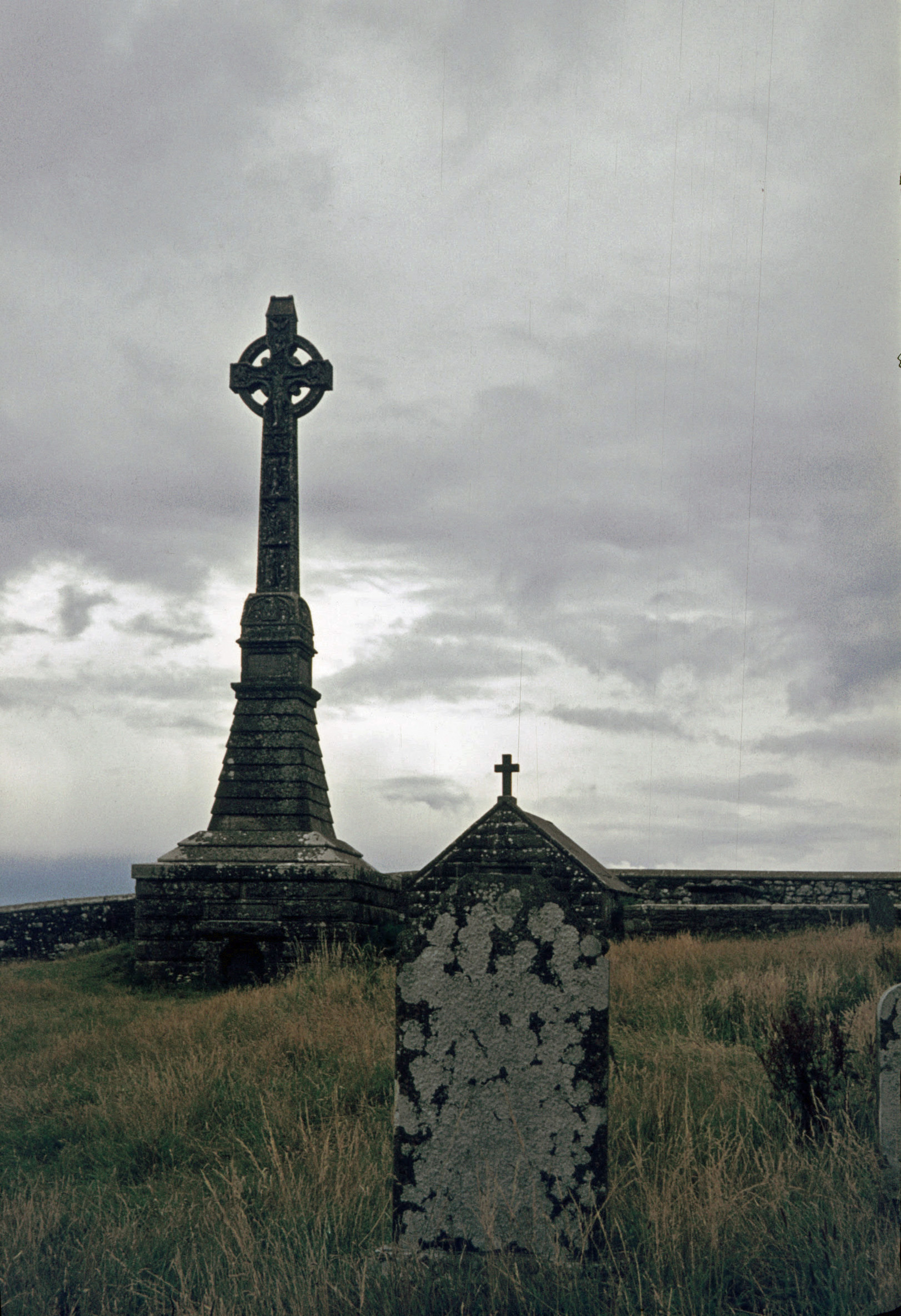
Spread across the summit of the Rock, between and around the great buildings, lies one of the most atmospheric graveyards in Ireland. For centuries it was considered a place of enormous honour to be buried on Cashel, as close as the dead could get to the holy buildings and, it was believed, to heaven itself. The result is a dense field of tombs, table graves and leaning headstones, many of them beautifully carved and softened by moss and lichen.
Among the graves stand several high crosses and grave markers of great age, their surfaces worked with the interlacing patterns and figures that Irish stone carvers made their own. To wander here at dusk, with the towers black against a fading sky and the wind moving through the long grass, is to feel the full weight of the centuries. It is a place that has drawn poets, painters and photographers for generations, and it is easy to see why.
The graveyard also frames some of the finest views from the Rock, out over the town of Cashel and across the Tipperary plain to the distant mountains. Nearby, at the foot of the Rock, lie the romantic ruins of Hore Abbey, a Cistercian monastery whose grey arches echo the great buildings above. Together they make the Rock feel less like a single monument and more like a whole vanished world, a sacred landscape where the living and the dead have kept company for well over a thousand years.
Look closely among the stones and you will find a remarkable range of monuments, from grand table tombs raised over local gentry to simple markers worn almost smooth by three centuries of rain. Each tells a small story of the families who lived in the shadow of the Rock and who wanted, above all else, to rest here when their time came. The desire to be buried on Cashel was so strong that space grew tight, and the graveyard became the crowded, layered place we see today.
The Rock on Screen and in Song
A place this striking was never going to escape the attention of film-makers and storytellers. The Rock of Cashel and its neighbour Hore Abbey have appeared on screen more than once, most famously as a backdrop in John Boorman’s 1981 fantasy epic Excalibur, which was shot largely in Ireland and used the drama of the Tipperary landscape to conjure the world of King Arthur. The Rock’s silhouette has a way of turning any scene instantly medieval.
Beyond the movies, Cashel has become one of the defining images of Ireland itself, the kind of view that appears on postcards, book covers and tourism posters the world over. Its combination of ruin, height and history makes it almost impossibly photogenic, and photographers chase its changing moods through mist, rain, snow and golden evening light. Few buildings anywhere are so instantly recognisable as a symbol of a whole country’s past.
To get a real sense of the place before you visit, or to relive it afterwards, it helps to see it in motion, with the wind in the grass and the towers wheeling overhead. The short guided tour below walks you around the summit and brings the buildings and their stories to life far better than any still photograph can.
Standing on the Rock Today
The Rock of Cashel is cared for by the Office of Public Works and is open to visitors throughout the year, and it richly rewards the climb. From the town below, a short but steep walk brings you up to the entrance beside the Hall of the Vicars Choral, where you buy your ticket and can join one of the excellent guided tours. The guides know the Rock intimately, and their stories of kings, saints and the terrible day of 1647 bring the grey stones vividly to life.
Give yourself at least a couple of hours to do the Rock justice. Cormac’s Chapel is usually visited on a guided tour to protect its fragile frescoes, so it is worth timing your visit around one. Wear sensible shoes for the uneven ground and worn steps, bring a coat because the summit catches every breath of wind, and if you possibly can, come early or late in the day when the crowds thin and the low light sets the walls glowing. A walk down to Hore Abbey afterwards makes a perfect, peaceful end to the visit.
You will find the Rock in the town of Cashel in County Tipperary, roughly halfway between Dublin and Cork and easily reached from either. For exact directions, here is a map link to guide you right to the foot of the Rock:
The castle sits at roughly 52.5203, -7.8906. Punch that into Google Maps and it will take you straight to undefined.
. However you arrive, the first sight of those towers rising from the plain is one you will not forget.

Nearby Castles
A Rock Like No Other
The Rock of Cashel is many things at once: a fortress of ancient kings, a shrine touched by legend, a masterpiece of Romanesque and Gothic building, a scene of appalling slaughter, and one of the most beautiful ruins on earth. Few places pack so many layers of Irish history into so small a space, and fewer still wear them so gracefully.
Stand at the top with the wind in your face and the plain spread out below, and you are standing where Brian Boru was once a king, where Saint Patrick is said to have preached, where a chapel still holds nine-hundred-year-old paint, and where a thousand people once died in a single afternoon. That is a lot for one hill to carry, and yet the Rock carries it lightly, glowing gold at sunset as though none of it ever weighed a thing.
You May Like

Château d’Amboise: Where the French Renaissance Was Born


