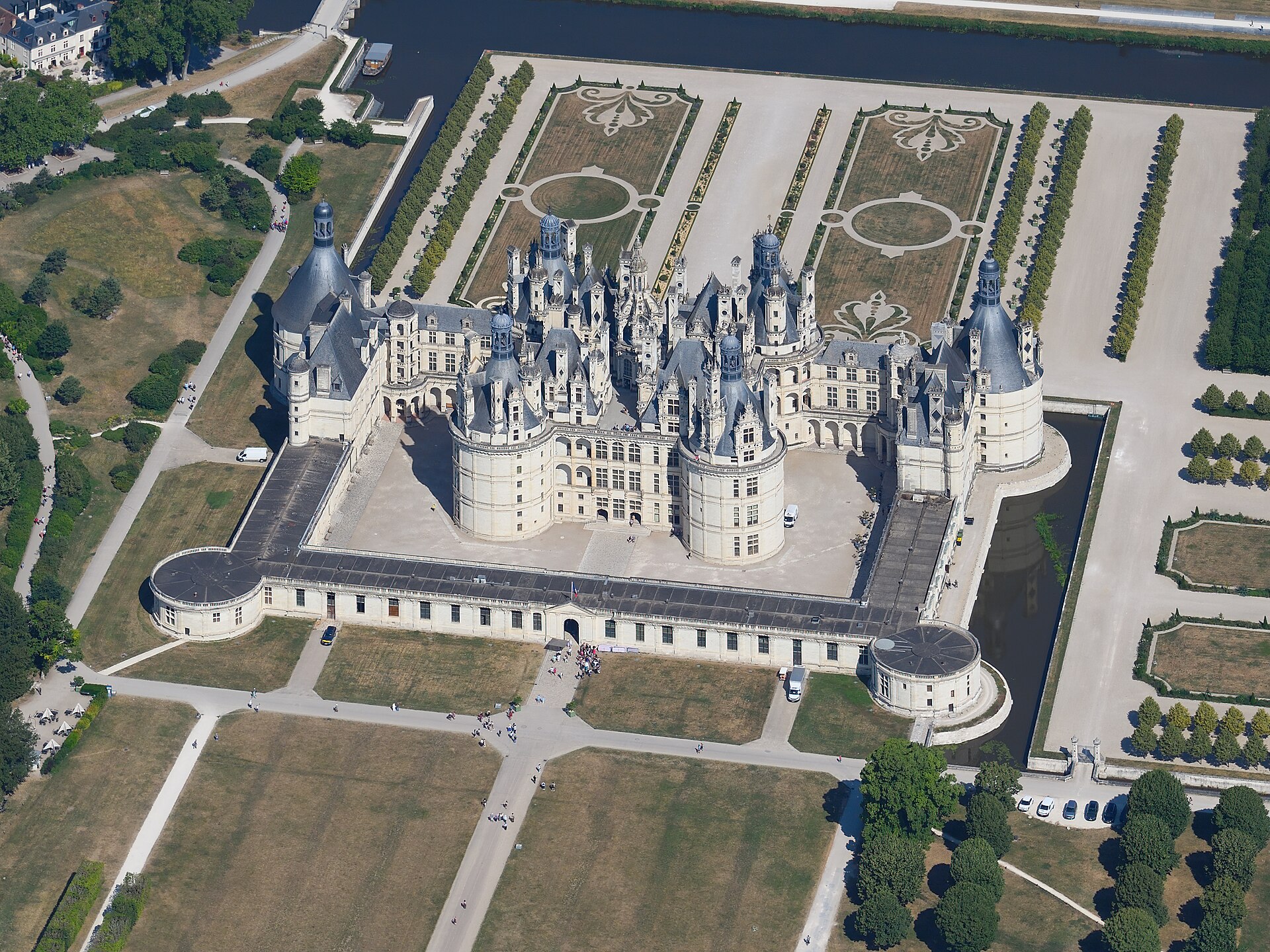
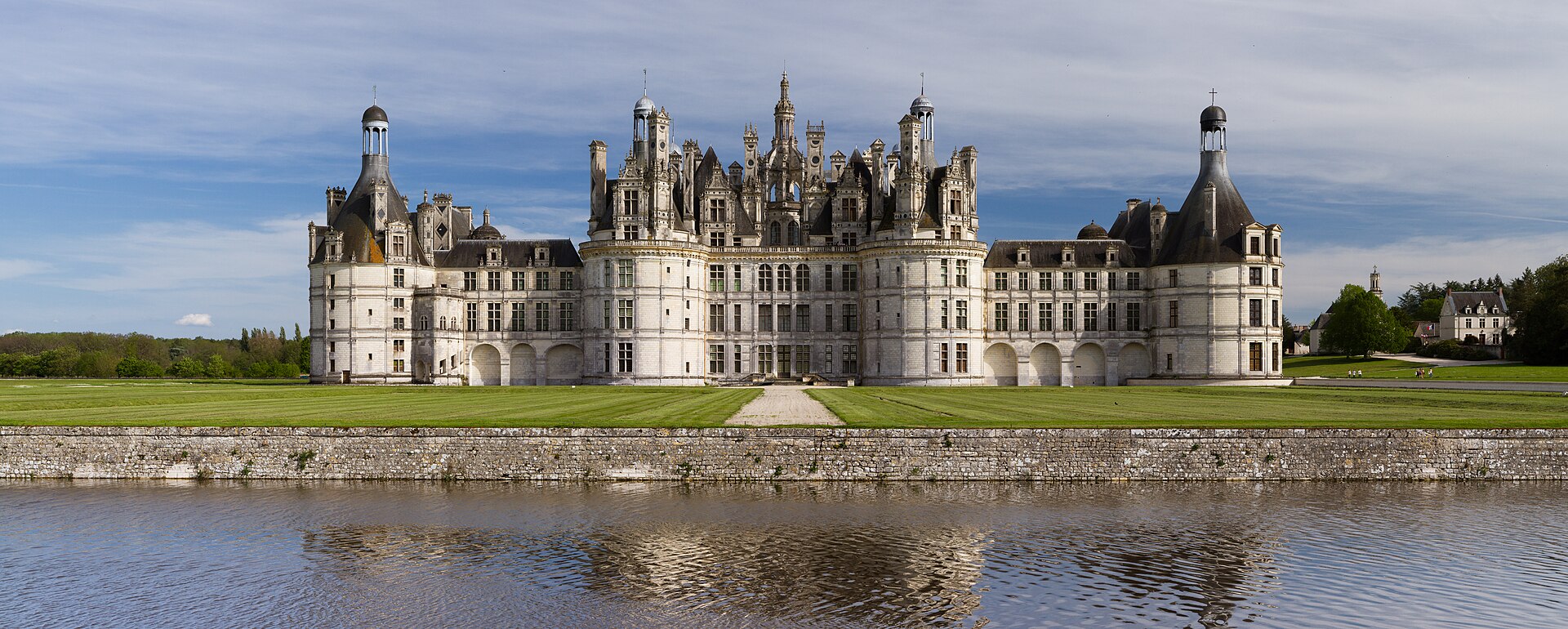
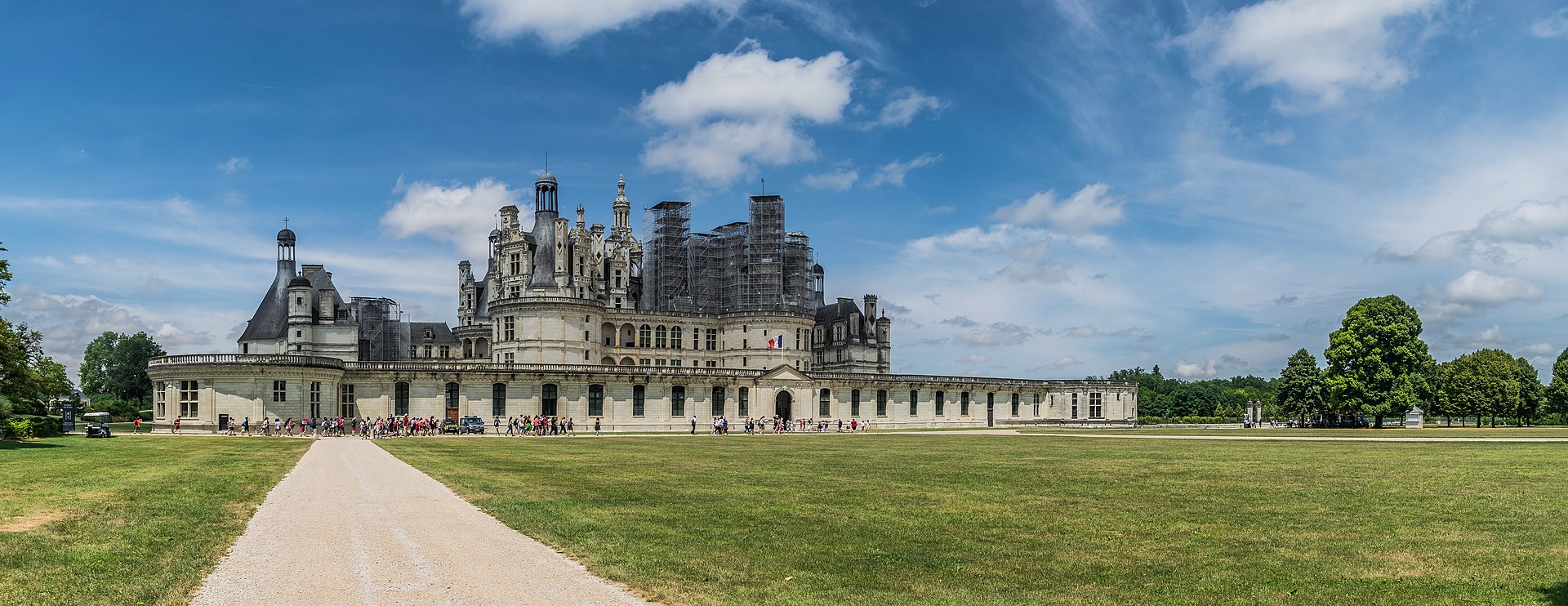
Come around the last bend in the road, and Chambord simply stops you. Out of the flat forest of the Sologne rises a fantasy in pale stone, a great white castle bristling with hundreds of towers, turrets, chimneys and pinnacles, so extravagant that it looks less like a building than a dream someone had about what a palace should be. This is the largest of all the châteaux of the Loire Valley, and it may be the most astonishing building the French Renaissance ever produced.
Yet for all its size and swagger, Chambord was never meant to be a home, or a fortress, or a seat of government. It was built as a hunting lodge, a place for a young and ambitious king to ride out after deer and boar and to show the whole world just how magnificent he was. Everything about it, from its impossible roofline to its famous double staircase, was designed to dazzle, and five centuries later it still does exactly that.
Behind the spectacle lies a story full of great names: a king who wanted to outshine every rival in Europe, an ageing Italian genius who may have sketched its most famous feature, a deposed Polish monarch, a victorious marshal, and a war that saw the treasures of the Louvre hidden within these walls. Let’s walk out to Chambord and discover how a lodge in the woods became one of the wonders of France.
In This Article
- A King’s Impossible Dream
- Building a Renaissance Marvel
- The Staircase That Defies Belief
- A Rooftop Like No Other
- Among the Chimneys and the Lantern
- The Salamander King
- Inside the Great Keep
- The Chapel and the King’s Faith
- A Lodge Fit for Kings and Courtiers
- When Kings Came and Went
- A Polish King and a Great Marshal
- Revolution, Neglect and Rescue
- The Château That Hid the Mona Lisa
- Wandering Chambord Today
A King’s Impossible Dream
To understand Chambord you first have to understand the man who built it. King François I came to the French throne in 1515 as a young, energetic and hugely ambitious ruler, determined to make France the cultural leader of Europe and himself the most glittering prince of the age. He had fought in Italy, seen the wonders of the Italian Renaissance with his own eyes, and come home hungry to create something that would rival anything south of the Alps.
In 1519, still only in his twenties, he ordered work to begin on a vast new château at Chambord, on the site of an old hunting lodge belonging to the counts of Blois. The location, deep in a game-rich forest near the Loire, was chosen for the hunting he loved, but the scale of what he planned had nothing to do with practicality. This was to be a statement in stone, a building whose sheer ambition would announce the arrival of a new kind of king.
What makes the choice so striking is that François already had grander, more convenient palaces. Chambord was a luxury, an indulgence, a place he did not need except as a way of expressing who he was. That is the key to the whole building. Chambord is not architecture for living or for defence; it is architecture as pure self-expression, the dream of a young king given permanent, glorious form.
François I had been captivated by what he saw during his campaigns in Italy, where princes competed to surround themselves with the finest art and architecture in the world. He came home not just with military ambitions but with a cultural mission, determined to import the genius of the Italian Renaissance and plant it in French soil. He invited Italian artists north, collected paintings, and dreamed of buildings that would make France the equal of Florence or Rome. Chambord was to be the crowning proof of that dream.
There was politics in the stone, too. The early sixteenth century was an age of intense rivalry between the great monarchs of Europe, above all between François and his lifelong rival, the Emperor Charles V. In such a contest, magnificence itself was a weapon. A building as staggering as Chambord told ambassadors, rivals and subjects alike that here was a king of boundless wealth, taste and power, a message no despatch could convey half so well as a mile of carved white stone.
Building a Renaissance Marvel
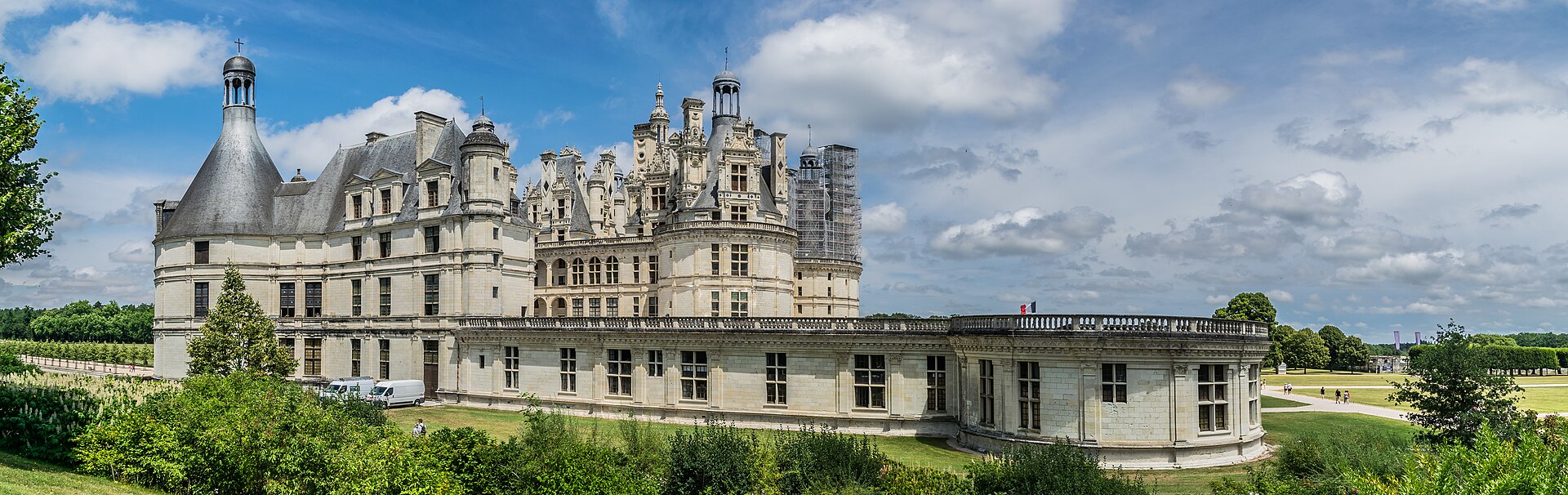
Construction of Chambord went on for decades, and it was a colossal undertaking. Thousands of workers laboured to raise the château out of the marshy ground, driving huge numbers of oak piles into the soft earth to support the enormous weight of stone. The pale local tuffeau limestone, easy to carve when freshly quarried and hardening over time, was perfect for the intricate decoration the design demanded.
The plan of the building is a fascinating hybrid. At its heart sits a great square keep, or donjon, laid out on the pattern of a Greek cross with four huge round towers at the corners, a shape borrowed from medieval castle design. But onto this old bones the builders grafted the new language of the Italian Renaissance: symmetry, classical pilasters, elegant mouldings and refined proportion. The result is a building that looks back to the age of chivalry and forward to a new world at the same time.
Exactly who designed it remains one of the great questions of architectural history. The Italian architect Domenico da Cortona is usually credited with the main design, but the shadow of an even greater name falls across Chambord. Leonardo da Vinci spent his final years in France as an honoured guest of François I, living just a short distance away, and many believe he had a hand in the plans, particularly the extraordinary staircase at the château’s heart.
The scale of the workforce and the length of the project meant that Chambord became a world of its own during construction, a small town of masons, carpenters, carvers and labourers living and working on the site for years on end. Fortunes were spent, and at times the king’s ambitions ran well ahead of his treasury, so that work slowed or paused before surging forward again. The building we see is the product of that long, uneven struggle between a king’s dream and the hard realities of stone, money and time.
The Staircase That Defies Belief
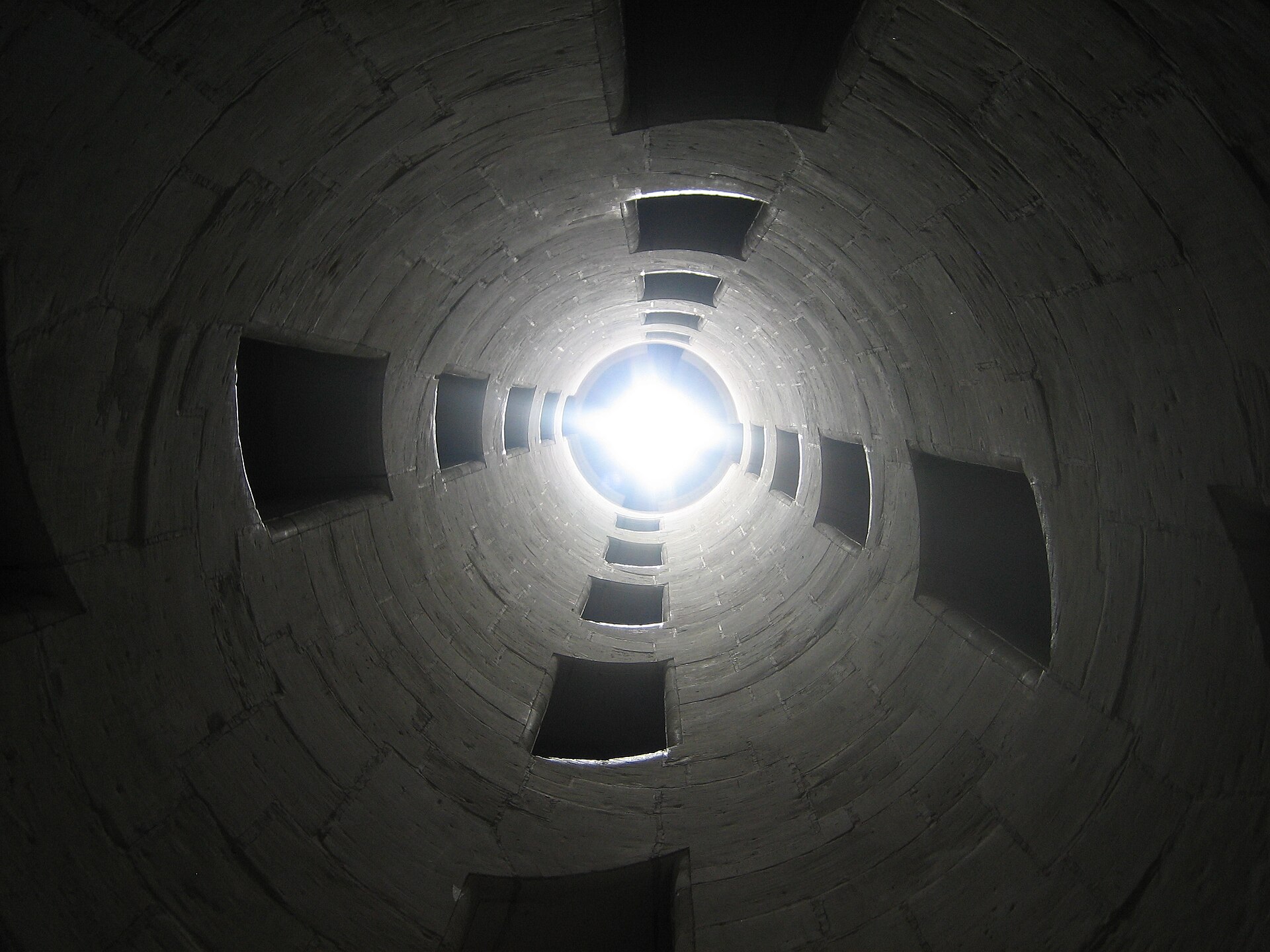
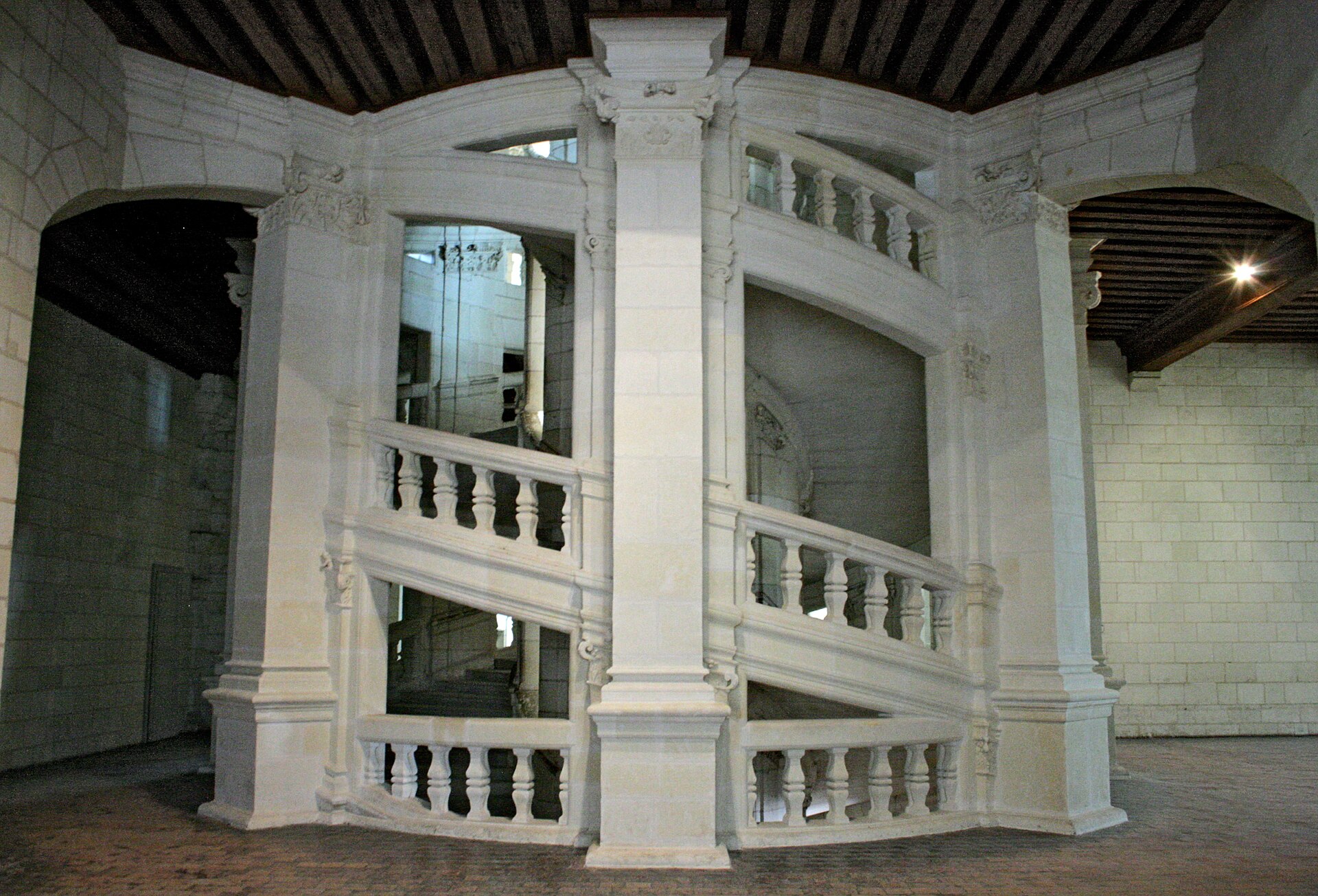
If Chambord has one feature that everyone remembers, it is the double-helix staircase that rises through the centre of the keep. At first glance it looks like a single grand spiral stair, but look closer and you realise it is two separate staircases, wound around each other like the strands of a rope, coiling up around a shared open core without ever meeting.
The effect is genuinely magical. Two people can climb the stair at the same time, one on each spiral, and they will glimpse each other through the openings in the central column, yet they will never actually cross paths or meet on the steps. Whether it was designed for practical reasons, to separate different groups of people, or simply as a piece of architectural showing-off, it is a masterpiece of geometry and one of the most famous staircases in the world.
It is this staircase, above all, that draws Leonardo da Vinci’s name to Chambord. The double-spiral form matches ideas the great man explored in his notebooks, and the timing of his years in France fits neatly with the château’s design. There is no document that proves his involvement beyond doubt, but standing at the foot of that impossible stair, watching it wind up toward the light, it is very easy to believe that a genius touched it.
Part of the genius of the staircase is the way it turns a simple act, climbing from one floor to the next, into a piece of living theatre. As you rise, you catch glimpses of other people through the open stonework, appearing and vanishing, close enough to see yet never able to meet. Courtiers must have delighted in the game of it, and it is easy to imagine the flirtations and intrigues that played out on those endlessly circling steps.
The stair also does something clever for the whole building. By placing it dead centre, beneath the great lantern that draws down the daylight, the designers gave Chambord a natural heart, a point around which the entire cross-shaped plan turns. Everything in the keep radiates from this spiralling core, so that the staircase is not just a way of getting upstairs but the organising idea of the whole extraordinary structure.
A Rooftop Like No Other
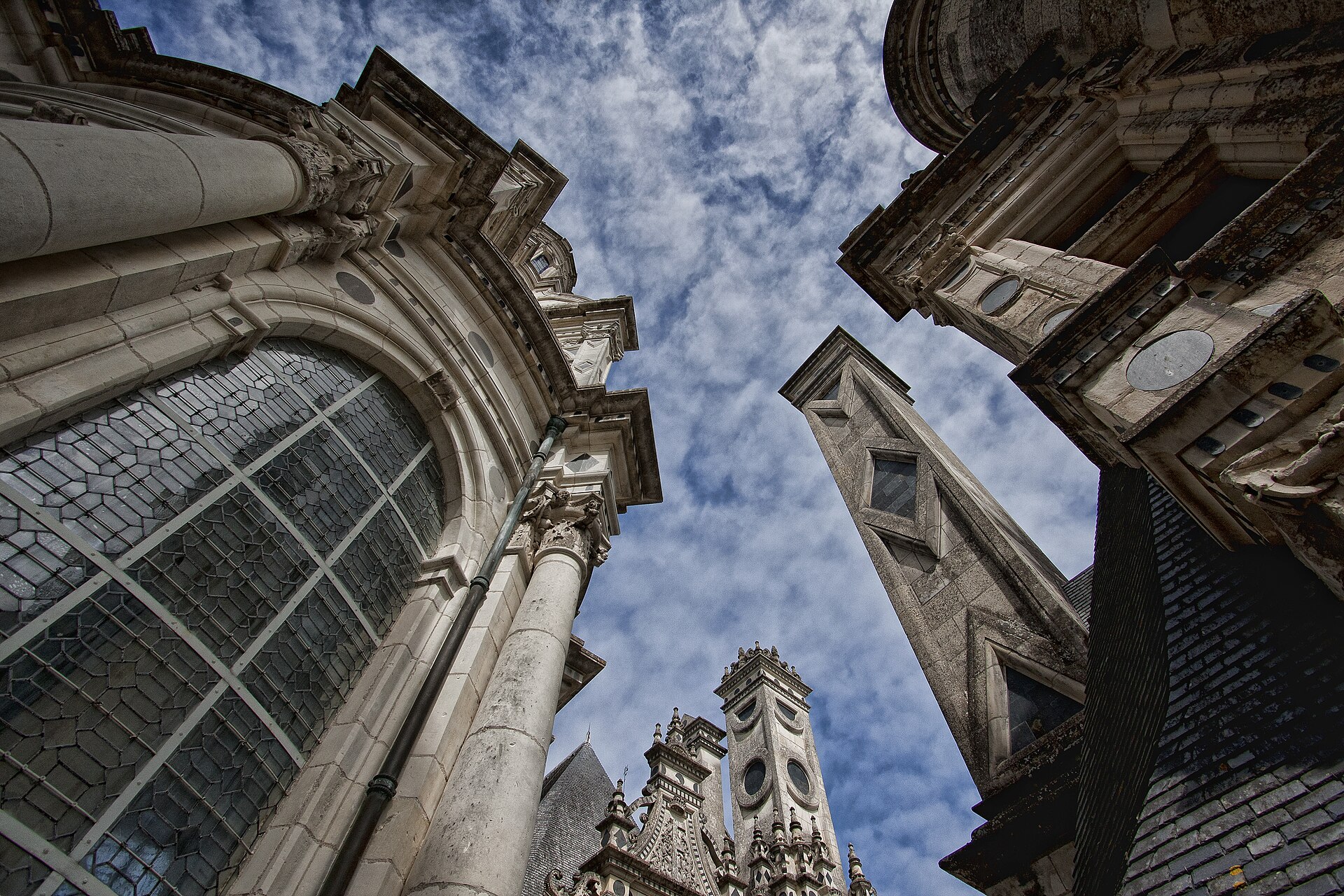
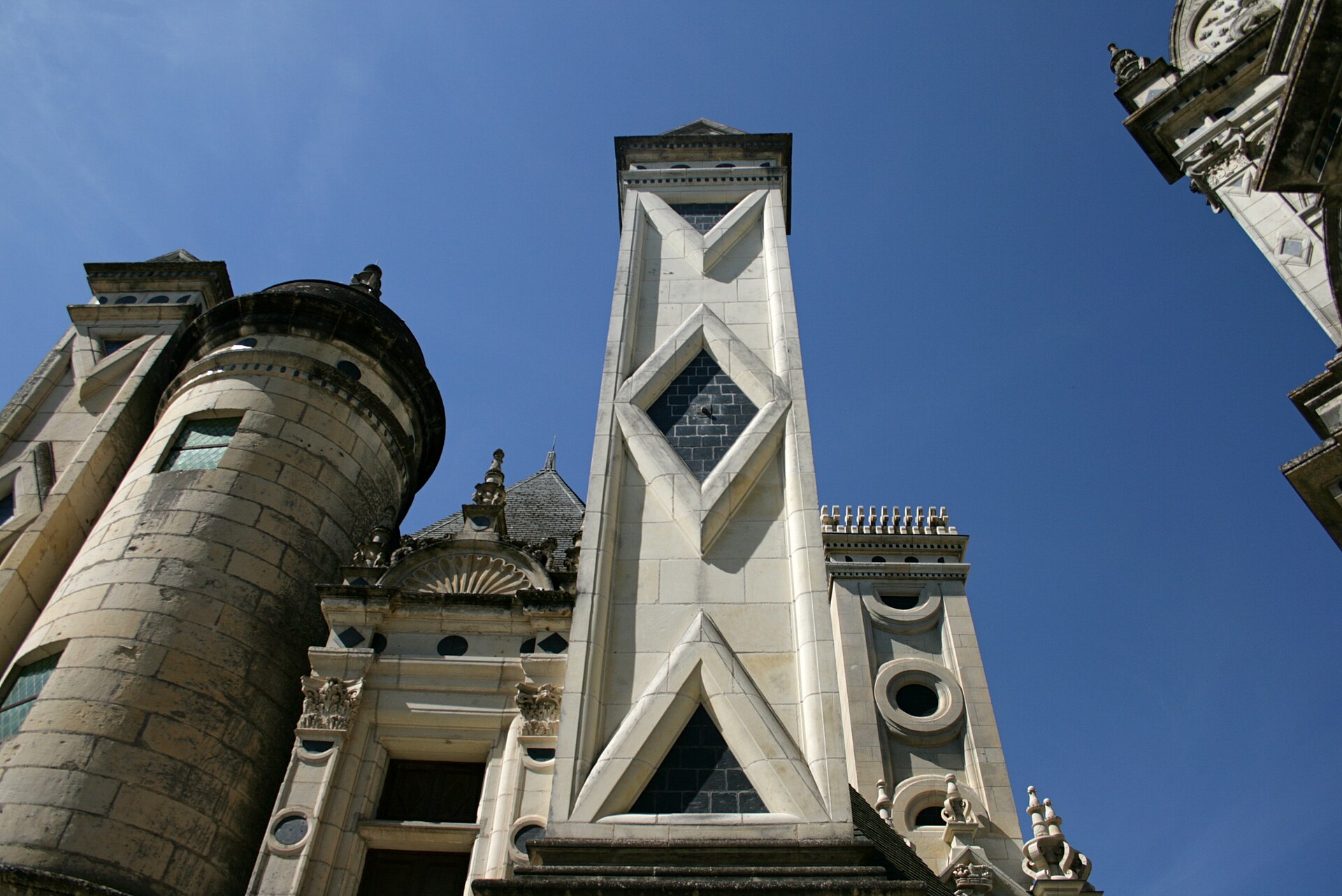
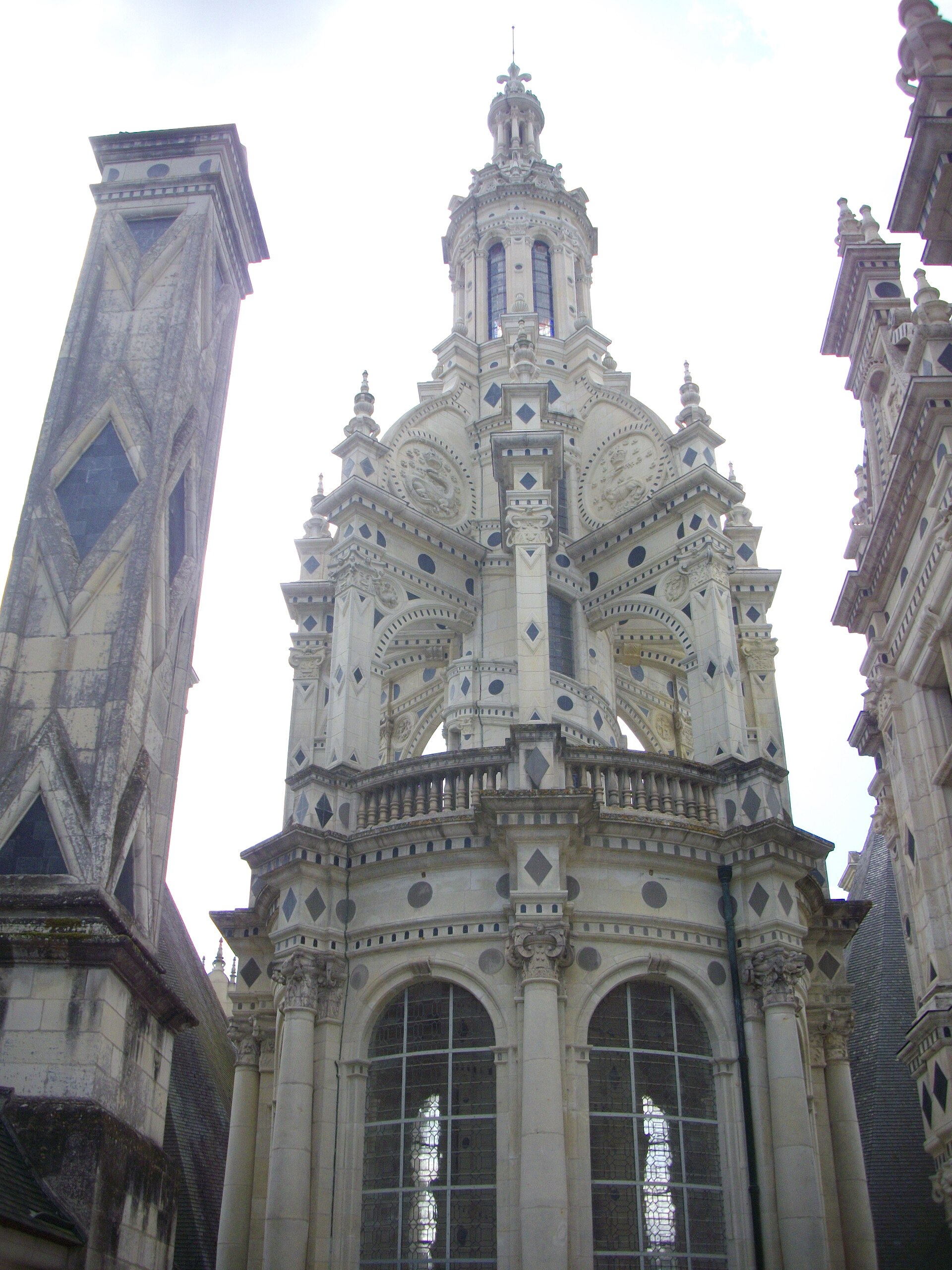
Climb the great staircase to the top of the keep and you step out onto what may be the most extraordinary rooftop in France. Chambord’s roofline is a forest in itself, a bewildering skyline of towers, cupolas, gables, spires and, above all, chimneys, so many and so richly carved that visitors have long joked there is one for every day of the year. Wander among them and you feel less like you are on a roof than in a strange stone town in the sky.
This roofscape was not an accident but the whole point. In François I’s day, the flat terraces up here were where the court gathered during the hunt. From these high walkways, ladies and courtiers could watch the riders and hounds streaming through the forest below, follow the chase, and enjoy the spectacle in comfort. The roof was a grandstand, a social space, a place to see and be seen, and its fantastical decoration turned even the act of standing about into theatre.
Every chimney and turret is encrusted with carved detail, slate inlays and classical ornament, so that the whole ensemble shimmers in the light. It is architecture designed to overwhelm, to make the visitor’s head spin with its richness. Nowhere else does Chambord’s purpose as a machine for dazzling people come through so clearly as it does up here, among the chimneys, with the forest rolling away to the horizon.
The idea of using a roof as a social space might seem strange to us, but for a Renaissance court it made perfect sense. Hunting was the great passion and the great theatre of royal life, and the terraces of Chambord gave the court a grandstand from which to watch it unfold. From up here, sheltered among the chimneys, the ladies of the court could follow the distant riders and the cry of the hounds without ever having to mount a horse or muddy a hem.
Among the Chimneys and the Lantern
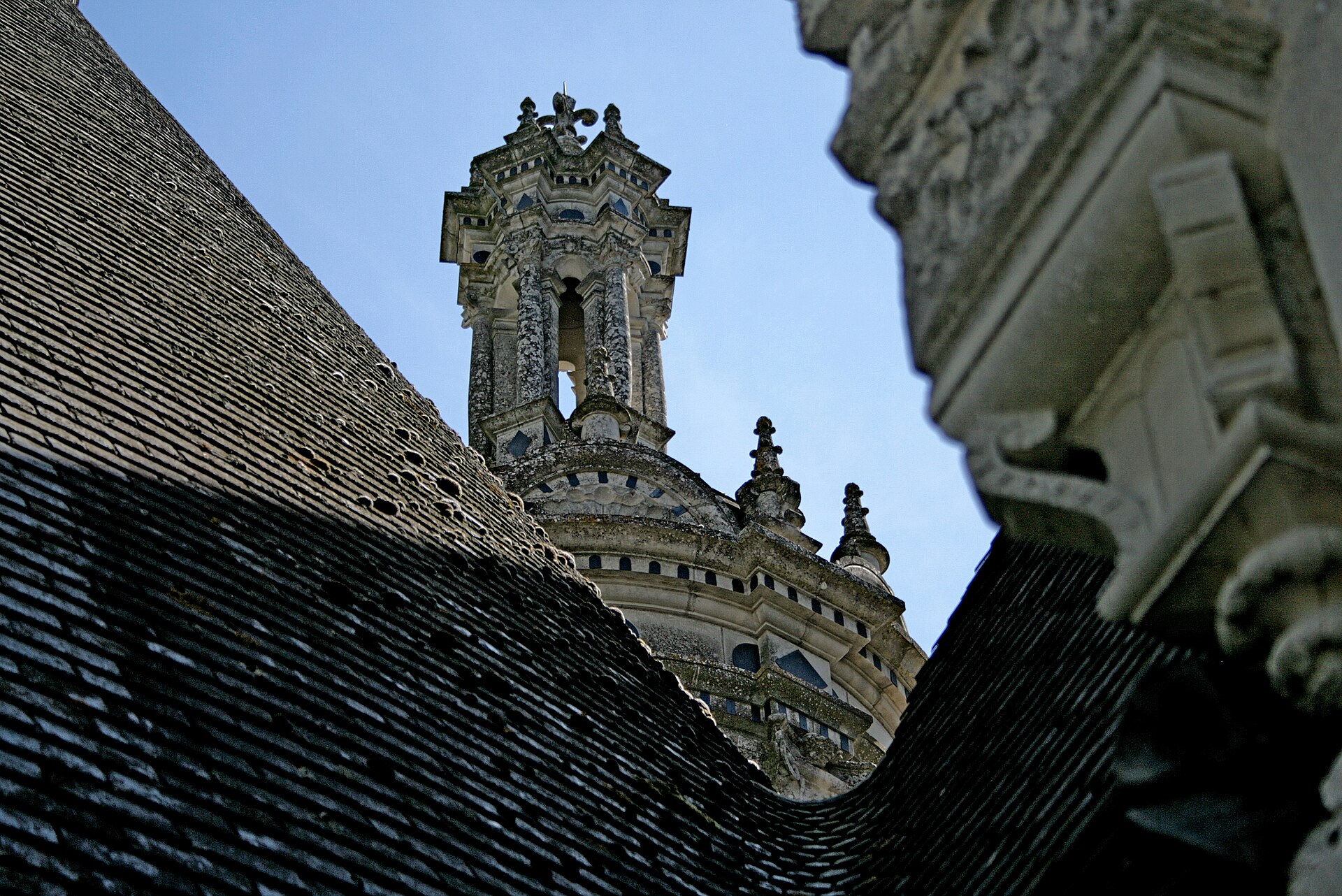
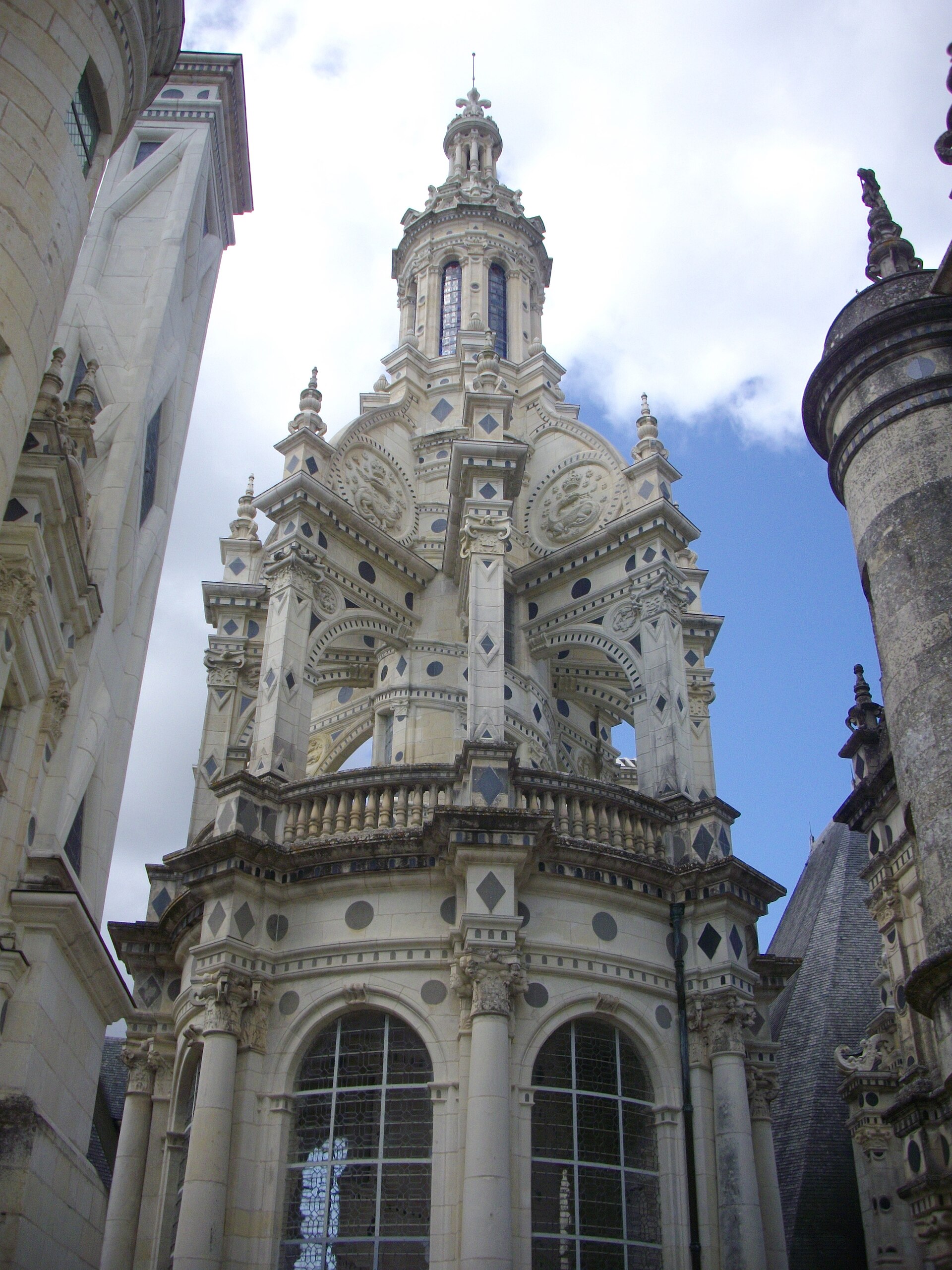
The crowning glory of the whole composition is the great lantern tower that rises from the very centre of the keep, directly above the double staircase. Tall, slender and pierced with light, it lifts the eye upward and pulls the entire building together, and it is topped not with a cross or a weathervane but with the fleur-de-lis, the emblem of French royalty, planted proudly at the highest point.
All around it cluster the famous chimneys, and they repay close attention. Many are decorated with slate set into the stone in geometric patterns, and carved into the stonework, again and again, you will find the salamander, François I’s personal emblem. This little fire-dwelling creature of legend, shown wreathed in flames, was the king’s chosen symbol, and at Chambord he scattered it everywhere, a signature repeated hundreds of times across his masterpiece.
Looking at this roofscape, you begin to see Chambord not as a single building but as a piece of sculpture on a giant scale. The lantern, the chimneys, the turrets and the salamanders all work together to turn a functional roof into a fantasy. It is the kind of detail that reveals a builder who cared about the experience of every moment, right up to the very last stone against the sky.
The Salamander King
The salamander that appears so often at Chambord is worth pausing on, because it tells you a great deal about the man who built the place. In medieval legend, the salamander was a creature so cold that it could live in fire and even put out flames, and it came to stand for the idea of enduring through hardship and mastering the elements. François I adopted it as his personal device, paired with a motto that spoke of nourishing the good fire and extinguishing the bad.
At Chambord the king had his salamander carved into ceilings, over doorways, on chimneys and across walls, hundreds of times over. Wherever you go in the château you find it watching you, crowned and wreathed in stylised flames, a constant reminder of whose vision this was. It was a form of branding centuries before the word existed, stamping the king’s identity onto every corner of his creation.
There is something fitting in the choice. Chambord itself has proved as enduring as its emblem, surviving revolution, neglect and war to stand today much as François left it. The salamander in the flames is a good symbol for a building that has passed through so much and come out still glorious, still cold and white and untouched, at the heart of its great forest.
It is easy to walk through Chambord and miss just how completely the king stamped himself on the place, until you start counting salamanders and lose track somewhere in the hundreds. This relentless repetition was not vanity alone; it was a language everyone of the time could read. To see the salamander was to know instantly whose hall you stood in, whose power surrounded you, and whose vision had summoned this whole marvel out of the marsh and the forest.
Inside the Great Keep
Step inside the keep and the logic of Chambord’s design becomes clear. The great double staircase sits at the very centre, and from it four huge halls radiate outward in the shape of a cross, dividing each floor into four equal apartments. It was a strikingly modern idea for its day, a rational, symmetrical plan that let people move easily through the building and gave each set of rooms its own privacy and light.
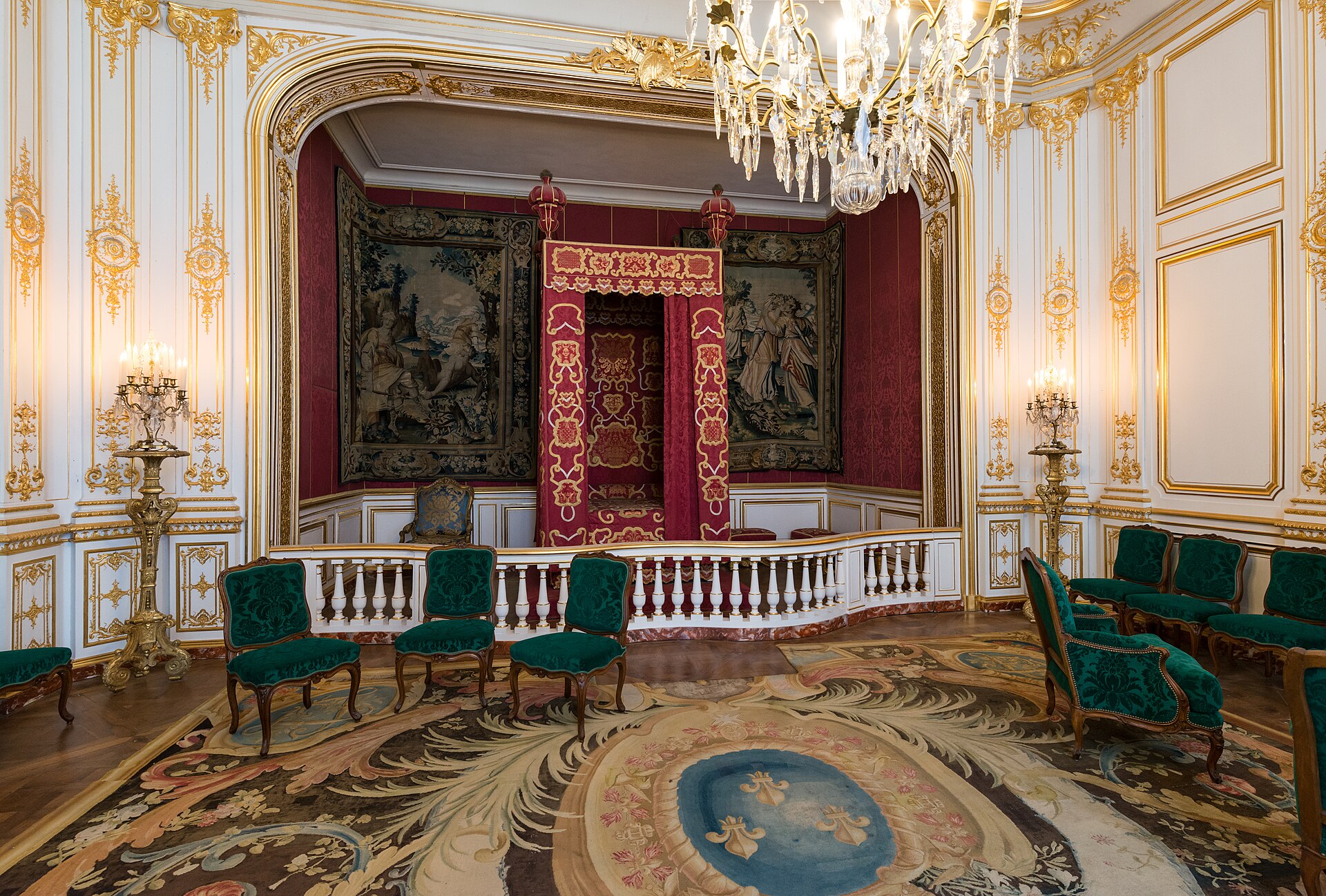
The halls themselves are vast and cool, their ceilings carved with the royal monogram and, of course, the ever-present salamander. In François I’s time these spaces would have been hung with rich tapestries and filled with the coming and going of the court during the hunting season, though the château was never permanently furnished in the way a lived-in palace would be. Furniture travelled with the king, and when he left, much of the life of the place left with him.
Wandering these rooms today, you are struck by how the building feels both palatial and strangely empty, grand beyond measure yet never quite domestic. That is Chambord’s peculiar character. It was built for spectacle and for the great set-piece occasions of royal life, not for everyday living, and even now it wears its emptiness like part of the design, a vast stage waiting for a king who only ever came now and then.
The cross-shaped division of each floor was more than an aesthetic choice; it reflected a new way of thinking about comfort and privacy. Instead of the tangled, defensive layouts of older castles, Chambord offered clear, self-contained apartments, each with its own rooms arranged in a logical suite. It was an early step toward the way grand houses would be planned for centuries afterwards, and it showed how the Renaissance was reshaping not just how buildings looked but how people lived in them.
It is worth remembering, too, that Chambord was designed to be experienced in movement. The great halls, the radiating rooms and the central stair were all arranged to lead the eye and the feet onward, drawing visitors deeper into the building and upward toward the light and the roof. Even standing empty, the keep still carries you along its intended path, a piece of choreography in stone that has lost none of its power to guide and impress.
The Chapel and the King’s Faith
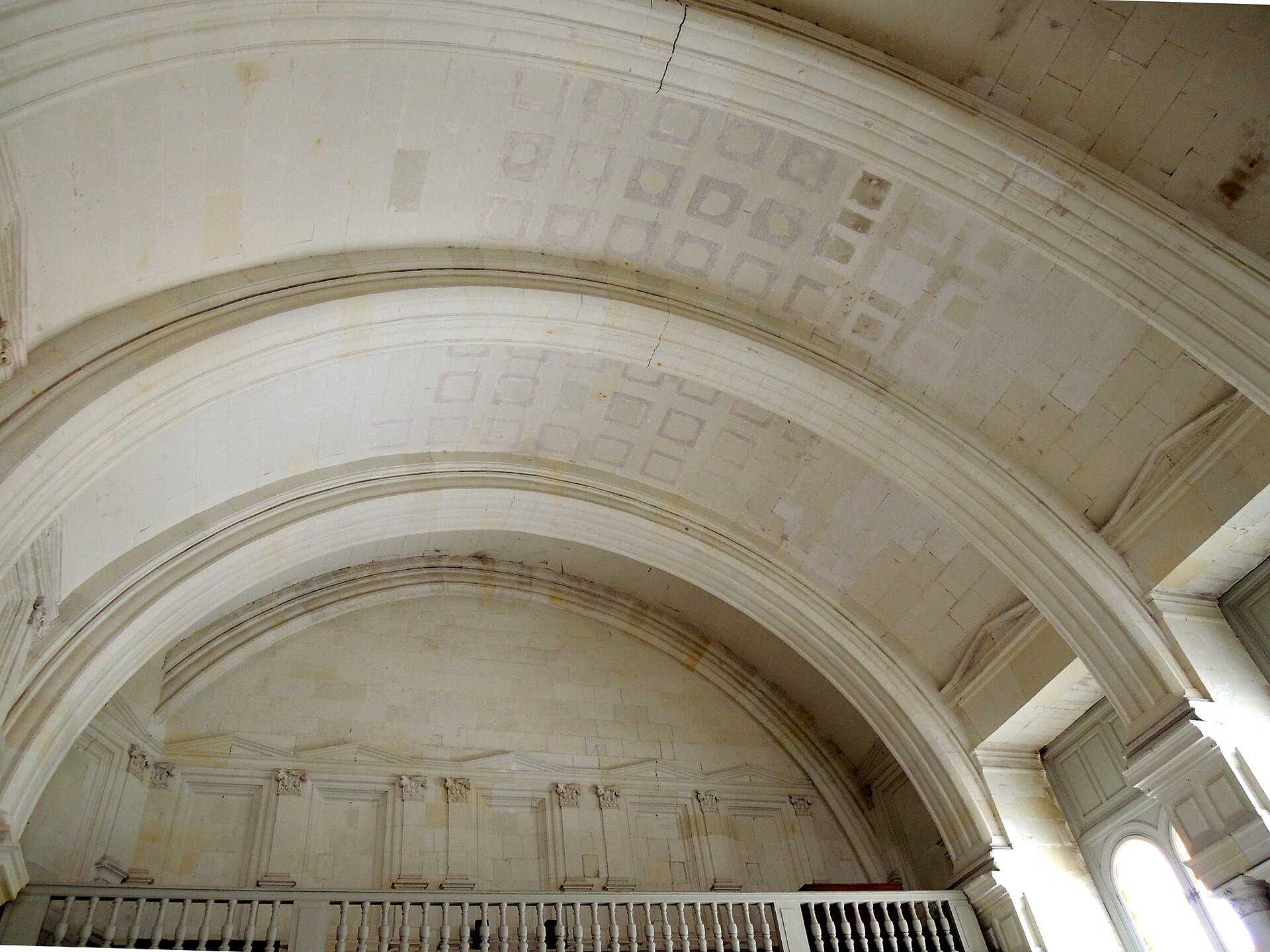
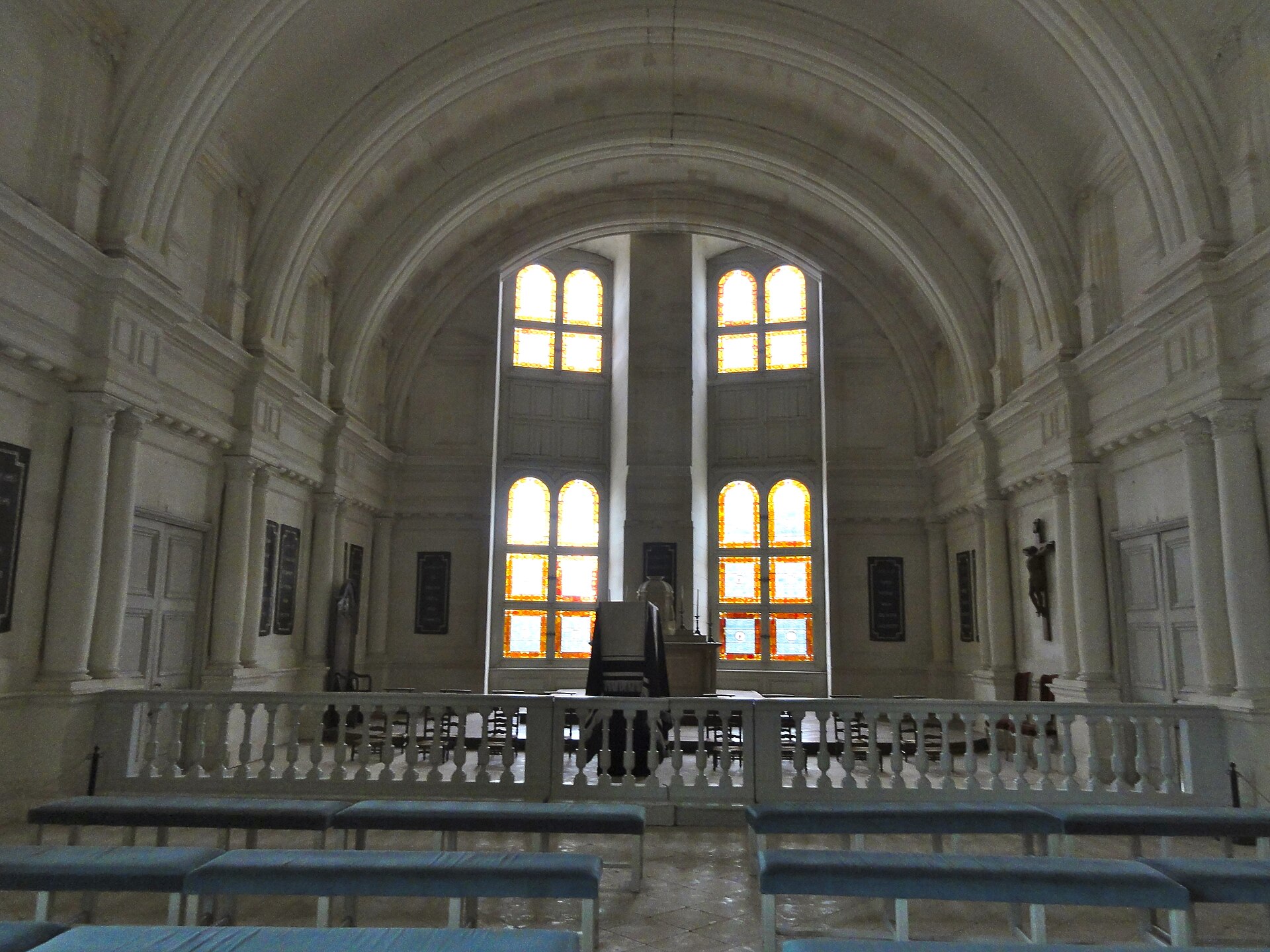
Tucked into one of the great corner towers of the keep lies the château’s chapel, the largest single room at Chambord and one of its quietest, most dignified spaces. Begun under François I and completed under later kings, particularly Louis XIV, it rises through two storeys beneath a fine vaulted ceiling, a place of calm amid all the exuberance of the rest of the building.
The chapel reminds us that even a pleasure palace built for hunting and display had to make room for the rituals of faith. Kings and their courts moved constantly between the worldly and the sacred, and no royal residence, however extravagant, could do without a proper place of worship. Here the carved royal monograms mingle with religious symbolism, tying the crown and the church together in stone, as they were tied together in the life of the age.
Its completion over several reigns also tells the story of Chambord in miniature. François I began the château but did not live to see it finished, and it fell to his successors to carry on the work over the following centuries. The chapel, with its layers of different royal builders, is a reminder that a building this size was never the work of one man or one lifetime, but a project handed down like an inheritance from king to king.
The chapel’s relative restraint also offers a moment of calm that sets off the exuberance of the rest of the château. After the dizzying staircase and the fantastical roof, its quiet, ordered space feels almost like a held breath, a reminder that even the most theatrical of buildings needed a still centre where the serious business of prayer could go on.
A Lodge Fit for Kings and Courtiers
For all the effort poured into it, François I actually spent very little time at Chambord, perhaps only a matter of weeks across his whole reign. The château was often left cold and empty, its hundreds of rooms echoing and unused, waiting for the rare occasions when the king and his enormous travelling court would descend on it for the hunt and briefly fill it with life, noise and colour.
Those visits, when they came, were spectacular. The king would arrive with a vast retinue, and for a few glittering days Chambord would blaze with fires in its countless chimneys, ring with music and fill with the business of the chase. Then the court would move on, the fires would die, and the great white building would sink back into silence in the middle of its forest, a palace that spent most of its life waiting.
Later monarchs used it in much the same way, as an occasional retreat rather than a home. Its very impracticality, so far from the centres of power, so expensive to heat and maintain, meant that Chambord was always more of a grand gesture than a working residence. Yet that is part of its magic. It was built to be extraordinary, not comfortable, and it has remained extraordinary precisely because ordinary life never quite wore it down.
When Kings Came and Went
After François I, Chambord passed through the hands of a long line of French kings, each of whom left some mark or simply let the great building drift. For long stretches it stood almost abandoned, too vast and too remote to be practical, and more than once it seemed in danger of being forgotten altogether. Then a new royal enthusiasm would flare up, and Chambord would be dusted off and pressed back into service.
The most vivid of these revivals came under Louis XIV, the Sun King, who visited several times and gave the château some of its liveliest moments. It was here, for the entertainment of the king and his court, that the great playwright Molière staged some of his work, including the first performance of one of his most famous comedy-ballets. For a few brilliant evenings, the halls of Chambord rang with laughter and music laid on for the most powerful monarch in Europe.
Louis XIV also completed unfinished parts of the building and laid out formal grounds, treating Chambord with a seriousness it had not always enjoyed. Yet even he never made it a true home. Like every king before and after him, he came, he dazzled and he departed, leaving the great white château to its long stretches of solitude between royal visits.
Molière’s performances at Chambord were mounted with all the resources of the royal court, complete with music by the celebrated composer Lully and elaborate staging. For the writer, being commanded to entertain the king at his forest palace was both an honour and a challenge, and the works he created for these occasions helped shape the whole tradition of French comedy. That such enduring art was made within these walls adds another layer to Chambord’s remarkable story.
A Polish King and a Great Marshal
In the eighteenth century Chambord entered one of its stranger chapters, becoming a home for people who were not French kings at all. For a number of years it was granted to Stanislas Leszczynski, a deposed king of Poland and the father-in-law of Louis XV, who lived here in exile. It was a curious fate for a royal hunting lodge, to become a comfortable retirement home for a monarch without a throne.
Later the château was given to one of the greatest soldiers of the age, Maurice de Saxe, the victorious Marshal of France, as a reward for his triumphs on the battlefield. The marshal took up residence in real style, even stationing his own regiment nearby, and he threw himself into life at Chambord with gusto until his death there in 1750. Under him the old lodge saw some of its most colourful days since the time of François I.
These episodes give Chambord a human warmth that its sheer scale might otherwise hide. Behind the spectacle, real people lived here, an exiled king playing out his final act, a great general enjoying the fruits of victory. They remind us that the château was not only a symbol but also, from time to time, a genuine home, filled with the everyday business of the remarkable individuals who were lucky enough to hold it.
Maurice de Saxe brought a touch of military splendour to Chambord that it had not known since the days of its royal founder. He kept a regiment of cavalry stationed near the château, and their exotic horses and colourful uniforms must have made an extraordinary sight against the pale stone. The marshal lived on a grand scale, entertaining lavishly, and his years here gave the old lodge a last burst of the theatrical life for which it had first been built.
Revolution, Neglect and Rescue
The French Revolution fell hard on Chambord, as it did on so many symbols of royal power. Revolutionaries ransacked the château, its furnishings were sold off, and the game that had once filled its forest was hunted almost to nothing. Stripped and emptied, the great building entered a long period of decline, passing through various owners and often standing neglected, its glory fading behind cobwebs and dust.
For much of the nineteenth century Chambord’s future was uncertain. It was owned for decades, largely in absence, by a royal claimant who took his very title, the Count of Chambord, from the place, yet rarely set foot in it. The château drifted on, admired by visitors but starved of the care a building of its size demanded, slowly surrendering to time and weather.
Rescue came at last in the twentieth century, when the French state bought Chambord in 1930 and began the long work of restoration that continues to this day. In 1981 it was recognised as a UNESCO World Heritage Site, its importance to the whole story of European architecture formally acknowledged. After centuries of glory, neglect and revival, Chambord had finally found a guardian equal to its scale.
The long neglect, oddly enough, may have helped preserve Chambord’s character. Because it was so rarely modernised or lived in, it escaped the heavy remodelling that transformed many other great houses, and much of François I’s original vision survived intact beneath the dust. When restoration finally came, there was a genuine Renaissance masterpiece waiting to be uncovered, rather than a building buried under later alterations.
The Château That Hid the Mona Lisa
Chambord’s most surprising modern adventure came during the Second World War. As war loomed and then broke over France, the authorities faced an agonising problem: how to protect the priceless treasures of the Louvre and other great collections from bombing and looting. The answer, in part, was Chambord. Its remote location and enormous, empty halls made it a perfect hiding place, and so the masterpieces of French art were spirited out of Paris and into the countryside.
For a time the greatest paintings and sculptures in France sheltered within or passed through these walls, among them, by tradition, the most famous painting in the world, Leonardo da Vinci’s Mona Lisa. There is a beautiful circularity in that. The very artist who may have helped design Chambord’s staircase now had his most celebrated work protected inside the château, four centuries after his death, as if the building were repaying an ancient debt to its possible creator.
Great crates of art were stored and sorted here as curators worked desperately to keep the nation’s heritage safe. For a building that had spent so much of its life as an empty stage, it was a strange and moving role, guardian of the treasures of a civilisation in its darkest hour. Chambord, built to dazzle, spent the war years quietly keeping beauty safe from destruction.
The operation to save France’s art was one of the great untold dramas of the war, carried out by dedicated curators who risked everything to keep the nation’s treasures out of enemy hands. Works were packed with painstaking care, labelled, and moved from refuge to refuge as the danger shifted, and Chambord served as one of the key staging posts in that vast, secret effort. Trucks laden with priceless canvases rolled up to a château that had been built, centuries earlier, purely for pleasure.
Wandering Chambord Today
Modern Chambord is one of the most visited châteaux in France, and it is easy to see why. The building sits at the heart of an enormous walled park, the largest enclosed forest estate in Europe, a vast green world of woods and clearings where deer and wild boar still roam much as they did in François I’s day. Simply approaching the château across this landscape, watching it grow on the horizon, is an experience in itself.
Inside, visitors can climb the famous double staircase, wander the great cross-shaped halls, explore the royal apartments with their tapestries and period furnishings, and step out onto the extraordinary roof terraces among the chimneys and the salamanders. Exhibitions, carriage displays and beautifully restored rooms bring the long history of the place to life, while the surrounding estate offers walking, cycling and the chance to spot wildlife.
However you choose to explore it, Chambord rewards time and attention. It is a building that reveals more the longer you look, its symmetry and its madness, its Renaissance order and its fairy-tale excess, all held together in one impossible, unforgettable whole. Few places in France, or anywhere, leave quite such a strong impression on everyone who sees them.
You will find Chambord in the Loir-et-Cher department of central France, an easy drive from the Loire towns of Blois, Tours and Orléans and a comfortable day trip from Paris. It is open all year, and it is worth arriving early or late to enjoy the château and its park at their most peaceful. For exact directions, here is a map link to guide you there: 47.6161, 1.5169.
The estate around the château is a treasure in its own right, a rare survival of the great royal hunting forests that once covered much of France. Enclosed by a wall many kilometres long, it shelters an abundance of wildlife and offers visitors the chance to experience something of the landscape that drew François I here in the first place. Walking or cycling its paths, with the towers of the château appearing and disappearing through the trees, is one of the great pleasures of a visit.
The Dream in the Forest
Chambord is a building that should not really exist. It was too big, too impractical, too expensive, built for a king who barely used it, in a place chosen for its deer rather than its convenience. And yet there it stands, five centuries on, as glorious and strange as the day its last chimney was set in place, a monument to ambition, imagination and sheer royal willpower.
That is perhaps the secret of its enduring magic. Chambord was never meant to be useful; it was meant to be wonderful, and in that it succeeded beyond all measure. To come around that last bend and see it rise from the forest is to understand, in a single glance, exactly what a young king dreamed of long ago, and to feel that, against all the odds, his impossible dream came true.
You May Like
Castello di Miramare: The White Castle of a Doomed Prince


3 thoughts on “Château de Chambord: The Renaissance Dream in the Forest”