High above the little town of Amboise, on a great rocky spur overlooking the River Loire, stands one of the most important royal residences in the history of France. The Chateau d’Amboise does not have the fairy-tale extravagance of Chambord or the watery grace of Chenonceau, but it has something those younger palaces cannot match: it was here, more than anywhere, that the French Renaissance was born, and here that some of the most dramatic scenes in French history were played out.
This was a cradle of kings. A king was born here, a king died here in the strangest of accidents, and here a young prince who would become the great François I spent his boyhood, growing up to bring the art and genius of Italy flooding into France. It was to Amboise that Leonardo da Vinci came in his final years, and it is at Amboise, in a small and lovely chapel, that the greatest genius of the age is said to lie buried.
But Amboise has a darker memory too. Its walls and balconies were once the scene of a savage massacre that helped tip France into decades of religious war. Grand and beautiful, tragic and haunted, this is a castle where the light and the shadow of the Renaissance meet. Let’s climb the great ramp to the terrace and discover the many lives of the Chateau d’Amboise.

In This Article
- A Fortress Above the Loire
- The King Who Brought Italy Home
- Death at a Doorway
- Young François and the Golden Age
- Leonardo da Vinci Comes to Amboise
- The Chapel of Saint-Hubert
- A Masterpiece of Carved Stone
- The Great Ramps of the Horsemen
- Climbing the Tour des Minimes
- The Terrace and Its Kings
- The Amboise Conspiracy
- Decline and Survival
- Visiting Amboise Today
A Fortress Above the Loire
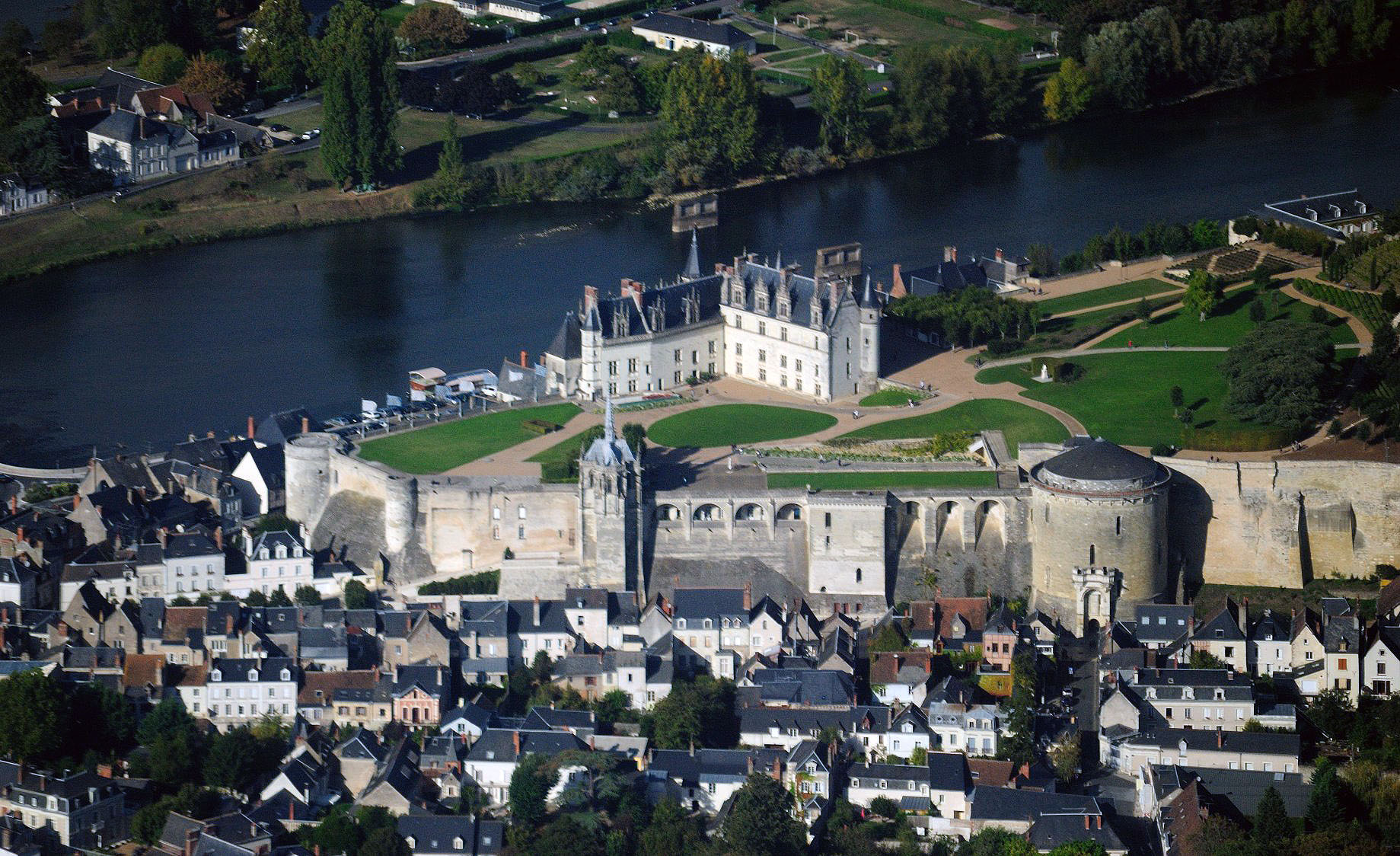
Amboise owes everything to its position. The great limestone spur on which the chateau stands rises steeply above the Loire, commanding the river and the crossing below, and people have recognised its value as a stronghold since ancient times. There was a fortress here in the Roman era, and through the Middle Ages a powerful castle guarded this stretch of the great river, controlling the traffic and trade that flowed along it.
For centuries Amboise belonged to a powerful noble family, but its sheer strategic importance made it too tempting a prize for the crown to leave in private hands. In 1434 King Charles VII seized the castle from its owner, and from that moment Amboise became royal property. In the hands of the kings of France, this mighty river fortress would soon be transformed into something far more than a place of war.
That transformation is the heart of the Amboise story. The medieval stronghold, all thick walls and hard practicality, was about to become a royal palace and a fountainhead of art and learning. Yet the old fortress never entirely vanished. Even today, as you look up at the chateau on its rock, you can feel the weight of its origins as a place built to dominate the river and everyone who travelled it.
The Loire was the great highway of medieval and Renaissance France, carrying goods, armies and kings along its broad waters, and any castle that could command a crossing of it held real power. Amboise sat at exactly such a point, where the river could be watched and controlled, and this is why it mattered so much to whoever ruled the surrounding lands. Its rock was not chosen for beauty but for dominance, and beauty came only later.
When Charles VII took the castle into royal hands in the fifteenth century, he was doing what strong kings always did with dangerous strongholds: bringing them under the crown so that no over-mighty subject could use them against him. Amboise thus became part of the growing power of the French monarchy itself, a royal fortress that embodied the crown’s determination to master the great river and the nobles who lived along it.
The King Who Brought Italy Home
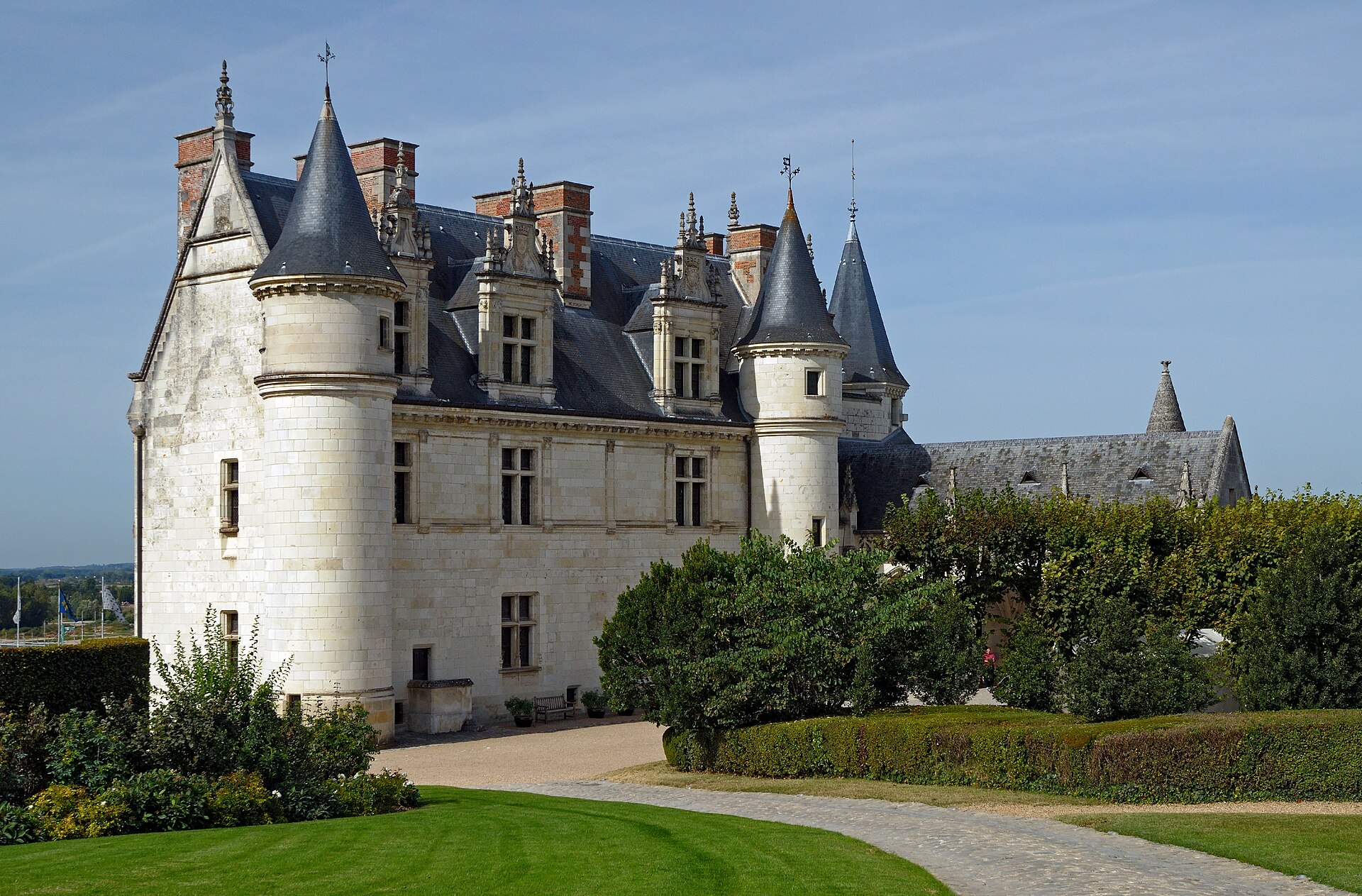
The first great royal builder at Amboise was Charles VIII, who had been born in the castle in 1470 and loved it dearly. As a young king he led a military expedition into Italy, and though the campaign achieved little in the way of conquest, it changed France forever. Charles was dazzled by what he saw there: the palaces, the gardens, the art and the elegance of the Italian Renaissance, a world of beauty far beyond anything at home.
He came back determined to recreate that beauty at Amboise. Charles brought Italian craftsmen, gardeners and artists north with him, and set them to work transforming his childhood home into a modern palace in the new style. Italian gardens were laid out, new royal apartments raised, and the whole character of the place began to shift from medieval fortress toward Renaissance residence. In doing so, Charles VIII opened the door through which the Renaissance would pour into France.
It is one of history’s great ironies that a failed military adventure should have produced such a lasting cultural revolution. Charles won no lasting territory in Italy, but he brought home something far more valuable: a vision of a new kind of civilisation. Amboise was the first place where that vision took root on French soil, and from here it would spread across the whole kingdom in the decades that followed.
The Italian craftsmen Charles VIII brought back with him included gardeners, sculptors, and specialists in the decorative arts, and their influence spread quickly from Amboise into the wider world of French building and design. They introduced new techniques, new motifs and a whole new sense of elegance, and French artists learned eagerly from them. In this way the chateau became a kind of school, where two artistic traditions met and began to blend into something new.
It is worth remembering how astonishing this cultural traffic must have seemed at the time. France and Italy were rivals and often enemies, yet here was a French king deliberately importing the finest flowers of Italian civilisation and planting them in his own soil. Amboise stood at the very front line of that exchange, the place where the ideas of the Italian Renaissance first became part of French life, and from which they would eventually transform the entire kingdom.
Death at a Doorway
For all his achievements, Charles VIII is remembered above all for the bizarre and sudden way he died, in his own beloved chateau, in 1498. The story is almost too strange to believe. Hurrying through the castle on his way to watch a game of real tennis in the ditch below, the king struck his head hard on the low stone lintel of a doorway. At first he seemed unharmed and carried on to watch the game, but later that day he collapsed and died. He was only twenty-seven.
It was an absurd, undignified end for a king who had brought the Renaissance to France, felled not by an enemy sword or a battlefield wound but by a doorway in his own home. His death sent a shock through the kingdom and left the throne to pass to a cousin, changing the course of the royal succession in a moment of pure accident.
There is something almost symbolic in the story. Amboise was a place of soaring ambition and new beginnings, yet here its greatest royal patron was struck down by the humblest of obstacles. The tale has clung to the chateau ever since, a reminder of how suddenly fortune could turn even for the most powerful, and of how history can hinge on the smallest and most ordinary of things.
Charles VIII’s building works were still unfinished when he died, and much of what he had planned for Amboise was never completed as he had imagined. Yet his brief reign had already changed the course of French culture, and the momentum he created did not die with him. His successors would carry on the work of turning the old fortress into a Renaissance palace, so that the vision he brought back from Italy outlived the king himself.

Young François and the Golden Age
The prince who spent much of his childhood at Amboise would grow up to become the most brilliant king of the French Renaissance: François I. Raised in and around the chateau, he absorbed its Italian-influenced beauty from his earliest years, and when he came to the throne he made Amboise one of the great centres of his glittering court. Under him the castle enjoyed its golden age.
François filled Amboise with festivities on a scale the region had never seen. There were tournaments and pageants, wild-animal shows, masked balls and lavish banquets, entertainments designed to dazzle the court and proclaim the magnificence of the young king. The chateau on its rock became a stage for the theatre of Renaissance kingship, ablaze with colour, music and spectacle, the beating heart of a court that prized art and pleasure above almost everything.
More importantly, François shared his predecessor’s passion for Italian art and took it much further. He gathered artists, scholars and craftsmen around him and set out to make France the cultural equal of Italy. It was this hunger for genius that led him to make the single most famous invitation in the chateau’s history, one that would bring the greatest mind of the age to spend his final years in the shadow of Amboise.
The France that François I ruled from residences like Amboise was becoming, under his guidance, one of the great cultural powers of Europe. He collected art, founded institutions of learning, sponsored writers and builders, and drew to his court the finest talents he could find. Amboise, where he had grown up steeped in Italian-influenced beauty, was in a real sense the seedbed of that whole ambitious project, the place where his lifelong love of art and magnificence had first been formed.

Leonardo da Vinci Comes to Amboise
In 1516 François I persuaded the ageing Leonardo da Vinci to leave Italy and come to France as his honoured guest. The king gave the great artist a beautiful manor house called Clos Lucé, just a short walk from the chateau, and, according to tradition, the two were so close that an underground passage linked the king’s castle to the master’s house. Leonardo was showered with respect, given a generous pension, and treated not as a servant but as a treasured friend.
Leonardo brought with him some of his most precious works, including, it is believed, the Mona Lisa herself, and he spent his last years at Clos Lucé drawing, planning and designing. He devised entertainments and mechanical wonders for the king’s court, sketched grand schemes for palaces and canals, and shared his boundless curiosity with the young monarch who so admired him. For François, having Leonardo close was the ultimate proof that the Renaissance had truly come to France.
When Leonardo died in 1519, tradition holds that he passed away with the king himself at his side, though historians debate whether François was really there. True or not, the story captures the depth of the bond between the king and the genius. The greatest artist of the age had chosen to end his days in the orbit of Amboise, and the chateau would become his final resting place, binding his name to it forever.
Leonardo was an old man by the time he reached Amboise, his right hand reportedly weakened so that he could no longer paint as he once had, but his mind remained as restless and brilliant as ever. At Clos Luce he filled notebooks with drawings and ideas, dreamed up elaborate court festivities for the king, and sketched grand schemes, including plans for an ideal palace and a great network of canals to link the rivers of France.
For the young François I, the presence of this legendary figure was a source of endless fascination and pride. To have the greatest artist and thinker of the age living in his gift, walking the paths near his chateau, was the ultimate ornament of a Renaissance court. The friendship between the ageing genius and the young king has become one of the most romantic stories of the period, a symbol of the meeting of French power and Italian genius that Amboise did so much to bring about.
The tradition that a secret underground passage connected Clos Luce to the chateau, allowing the king to visit his friend unseen, may be more legend than fact, but it captures a deeper truth about how close the two men were. Whatever the reality of the tunnel, François treated Leonardo with a respect and affection almost unheard of for an artist in that age, and their relationship set a new standard for how a ruler might honour genius.

The Chapel of Saint-Hubert
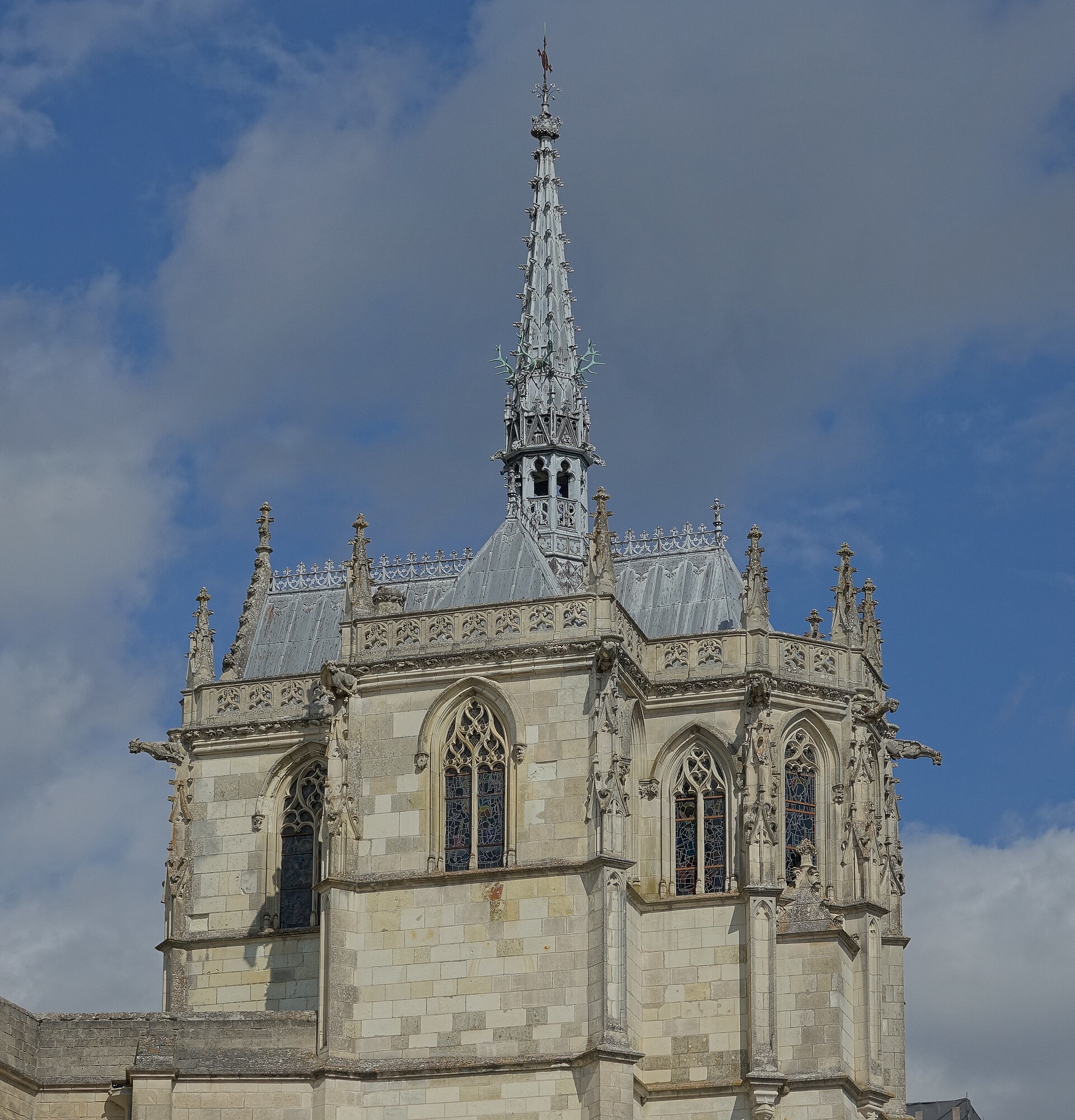
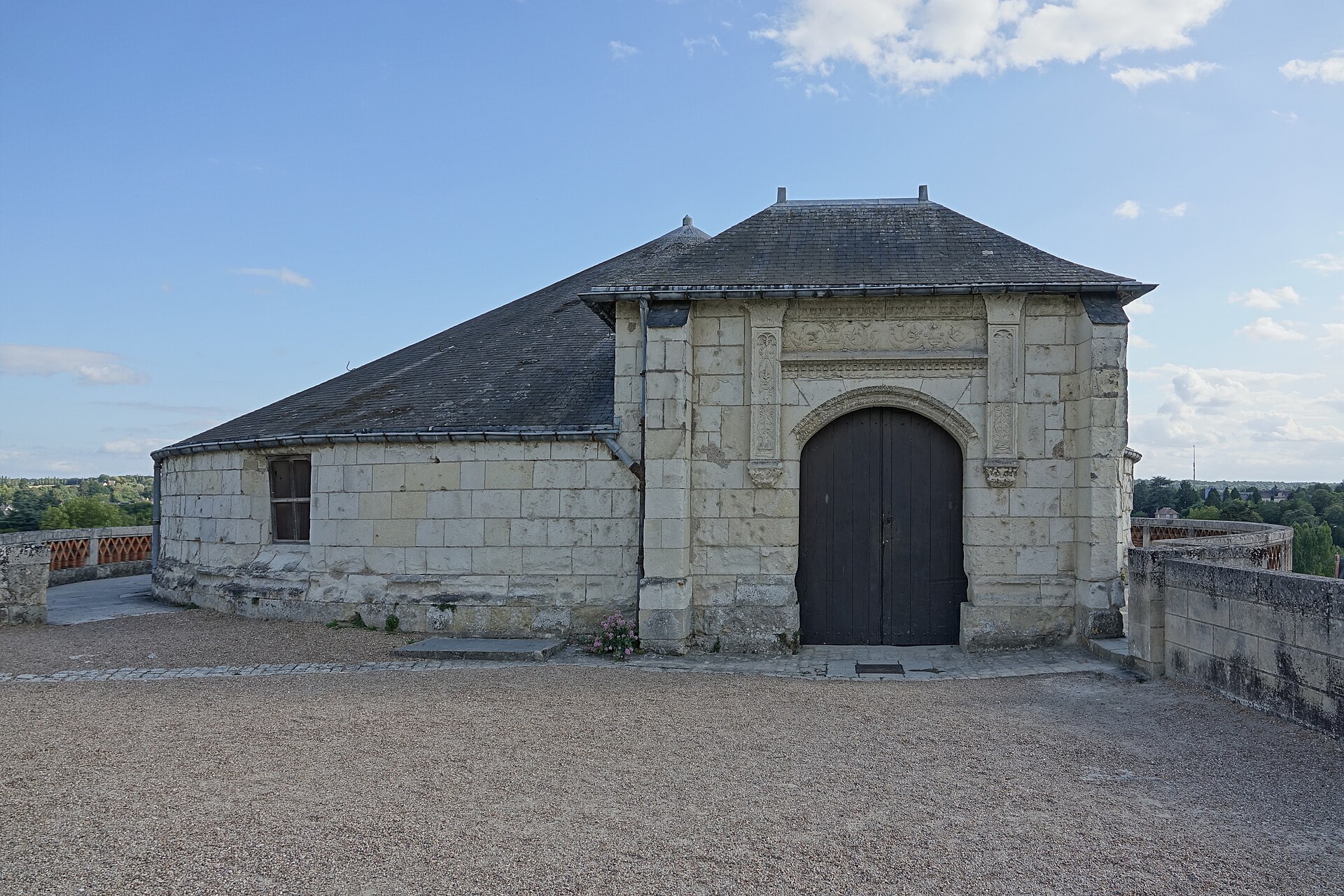
Perched on the very edge of the chateau’s terrace, overlooking the Loire, stands one of the loveliest small buildings in France: the Chapel of Saint-Hubert. This exquisite little Gothic gem, all delicate stone tracery and finely carved detail, was built in the late fifteenth century as a private oratory for the royal family, and it survives beautifully to this day, a jewel of late Gothic craftsmanship.
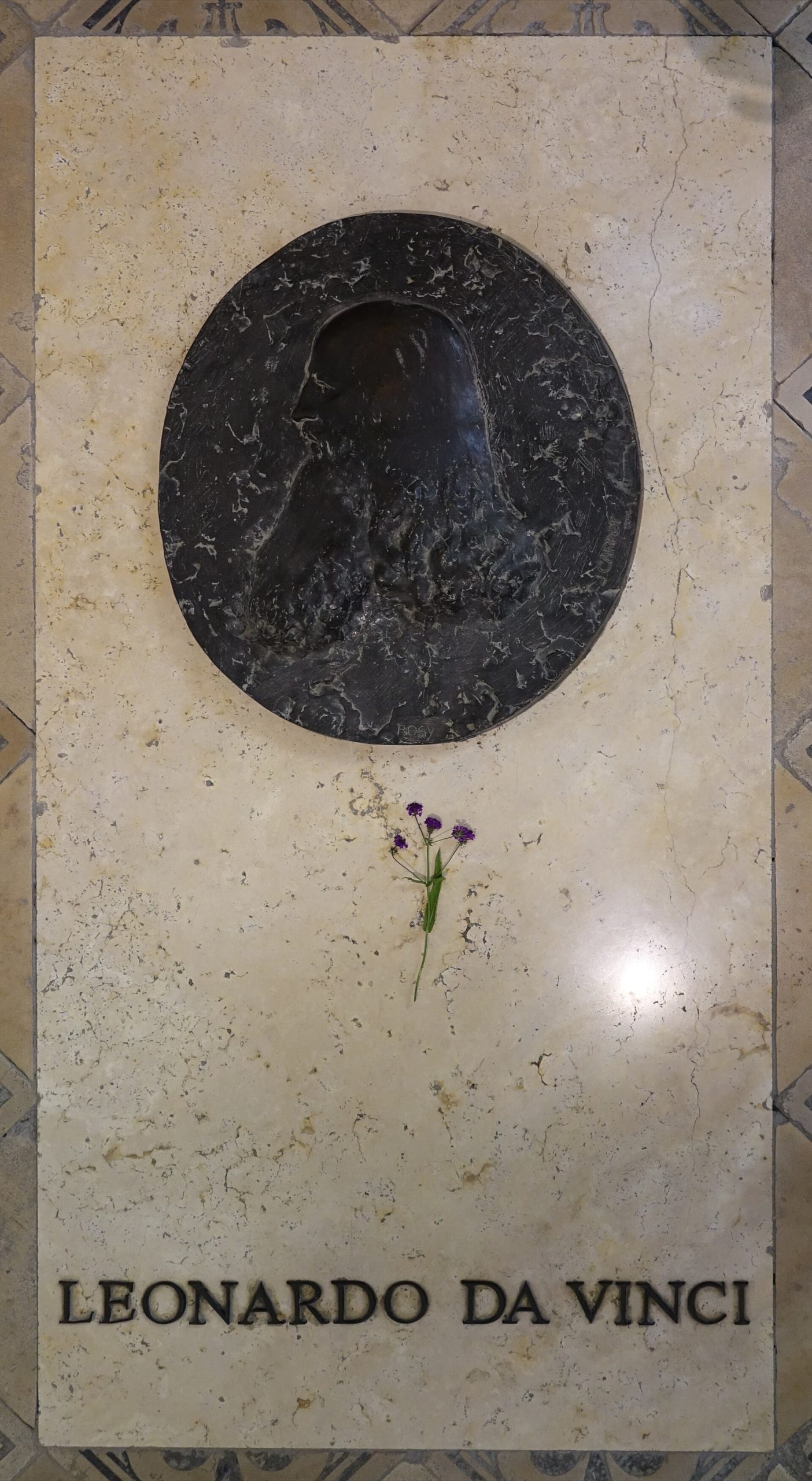
The chapel’s fame, however, rests above all on who is said to lie within it. Leonardo da Vinci was originally buried in a church at Amboise that was later destroyed, and his grave was lost. In the nineteenth century, bones believed to be his were recovered and, with great ceremony, reburied here in the Chapel of Saint-Hubert. A simple stone slab now marks the spot, and visitors from all over the world come to pay their respects to the greatest genius of the Renaissance.
Whether the bones beneath the slab are truly Leonardo’s can never be certain, but that hardly matters to the thousands who come each year. The chapel has become a place of pilgrimage, a quiet, beautiful spot where the memory of Leonardo is honoured above the river he knew in his final years. Small as it is, it may be the most visited and most moving corner of the whole chateau.
A Masterpiece of Carved Stone
It is worth lingering on the chapel itself, because it is a masterpiece in miniature. Built in the Flamboyant Gothic style, its exterior drips with pinnacles, gargoyles and lacy stonework, while above its doorway a superb carved lintel depicts scenes from the legend of Saint Hubert, the patron saint of hunters, whose vision of a stag with a crucifix between its antlers is rendered in wonderful detail.
Inside, the chapel is small but richly worked, its vaulted ceiling and delicate windows creating a space of great intimacy and beauty. Every surface seems to have been considered, and the quality of the carving reflects the wealth and taste of the royal family who worshipped here. It stands as a reminder that alongside the Italian Renaissance flooding into Amboise, the older French tradition of Gothic craftsmanship was still capable of producing work of breathtaking refinement.
The chapel’s position, right on the lip of the terrace with the river far below, only adds to its magic. From here the view stretches out over the rooftops of the town and the broad, gleaming Loire, a fitting resting place, real or supposed, for a man like Leonardo, who spent his life looking at the world more closely and more curiously than anyone before him.
The dedication of the chapel to Saint Hubert, the patron of hunters, was fitting for a royal residence where the chase was one of the great pleasures of court life. The kings and nobles who worshipped here rode out regularly into the surrounding forests, and the legend of the saint, converted by a vision while hunting, would have held a special meaning for them. Even in its sacred art, the chapel reflects the world of the court that built it.

The Great Ramps of the Horsemen
One of the most remarkable and unusual features of Amboise is hidden inside its two massive round towers, the Tour des Minimes and the Tour Heurtault. From the outside they look like ordinary defensive towers, but step inside and you find something extraordinary: instead of a staircase, each contains a broad, gently sloping spiral ramp, wide and smooth enough for horses and even carriages to climb.
These ramps solved a very practical problem. The chateau sits high on its rock, well above the town, and getting people, horses and supplies up to the terrace was no easy matter. The great ramps allowed riders to trot straight up from the streets below to the heart of the royal residence without ever dismounting, and carts to haul provisions directly to the kitchens and stores. It was an ingenious piece of engineering, blending the practical and the theatrical.
There is something wonderful about the idea of horsemen spiralling up through the thickness of a tower to emerge onto a terrace high above the Loire. The ramps turned the simple act of arriving into a kind of grand entrance, and they remain one of the most memorable things about a visit to Amboise, a clever and characterful solution that few other castles can boast.
The two towers were also, of course, part of the castle’s defences, their great bulk anchoring the walls and guarding the approaches from the town. The genius of their design lay in combining that defensive strength with the practical convenience of the ramps within, so that a single structure served both to protect the chateau and to ease the daily flow of life up and down its steep rock. It is a perfect example of Renaissance builders making a virtue of necessity.

Climbing the Tour des Minimes
The Tour des Minimes is the more famous of the two great ramp towers, and climbing its spiral is one of the highlights of any visit. As you wind upward through the tower’s core, the ramp curves gently around a central well, and you can easily imagine the clatter of hooves and the rumble of cartwheels that once echoed here as the business of a royal court flowed up and down its slope.
The tower was part of the ambitious building programme that turned the medieval fortress into a Renaissance palace, and it shows how cleverly the builders adapted the hard demands of the site. Rather than fighting the steep rock, they worked with it, threading a road up through solid stone so that the height of the chateau became an asset rather than an obstacle. It is engineering in the service of grandeur, exactly the sort of thing the Renaissance loved.
Emerging at the top, out onto the open terrace with the wind off the river and the great sweep of the Loire valley spread below, you understand at once why the kings of France loved this place. The climb through the tower builds the anticipation, and then the view delivers. Few castles stage the moment of arrival quite so brilliantly as Amboise does through its extraordinary horsemen’s ramp.
From the top of the tower, the defensive logic of Amboise also becomes clear. The chateau commands the river and the town in every direction, and it is easy to see why this rock has been fortified since ancient times. The same height that made the ramps necessary also made the site almost impregnable, so that the builders of the Renaissance palace inherited a position of tremendous natural strength on which to raise their works of beauty.
The Terrace and Its Kings
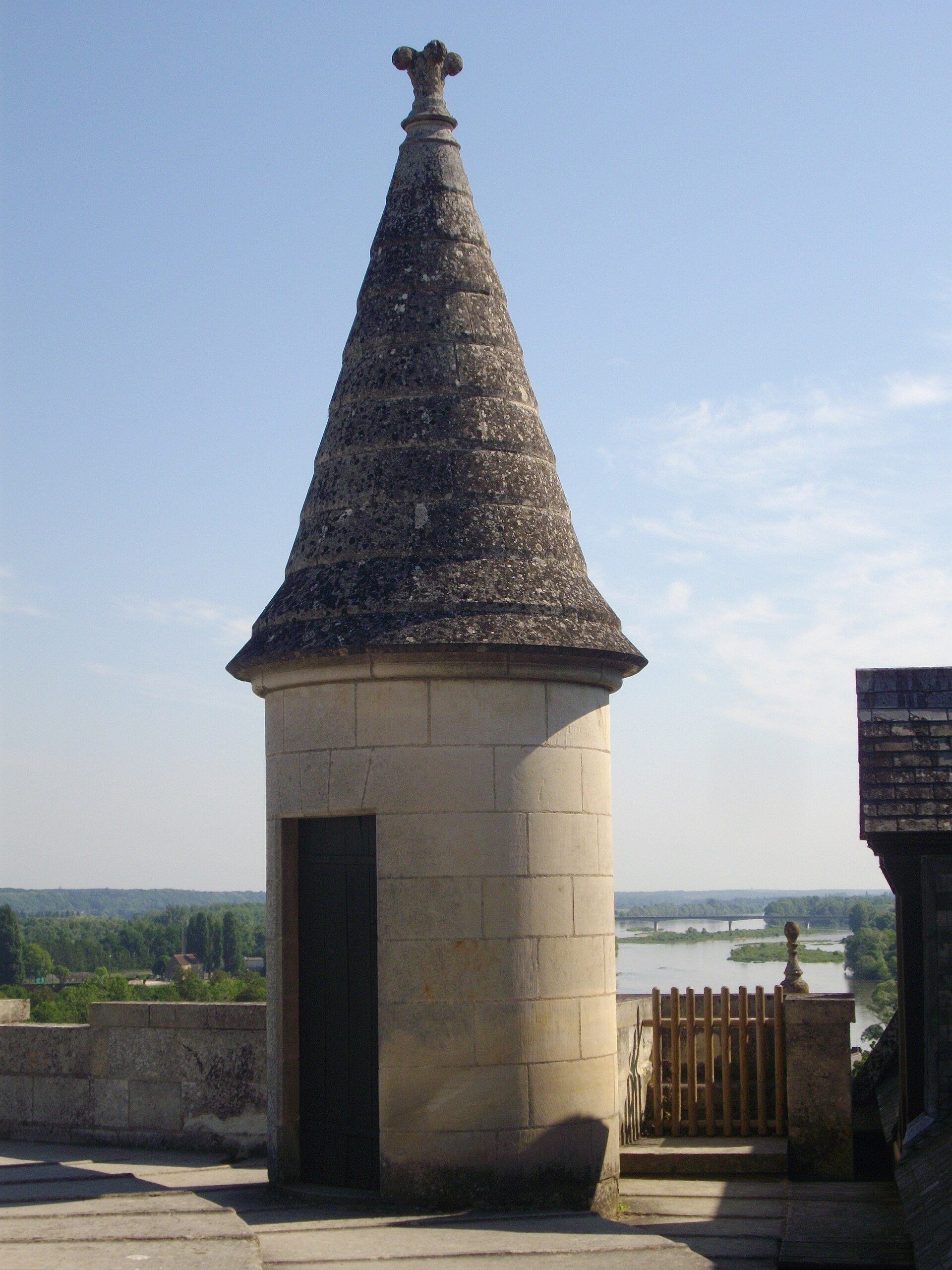
At the top of the ramps lies the great terrace, the open heart of the chateau, high above the river. In the days of the medieval fortress this whole area was covered with buildings, a dense complex of halls, lodgings and chapels crowded onto the rock. Much of it was demolished in later centuries, and today the terrace is a broad, airy space, but it is easy to picture the bustle of a royal court that once filled it.
From here the Heurtault tower guards the second of the great ramps, and the royal lodging stretches along the edge of the rock, its windows gazing out over the Loire. This was the setting for the festivities of François I, for the comings and goings of ambassadors and courtiers, and for the daily life of a court that stood at the very centre of French power during the golden decades of the Renaissance.
Standing on the terrace now, with the town at your feet and the river winding away into the distance, you feel the double nature of Amboise very clearly. It is at once a mighty fortress, planted on its rock for war, and a place of beauty and pleasure, opened up to the light and the view. The kings who walked here commanded both the river below and, for a time, the cultural life of a whole kingdom.
The loss of so many of the buildings that once crowded this space means that today’s visitors see a rather different Amboise from the one François I knew, more open and airy, with grass and trees where halls and lodgings once stood. Yet this very openness has its own beauty, and it allows the surviving buildings, and the tremendous views, to be appreciated all the more fully. The terrace remains the natural place to begin to understand the chateau and its setting.
The Amboise Conspiracy
Not all of Amboise’s history is golden. In 1560 the chateau was the scene of one of the most terrible episodes of the French Wars of Religion. France was bitterly divided between Catholics and Protestants, and a group of Protestant nobles, known as Huguenots, hatched a plot to seize the young king François II, who was staying at Amboise, and to remove the powerful Catholic family who dominated his government.
The conspiracy was betrayed before it could succeed. The plotters were rounded up as they converged on the chateau, and the reprisals that followed were savage. Over the following days, huge numbers of the conspirators were executed at Amboise in an orgy of violence meant to terrify the Protestant cause into submission. Men were hanged, beheaded and drowned, and, in the most notorious detail of all, bodies were hung from the very balconies and battlements of the chateau for all to see.
The court, including the young king and his family, is said to have watched the executions, and the horror of those days left a lasting stain on Amboise. The conspiracy and its bloody suppression did not cool the religious hatreds of France but inflamed them, helping to push the country into decades of ferocious civil war. The beautiful chateau of the Renaissance had become, for a moment, a place of mass killing.
The plot, sometimes called the Tumult of Amboise, was born of the deep frustration of French Protestants at their treatment under a government dominated by their Catholic enemies. The conspirators hoped not to harm the young king but to free him, as they saw it, from the grip of the Guise family, and to win toleration for their faith. Instead their failure handed the Guises an excuse for a crackdown of terrifying severity.
The scale and cruelty of the reprisals shocked even contemporaries hardened to violence. For days the chateau and the town became a place of public execution, the killings staged deliberately as a spectacle of power meant to cow the Protestant movement. Far from ending the conflict, the massacre poisoned relations between the two faiths still further, and within a few years France would descend into a series of religious wars that would tear it apart for a generation.
Decline and Survival
After its Renaissance heyday, Amboise slowly slipped from the centre of royal life. Later kings preferred other palaces, and the chateau was used less and less as a principal residence, though it remained crown property and served at times as a prison for important captives. Without a resident court to justify its upkeep, the vast complex of buildings on the rock gradually fell into decline.
The greatest losses came later still. During the upheavals that followed the French Revolution and into the Napoleonic era, much of the chateau was demolished, its stone sold or reused, so that only a fraction of the sprawling royal residence of François I’s day survived. What we see today, impressive as it is, is only a part of the far larger palace that once crowned the rock above the Loire.
Yet Amboise did survive, and in time it came to be cherished again as one of the most historic places in France. Restored and cared for, the surviving buildings, the great towers, the royal lodging and above all the chapel with its famous grave, still tell the story of the chateau’s extraordinary past. Battered by centuries of change, Amboise remains a place where the whole drama of the Renaissance can still be felt.
The demolition of so much of Amboise is one of the sadder chapters in the history of the Loire chateaux. Buildings that had witnessed the birth of the French Renaissance were pulled down for their materials or simply left to decay, and a royal residence that had once rivalled any in France was reduced to a fraction of its former size. It is a reminder that even the greatest monuments are fragile, and depend on each age choosing to value what the last one built.
That Amboise was eventually rescued owes much to a growing sense, from the nineteenth century onward, of the importance of France’s historic heritage. The reburial of Leonardo’s supposed remains in the Chapel of Saint-Hubert was part of this new reverence for the past, and it helped fix Amboise in the public imagination as a place of pilgrimage. Careful restoration since has ensured that what survived the age of demolition will now be preserved for the future.

Visiting Amboise Today
Today the Chateau d’Amboise is one of the most rewarding of all the Loire chateaux to visit, precisely because it packs so much history into one dramatic setting. From the terrace high above the river you can take in the great sweep of the Loire, explore the surviving royal apartments with their fine furnishings, wonder at the horsemen’s ramps inside the towers, and, of course, pay your respects at the reputed tomb of Leonardo da Vinci in the beautiful Chapel of Saint-Hubert.
The town of Amboise at the foot of the rock is a delight in itself, with its narrow streets, riverside walks and the nearby manor of Clos Luce, where Leonardo spent his final years and which can be visited to see reconstructions of his astonishing machines. Together the chateau and Clos Luce make Amboise one of the essential stops for anyone interested in the Renaissance, and a place where the presence of Leonardo still feels remarkably close.
You will find Amboise in the Indre-et-Loire department, in the very heart of the Loire Valley, easily reached from Tours and a natural companion to Chambord and Chenonceau on any tour of the region. For exact directions, here is a map link to guide you there: 47.4131, 0.9856. Standing on that terrace, with the river below and the chapel of Leonardo at your side, you are as close to the heart of the French Renaissance as anywhere in France can bring you.
The chateau is owned and run by a foundation dedicated to preserving it, and it hosts exhibitions, events and educational programmes throughout the year, keeping its long history alive for new generations. In the warmer months the gardens and terrace come into their own, offering some of the finest views anywhere along the Loire, and the whole site rewards a slow, unhurried visit rather than a rushed tour.
Castles Nearby
Where the Renaissance Took Root
Amboise is not the largest or the most extravagant of the Loire chateaux, but it may be the most important of them all. This was the place where the French Renaissance first took hold, where kings were born and died, where the young Francois I grew into the great patron of his age, and where Leonardo da Vinci chose to end his days. Its rock above the river has seen the very best and the very worst of the age, dazzling festivities and a terrible massacre alike.
To stand on its terrace is to stand at a crossroads of history, with the Loire flowing below and the small stone chapel of Leonardo close at hand. Much of the great palace is gone now, lost to the centuries, but what remains still speaks powerfully of a moment when France opened its arms to the art and genius of Italy, and a new world of beauty came flooding in. At Amboise, more than anywhere, you can feel the Renaissance being born.
You May Like
Mafra, the Palace a King Built From a Vow


One thought on “Château d’Amboise: Where the French Renaissance Was Born”