Walk across the wide stone bridge toward the Meridian Gate of Hue, and you feel the temperature of history drop a little. The moat is still, the citadel walls stretch away in both directions, and the yellow flag of the old empire snaps above the flag tower across the river. This is the Imperial City of Hue, the seat of the Nguyen emperors who ruled a unified Vietnam from 1802 until the middle of the twentieth century. For a country that spent so much of its modern life at war, this walled compound on the banks of the Perfume River is something rare, a place where the whole apparatus of a Confucian monarchy was gathered in one carefully ordered space.
You come here expecting a Vietnamese version of Beijing’s Forbidden City, and in some ways that comparison holds. The layout follows the same cosmological logic, the same nested rectangles of citadel, imperial enclosure, and forbidden inner sanctum. But Hue is smaller, greener, and marked by loss in a way the Chinese capital is not. Much of what once stood here was destroyed, and what you walk through today is partly restoration and partly quiet ruin, grass growing where great halls used to be. That mixture of grandeur and absence is the first thing that gets under your skin.
The Nguyen emperors chose this spot deliberately. Hue sits in the narrow center of Vietnam, a compromise capital between the older power centers of the north and the frontier lands of the south. Geomancers studied the river and the low mountains, and the whole city was aligned to bring the ruler into harmony with the landscape and the heavens. To understand Hue is to understand that a palace here was never just a residence. It was an instrument for keeping the cosmos in order, with the emperor as the single point where earthly and heavenly authority met.
Over the next sections you will move from the outer defenses inward, through the great ceremonial gate, into the throne hall where emperors were crowned, past the vanished palaces of the forbidden inner city, and out to the gardens, the ritual grounds, and the haunting music that UNESCO has worked to keep alive. By the time you leave through the same gate you entered, Hue will have stopped being a ruin on a map and become something closer to a living memory that Vietnam has decided, against considerable odds, to hold onto.

In This Article
- A Walled City on the Perfume River
- The Nguyen Emperors and a Unified Vietnam
- Walls, Moats, and the Flag Tower
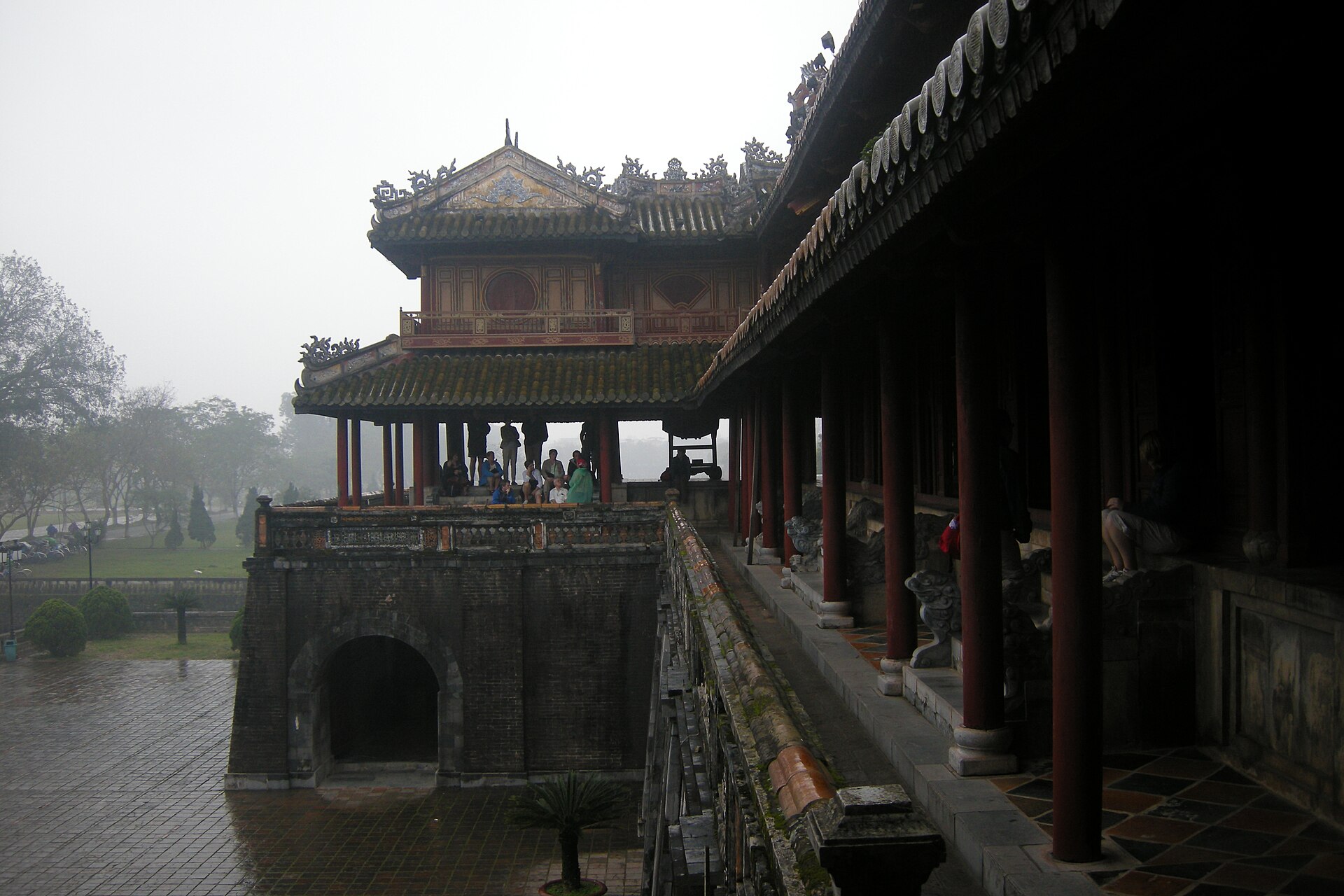
- The Meridian Gate: Ngo Mon
- The Palace of Supreme Harmony
- The Forbidden Purple City
- Halls of the Mandarins
- The Rhythm of Court Ritual
- Nha Nhac: The Music of the Court
- Gardens, Ponds, and Pavilions
- Destruction and the Long Work of Repair
- Treasures and Everyday Splendor
- Hue Today: A Heritage Reclaimed
A Walled City on the Perfume River
The first thing to grasp about Hue is that it is a city within a city within a city. The outermost ring is the Citadel, a vast fortified square with thick earth-and-brick walls, a wide moat, and ten gates. Inside that sits the Imperial City proper, the ceremonial and administrative heart. And nested deepest of all was the Forbidden Purple City, reserved for the emperor and his household alone. Each layer was more restricted than the last, and moving inward meant moving closer to sacred authority.
The scale surprises people. The Citadel walls run for kilometers, and within them once stood not only palaces but temples, gardens, libraries, workshops, and the homes of officials. This was a functioning capital, the administrative brain of an empire, not merely a royal retreat. When you stand at the center and turn slowly around, you are seeing the footprint of a whole vanished way of governing.
The Perfume River, which curls past the southern wall, is inseparable from the city’s identity. Its name comes from the aroma of flowers that once drifted downstream from orchards upriver in autumn. The emperors used the river for processions and pleasure, and its gentle presence softens the martial geometry of the walls. Hue without the river would be a fortress; with it, the place feels almost meditative.
The whole plan is oriented on a north-south axis, with the most important buildings facing south, the auspicious direction from which the emperor, seated like the pole star, received his court. This is Confucian city-planning imported from China and adapted to Vietnamese soil, and once you notice the axis you start reading the entire complex as a single deliberate composition rather than a scatter of monuments.
To visit is to walk that axis on foot, from the flag tower and the great gate, through the throne hall, and into the green emptiness beyond, where signboards mark the outlines of halls that no longer stand. It is a strange and moving kind of tour, part triumph and part elegy, and it rewards a slow pace and a willingness to imagine what the gaps once held.
Give yourself half a day at least. Hue rewards the visitor who lingers, who sits for a while in the shade of a gate and lets the scale of the place settle in. Rushing through in an hour, you will see a series of old buildings; walking slowly through a morning, you begin to feel the logic that binds them, the way the whole city was composed as a single argument about order, authority, and the proper relationship between an emperor and the heavens above him.
The Nguyen Emperors and a Unified Vietnam
The Imperial City belongs to the Nguyen dynasty, the last ruling family of Vietnam. Their founder, Gia Long, unified the country in 1802 after decades of civil war, bringing the northern and southern halves under a single throne for the first time in a durable way. He chose Hue as his capital and began building the citadel that you see today, drawing openly on the model of the Chinese imperial capital.

Gia Long and his successors ruled a Confucian state in which the emperor was the son of heaven, the moral center of the realm, responsible for the harmony between the human world and the cosmos. The court that filled these halls was organized by rank and ritual to an extraordinary degree, with mandarins graded into nine levels and every gesture of the ceremonial calendar prescribed in advance.
The most powerful of the early Nguyen emperors, Minh Mang, expanded and formalized the palace and the bureaucracy, tightening the state along strict Confucian lines. Under him the empire reached its widest extent and its most confident cultural expression, and much of the ceremonial machinery that Hue was built to house took its mature form.
Then came the French. From the 1880s Vietnam fell under French protection, and the emperors of Hue became increasingly hemmed in, sovereigns in name whose real power drained away to colonial administrators. The court continued its rituals inside the walls even as the country changed around it, giving the later dynasty a poignant, almost theatrical quality, majesty performed on a shrinking stage.
The line ended in 1945, when Bao Dai, the last emperor, abdicated as revolution swept the country. With him a thousand years of Vietnamese monarchy came to a close. The palace he left behind became a relic of a system that had suddenly, decisively ended, and the walls of Hue have carried that sense of a closed chapter ever since.
Walls, Moats, and the Flag Tower
The defenses of Hue are the work of a state that took security seriously. The citadel walls were built in a style influenced by the French military engineer Vauban, whose star-fort geometry had spread across the world, combined with older East Asian fortification. Thick, low, and backed by earth, they were designed to absorb cannon fire rather than simply tower over attackers.
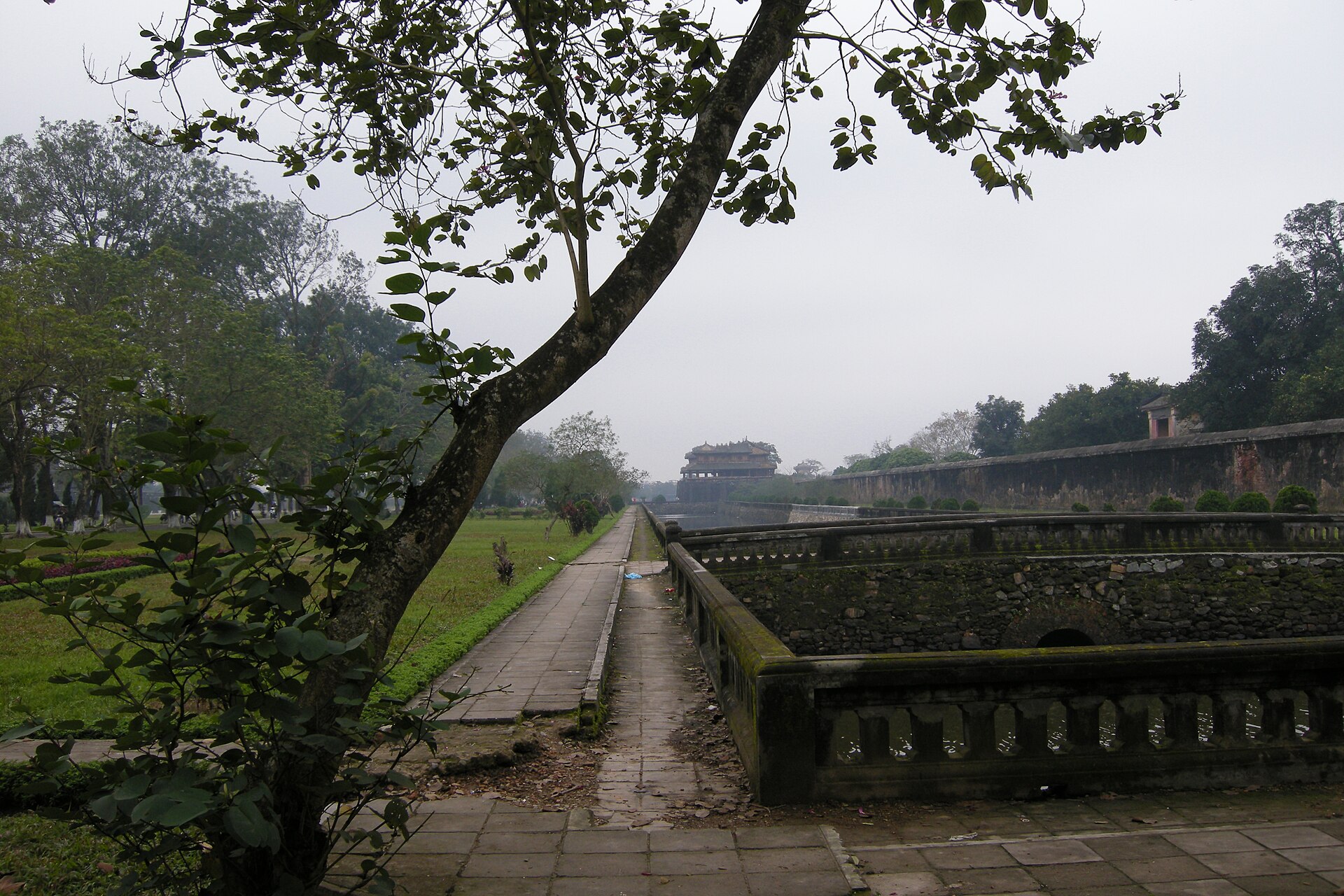
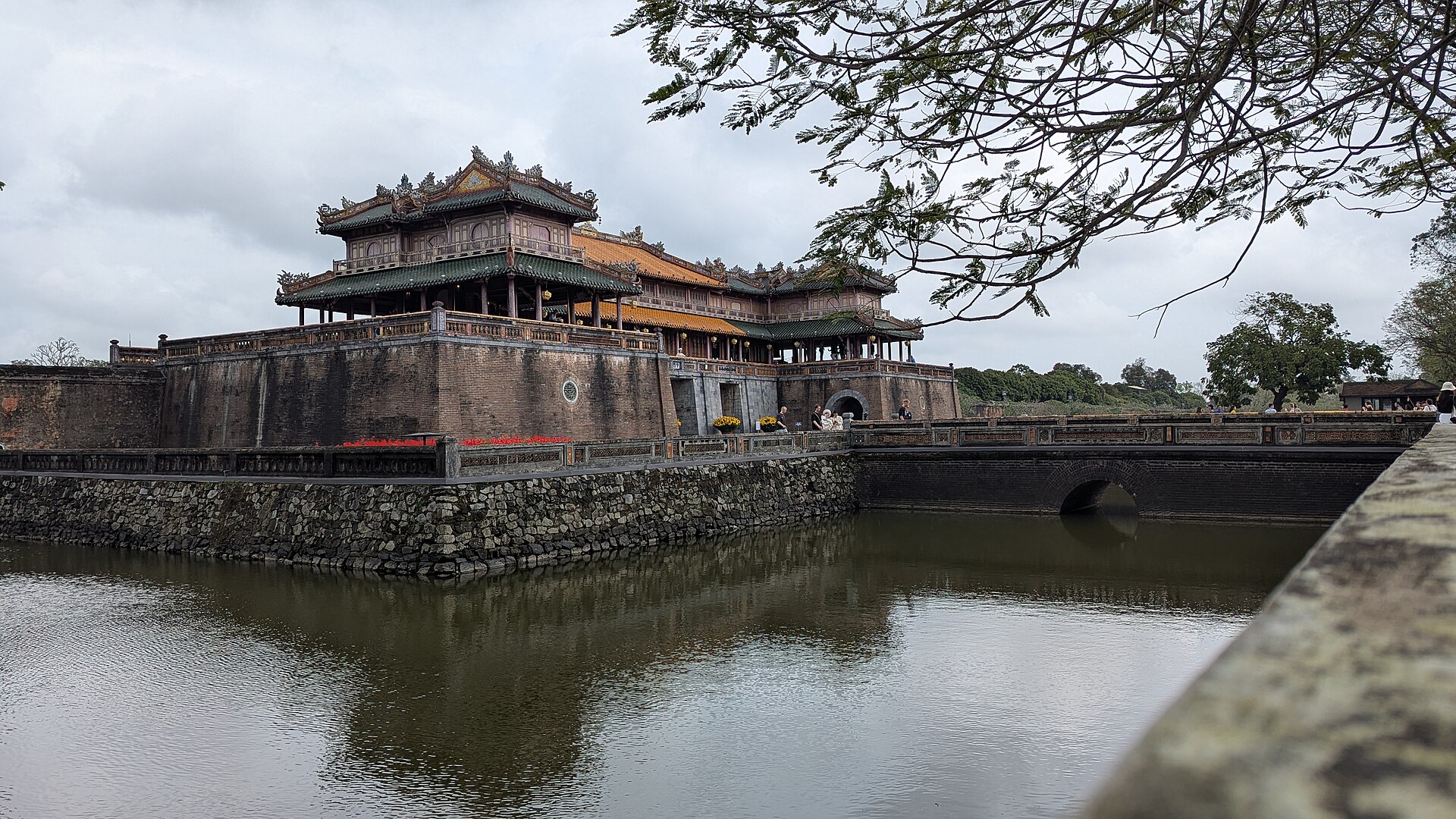
A broad moat rings the citadel, fed from the river, and crossing it you understand how serious a barrier this once was. The ten gates that pierce the walls were the only ways in, each controllable, each a checkpoint between the ordinary city and the imperial precinct. Walking through one today, under its heavy masonry, you pass from modern Hue into something older in a single step.
Facing the river stands the Flag Tower, a tall three-tiered brick platform that is one of the most recognizable landmarks in the country. The enormous flag that flies from it can be seen from far across the water, and control of that flagpole has been a symbol of political power in Hue through every upheaval of the modern era, from dynasty to colony to war to republic.
Between the flag tower and the main gate lies a great open esplanade where the emperor’s soldiers once paraded and where cannon were displayed. Nine sacred cannon, cast early in the dynasty and named for the seasons and the elements, still rest near the gates as guardian figures, never meant to be fired, only to stand watch over the realm.
The overall impression from outside is of restrained, purposeful strength. Hue does not overwhelm you with height the way a European fortress might. Its power is horizontal, spread along the walls and the water, a statement that the empire meant to endure by patience and order as much as by force.
The Meridian Gate: Ngo Mon
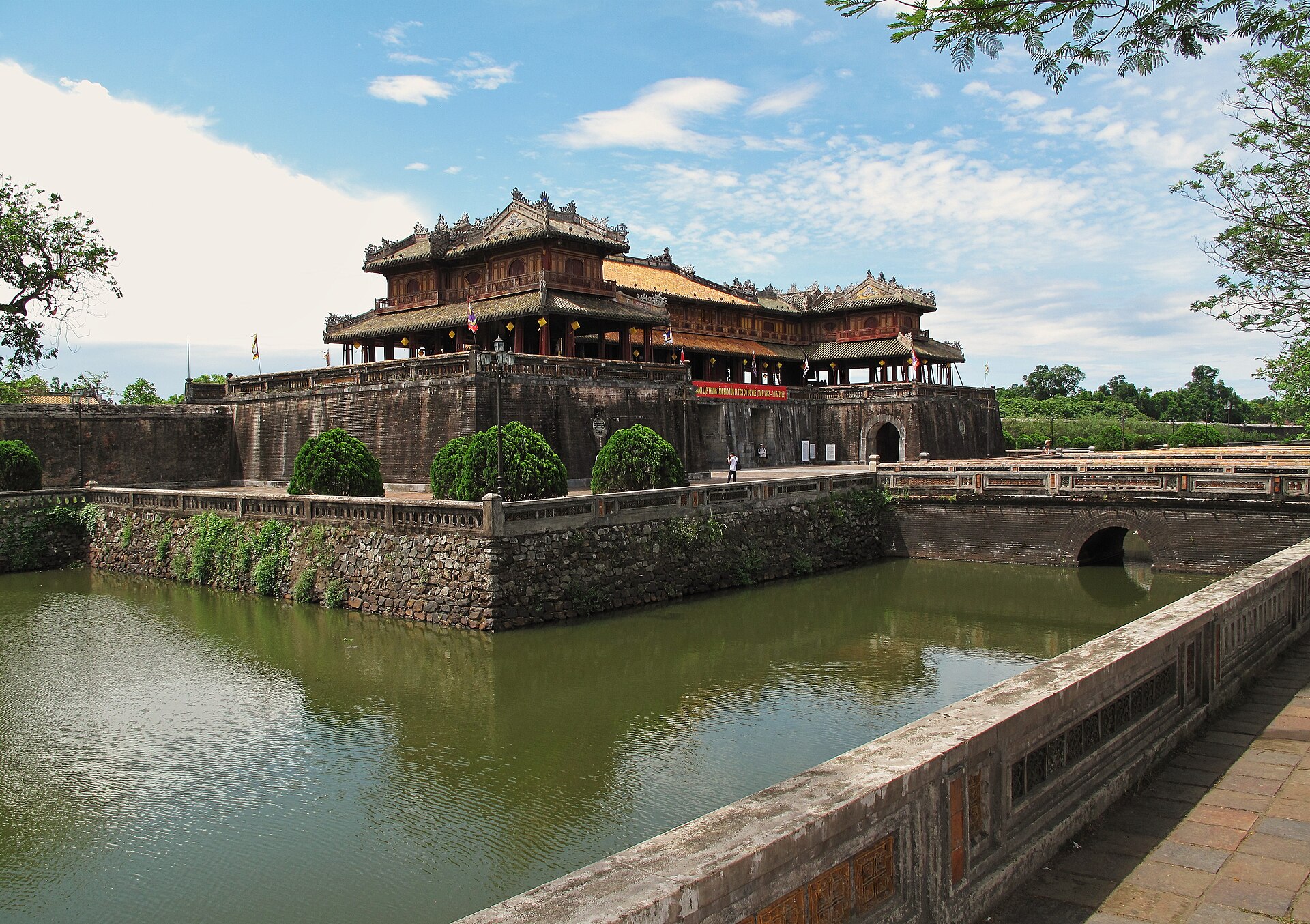
The grand entrance to the Imperial City is the Meridian Gate, called Ngo Mon, and it is the single most photographed structure in Hue. A massive stone base is pierced by five passages, the central one reserved for the emperor alone, and atop it sits an elegant wooden pavilion with sweeping tiled roofs known as the Belvedere of the Five Phoenixes.
The five openings were a strict hierarchy made architecture. The emperor used the center; civil and military mandarins used the flanking gates; the outermost passages were for soldiers, horses, and elephants. Simply by watching who walked through which arch, an observer could read the entire rank structure of the court.
From the pavilion above, the emperor presided over great ceremonies staged on the esplanade below. It was here that the lunar new year was proclaimed, that the calendar was announced to the realm, and that the results of the highest civil service examinations were read out, sending scholars home as officials of the empire.
The gate also witnessed the dynasty’s final act. It was on a balcony of Ngo Mon that Bao Dai abdicated in 1945, handing over the imperial seal and sword and formally ending the monarchy. The very structure built to display the emperor’s supremacy became the stage for its dissolution, which gives the place a double weight when you stand beneath it.
Restored and cared for, Ngo Mon today is the threshold every visitor crosses, and it still does its old work of framing what lies beyond. Passing through it, you leave the world of walls and moats and enter the ceremonial heart of the empire, exactly as the design intended.
The Palace of Supreme Harmony
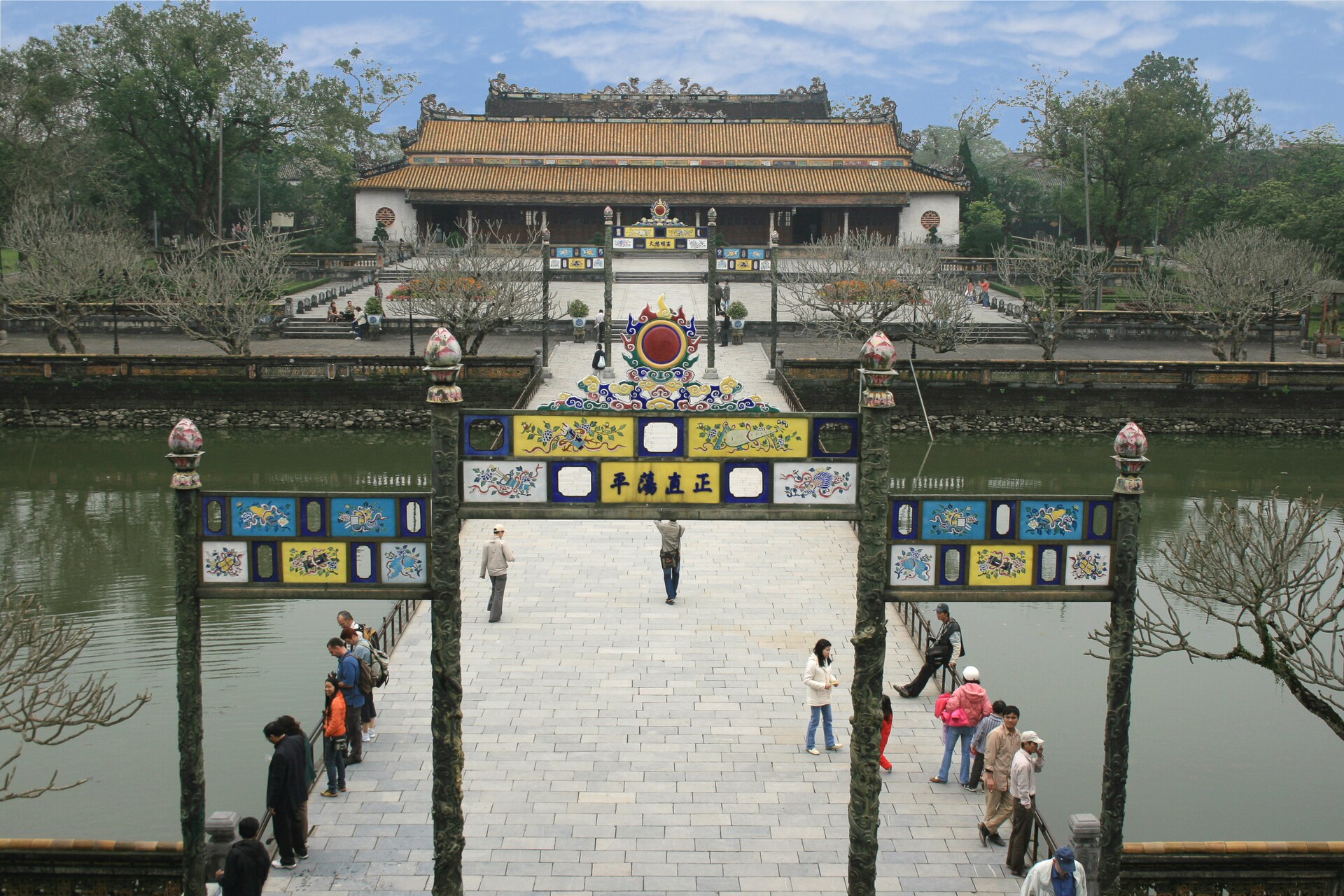
Beyond the gate, across a courtyard and an ornamental bridge, stands the Thai Hoa Palace, the Palace of Supreme Harmony. This was the throne hall, the most important building in the empire, where the emperor held his grand audiences seated on a raised golden throne beneath a canopy, facing south down the central axis of the whole city.
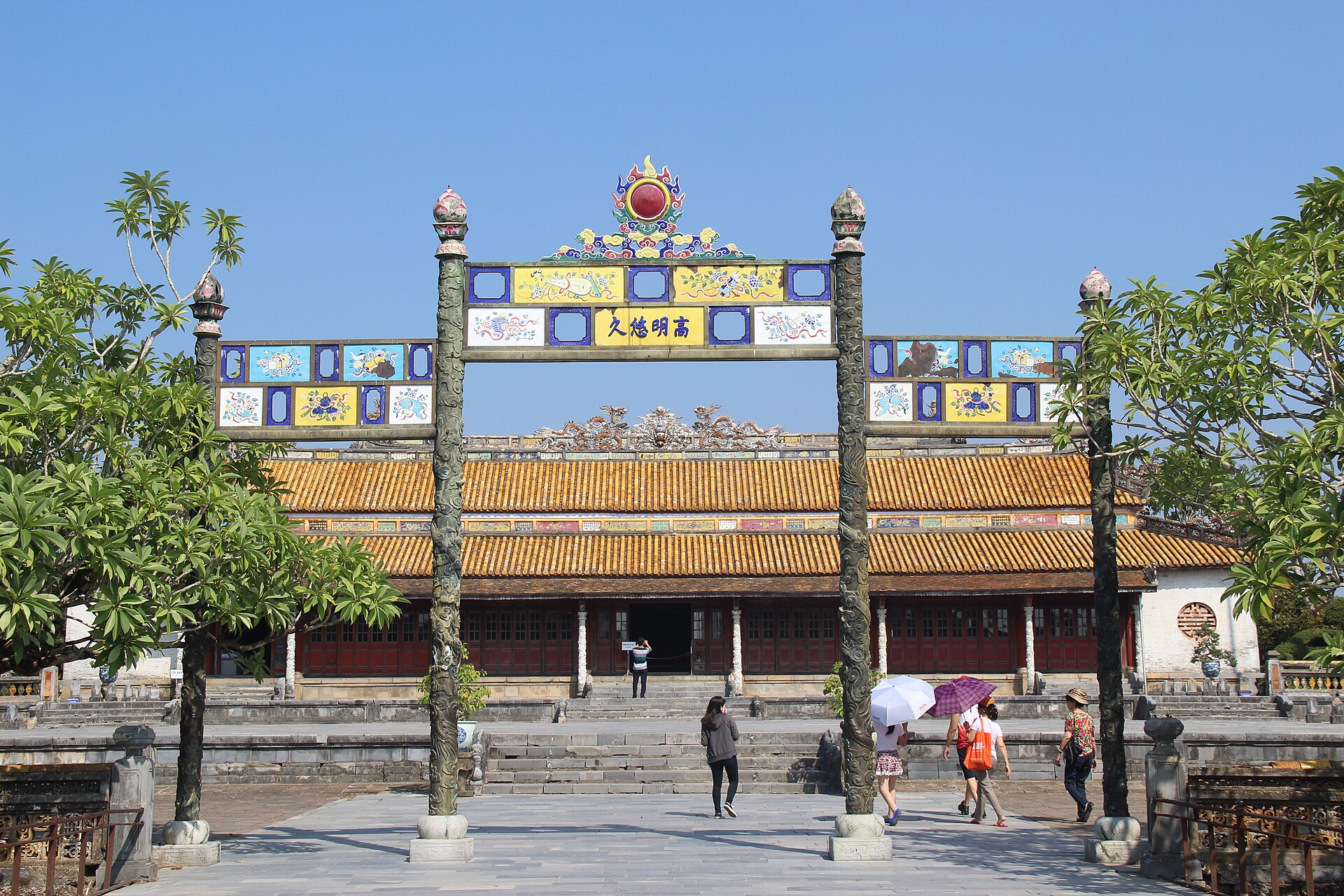
The hall is a masterpiece of Vietnamese timber craft. Dozens of ironwood columns, lacquered a deep red and wound with gilded dragons, hold up an intricate roof. The dragon, symbol of imperial power, is everywhere, coiling up the pillars and spreading across the beams, so that the emperor sat quite literally within a forest of his own emblem.
In the courtyard outside stand rows of small stone stelae marking where mandarins of each rank were to position themselves during ceremonies, the highest nearest the throne, the lowest farthest away. On the great ritual days the whole graded body of officials would assemble here in their robes and prostrate themselves toward the hall in a choreographed display of the Confucian order.
Poems and inscriptions in classical Chinese characters decorate the interior, a form of literary decoration in which each panel carries a couplet praising the dynasty or invoking harmony and long life. This union of poetry, painting, and architecture is a distinctive feature of Nguyen court taste, and scholars still study the verses as a record of the dynasty’s ideals.
Thai Hoa is one of the best-preserved structures in the complex, and stepping inside gives you the clearest sense available of what the working empire felt like. Cool, dim, and heavy with red and gold, the hall still holds the hush of a space designed to make a mortal ruler seem like the fixed center of the turning world.
Photography is restricted inside the throne hall, and that restriction, whatever its practical reason, has an unexpected effect. Without a camera between you and the space, you are forced to simply look, to take in the red columns and the gilded dragons and the throne itself with your own eyes. It slows you down, and in the slowing you catch something of the reverence the hall was built to command, a hush that no photograph could carry home with you anyway.
The Forbidden Purple City
Behind the throne hall lay the most private and most sacred zone of all, the Forbidden Purple City, the residential heart reserved for the emperor, his empress, his concubines, and the eunuchs and servants who attended them. Its name echoed the Purple Forbidden City of Beijing, and like its model it was closed to almost everyone in the realm.

Here stood the emperor’s living quarters, the halls where he dined and rested, the residences of the imperial women, the kitchens, the libraries, and the theaters. This was where the private life of the dynasty was lived, hidden from the court and the country, a world of ritual and intrigue that ordinary subjects could only imagine.
And this is where Hue’s great tragedy is most visible, because most of the Forbidden Purple City is simply gone. What was once a dense quarter of palaces and courtyards is now largely open ground, marked by foundations, fragments of wall, and signboards describing buildings that no longer exist. Grass and trees have claimed much of the space.
Walking here is the emotional low point and, strangely, the high point of a visit. The emptiness forces you to reckon with how much was lost, and the surviving details, a carved balustrade, a tiled roof gate, a stretch of decorated wall, become precious precisely because so little remains around them. The absence does more work than any intact hall could.
Restoration is slowly bringing pieces of it back. A few structures have been rebuilt using old photographs and traditional techniques, and the reconstructed royal theater lets visitors glimpse the entertainments of the court. But much will never return, and Hue has largely chosen to conserve the ruin honestly rather than to invent a complete fantasy of what once stood.
Local guides often carry old black-and-white photographs of the Forbidden Purple City as it was, and if you can find one, the images transform your walk. Held up against the empty ground, they show dense rooftops and busy courtyards where you see only grass, and the gap between the picture and the view in front of you becomes the truest exhibit in all of Hue, a measure of loss that no wall label could ever state so plainly.
Halls of the Mandarins
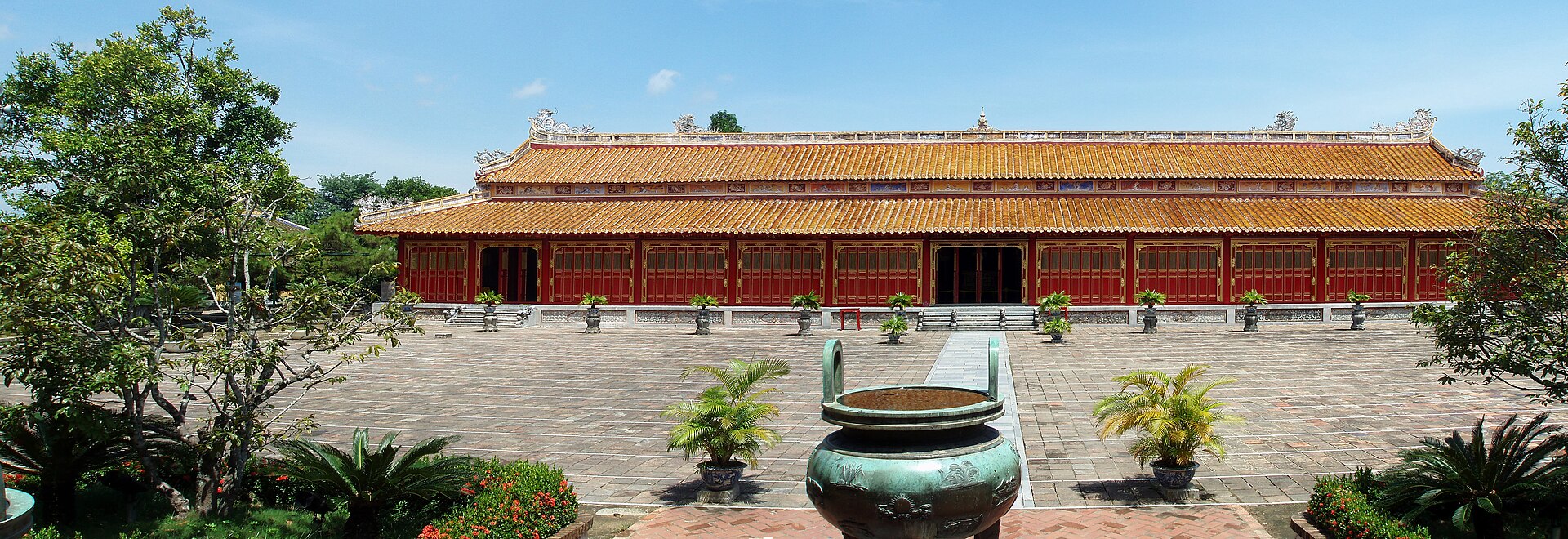
Flanking the ceremonial axis are the halls where the machinery of government actually ran. The Halls of the Mandarins, on either side of the throne palace, were where officials prepared for audiences, changed into their court robes, and waited to be summoned. These were the offices and antechambers of a working bureaucracy.

The Nguyen state was run by scholar-officials selected, in the Confucian ideal, through rigorous examinations in the classics. A young man who mastered the ancient texts could rise from an obscure village to a high post at Hue, and the mandarins who filled these halls were the products of that system, a meritocratic elite bound together by a shared literary education.
Their world was one of exacting protocol. Rank was shown in the color and decoration of robes, in the insignia badges worn on the chest, in the precise depth of a bow and the exact spot on which one stood. To serve here was to inhabit a code so detailed that a single error of etiquette could end a career.
Some of these buildings now house exhibitions and restoration workshops, and one of them contains displays about the painstaking conservation work that keeps the whole site standing. Watching artisans repair lacquer and carve replacement timbers, you see that the mandarins’ successors, in a sense, are the craftspeople who now tend their halls.
The mandarin halls remind you that Hue was not only theater and ritual but also paperwork, decisions, and administration. Behind every grand ceremony lay a vast effort of governance, and these relatively modest buildings are where that unglamorous, essential work was done.
The Rhythm of Court Ritual
Life at Hue was governed by a dense calendar of ceremonies, each timed to the lunar year and each meant to keep the empire in harmony with heaven. The greatest of these was the Nam Giao sacrifice, in which the emperor traveled to a special esplanade south of the city to offer sacrifice to heaven and earth, a rite that only he, as the son of heaven, was permitted to perform.
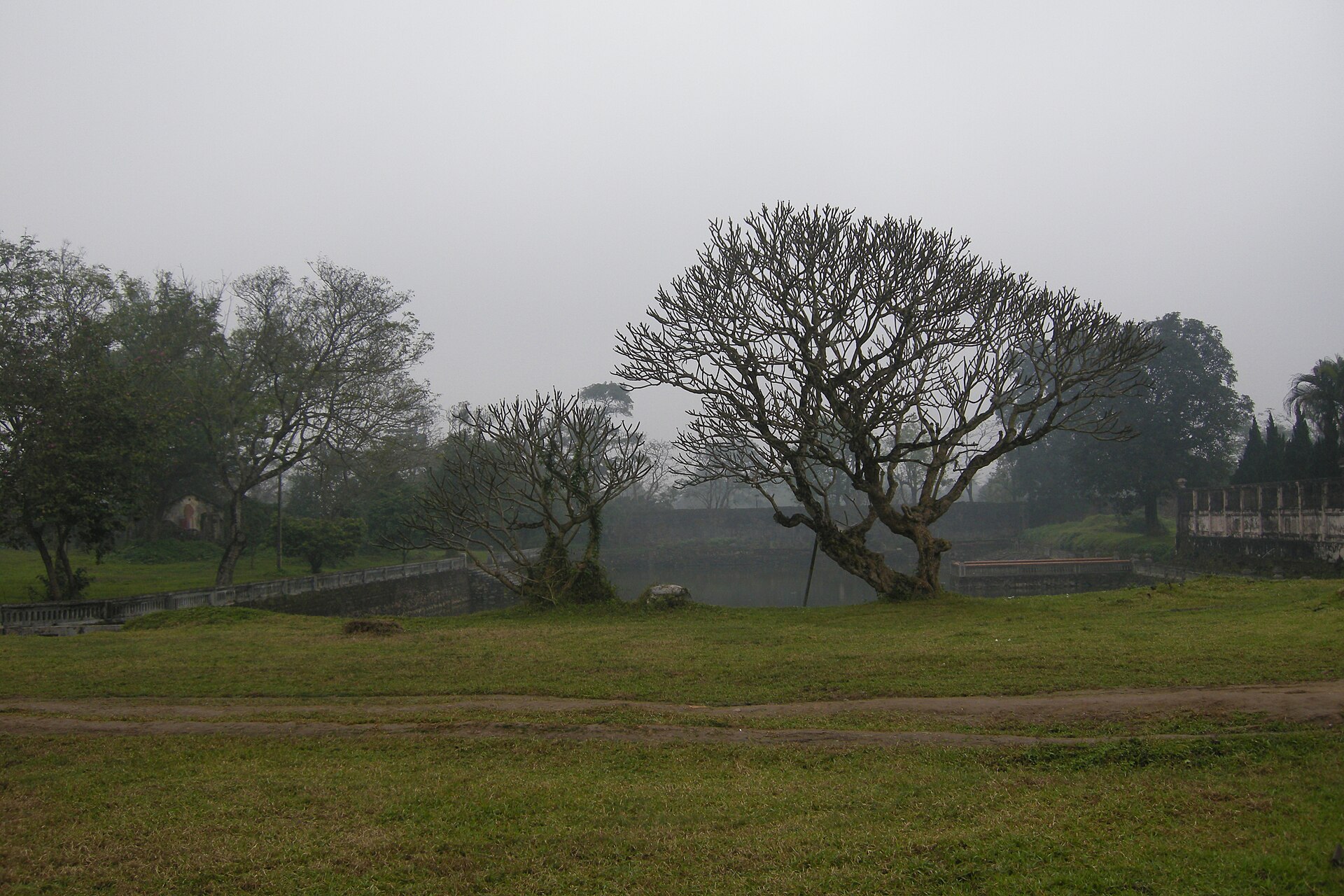
The Nam Giao ceremony was the supreme expression of the emperor’s cosmic role. For days beforehand he fasted and purified himself, and on the appointed night he ascended a three-tiered altar, round above and square below to mirror heaven and earth, to pray for the welfare of the realm. The whole state held its breath around this single act of communion.
Within the palace, lesser rites filled the year. There were ceremonies to mark the new year, to honor the imperial ancestors in their temples, to celebrate the emperor’s birthday, and to receive foreign envoys. Each had its prescribed music, costume, and choreography, and the court existed in large part to perform them correctly.
Ancestor worship was central. The dynasty maintained temples within the citadel where the tablets of past emperors were venerated, and the reigning ruler’s legitimacy flowed in part from his faithful service to these forebears. To govern well was, in this worldview, to honor the dead properly and so keep their favor.
For a visitor, understanding this ritual calendar transforms the empty courtyards. Those wide paved spaces were not decorative; they were stages built to hold hundreds of officials in precise formation on the great days. The stillness you find now is the silence of a theater between performances that will never resume.
Nha Nhac: The Music of the Court
No account of Hue is complete without its music. Nha Nhac, meaning elegant music, was the ceremonial court music of the Nguyen dynasty, performed at sacrifices, audiences, and festivals. It is a sophisticated tradition of orchestras and voices, of stately melodies designed to accompany ritual and to embody the dignity of the throne.
The ensembles combined a wide range of instruments, drums and gongs, stringed instruments, flutes, and oboes, in a texture that could be both grand and delicate. Different ceremonies called for different repertoires, and the musicians of the court, like everyone else in this world, worked within a strict framework of what was appropriate to each occasion.
When the monarchy fell, this music nearly died with it. Deprived of the court that had sustained it, and battered by decades of war and upheaval, Nha Nhac survived only in the memories of aging performers and a handful of dedicated musicians who kept the tradition barely alive through hard years.
Its revival is one of Hue’s quiet triumphs. In 2003 UNESCO recognized Nha Nhac as a Masterpiece of the Oral and Intangible Heritage of Humanity, and that recognition brought resources and prestige that helped a new generation learn the old repertoire. Today you can hear it performed again within the palace grounds.
Sitting in a restored pavilion while an ensemble plays, you get something no ruin can give you, a living thread back to the vanished court. The music was made to fill these spaces, and for the length of a performance the empty halls of Hue seem to remember what they were built for.
Gardens, Ponds, and Pavilions
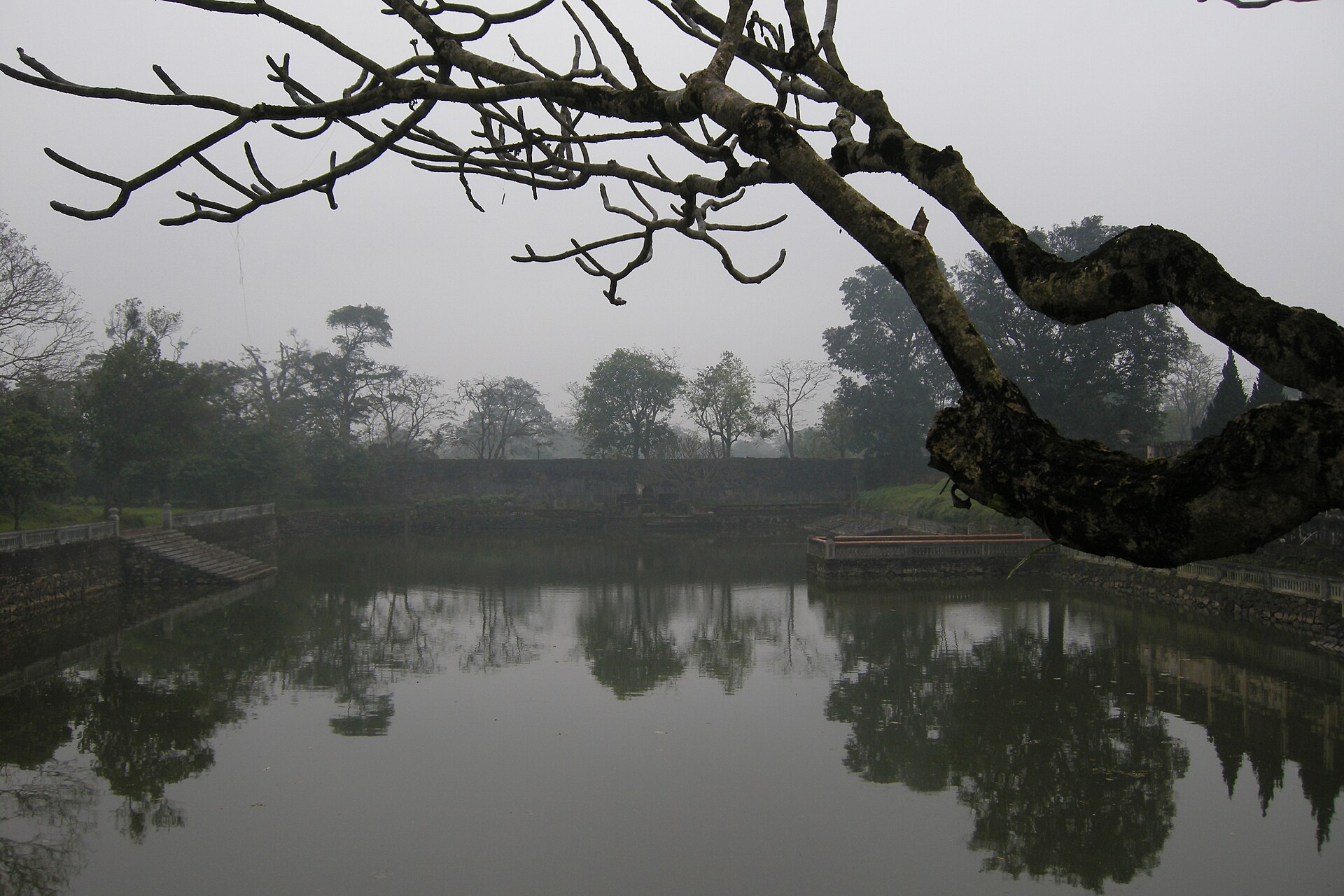
For all its ceremonial rigor, Hue was also a place of gardens and water, designed to give the court beauty and repose. Ornamental ponds, planted with lotus, mirror the pavilions that stand beside them, and old trees shade courtyards that would otherwise bake under the central Vietnamese sun.

The garden aesthetic here draws on East Asian ideals in which a designed landscape is meant to compress the whole natural world into a small, contemplative space. Rocks stand in for mountains, ponds for seas, and carefully placed pavilions offer framed views meant to be savored slowly, as one might read a poem.
Among the loveliest structures is a small library pavilion set among greenery, where emperors could read and reflect away from the weight of ceremony. Such buildings show the other side of Nguyen court life, the cultivation of literature, calligraphy, and quiet scholarship that the Confucian ideal prized as highly as good government.
Water is a constant presence, from the great moat to the small lotus ponds, and it does more than please the eye. In the geomantic thinking that shaped the city, water carried and balanced vital energy, so these ponds were part of the same cosmic engineering as the walls and the axis, beauty and belief working together.
After the intensity of the throne hall and the melancholy of the ruins, the gardens offer a gentler register. They are where the human scale of the place reasserts itself, and where you can most easily imagine an emperor as a person rather than a symbol, walking beside the lotus in the cool of the morning.
Destruction and the Long Work of Repair
The wounds that give Hue its haunted quality are recent. The complex suffered damage during the French reconquest in the late 1940s, but the catastrophe came in 1968, during the Tet Offensive, when the Citadel became the site of one of the fiercest battles of the Vietnam War. For weeks the fighting raged through these walls.
The destruction was immense. Artillery and air strikes, street fighting through the imperial precinct, and fire consumed a great many of the historic structures, especially in the Forbidden Purple City. Much of what had survived the previous century of colonial neglect was lost in those few weeks of concentrated violence.
For years afterward the site lay damaged and largely untended, its significance uncertain in a country focused on survival and reunification. To some it was a symbol of a feudal past that the revolution had swept away, and there was little appetite or means to restore a fallen dynasty’s palace.
Attitudes changed. In 1993 the Complex of Hue Monuments was inscribed on the UNESCO World Heritage List, an international recognition that reframed the ruins as a treasure of world culture rather than an embarrassment of the old regime. That listing unlocked funding, expertise, and a sustained program of conservation.
The work continues today, patient and painstaking. Craftspeople rebuild timber halls, restore lacquer and gilding, and stabilize what remains, guided by old photographs and traditional methods. Hue will never be whole again, but the long labor of repair has turned it from a forgotten ruin into a site actively reclaimed, wound by wound.
It is worth pausing to remember that the 1968 battle was fought by people, on both sides, among these monuments, and that the destruction was not an accident of nature but a consequence of human decisions. Hue therefore stands as a war memorial of an unusual kind, one that mourns not soldiers alone but a shared cultural inheritance caught in the crossfire, and that quietly argues for the value of protecting such places even, or especially, in the worst of times.
Treasures and Everyday Splendor
Scattered through the complex and in the nearby royal museum are the surviving objects of court life, and they repay close attention. There are thrones and palanquins, ceremonial robes heavy with embroidery, gilded ritual vessels, and the fine porcelain, some of it made to imperial order abroad, that graced the emperor’s table.
The craftsmanship reflects a court that drew the finest artisans in the land to its service. Nguyen decorative art has a distinctive vocabulary, dragons and phoenixes, stylized clouds and waves, and an intricate technique of embedding fragments of glass and porcelain into plaster to create shimmering mosaic surfaces on roofs and walls.
Costume and insignia tell the story of rank and ritual. The emperor’s own robes, in the sacred yellow reserved for him alone, were embroidered with dragons and cosmological symbols that turned the wearer into a walking diagram of his role. The graded robes of the mandarins spelled out the whole hierarchy in color and emblem.
Everyday objects can be as moving as the grand ones. A writing set, a tea service, a musical instrument, these bring the human texture of court life closer than any throne. You begin to picture the people who used them, the scholars and servants and royal women whose days were spent within these walls.
Seen together, the surviving treasures resist the sense of total loss that the empty courtyards can create. They prove that Hue was not only about power and ceremony but about beauty made by human hands, and that a great deal of that beauty, against the odds, has come down to us intact.
Hue Today: A Heritage Reclaimed
Today the Imperial City is the centerpiece of a UNESCO World Heritage site and the pride of the city that grew up around it. Visitors from across Vietnam and the world walk its axis daily, and the revenue and attention they bring help fund the continuing restoration, so that the crowds are, in a sense, part of the machinery keeping the place alive.
View the exact location on Google Maps
For Vietnamese visitors the site carries a complicated charge. It represents a monarchy the revolution rejected, yet also a period of national unity and a high point of the country’s art and culture. Many come to reconnect with a heritage that the twentieth century nearly erased, and the yellow imperial flag over the tower has become a point of pride rather than shame.
The city of Hue leans into this identity. Festivals stage reenactments of court ceremonies, performances of Nha Nhac fill restored pavilions, and the wider landscape of royal tombs along the Perfume River draws travelers into the full world of the Nguyen. The palace is the anchor of a heritage economy that has given the city a distinct place in modern Vietnam.
What stays with you is the honesty of the place. Hue does not pretend to be undamaged. It lets you see the ruins alongside the restored halls, the emptiness alongside the splendor, and in doing so it tells a truer story than a perfectly reconstructed palace ever could, about grandeur, about war, and about the choice to remember.
Leaving across the bridge over the moat, with the flag tower behind you and the Perfume River sliding past, you carry away a sense of a nation deciding what to keep. Hue could have been left to the grass. Instead Vietnam chose to hold onto it, ruins and all, as a place where the country can stand face to face with its own long, difficult, and deeply human past.
If your visit allows, come back at dusk, when the day tourists have gone and the light turns the old walls amber. In the quiet you can hear the river and the wind in the trees, and the palace settles into itself. That is the hour when Hue stops being a site to be seen and becomes a place to be felt, a walled garden of memory in the middle of a busy modern city that has, remarkably, decided it is worth keeping.
Palaces Nearby
Hue belongs to a wider Asian world of royal cities well worth exploring. Cross the sea to the living Javanese court of the sultans, or climb north to the great fortress-palace of the Dalai Lamas on the roof of the world.
You May Like
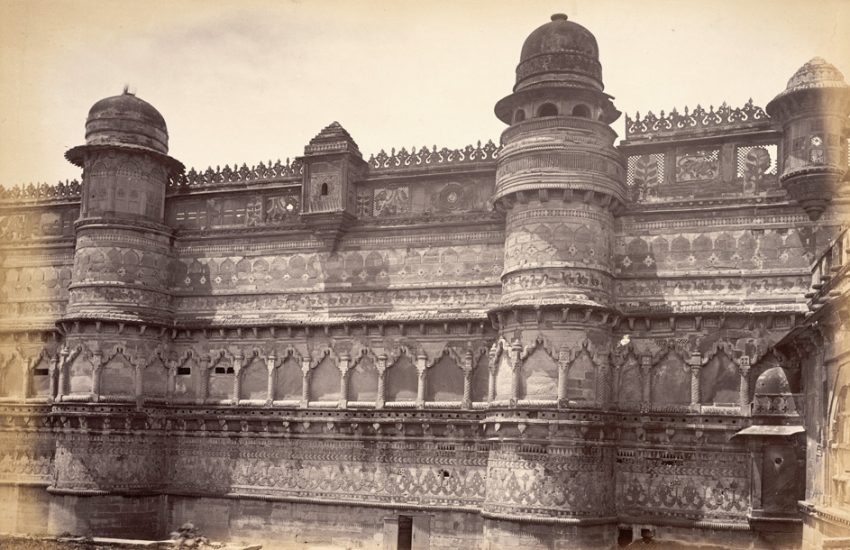
The Palaces of Orchha: A Bundela Capital on the Betwa