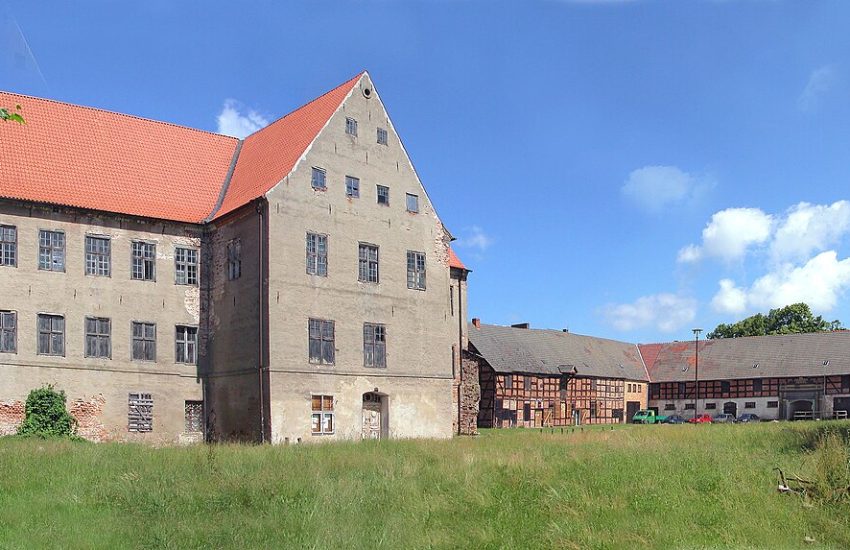
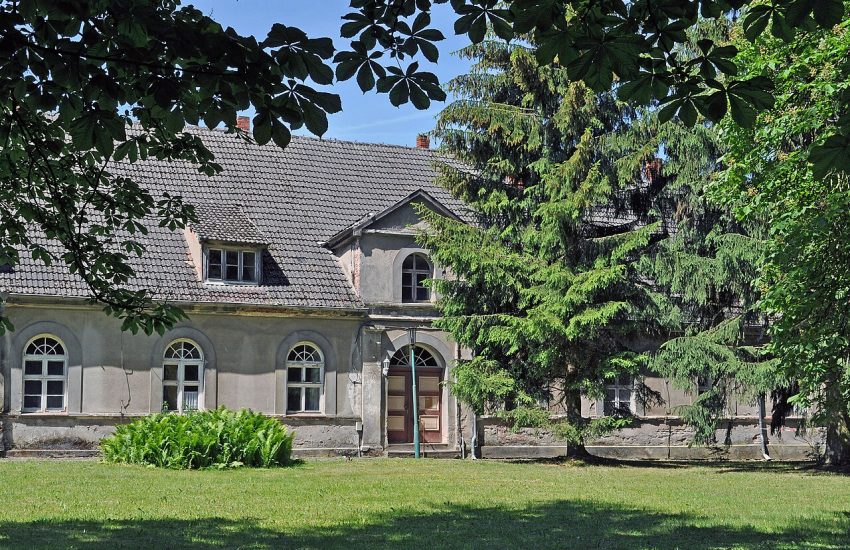
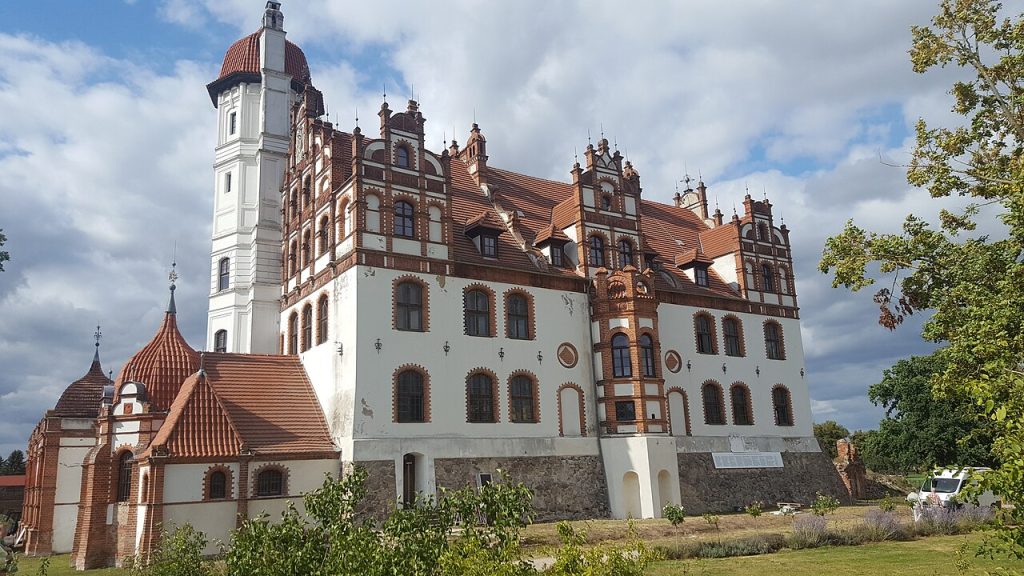
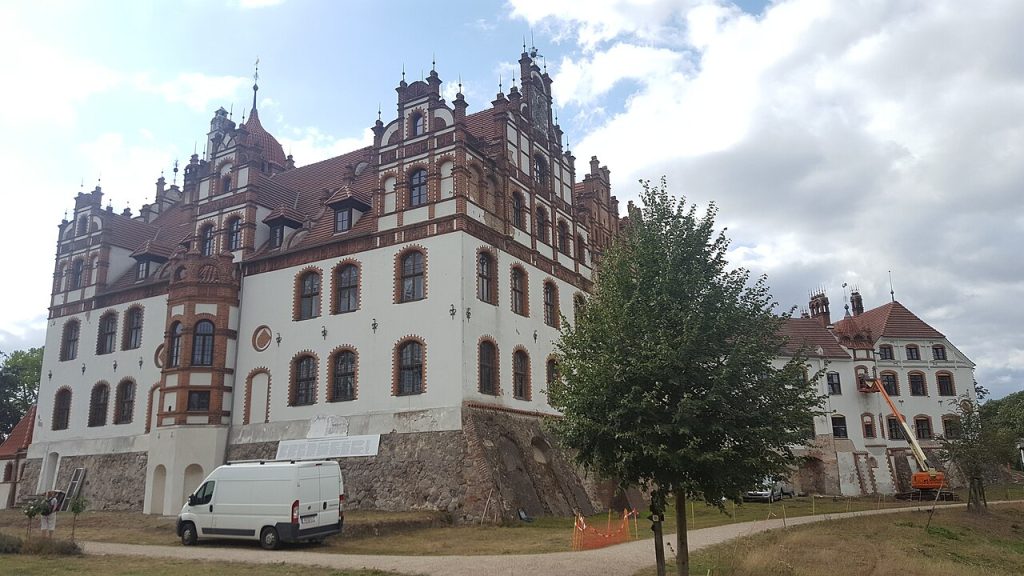
There are villages that belong to a family, and there are families that belong to a village. Basedow, in the rolling country the Mecklenburgers proudly call their Switzerland, is both. From 1337 until the spring of 1945 the estate was held by the Hahn family, barons and later counts, and almost everything you can see here, the palace with its Renaissance core and romantic towers, the vast stable block that looks like a cathedral for horses, the church with its tombs, the park that rolls away toward the Malchiner See, was built, rebuilt or planted by a Hahn. Six hundred years on one piece of land leaves marks.
The family was not dull. One count built an observatory and corresponded with the astronomers of Europe. His son fell so deeply in love with the theatre that he spent an entire fortune on actors, singers and his own touring company, and ended up in debt and disgrace. A later generation called in Friedrich August Stüler, the king’s architect, and Peter Joseph Lenné, the king’s gardener, and gave Basedow the shape it has today. Then history arrived, as it did everywhere east of the Elbe, and the Hahns were gone within a week.
What remains is one of the most atmospheric estates in Mecklenburg, half restored, half waiting, entirely worth the detour. Let me show you around in the order I would walk it, from the church to the stables to the lake. The contents are below if you want to skip ahead.
In This Article
- The Mecklenburg Switzerland
- The Hahns: 1337 to 1945
- A Renaissance House on an Older Foundation
- The Astronomer Count
- The Theatre Count and the Lost Fortune
- Stuler Rebuilds the Palace
- Towers, Terraces and a Mixed Style
- The Marstall: A Cathedral for Horses
- Lenne’s Park
- The Church, the Altar and the Family Tombs
- A Village Built to Match
- 1945 and the Years as Apartments
- Restoration in Slow Motion
- Basedow on Video
- Visiting Basedow Palace Today
- Palaces Nearby
The Mecklenburg Switzerland
First, a word about the landscape, because Basedow does not make sense without it. Between the towns of Malchin and Teterow the last ice age left a jumble of hills, ridges and deep lakes that rises to a dizzying one hundred and twenty metres above sea level. In the flat north of Germany that counts as mountainous, and nineteenth-century travellers, with a straight face, called it the Mecklenburgische Schweiz. The name stuck, and the region is now a nature park of beech woods, lakes and wide views.
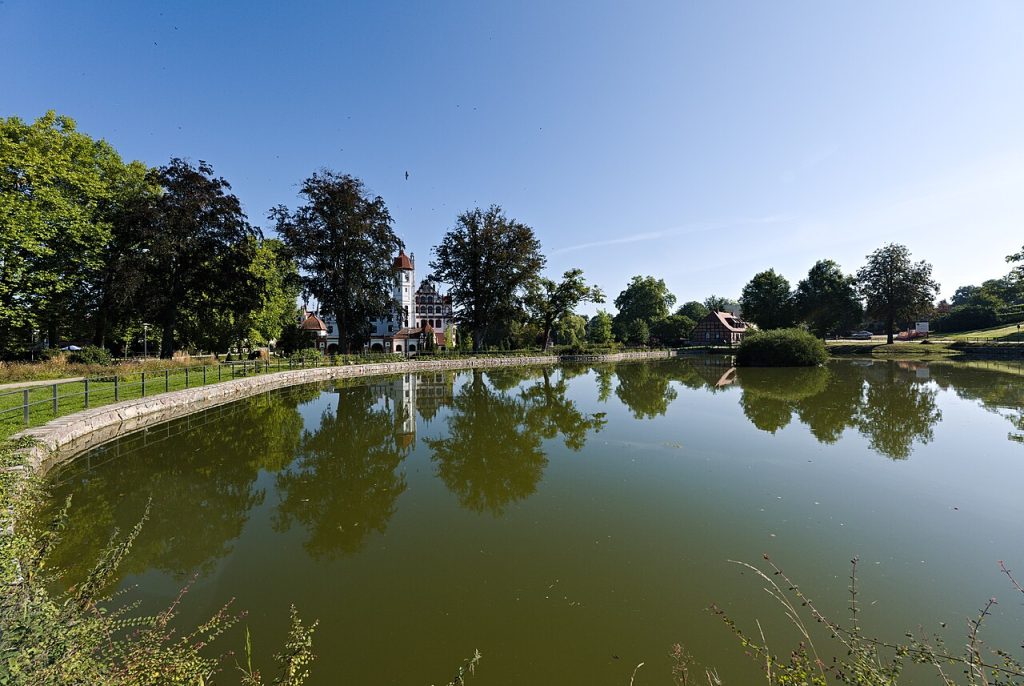
Basedow sits at the northern edge of this country, on a gentle rise above the Malchiner See, with the land falling away toward the water. Now, stop here at the entrance to the village and look at how the church tower, the palace towers and the stable roofs all appear together above the trees. That is not an accident. The whole ensemble was composed in the nineteenth century to be seen from exactly this road.
The Hahns: 1337 to 1945
The Hahn family, whose name means rooster and whose arms show the bird, acquired Basedow in 1337 and never let it go. They were knights first, then barons, and in 1802 the head of the family was made an imperial count. They served the dukes of Mecklenburg as marshals, councillors and soldiers, married into the other great houses of the north, and accumulated a landholding that at its height covered dozens of villages and tens of thousands of hectares. In Mecklenburg, where the nobility ran the state until 1918, that made them something close to royalty.
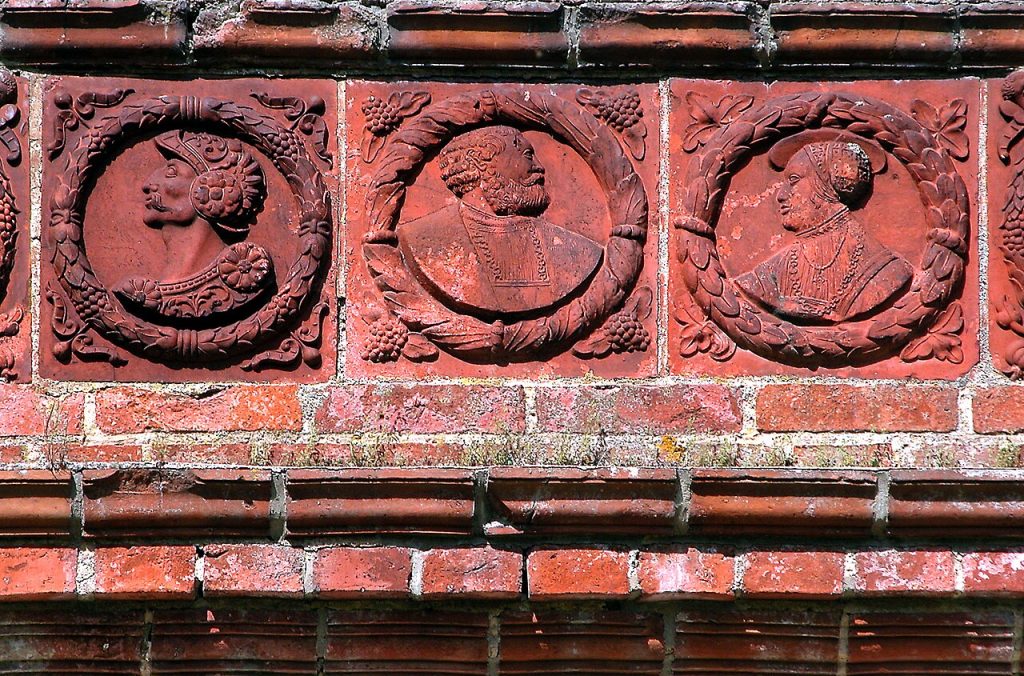
Six centuries produce every kind of character, and we will meet several. What unites them is Basedow itself: every generation added something, and no generation tore everything down. The result is a house and a village that read like a family diary written in brick, stone and trees. Look for the rooster. It appears on gates, gables, tombs and the church, the signature of a family that was here before the Reformation and left only when the tanks arrived.
A Renaissance House on an Older Foundation
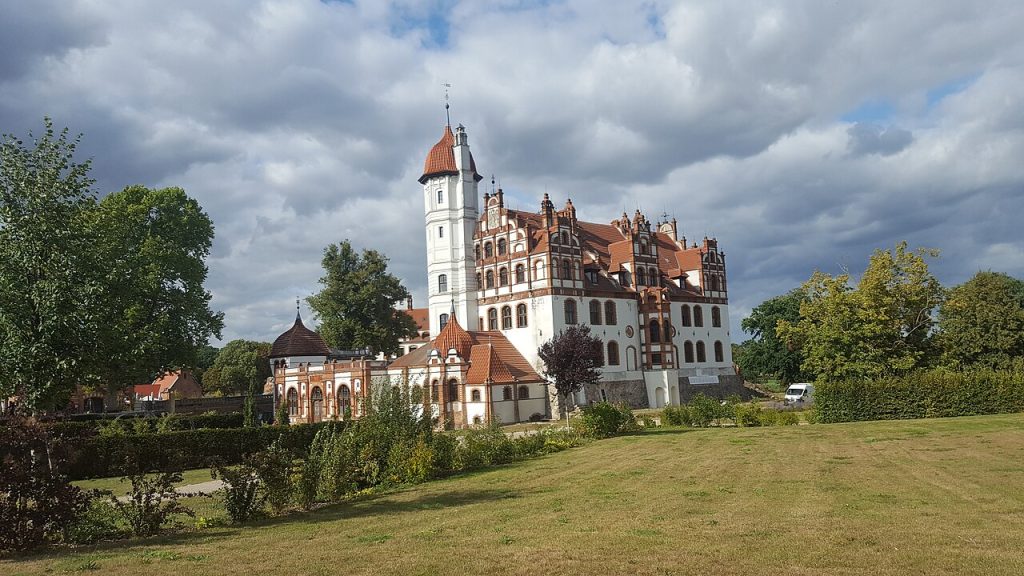
The palace you see is a layer cake. At its core stands a Renaissance manor built in the sixteenth century, around 1552, on the cellars of a mediaeval castle. Parts of this early house, with its thick brick walls and vaulted ground floor, survive inside the present building, and in places the old masonry shows through. In the seventeenth and eighteenth centuries the Hahns added wings and modernised the interiors, so that by 1800 Basedow was a rambling, comfortable, slightly old-fashioned seat.
Walk around to the courtyard side and look at the lower walls. You can read the changes in the brick: large early bricks in irregular bonds, smaller later ones laid with precision, patches of render that once covered everything. Nobody set out to make Basedow picturesque, but five hundred years of alteration did it anyway, and the nineteenth-century architect who finally pulled it together had the sense to keep the irregularity rather than fight it.
The Astronomer Count
Now for the first of the great characters. Count Friedrich von Hahn, born in 1742, inherited Basedow and the neighbouring estate of Remplin and devoted his life and a large part of his fortune to the stars. At Remplin he built the first private observatory in Mecklenburg, equipped it with the best instruments he could buy from England, and spent his nights measuring the positions of stars, observing nebulae and corresponding with the leading astronomers of the age, among them William Herschel, who had discovered Uranus.
Hahn was more than a wealthy amateur. He published observations, discovered the central star of a planetary nebula and was taken seriously by professionals. He employed trained assistants, bought the finest instruments of the day and kept a scientific library that was famous across the north. When he died in 1805, Mecklenburg lost its one genuine man of science among the nobility, and Basedow passed to a son who had very different passions.
The Theatre Count and the Lost Fortune
Count Karl Friedrich von Hahn, born in 1782, inherited the astronomer’s estates, a fortune that made him one of the richest men in northern Germany, and a weakness for the stage that would consume all of it. He built theatres on his estates, hired actors, singers and dancers, maintained a touring company, acted himself, and poured money into productions that had no hope of recovering their costs. Contemporaries called him the Theatergraf, the Theatre Count, and the name was not kindly meant.
By the 1820s his debts were catastrophic. His family had him placed under guardianship, the estates were put into administration and much of the land had to be sold. He kept acting under assumed names in provincial theatres and died in Altona in 1857, more or less penniless. Basedow survived only because the law protected the entailed core of the estate from his creditors. Now, stop here on the terrace and consider that the money which might have built a Baroque palace here went instead on greasepaint and scenery. Mecklenburg gossiped about it for a century.
Stuler Rebuilds the Palace
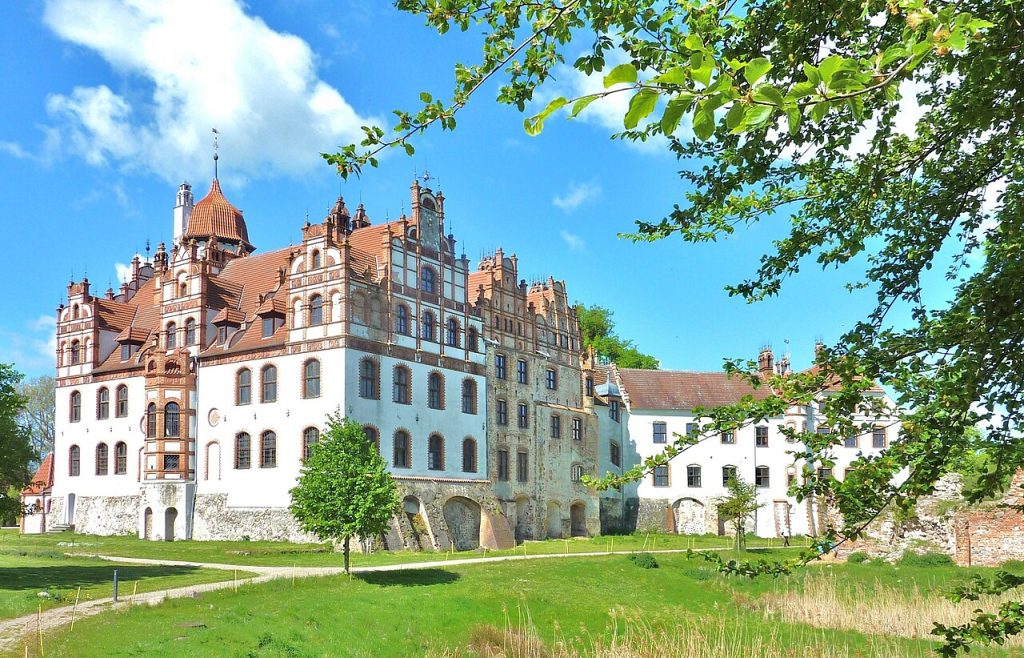
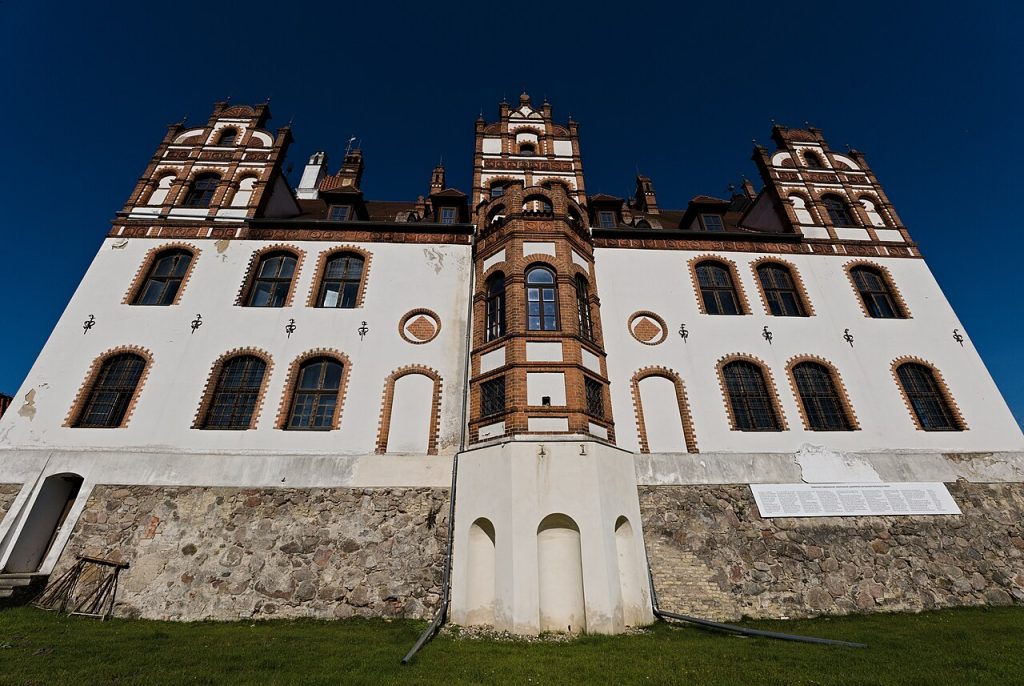
The family recovered under the Theatre Count’s son, Count Friedrich, who took over a diminished but still substantial estate and set about making Basedow a seat worthy of the name. For the architecture he turned to Friedrich August Stüler, pupil of Schinkel and architect to the King of Prussia, whose Berlin works include the Neues Museum. Between 1835 and 1850 Stüler remodelled the old house in stages, adding towers, terraces and new wings in a free mixture of Renaissance and Gothic forms that was the height of fashion.
Stüler’s approach is interesting. Rather than demolishing the Renaissance core, he enlarged and dramatised it, so that the palace grew into an irregular, picturesque mass that looked as if it had evolved over centuries. In a sense it had. The same architect designed the stables and much of the village, which is why Basedow has an unusual unity for an estate that was never built in one campaign.
Towers, Terraces and a Mixed Style
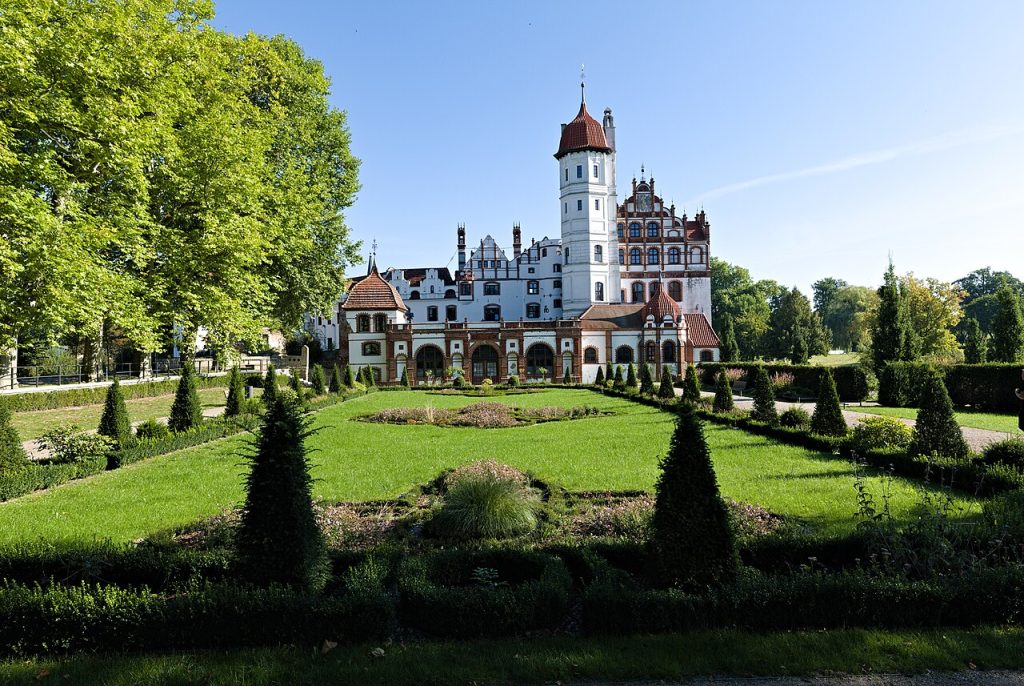
Walk the full circuit of the palace and count the styles. There are stepped gables that quote the brick Renaissance of the Baltic, a tower with a Gothic air, an Italianate terrace with a balustrade and round-arched windows that could be in Potsdam. Nineteenth-century critics called this Rundbogenstil, the round-arch style, and Stüler was its master. The point was not purity but mood: a house that spoke of ancient lineage and modern comfort at the same time.
The interiors followed the same logic, with a great hall, a library and a chapel, panelled rooms and painted ceilings, most of which were lost in the twentieth century. The restoration now under way has recovered some rooms on the ground floor, and the view from the terrace across Lenné’s park is still exactly what the count paid for. Bring a camera in the late afternoon, when the brick glows and the towers throw long shadows across the lawn.
The Marstall: A Cathedral for Horses
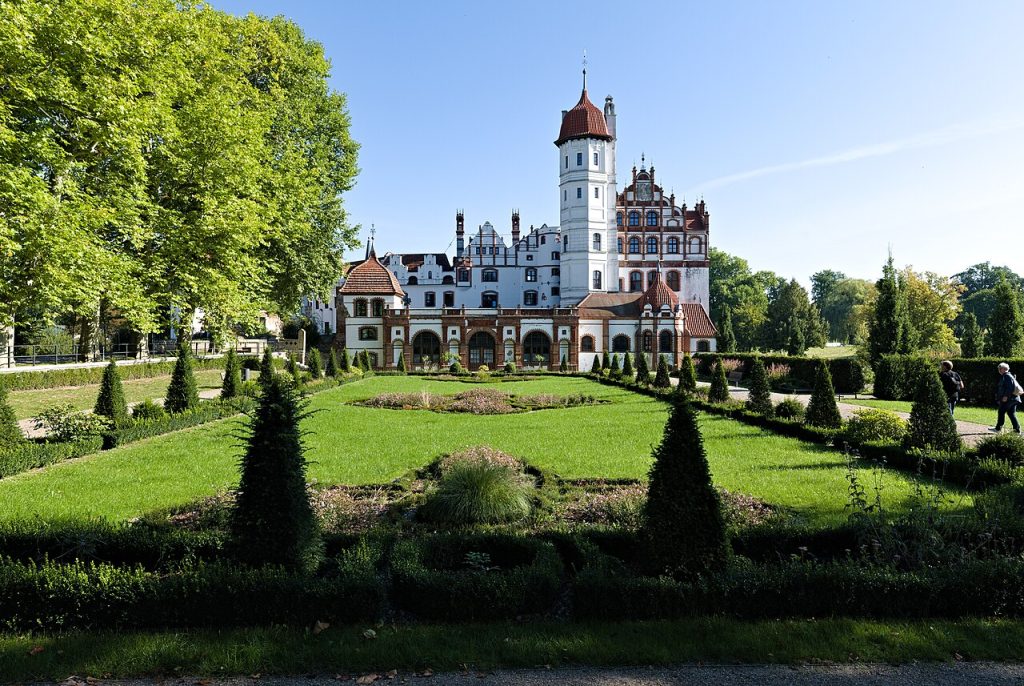
Now walk toward the enormous building beside the palace, because it may be the most impressive thing in Basedow. The Marstall, the stable block, was built by Stüler in the 1830s for the Hahn stud, which bred horses that were famous across Germany. It is a vast brick structure with a tall central section, round-arched windows and a roof like a basilica, and it was designed to house dozens of horses in conditions better than most Mecklenburg peasants enjoyed.
Look at the carved horse heads over the doors and at the quality of the brickwork, which is finer than on the palace itself. Basedow horses won prizes in Berlin and Hamburg, and the stud was a major source of income and prestige for the family. Today the Marstall has been restored and serves for events, exhibitions and concerts, and stepping into its nave-like interior you understand why visitors keep comparing it to a cathedral.
Lenne’s Park
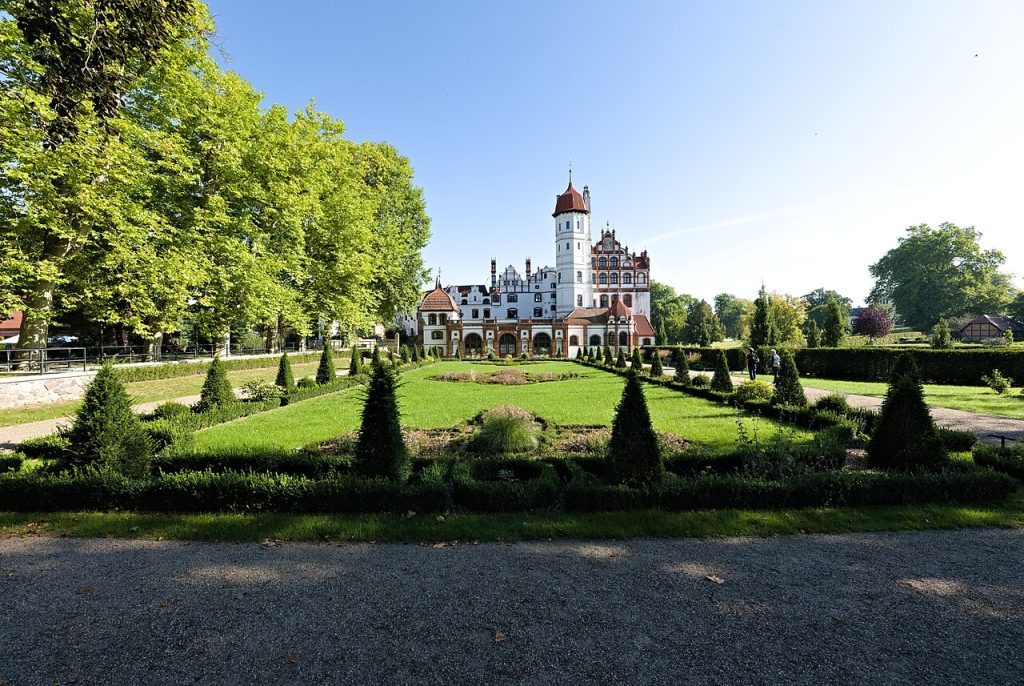
From the terrace, walk down into the park. Peter Joseph Lenné, the director of the royal gardens in Potsdam and the most important landscape gardener of nineteenth-century Germany, designed it in 1835, at the same time as Stüler was working on the house. It is one of his largest commissions outside Prussia, and it has the Lenné signature: long sightlines across meadows, groups of trees placed like actors on a stage, water used as a mirror and the whole village drawn into the composition.
Lenné’s masterstroke was to treat the surrounding farmland as part of the park, so that avenues and tree groups continue far beyond the garden fence toward the Malchiner See. Walk the main axis from the palace toward the lake and notice how the view opens and closes. Many of the oaks and beeches are his original planting, now nearly two hundred years old. If you have walked in the parks of Potsdam, you will feel the kinship immediately.
The Church, the Altar and the Family Tombs
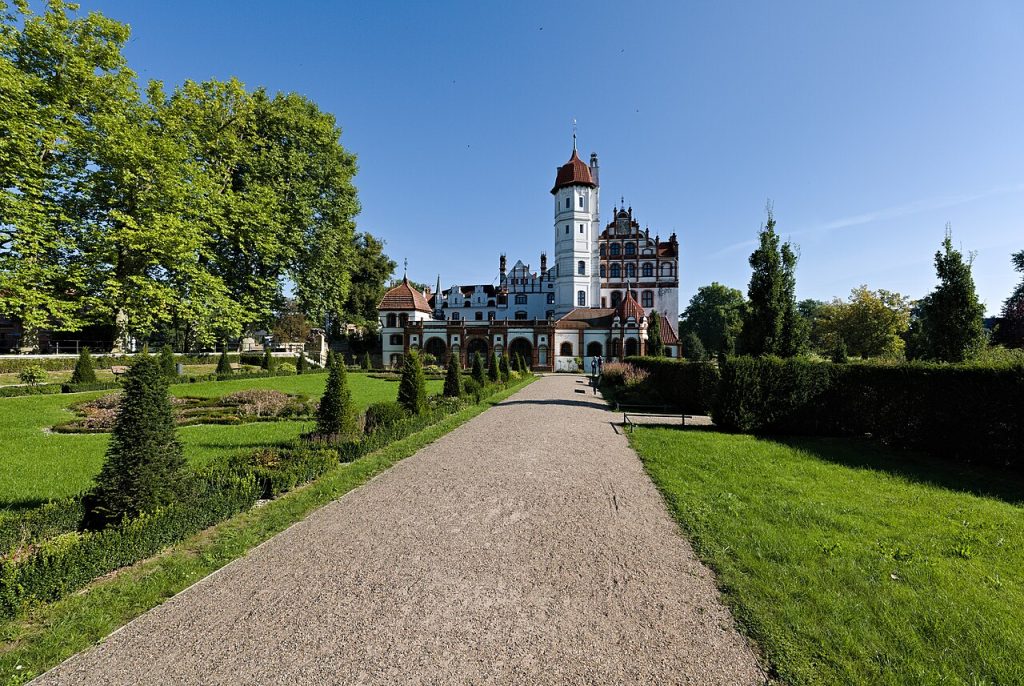
The village church stands between the palace and the main street, and it is the family’s memorial. It is a mediaeval brick building enlarged and refitted by the Hahns, with a Renaissance altar of carved and painted wood, a pulpit of the same period and a Baroque organ. The real treasure is the collection of tombs and epitaphs: stone knights, painted panels, iron and marble memorials from the sixteenth to the twentieth century, filling the chancel and the walls.
Here lies the astronomer, and here are his ancestors who fought in the Thirty Years’ War. The Theatre Count, who died far away in Altona, is absent, which tells its own story. Now, stop here in the quiet of the nave and count the roosters on the memorials; you will lose track. No other building in Mecklenburg holds so complete a record of one family’s passage through six centuries.
A Village Built to Match
Leave the church and look at the village itself. Stüler did not stop at the palace and the stables; he designed farm buildings, cottages, a school and a gatehouse in the same round-arched brick manner, and Lenné planted the lanes with trees. The result is a Gesamtkunstwerk, an estate village composed as a single artwork, and it is one of the best preserved in northern Germany. The Hahns wanted their tenants housed in a way that reflected the dignity of the house, and incidentally reminded everyone who owned what.
Walk the main street slowly and you will spot the family rooster on the gables of ordinary houses. The brick is the same warm red, the proportions the same, the details simpler. Many of these buildings survived the GDR because they were useful, and the village as a whole was recognised as a monument after 1990, which has helped funds flow in for restoration.
1945 and the Years as Apartments
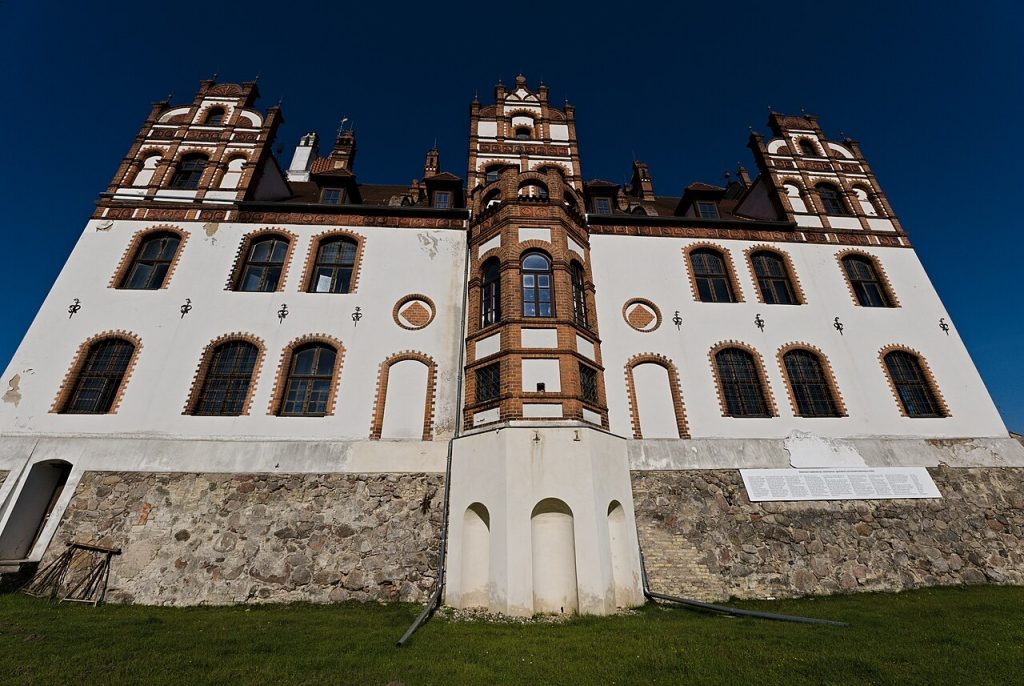
In late April 1945 the Red Army reached the Malchiner See, and the Hahn family fled west. The land reform that followed expropriated the estate, and six hundred years ended in a few days. The palace was divided into apartments for refugees and farm workers, the Marstall became a cooperative barn and workshop, the park was partly ploughed and the family’s furniture, pictures and library scattered or destroyed. For four decades Basedow was a working village with a decaying landmark at its centre.
The apartments, as so often, kept the roof on. Families lived in the old count’s rooms, children played on the terrace and the stables held tractors. When reunification came in 1990 the palace was inhabited, shabby and structurally weakened, with water damage in the towers and Stüler’s details crumbling. The Hahns, like all expropriated families, received no restitution for land taken under the Soviet land reform.
Restoration in Slow Motion
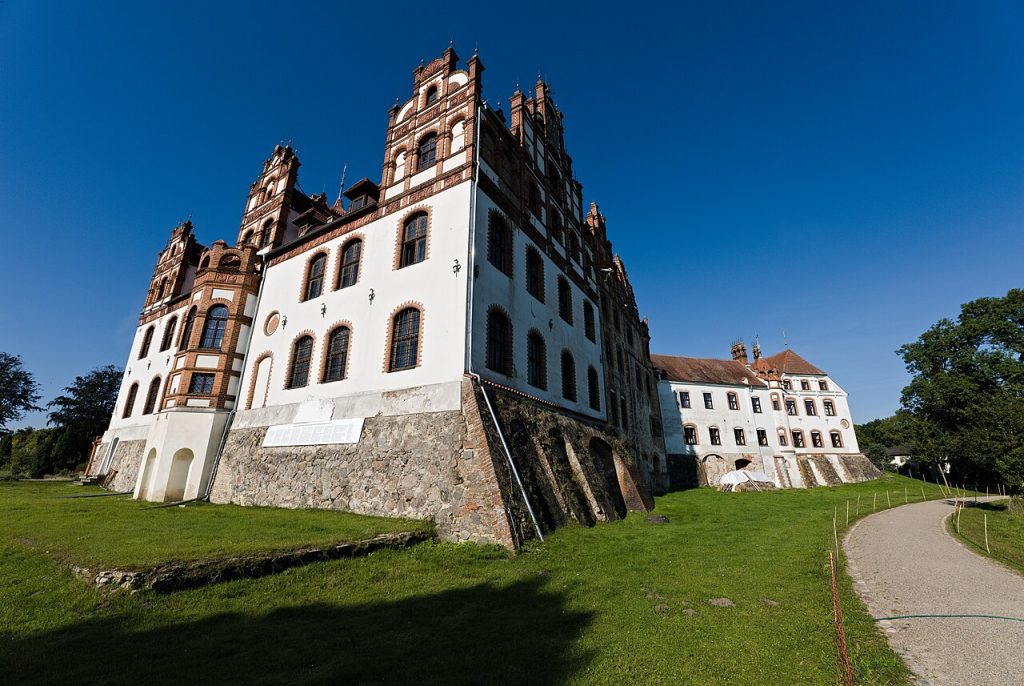
Since the 1990s Basedow has been restored piece by piece. The Marstall came first and is now in excellent condition, used for concerts, weddings and exhibitions. The church and village were repaired with monument funds. The palace itself changed hands several times among private investors, and work has advanced in stages: roofs secured, towers repaired, facades restored, rooms on the ground floor reopened for events while the upper floors wait their turn. Lenné’s park has been cleared and the main views reopened.
It is restoration in slow motion, and visitors should know that parts of the house may be closed or under scaffolding. Yet that is also what makes Basedow honest. You can see the whole arc, from the Renaissance cellar to the fresh plaster, and you can see how much it costs to carry a six-hundred-year inheritance into a seventh century.
Basedow on Video
Before you plan your trip, take a few minutes to see Basedow Palace in motion. The video below gives a good sense of the setting, the scale of the buildings and the atmosphere of the grounds.
Visiting Basedow Palace Today
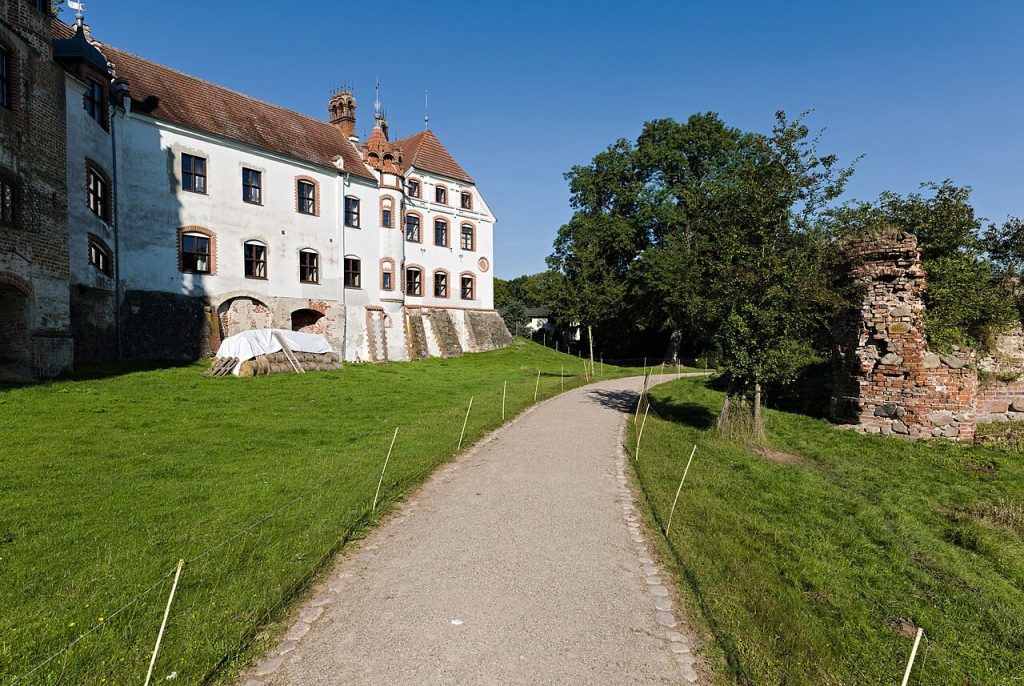
Basedow lies about six kilometres north-west of Malchin in the Mecklenburg Switzerland nature park. The park, the village and the exterior of the palace and Marstall can be visited at any time; the church is usually open in daytime during the summer months, and the Marstall and palace rooms open for events, guided tours and exhibitions, so check the current programme before you come. Allow two hours for a full walk of palace, stables, church, village and park, and bring good shoes, because the best views need a stroll toward the Malchiner See.
Malchin has a railway station on the Rostock to Neubrandenburg line, and from there it is a short taxi or bicycle ride. Combine Basedow with Ulrichshusen, the moated Maltzahn castle a few kilometres to the south-west, and with Mirow and Hohenzieritz for a full day in the lake country. Here is the exact spot: Basedow Palace on Google Maps.
Palaces Nearby
If you have enjoyed this palace, the region holds more remarkable residences. Here are two more well worth adding to your journey:
You May Like