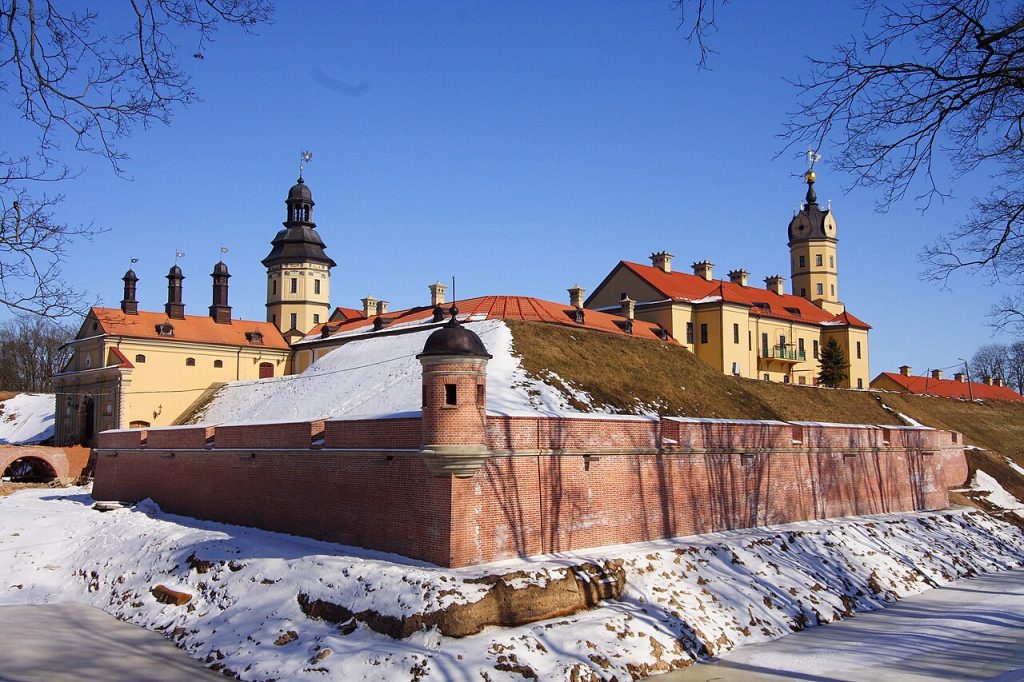
Now, stop on the causeway between the lakes and look at the towers across the water. Nesvizh is a palace built by a family who, for three centuries, were richer than most of the kings around them and behaved accordingly.
The Radziwills held lands across the Polish-Lithuanian Commonwealth, kept their own army, minted their own coinage at times, maintained a court theatre with its own orchestra, and collected a library and an armoury that foreign ambassadors travelled to see.
What stands here today is the physical record of that power, rebuilt after the catastrophes of the twentieth century, in a country most visitors to Europe never reach.
- The Commonwealth and Its Magnates
- The Radziwill Family
- Mikolaj Radziwill and the New Castle
- Bernardoni and the Italian Fortress
- Bastions, Water and Artillery
- The Halls and Their Names
- The Library and the Archive
- A Private Theatre and Orchestra
- The Church of Corpus Christi
- Partition, War and Loss
- The Sanatorium Years
- Restoration and World Heritage
- What You See Today
The Commonwealth and Its Magnates
The Polish-Lithuanian Commonwealth, formed in 1569, was one of the largest states in Europe, an elective monarchy in which the nobility held extraordinary power and the richest families, the magnates, operated almost as independent principalities.
A magnate could raise troops, conduct foreign correspondence, patronise churches and schools, and block legislation. The king was elected, often foreign, and frequently poorer than the men who elected him.
Understanding that system is essential here. Nesvizh is not a royal palace. It is the capital of a private empire.
The Radziwill Family
The Radziwills were Lithuanian in origin, Protestant and then Catholic, and they rose through the fifteenth and sixteenth centuries to become princes of the Holy Roman Empire, hetmans of Lithuania, chancellors and voivodes.
Their estates covered enormous areas of what is now Belarus, Lithuania, Poland and Ukraine. They married into the royal families of Poland and beyond, and the family survives today across several countries.
Nesvizh was their principal seat, and the family held it, with interruptions, until 1939.
Mikolaj Radziwill and the New Castle
The builder was Mikolaj Krzysztof Radziwill, called Sierotka, the orphan, who converted to Catholicism, travelled to the Holy Land, wrote an account of his pilgrimage and returned determined to rebuild his family seat in the modern Italian manner.
Work began in 1583 on the site of an earlier wooden castle. What he commissioned was not a medieval fortress but a palazzo in fortifications, combining comfort and firepower.
His pilgrimage account was a bestseller in its day, translated across Europe. He was a man who understood both artillery and publicity.
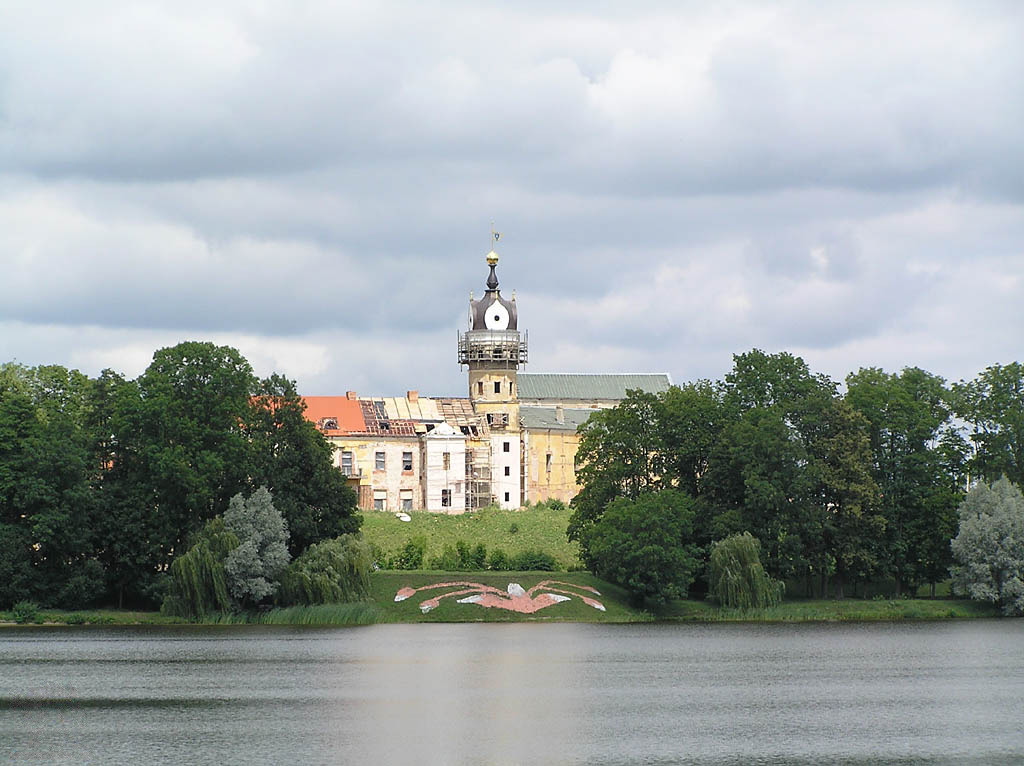
Bernardoni and the Italian Fortress
The architect was Giovanni Maria Bernardoni, an Italian Jesuit who worked across the Commonwealth and who brought with him the latest ideas in both church architecture and military engineering.
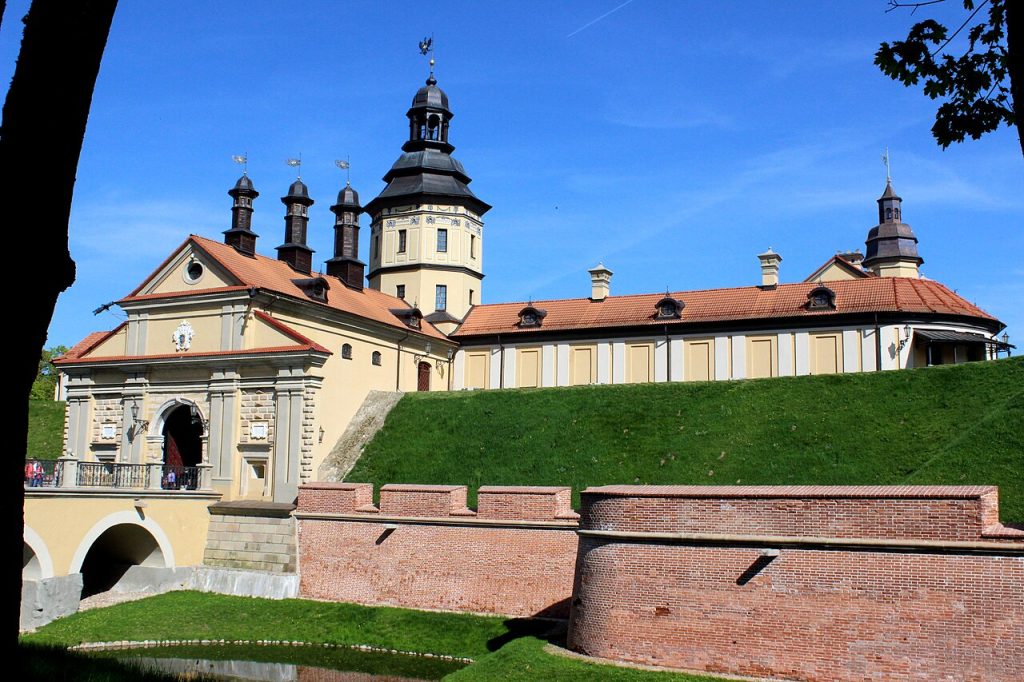
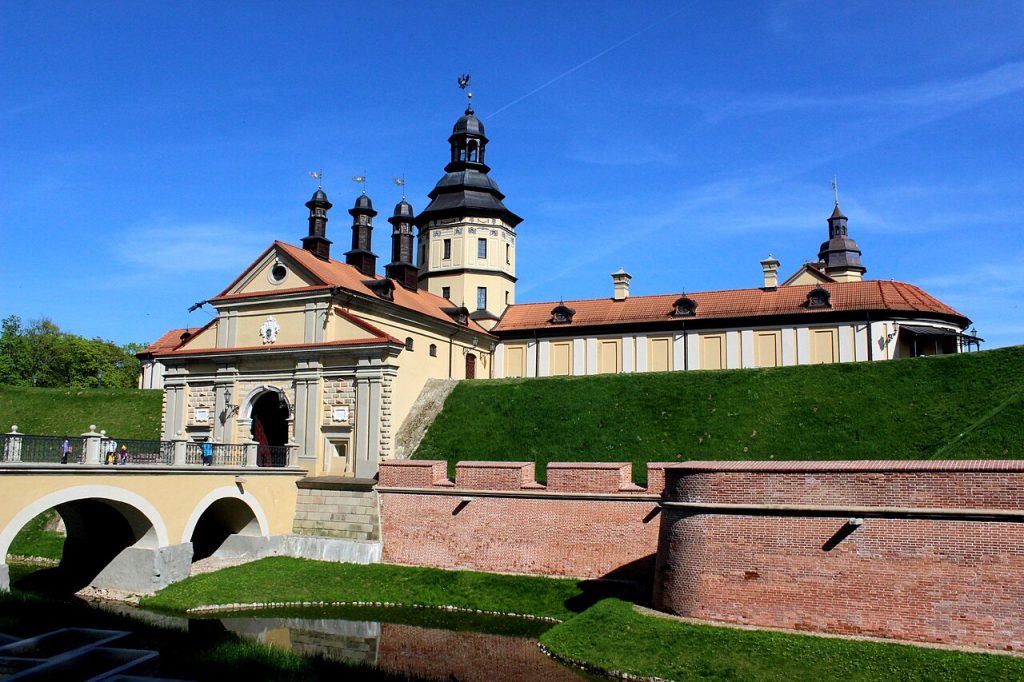
The combination defines Nesvizh: a comfortable residential palace wrapped inside an artillery fortification, with earthworks, bastions and water doing the defensive work that medieval walls no longer could.
This was state-of-the-art in the 1580s, and it worked. The castle withstood sieges that destroyed less modern places.
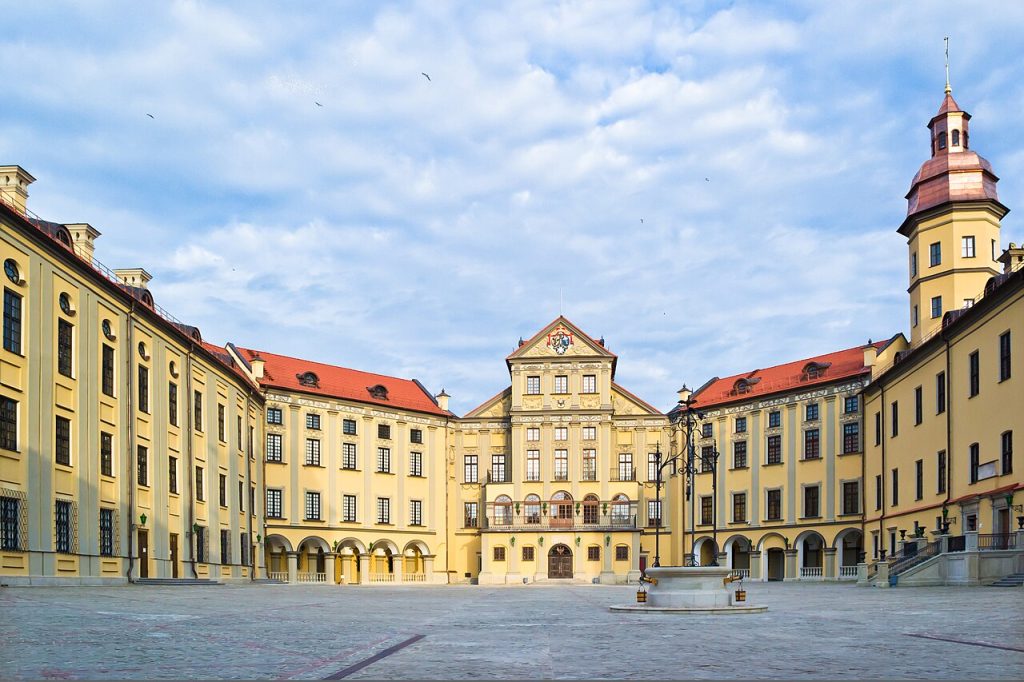
Bastions, Water and Artillery
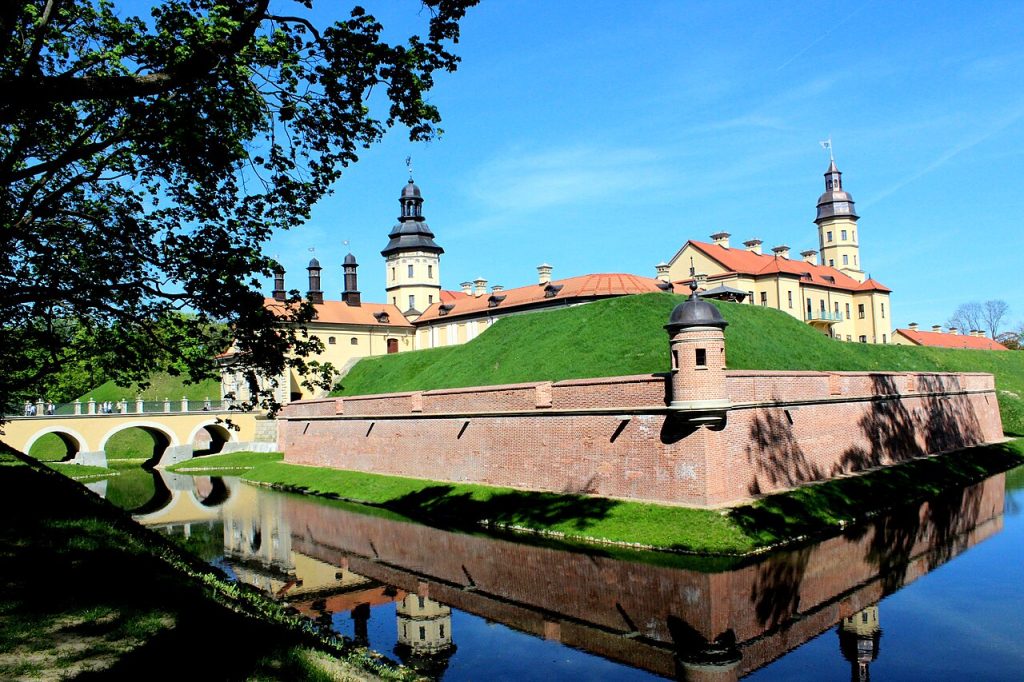
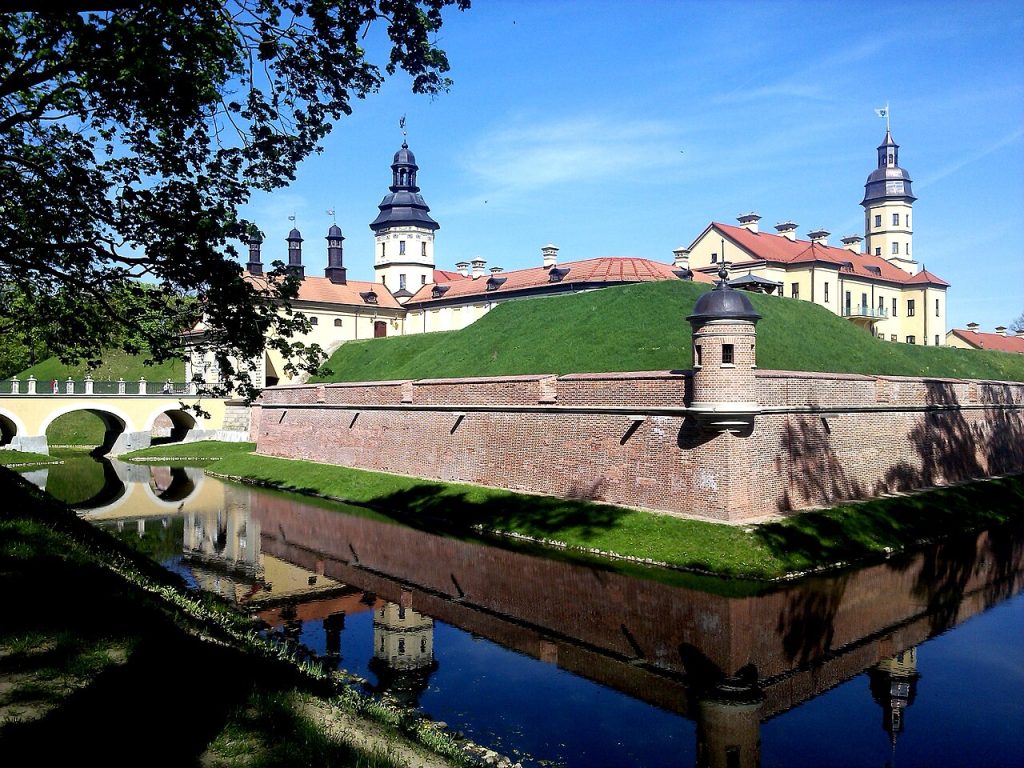
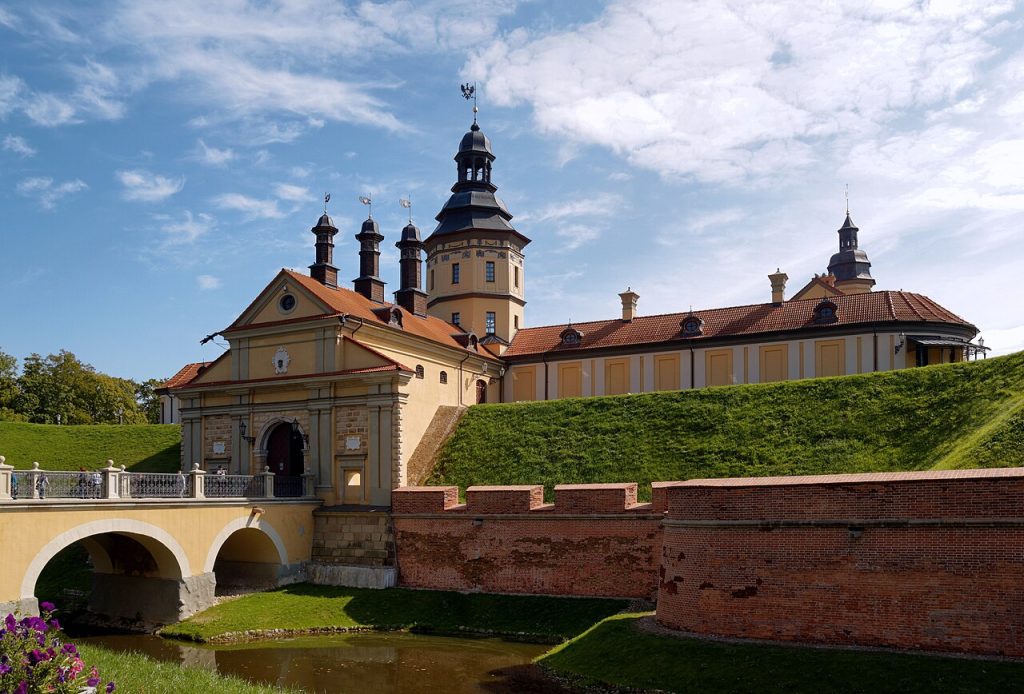
The castle sits on an island formed by damming the river, surrounded by water and earth bastions designed to absorb cannon fire rather than resist it. The approach is by causeway, under fire from several directions.
It held against Swedish attacks in the seventeenth century, although the town suffered, and it remained a serious military proposition into the eighteenth.
Walk the causeway slowly and look at the angles. Every line of the earthworks is calculated to give defenders overlapping fields of fire.
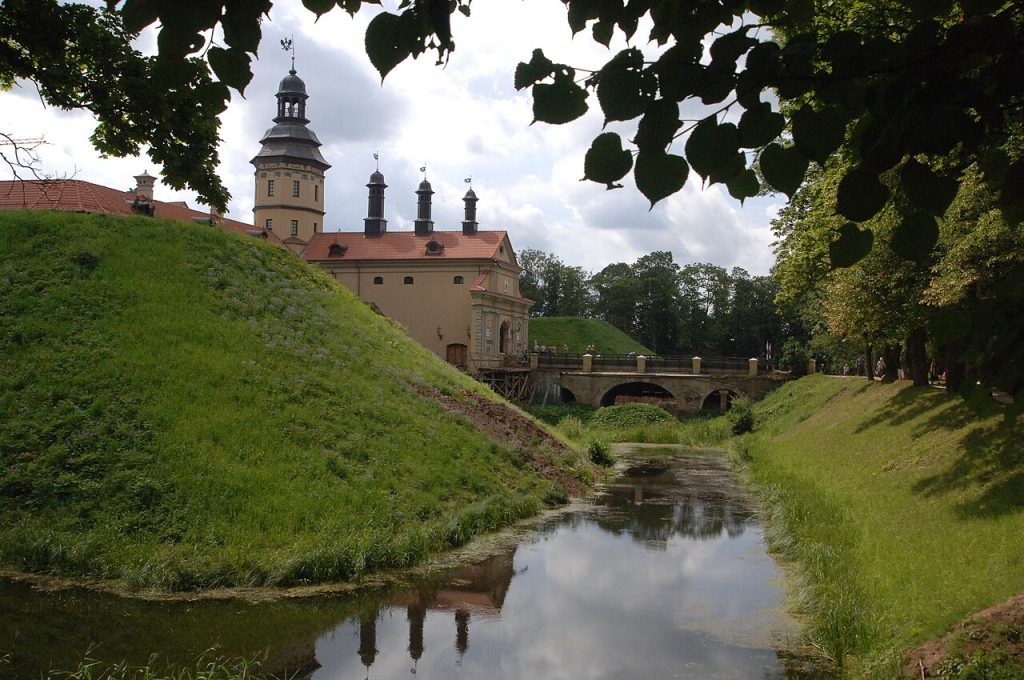
The Halls and Their Names
The interiors are arranged as a sequence of named halls: the Golden Hall, the Hunting Hall, the Hetman’s Hall, the King’s Hall, each decorated according to its function and each used for a different kind of reception.
Much of what you see today is restoration based on inventories, photographs and surviving fragments, because the original contents were dispersed in the twentieth century.
The restoration is generally well done and clearly explained, though purists note the difference between surviving and recreated work.

The Library and the Archive
The Radziwill library and archive were among the most important private collections in eastern Europe, holding manuscripts, charters, printed books and the administrative records of a vast estate.
The collection was moved, split and partly removed to Russia after the partitions, and further dispersed during the twentieth century. Parts survive in Minsk, Warsaw, Vilnius, St Petersburg and elsewhere.
The archive remains a crucial source for the history of the Commonwealth, and researchers from several countries work on it.
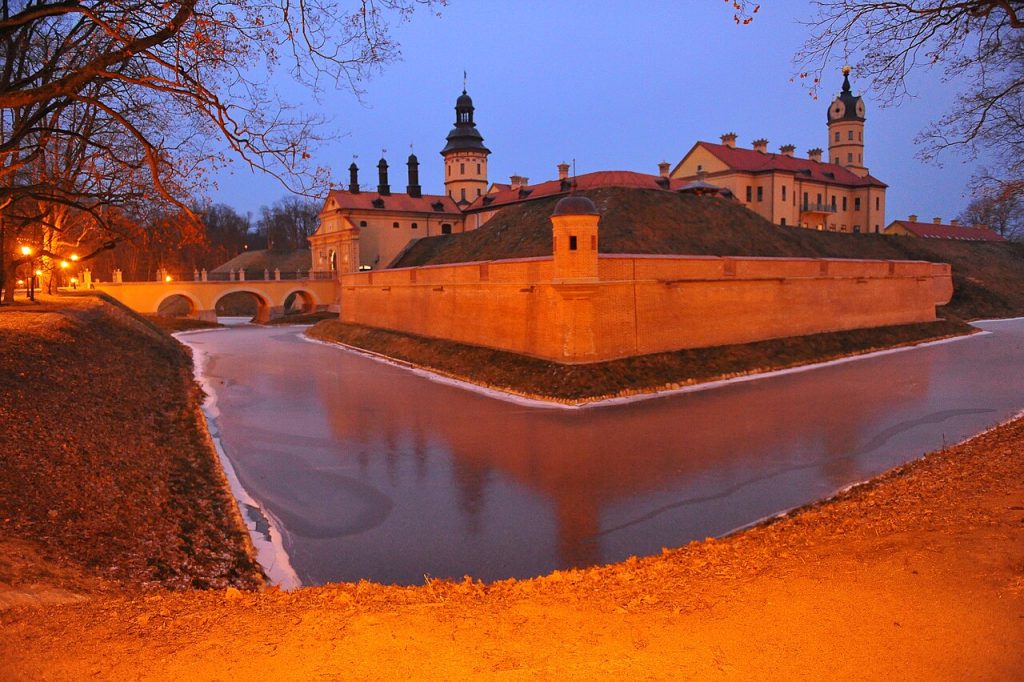
A Private Theatre and Orchestra
In the eighteenth century, under Michal Kazimierz Radziwill and his wife Franciszka Urszula, Nesvizh maintained a court theatre with its own troupe, orchestra and ballet, performing works that Franciszka Urszula wrote herself.
She is now regarded as one of the first significant women playwrights in the Polish language, and her plays were staged here for a private audience of guests and family.
A private theatre of this quality, hundreds of kilometres from any capital, says everything about the scale of magnate wealth.
The Church of Corpus Christi
In the town stands the Church of Corpus Christi, built between 1587 and 1593 by Bernardoni, and it is historically more important than the castle. It was the first baroque church in the Commonwealth and one of the first outside Italy, modelled on the Gesu in Rome.
Beneath it lies the Radziwill crypt, the largest family burial vault in eastern Europe after the Habsburg crypt in Vienna, holding dozens of coffins from four centuries.
Visit the church even if time is short. It is a genuine landmark in the history of European architecture, not merely a local monument.
Partition, War and Loss
The Commonwealth was partitioned out of existence between 1772 and 1795 by Russia, Prussia and Austria, and Nesvizh fell under Russian rule. The family’s position changed overnight from near-sovereign to subject.
Napoleon’s campaign of 1812 passed through, and the castle was looted. The nineteenth century brought confiscations, returns, restorations and decline. The twentieth brought worse: the First World War, the Polish-Soviet war, and then 1939.
In September 1939 the Soviet Union occupied eastern Poland. The Radziwills were arrested, the contents removed, and the family’s six-century association with Nesvizh ended.
The Sanatorium Years
Under Soviet rule the castle became a sanatorium, a rest home for party officials and workers. Rooms were partitioned, fittings removed, the park neglected and the interiors adapted for institutional use.
This was the fate of many great houses across the eastern bloc, and it is not the worst one. Buildings that became sanatoria were at least heated and occupied; those that were abandoned usually collapsed.
The sanatorium operated into the 1990s, and photographs from the period show the halls lined with hospital furniture.
Restoration and World Heritage
After Belarusian independence the castle was declared a national monument, and a long and expensive restoration began. UNESCO inscribed the architectural, residential and cultural complex of the Radziwill family at Nesvizh on the World Heritage list in 2005.
A serious fire in 2002 damaged part of the complex and slowed the work. The restored castle opened progressively through the 2010s and now functions as a museum with exhibitions, concerts and events.
Debate continues about the degree of reconstruction, as it does at every heavily restored site in the region. What is not debatable is that the building would not exist without it.
What You See Today
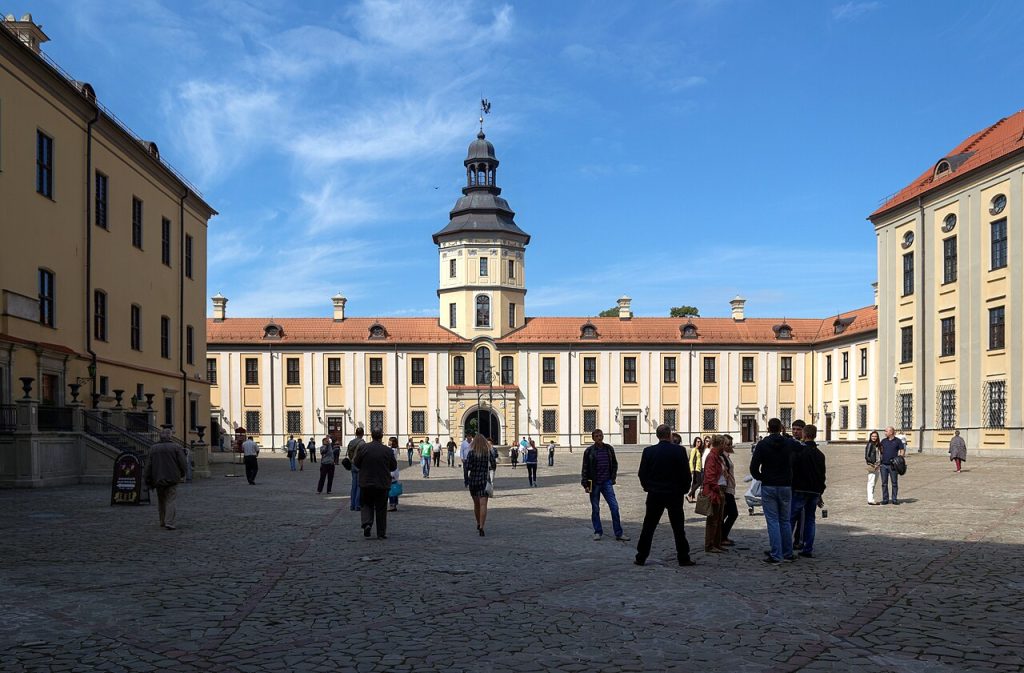
You see a restored magnate palace with furnished halls, a park of considerable size with lakes and avenues, the church and crypt in the town, and a small town that still shows its planned Renaissance layout.
The park alone takes an hour. It was laid out in the nineteenth century in the English manner and is one of the largest landscape parks in Belarus.
Look back from the far side of the lake before you leave. The reflection of the towers in still water is the image every visitor takes home, and it has been the point of this siting for four hundred years.
Watch the Castle on Film
Visiting Nesvizh Castle Today
Nesvizh lies about 120 kilometres southwest of Minsk, roughly two hours by car or by bus from the capital. Organised day trips from Minsk usually combine it with Mir Castle, which is the most efficient way to see both.
The castle museum opens daily with ticketed entry, and audio guides are available in several languages. The park is open and free. Check current travel requirements and the political situation before planning a trip to Belarus.
Allow three to four hours for castle, park and the Corpus Christi church with its crypt. Find it here: https://www.google.com/maps?q=53.2228,26.6911
Palaces Nearby
You May Like
Bessastadir and the Farmhouse That Became a Presidency