Central Anatolia’s closest door to the sea… Düzce’s seaside, the first holiday destination of Ankara residents many years ago, the charming town of the Black Sea that attracts attention with its natural structure, Akçakoca, which leaves a mark in memories with its sea, sand, sunsets, civil architecture examples, wild strawberries and hazelnuts, kilometers-long beaches, lush vegetation, historical castle, caves, waterfalls, plateaus, friendly people, local tastes. It arouses admiration.
You enter the district, which began to stand out as a holiday center in 1950-55, via a beautiful road. A modern mosque with a unique architecture welcomes you in the district center. While the magnificent building surroundings become the focal point of the district as a shopping center, the landscaping, green fields and park areas attract attention.
The clock tower, which was built in recent years, and the aesthetic benches with trolley wheels that allow you to sit and watch it in the same square and rest comfortably are pleasing to the eye. You can walk along the beach from the square, sometimes sit on the ox-cart wheeled benches and watch the fishermen’s shelter, sometimes take walks on the breakwater and watch Akçakoca with the silhouette of the Central Mosque from the sea.
Another striking feature along the coast is that various examples of wooden huts built to store corn cobs in the villages are used as cafes. Those who enjoy watching the Black Sea coastline and sipping their refreshments or tea under the colorful sunshades that open around them feel like they are in a different region.
The shady street along the coast of Akçakoca, lined with centuries-old plane trees, where restaurants and rest stops providing quality service are located, is closed to vehicle traffic due to the increase in tourist density in summer and is used as a strolling and walking area. Apart from the statues of Osmangazi, Konuralp Bey and Akçakoca Bey, various symbolic monuments, flower pools and urban furniture can be seen in the district.
A complex made of jugs, various animal figures such as lions and rabbits among the flowers, hazelnut statues, various agricultural tools used in villages and rural areas, cars, balcony railings and ornate bridges attract attention. The fisherman’s shelter, which was once a sandy beach and a pier was built on its shore, adds color to the interior of the harbor, reflecting the Black Sea fishermen’s fondness for vibrant colors.
Boats entering and leaving the shelter throughout the day and fishermen repairing their nets encourage people to take photographs and paint paintings of Akçakoca. When you sit on one of the beach banks in Akçakoca, which starts the day early in the morning, and watch the harbour, you see that the fishermen, boat captains and even the entire harbor staff are very cooperative and helpful.
If a boat is to be launched or landed that day, he always leaves what he is doing and runs to help. The people of the shelter, who are almost one body, hold a small meeting and divide the work and start bringing the tree trunks on which they will slide the boat. The round trunk timbers placed under the boat are lubricated well. Thick ropes are tied tightly on both sides of the boat, and those ropes are locked to the wheel machine.
The rafters that keep the boat upright and are responsible for feeding are pulled and they start loading with a single command. The boat is big, it requires more strength and hands, the knots are forced, leverage is made with planks from the bow. The boat, which cannot resist the determination and faith of the Black Sea people any longer, reaches the waters amidst the pushing and shoving and the show of power. Of course, during this reunion, commands, sounds and jokes mix together.
“Empty place, come on, let it come. While all the streets opening to the beach display a peaceful bazaar view with open-air cafes, boutiques and souvenir shops, we leave the center of Akçakoca and travel 3 km to the west, reaching the historical castle.
Historical Genoese Castle
Thanks to the beaches to the West and East of the castle and the tea garden around the castle, the castle does not feel lonely at all. The castle, which is flooded with visitors throughout the year due to its location, was built on a cape with rubble stones. Although there is no definitive evidence, the castle, which is said to have been built by the Genoese, is used as a recreation area today.
There are those who say that it was actually a remnant from the Seljuks, repaired by the Ottomans, and used against the Genoese. There is a tower next to the entrance gate and a water cistern inside the castle, whose sea side walls have been demolished. The interior of the castle, which does not have much of a visible part as a result of the trees around it growing taller every year, has a kind of observation terrace that can see the sea and beaches from above.
The tables, placed on various levels, are accessed via small paths. In the heat of the summer months, you can cool off and have a picnic with the cool air, sea breeze and land winds. There is also a warning sign at the entrance of the castle stating that the sale of alcoholic beverages is prohibited!
Visitors and picnickers who park their vehicles in the large parking area at the foot of the castle can enjoy the castle atmosphere in peace all day long. There are two small bays and sandy beaches to the right and left of the castle. The beach, called “Yalıyarlar”, attracts attention with its rock formations arranged in layers like a diamond. It is also called seal rocks because it contains caves along the coast.
The other beach is popular with its longer beach and units that will meet the needs of those who come to the beach. In Akçakoca, which has a 30 km long coastline, Martı, Tersane, Bulaklı, Köy Hizmetleri, Değirmenağzı, Çınaraltı and Çuhallı Çarşı beaches host more guests because they are within the district center, while those looking for a quiet place prefer Çayağzı, Kumpınar, Akaya Village, Edilli Ağzı Beach, Melenağzı Village Beach, Karaburun Village and Beaches.
Civil Architecture
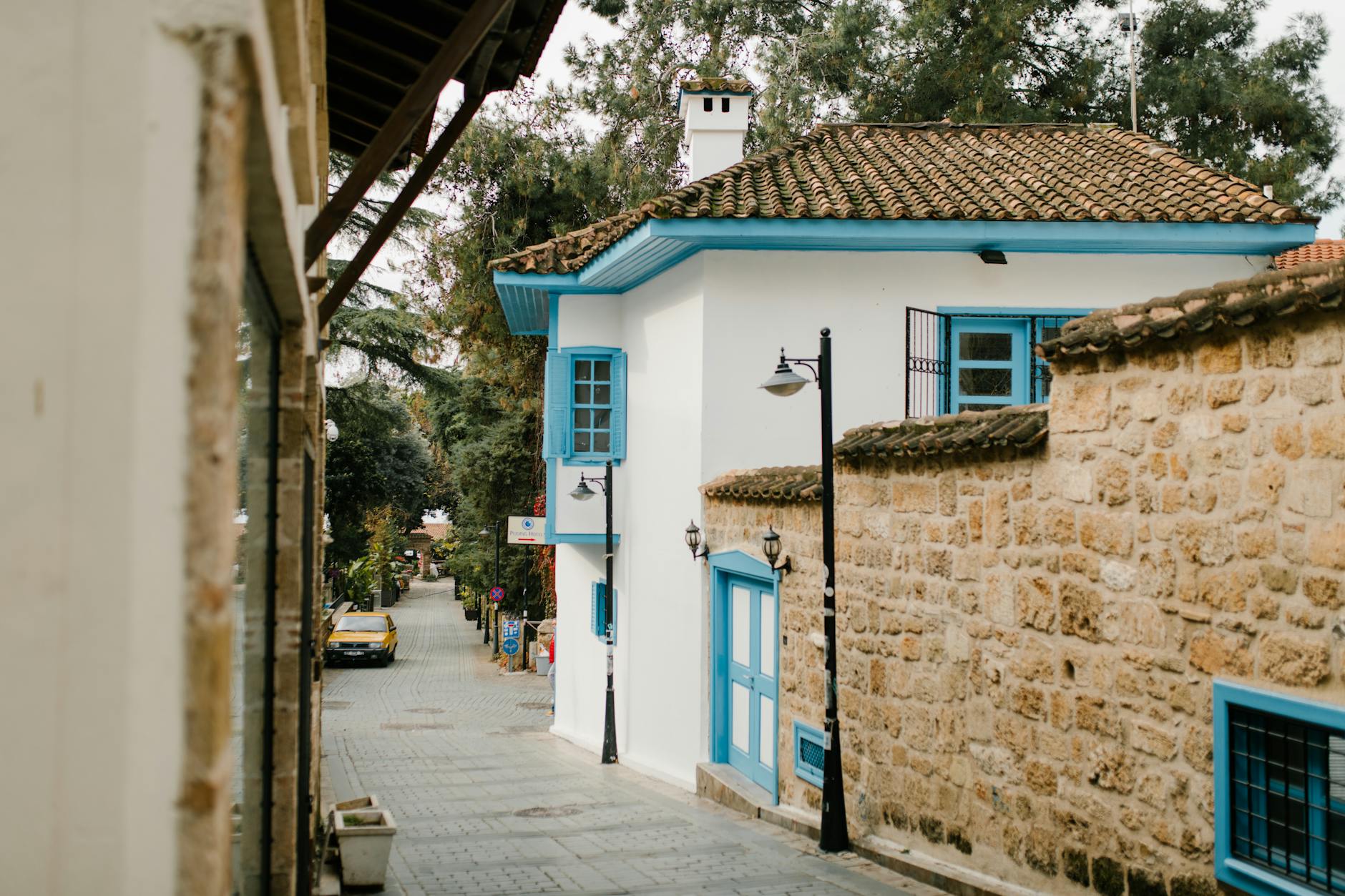
This time, we go up from Akçakoca center and the ramp behind the hospital and visit Yukarı Yeni Neighborhood. The distinctive feature of the houses, most of which are two-storey, is their unplastered facades. The houses, whose walls are built with the use of red bricks between wooden frames, attract your attention with their street projections, wooden bay windows, and garden locations and layouts. First of all, a brainstorming begins as soon as you see the painting in your mind.
You start to say that this place has nothing more or less than Safranbolu, Beypazarı, Mudurnu, Taraklı, and then every house you see displays beauties that will cause you to create different projects. First of all, they were not built inside each other like the houses inside the castle, then they all had gardens and their flowers were abundant due to the care and taste of the people living in them.
Apparently, the vines surrounding the houses, orchids, lilies, roses and all the flowers whose names I don’t know springing from the gardens are happy and content to be here. Its wooden doors, hand-woven curtains, the clean air, smell, silence and peace of the village, and the hospitable and friendly behavior of the residents. It makes me say, “Oh, if only there were a few houses and a boutique hotel here, if I could sit in that garden and have a village breakfast under the trees, read my book, I wouldn’t look for the sea or city life.”
Like every tourist, you put your camera on your neck and start wandering around the side streets. You start to feel like you’ve lived here for years. Sometimes a doorknob, sometimes a tiny room hidden in the attic, sometimes a smiling child increases your movie consumption.
You sigh one after another as you see the cherry trees with their fruits hanging like red earrings on their branches, the honeyed mulberries spilling on the ground, and the abandoned houses, many of which are waiting for their unknown fate. You convince yourself that you can have a holiday away from the sea.
The only thing to do is to start from somewhere, you leave your mind and heart in Yukarı Yeni Mahalle, thinking that if one example is made first, then this happiness will surely follow and spread. You feel like saying, I will definitely come here again, I will bring someone I love and show him/her too. If you ask whether Akçakoca is over, of course not.
Now it is expanding a little more in diameter to the Evliya Mosque Recreation Area, which is another recreation area and is surrounded by monumental plane trees with a stream passing through it, covering it like an umbrella, and there is almost no sunny area left. A mill pallet placed on the edge of the stream in the recreation area rotates with the speed of the water. A bridge over the stream, a country restaurant with picnic tables and wooden terraces, a playground, swings, etc.
In the far corner of the recreation area, there are ruins of arched rooms of a building that was used as a mint in ancient times, while in another corner there is a concrete mosque built in recent years. Right behind the mosque is the “Eskici Secaaddin Tomb”. Between the engraved tombstones at both ends of the tomb, two tall tree trunks rise to the sky.
Due to the religious section of the recreation area, its visitors also adapt to the environment.
While the beaches of Akçakoca, where green and blue are intertwined, usually host those who are overwhelmed by the extreme heat, there are many beauties in the district that are worth visiting and participating in various activities. Those who wish can take nature walks in the forest or see caves.
Karaburun Village
The first thing that attracts attention is the wide, untouched sandy beaches that stretch as far as the eye can see, followed by camping areas, economically priced countryside restaurants and shady picnic areas. Karaburun, which was once one of the most popular holiday destinations for caravan and tent tourism, especially for German tourists, today serves mostly domestic tourists. When you come to the village square, you get used to the environment very quickly and can see everywhere in a jiffy.
While taking a rest break in the small park under the tall trees, the beach stretching on both sides welcomes those who swim in the sea. Offshore, human-friendly dolphins show their dorsal fins and perform various tricks, attracting attention and giving a message that the beaches are safe. The sea is shallow for 100 meters from the shore, and even if there are waves, it does not adversely affect swimmers.
In the large area, camping sites, discotheques, bars, tea gardens, restaurants with two drinks and one without alcohol, and developed home pensions are sufficient to meet the needs. The season starts in May and provides holiday leave until November. We encounter Melenağzı Village at the end of the road we continue parallel to the sea on the Karaburun coast. In this region where the B.Melen Stream meets the sea, fishing boats adorn the earth-coloured stream with their vibrant colours.
The bridge located in Melenağzı location, which is the finishing point for rafting participants starting from Dokuz Değirmen village, allows viewing both sides of the stream and the surrounding area, while the areas suitable for picnics, hostels and gardens are pleasing to the eye. The local people are engaged in hazelnut farming, and those who earn their living by fishing fill the nets they leave in suitable places with mullet fish, even if they are small.
Plateaus, Waterfalls, Caves, Villages and Surprises
Click to enlarge. If we look at its geographical location, we see that it is located on a plateau rising towards the mountainous area in the south, 15 km behind the Akçakoca coastline. In Kaplande, the land structure rising towards the Orhan Mountains reaches up to 1486 meters in the Kızıltepe valley in the east. We explore the beauties hidden within Akçakoca, towards the hills rising in the green forest sea that nature is generous to.
We will visit the beautiful houses in Pasalar Village, Edilli Village and other villages on our way, and make a photo safari.
Aktas Waterfall
Returning from Melenağzı, we proceed parallel to the Melen Stream and first reach Uğurlu Village, and Esma Hanım Village, an Abaza village, among typical houses and corn-stored bags. There is a centuries-old, showy and elegant plane tree fed by a branch of the Melen Stream in the village square. Unlike other houses, aesthetic Abaza village houses with large gardens in front attract attention.
When we continue our journey after watching Melenin flowing into the sea from Hemşin, which is located on a very high hill, we arrive at Aktaş Village. We get out of the vehicle and start walking on the path that leads into the forest to watch the Aktaş Waterfall fall.
As you pass three small bridges along the highly humid forest road covered with calcareous and gourd plants along the way and proceed parallel to the stream, you see a tiny cave with its porous limestone structure, mossy rocks, monumental trees with vines hanging from their high branches, the chorus of unseen forest birds mixing with the sound of water, giving you the feeling that you are in the untouched Amazon Forest.
As soon as you reach the place where the waterfall falls, you see the waterfall coming from a 40-50 meter humpbacked rock and continuing on its way as a stream. Your environment consisting of natural rocks that look like a flat and high wall, covered with plants, leaves a very small window for you to see the sky.
You understand that the hours when the waterfall gets light are between 11.00 and 15.00, and you return accompanied by chestnut, oak, beech, juniper trees, ferns, blackberries and rhododendrons. If you have used your energy economically, you can climb the difficult slope you descended and go to the shack with a tea stove at the entrance.
The hut, which serves as a tea garden, also has toast-like foods, village breakfast varieties, and a camping area for those who want to live the Robinson life. For those who will stay away from civilization and want to go to the camping area with a pat pat vehicle, call Rasim Aydın on 0535 789 03 54. Before the Derebaşı tent site at an altitude of 450 meters, you can see a green forest sea, Akçakoca beaches, Alaplı, Zonguldak Ereğlisi and the Black Sea.
Rasim guides those who come to the region, takes them to the lakes in the levels above the waterfall, shows them the cave decorated with stalactites and stalagmites, and encourages them to go trekking. While leaving Aktaş and heading to Sarıyayla, another waterfall, a waterfall on the side of the road attracts attention.
Maiden’s Rock Water
The steep rock, which looks like a rising wall, is covered with moss. The mosses look like they are waiting for hands to caress and love them in their grass green color tones, creating the impression that they are crying inside with the drops falling from different plant textures. The reason why it is called Kız Kayası Water is that it is believed to be the place where girls living in the region and who are of marriageable age wish to find a good husband, and its water is drunk and visited.
Further on the road, Cingirt District looks cute with its three-storey natural houses with village ovens. As we pass poetically beautiful plateau villages one after another, on our way, we come across a wooden mosque hidden in the valley in Hemşin Village. The Central Old Mosque is not made of a common type of material, it was built with the interlocking technique, without using any nails, and chestnut wood was used throughout.
The minaret, sermon and walls of the mosque, which has a history of more than 130 years, are all made of wood. The ceilings are handcrafted like carved embroidery. Its base is made of stone, even the altar is carved into stone. Restoration work is progressing slowly due to lack of funds. For now, the decayed minaret, steps and roof have been repaired.
Pat Pat Safari on Aktaş and Sarıyayla Waterfall Road
We go to the ring road from Akçakoca center, turn right at the Cumayeri promenade junction and come to Arabacı Village after 4 km. The road splits into two here, the right road leads to Aktaş waterfall and the left road leads to Sarıyayla waterfall. We start climbing by passing through Koçullu Village, a local Turkish village. The road continues next to Akçakoca drinking water treatment facilities. 12.
The Sarıyayla Waterfall road, which is 1000 km away, continues as asphalt and reaches an altitude of 1000 meters. Residents of Sarıyayla, a plateau village, go to the region in the spring and come down in the winter. 500 meters after passing the wooden houses lined here, there is the Çamlı Pass descent path for those who want to walk to the waterfall. Nature lovers who want to use this road as a trekking track should not miss the small sign saying waterfall.
Those who continue the road by car can go to the waterfall on the left after the bridge, and those who continue on the right can go to the small waterfalls and recreation areas in the forest. There is the opportunity to catch natural trout in the stream bed, see small caves, and take a shower under the waterfall. Zucchini plants with leaves as wide as umbrellas are adorned with yellow and purple wildflowers.
Hormone-free, mountain strawberries that look like red beads on the ground and grow on their own, color your walk and sweeten your mouth. On the high hills, birds such as falcons and hawks that come to breed in June can be seen flying.
Pat Pat to the Waterfall safari
From Sarıyayla Village’s Yumurtayeri District to the waterfall bed, the villagers are bringing down the amazing invention of recent years with a pat. The journey through hazelnut gardens is both interesting and enjoyable. First of all, this so-called invention is an extremely useful vehicle with eight gears, one in reverse and three in reverse. It is easier to answer the question of what he is not doing than what he is doing.
It can go up and down the steepest slopes in the toughest conditions, it can be attached to a trailer, it has models with a steering wheel and handlebars, it can work at night by illuminating the front with its headlights, it can carry 10-15 people, it can go up to 80 km on a flat road, those who want can put a tarpaulin on the chassis and use it in winter. He carries products, cuts wood, plows fields, and hoes. Not only that, he also does spraying and irrigation.
When you attach a chain (lock) to the rear wheel of the flats using 12 horsepower snow type tires, it is treated like a 4×4. His only flaw is that he cannot enter the city because he does not have a license plate. Warning signs indicating these prohibitions, such as “pat pat compulsory direction” and “pat pat not allowed” can be seen in the city. Cased putts are up for grabs for 7 billion. The villagers say about pat pats, “He saved us from being a porter, he swept us off our feet,” and they are not wrong.
After explaining the putts, you call the putt-putt guide Şerif Çetin on 0537 329 14 58 and he will take you, your family or a group of friends and show you around the waterfall. If you want to go to Sarıyayla with the village headman, Hüseyin Baykan, you can make an appointment by calling his home phone number 0536 550 97 13 or 0(380) 623 32 30. You will not encounter anything that will disrupt security, disrupt peace, or cause trouble during your trip.
At the exit, pure and cold village ayran, the taste of which we have almost forgotten, is poured into your glasses. You leave happily from the adventurous journey you had to experience.
Plateau Houses
The refined taste of the Black Sea people can be seen in both plateau houses, village houses and vineyard houses. Houses that are modest, fit for purpose and shaped according to need are generally two-storey, but depending on the suitability of the ground, three-storey houses are also encountered. Almost all of them have huts, called bagen, which have no contact with the ground and are used as warehouses.
Consideration was given to the selection of timber used in the construction of houses, and chestnut trees were used especially because of their durability. During the construction of houses that are nearly 100 years old, the timbers were laid under the snow, a natural type of kiln-firing, to release the bitter water of the tree. Timber that has been under snow for a year or two is given durability by using snow water, and then it does not warp or crack under the sun.
It makes the house livable and long-lasting by releasing the smell of wood into the house.
Fakilli Cave
To go to the Fakıllı Cave in Akçakoca’s Fakıllı Village, you can reach the village center by following the fire station and prison route from Çuhallı bazaar, passing under the ring road bridge. When you proceed next to the mosque and pass the cafe, you leave the car and get off according to the amateur sign indicating the right slope. There is a switch that lights up the cave in the upper right corner of the cave entrance.
After lighting this, after a 15-meter entrance, you walk, bend, and sometimes duck walk on the uneven ground that is wet and even flowing, passing from gallery to gallery. The cave, 150 meters of which has been visited, attracts admiration with its stalactite and stalagmite formations. The formations containing the columns, called white rooms, attract attention. It seems that the cave, which has a 1500-meter tour gallery and cannot be visited in its entirety, needs the attention of those concerned!
There is a bench in the cave for those with asthma problems. Those who breathe in the humid air here for a while gain breathing comfort when they leave the cave. Those who will shoot should bring a flash and a tripod. They should be careful not to hit their heads in low places or to slip on wet stones.
“Healing Water Forest Recreation Place”, famous for its proximity to Akçakoca, healing water and local village products, can be another place you visit during your Akçakoca trip. (See the What to Eat page for detailed information) Konuralp, located on the Duzce Akçakoca road, is another alternative for you with its ancient theatre, horse gate, museum and houses that you can see on your departure or return. (For Konuralp, please click Düzce)
History
Ancient artifacts found as a result of excavations in the region date back to B.C. It is estimated that it belongs to the Thracian Tribes who crossed to Anatolia via Thrace in 1200. Akçakoca, which was named Diapolis during the Romans and Byzantines, was built in the 13th century. In the century IV. It was captured by the Genoese during the Third Crusades. In the period that started with the arrival of the Ottomans in Anatolia, the Genoese and Byzantines, who could not withstand the raids of the Turks, had to leave the region.
The capture of Akçakoca was carried out in 1323 by Akçakoca Bey, one of the commanders of Orhangazi. Akçakoca, which was administered as a voivodeship under the Bolu sanjak principality until 1692, became a district on 23 June 1934.
You May Like
Aspendos Ancient Theater Travel Guide