In the ancient city, which has been the focal point of religions, cultures and science throughout its three thousand years of history, natural treatment was applied for the first time with the use of music, theater, sports, sun, water and mud. The first festival of our country was organized. The first excavation museum was established in Bergama. It hosted one of the first 7 Christian Churches mentioned in the Bible. It was the place that broke the first occupation (June 15, 1919). The first city zoning law and the first 3-degree education were implemented here…
History
Today, Bergama is the focal point of tourists with its Acropolis, Akslepion and other ancient monuments, while it also provides healing with its natural features.
The name Pergamon is of Anatolian origin and means “castle”. As can be understood from the settlements in the surrounding area, it is understood that the region has been inhabited since the Neolithic Age. According to legends, it is stated that the first people were settled in the region by Telephos, the son of Herakles, one of the immigrants after the Trojan War. Pergamum first came under Lydian and then Persian rule. B.C. In 285, Philetarios founded the Kingdom of Pergamum.
During the reign of Eumeles II, the kingdom reached its strongest period in 190 BC and reached its widest borders. In 133 BC, with the will of Attalos III, the kingdom was transferred to Rome. The city, which came under Byzantine control in 300 AD, came under Turkish rule in 1320.
The first thing you see at the entrance of Bergama city is Akslepion, which serves as a health center. Akslepion, the God of Health, preserved its importance until the Christian era. Many people found health in the health dormitories built in his name. In addition to their religious characteristics, Akslepines continued their functions as schools where research and experiments in the field of medicine were carried out and famous doctors were trained.
Pergaman Akslepion, which was established in the 4th century BC where the holy water dedicated to Akslepion, the God of Health, was located, developed in the Hellenistic period and lived its brightest age during the Roman period. Patients who were healed with various methods applied in Akslepion, where hundreds of patients were sheltered every day, visited the Akslepion Temple as they left and made donations according to their abilities.
Emperor Carakalla fell ill and was brought to Pergamum Akslepion, and when he recovered there, he donated to the city and had the Temple of Dionysus rebuilt.
Amphitheater health center is 300 m from the Viran gate, which is the beginning of the sacred road to Akslepion. The fact that there are only two examples of this magnificent structure, located in the north, on Tellidere, built by the Romans on Tellidere to perform water games, in Anatolia, together with Kyzicus, emphasizes its importance. The vaults of the work, which has a capacity of 50 thousand people, in the stream bed and the Carea feet, which are visible today, are awaiting excavations.
There is the sacred road coming from the Viran Gate, the small square in front of the Propylon, the library to the east, and the Zeus Akslepios Temple with a Monoptheros plan to the west. Pergamon Museum, located on the left side of the road as you approach the city center, is an archology warehouse established in the German excavation house between 1910 and 1913, and is known as one of the first warehouse museums of the young Republic of Turkey.
The museum building was restored in recent years and the presentation of the works was organized. Most of the works exhibited in the museum today consist of works unearthed as a result of excavations in the Acropolis, Akslepion and Basilica, Gryneion (New Şakran), Pitane and Kestel.
“Kale Fountain”, known as a flowing fountain in the city for 2000 years, “Grand Mosque” with a single minaret built by Yıldırım Beyazıt in 1399, “Parmaklı Masjid”, which draws attention with its stone and brick masonry, is built in the 16-17th century with two rows of 6 domes. The “Badesten”, which is a work of the century, and the “Gazipaşa School” and Bergama High School, which are historical buildings that attract attention with their architecture, can be seen.
Bergama Houses
Bergama houses, each more beautifully maintained and with characteristic architecture, at the beginning of the road leading to the acropolis, create a different travel area with their interesting streets and ongoing life, and offer opportunities for people who are interested in visual arts such as photography, painting and film to experience the richness of composition.
The masonry houses, which are generally built of cut and rubble stones as regular and one or two storeys adjacent to both sides of narrow streets, reflect the culture and characteristic features of Ottoman-Turkish buildings. The neighborhood, which also has dead-end streets, evokes the feeling of a theater stage or a movie set with its wide eaves, Turkish-tiled roofs, inscribed facade ornaments, door knockers with interesting motifs and strikingly colored facades.
As of January 2002, the restoration of 21 buildings, including those opposite the Basilica, is being carried out within the framework of the “street rehabilitation” project, with the permission of the Cultural and Natural Heritage Preservation Board.
souvenirs
Bergama bazaar, selling souvenir touristic items such as various copper containers, trays, rugs, textiles such as saddlebags, and iron irons of the old times, which were used as decorative pots with soil in them.
The first thing you notice in the shops is the Bergama Carpets, which are unique to the region. For the Bergama Carpets, which came to life in the paintings of European painters such as Holbein and Lotto in the 16th century and made their name known to the world, the evil eye sign is shown as the feature that distinguishes the Pergamon Carpet from Anatolian Carpets.
It is said that while the carpet weaver was weaving his carpet, he cut off a piece of his skein and sewed it to one side of the leading part of the carpet, in order to avoid the evil eye of a sudden visitor. The reason for this is that what the weavers, who are usually young girls, weave is, to some extent, their life, their longing, or their love. It is said that they do not want it to be broken or hurt!
Basilica
One of the must-see works in Bergama is the Basilica called “Red Courtyard”. The building, which is an unusual temple belonging to the culture of Serapis, Isis and Osiris, among the Egyptian gods worshiped during the Roman Empire, was built with a rectangular plan with dimensions of 30×200 m. Selinos Stream passes through two tunnels under the building, which today remains mostly under Bergama houses.
The building, which has 25-meter-high walls up to its roof and is named Red Courtyard because it is made of red brick, is considered one of the largest religious and monumental structures in Anatolia. While entering the main building through a 7×14 m doorway, there is a pool and a well in the hall, thought to be related to the Serapis culture. One of the towers of the Temple of Seramis, which was converted into a church with its two sections, nave and apse, during the Byzantine period, is used as a mosque today.
An ancient bridge can be seen in the neighborhood located at the rear of the temple.
acropolis
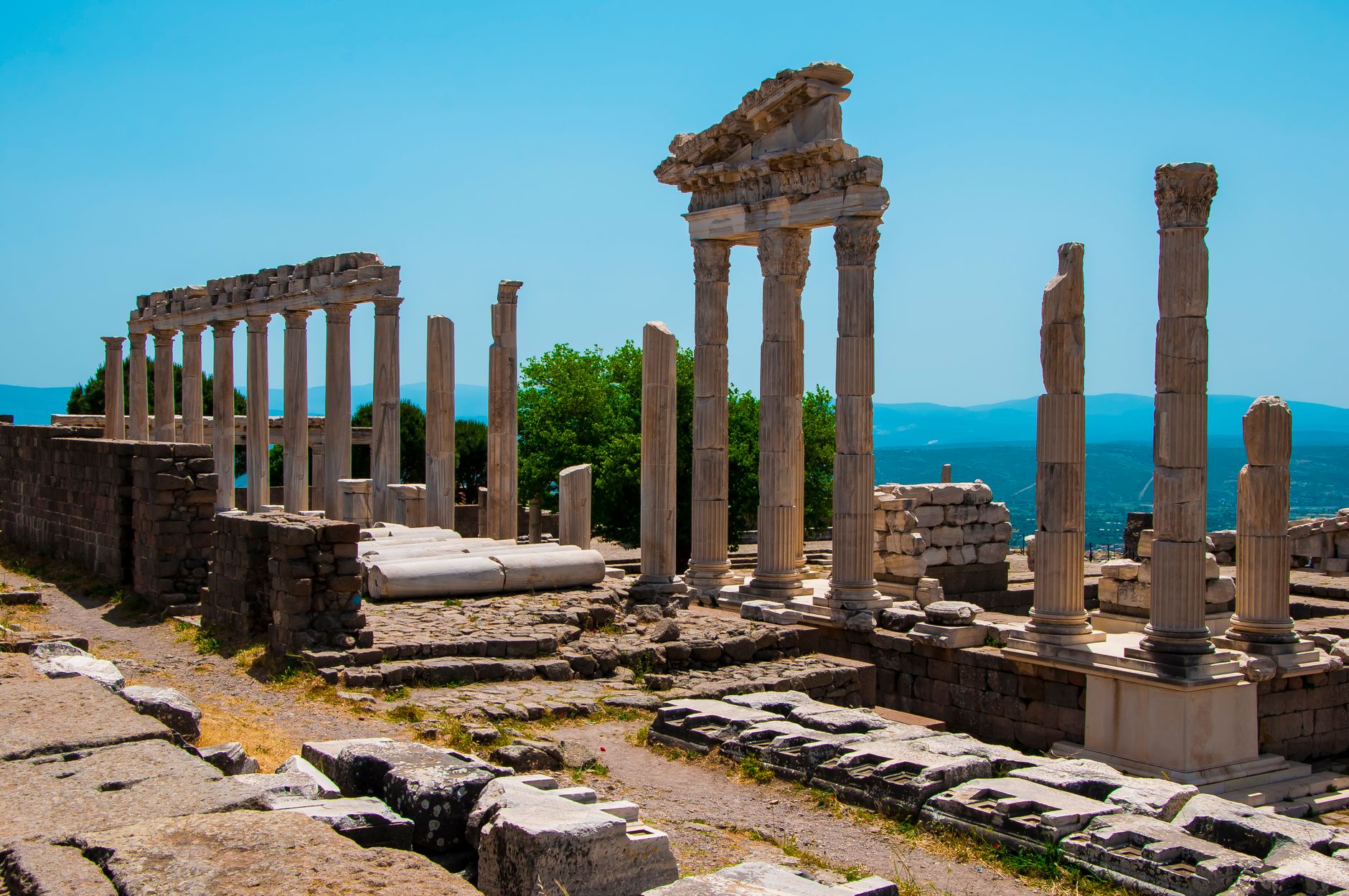
The Acropolis, located on the hill with the most commanding view of Bergama, has been excavated since 1878. The most important structure of the Acropolis, which rises among the walls surrounding it, is the Zeus Altar, which is now taken to the Berlin Pergamon Museum. The location of the Zeus Altar, built by Eumeles II to commemorate the victory against the Galatians, is of interest to tourists.
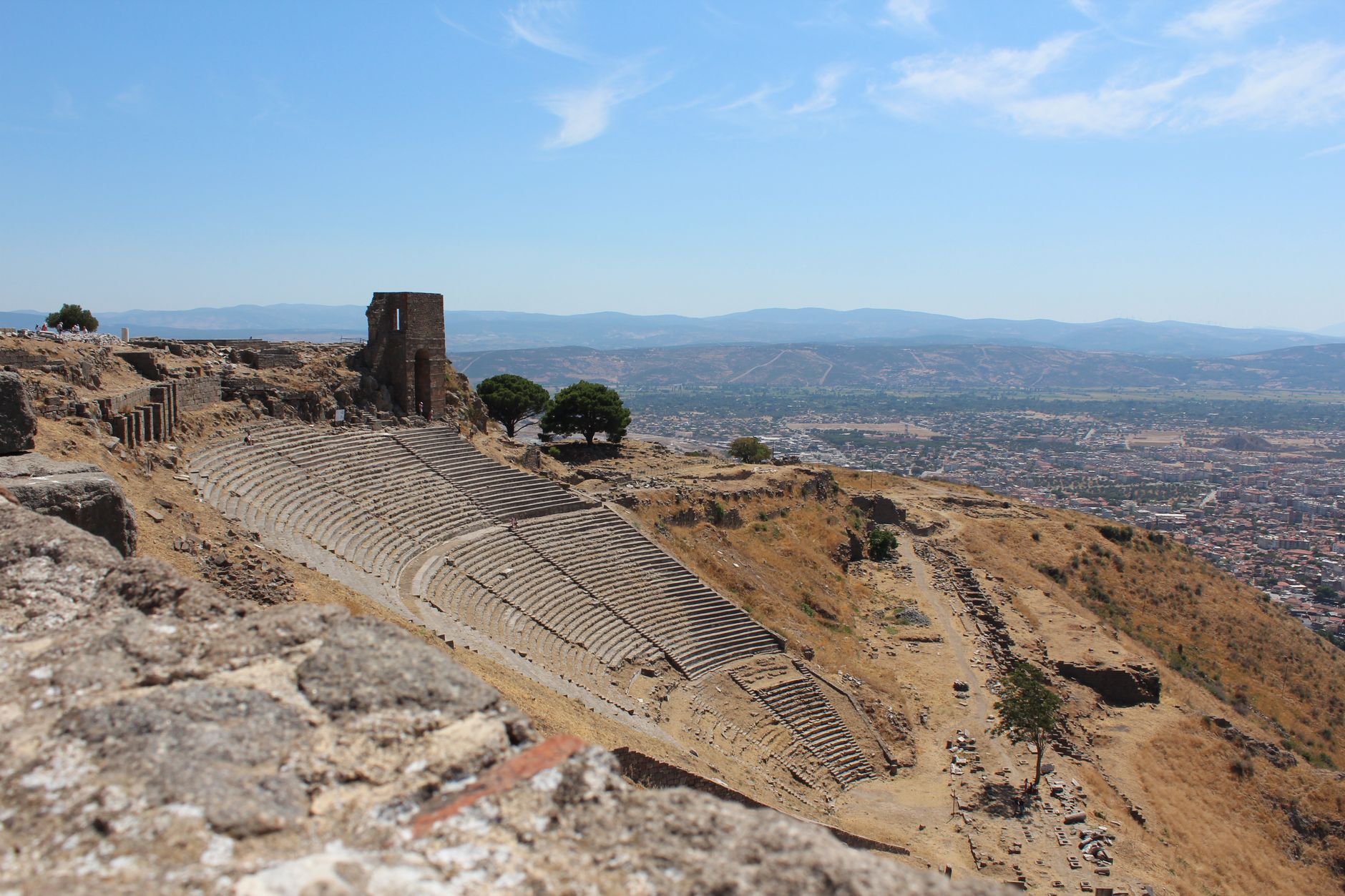
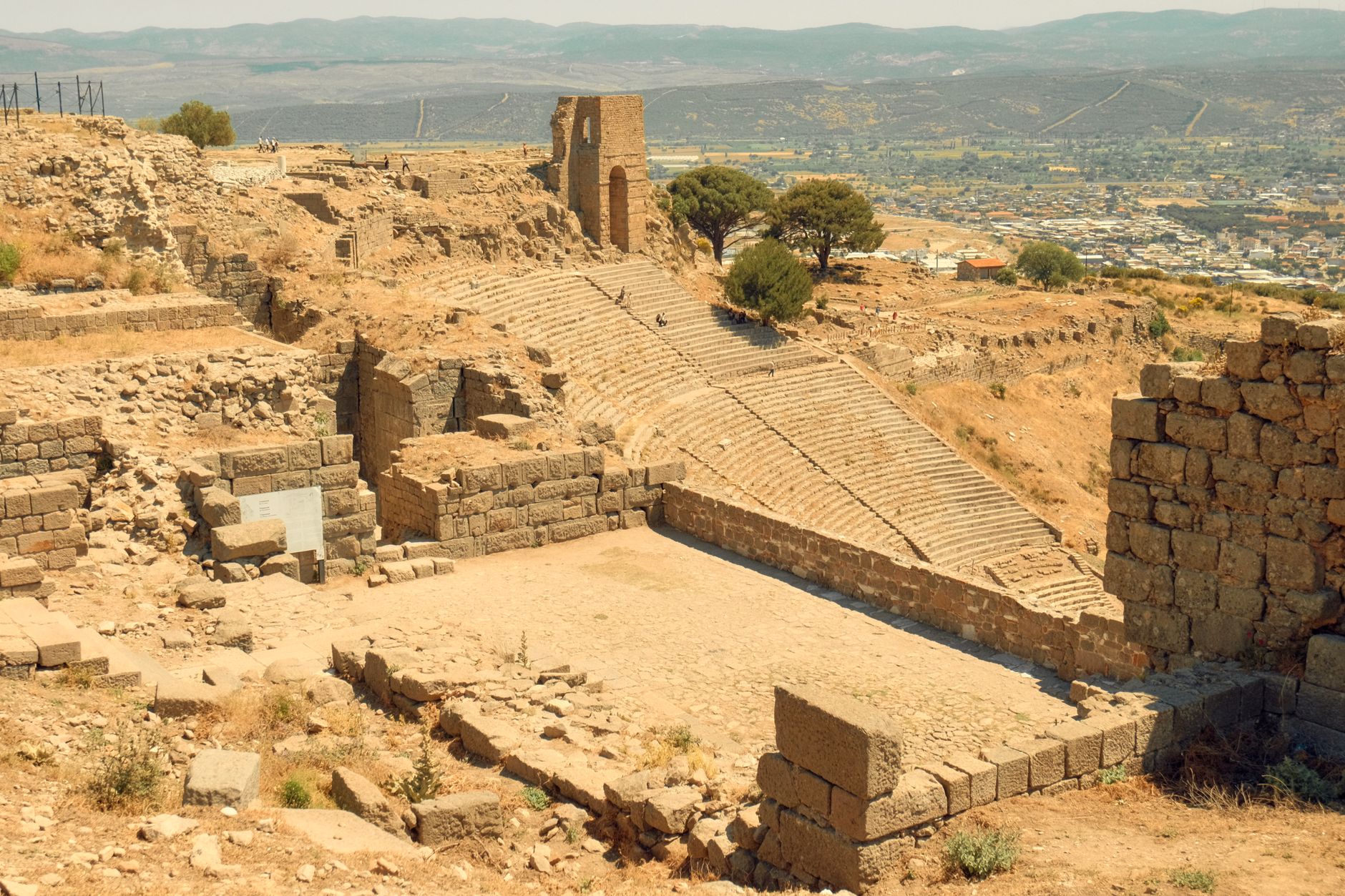
being watched. On the west-facing slope, there is the only theater of the ancient era with a portable stage, with a capacity of 10 thousand people.
In order not to block the road to the Acropolis theater, which is the steepest theater in the world, and to the temple of Dionysus behind it, and at the same time not to block the view of the temple, they built the stage building of the theater out of wood. When the play was not being played, they dismantled this portable wooden stage and provided access to the already narrow sacred terrace and temple road.
You May Like
Aspendos Ancient Theater Travel Guide