On a plain in central Turkey, beneath twin mounds of accumulated mudbrick, lies one of the most important and enigmatic settlements ever built: a Neolithic town of thousands of people who lived without streets, entered their homes through the roof, and buried their dead beneath their beds. This is the story of Çatalhöyük, one of the world’s oldest and largest known proto-urban settlements.
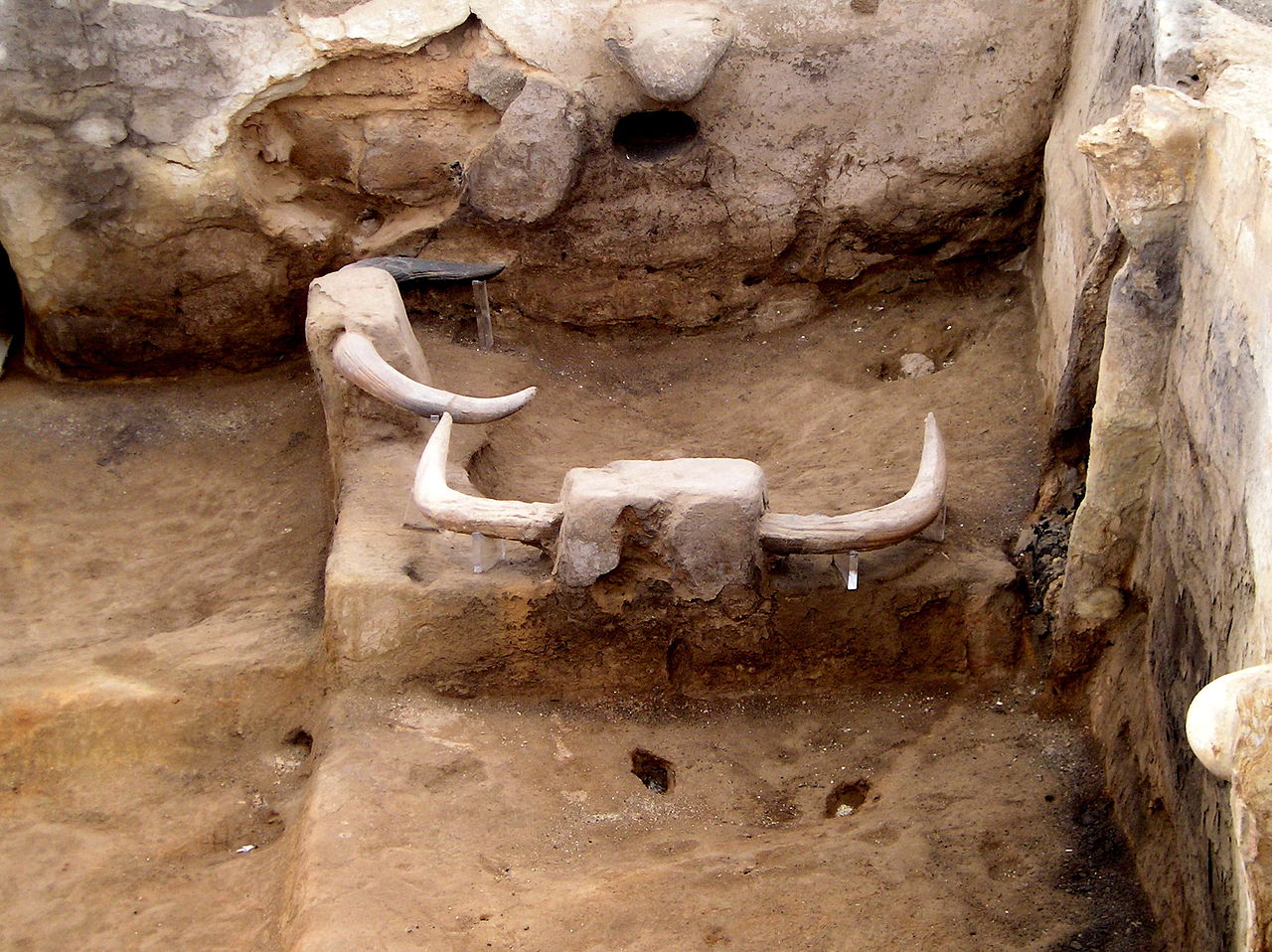
Table of Contents
- A town with no streets, entered through the roof
- Thousands of people, but not quite a city
- Life inside a Çatalhöyük house
- The dead beneath the living floor
- Bulls, leopards, and vultures on the walls
- The ‘mother goddess’ and the debate she inspired
- Farming, herding, and a changing diet
- Obsidian, pottery, and long-distance connections
- A society without rulers
- From Mellaart’s discovery to modern science
- A World Heritage Site and a Neolithic icon
- Standing at the dawn of the farming world
- The rhythm of a working day
- Houses rebuilt in the footsteps of the old
- What their bones reveal about health and hardship
- Why the great town was finally left behind
- What Çatalhöyük teaches us about being human
- Çatalhöyük among the world’s first settlements
- Walking above the excavations today
- Nearby in Anatolia’s ancient story
- Closing thoughts
A town with no streets, entered through the roof
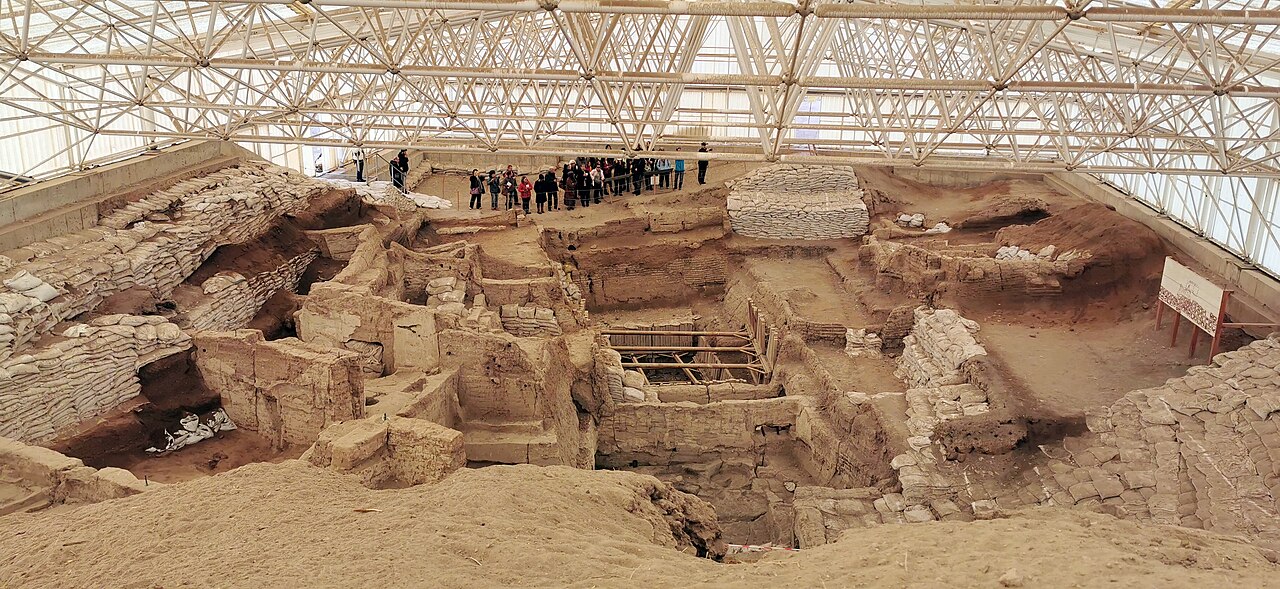
Çatalhöyük, rising from the Konya plain of central Anatolia around 7100 BCE, was unlike almost any settlement built before or since. It had no streets, no alleys, and no public squares. Instead, its mudbrick houses were packed together wall to wall in a dense honeycomb, so tightly that there was no ground-level space to walk between them. Residents moved across the rooftops of the town and climbed down into their homes through openings in the ceiling, using ladders that also served as the household’s smoke vent above the hearth below.
This extraordinary arrangement meant that the roofs of Çatalhöyük formed the true public space of the community, a raised plaza of packed earth where daily work, socializing, and movement all took place high above the enclosed rooms within. To imagine the town in life is to picture people crossing a continuous rolling surface of rooftops, descending into the dim, warm interiors of their houses only to sleep, cook, store food, and bury their dead beneath the floors on which they lived.

Thousands of people, but not quite a city
At its height, Çatalhöyük may have housed somewhere between five and eight thousand people, a staggering concentration for its time and one of the largest gatherings of humanity anywhere in the world during the Neolithic period. This alone makes the site pivotal, for it demonstrates that people were capable of living together in very large numbers thousands of years before the rise of the first true cities in Mesopotamia, and long before writing, kings, or centralized administration existed to organize such populations.
Yet archaeologists hesitate to call Çatalhöyük a city, and the distinction is instructive. Despite its size, the settlement shows little evidence of the features usually associated with urban life: there are no palaces, no temples set apart from ordinary homes, no marketplaces, and no obvious signs of rulers or a governing class. Every house looks broadly similar to its neighbors, suggesting a remarkably egalitarian community that achieved enormous scale without developing the social hierarchy and specialized institutions that would define cities elsewhere.

Life inside a Çatalhöyük house
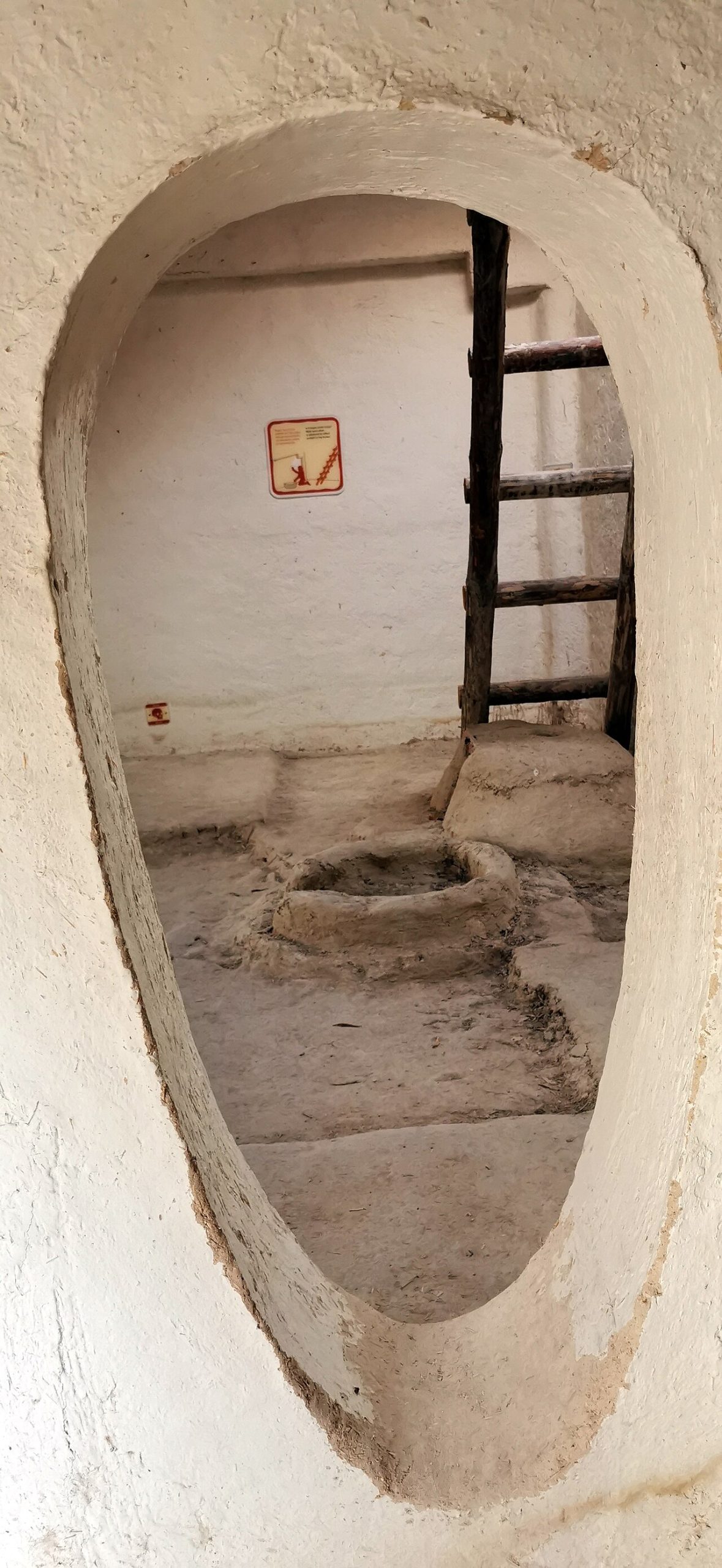
A typical Çatalhöyük house consisted of a single main room, kept scrupulously clean and divided into distinct zones for different activities. Raised platforms along the walls served for sitting and sleeping, an oven and hearth occupied one area near the entry ladder, and the walls were regularly replastered with white lime, giving the interiors a bright, cared-for appearance despite the absence of windows. Storage rooms and food-preparation areas were often set apart in adjoining smaller spaces, and the whole home was maintained with an evident concern for order and cleanliness.
What is most striking is how uniform these houses were and how tightly the community regulated the use of space within them. Certain platforms were consistently associated with particular activities, and the dead were buried in specific locations beneath the floors, indicating shared rules and beliefs about how a proper household should be arranged. Living at Çatalhöyük meant inhabiting a world governed by strong, unspoken conventions that shaped everything from where one slept to where one’s ancestors lay.
The dead beneath the living floor
One of the most haunting features of Çatalhöyük is that its people buried their dead beneath the floors of their own homes, often directly under the sleeping platforms where the living rested each night. Bodies were placed in the ground in a tightly flexed position, sometimes wrapped in matting or textiles, and a single house floor might conceal the remains of many individuals accumulated over generations of occupation. The living and the dead thus shared the same intimate space, separated only by a layer of plastered earth.
In some cases the treatment of the dead went further still. Skulls were occasionally removed from buried bodies after the flesh had decayed, and certain of these skulls were replastered and painted to recreate facial features, then kept, circulated, and sometimes reburied with new individuals. This practice of curating ancestral skulls, found at other Neolithic sites across the Near East, points to a powerful cult of ancestors at Çatalhöyük, in which the remembered dead remained active participants in the life of the household long after death.
Bulls, leopards, and vultures on the walls
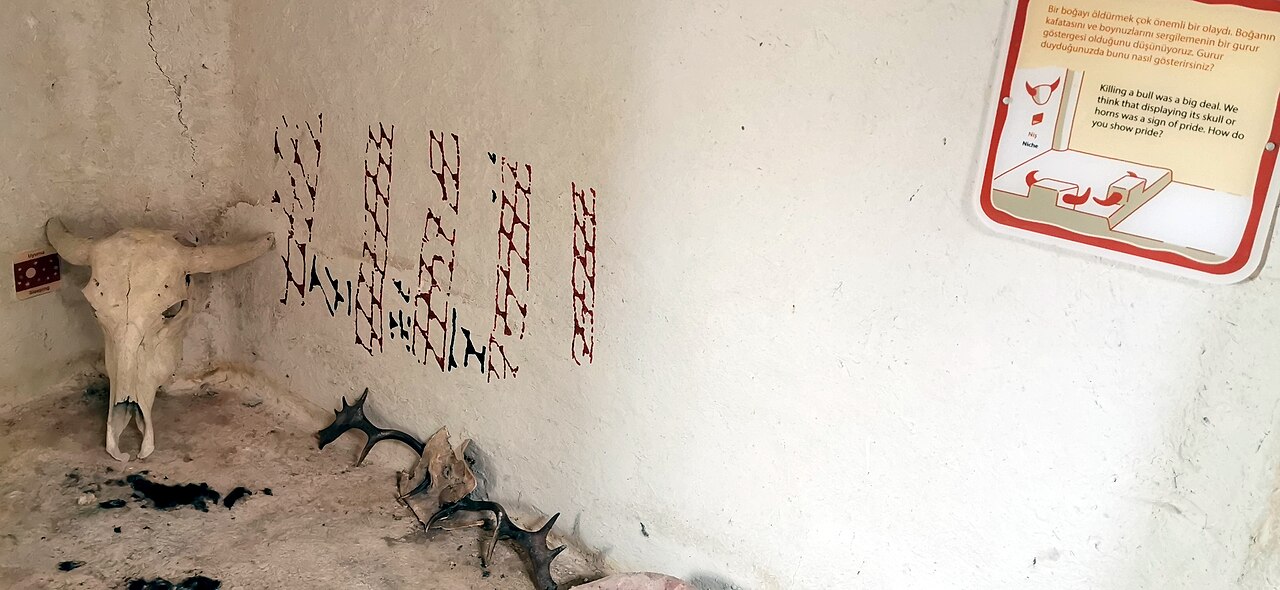
The interior walls of many Çatalhöyük houses were decorated with vivid paintings, moulded reliefs, and installations that offer a rare and vivid window into the Neolithic imagination. Recurring images include great bulls, leopards facing one another in symmetrical pairs, and vultures shown swooping over headless human figures, alongside geometric patterns and scenes that some interpret as depicting hunting or dancing. The walls were periodically replastered and repainted, so that layer upon layer of imagery accumulated over the life of a house.
Especially dramatic were the installations of real animal parts built into the architecture itself, most famously the horned skulls of wild cattle, or bucrania, mounted on walls and benches, their horns projecting into the living space. The imagery is overwhelmingly focused on wild and dangerous animals rather than the domesticated sheep and goats the community actually relied upon, suggesting that the symbolic world of Çatalhöyük was bound up with the untamed and the powerful, with forces beyond the settled, ordered life of the town.

The ‘mother goddess’ and the debate she inspired
Among the most famous finds from Çatalhöyük are small figurines, including the celebrated seated figure of a full-bodied woman flanked by two large felines, often interpreted as a mother goddess or fertility deity. This and similar figurines fueled a hugely influential twentieth-century theory that Çatalhöyük was the center of a goddess-worshipping, possibly matriarchal society, an idea that resonated far beyond archaeology and became central to modern spiritual and feminist movements seeking evidence of an ancient age of the goddess.
More recent excavation and analysis have complicated this romantic picture considerably. Many figurines depict animals or ambiguous forms rather than women, and detailed study of diet, workload, and burial treatment has found little evidence that women and men occupied fundamentally different or unequal social positions at Çatalhöyük, suggesting a broadly egalitarian rather than matriarchal society. The seated woman remains a genuinely important artifact, but scholars now approach the sweeping goddess theory with caution, treating it as one interpretation among several rather than established fact.
Farming, herding, and a changing diet
The people of Çatalhöyük were farmers and herders, cultivating wheat, barley, peas, and lentils and keeping domesticated sheep and goats, supplemented by the hunting of wild cattle, boar, and other game and the gathering of wild plants from the surrounding wetlands and plains. This mixed economy, combining early agriculture with continued hunting and gathering, is characteristic of the Neolithic transition, a period when communities had adopted farming but had not yet abandoned the older ways of drawing food from the wild.
Analysis of human remains and food residues has allowed archaeologists to reconstruct this diet in remarkable detail, revealing changes over the centuries of the settlement’s occupation as reliance on domesticated animals gradually increased. The location of Çatalhöyük beside a marshy river environment gave its people access to rich and varied resources, and it was almost certainly this natural abundance, as at so many early settlements, that made it possible for such a large population to sustain itself in one place for well over a thousand years.
Obsidian, pottery, and long-distance connections
Çatalhöyük’s inhabitants were skilled craftspeople who produced pottery, wove textiles, made tools of bone and stone, and worked obsidian, the sharp volcanic glass that was one of the most prized materials of the Neolithic world. Obsidian from sources in the volcanic highlands of Cappadocia was worked at Çatalhöyük into blades, points, and mirrors, and the settlement’s role in acquiring and distributing this valuable material connected it to exchange networks reaching across Anatolia and beyond.
The presence of materials such as Mediterranean seashells and other non-local goods shows that Çatalhöyük was not an isolated community but part of a wider web of contact and exchange linking the Neolithic peoples of the region. This trade in obsidian and other goods hints at how ideas, techniques, and beliefs may also have travelled between communities, helping to spread the shared Neolithic culture, with its distinctive symbolism and way of life, across a broad swath of the ancient Near East.
A society without rulers
Perhaps the most profound puzzle of Çatalhöyük is how thousands of people managed to live together for centuries without the rulers, hierarchies, and institutions that we tend to assume are necessary to organize large populations. The archaeological record shows no palaces, no elite burials conspicuously richer than the rest, and no houses that dominate the settlement, but rather a remarkable uniformity in which each household appears broadly equal to its neighbors, managing its own storage, production, and ritual life with considerable autonomy.
Some archaeologists suggest that the community was held together not by centralized authority but by a dense web of shared beliefs, rituals, and social rules, the kind of powerful common culture reflected in the uniform house layouts, the consistent burial practices, and the pervasive symbolic art. If so, Çatalhöyük represents a strikingly different model of large-scale human cooperation from the top-down states that would later emerge, one based on shared identity and mutual obligation rather than command, and it continues to challenge assumptions about the supposed inevitability of hierarchy.
From Mellaart’s discovery to modern science
Çatalhöyük was first excavated in the 1960s by the British archaeologist James Mellaart, whose discovery of its astonishing wall paintings, figurines, and dense architecture caused an immediate sensation and revealed a Neolithic world far richer and more complex than anyone had imagined. Mellaart’s flamboyant interpretations, particularly regarding the goddess cult, proved enormously influential but also controversial, and his work at the site ended amid academic disputes that left many questions unresolved for decades.
Excavation resumed in the 1990s under Ian Hodder, who brought to bear a new generation of scientific methods and a more cautious, multidisciplinary approach, involving specialists in everything from ancient plant remains and human bones to the microscopic analysis of house floors. This long-running modern project has transformed understanding of the settlement, refining its chronology, reassessing older theories, and building one of the most detailed pictures of daily Neolithic life available anywhere, making Çatalhöyük a benchmark site for how careful archaeology can reconstruct a vanished world.
A World Heritage Site and a Neolithic icon
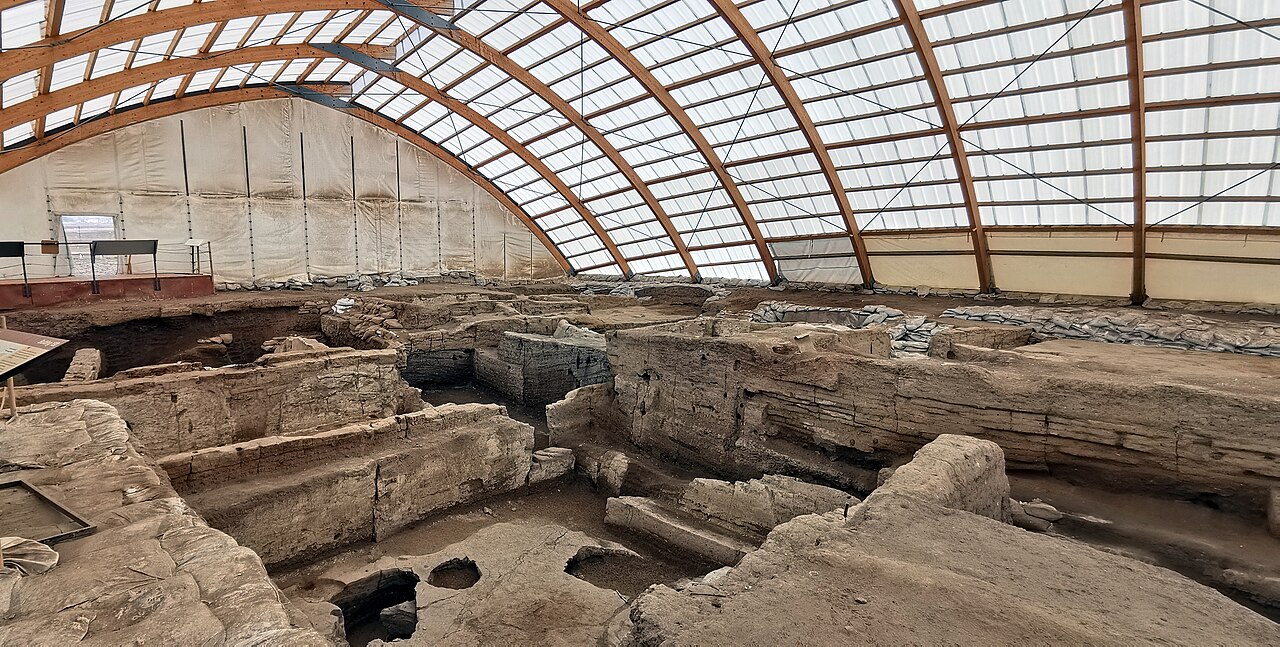
Recognized as a UNESCO World Heritage Site, Çatalhöyük today stands as one of the most important archaeological sites in the world for understanding the Neolithic revolution and the deep origins of settled human life. Protective shelters now cover the most significant excavation areas, allowing visitors to look down into the excavated houses and see the platforms, hearths, and wall installations much as they were uncovered, while a visitor center interprets the extraordinary story the site has to tell.
Its significance lies not in monumental grandeur, for Çatalhöyük built no pyramids or temples, but in the intimate detail with which it preserves the texture of everyday Neolithic existence at a moment of profound transformation in the human story. As one of the earliest and largest known farming settlements, and one that achieved great size without hierarchy, it occupies a unique and irreplaceable place in the global history of the oldest settlements, a mudbrick town on the Anatolian plain that still has much to teach us about who we are and how we came to live as we do.
Standing at the dawn of the farming world
Çatalhöyük occupies a crucial position in the long story of how humanity moved from foraging to farming, sitting a few thousand years after the first domestication of plants and animals in the Fertile Crescent and representing one of the fullest flowerings of the early agricultural way of life. Its inhabitants were among the pioneers of a transformation that would eventually remake the entire planet, tying human communities to fixed fields and permanent homes and setting in motion the population growth that would ultimately give rise to cities, states, and civilization as we know it.
Yet Çatalhöyük also shows how gradual and incomplete that transformation still was. Its people continued to hunt wild cattle and gather wild plants even as they farmed, and their art remained obsessed with the wild animals of an older world rather than celebrating the crops and herds that sustained them. In this tension between the settled and the wild, the domesticated and the untamed, Çatalhöyük captures the Neolithic revolution not as a finished achievement but as a living, unresolved process still working itself out in the minds and lives of its people.
The rhythm of a working day
Reconstructing an ordinary day at Çatalhöyük, archaeologists picture a community whose labor filled the rooftops and interiors from dawn to dusk. Women and men ground grain into flour on stone querns, tended ovens and hearths, wove baskets and textiles, knapped obsidian and flint into tools, and processed the meat, hides, and bones of animals both wild and domesticated. Studies of the skeletons reveal the physical toll of this life, with wear patterns on bones and joints reflecting years of repetitive, demanding work.
Analysis of the residues left on floors and tools has allowed researchers to map where specific tasks were carried out within and around the houses, revealing a highly organized use of space in which cooking, sleeping, craft production, and ritual each had their proper place. This attention to the fine grain of daily life, made possible by meticulous modern excavation, has turned Çatalhöyük into a place where the ordinary routines of Neolithic existence, so often invisible in the archaeological record, can be traced with unusual clarity and vividness.
Houses rebuilt in the footsteps of the old
One of the most telling patterns at Çatalhöyük is the way houses were repeatedly demolished and rebuilt directly on top of their predecessors, following the same layout and orientation across many generations. When a house had reached the end of its useful life, it was carefully filled in and a new one raised on the identical footprint, so that over centuries the settlement grew upward into the great mounds that survive today, each house a link in a chain stretching back through the ancestors.
This deliberate continuity suggests that particular houses, and the families or social groups attached to them, held deep significance that was passed down through time. Certain buildings, sometimes called history houses by archaeologists, contained especially large numbers of burials and elaborate symbolic installations, hinting that they served as focal points for extended kin groups or ritual communities. The rebuilding of houses in the footsteps of the old was thus not mere practicality but an expression of memory, identity, and belonging that bound the living to the generations who had come before.
What their bones reveal about health and hardship
The many human skeletons recovered from beneath Çatalhöyük’s floors have become a rich source of information about the health, diet, and hardships of early farming life. Study of these remains reveals a population that, while sustaining itself successfully for over a millennium, paid a price for its dense, settled existence. Evidence of infectious disease, dental problems from a grain-heavy diet, and the physical strain of hard daily labor all appear in the bones, offering a sobering counterpoint to any romantic image of Neolithic life.
Researchers have also found that living in such crowded conditions, packed tightly together with their animals and their refuse, exposed the people of Çatalhöyük to health challenges that more mobile foragers largely escaped. In this respect the settlement offers an early glimpse of a trade-off that would recur throughout the history of dense human living: the security and abundance of settled agricultural life came bundled together with new burdens of disease, crowding, and toil, a bargain that humanity has been negotiating ever since.
Why the great town was finally left behind
After more than a thousand years of continuous occupation, Çatalhöyük was gradually abandoned, its population dwindling and eventually dispersing to smaller settlements across the surrounding landscape. As with many ancient sites, the reasons are not fully understood and were probably multiple, including shifts in climate that altered the wetland environment on which the community depended, changes in agricultural practice, and perhaps social transformations that made the old dense way of living less viable or less desirable over time.
The later phases of the settlement show signs of change, including a loosening of the tightly packed architecture and shifts in the symbolic and ritual life that had bound the community together, hints that the powerful shared culture holding Çatalhöyük together was itself evolving. Whatever the precise causes, the abandonment of this great Neolithic town marked the end of a remarkable experiment in large-scale, egalitarian settled life, though the farming way of life it embodied would continue to spread and reshape the world long after its own mounds fell silent.
What Çatalhöyük teaches us about being human
More than nine thousand years after its founding, Çatalhöyük continues to occupy a singular place in our understanding of the human past, precisely because it resists easy categories and confounds tidy assumptions about how societies develop. It was a settlement of thousands without a ruler, a place of dense communal life without the machinery of a state, a farming town still enthralled by the wild, and a community that kept its dead close and its ancestors present in the most literal way imaginable. In each of these features it offers a different model of human possibility from the one that later history made familiar.
For this reason Çatalhöyük speaks to some of the largest questions we can ask about ourselves: how people learn to live together in great numbers, how belief and ritual can organize a society, and what was gained and lost as our ancestors committed themselves to the settled, farming life that underpins the modern world. Standing among its excavated houses, one confronts not a primitive precursor to be measured against our own achievements, but a fully realized human world, strange and sophisticated in its own terms, that still has the power to expand our sense of who we are and how else we might have lived.
Çatalhöyük among the world’s first settlements
Placed beside the other great early settlements of the ancient world, Çatalhöyük both belongs to a shared story and stands strikingly apart. Like the Mesopotamian towns that would follow at Eridu and Uruk, it drew a large population together around agriculture and a rich wetland environment, and like the ceremonial centers of Neolithic Britain it expressed a powerful communal symbolic life. Yet it predates the Mesopotamian cities by thousands of years and, unlike them, never developed the temples, rulers, and writing that transformed those later settlements into true cities and states.
This comparison highlights just how many different paths early human communities took toward complexity. The nearby monumental sanctuaries of Göbekli Tepe show monumental construction preceding farming; the eel-farming landscape of Budj Bim in Australia shows engineered abundance without crops at all; and Çatalhöyük shows dense, large-scale settled life achieved without hierarchy. Together these sites dismantle any notion of a single ladder of progress, revealing instead a rich diversity of ways in which our ancestors, on different continents and in different environments, first learned to live together in large and lasting communities.
Walking above the excavations today
For the visitor who makes the journey to the Konya plain today, Çatalhöyük presents itself as a pair of grassy mounds rising gently from the flat agricultural landscape, their unassuming exterior giving little hint of the density of human history layered within. Beneath protective shelters, raised walkways carry visitors above the excavated houses, allowing them to peer down into the plastered rooms, to see the ovens and sleeping platforms, and to grasp, in a way no photograph can convey, just how tightly the town was packed together.
A visitor center and a reconstructed experimental house help interpret the remarkable way of life the excavations have revealed, translating decades of painstaking research into a form that ordinary travelers can absorb. To stand above the excavations, looking down into homes abandoned nine thousand years ago yet still bearing the marks of the people who lived, worked, and were buried there, is to feel the immense depth of the human past with unusual immediacy, and to understand why this modest-looking site holds such an outsized place in the story of humankind.
Nearby in Anatolia’s ancient story
To place this site within its wider region, these related articles trace nearby chapters of the ancient story:
- Eridu and the memory of the world’s first city
- Before Uruk, Before Ur: the story of Ur
- Göbekli Tepe and the temples before farming
Closing thoughts
Çatalhöyük endures as a reminder that the human story took many forms, that people learned to live together in their thousands long before kings and cities, bound not by rulers but by shared belief. To descend in imagination into its plastered rooms, past the bulls on the walls and the ancestors beneath the floor, is to glimpse a world both utterly strange and deeply, recognizably human.
You May Like
Mafra, the Palace a King Built From a Vow


One thought on “A Town of Thousands With No Streets, Where the Dead Slept Beneath the Living: The Story of Çatalhöyük”