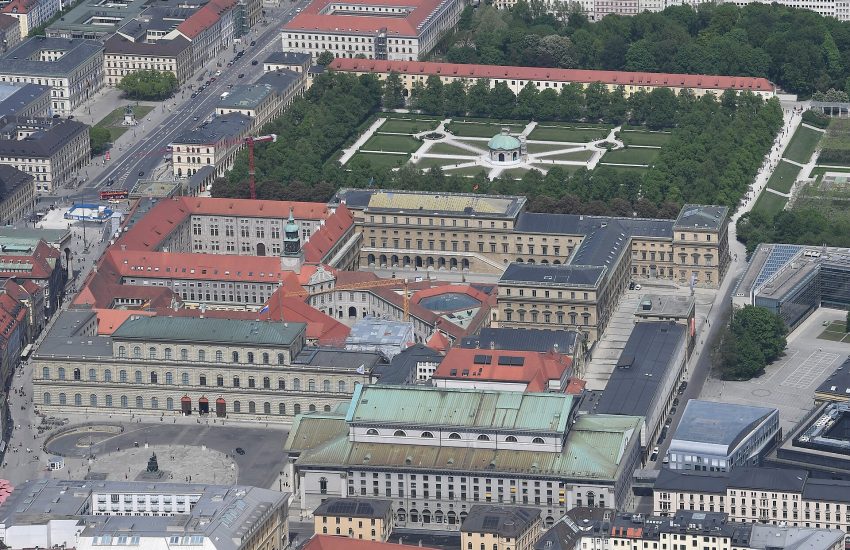
On the eastern edge of Paris, where the city gives way to a great wooded park, stands one of the most remarkable and least expected of all French castles: the Chateau de Vincennes. Here, in the midst of a modern metropolis, rises a genuine medieval fortress on a colossal scale, its walls and towers surrounding the tallest medieval keep in the whole of Europe, a mighty tower of pale stone soaring some fifty metres into the Parisian sky.
Vincennes is often overlooked by visitors dazzled by the grander names of the Loire, yet it has a claim to be one of the most important castles in French history. This was a favourite residence of the medieval kings, a fortress of government and a symbol of royal power, the place where Saint Louis is said to have dispensed justice beneath an oak, where an English king died, and where, in later centuries, famous philosophers were imprisoned and the last of many prisoners were shot.
From royal palace to state prison, from medieval stronghold to modern military archive, the Chateau de Vincennes has served the French state in almost every capacity across seven centuries, and it stands today as a magnificent survival of the medieval world at the very gates of Paris. Let us cross its moat and climb its great keep to discover the many lives of the fortress of Vincennes.

In This Article
- From Hunting Lodge to Fortress
- The Tallest Keep in Europe
- Charles V and a Troubled Age
- Walls, Towers and a Moat
- The Grand Gatehouse
- The Sainte-Chapelle of Vincennes
- Light Through the Windows
- The Rose Window
- Inside the Great Keep
- The Death of an English King
- A Prison for Philosophers
- Executions in the Moat
- Visiting the Château de Vincennes
From Hunting Lodge to Fortress
Vincennes began not as a fortress but as a place of pleasure. In the twelfth century, the kings of France established a hunting lodge here, in the great forest of Vincennes that stretched east of Paris, a convenient retreat where the court could enjoy the chase amid the woods. For generations, the kings came to Vincennes to hunt, and the manor grew in importance as a favourite royal residence just outside the capital.
The most famous of these early royal associations belongs to King Louis IX, the saintly monarch known as Saint Louis. According to a cherished tradition, this most just of kings would sit beneath an oak tree in the forest of Vincennes and hear the petitions and complaints of his ordinary subjects in person, dispensing justice directly and without ceremony. The image of the king beneath the oak became one of the great symbols of good and accessible kingship in French history.
Over time, however, the modest hunting lodge grew into something far grander and more serious. As the importance of Vincennes to the crown increased, so did the scale of its buildings, until in the fourteenth century it was transformed into one of the mightiest fortresses in France. The place of the hunt and of royal justice became a stronghold of royal power, a change that reflected the turbulent and dangerous times in which it took place.
The forest of Vincennes, in which the castle stands, was one of the great royal hunting grounds near Paris, and it remains today a vast park on the edge of the city, the Bois de Vincennes, one of the green lungs of the capital. The survival of both the fortress and its forest, side by side at the edge of a great modern city, is a remarkable link to the medieval world of the kings who hunted here and dispensed justice beneath the oaks.
The tradition of Saint Louis dispensing justice beneath the oak of Vincennes became one of the founding legends of French kingship, an image of the ideal ruler who was accessible to his humblest subjects and who placed justice above ceremony. Whether or not the story is literally true, it captured a powerful ideal, and it linked Vincennes forever with the memory of the most revered of all the medieval kings of France, lending the fortress a special aura of royal virtue.
The Tallest Keep in Europe
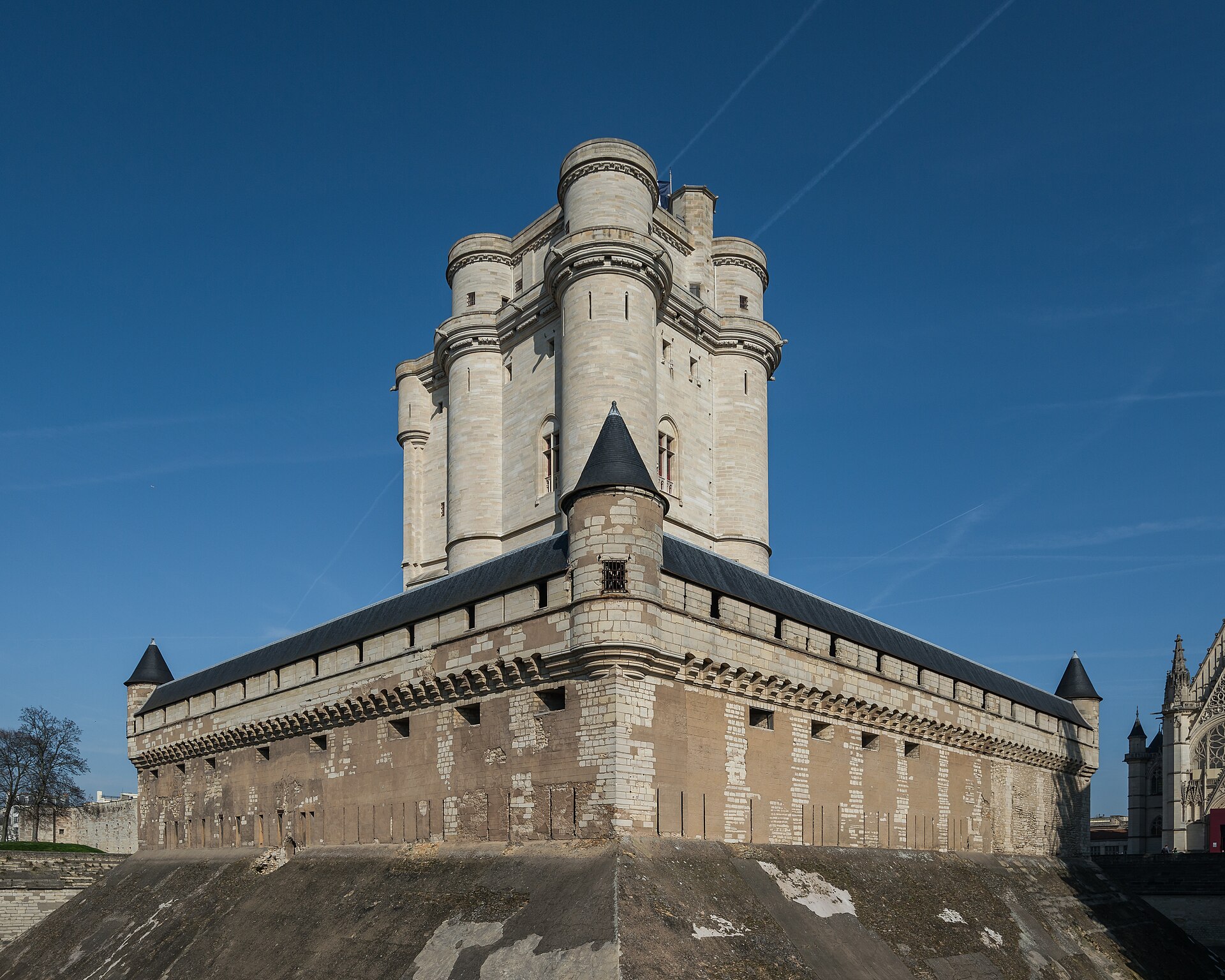
The heart of the Chateau de Vincennes, and its most astonishing feature, is its enormous keep, or donjon. Built in the fourteenth century, chiefly under King Charles V, this mighty tower rises some fifty metres into the air, making it the tallest medieval keep still standing anywhere in Europe. Square in plan, with slender round turrets at its corners, it dominates the whole fortress and the surrounding country, a breathtaking symbol of royal might.
The keep was far more than a defensive tower; it was a self-contained royal residence, a palace stacked vertically behind walls of tremendous thickness. Within its great height were arranged the king’s apartments, chambers, and all that a monarch might need, spread over several floors and linked by a spiral stair, so that the king could live in security high above the world, protected by walls that no army of the day could hope to breach.
To stand at the foot of the keep and look up is to feel the full weight of its ambition. This was a building designed to overawe, to proclaim in stone the power and security of the French crown at a time when both were under threat. That it still stands, complete and magnificent, on the edge of modern Paris, is one of the wonders of French heritage, a direct link to the age of Charles V and the height of medieval royal power.
The engineering of so tall a tower was a formidable achievement for its day. The walls of the keep are of tremendous thickness, and they were reinforced with iron tie-bars to give the structure the stability it needed to rise to such a height. The corner turrets not only strengthened the tower but housed staircases and small chambers, adding to the accommodation available within this vertical palace.
The keep was surrounded by its own wall and moat, forming a fortress within the fortress, a final stronghold that could hold out even if the outer defences fell. This arrangement, of a strongly defended keep set apart within the wider castle, gave the king an ultimate refuge of unparalleled security. In an age of civil strife and foreign war, such a secure retreat was worth almost any expense, and Charles V spared none in its building.

Charles V and a Troubled Age
The great fortress of Vincennes was largely the creation of King Charles V, who ruled France in the second half of the fourteenth century, during one of the most difficult periods of the Hundred Years War. Charles had lived through terrible times, including the capture of his father by the English and dangerous revolts in Paris itself, and these experiences left him with a keen awareness of the need for royal security.
It was against this background that Charles transformed Vincennes into a mighty stronghold. He built the great keep as a secure residence and refuge, and then surrounded the whole site with a vast rectangular circuit of walls, studded with nine great towers and ringed by a moat, creating a fortress capable of protecting the king and his government even if Paris itself should turn against them. Vincennes became, in effect, a fortified seat of government, a stronghold from which France could be ruled in safety.
Charles V was a thoughtful and cultured king, remembered as Charles the Wise, and Vincennes reflected both his fears and his ambitions. It was at once a fortress, a palace and a centre of government, and under him it became one of the principal residences of the French crown. The scale and sophistication of what he built here stand as a monument to a king who, in dangerous times, sought to secure his throne and his kingdom behind the strongest walls he could raise.
Charles V is remembered as one of the ablest of the medieval French kings, a ruler who patiently rebuilt the strength of the crown after the disasters of his father’s reign, recovering much of the territory lost to the English and restoring order to a troubled kingdom. His building at Vincennes was part of this wider work of restoring and securing royal power, a physical expression of his determination to place the monarchy beyond the reach of its enemies.
A cultured and bookish king, Charles was also a great patron of learning, and he assembled a famous royal library that would form the nucleus of the later national library of France. The fortress of Vincennes, at once a stronghold and a centre of government and culture, reflected the many sides of this remarkable king, who sought to secure his kingdom not only with walls and towers but with wise governance and the patronage of learning.
The building of Vincennes on such a scale was also a statement to the world, and to the rebellious Parisians in particular, that the crown intended to endure and to rule. In its towering keep and its mighty walls, Charles V left a lasting monument to the resilience of the French monarchy, which had survived defeat, captivity and revolt to emerge stronger than before. The fortress stands, in a sense, as his answer to the disasters of his age.
Walls, Towers and a Moat
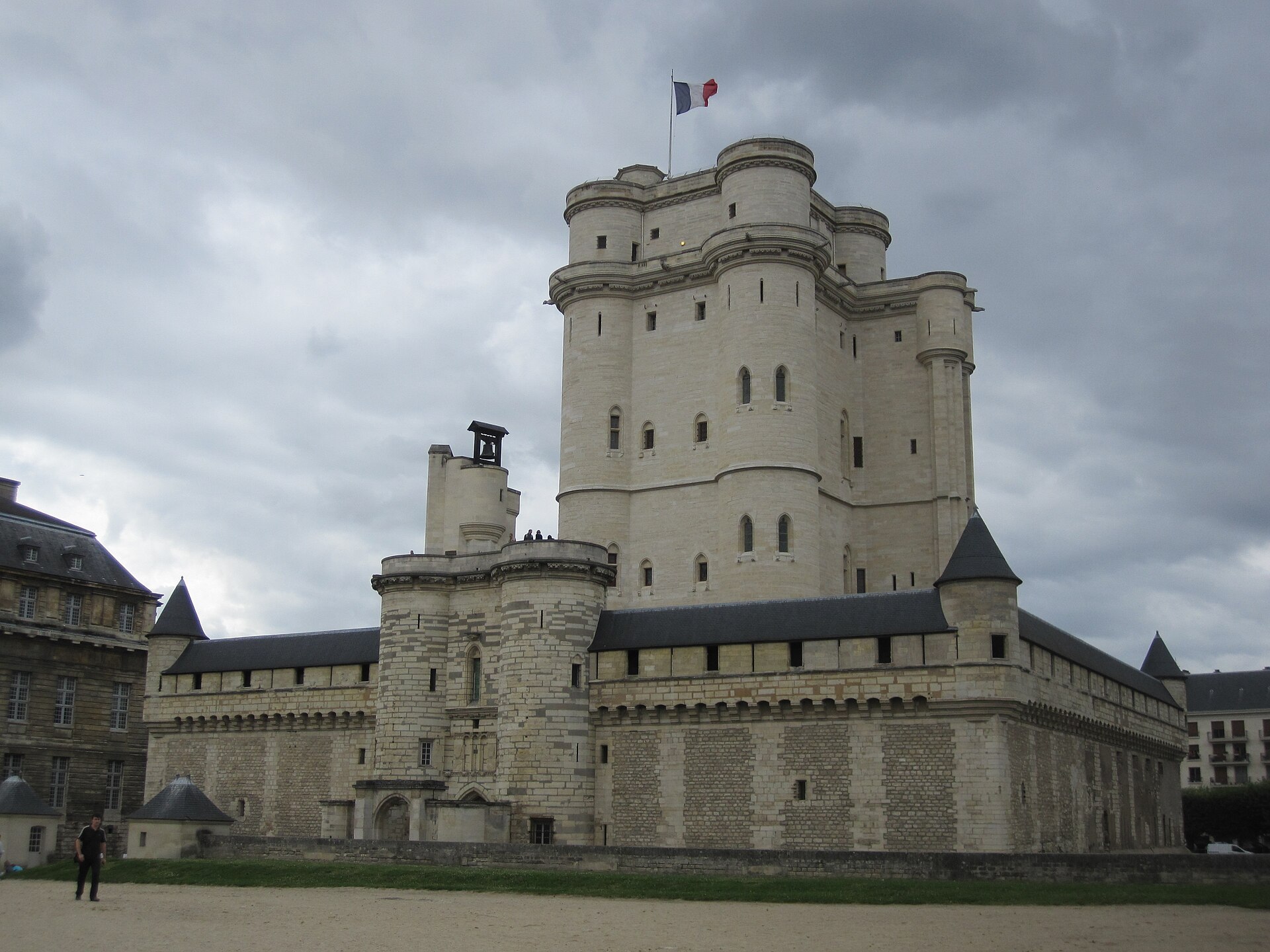
Around the great keep, Charles V and his successors built one of the most impressive fortified circuits in France. A vast rectangular curtain wall, over a kilometre in circumference, enclosed the whole site, and along it rose nine great towers, guarding every angle and stretch of the defences. A wide moat ran around the outside, and access was controlled through strongly fortified gatehouses. The result was a fortress of enormous strength, a true castle on the grand scale.
The scale of the enceinte is one of the things that surprises visitors most, for it encloses a huge area, more like a fortified town than a single castle. Within its walls stood not only the keep but the chapel, royal lodgings, and all the buildings needed for the life of a great royal residence and seat of government. The whole formed a self-contained world, secure behind its walls and moat at the edge of the capital.
Though some of the towers were later reduced in height, the great circuit of walls survives, giving a powerful impression of the fortress in its prime. To walk around the outside, along the line of the moat, is to appreciate the sheer ambition of Charles V’s creation, a medieval fortress of the first rank set down, astonishingly, within the bounds of modern Paris. Few cities in the world can boast such a stronghold at their gates.
The great enclosure of Vincennes was designed to function almost as a fortified royal town, containing within its walls everything the king and his government might need. In times of danger, the whole apparatus of the state could withdraw here behind the walls and moat, secure from the turbulence of Paris, which had more than once risen in revolt against the crown. Vincennes was, in this sense, an insurance policy against the dangers of the capital itself.

The Grand Gatehouse
The main entrance to the fortress was through the Tour du Village, the great gatehouse that controlled access from the direction of the town. This was a mighty structure in its own right, tall and strong, defended by all the devices of medieval fortification and serving as both a gateway and a stronghold. Passing through it, visitors entered the great enclosure of the castle, dominated by the keep rising ahead.
The gatehouse was more than a defensive work; it was also a symbol and a threshold, the point where the outside world gave way to the royal fortress. Its height and strength announced the importance of what lay within, and its defences ensured that no one entered except on the crown’s terms. Like the great gates of other royal castles, it combined the practical business of defence with the ceremonial function of impressing all who approached.
Today the Tour du Village remains one of the most striking features of the castle, a reminder of the elaborate care that medieval builders lavished on the defence of their gates, always the most vulnerable point of any fortress. To pass beneath it, as kings and courtiers, soldiers and prisoners once did, is to enter the long and dramatic history of Vincennes.
In later centuries, the Tour du Village and the other buildings of the fortress were adapted to new uses as the role of Vincennes changed, from royal residence to prison to military establishment. Through all these transformations the great gatehouse endured, a constant presence guarding the entrance to the fortress across the centuries, and it remains today one of the most impressive and evocative of all the buildings of Vincennes.

The Sainte-Chapelle of Vincennes
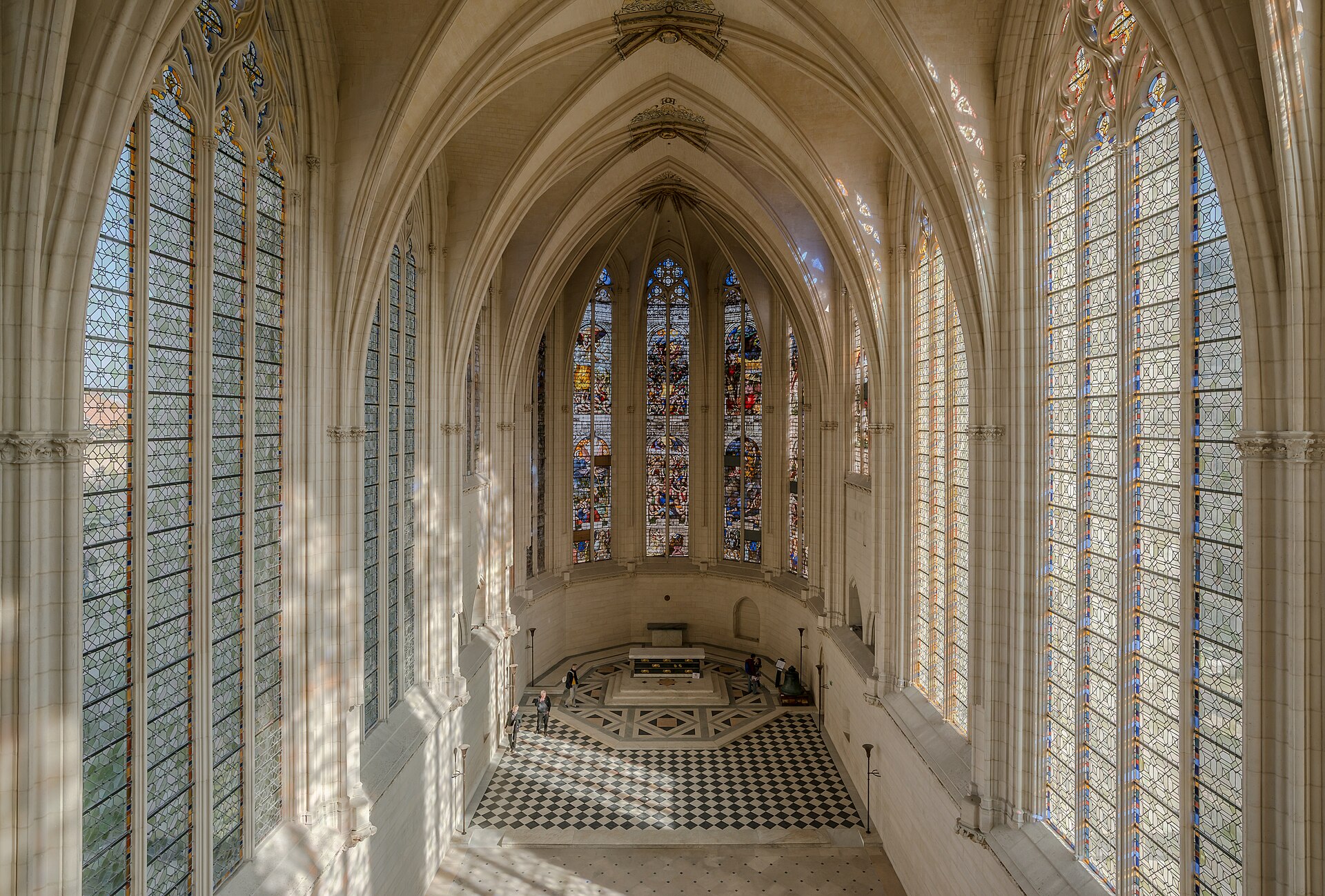
Within the walls of Vincennes stands one of its greatest treasures: the Sainte-Chapelle, a royal chapel of exquisite beauty, begun by Charles V and completed long after his death. Modelled on the famous Sainte-Chapelle in Paris, it was built to house holy relics and to serve as the private chapel of the royal household, and it is one of the finest examples of the Flamboyant Gothic style in France.
The chapel took a very long time to complete, and its construction spanned nearly two centuries, so that it combines the vision of Charles V with the craftsmanship of a much later age. Its greatest glory is its stained glass, a magnificent scheme of sixteenth-century windows filling the upper chapel with jewel-like light and depicting, among other subjects, the dramatic scenes of the Apocalypse, the visionary book that closes the Bible.
To step into the Sainte-Chapelle is to leave behind the martial world of the keep and the walls and to enter a space of soaring beauty and coloured light. Tall, elegant and richly decorated, it reveals the other face of Vincennes, not the fortress but the palace, not the stronghold of war but the sanctuary of faith and royal splendour. It is one of the loveliest interiors in the whole of Paris.
The dedication of the chapel as a Sainte-Chapelle, a holy chapel, followed the model established by Saint Louis with the famous Sainte-Chapelle in Paris, built to house the relics of Christ’s Passion. Such royal chapels were a special mark of prestige, associating the crown with the holiest of relics and the highest of religious functions, and the building of one at Vincennes underlined the importance of the fortress as a royal residence of the first rank.

Light Through the Windows
The stained glass of the Sainte-Chapelle is among the finest in France, and it repays the closest attention. The great windows of the upper chapel, filled with vivid colour and intricate design, transform the sunlight into a shifting play of red, blue and gold across the pale stone, creating an atmosphere of otherworldly beauty. For the royal household who worshipped here, it was a foretaste of heaven itself.
The scenes depicted in the glass are drawn largely from the Book of Revelation, the vision of the end of the world, and their dramatic imagery of angels and beasts, judgement and glory, would have made a powerful impression on those who gazed up at them. Medieval and Renaissance stained glass served as a kind of illustrated scripture, teaching and inspiring the faithful through colour and light, and the windows of Vincennes are a superb example of the art.
That such fragile treasures should have survived the centuries, through war, revolution and neglect, is little short of miraculous, and their preservation makes the Sainte-Chapelle one of the great artistic glories of Vincennes. To sit in the chapel as the light moves through the glass is to experience one of the most beautiful and peaceful moments that a visit to the fortress can offer, a world away from the grim history of the keep next door.
The long span of the chapel’s construction, stretching across the upheavals of the late Middle Ages and into the Renaissance, means that it embodies the changing tastes of several generations. Begun in one age and completed in another, it unites the vision of Charles V with the artistry of a much later period, and its stained glass in particular reflects the mature achievement of the sixteenth-century glass-painters, among the finest of their kind in France.

The Rose Window
Among the glories of the Sainte-Chapelle is its great rose window, a circular masterpiece of stone tracery and coloured glass set high in the wall of the chapel. Rose windows were among the supreme achievements of Gothic architecture, combining engineering, geometry and art in a single breathtaking form, and the rose of Vincennes is a fine example of the type, filling its end of the chapel with pattern and light.
The delicate stonework of the window, radiating out from the centre in an intricate web of tracery, holds panes of coloured glass that catch and transform the daylight. Such windows were designed to draw the eye and the spirit upward and to fill the sacred space with the beauty of coloured light, and they remain among the most admired features of the great churches and chapels of the Middle Ages.
The rose window of Vincennes is a reminder that this fortress, for all its military might, was also a place of great art and refinement. The same royal builders who raised the towering keep and the mighty walls also created spaces of exquisite beauty within them, and the contrast between the two, between the fortress and the chapel, is one of the things that makes Vincennes so rich and rewarding to explore.
The survival of the rose window and the other glass of the Sainte-Chapelle through the destruction of the twentieth century, when the fortress suffered severe damage in the closing stages of the Second World War, is particularly fortunate. The careful restoration of the chapel and its glass in the years since has ensured that this great artistic treasure can still be admired, a jewel of colour and light at the heart of the ancient fortress.

Inside the Great Keep
The interior of the keep is as impressive as its exterior, revealing how this mighty tower served as a secure royal residence. Behind its enormous walls, the rooms are arranged over several floors, including the king’s own vaulted chambers, reached by a spiral stair that winds up through the thickness of the masonry. Here the king could live, work and take refuge, high above the world and protected by walls of tremendous strength.
The vaulted chambers of the keep, with their great central pillars and ribbed ceilings, are fine examples of the architecture of the age, combining strength with a certain austere elegance. It was in rooms like these that the business of government was carried on and the treasures of the crown were kept, and later, when the keep became a prison, that famous captives spent their long years of confinement behind the same unyielding walls.
The keep also served as a stronghold for the crown’s most precious possessions, from treasure to important documents, kept safe behind its impregnable defences. To explore its interior is to understand how such a tower could be at once a palace, a fortress, a treasury and a prison, a self-contained world of royal power raised in stone, and to appreciate the extraordinary ambition of the builders who created it.
In later centuries, when the keep served as a prison, its very strengths as a royal refuge made it a formidable place of confinement. The thick walls and secure chambers that had protected kings now held prisoners fast, and the tower that had been built to keep enemies out was equally effective at keeping captives in. Few of those confined in the great keep of Vincennes ever escaped its walls.
The Death of an English King
Vincennes has witnessed many dramatic events, but few more significant than the death, within its walls, of a king of England. In 1422, King Henry V, the great warrior-king who had triumphed at the Battle of Agincourt and gone on to conquer much of France, died at Vincennes, struck down not in battle but by disease, at the height of his power and still a relatively young man.
Henry V had come close to making himself master of both England and France, and had been recognised as heir to the French throne. Had he lived, the history of both kingdoms might have been very different. Instead he died at Vincennes, leaving an infant son and a French war that would eventually turn against the English, so that all his conquests were in time undone. The fortress thus played its part in one of the great turning points of the Hundred Years War.
That so momentous a death should have taken place at Vincennes is a measure of the castle’s importance in the affairs of the age. This was no obscure stronghold but a fortress at the very centre of events, a place where kings lived and died and where the fate of nations could be decided. The memory of Henry V is one of many that cling to the ancient walls of the great fortress.
The circumstances of Henry V’s death at Vincennes, cut down by illness at the very height of his success, struck contemporaries as a dramatic example of the uncertainty of human fortune. The conqueror of so much of France, who had seemed on the verge of uniting the two crowns, was carried off by disease within the walls of a French fortress, leaving his great work unfinished. It was a turning point whose consequences would unfold over the following decades of the long Anglo-French war.

A Prison for Philosophers
In the centuries after its heyday as a royal residence, Vincennes took on a new and darker role: that of a state prison. The great keep, so strong and so secure, made an ideal place to confine prisoners of the crown, and over the years many notable figures were held here, often on the strength of the notorious sealed royal orders known as lettres de cachet, which allowed the king to imprison people without trial.
The prisoners of Vincennes included some of the most famous names of their age. The great philosopher and encyclopaedist Denis Diderot was confined here in the eighteenth century for his controversial writings. The fiery orator Mirabeau, later a leading figure of the French Revolution, spent time as a prisoner within these walls. And the notorious Marquis de Sade, whose name has passed into the language, was also among the captives held in the great keep.
That a fortress built to protect kings should have become a place to silence their critics is one of the ironies of its history, and it reflects the changing role of such castles in the age of absolute monarchy. The keep that had once sheltered the king from his enemies now confined those the king considered dangerous, and the story of its prisoners is a vivid chapter in the long history of Vincennes and of the French state.
The imprisonment of a figure like Diderot at Vincennes highlights the tensions of the age of the Enlightenment, when new ideas increasingly clashed with the authority of church and crown. The great keep, symbol of royal power, became a tool for suppressing the very thinkers whose ideas would eventually help to bring down the monarchy that imprisoned them. There is a deep historical irony in the fact that the fortress of the kings became a prison for the philosophers who challenged them.
The lettres de cachet, under which many prisoners were confined at Vincennes, became one of the great grievances against the old monarchy, a symbol of arbitrary royal power that could deprive a person of liberty without trial or appeal. Their use, and the imprisonment of famous men behind the walls of Vincennes, helped to fuel the resentment that would eventually explode in the French Revolution, in which Vincennes itself would play a part.

Executions in the Moat
The grimmest chapters of the history of Vincennes were played out not in the keep but in the moat, which in later centuries became a place of execution. Here, in the shadow of the great walls, the enemies of the state met their end before firing squads, and the dry ditch that had once been a defence became a place of death, adding a sombre note to the long story of the fortress.
Among those executed at Vincennes was the Duke of Enghien, a member of the royal house of Bourbon, who was shot in the moat in the early nineteenth century on the orders of Napoleon, in a notorious act that shocked all of Europe. It was one of the most controversial episodes of Napoleon’s career, and it fixed the moat of Vincennes in the public memory as a place of political violence and summary justice.
More than a century later, during the First World War, the moat was again the scene of an execution that captured the world’s imagination, when the famous dancer and accused spy known as Mata Hari was shot here by a French firing squad. These dark events form part of the long and varied history of Vincennes, a reminder that the fortress served the French state not only as a palace and a prison but, at times, as a place of execution.
The execution of the Duke of Enghien in particular sent shockwaves across Europe and did lasting damage to Napoleon’s reputation, for the duke was widely believed to have been innocent of the charges against him. The affair became a byword for ruthless political murder, and the moat of Vincennes, where it took place, was forever after associated with this dark episode. It is a striking example of how a great fortress could become a stage for the grimmest acts of state.

Visiting the Château de Vincennes
Today the Chateau de Vincennes is one of the most accessible great castles in France, standing at the very edge of Paris and reached in minutes by the city metro. Restored and opened to the public, it offers visitors the chance to explore a genuine medieval fortress on a grand scale without ever leaving the capital, a remarkable survival of the Middle Ages at the gates of a modern city.
A visit allows you to climb the great keep, the tallest in Europe, to explore its vaulted chambers and enjoy the views from its heights, and to admire the exquisite Sainte-Chapelle with its glorious stained glass. You can walk the line of the great walls, cross the moats, and trace the long and dramatic history of the fortress, from royal palace to state prison to military stronghold. Much of the site is still occupied by the historical service of the French armed forces, a fitting continuation of its long service to the state.
You will find the Chateau de Vincennes just east of central Paris, at the edge of the great park of the Bois de Vincennes, at the end of one of the city’s metro lines. For exact directions, here is a map link to guide you there: 48.8425, 2.4356. Cross the moat, climb the mighty keep, and discover one of the greatest and least expected of all French castles, a medieval fortress hidden in plain sight at the gates of Paris.
The contrast between the ancient fortress and the modern city that surrounds it is one of the most striking things about a visit to Vincennes. Emerging from the metro to find a genuine medieval castle, complete with keep, walls, moat and chapel, rising at the edge of the busy suburbs, is a memorable experience, and it makes Vincennes one of the most convenient as well as one of the most impressive of all the great castles of France to visit.
Castles Nearby
The Fortress at the Gates of Paris
The Chateau de Vincennes is one of the great survivals of medieval France, a mighty fortress raised at the edge of Paris and crowned by the tallest medieval keep in Europe. From its beginnings as a royal hunting lodge, through its transformation by Charles V into a stronghold of royal power, to its later lives as a prison, an arsenal and a place of execution, it has served the French state across seven centuries and witnessed some of the most dramatic events in the nation’s history.
To visit it is to encounter the Middle Ages in the most unexpected of settings, within the bounds of a great modern city, and to explore a fortress that is at once a palace, a stronghold, a chapel and a prison. Grand, ancient and endlessly various, the Chateau de Vincennes stands guard at the gates of Paris as it has for seven hundred years, a magnificent reminder of the age of kings and one of the finest castles in all of France.
You May Like
Mafra, the Palace a King Built From a Vow