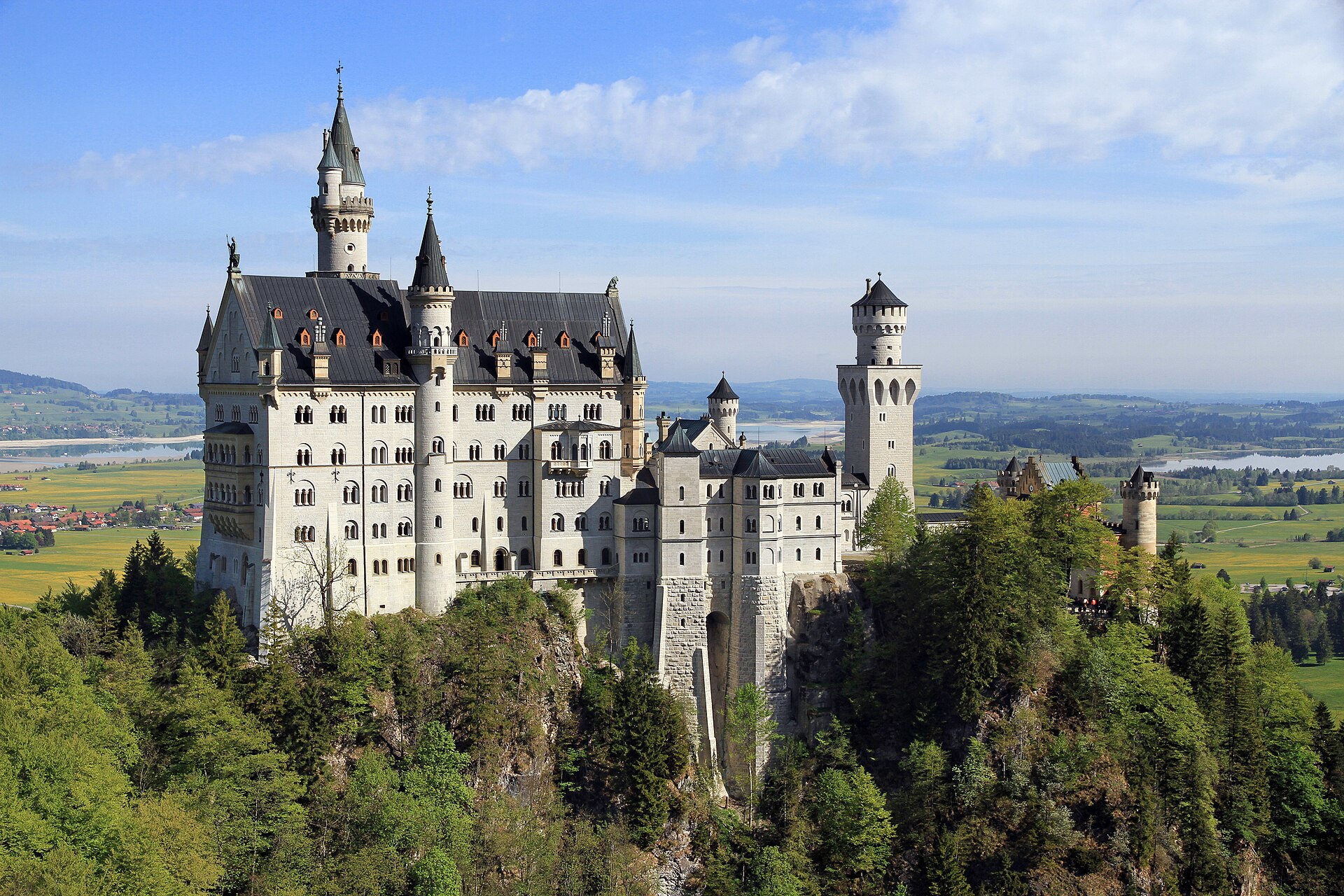
It is the castle of a thousand postcards, a hundred films, a million dreams. Rising white and turreted from a wooded crag high in the Bavarian Alps, its slender towers pointing at the sky, Neuschwanstein is perhaps the most famous castle in the world, the very image that comes to mind when anyone imagines a fairy-tale castle. It looks like something conjured from a storybook, and in a sense that is exactly what it is.
For Neuschwanstein is not an ancient medieval fortress at all, but a nineteenth-century fantasy, built by a shy, dreamy and troubled king who loved the legends of the Middle Ages and the operas of Richard Wagner more than the real world of politics and power. King Ludwig II of Bavaria poured his soul and his fortune into this castle, creating not a stronghold for war but a stage set for his dreams, a private world of romance and legend perched high above the mountains.
The story of Neuschwanstein is inseparable from the strange and tragic story of the king who built it, a man who died in mysterious circumstances before his dream castle was even finished. Grand, beautiful and haunted by the memory of its lonely creator, Neuschwanstein is a castle unlike any other. Let us climb the mountain path to Neuschwanstein and discover the dream of the king they called mad.
In This Article
- The Dream of a Young King
- A Castle for the Legends
- Building in the Mountains
- The Throne Hall
- The Singers’ Hall
- A Palace of Painted Legends
- The King’s Private World
- The Bridge and the View
- The Mad King?
- Death in the Lake
- A Dream Opened to the World
- The Castle That Inspired the World
- Visiting Neuschwanstein
The Dream of a Young King
To understand Neuschwanstein, you must first understand Ludwig II of Bavaria. He came to the throne as a very young man, tall, handsome and romantic, but temperamentally unsuited to the hard business of ruling. Ludwig was a dreamer, deeply in love with beauty, with music, with the myths and legends of the medieval past, and increasingly uncomfortable in the modern world of politics, war and industry that surrounded him.
As his reign went on, Ludwig withdrew more and more from public life and from the duties of kingship, retreating instead into a private world of imagination and art. He became a passionate admirer of the composer Richard Wagner, whose operas retold the great German legends of knights, swans and doomed love, and he dreamed of creating physical places where these legends could come to life. Out of these dreams came his great building projects, of which Neuschwanstein was the most famous.
Neuschwanstein was to be Ludwig’s personal refuge, a castle built not for the state or the court but for himself alone, a place where he could live surrounded by the legends and beauty he loved, far from the world that troubled him. It was, in a sense, an escape rendered in stone, the physical expression of one man’s longing for a purer, more beautiful and more heroic age than his own.
Ludwig’s relationship with Richard Wagner was one of the defining passions of his life. As a young king he became the composer’s patron and saviour, rescuing him from debt and making possible some of his greatest works, and the two shared a deep bond over their love of the old Germanic legends. Wagner’s operas, with their heroes, gods and doomed lovers, gave shape to Ludwig’s own longings, and the composer’s influence can be felt throughout Neuschwanstein, which is in many ways a monument to their shared vision.
The young king’s temperament was ill-suited to the age in which he lived. The later nineteenth century was a time of iron and steam, of realpolitik and rising industry, of the unification of Germany under the hard-headed statesmanship of Bismarck. In such a world, a dreamy king who preferred building fairy-tale castles to attending to affairs of state was bound to seem, at best, an anachronism, and Ludwig’s retreat into his private world of legend was in part a flight from a reality he found unbearable.
Ludwig had come to the throne while still only a teenager, thrust into a role for which he had little appetite and less aptitude. From the beginning he seemed happier in the world of art and imagination than in the council chamber, and as the pressures of kingship grew, so did his need for escape. The building of his fantasy castles became, in time, the true work of his life, the outlet for a soul that found the real world too harsh to bear.

A Castle for the Legends
The inspiration for Neuschwanstein came above all from the world of medieval legend and from the operas of Richard Wagner that brought those legends to life. Ludwig was captivated by the old German tales of heroes and knights, of the swan-knight Lohengrin, of the singers’ contests of the minstrels, and of the whole romantic vision of the Middle Ages, and he wanted to build a castle that would embody this world.
The very name Neuschwanstein, meaning New Swan Stone, reflects this, for the swan was a recurring symbol in the legends Ludwig loved and in the operas of Wagner, and it appears again and again in the decoration of the castle. Throughout Neuschwanstein, the walls are covered with paintings depicting the legends that so enthralled the king, turning the whole building into a kind of illustrated storybook of medieval romance.
In building Neuschwanstein, Ludwig was not trying to recreate a real medieval castle accurately, but to create an idealised vision of one, a castle as it appeared in the romantic imagination of his own age. The result is a building that is medieval in inspiration but thoroughly nineteenth-century in spirit, a dream of the Middle Ages more perfect and more beautiful than any real castle of that age ever was.
The swan, which gives the castle its name, was a symbol of deep significance to Ludwig, associated both with the legend of the swan-knight Lohengrin, a hero he identified with intensely, and with the arms of the local counts of Schwangau. Throughout Neuschwanstein, swans appear in the decoration, on taps and tiles, in paintings and carvings, a constant reminder of the legends that lay at the heart of the king’s imagination and of the castle’s very identity.

Building in the Mountains
The construction of Neuschwanstein began in 1869, on a dramatic site high on a rocky crag in the Bavarian Alps, near the older castle of Hohenschwangau where Ludwig had spent much of his childhood. The location was breathtaking but hugely challenging, and building a great castle on such a remote and difficult mountain site was an enormous undertaking that would continue for many years.
Interestingly, the design of Neuschwanstein was created not by a conventional architect but with the close involvement of a theatrical scene painter, which is fitting for a castle that was, in essence, a stage set for the king’s dreams. Ludwig was intimately involved in every detail of the design, and the whole building reflects his personal vision, a romantic composition of towers and gables and turrets designed above all for dramatic effect.
The building work went on for the rest of Ludwig’s life and beyond, for the castle was never fully completed. Vast sums were spent, straining the king’s finances and contributing to the crisis that would eventually engulf him, but slowly the great white castle rose on its crag, its towers climbing ever higher above the forests and lakes of the beautiful Alpine landscape.
The technical challenges of building Neuschwanstein were immense, and in meeting them the builders made use of the most advanced engineering of the age, even as they clothed the results in the forms of the Middle Ages. Behind its medieval-looking walls, the castle incorporated modern conveniences and up-to-date construction techniques, a reminder that Neuschwanstein, for all its romantic appearance, was very much a product of the nineteenth century and its technology.
The remote mountain site meant that everything had to be brought up with great difficulty, and a small army of workers laboured for years on the project. The scale of the undertaking, and the perfectionism of the king, meant that progress was slow and costs enormous, and the building was still far from finished when Ludwig died. Much of what visitors see today represents only a part of the vast complex that the king had originally envisioned.

The Throne Hall
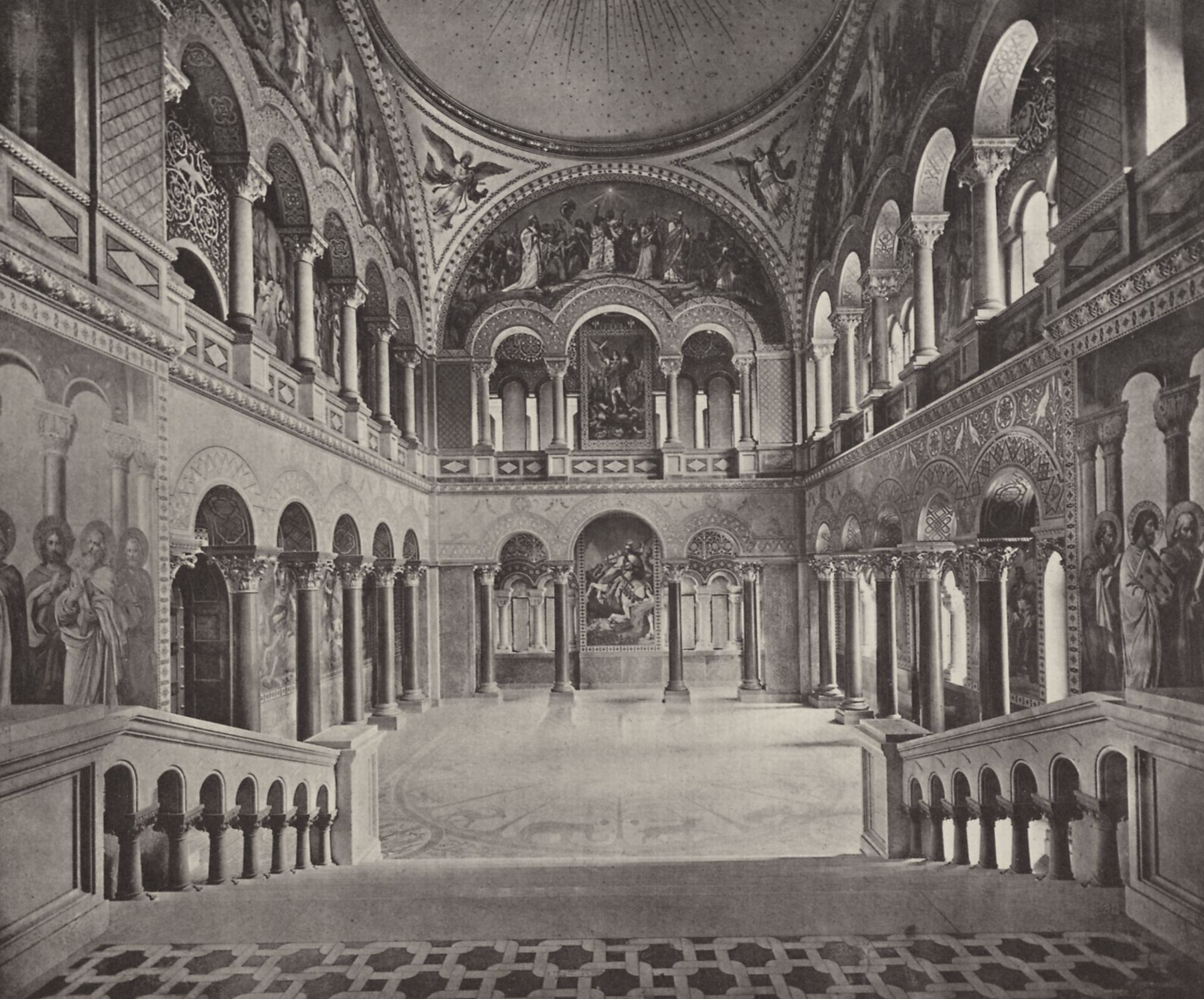
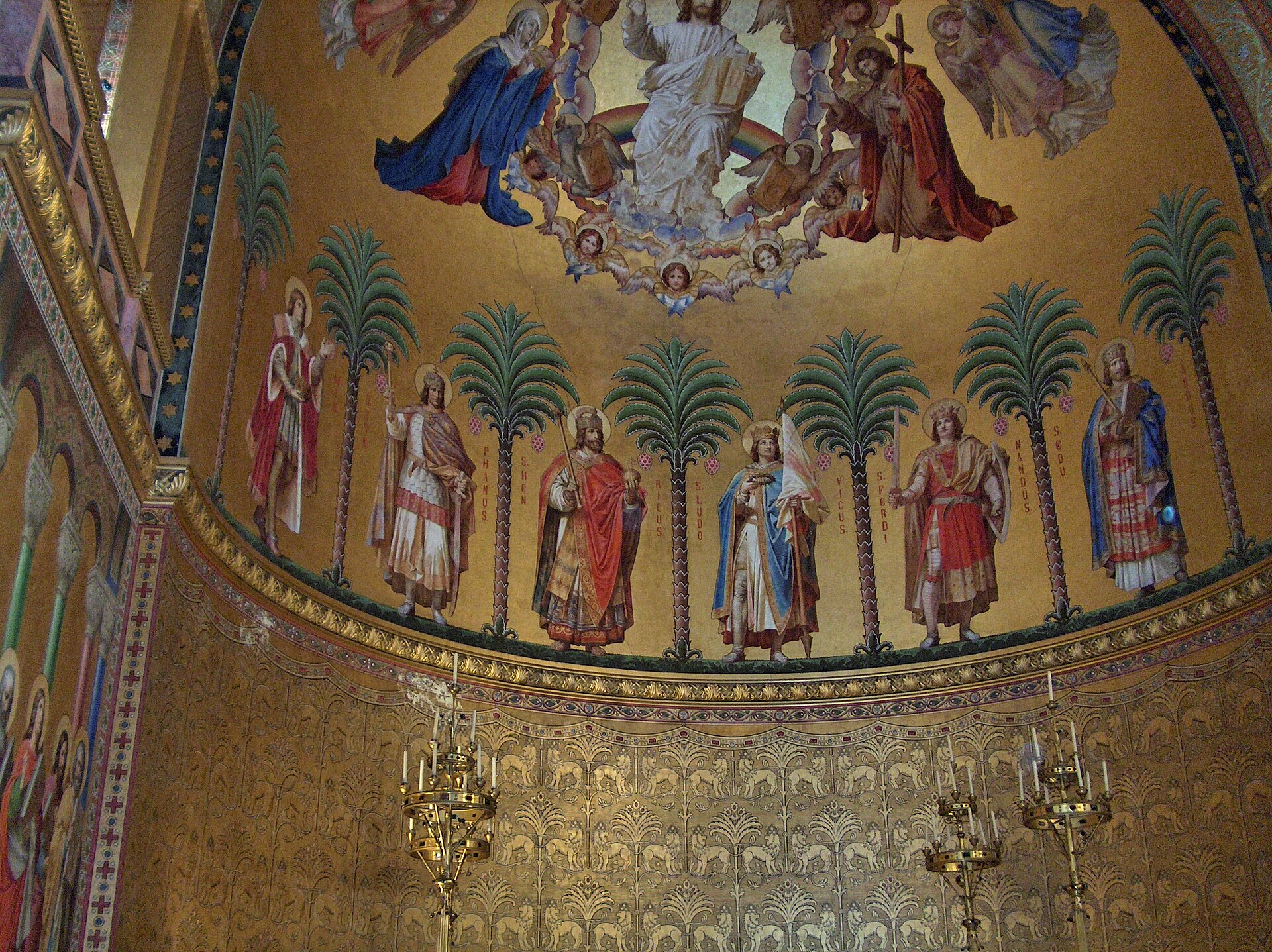
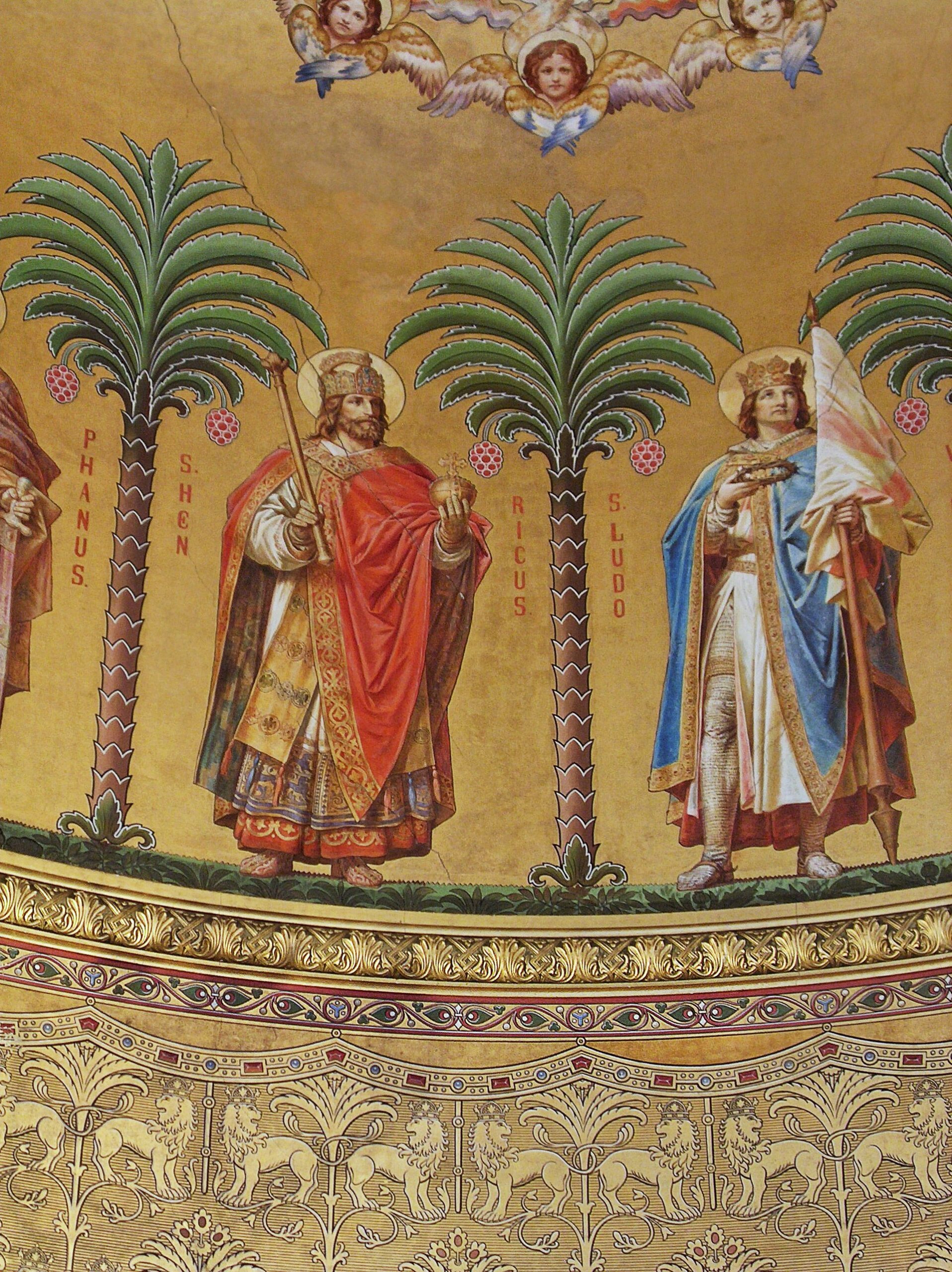
The most magnificent room in Neuschwanstein is the great Throne Hall, a space of overwhelming richness inspired by the churches of the Byzantine East. Rising through two storeys, gleaming with gold and colour, ringed with columns and painted with images of saints and kings, it is a room that takes the breath away, a sacred and majestic space fit for a king who saw kingship itself in almost mystical terms.
The Throne Hall reflects Ludwig’s exalted, almost religious idea of monarchy, presenting the king as a figure set apart, sanctified and above ordinary men. Its decoration draws on the imagery of Christian kingship and of the divine right of kings, and it was designed to be the spiritual heart of the whole castle, a place where the sacred nature of the royal office would be made visible in gold and colour.
Yet there is a poignant irony at the heart of this magnificent room, for the throne itself, the very focus of the whole hall, was never made. Ludwig died before the room could be completed, and the great golden hall was left without the throne it was built to hold. The empty space where the throne should stand is a fitting symbol of the whole castle, a magnificent dream left forever unfinished by the death of its creator.
The design of the Throne Hall drew on the great churches of the Byzantine world, and above all on the imagery of the Christian emperors of the East, whom Ludwig admired as models of sacred, God-given kingship. Its two tiers of columns, its glittering mosaics and murals, and its apse where the throne was to stand all evoke the atmosphere of a great church, reflecting the king’s almost religious conception of his own royal office.
The absence of the throne, never completed before Ludwig’s death, gives the hall a strange and haunting quality. All the magnificence of the room converges on an empty space, a void where its whole meaning should be focused. It is impossible not to read this as a symbol of Ludwig himself, a king who dreamed of a sacred and exalted monarchy but who was, in the end, stripped of his power and denied even the completion of his greatest room.

The Singers’ Hall
Another of the great rooms of Neuschwanstein is the Singers’ Hall, or Sängersaal, one of the largest and most important spaces in the castle. This magnificent hall was inspired by the famous minstrels’ hall of the medieval castle of the Wartburg, where, according to legend, the great singers of the Middle Ages held their contests of song, a subject dear to Ludwig and central to the operas of Wagner.
The Singers’ Hall is richly decorated with paintings depicting the legend of Parzival and the search for the Holy Grail, subjects drawn from the medieval romances that Ludwig loved and that Wagner had set to music. The whole room is a celebration of the world of medieval song and legend, a space designed for music and for the imagination, though in Ludwig’s lifetime it was never used for the performances for which it was intended.
This great hall, like so much of Neuschwanstein, was built for a dream rather than for practical use. Ludwig imagined it as a setting for the music and legends he loved, a place where the romantic world of the Middle Ages could come to life, and its decoration and its very existence testify to the depth of his devotion to that vision. It is one of the most beautiful and evocative rooms in the whole castle.
The choice of the Wartburg as the model for the Singers’ Hall was deeply significant, for that ancient castle was famous both as the setting of the legendary contest of the minstrels and as the place where the reformer Martin Luther had translated the Bible. For Ludwig, steeped in Wagner’s opera Tannhäuser, which dramatised the minstrels’ contest, the Wartburg represented the very essence of the romantic medieval world he sought to recreate, and his own Singers’ Hall was a homage to it.
A Palace of Painted Legends
Throughout Neuschwanstein, the rooms are decorated with a wealth of paintings, carvings and ornament that turn the whole castle into an illustrated encyclopaedia of medieval legend. The walls are covered with scenes from the old German tales and the operas of Wagner, so that wherever the visitor looks, the stories that so enthralled the king unfold across the walls in glowing colour.
These decorations were not mere ornament but the very heart of the castle’s purpose. Ludwig wanted to live surrounded by the legends he loved, to be able to look up at any moment and see the heroes and stories of his imagination brought to life around him. The paintings of Neuschwanstein are a window into the king’s inner world, a world of knights and swans, of doomed love and heroic quest, of a Middle Ages more beautiful than any that ever really existed.
The craftsmanship of the interiors is of the highest quality, reflecting the vast sums that Ludwig lavished on his dream. Skilled artists and craftsmen worked for years on the decoration of the rooms, creating spaces of extraordinary richness and detail. The result is a series of interiors that are among the most sumptuous and imaginative of the nineteenth century, a fitting frame for the king’s romantic vision.
The subjects of the paintings were carefully chosen by the king himself, drawn from the medieval epics and the operas of Wagner that meant so much to him. Scenes from the legends of Tannhäuser, Lohengrin, Tristan and the Holy Grail unfold across the walls, so that each room is dedicated to a particular story or theme. To tour the castle is thus to move through the whole world of German romantic legend, room by painted room.
The King’s Private World
Beyond the grand state rooms, Neuschwanstein contained the private apartments where Ludwig actually lived during his brief stays at the castle. These rooms, too, were richly decorated with scenes from the legends he loved, and they included such marvels as an artificial grotto, complete with stalactites and coloured lighting, created to evoke the magical cave of one of Wagner’s operas. Even the king’s private life was to be lived amid the settings of romance.
Ludwig was an intensely private and increasingly reclusive man, and Neuschwanstein was designed to allow him to withdraw entirely from the world. He preferred to live at night and sleep by day, and he shunned the company of others, retreating into his dreams and his beloved legends. The castle was his sanctuary, a place where he could be alone with his imagination, far from the court and the demands of state that he found so oppressive.
There is something deeply melancholy about this vision of a king living alone in a vast and beautiful castle, surrounded by painted legends but shunning the company of real people. Neuschwanstein was built as a refuge, but it was also, in a sense, a gilded prison of the king’s own making, a beautiful world into which he retreated ever more completely as his troubles closed in around him.
The artificial grotto within the castle, with its stalactites, its pool and its coloured lighting, was one of the most remarkable of Ludwig’s creations, a piece of pure theatrical illusion built into the fabric of the castle. It evoked the magical Venus grotto of Wagner’s opera Tannhäuser, and it shows how completely Ludwig sought to surround himself with the settings of the legends he loved, blurring the line between the real castle and the fantastical world of the stage.
The Bridge and the View
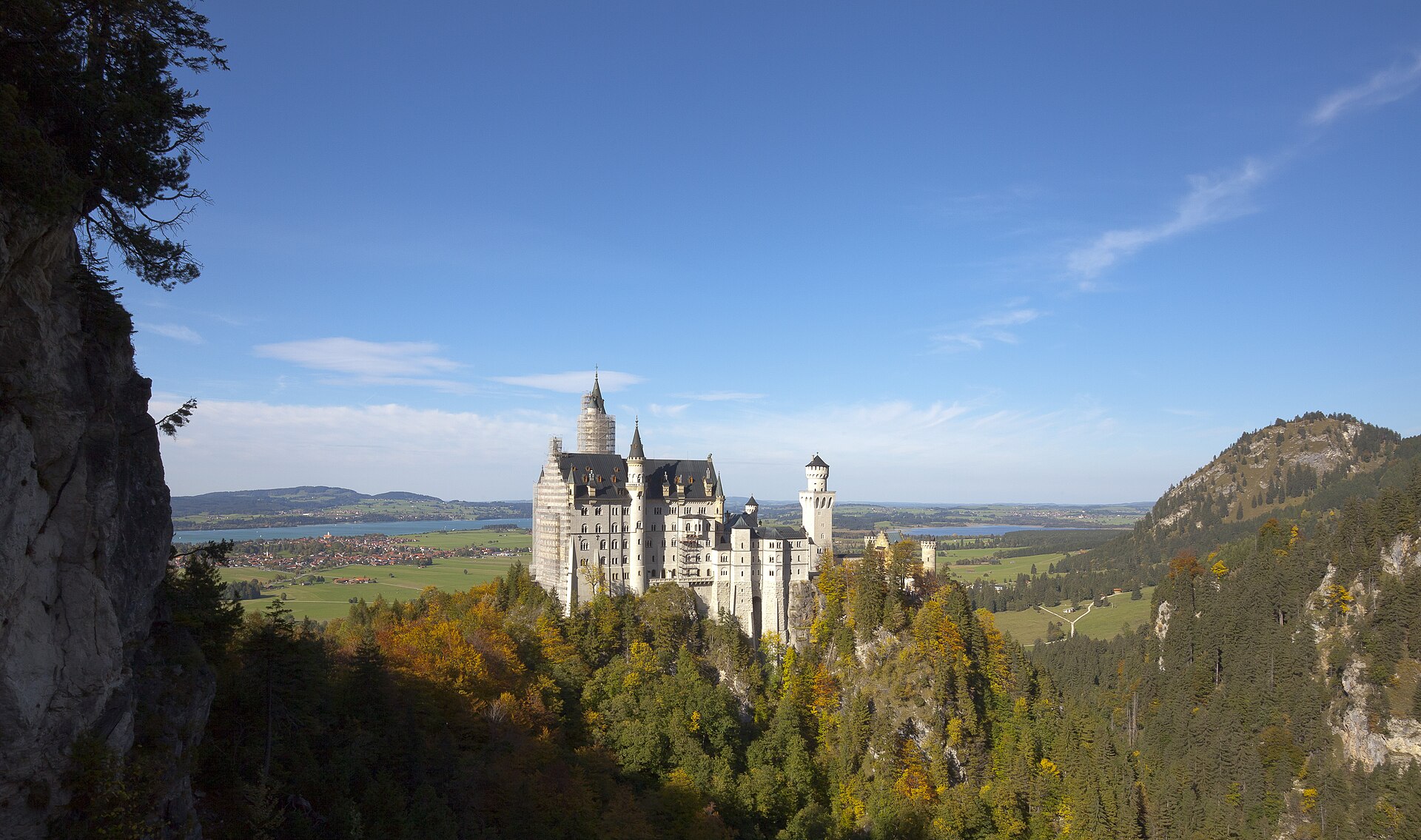
One of the most famous features associated with Neuschwanstein is not part of the castle itself but the bridge that offers the most spectacular view of it. High above a deep gorge, spanning a rushing waterfall, the Marienbrücke, or Mary’s Bridge, provides the classic postcard view of the castle, its white towers rising from the wooded crag against the backdrop of the mountains.
The bridge existed before the castle, but Ludwig had it rebuilt, and it became the ideal vantage point from which to admire his creation. From here, the full drama of Neuschwanstein’s design and setting can be appreciated, the castle appearing at its most fairy-tale and magical, seemingly floating above the forest with the Alps stretching away behind. It is from this bridge that most of the world’s most famous images of the castle have been taken.
The setting of Neuschwanstein was as important to Ludwig as the castle itself. He chose the site with immense care, high on its crag amid some of the most beautiful scenery in Bavaria, with lakes and mountains all around, so that the castle and its landscape together would create a single perfect vision of romantic beauty. The view from the Marienbrücke shows how completely he succeeded.
The Marienbrücke was named in honour of Ludwig’s mother, Queen Marie, and it spans a dizzying gorge with a waterfall plunging far below. Crossing it is not for the faint-hearted, but the reward is the single most famous view of Neuschwanstein, the one reproduced on countless postcards and in countless photographs. It is a view that captures the castle at its most magical, and it draws crowds of visitors eager to take home their own image of the fairy-tale castle.

The Mad King?
As the years passed, Ludwig’s behaviour grew ever more eccentric, and his obsessive building projects, of which Neuschwanstein was only one, threatened to bankrupt his personal finances. His withdrawal from the duties of kingship, his enormous spending, and his increasingly reclusive and unusual way of life alarmed his ministers and his family, and eventually a crisis broke that would end in tragedy.
In 1886, Ludwig’s ministers moved to depose him, declaring him insane and unfit to rule. A commission was sent to examine him, and, on the basis of statements from doctors who had never actually examined the king in person, he was declared mad and removed from power. Whether Ludwig was truly insane or merely eccentric and inconvenient has been debated ever since, and many have come to see him as more misunderstood than mad, a dreamer out of step with a harsh and practical age.
Whatever the truth, the consequences were swift and terrible. Deposed and taken into custody, Ludwig was removed from his beloved Neuschwanstein, where he had lived for only a short time, and confined at another castle by the shores of a lake. There, within days, he would meet a mysterious and tragic end that has never been fully explained, bringing the strange story of the dream king to its dramatic close.
The question of Ludwig’s sanity has fascinated historians and the public alike for well over a century. Certainly he was eccentric, reclusive and increasingly detached from reality, but whether this amounted to genuine madness, or simply to the temperament of an artist and dreamer unsuited to his role, remains a matter of debate. What is clear is that his deposition was driven at least as much by political and financial considerations as by any real concern for his mental health.
His enormous spending on his castles had alarmed his government, and there were fears that his projects would ruin the finances of the crown. Yet the money was his to spend on his own passions, and the castles he built have since repaid their cost many times over. In hindsight, the treatment of Ludwig appears to many as a tragedy, the destruction of a gentle, misunderstood dreamer by a world that had no place for him.

Death in the Lake
The end of Ludwig II is one of the great mysteries of European history. Only days after being deposed and taken into custody, the king went for an evening walk beside Lake Starnberg, in the company of the doctor who had declared him mad. Neither man returned alive. Their bodies were later found in the shallow water of the lake, and to this day no one knows for certain what happened.
The official verdict was suicide by drowning, but this explanation has never fully satisfied, for Ludwig was known to be a strong swimmer, and the shallow water where he was found made drowning seem unlikely. Rumours and theories have swirled ever since, some suggesting that the king was murdered, others that he died while trying to escape, and the true circumstances of his death remain unknown, adding a final layer of mystery and tragedy to his story.
Ludwig died at the age of only forty, leaving Neuschwanstein and his other great building projects unfinished. He had spent only a few brief periods living in the castle that has become his lasting monument, and he never saw it completed. His mysterious death cut short the strange and troubled life of one of the most romantic and tragic figures in the history of European royalty, and it has haunted the story of Neuschwanstein ever since.
The manner of Ludwig’s deposition troubled many even at the time. The declaration of insanity rested on flimsy evidence, and the speed and secrecy of the whole affair, followed so swiftly by the king’s mysterious death, gave rise to lasting suspicions. To many Bavarians, Ludwig was not a madman but a beloved and misunderstood king, cruelly removed by cynical politicians, and his death only deepened the sense of tragedy and injustice surrounding his end.
In the years since, Ludwig has come to be regarded with great affection, remembered less as a mad king than as a romantic dreamer, an artist on the throne whose real crime was to be out of step with his brutal, practical age. His castles, once seen as evidence of his folly, are now treasured as works of genius, and Ludwig himself has become one of the most beloved and romanticised figures in the history of Bavaria.
The tragedy of Ludwig’s end has lent Neuschwanstein a poignancy that deepens its beauty. Every visitor who marvels at the great white castle knows that the king who dreamed it barely lived within its walls and died before it was done, and this sense of a dream cut short hangs over the whole place. It is a monument not only to a vision of beauty but to the fragility of the dreamer who created it.

A Dream Opened to the World
In one of the great ironies of the castle’s history, Neuschwanstein, which Ludwig had built as a private refuge from the world, was opened to the public almost immediately after his death. The king had guarded his privacy fiercely and had intended the castle for himself alone, but within weeks of his death the doors were thrown open to paying visitors, and the crowds have never stopped coming since.
This decision, made partly to recoup some of the enormous cost of the building, transformed Neuschwanstein from a private dream into a public spectacle. The very castle that had been built to shut out the world became one of the most visited buildings on earth, drawing millions of people every year from every corner of the globe. Ludwig would perhaps have been horrified, but his creation found a new life as a monument admired by all.
There is something fitting, all the same, in the castle’s fame. Ludwig had built Neuschwanstein as a work of art and a place of beauty, and now that beauty is shared with the whole world. The crowds who come to marvel at it are, in their way, paying tribute to the vision of the lonely king, whose dream, though it destroyed him, has given lasting joy to countless others.
The revenues from the millions of visitors who now come to Neuschwanstein have long since repaid the enormous costs of its construction, and the castle has become one of the great economic assets of the region. In death, Ludwig gave to Bavaria a source of pride and prosperity far greater than anything his cautious ministers could have imagined, a final irony in the story of the king they had declared incompetent to rule.

The Castle That Inspired the World
Neuschwanstein has become far more than a famous building; it has become the very archetype of the fairy-tale castle, the image that shapes the way people all over the world imagine such places. Its white towers and dramatic setting have inspired artists, film-makers and designers, and its influence can be seen in countless representations of castles in art and popular culture.
Most famously of all, Neuschwanstein is widely believed to have inspired the design of the fairy-tale castles that appear in the films and theme parks of Walt Disney, so that its silhouette, transformed and multiplied, has become known to billions of people around the world, often without their realising the source. In this way, the dream of a reclusive Bavarian king has entered the imagination of the whole planet.
This extraordinary afterlife is perhaps the greatest irony of all in the story of Neuschwanstein. The castle that Ludwig built as a deeply personal refuge, an escape into a private world of legend, has become one of the most universally recognised images on earth, the shared property of the global imagination. Few buildings anywhere have had so profound an influence on the way we picture the world of fairy tales and dreams.
The influence of Neuschwanstein on the popular image of the castle can hardly be overstated. Its distinctive silhouette, with its cluster of white towers and its dramatic mountain setting, has become the template for countless fairy-tale castles in books, films, cartoons and theme parks. When children the world over draw a castle, or when a story calls for an enchanted stronghold, it is very often Neuschwanstein, in one form or another, that they are picturing.
Visiting Neuschwanstein
Today Neuschwanstein is one of the most visited castles in the world, drawing well over a million people every year to the mountains of southern Bavaria. Despite the crowds, it remains an unforgettable experience, for no photograph can quite prepare the visitor for the reality of the great white castle rising from its crag against the backdrop of the Alps, or for the richness of the interiors within.
A visit usually involves a climb or a ride up the mountain from the village below, followed by a guided tour of the state rooms, including the great Throne Hall and the Singers’ Hall, and the king’s private apartments. A walk to the Marienbrücke offers the classic view of the castle, and the surrounding landscape of mountains, lakes and forests is beautiful in its own right, well worth exploring before or after the tour.
You will find Neuschwanstein near the town of Füssen, in the far south of Bavaria, close to the Austrian border, easily reached from Munich for a day trip. For exact directions, here is a map link to guide you there: 47.5576, 10.7498. Climb the mountain path, stand beneath the white towers, and step into the dream of King Ludwig II, the most famous fairy-tale castle in the world.
The neighbouring castle of Hohenschwangau, where Ludwig spent much of his childhood, stands close by and makes a natural companion to a visit to Neuschwanstein. Older and more genuinely historic, it offers a fascinating contrast to Ludwig’s fantasy castle and helps to explain the influences that shaped his imagination. Together, the two castles and their spectacular Alpine setting make this one of the most rewarding destinations in all of Germany.

The Castle of a Dream
Neuschwanstein is a castle born not of war but of dreams, the creation of a lonely and romantic king who loved the legends of the Middle Ages more than the world he lived in. It is not an ancient fortress but a nineteenth-century fantasy, a stage set for the imagination, and yet it has become more famous than almost any genuine medieval castle, the very image of what a fairy-tale castle should be.
Behind its white towers lies the strange and tragic story of King Ludwig II, who poured his soul into this dream and died mysteriously before it was finished, never seeing his creation completed or knowing that it would become one of the most beloved buildings on earth. To visit Neuschwanstein is to enter his dream, a vision of romance and beauty raised high above the Bavarian Alps, and to feel the enduring power of one man’s longing for a more beautiful world.
You May Like
Mafra, the Palace a King Built From a Vow


4 thoughts on “Neuschwanstein: The Fairy-Tale Castle of the Dream King”