Almost everyone who comes to this corner of Bavaria comes to see Neuschwanstein, the impossibly famous fairy-tale castle on its crag. But there is a second castle in the valley below, a warm yellow palace beside a mountain lake, and to skip it in the rush to the more famous one is to miss half the story. This is Schloss Hohenschwangau, and without it the great castle on the hill above would very likely never have been built at all.
Hohenschwangau is the quieter, older, and in many ways more human of the two. Where Neuschwanstein is a lonely fantasy that its royal builder barely lived to inhabit, Hohenschwangau was a real home, a place where a family actually lived, where children grew up, where a queen kept her rooms and a future king spent the summers of his boyhood gazing at the mountains. It was here, in this romantic yellow castle by the Alpsee, that the dream which would become Neuschwanstein first took root in a young prince’s imagination.
To understand the famous castle, in other words, you must first understand this one. Hohenschwangau is where the Bavarian royal family played out its romantic love of the Middle Ages and of German legend, where the boy who became the Dream King was shaped, and where the swan that gives the whole valley its name spread its wings across the walls. Come down from the crowds on the hill with me and we will explore the castle that made a king, and made a legend.

In This Article
- The Castle of the Swans
- Overshadowed by a Famous Neighbour
- A Medieval Ruin Reborn
- A Crown Prince’s Romantic Vision
- Walls Painted With Legend
- A Queen Who Climbed Mountains
- Beside the Alpsee
- A Window Onto the Mountains
- The Boy Who Became the Dream King
- The Swan Knight and the Composer
- Still in the Family
- The Castle Through the Year
- Visiting Hohenschwangau
The Castle of the Swans
The very name of the place is a clue to its character. Hohenschwangau means, roughly, the high district of the swan, and the swan is everywhere here, in the name of the castle, in the lakes below, and painted and carved throughout the building. Long before the present castle was built, this valley was associated with the swan, and the romantic imagination that raised the modern palace seized on the bird as its guiding emblem.
The swan is no accident. It links the valley to one of the most beloved of medieval German legends, the tale of the Swan Knight, a mysterious hero who arrives in a boat drawn by a swan to defend a lady in distress. That legend, which we will return to, runs like a silver thread through the whole story of Hohenschwangau and its royal family, and it helps explain why the swan became the presiding symbol of the place.
Even the colour of the castle sets it apart. Painted a warm, distinctive yellow, Hohenschwangau glows against the greens and greys of the mountains, a cheerful, welcoming presence quite unlike the pale severity of Neuschwanstein above. It looks, from the first, like a home rather than a fantasy, a place made to be lived in and loved, and that impression, as we shall see, is exactly right.
The choice of a bird as an emblem was itself very much in the spirit of the romantic age, which loved to attach symbols and stories to places. The swan, graceful, white, and linked to a noble legend, was a perfect fit for a castle that wished to present itself as a home of chivalry and beauty. Once you notice it, you find the swan everywhere at Hohenschwangau, a gentle motif that ties the whole building together.
The warm tone of the walls has become one of the castle’s signatures, so much so that people sometimes speak simply of the yellow castle when they mean Hohenschwangau. That cheerful colour, set among the greens and blues of the Alpine landscape, gives the building an approachable, almost sunny character that stands in deliberate contrast to the cooler grandeur of its famous neighbour on the hill.

Overshadowed by a Famous Neighbour
It is impossible to talk about Hohenschwangau without talking about Neuschwanstein, because the two castles share a valley and a story, and the fame of the one has largely eclipsed the other. Millions come each year to see Neuschwanstein on its crag; only a fraction give equal attention to the older, lower castle from which it can be seen. Yet the relationship between the two is the very heart of what makes this valley so remarkable.
The two castles face each other across the landscape, the yellow palace of Hohenschwangau on its lower rise and the white fantasy of Neuschwanstein on its high rock opposite. From the windows and terraces of the older castle, the younger one is in plain view, and that line of sight is no coincidence. The connection between the two buildings is not just geographical but deeply personal, bound up with the family that owned the one and built the other.
To visit only Neuschwanstein and ignore Hohenschwangau is therefore to see the effect without the cause. The older castle is where the story begins, the home that shaped the imagination that dreamed the famous castle into being. Giving it its due means stepping out of the shadow of its glamorous neighbour and recognising Hohenschwangau as a place of the first importance in its own right, without which the whole legend of the valley would be incomplete.
There is a lesson in the contrast between the crowds at Neuschwanstein and the quiet at Hohenschwangau. Fame is not the same as importance, and the building that draws the smaller crowds is in many ways the more historically significant of the two. Visitors who take the time to see both often come away feeling that the older castle, with its human warmth and its deep connection to the famous one, was the more rewarding of the pair.

A Medieval Ruin Reborn
Like several of Germany’s romantic castles, Hohenschwangau was not built on empty ground but on the remains of a genuine medieval fortress. A castle had stood on this rise since the Middle Ages, the seat of a line of knights, and it had played its part in the history of the region before falling, like so many others, into ruin over the centuries. By the early nineteenth century little was left but crumbling walls in a spectacular setting.
It was this romantic ruin, in its glorious mountain landscape, that caught the eye of a young Bavarian crown prince in the 1830s. Enchanted by the site and by the medieval and legendary associations that clung to it, he acquired the ruins and resolved to raise a new castle upon them, a summer residence that would revive the spirit of the vanished fortress in a form suited to a romantic age. Where others saw a wreck, he saw the raw material of a dream.
The rebuilding that followed, carried out through the 1830s, transformed the ruin into the yellow castle we see today. It was less a strict restoration than a romantic re-creation, keeping the memory and the setting of the medieval fortress while giving it new life as a princely home. In this Hohenschwangau followed a pattern common to its age, but it did so earlier and, some would say, more gracefully than most, becoming one of the first of Bavaria’s romantic royal castles.
The reuse of a medieval site gave the new castle an air of authenticity and rootedness that a wholly new building would have lacked. It could claim, with some justice, to be reviving an ancient stronghold rather than merely inventing a fantasy, and this link to a real past was part of its romantic appeal. The nineteenth century loved exactly this sense of continuity with the Middle Ages, and Hohenschwangau supplied it in full.

A Crown Prince’s Romantic Vision
The man who rebuilt Hohenschwangau was Maximilian, the crown prince and later king of Bavaria, a cultivated and romantic figure with a deep love of history, legend, and the Middle Ages. The castle he created was an expression of that love, a summer retreat where the royal family could escape the formalities of court and immerse themselves in the romantic landscape and the medieval fantasies that so appealed to the age.
The rebuilt castle was designed in the Gothic revival taste, with battlements, towers, and pointed detailing evoking the medieval past, but arranged for comfort and beauty rather than defence. It was, above all, a family home, and it was fitted out with every care to make it a delightful place to live, its rooms richly decorated and its windows framing some of the most beautiful mountain and lake views in all of Bavaria.
Maximilian and his family used Hohenschwangau as their summer and hunting residence, returning year after year to its yellow walls and its mountain setting. It was here that his sons spent their boyhood summers, and here that the whole romantic sensibility of the family found its fullest expression. The castle was the crown prince’s dream made real, and it would in turn plant the seed of an even more famous dream in the mind of his eldest son.
Maximilian was a serious patron of the arts and learning as well as a romantic dreamer, and Hohenschwangau reflects both sides of his character. It is a place of fantasy and legend, but also of cultivation and taste, decorated by skilled artists and furnished with real refinement. The castle stands as a portrait of its builder, a prince who governed a kingdom but whose heart lay in history, poetry, and the beauty of the mountains.

Walls Painted With Legend
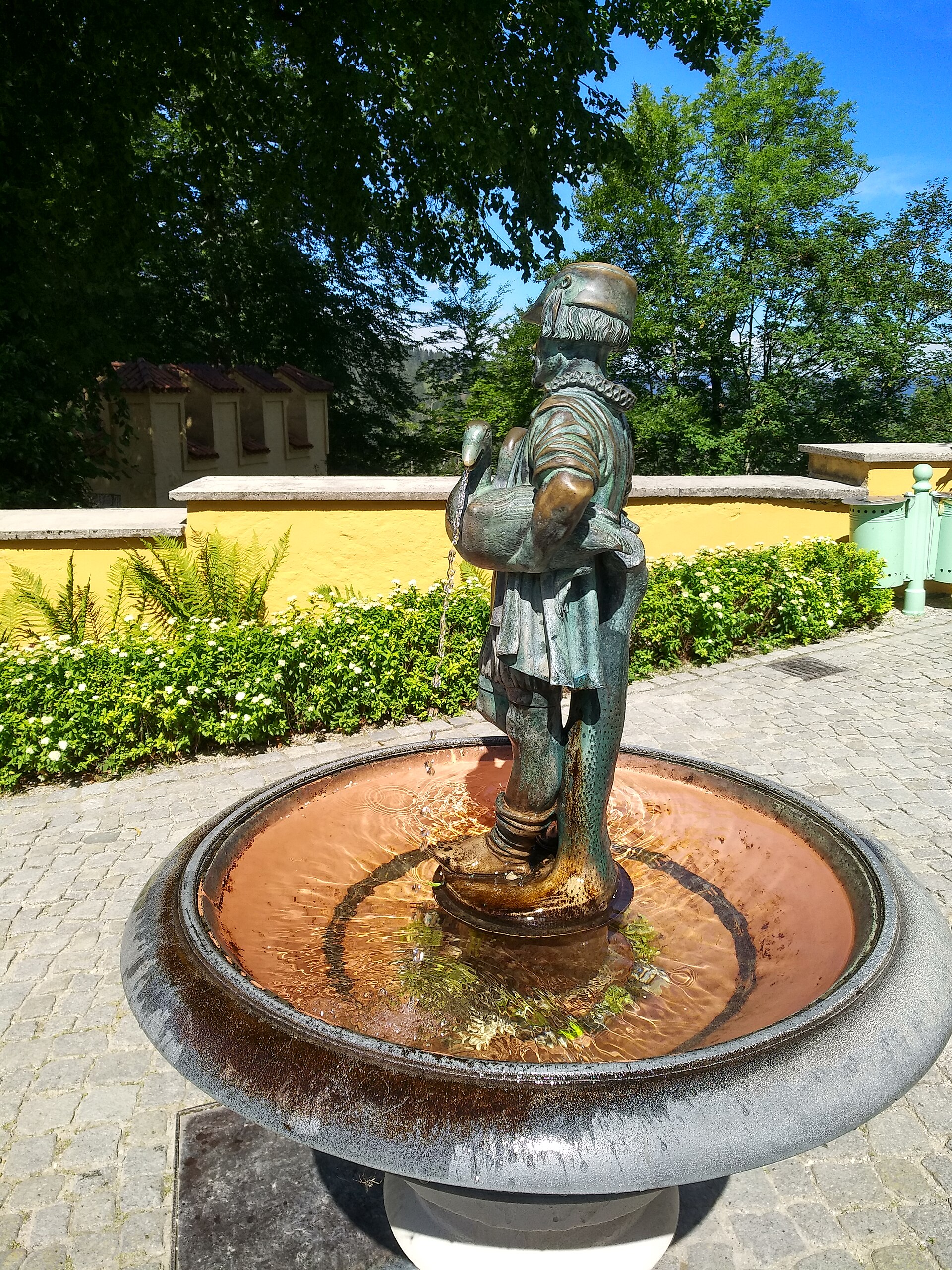
Step inside Hohenschwangau and you enter a world of painted stories. The walls of its rooms are covered with murals depicting scenes from medieval German history, myth, and legend, a whole gallery of heroes, knights, and romances rendered in the glowing colours of the nineteenth-century imagination. To move through the castle is to walk through the tales that the romantic age loved best, told in paint across room after room.
Among the many legends depicted, the story of the Swan Knight holds a special place, fitting for the castle of the swans. These painted romances were not mere decoration; they were the visual expression of the family’s whole cultural world, a daily immersion in the heroic and chivalric past that shaped the imaginations of everyone who lived among them. For an impressionable child, growing up surrounded by such images would leave a lasting mark.
The interiors also preserve the furnishings and atmosphere of a nineteenth-century royal residence, from the rooms of the king and queen to the chambers where their children slept. Because the castle remained a real home rather than becoming a ruin or a museum piece, much of this survives intact, giving visitors a vivid sense of the life once led within these painted walls. It is one of the most complete windows we have into the private world of a romantic royal family.
The practice of covering walls with narrative murals was a favourite of the romantic age, which saw in it a revival of a medieval and Renaissance tradition. At Hohenschwangau these painted cycles turn the whole castle into a kind of illustrated book of legends, to be read room by room. For the family who lived here, they were a constant reminder of the heroic past they admired, and for the young Ludwig they were among his earliest and most formative impressions.
A Queen Who Climbed Mountains
The lady of the castle was Marie, the crown prince’s wife, a princess of Prussia who became devoted to Hohenschwangau and to the mountains around it. Unusually for a royal woman of her time, Marie was a passionate lover of the outdoors and a keen mountaineer, who explored the peaks and valleys of the region with real enthusiasm and did much to popularise the area. The castle and its gardens were her domain, and she left her mark on both.
The gardens and terraces of Hohenschwangau were laid out to make the most of the extraordinary setting, with views over the lakes and up to the mountains, and they provided the family with a place to walk, to take the air, and to enjoy the landscape that had drawn them here. In an age that increasingly prized nature and the romance of wild scenery, these terraces were as much a part of the castle’s appeal as its painted halls.
Marie’s love of the mountains was part of the wider romantic spirit that animated the whole family. To them the Bavarian Alps were not merely a backdrop but a source of inspiration and delight, a landscape of legend and beauty in which their castle was perfectly placed. The gardens where the queen once walked still offer the same views she loved, and they remain one of the loveliest features of a visit to Hohenschwangau.
Marie’s enthusiasm for the mountains was part of a broader shift in how people regarded wild landscapes. Where earlier ages had often seen mountains as forbidding obstacles, the romantic era learned to find them beautiful and inspiring, and figures like Marie helped lead the way. Her presence at Hohenschwangau, striding out to explore the peaks, embodies that new love of nature that the castle and its setting so perfectly express.

Beside the Alpsee
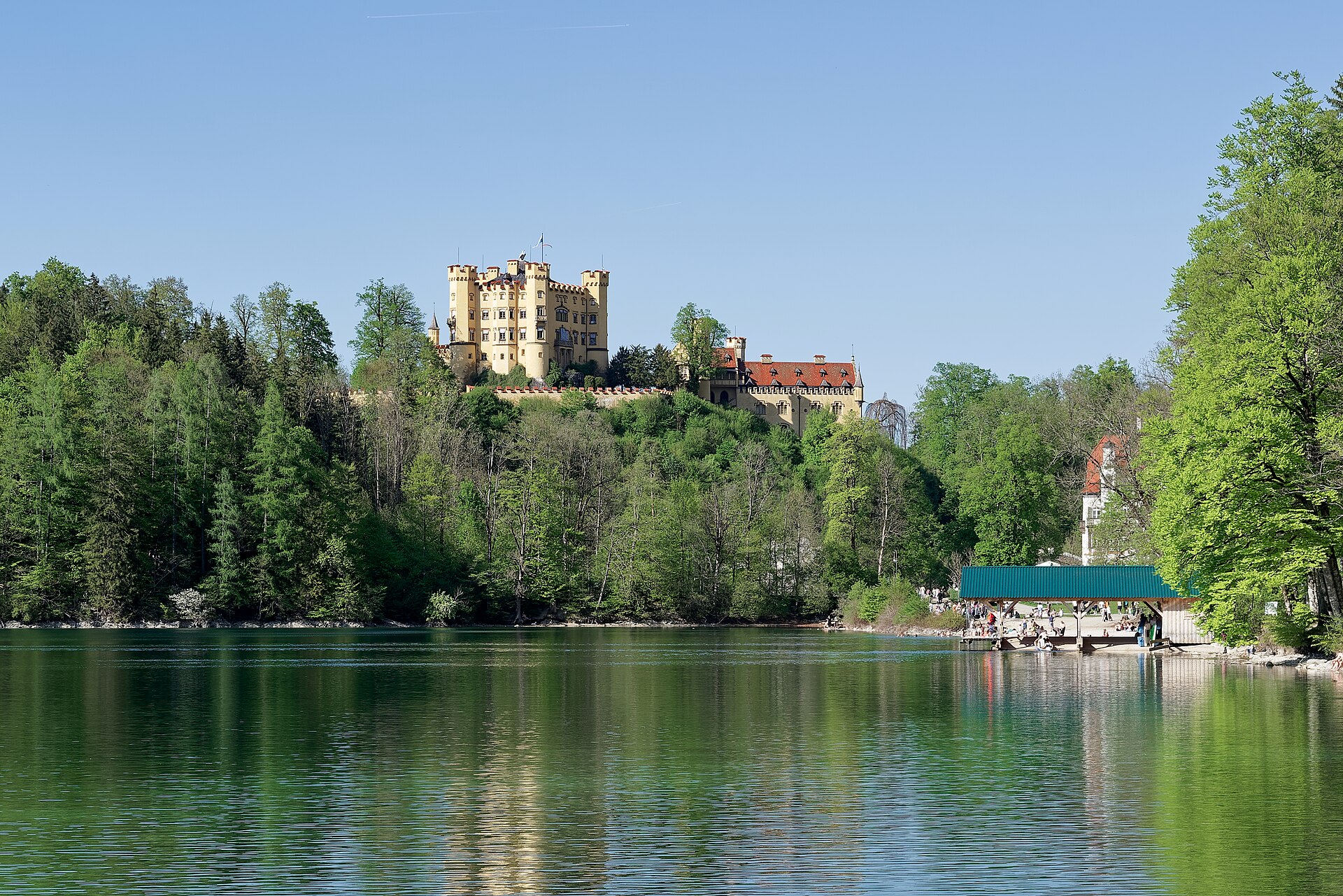
Below the castle lies the Alpsee, a beautiful mountain lake of clear green water ringed by wooded slopes and framed by peaks. It is one of the loveliest lakes in the Bavarian Alps, and the castle above it seems perfectly placed to enjoy its beauty. The combination of the yellow castle, the still water, and the mountains beyond is one of the classic images of romantic Bavaria, and it is easy to see why the royal family found the spot so enchanting.
The lake was part of the pleasure of life at Hohenschwangau. The royal family could walk and boat on its shores, and its calm surface mirrored the mountains and the castle in a way that delighted the romantic eye. A second, smaller lake, the Schwansee or swan lake, lies nearby, reinforcing once again the presence of the swan that gives the whole valley its name and its emblem.
Today the Alpsee remains a highlight of any visit, and a walk around its shore is one of the great pleasures of the area. From its banks you can see both castles, the yellow one close above the water and the white one on its distant crag, held together in a single view. It is a landscape that seems almost designed for romance, and it was this beauty, above all, that drew a royal family to make its summer home here.
The clarity of the Alpsee is famous, its green waters so clean that they mirror the surrounding scenery with startling precision. On a still day the reflection of the mountains and the castle in the lake doubles the beauty of the view, and it is no wonder that painters and photographers have returned to this spot for generations. The lake is not merely near the castle; it is an essential part of the picture the castle was built to complete.
In the warmer months the Alpsee is popular with swimmers and walkers, and its shore offers some of the finest and least crowded views of the whole royal landscape. A slow circuit of the lake, with the two castles appearing and disappearing between the trees, is one of the quiet pleasures that many visitors, intent only on the castles themselves, sadly miss. It is well worth the extra hour.

A Window Onto the Mountains
The views from Hohenschwangau are among its greatest treasures. From its windows and terraces the eye travels over the Alpsee, across the wooded valley, and up to the surrounding peaks, taking in one of the most beautiful mountain panoramas in Germany. For the royal family, and for the boy who would become the Dream King, these views were a daily companion, shaping a sensibility steeped in the romance of the Alps.
One view in particular would prove momentous. From Hohenschwangau you can see the high rock opposite on which Neuschwanstein now stands, and it was from the windows of the older castle that the future King Ludwig, growing up here, looked out at that dramatic crag. In time he would choose that very spot for his own fantasy castle, and while it was being built he is said to have watched its progress from Hohenschwangau through a telescope, following the rise of his dream stone by stone.
That connection makes the view from Hohenschwangau one of the most significant in the whole story. Standing where the young prince once stood, looking across to the site of the castle he would create, you can feel the direct link between the home that shaped him and the dream he would build. The window onto the mountains was also, for Ludwig, a window onto his own future, and onto one of the most famous buildings in the world.
The image of the young king watching his dream castle rise through a telescope is one of the most evocative in the whole story of the valley. It captures perfectly the strange, dreamlike quality of Ludwig himself, a king who preferred to observe his fantasies taking shape from a distance rather than to live an ordinary royal life. That telescope, trained from the old castle onto the new, links the two buildings in a single, unforgettable picture.

The Boy Who Became the Dream King
The most famous child ever to grow up at Hohenschwangau was Ludwig, the future King Ludwig II of Bavaria, remembered today as the Dream King or the Fairy-Tale King. He spent much of his boyhood in this castle, surrounded by its painted legends, its swan symbolism, and its romantic mountain setting, and the impression it made on him would shape the whole course of his extraordinary life.
Ludwig grew into a shy, imaginative, and intensely romantic young man, more at home in the world of legend and music than in the hard business of ruling. The dreams nurtured at Hohenschwangau, of knights and swans and a heroic medieval past, never left him, and when he came to the throne he devoted himself, and vast sums of money, to building fantasy castles that would make those dreams real. The greatest of them, Neuschwanstein, rose on the crag he had gazed at as a boy.
In this sense Hohenschwangau is the cradle of the whole legend of the Dream King. Everything that made Ludwig the figure he became, his love of legend, his romantic sensibility, his obsession with the Middle Ages, was fed by his boyhood in this castle. To understand the man who built Neuschwanstein and captivated the world, you have to begin here, in the yellow castle by the lake where his imagination was formed.
Ludwig’s later life was as tragic as it was extraordinary. Increasingly withdrawn from the duties of kingship and devoted entirely to his building projects and his private fantasies, he ran up enormous debts and grew estranged from his government, and he died in mysterious circumstances while still a relatively young man. The seeds of both his genius and his troubles can be traced, in part, to the dreamy boyhood he spent among the legends of Hohenschwangau.
It is worth remembering, too, that Ludwig was not the only royal child raised here. His younger brother Otto also grew up in the castle, and the two boys shared the same romantic upbringing among the painted halls and mountain views. The atmosphere of Hohenschwangau shaped a whole generation of the Bavarian royal family, though it was Ludwig, with his singular imagination, who would carry its influence to the most extraordinary lengths.
The Swan Knight and the Composer
The swan that presides over Hohenschwangau connects the castle to one of the great cultural stories of the nineteenth century. The legend of the Swan Knight, Lohengrin, a mysterious hero who comes and goes in a boat drawn by a swan, was depicted in the castle and was part of the romantic world in which the young Ludwig grew up. That legend would find its most famous expression not in paint but in music.
It was the composer Richard Wagner who turned the tale of Lohengrin into one of his celebrated operas, and it was partly through such works that the young King Ludwig became Wagner’s most devoted patron. The king’s passion for the composer’s music, rooted in the same legends that adorned his boyhood home, led to one of the most remarkable relationships between an artist and a royal patron in history, and it shaped the cultural life of the age.
So the swan of Hohenschwangau flew far beyond the valley. From the painted walls of the castle to the operas of Wagner to the fantasy of Neuschwanstein, which is itself steeped in the imagery of the Swan Knight, the emblem of this place spread its influence across music, architecture, and legend. Few symbols attached to a single castle have travelled so far, and it all began here, in the high district of the swan.
The bond between Ludwig and Wagner had consequences far beyond the two men. The king’s patronage helped make possible some of the composer’s greatest works, and through them Hohenschwangau’s swan legend entered the permanent repertoire of world culture. It is a striking example of how a single romantic household, steeped in old stories, could send ripples out across the arts of an entire age and beyond.
Still in the Family
Unlike Neuschwanstein, which passed quickly into public hands after King Ludwig’s death, Hohenschwangau has remained closely tied to the Bavarian royal house, the Wittelsbachs, who built it. It is cared for through a foundation connected to the family, and this continuity has helped preserve the castle’s character as a genuine royal home rather than turning it into a mere monument. The result is a place that still feels lived in and loved.
That continuity matters because it keeps the human dimension of the castle alive. Where Neuschwanstein can feel like a magnificent but empty stage set, built for a king who barely inhabited it, Hohenschwangau retains the atmosphere of a family that truly dwelt within its walls across generations. The furnishings, the personal touches, the sense of daily life, all survive to give the visitor a warmer and more intimate experience.
In this way the two castles complement each other perfectly. Neuschwanstein offers the grand fantasy, the lonely dream of a troubled king; Hohenschwangau offers the reality behind it, the real royal home where that king grew up and where his family lived out their romantic ideals. Seeing both, and understanding how they are linked, gives a far richer picture than either could provide alone, and it is the older castle that supplies the human heart of the story.
The Wittelsbach family ruled Bavaria for many centuries, and their long association with the region gives Hohenschwangau an added depth. This was not the folly of a passing owner but a cherished home of a great dynasty, bound up with its history and its identity. That the family retains a connection to the castle to this day is a rare thread of continuity linking the romantic nineteenth century to the present.
Preserving a castle as a home rather than a museum brings its own challenges, of course, from the sheer cost of upkeep to the balance between welcoming visitors and protecting a private inheritance. That Hohenschwangau has managed this balance so well is part of why it remains such a rewarding place to visit, neither a dead relic nor a mere attraction but a living survivor of a vanished royal world.

The Castle Through the Year
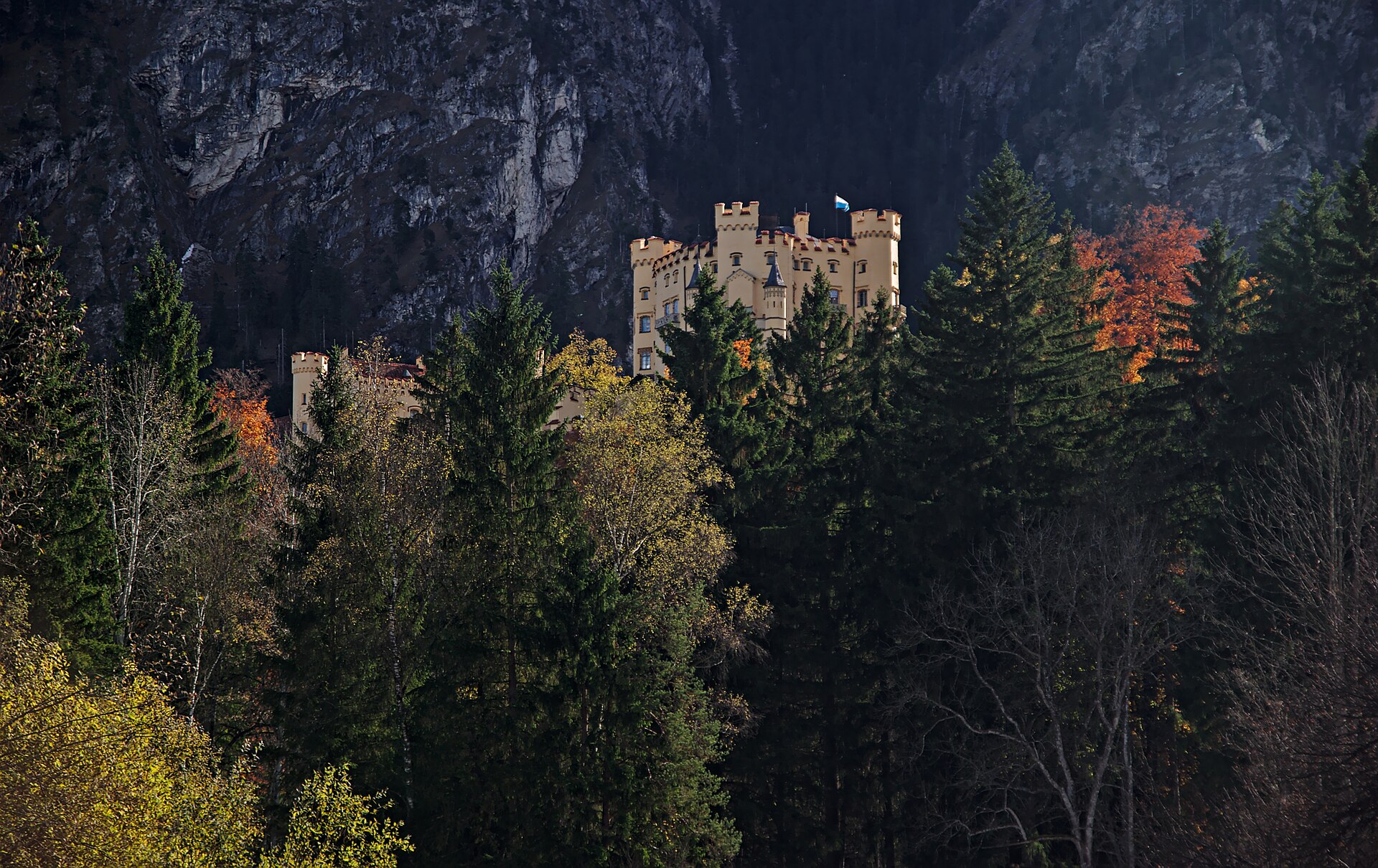
Like all the great castles of the Bavarian Alps, Hohenschwangau changes character with the seasons, and each brings its own beauty. In summer the yellow walls glow against green forests and blue lakes, and the terraces and gardens are at their best. In autumn the surrounding woods turn to gold and copper, and the castle sits in a blaze of colour that photographers travel far to capture.
Winter transforms the valley again, dusting the castle and the mountains with snow and lending the whole scene a hushed, crystalline beauty. The frozen or misty Alpsee, the white peaks, and the yellow castle among them make a picture of almost unreal loveliness, and the winter months, though colder and quieter, reward the visitor with some of the most magical views of all.
Whatever the season, the interplay of castle, lake, and mountain is the essence of Hohenschwangau’s appeal. The building was placed here precisely to enjoy this ever-changing landscape, and the romantic family who built it treasured the valley in all its moods. To see the castle once is to want to see it again in another season, for it offers not a single fixed image but a whole cycle of beauty across the turning year.
The crowds, too, shift with the seasons, and those who wish to enjoy the castle in relative peace often find the quieter months of spring and autumn the most rewarding. In the height of summer the valley can be very busy, drawn by the fame of Neuschwanstein, but even then Hohenschwangau tends to be the calmer of the two, offering a more reflective experience of this remarkable royal landscape.

Visiting Hohenschwangau
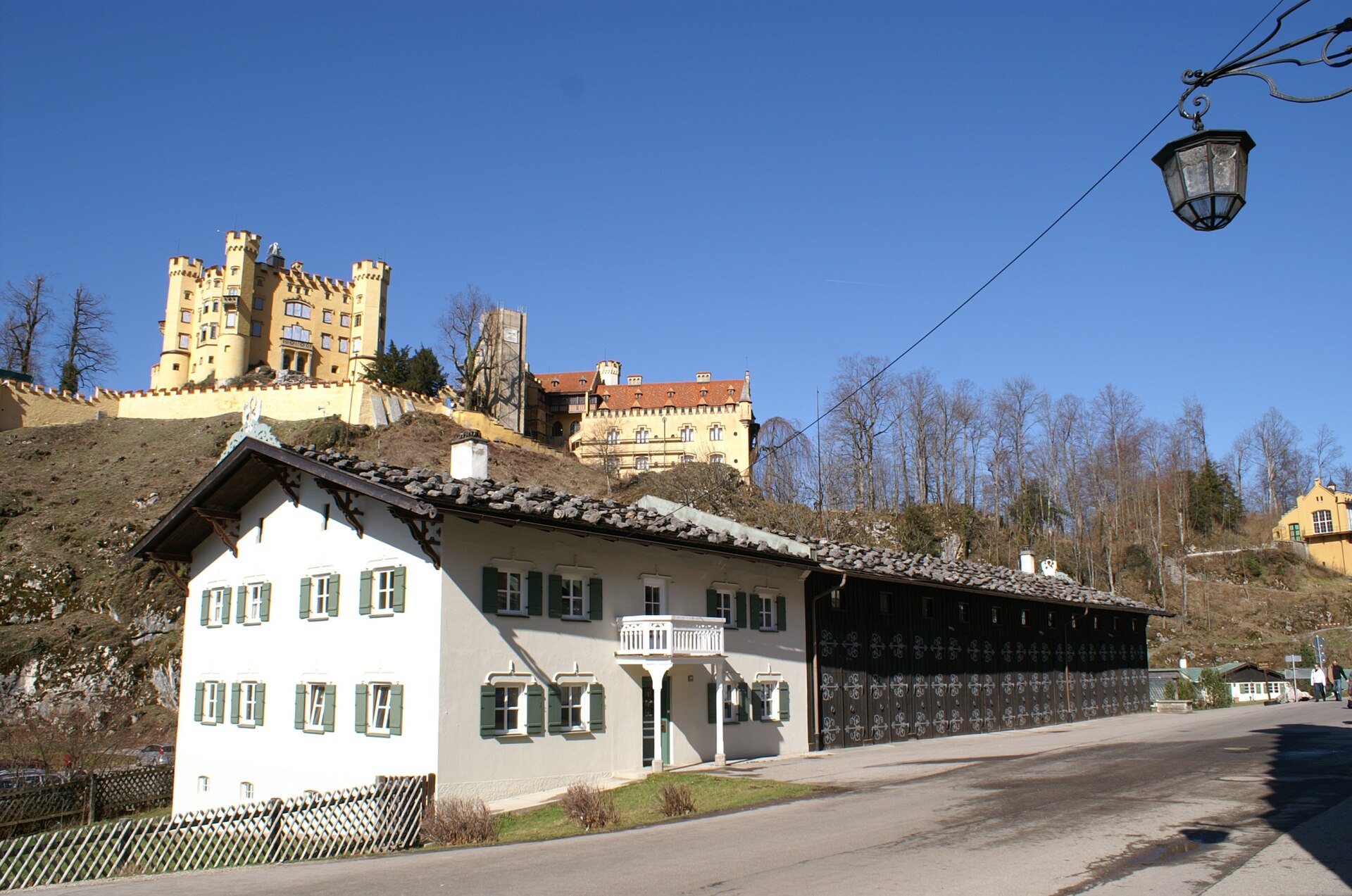
Hohenschwangau lies in the far south of Bavaria, near the town of Fussen, in the same valley as its famous neighbour Neuschwanstein, and most visitors see the two together. The village of Hohenschwangau at the foot of the castles is the base for both, with a ticket centre serving the two palaces, and from there it is a walk up to the yellow castle, gentler and shorter than the climb to Neuschwanstein on its higher rock.
The interior of Hohenschwangau is seen on a guided tour, which leads you through the painted rooms, the royal apartments, and the world of the family who lived here, telling the story of Maximilian and Marie and of the boyhood of King Ludwig. Around the tour there are the gardens and terraces to enjoy, and the glorious views over the Alpsee to both castles. A walk around the lake is a perfect complement to the visit, offering the classic views of the whole royal landscape.
If you would like to find it and plan your visit, here is the castle’s position beside the Alpsee: 47.5556, 10.7375. Do give Hohenschwangau its due rather than rushing past it to Neuschwanstein, for it is the older, warmer, and more human of the two, and it holds the key to the whole story of the valley. See both castles together, and you will understand not just the fairy tale on the hill but the real family and the real childhood from which that fairy tale grew.
Because the two castles share a ticket centre and a valley, it is easy and rewarding to plan a full day here, seeing Hohenschwangau and Neuschwanstein in turn with time for the lake and the views in between. Tickets are timed and can sell out in the busy season, so booking ahead is wise, and arriving early helps you enjoy the valley before the largest crowds arrive. Comfortable shoes and a little time in hand will let you make the most of one of the most beautiful corners of Germany.
Castles Nearby
- Neuschwanstein, the fairy-tale castle of the Dream King
- Schloss Lichtenstein, the fairy-tale castle born from a novel
- Hohenzollern Castle, the mountaintop seat of Prussia’s kings
The Castle That Made a King
It is easy, in this valley, to look only upward, at the white towers of Neuschwanstein on their crag, and to hurry past the yellow castle by the lake. But to do so is to mistake the sequel for the story. Hohenschwangau came first, and it holds the beginning of everything: the romantic family, the painted legends, the swan and its knight, and above all the dreamy boy who grew up among them and would one day build the most famous castle in the world.
The two castles need each other. Neuschwanstein is the dream; Hohenschwangau is the dreamer’s home, the real and human place from which the dream arose. In the older castle you meet not a lonely fantasy but a living family, a queen who loved the mountains, a prince who loved the past, and a child whose imagination, fed on these painted walls and these lake-and-mountain views, would carry the swan of Hohenschwangau to the heights of art and legend.
So when you come to this famous valley, give the yellow castle its due. Walk its painted rooms, stand at the window where the young king once gazed across at his future, and follow the swan through the halls of the home that made him. Neuschwanstein may be the more dazzling of the two, but Hohenschwangau is the deeper, the castle that made a king and, through him, made a legend that has enchanted the whole world.
You May Like
Mafra, the Palace a King Built From a Vow


One thought on “Schloss Hohenschwangau: The Castle That Made a King”