In the wooded hills of the Harz, in the heart of Germany, there is a town of painted timber houses so pretty that it looks like a stage set, and above it, on a wooded hill, a castle of towers and turrets and steep roofs that seems to have been designed by someone dreaming of the perfect medieval fortress. This is Schloss Wernigerode, and it is one of the loveliest of all Germany’s romantic castles, a place where a real medieval stronghold was transformed, in the great age of romanticism, into a fairy tale in stone.
Wernigerode has been used again and again as a film location precisely because it looks the way we imagine castles should look, rising dramatically above its colourful town against the dark forests of the Harz. But behind the storybook appearance lies a genuine history stretching back to the Middle Ages, and a nineteenth-century transformation carried out by one of the most powerful men in the newly united Germany, a count who was also a minister of the empire.
The castle you see today is therefore, like several others in this series, a building of two ages: a real medieval fortress at its core, wrapped in a romantic reconstruction that turned it into the picture-perfect castle we admire now. Come up the hill above the painted town with me and we will explore the Harz stronghold that became a fairy tale, meet the statesman who rebuilt it, and discover why Wernigerode is one of the most enchanting castles in all of Germany.
In This Article
- Above the Colourful Town
- The Castle on the Hill
- A Town of Timber and Legend
- From Fortress to Count’s Seat
- A Statesman’s Grand Rebuild
- Historicism in Stone
- Into the Castle Courtyard
- Timber, Turrets and Detail
- The Grand Rooms of a Prince
- The Castle Chapel
- A Home Fit for a Minister of the Empire
- The View Over the Harz
- Visiting Schloss Wernigerode
Above the Colourful Town
The first thing to understand about Wernigerode is that castle and town belong together, and each makes the other more beautiful. The town of Wernigerode is famous in its own right as one of the prettiest in Germany, a place of narrow streets lined with brightly painted half-timbered houses, crowned by a spectacularly ornate medieval town hall. And above it all, on its wooded hill, floats the castle, visible from almost every corner of the old town.
The effect of looking up from the colourful streets to the castle on its height is one of the great pleasures of a visit. The town seems to gather at the foot of the hill, its gabled roofs climbing toward the fortress that has watched over it for centuries. From the castle, in turn, you look down on the whole picture, the painted houses, the church towers, and the dark forests of the Harz rolling away beyond.
This intimate relationship between a fortress and the settlement at its feet is a very old one, repeated across the castles of Germany, but few examples are as charming as Wernigerode. The beauty of the town and the drama of the castle reinforce each other, and together they make the whole place feel like something out of a storybook. It is no wonder that filmmakers and travellers alike have long been drawn to this corner of the Harz.
The town has grown used to sharing its identity with its castle, and the two are marketed and loved together as a single destination. Visitors who come for the famous timber-framed streets almost always climb to the castle as well, and those who come for the castle are captivated by the town. It is this doubling of pleasures, the painted houses below and the fairy-tale fortress above, that makes a day in Wernigerode so memorable.

The Castle on the Hill
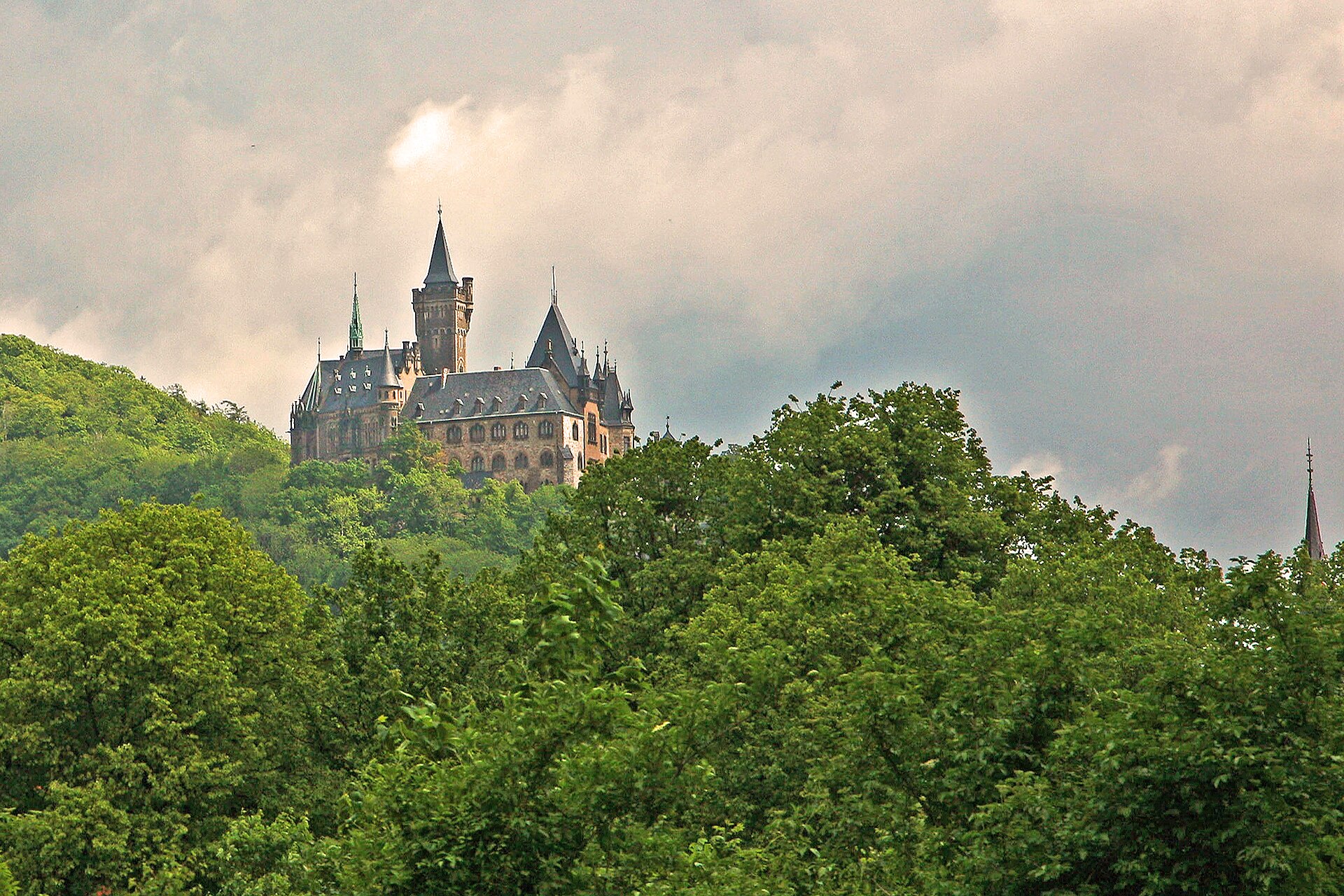
Seen from one of the viewpoints on the surrounding hills, Schloss Wernigerode reveals itself in its full romantic glory, a mass of towers, gables, and steep roofs rising from the trees against the backdrop of the Harz. The Harz is the highest mountain range in northern Germany, a region of deep forests, misty peaks, and old mining towns, long wrapped in legend, and the castle sits perfectly within this atmospheric landscape.
The choice of the site goes back to the Middle Ages, when a castle here commanded the town and the routes through the hills. Height meant safety and authority, and a fortress on this wooded rise could watch over the surrounding country and assert the power of its lords. The romantic rebuilders of the nineteenth century inherited this dramatic position and made the most of it, composing their new castle to be seen and admired from every direction.
The forests of the Harz add to the castle’s fairy-tale quality. This is a landscape steeped in folklore, the setting of countless German legends and tales of witches and spirits, and the castle rising from its wooded hill fits that mythic atmosphere completely. To see Wernigerode from across the hills, floating above the trees, is to understand at once why this place has so often been chosen to stand in for the storybook castles of the imagination.
The Harz has long exerted a powerful hold on the German imagination. Its highest peak, wrapped in cloud and legend, was believed to be a gathering place for witches, and the region features in some of the most famous works of German literature. A castle set in such a landscape inevitably takes on some of its mythic charge, and Wernigerode wears the atmosphere of the Harz as naturally as it wears its own towers and turrets.
Approaching from different directions reveals different castles, or so it seems, for the irregular, many-towered silhouette presents a new composition from every angle. This variety was quite deliberate on the part of the rebuilders, who wanted a building that would look dramatic and picturesque wherever it was seen from, and it rewards the visitor who takes the time to view it from several of the surrounding heights.

A Town of Timber and Legend
No visit to the castle is complete without time in the town below, and its heart is one of the most famous buildings in the Harz: the medieval town hall of Wernigerode, a fantastical half-timbered structure with pointed towers and richly carved beams that looks almost too elaborate to be real. It stands on the market square as the centrepiece of a town that has preserved its old timber-framed houses with unusual completeness.
Wernigerode is often called the colourful town in the Harz, and a walk through its lanes explains why. House after house presents its painted timber frame to the street, in a riot of ochre, red, green, and blue, their upper storeys leaning out overhead and their beams carved with patterns and inscriptions. It is one of the best-preserved timber-framed towns in Germany, and it forms the perfect setting for the castle above.
The wider Harz region adds a layer of legend to all this beauty. These mountains are the traditional home of German witch lore, above all the tales of witches gathering on the heights on the eve of May, stories that have coloured the region’s identity for centuries. To wander Wernigerode, with its painted houses, its fairy-tale town hall, and its castle on the hill, all set among the legend-haunted forests of the Harz, is to feel that you have stepped into the pages of a German fairy tale.
The town hall in particular has become a symbol of the whole region, its twin pointed towers and carved facade appearing on countless photographs and postcards. Buildings like this were statements of civic pride, raised by prosperous medieval towns to show their wealth and independence, and Wernigerode’s is among the most beautiful survivors of its kind, a fitting companion to the castle that shares its skyline.
Wandering these streets is a pleasure in itself, with something to catch the eye at every turn, a carved beam here, a painted inscription there, a crooked gable leaning over the lane. The town rewards slow, aimless exploration as much as any guided route, and many visitors find that the walk up through its streets to the castle is half the charm of the day.

From Fortress to Count’s Seat
Long before it became a romantic showpiece, Wernigerode was a real medieval fortress. A castle stood on this hill from at least the twelfth century, the seat of the counts of Wernigerode, who ruled the surrounding territory and took their name from it. For centuries this was a working stronghold and the centre of a small but proud county, holding its place among the many lordships that made up the patchwork of medieval Germany.
Over the generations the castle passed by inheritance to the counts of Stolberg, who added Wernigerode to their name and their possessions, becoming the counts of Stolberg-Wernigerode. Under their long rule the castle was repeatedly altered and extended, rebuilt in the fashions of successive ages, so that its fabric came to hold layers of medieval, Renaissance, and Baroque work, the accumulated record of centuries of aristocratic life.
By the nineteenth century, then, Wernigerode was already an ancient and much-altered castle with a deep history behind it. It was this venerable stronghold, rich in the memory of the counts who had held it for so long, that would become the canvas for the great romantic transformation of the later nineteenth century. The fairy-tale castle we see was not conjured from nothing but grew from a genuine medieval seat with roots reaching far back into the German past.
The long continuity of aristocratic ownership shaped the castle profoundly. Because it remained the seat of one connected line of counts for so many centuries, Wernigerode accumulated the history, the traditions, and eventually the wealth that would make its great nineteenth-century transformation possible. The fairy-tale castle of today rests, in every sense, on the deep foundations of that long medieval and early modern history.
A Statesman’s Grand Rebuild
The castle owes its present romantic appearance above all to one man: Count Otto zu Stolberg-Wernigerode, who in the later nineteenth century undertook a sweeping transformation of his ancestral seat. Otto was no ordinary nobleman. He was one of the leading statesmen of the newly united German Empire, serving at the highest levels of government, and he had the wealth, the taste, and the ambition to remake his castle on a grand scale.
Between the 1860s and the 1880s, Otto had the old castle rebuilt and extended in the romantic historicist style then in fashion, turning the much-altered medieval fortress into a coherent and spectacular fairy-tale castle. Working with a talented architect, he gave Wernigerode the towers, gables, and picturesque silhouette that make it so striking today, drawing inspiration from the romantic castles of the Rhine and from an idealised vision of the German Middle Ages.
The result was a castle that looked convincingly medieval while offering all the comforts and grandeur expected of a great nineteenth-century residence. It was a home worthy of a prince of the empire, a place to receive important guests and to display the standing of one of Germany’s leading families. In rebuilding Wernigerode, Otto created not just a beautiful castle but a statement of his own eminence, a fairy tale that was also a monument to power.
It is striking how often, across nineteenth-century Germany, it was men of great wealth and power who drove these romantic rebuildings. To transform an ancestral castle into a fairy-tale palace was both an act of romantic devotion and a demonstration of status, and figures like Otto had the resources to indulge it on a grand scale. Wernigerode is thus a monument to the confidence and ambition of the German aristocracy in the age of the empire.
Historicism in Stone
The style in which Wernigerode was rebuilt is known as historicism, the nineteenth-century movement that looked back to the architecture of earlier ages and revived it, often mixing elements freely to achieve a romantic effect. Wernigerode is one of the finest examples of this approach in northern Germany, a castle that draws on medieval and Renaissance models to create something that feels old and heroic while being, in fact, largely a product of its own age.
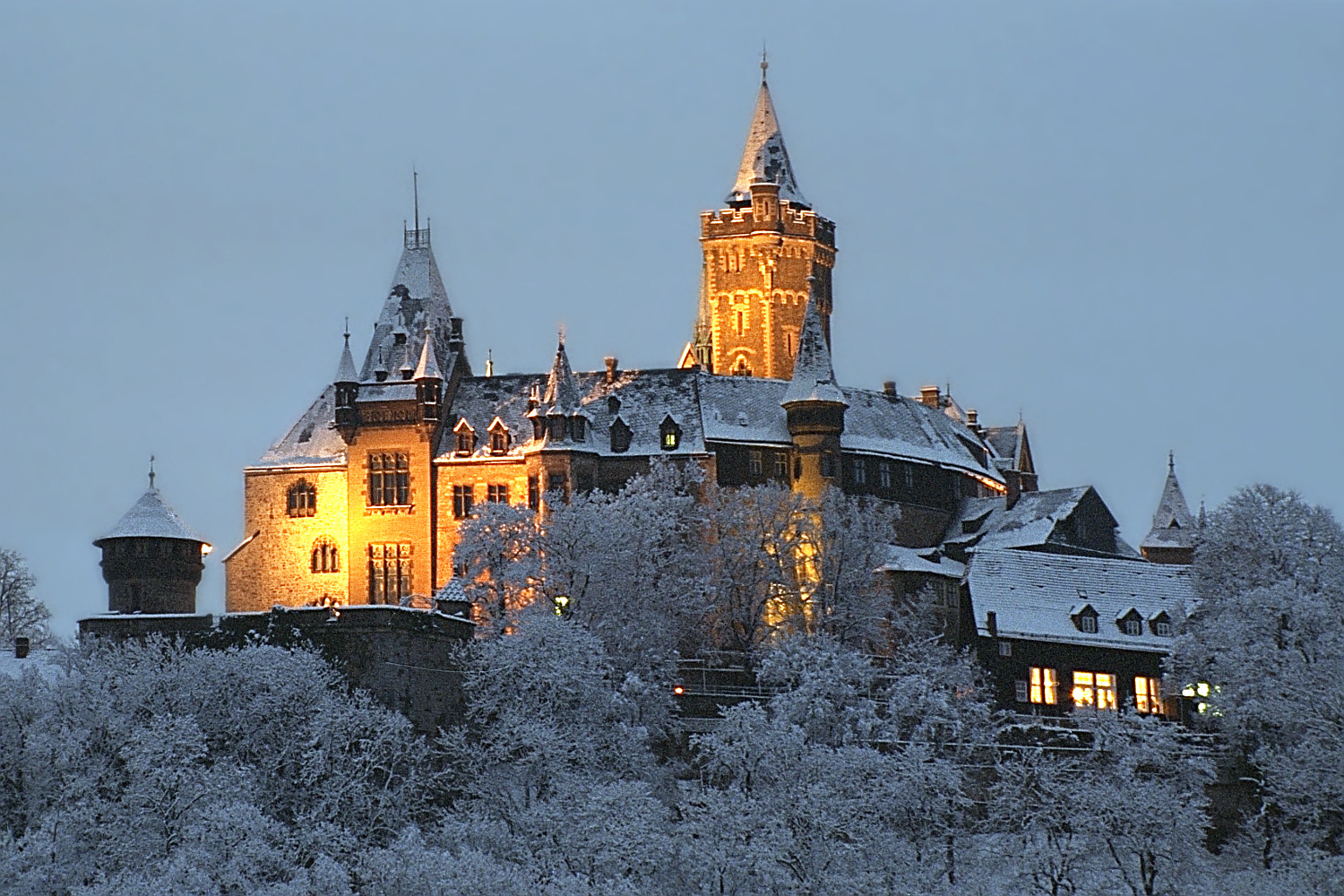
This was architecture as storytelling. The rebuilders were not trying to reconstruct the castle exactly as it had been at any single moment; they were composing an ideal, a vision of what a great German castle ought to look like, full of towers and turrets and picturesque irregularity. The aim was to stir the emotions, to evoke the romance of the past, and in this Wernigerode succeeds triumphantly, especially in the golden light of evening when its silhouette glows against the sky.
Historicism has sometimes been dismissed as mere imitation, but at its best, as here, it produced buildings of real beauty and power. Wernigerode is not a fake so much as a heartfelt homage, a nineteenth-century dream of the Middle Ages given permanent form. Like the other romantic castles of Germany, it tells us as much about the age that built it, with its passionate love of history and legend, as about the medieval world it so lovingly imitates.
The nineteenth century was an age fascinated by history, and its architecture reflected that fascination in a profusion of revived styles. Castles like Wernigerode, along with the neo-Gothic and neo-Romanesque churches, town halls, and palaces of the era, expressed a longing to connect the present with a glorious past. Understood in this light, the castle is not an oddity but a characteristic and especially beautiful product of its time.
Seen at sunset, when the low light gilds the towers and throws the gables into relief, the castle achieves its most romantic effect, and it is easy to forget that much of what one is admiring is the work of the nineteenth century rather than the Middle Ages. That, in a sense, is the whole point: the rebuilders wanted to create beauty and emotion, and the golden hour at Wernigerode shows how completely they succeeded.

Into the Castle Courtyard
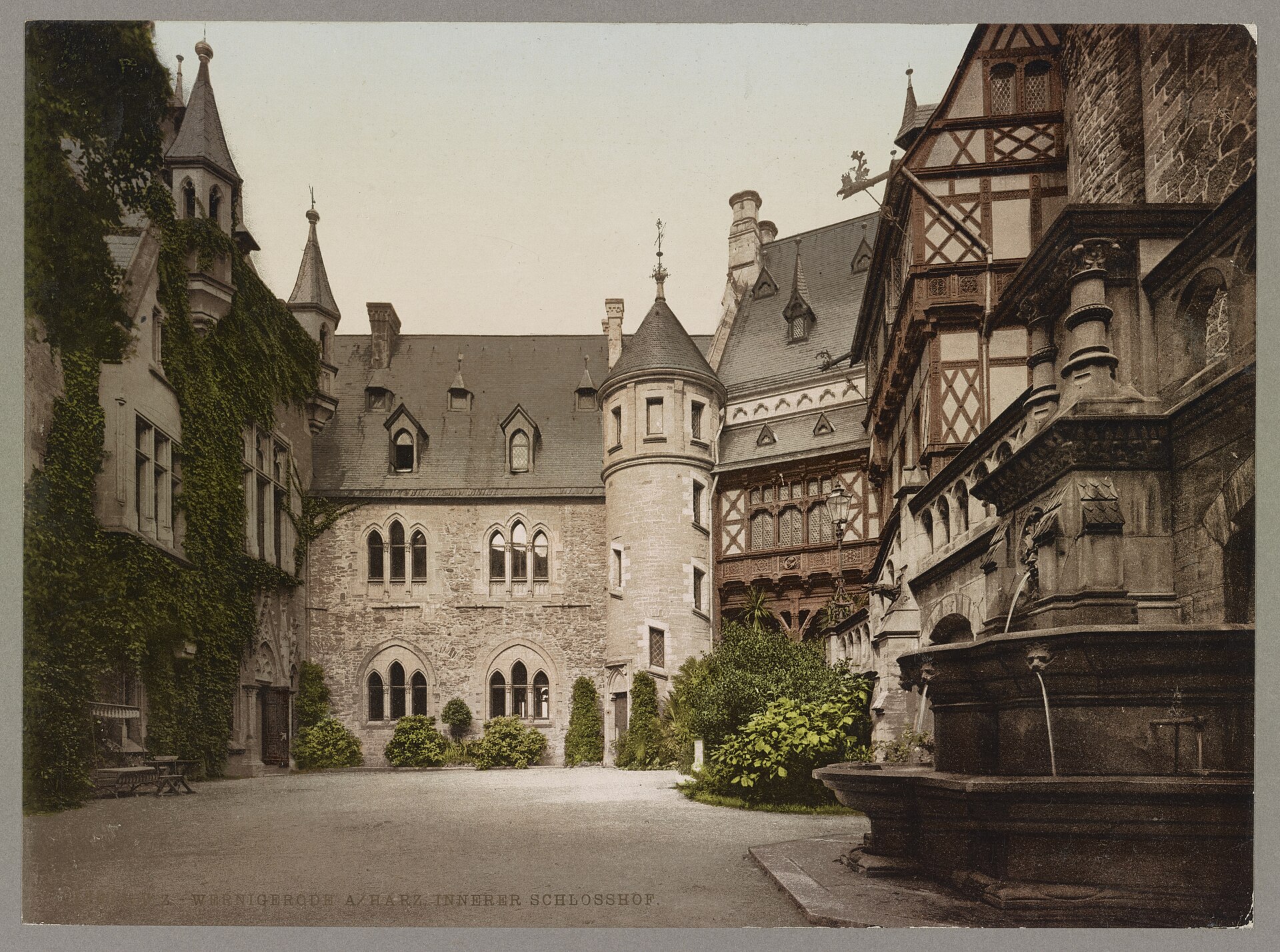
Passing into the castle, you reach the inner courtyard, an enclosed space ringed by the picturesque wings of the building, with their towers, oriels, and steep roofs rising on every side. Here the romantic vision of the rebuilders is fully apparent, in the careful irregularity of the facades and the wealth of decorative detail that turns even a functional courtyard into a stage for the imagination.
The courtyard is the hub around which the castle is arranged, and from it the various parts of the building open off in turn: the grand reception rooms, the private apartments, the chapel, and the terraces with their views. Standing here you are at the heart of the composition, able to appreciate how the rebuilders wove together the older fabric of the castle and their new additions into a single harmonious, if deliberately irregular, whole.
There is a pleasing sense of enclosure and shelter in the courtyard, a feeling of having passed through the outer defences into the private world of the castle. In the Middle Ages this would have been the secure heart of the fortress; in the romantic reconstruction it became the elegant centre of a princely residence. Either way, it is the natural place to pause and take in the castle before exploring the splendid rooms that open off it.
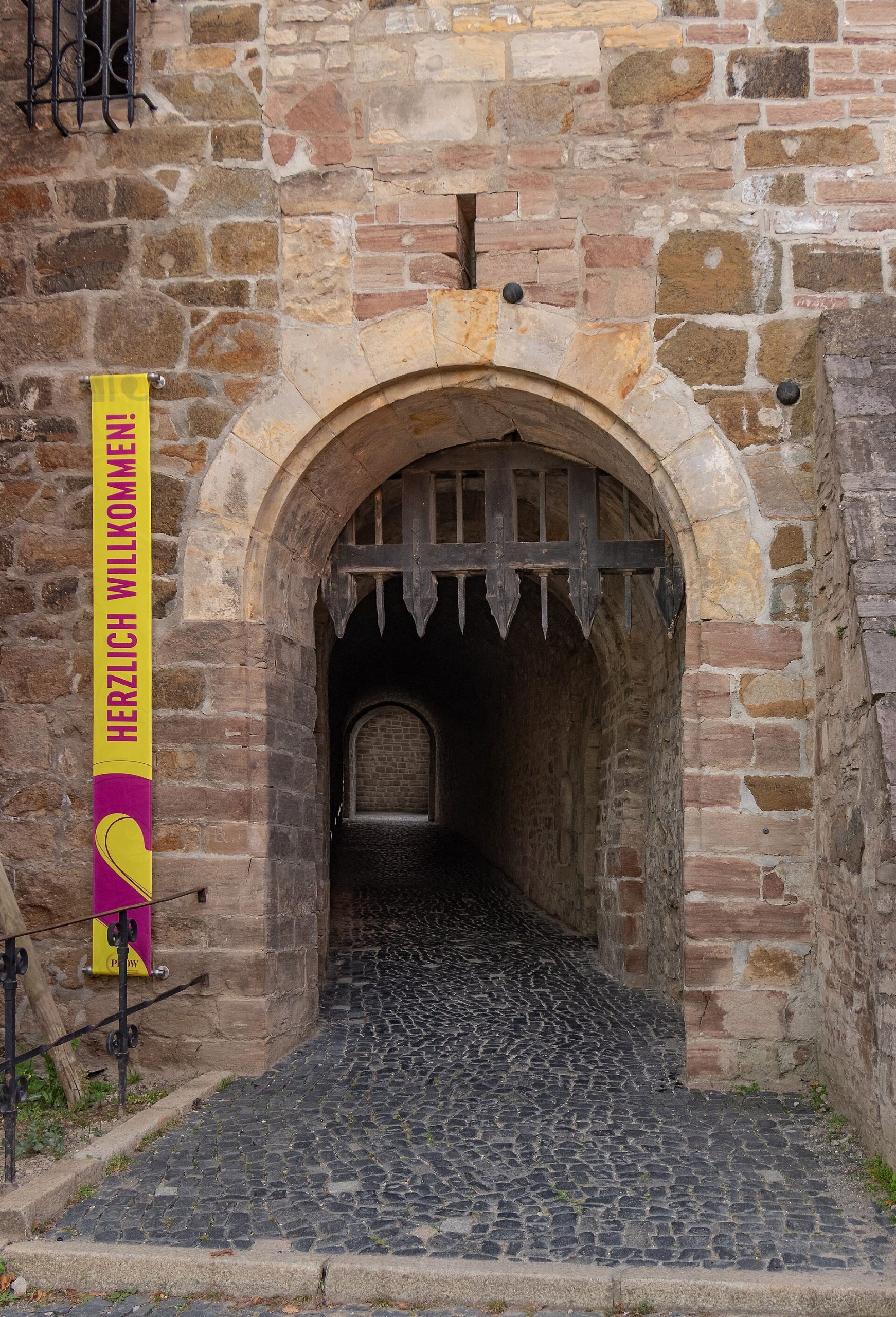
The transition from the outer approach to the enclosed courtyard is one of the most satisfying sequences of any castle visit, and Wernigerode manages it with real theatrical skill. The rebuilders understood the drama of arrival, and they arranged the approach and the courtyard to build a sense of anticipation and reward. It is a reminder that these romantic castles were designed as much for effect and experience as for use.

Timber, Turrets and Detail
One of the delights of Wernigerode is its wealth of decorative detail, and nowhere is this clearer than in the half-timbered work that appears throughout the castle. The rebuilders drew on the rich tradition of German timber framing, the same craft that gives the town below its charm, and used it to ornament the castle with patterned beams, carved woodwork, and picturesque gables that soften the stonework and add warmth and texture.
This attention to detail is characteristic of the historicist approach, which loved to fill its buildings with the marks of craftsmanship and the flavour of the past. Every turret, every carved beam, every decorative flourish was chosen to contribute to the overall romantic effect, and the cumulative result is a castle that rewards close looking as much as the sweeping view. There is always some small delight to catch the eye.
The blending of stone and timber, of massive walls and delicate woodwork, gives Wernigerode much of its distinctive character. It is a castle that manages to be at once imposing and intimate, grand in its silhouette but full of human-scaled detail up close. This marriage of the monumental and the picturesque is one of the great achievements of the rebuilding, and it is part of what makes the castle so satisfying to explore.
The craftsmanship on display also connects the castle to the living traditions of the region. The same skills that raised the painted houses and the great town hall below were employed, at a grander scale, in the castle above, so that fortress and town share a common visual language of timber and carving. This harmony between castle and town is one of the quiet pleasures of Wernigerode, binding the whole ensemble together.

The Grand Rooms of a Prince
Inside, Wernigerode preserves a magnificent suite of rooms that show how a great German nobleman of the nineteenth century lived and entertained. The state apartments are richly decorated and furnished, from grand halls for receptions and banquets to more intimate rooms for family life, all fitted out with the care and expense befitting a leading family of the empire. To tour them is to step into the world of the German aristocracy at the height of its power.
The dining hall and the other principal rooms are particularly splendid, panelled and painted and hung with the trappings of rank, designed to impress the many distinguished guests who came to the castle. Everything speaks of wealth, cultivation, and a deep pride in history and lineage, the values that the romantic aristocracy held dear. These are not the cold galleries of a museum but the living rooms of a great house, preserved much as they were.
Because Wernigerode became a museum with its interiors largely intact, visitors today can experience these rooms almost as their original occupants knew them. They offer a rare and vivid picture of aristocratic life in the era of the German Empire, a world of grand dinners and important guests, of art and history and privilege, all set within the romantic shell of a fairy-tale castle. Few places bring that vanished world so completely to life.
The survival of so many original furnishings is itself a piece of good fortune, given the upheavals that swept Germany in the twentieth century. Where the contents of many great houses were dispersed by war and political change, Wernigerode kept much of its interior intact, so that the rooms still tell a coherent story of the family and the age that created them. That completeness is a large part of what makes the castle museum so rewarding.
Guided tours through these rooms bring the history vividly to life, explaining not only the art and furnishings but the family and the age that produced them. It is one thing to admire a grand hall and another to understand the world of the people who dined and danced and conducted business within it, and the interpretation offered at Wernigerode helps the visitor make that imaginative leap into the vanished nineteenth-century world.

The Castle Chapel
Among the most beautiful of the castle’s interiors is its chapel, a richly decorated space that served the religious needs of the household and reflected the piety and taste of its owners. Set within the walls of the castle, it is a jewel of colour and craftsmanship, its decoration in keeping with the romantic historicist spirit of the whole rebuilding.
A private chapel was an essential feature of any great aristocratic residence, a place for the family and household to worship and to mark the great occasions of life, from baptisms to funerals. At Wernigerode the chapel was given rich decoration befitting the standing of the family, and it remains one of the highlights of a tour of the interior, a quiet and lovely space amid the grandeur of the state rooms.
The chapel also reflects the deep entanglement of religion, family, and power in the world of the old aristocracy. To maintain a chapel within the castle was to assert both the piety and the standing of the house, and its decoration was as much a matter of display as of devotion. Beautiful in itself, it is also a window into the values and the self-image of the family that made Wernigerode their home.
Music and ceremony would have filled this space on the great days of the family’s life, and its decoration was designed to lift the spirit and to honour both God and the house that worshipped here. Small as it is beside the grand halls, the chapel is in some ways the emotional heart of the castle, the place where the private life of the family met the eternal rhythms of birth, marriage, and death.

A Home Fit for a Minister of the Empire
The private apartments of Wernigerode, including its furnished bedrooms and family rooms, reveal the domestic side of a castle that was also a seat of power. For Count Otto zu Stolberg-Wernigerode was not merely a wealthy landowner but one of the most important political figures in the German Empire, and his castle was a home worthy of a man who moved at the very centre of national affairs.
Otto served in the highest offices of the new empire, working closely with its great chancellor and holding senior positions in the government of Prussia and the Reich. A man of such standing needed a residence that could receive distinguished visitors and reflect his importance, and Wernigerode, rebuilt in its romantic splendour, was exactly that. Behind the fairy-tale facade lay the home of a real power in the land.
The comfortable, richly furnished private rooms show that the castle was, for all its grandeur, genuinely lived in. This was a family home as well as a political stage, a place where the count and his relatives spent their days amid the beauty they had created. Seeing these more intimate spaces alongside the grand state rooms gives a rounded picture of life at Wernigerode, at once a fairy-tale castle, a great house, and the residence of a minister of the empire.
There is a fascinating contrast between the fairy-tale appearance of the castle and the hard realities of the political world its owner inhabited. While the towers and turrets evoked a romantic medieval dream, their lord was engaged in the very modern business of governing a great industrial empire. Wernigerode embodies that tension perfectly, a nineteenth-century seat of real power dressed in the costume of the Middle Ages.
The presence of such an eminent owner also meant that Wernigerode saw its share of important guests, and the castle was built to receive them in style. To be entertained here was to be received by one of the leading families of the empire, in surroundings designed to impress, and the grand rooms still carry the memory of that world of high politics and aristocratic hospitality.

The View Over the Harz
One of the great rewards of climbing to Wernigerode is the view. From the castle terraces the whole panorama of the town and the surrounding country spreads out below, the painted roofs of Wernigerode, the church towers, and beyond them the wooded hills of the Harz rolling away toward the horizon. It is a prospect that has delighted visitors for generations and that repays a long, lingering look.
The view is a reminder of why a castle was built on this spot in the first place. Height gave command of the town and the surrounding routes, and the ability to see far in every direction was a real advantage to the medieval lords who first fortified the hill. What was once a matter of security and control is now simply a source of pleasure, but the two are connected: the castle stands where it does because of the very outlook that now enchants us.
The castle also lived through the turbulent history of twentieth-century Germany, and after the Second World War, when this region lay in the German Democratic Republic, it was opened to the public as a museum. That role helped preserve the castle and its treasures through difficult decades, and since the reunification of Germany it has flourished as one of the most popular castle museums in the country, drawing visitors from far and wide to its hill above the Harz.
The castle’s survival through the twentieth century was far from guaranteed, and its preservation as a museum, first under one German state and then within reunified Germany, is part of the reason we can enjoy it today. Many aristocratic residences did not come through those decades intact, and Wernigerode’s continued life as a treasured public monument is a quiet triumph worth appreciating as you take in the view.

Visiting Schloss Wernigerode
Schloss Wernigerode lies in the Harz mountains, in the state of Saxony-Anhalt in central Germany, above the town of Wernigerode. The town is easily reached by road and rail, and is itself a highlight of any visit, so most travellers explore the painted streets and the famous town hall before climbing to the castle. From the town you can walk up to the castle, take the little tourist train that runs up the hill, or drive to the parking near the top.
The castle is open as a museum for most of the year, and a visit lets you explore the state rooms, the private apartments, the chapel, and the courtyards, as well as the terraces with their glorious views. Wernigerode has often served as a film location thanks to its storybook looks, and walking through it you can see why directors have returned to it again and again. Allow time, too, for the town below, which is one of the most charming in Germany.
If you would like to find it and plan your visit, here is the castle’s position above the town: 51.7997, 10.7942. Try to see it in more than one season if you can, for the castle is magical under summer sun, autumn colour, and winter snow alike. Schloss Wernigerode is one of the great romantic castles of Germany, a real medieval fortress transformed into a fairy tale, and set above one of the prettiest towns in the country, it rewards everyone who makes the journey to the Harz.
The Harz around Wernigerode offers much more to the visitor who has time to linger, from steam railways that climb toward the region’s highest peak to forest walks, caves, and other historic towns. Making Wernigerode a base for exploring the wider Harz turns a castle visit into a richer journey through one of the most atmospheric corners of Germany, where nature, history, and legend are woven closely together.
Castles Nearby
- Schloss Hohenschwangau, the castle that made a king
- Schloss Lichtenstein, the fairy-tale castle born from a novel
- Reichsburg Cochem, the Moselle castle that was built twice
A Fairy Tale in the Harz
Schloss Wernigerode belongs to a distinguished company of German castles that are real medieval strongholds transformed, in the romantic nineteenth century, into fairy tales in stone. Like Cochem on the Moselle or Lichtenstein on its cliff, it takes a genuine old fortress and reimagines it as the perfect castle of the storybooks, and it does so with rare beauty, crowning its wooded hill above one of the loveliest towns in the country.
What sets Wernigerode apart is the completeness of the picture it offers. Here you have not just the castle but the whole ensemble: the painted timber town, the fairy-tale town hall, the legend-haunted forests of the Harz, and above it all the romantic castle on its hill, once the home of a real minister of the German Empire. Few places bring together so perfectly the beauty, the history, and the atmosphere that we associate with the German fairy tale.
So if your travels take you into the heart of Germany, to the misty hills of the Harz, do not miss the colourful town of Wernigerode and the castle that watches over it. Climb the hill, tour the grand rooms, look out over the painted roofs to the forests beyond, and let yourself feel the storybook magic of the place. Wernigerode is proof that, in Germany, the line between history and fairy tale can be as thin as the mist that drifts through the Harz.
You May Like
Mafra, the Palace a King Built From a Vow


One thought on “Schloss Wernigerode: The Fairy-Tale Castle of the Harz”