In the north of Germany, in a region of a thousand lakes, there is a castle that seems to rise straight out of the water. Set on its own small island, ringed by shining lakes and crowned with a forest of golden-tipped towers and turrets, Schwerin Castle is one of the most romantic buildings in all of Germany, so improbably beautiful that it is often called the Neuschwanstein of the North. Unlike its famous Bavarian cousin, though, this castle was the real seat of real rulers, and it remains, to this day, a working seat of power.
For centuries Schwerin was the residence of the dukes and later grand dukes of Mecklenburg, one of the old ruling houses of northern Germany, and the island on which it stands has carried a stronghold for more than a thousand years. The castle you see today, however, is largely the creation of the nineteenth century, when a romantic grand duke rebuilt it into a fairy-tale palace inspired by the great Renaissance chateaux of France, giving it the dreamlike silhouette that enchants visitors now.
Today Schwerin Castle wears several hats at once: it is a museum, a treasured landmark, and the home of the state parliament of Mecklenburg-Vorpommern, so that democratic debate now takes place within its romantic walls. It is also, according to legend, home to a small and famous ghost. Come with me to the lakes of the north and we will explore the island castle of the Mecklenburg dukes, the palace on the water that is at once a fairy tale, a seat of government, and one of the loveliest castles in Germany.
In This Article
- A Castle on an Island
- Mirrored in the Water
- The Neuschwanstein of the North
- A Thousand Years on the Island
- A Grand Duke’s Vision
- Inspired by the Loire
- The Castle Church
- The Garden Across the Water
- The Orangery and the Grounds
- The Little Ghost of the Castle
- From Grand Dukes to Parliament
- The Castle Through the Seasons
- Visiting Schwerin Castle
A Castle on an Island
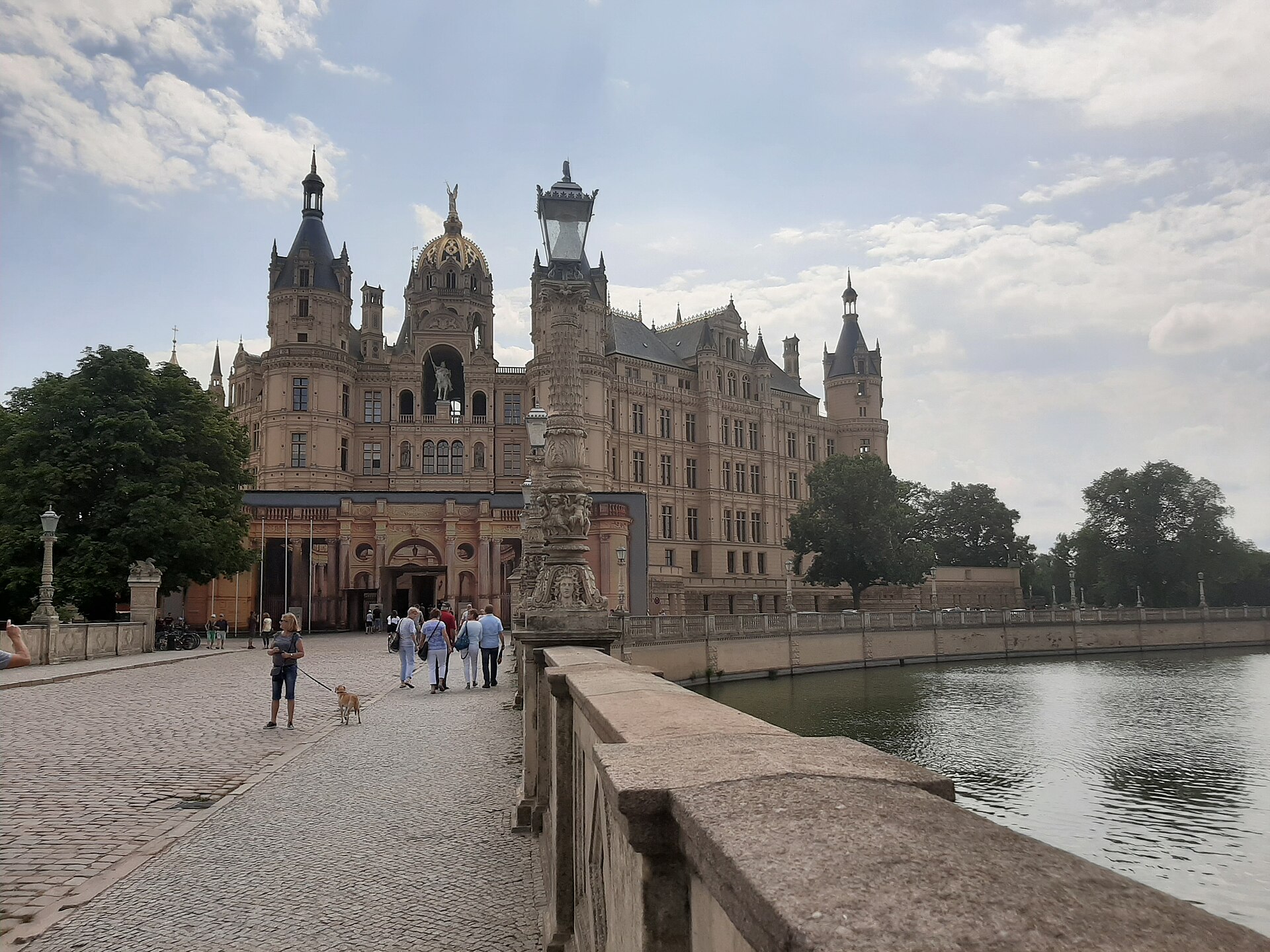
The setting of Schwerin Castle is the first of its many marvels. It stands on a small island in the Schweriner See, one of the largest lakes in a region famous for its water, connected to the surrounding city and gardens by bridges. To be built on an island was, in origin, a matter of defence: water is the oldest and most reliable of barriers, and a castle surrounded by a lake was extraordinarily difficult to attack.
That watery security is why there has been a stronghold on this island for so very long. Over a thousand years ago a fortress already stood here, and through all the centuries since, the island has never been without its castle. The lake protected the seat of power at its heart, and generation after generation of rulers made their home on this defensible spot, rebuilding and enlarging the castle as their wealth and ambitions grew.
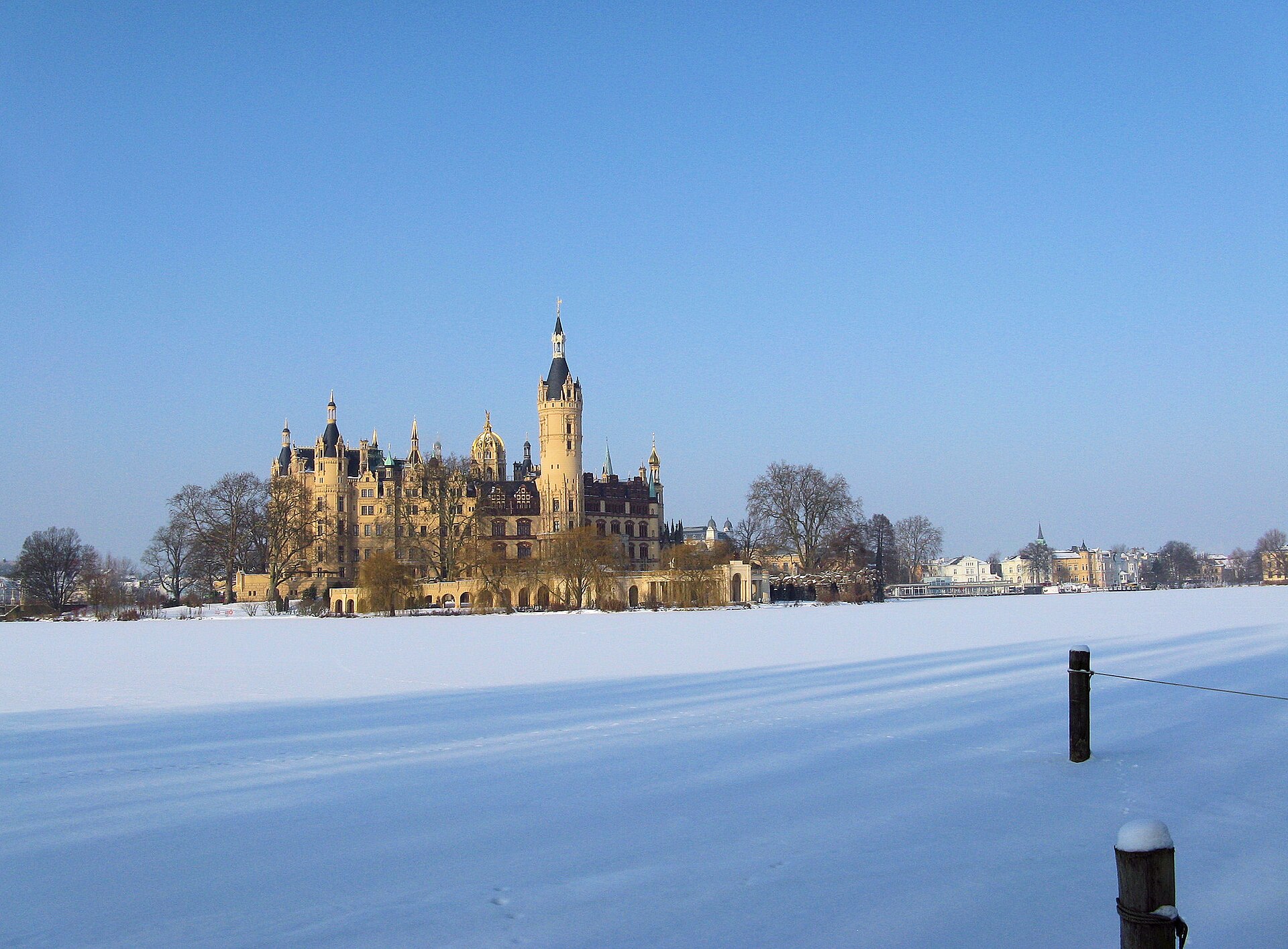
For the visitor today, of course, the island setting is simply beautiful. The castle seems to float on the water, its towers doubled in the reflections below, approached across bridges that heighten the sense of entering a world apart. What began as a hard calculation of defence has become one of the most romantic settings imaginable, and it is impossible to see the castle on its island without understanding at once why people have loved this place for a thousand years.
The bridges that now link the island to the shore make the castle easy to reach, but they also preserve the sense of crossing into a special, set-apart place. In earlier ages such crossings could be controlled and defended, the drawbridges raised to cut the castle off entirely from the land. Today they simply add to the pleasure of arrival, drawing the visitor across the water toward the towers rising ahead.
Islands have always held a special place in the human imagination, suggesting refuge, mystery, and enchantment, and a castle set on one gathers all of those associations to itself. Schwerin draws deeply on this ancient appeal, and part of what makes it so unforgettable is simply the primal magic of a great building rising alone from the water, cut off from the ordinary world by its ring of lake.

Mirrored in the Water
Schwerin lies in the Mecklenburg Lake District, a region so laced with lakes, rivers, and waterways that water is part of its very identity, and the castle makes the most of its watery surroundings. On a calm day the great lake becomes a mirror, and the castle with all its towers and turrets is reflected in perfect detail on the surface, doubling its beauty and lending the whole scene a dreamlike stillness.
These reflections are among the most photographed images of the castle, and for good reason. The combination of the ornate, golden-touched building and the shining water is irresistible, and it changes constantly with the light and the weather, from the soft colours of dawn to the fire of sunset to the crisp clarity of a winter’s day. The lake is not merely a backdrop but an active partner in the castle’s beauty.
The water also shaped the life of the castle and its city. Boats have long plied the lakes of Mecklenburg, and Schwerin grew as a residence and a capital on the shores of its lake, its fortunes bound up with the water that surrounds it. To this day, pleasure boats cross the Schweriner See, offering views of the castle from the lake that are among the finest to be had, and reminding the visitor that this is, above all, a castle of the water.
The Mecklenburg Lake District is one of the largest networks of lakes in Europe, a watery landscape that has shaped the whole character of the region. Schwerin, as its capital, sits at the heart of this country of water, and the castle is in a sense the crowning ornament of the whole lake district, the most beautiful of the many fine sights that line its shores and islands.

The Neuschwanstein of the North
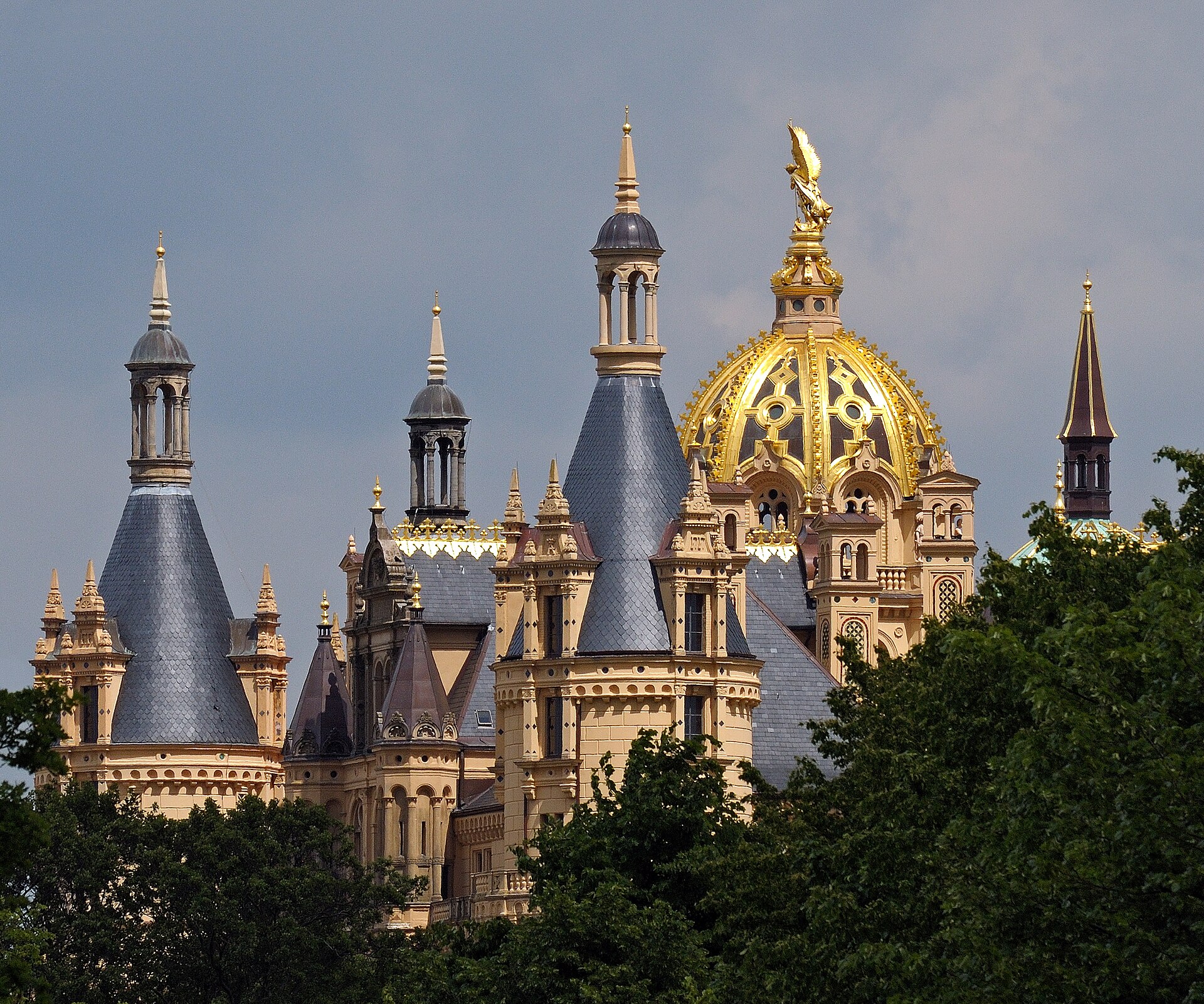
With its multitude of towers, turrets, domes, and gables, Schwerin Castle presents one of the most romantic silhouettes of any building in Germany, and it is often compared to the famous Bavarian fantasy of Neuschwanstein. The nickname the Neuschwanstein of the North captures the fairy-tale quality of the place, though in truth Schwerin is the older creation, its great rebuilding begun before Neuschwanstein was even conceived.
The comparison, however, only goes so far, and the differences are as telling as the likeness. Neuschwanstein was the private fantasy of a king who barely lived in it, a castle built for dreams rather than government. Schwerin, by contrast, was the genuine seat of a ruling dynasty, the working residence of the dukes and grand dukes of Mecklenburg, and its romantic splendour was the setting for a real court and a real state. It is a fairy tale that was also a capitol.
The golden gleam that touches some of the castle’s domes and details adds to its magical appearance, catching the light above the water and setting the whole building shimmering. From whichever angle you approach, across the bridges or from a boat on the lake, the crowded, glittering skyline of towers announces that you are arriving at something exceptional, a castle that has fully earned its reputation as one of the most beautiful in the land.
There is a certain irony in the nickname, since Schwerin’s great rebuilding was already under way before the Bavarian castle was begun. If anything, the influence ran the other way, for both belonged to the same wave of romantic castle-building that swept nineteenth-century Germany. Rather than an imitation of Neuschwanstein, Schwerin is better seen as one of the earliest and grandest expressions of the very impulse that would later produce it.
What both castles share, beyond their romantic silhouettes, is the nineteenth century’s passionate longing to reconnect with an idealised past, to build in stone the dreams of chivalry and splendour that filled the imagination of the age. Schwerin expresses that longing on a grand and public scale, and it does so with a confidence and a completeness that few of its rivals can match.
A Thousand Years on the Island
The history of Schwerin’s island stretches back astonishingly far. More than a thousand years ago, long before the present castle, a fortress stood here, a stronghold of the Slavic peoples who then inhabited this part of northern Europe. The island’s natural defences made it a place of power from the very beginning, and it has been continuously fortified ever since, an unbroken record of more than a millennium.
In time the region came under the rule of the house of Mecklenburg, one of the oldest ruling dynasties in Germany, whose princes made the island castle their principal seat. For century after century the dukes of Mecklenburg governed from Schwerin, rebuilding and expanding the castle in the styles of successive ages, so that its fabric grew to hold layers of medieval, Renaissance, and later work, the accumulated record of a long and proud dynastic history.
This deep continuity gives Schwerin a weight of history that its fairy-tale appearance might not suggest. The romantic castle of today rests on foundations reaching back a thousand years and more, and it was the seat of a dynasty that endured through the whole of that time. When you cross to the island, you are stepping onto one of the oldest continuously fortified sites in Germany, a place where power has resided, unbroken, since the age of the Slavs.
The name Schwerin itself is thought to derive from an old Slavic word, a reminder of the peoples who first fortified the island long before the German dukes. Layer upon layer of history is thus written into the place, from its Slavic beginnings through the long centuries of Mecklenburg rule to the romantic rebuilding and the democratic present. Few sites in Germany carry so continuous and so deep a record of power.

A Grand Duke’s Vision
The castle owes its present magnificence to a great rebuilding carried out in the middle of the nineteenth century, in the reign of a grand duke of Mecklenburg who wished to transform his ancestral seat into a residence worthy of a romantic age. Between the 1840s and the 1850s the old castle was largely reconstructed, its medieval and Renaissance fabric woven into a spectacular new palace in the historicist taste then sweeping Germany.
The driving force behind the design was the grand duke’s talented court architect, who oversaw the transformation of the castle into the fairy-tale palace we see today. It was a huge and costly undertaking, and it drew on the finest craftsmen and the latest ideas to create a building of extraordinary richness, its facades covered in ornament, its skyline crowded with towers, its interiors fitted out with every luxury the age could provide.
The rebuilding of Schwerin was thus a project of the same romantic impulse that produced the other great fairy-tale castles of nineteenth-century Germany, but carried out for a genuinely ruling house at the height of its power. The grand duke wanted a palace that would express both the ancient dignity of his dynasty and the romantic spirit of his age, and in the rebuilt Schwerin he got exactly that: a castle at once historic and dreamlike, rooted in a thousand years of rule yet glittering with nineteenth-century fantasy.
The rebuilding was not without its difficulties and controversies, as such vast and expensive projects rarely are, and it drew on the resources and energies of the whole court over many years. But the result vindicated the effort completely, giving Mecklenburg a residence that could stand comparison with any princely palace in Germany and providing the dynasty with a fitting stage for its power in the final decades of its rule.
It is worth pausing on the sheer ambition of transforming an inhabited, working castle into a romantic palace without ever abandoning its role as the seat of a ruling house. The rebuilding had to serve the practical needs of a court and a government even as it pursued its romantic vision, and that it achieved both so gracefully is a measure of the skill and determination that went into the project.

Inspired by the Loire
The particular beauty of Schwerin owes much to a foreign inspiration: the great Renaissance chateaux of the Loire valley in France. The architects and patrons who rebuilt the castle looked to these French models, and above all to the famous chateau of Chambord with its fantastical roofline, for the style and spirit of their new palace. The result is a building that brings a touch of the French Renaissance to the shores of a north German lake.
This borrowing was very much in the spirit of the age, which loved to draw on the styles of the past and of other lands to create romantic effects. In Schwerin the influence of the Loire is unmistakable, in the profusion of towers and turrets, the steep and elaborate roofs, and the rich ornamentation of the facades, all reminiscent of the palaces that the kings of France built along their own river valley three centuries earlier.
Yet Schwerin is no mere copy. The French inspiration was blended with German traditions and with the demands of the island site to produce something entirely its own, a castle that could only be where it is, rising from its northern lake. The marriage of French Renaissance fantasy and German romantic historicism, set upon a thousand-year-old island fortress, gives Schwerin a character unlike any other castle, and it is this rich blend that makes it so captivating.
The chateaux of the Loire had themselves been built to express the wealth and sophistication of the French Renaissance, and by echoing them the builders of Schwerin claimed a share of that glamour for the house of Mecklenburg. It was a way of announcing that this northern dynasty was as cultured and as splendid as any in Europe, and the borrowed magnificence of the French style served that ambition perfectly.
Visitors who know the castles of the Loire often feel a flicker of recognition at Schwerin, catching echoes of Chambord and its cousins in the roofline and the towers. Yet the northern light, the surrounding lakes, and the German setting transform these borrowed forms into something new, so that the recognition quickly gives way to a sense of having encountered a wholly distinct and original creation.

The Castle Church
Within the castle stands one of its greatest treasures, the castle church, a place of worship for the ducal family that is among the oldest surviving parts of the building. While much of Schwerin was rebuilt in the nineteenth century, the church preserves genuinely older fabric, and it holds an important place in the history of the region as one of the earliest Protestant church foundations in this part of Germany.
The interior is richly decorated, a jewel of colour and craftsmanship set within the larger fantasy of the castle. Here the ruling family worshipped and marked the great occasions of their lives, and its decoration reflects both their piety and their standing. Amid the romantic splendour of the rebuilt palace, the church offers a link to the deeper religious and dynastic history of the house of Mecklenburg.
A private chapel or church was an essential feature of any great princely residence, and at Schwerin it carried particular weight because of its historical importance to the Protestant faith in the region. Beautiful in itself, the castle church is also a reminder that the fairy-tale palace was the seat of a real dynasty with a real history of faith, government, and family, all woven together within these walls on the island.
The survival of older fabric within the church makes it especially precious, offering a direct link to the castle as it was before the great nineteenth-century transformation. Amid a building so thoroughly reshaped by the romantic age, the church is a place where the deeper past shows through, a reminder that beneath the fairy-tale palace lies a genuine and ancient seat of a long-lived dynasty.

The Garden Across the Water
The beauty of Schwerin does not end at the water’s edge. Around the castle and on the neighbouring shore lie extensive gardens, laid out over the centuries to complement the palace and to provide the ducal family with grounds for pleasure and display. The formal castle garden, with its geometric beds, canals, and statuary, is a fine example of the grand garden design that great residences demanded.
The gardens are graced with water features that echo the lakes all around, including ornamental canals that draw the eye toward the castle and mirror it in their still surfaces. Sculpture adorns the grounds, and avenues and parterres provide the ordered, elegant setting that a palace of this rank required. Together with the wilder beauty of the lakes, the gardens complete the picture of Schwerin as a residence conceived on the grandest scale.
For the visitor, the gardens are among the great pleasures of a trip to Schwerin, offering shifting views of the castle across water and greenery and a place to walk and linger. They connect the fairy-tale palace to the surrounding city and landscape, and they show how the whole ensemble of castle, water, and garden was composed together as a single romantic vision. To stroll them is to see the castle from its most flattering angles and to feel the full harmony of the place.
The design of great gardens was, in its day, an art as prestigious as architecture itself, and the grounds of a palace like Schwerin were meant to be read as an extension of the building, ordering nature into the same grand and harmonious vision. The formal beds, the canals, and the avenues all express that ambition to shape the landscape into a fitting frame for princely life.

The Orangery and the Grounds
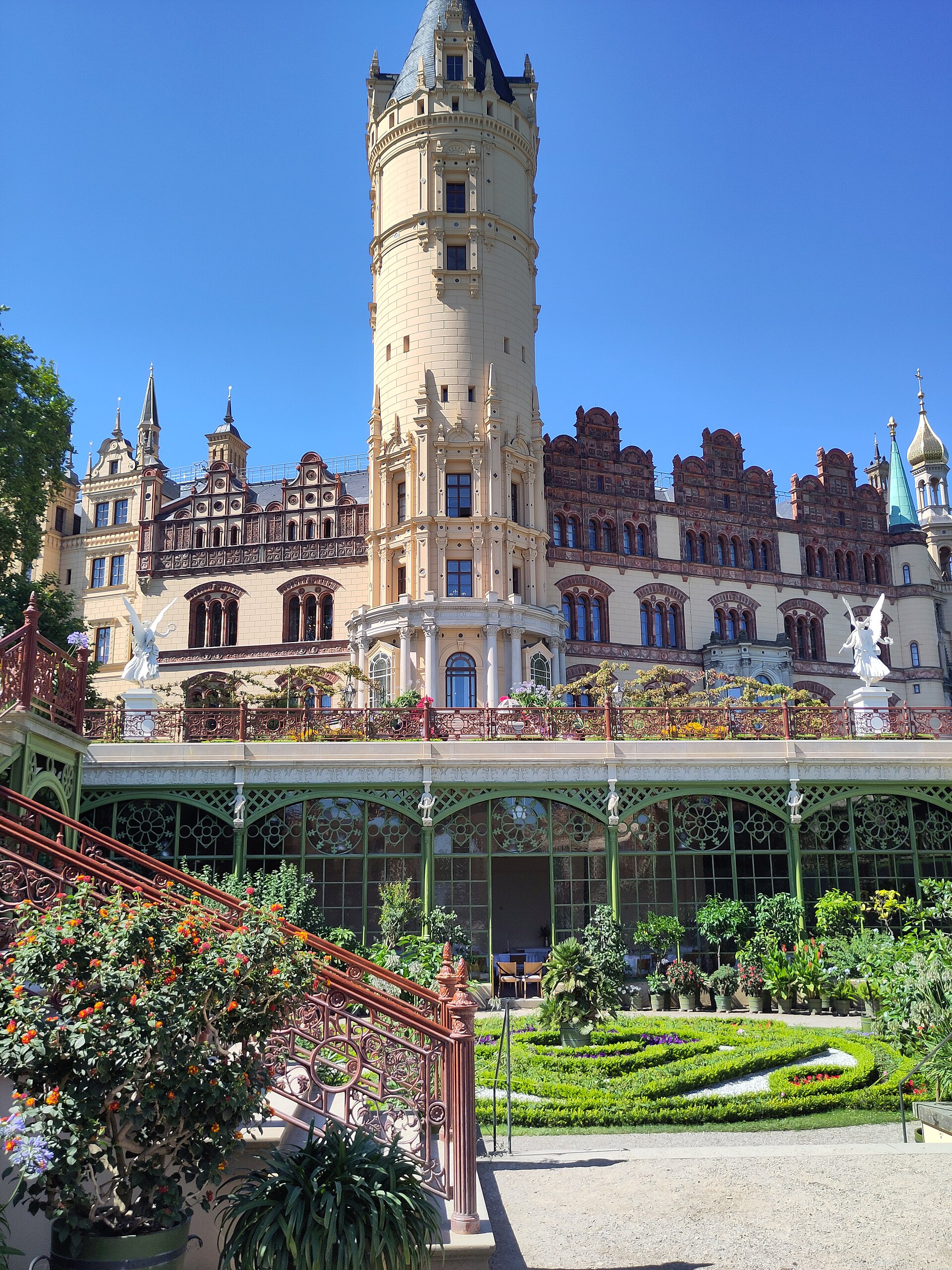
Among the elegant features of the castle grounds is its orangery, a graceful structure of the kind that great residences built to shelter tender plants through the northern winter and to provide a beautiful setting for leisure. Orangeries were a mark of refinement and wealth, allowing a court to enjoy exotic and delicate plants in a climate that would otherwise kill them, and to promenade among greenery even in the colder months.
The orangery at Schwerin, set beside the water, adds another note of elegance to the ensemble and speaks of the cultivated life that the ducal court enjoyed. Such structures were as much about pleasure and display as about horticulture, places to walk, to entertain, and to admire the collections of plants that were themselves a form of princely luxury. They embodied the leisured refinement of a great residence at its height.
Together with the formal gardens, the orangery helps to make the grounds of Schwerin a delight in their own right, a place where architecture, horticulture, and water combine in the grand manner. The whole composition, from the island castle to the gardens and the orangery, was designed to impress and to please, and it succeeds as completely today as it did when the grand dukes walked here, offering the visitor a vision of aristocratic elegance set among the northern lakes.
The presence of exotic plants in a northern climate was a small marvel in itself, a demonstration of the wealth and ingenuity that a great court could command. Behind the pleasure of the orangery lay real skill in cultivation and considerable expense, and its graceful architecture was designed to make that luxury visible, turning the practical business of overwintering plants into an elegant amenity of court life.
The Little Ghost of the Castle
No great castle is complete without a ghost, and Schwerin has one of the most beloved in Germany: Petermannchen, the little Peter, a small house-spirit said to haunt the castle and to have watched over it for centuries. Unlike the fearsome specters of many a haunted castle, Petermannchen is a friendly and even helpful spirit, a tiny figure in the dress of an earlier age who is said to guard the castle and its honest inhabitants.
According to the legends, Petermannchen rewards the good and honest but plays tricks on thieves, liars, and intruders, rattling and frightening those who mean the castle harm while protecting those who belong. He is a kind of guardian of the place, a spirit of the castle itself, and over the centuries he has become one of the most cherished figures of Schwerin’s folklore, as much a part of the castle’s identity as its towers.
Such legends are more than mere entertainment; they express the deep bond between a place and the people who have lived in and loved it. The little ghost of Schwerin gives the castle a soul and a personality, a sense that the building is watched over and cared for by something more than stone and mortar. Whether or not you believe in him, Petermannchen is part of the magic of Schwerin, a fitting guardian for a castle that looks as though it stepped straight out of a fairy tale.
Petermannchen has become a genuine mascot of the city as well as the castle, appearing in local stories, souvenirs, and celebrations, a friendly presence woven into the identity of Schwerin. Generations of children have grown up with tales of the little guardian spirit, and he lends the castle a warmth and a sense of belonging that a purely grand monument might lack. In him, the fairy-tale castle finds its fairy-tale spirit.
Stories of helpful house-spirits are common in the folklore of northern Europe, but few are as closely tied to a single famous building as Petermannchen is to Schwerin. He belongs to the castle as surely as its towers do, and the affection in which he is held says much about how deeply the people of the region cherish their island palace and the long history it embodies.

From Grand Dukes to Parliament
The story of Schwerin did not end with the age of grand dukes. When the monarchies of Germany came to an end in the early twentieth century, the castle passed out of the hands of the ruling family and into public use, and over the following decades it served a variety of purposes, including as a museum housing the rich art collections associated with the palace.
In more recent times the castle has taken on a remarkable new role. Since the reunification of Germany and the creation of the modern state of Mecklenburg-Vorpommern, Schwerin Castle has become the seat of the state parliament, so that the elected representatives of the region now debate and govern within the romantic walls once occupied by dukes. It is a striking continuity of function, the old seat of princely power reborn as a home of democratic government.
This living role sets Schwerin apart from the many castles that are now purely museums or ruins. It remains a genuine seat of power, its splendid rooms serving the practical business of a modern democracy, even as other parts of the castle welcome visitors as a museum. The palace that has been a centre of government for a thousand years continues to be one today, a rare and fitting fate for so historic a place, and one that keeps the castle vividly alive.
In recent years the wider ensemble of the Schwerin residence, encompassing the castle, its gardens, and the surrounding buildings that made up the ducal capital, has been recognised for its outstanding cultural value, taking its place among the internationally protected treasures of the region. This recognition reflects not only the beauty of the castle but the completeness and coherence of the whole princely landscape of which it is the centrepiece.

The Castle Through the Seasons
Set among its northern lakes, Schwerin is a castle that changes dramatically with the seasons, and each brings its own beauty. In summer the gardens are green and the lakes sparkle blue, and boats cross the water beneath the towers. In autumn the surrounding parks turn to gold and copper, and mist often rises from the lakes at dawn, wrapping the castle in an air of mystery.
Winter transforms the scene most dramatically of all. When the great lake freezes, the castle stands above a sheet of ice, and snow softens its towers and roofs, turning the whole island into a vision of crystalline beauty. The frozen lake, the white castle, and the bare trees make a picture of pure northern romance, and the winter months, though cold, reward the visitor with some of the most magical views of the year.
Whatever the season, it is the interplay of the castle and its water that defines the experience of Schwerin. The lakes double its beauty in their reflections, frame it from every side, and change its mood with their own shifting colours and states, from open water to sheets of ice. To see the castle once is to want to see it again in another season, for it offers not a single fixed image but a whole cycle of beauty across the turning year.
The changing light of the northern latitudes plays its own part in the castle’s beauty, from the long golden evenings of midsummer to the low, soft light of winter afternoons. Photographers return to Schwerin again and again to catch it in different weathers and seasons, knowing that the castle and its lakes never look quite the same twice, and that patience is often rewarded with a scene of unforgettable loveliness.

Visiting Schwerin Castle
Schwerin lies in the state of Mecklenburg-Vorpommern in northern Germany, and its castle stands on an island at the heart of the city, easily reached on foot from the old town across the bridges that link it to the shore. The city itself is well connected by rail and road, and a visit to the castle combines naturally with exploring Schwerin’s handsome old town, its cathedral, and its lakeside setting.
The castle serves today as both the seat of the state parliament and a museum, and visitors can tour the museum rooms, the castle church, and the splendid interiors, taking in the art and the history of the Mecklenburg dynasty. Around the castle, the gardens and the grounds are free to enjoy, and a walk through them, or a boat trip on the lake, offers the finest views of the palace on its island. Allow time for both the interior and the setting.
If you would like to find it and plan your visit, here is the castle’s position on its lake island: 53.6244, 11.4192. Try to see it from several angles, from the bridges, from the gardens, and if you can from a boat on the lake, and if possible in more than one season, for the castle is magical in summer green and winter white alike. Schwerin is one of the great romantic castles of Germany, a fairy-tale palace on the water that is also a living seat of power, and it rewards everyone who crosses to its island.
Because the castle is a working seat of parliament as well as a museum, access to some areas can depend on the business of government, so it is worth checking ahead if there are particular rooms you hope to see. This dual life, however, is part of what makes a visit so memorable, offering the rare chance to see a genuine fairy-tale castle that is not a preserved relic but a living centre of public life.
Castles Nearby
- Schloss Wernigerode, the fairy-tale castle of the Harz
- Schloss Hohenschwangau, the castle that made a king
- Neuschwanstein, the fairy-tale castle of the Dream King
The Fairy Tale on the Water
Of all the romantic castles of Germany, Schwerin may be the one that most perfectly unites beauty, history, and living purpose. It has the fairy-tale silhouette that earns it comparison with Neuschwanstein, but unlike that lonely fantasy it was, and remains, a real seat of power, home first to a ruling dynasty and now to a modern parliament. Its beauty is not a decoration but the setting for a thousand years of genuine history.
And what beauty it is. Rising from its island, ringed by shining lakes, crowned with a glittering forest of towers, mirrored in the water below and guarded, so they say, by a friendly little ghost, Schwerin is a castle that seems almost too romantic to be real. Yet it is entirely real, a working palace on the water that has been the heart of its region since the age of the Slavs, and remains so today.
So if your travels take you to the lake country of northern Germany, cross the bridges to the island and give yourself to the magic of Schwerin. Walk its gardens, tour its rooms, watch the towers shimmer on the water, and remember that within these fairy-tale walls a real dynasty once ruled and a real government still meets. Schwerin is the fairy tale on the water, and it is one of the loveliest and most alive of all the castles of Germany.
You May Like
Mafra, the Palace a King Built From a Vow