Come around a bend of the Moselle in western Germany and you will meet one of the most perfect castle views in the country. High on a cone of vine-covered rock, above a huddle of pastel houses and a slow green river, stands the Reichsburg Cochem, a castle so complete and so storybook-pretty that it looks as though it has stood there, unchanged, for a thousand years. Towers and turrets, steep roofs and battlements, all crowned with the little flags and pointed caps of the perfect medieval fortress.
The truth, as so often, is more interesting than the postcard. The castle you see is barely a century and a half old in its present form, a romantic reconstruction raised from a ruin by a wealthy dreamer in the nineteenth century. There was a medieval castle here, an important one, for the better part of seven hundred years, but it was blown apart by a French army and left as a shattered wreck for nearly two centuries before anyone thought to bring it back. What stands today is a Victorian-era vision of the Middle Ages, built on genuinely ancient foundations.
That double story, of a real medieval fortress destroyed and a romantic fantasy raised in its place, is what makes Cochem so fascinating. It is at once one of the oldest castle sites on the Moselle and one of the youngest castles you can visit, a place where history and imagination are braided together on a single rock. Climb the hill with me and we will meet the emperors and the wine-tolls, the French gunpowder and the Berlin millionaire, and untangle the tale of the loveliest castle on the river.

In This Article
- The Castle and Its Town
- Guardian of the Moselle
- An Imperial Castle
- Through the Gate and Up the Hill
- Towers, Turrets and a Witch’s Tale
- Tolls, Trade and the River Below
- The Night the French Came
- Two Centuries as a Ruin
- A Berlin Businessman’s Dream
- Rebuilt in the Romantic Taste
- Inside the Reimagined Castle
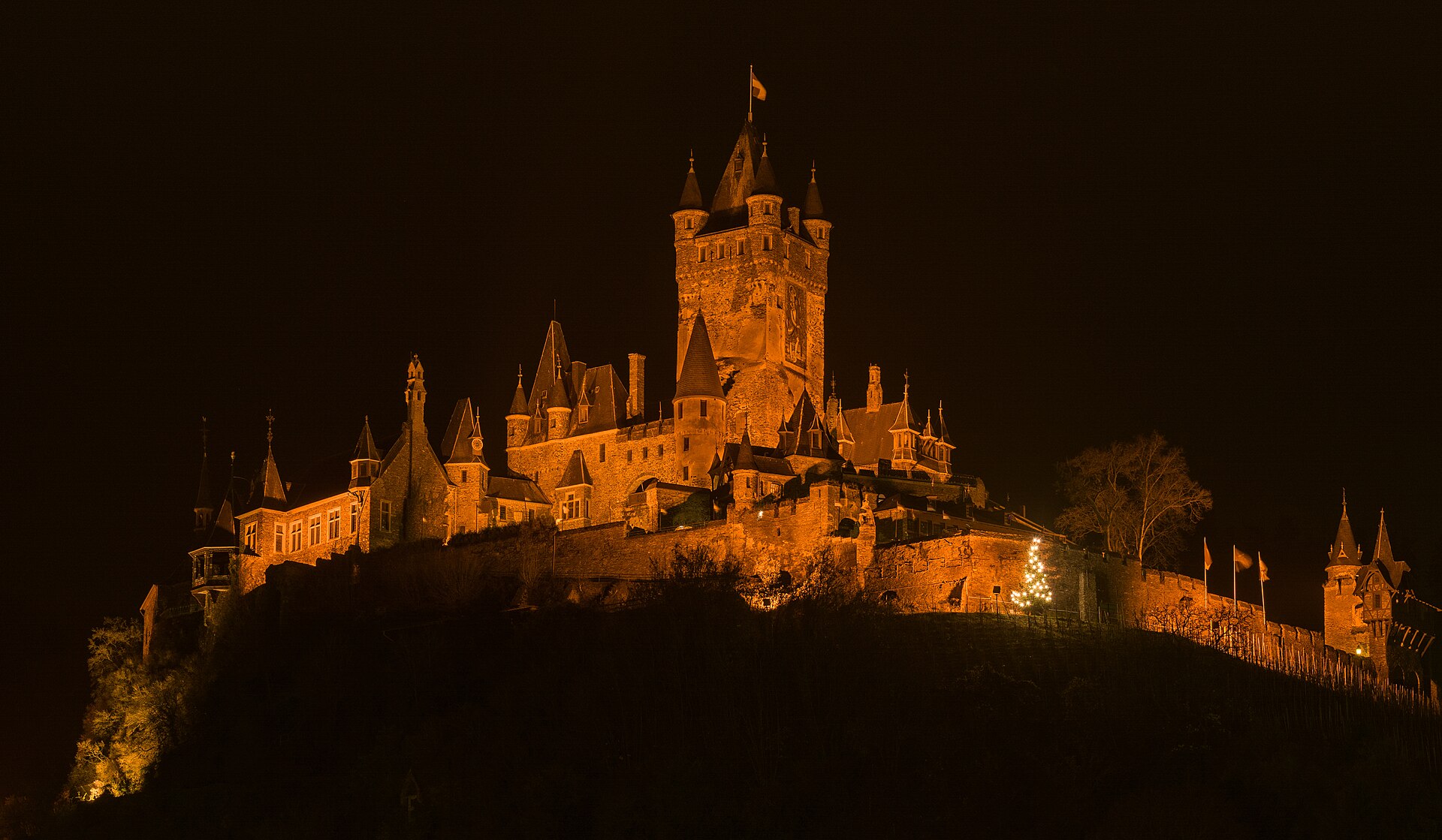
- A Fairy Tale by Floodlight
- Visiting Cochem
The Castle and Its Town
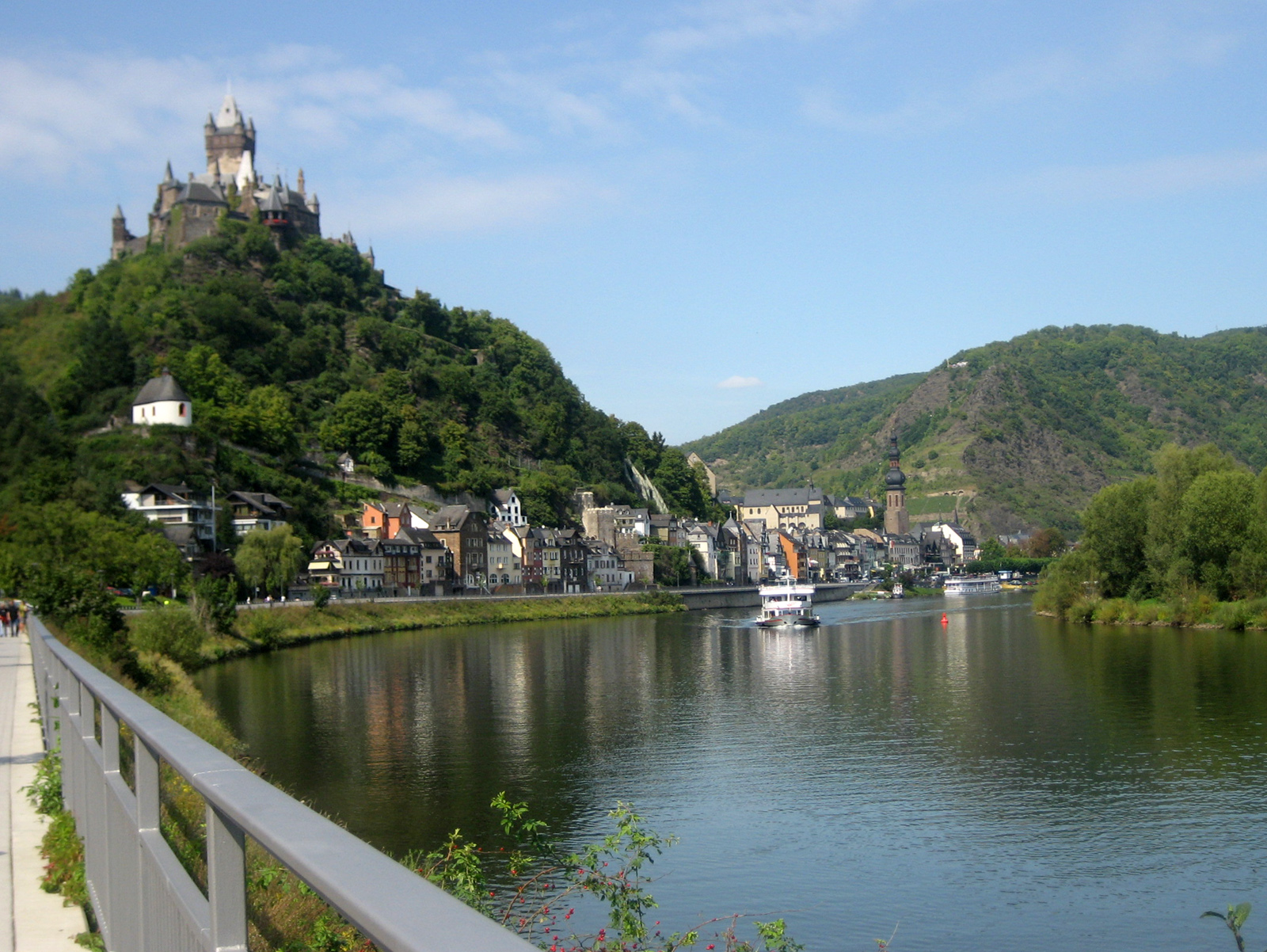
Cochem the town and Cochem the castle belong together so completely that it is hard to think of one without the other. The town spreads along the bank of the Moselle at the foot of the castle rock, a tangle of narrow streets and half-timbered houses, market squares and old gateways, all overlooked by the fortress on its height. From almost anywhere in the town you can look up and see the castle, and from the castle you look down on a sea of red roofs and the river beyond.
This intimacy between fortress and settlement is the classic pattern of the Moselle valley. The castle offered protection and asserted the authority of whoever held it, while the town provided the people, the trade, and the wealth that made the whole place worth defending. Cochem grew as a river port and a centre of the wine trade, and its prosperity and its castle rose together, bound by the same stretch of water and the same steep hills.
For the visitor, the town is the natural gateway to the castle, and it deserves time in its own right. Wander its lanes, find the old town gates and the riverside promenade, and let the castle draw your eye upward from every corner. The climb to the fortress begins here, among the houses, and the transition from the busy little town to the quiet height of the castle is part of what makes an arrival at Cochem so satisfying.
Cochem also makes a fine base for exploring the wider Moselle, whose slow loops and terraced slopes are among the most beautiful river landscapes in Germany. Boats leave from the town quay, cycle paths and footpaths follow the water, and the wine villages upstream and down repay a leisurely visit. But wherever you go in the valley, it is the castle above Cochem that lingers as the defining image, the picture people carry away.

Guardian of the Moselle
Like the Rhine, the Moselle was a working river, a winding highway carrying wine, goods, and travellers through the hills of western Germany, and its castles were built to watch and to tax that traffic. Cochem sits at a strategic point on one of the river’s great loops, where a fortress on the rock could survey a long stretch of water in both directions and control the passage of everything that moved along it.
That control was worth a great deal. In the Middle Ages the right to levy tolls on river traffic was a valuable privilege, and a well-placed castle turned that privilege into hard cash. Boats passing Cochem could be stopped and made to pay, and the castle above enforced the collection with the plain threat of its walls and its garrison. The loveliness of the setting should not disguise the hard commercial logic that first raised a fortress on this spot.
The river also shaped the character of the whole region. The steep valley sides, too precious to waste, were terraced for vineyards that still produce the Moselle wines the area is famous for, and the water carried that wine to distant markets. Cochem was a guardian not just of a trade route but of a whole way of life built around the river and the vine, and its castle presided over that green and industrious valley for century after century.
The density of castles along the Moselle can surprise visitors used to seeing one fortress dominate a whole region. Here they come thick and close, each guarding its own stretch of water and its own patch of vineyard, a legacy of the fragmented politics of medieval Germany, where power was divided among countless lords, bishops and towns. Cochem was one proud link in that long chain, and its command of the river made it one of the more important.

An Imperial Castle
The very name of the castle, Reichsburg, means imperial castle, and it points to the fortress’s proud early history. A castle was raised on this rock around the eleventh century, and it soon came under the direct authority of the German kings and emperors, making it a Reichsburg, a stronghold held for the crown rather than for a lesser local lord. To be an imperial castle was to belong, in a sense, to the highest power in the land.
That status did not always mean imperial care. Medieval rulers were often short of money, and a favourite way of raising funds was to pawn or pledge their castles and lands to wealthier subjects in exchange for ready cash. Cochem went through such an arrangement, passing as a pledge into other hands, and in time it came under the control of the powerful Archbishops and Electors of Trier, who dominated much of this region and added the castle to their broad territories along the Moselle.
For centuries thereafter the castle served as a seat of local power and administration, a base from which the surrounding district was governed and its revenues gathered. It was a working fortress and a symbol of authority, its walls a daily reminder to the people of the valley of who ruled over them. This long medieval life, stretching across some seven hundred years, gave Cochem a deep history long before the disaster that would sweep so much of it away.
The pledging of imperial castles had long consequences, because once a fortress passed into the hands of a powerful family or a great archbishopric, it rarely returned to direct royal control. Through such arrangements the Electors of Trier and other regional powers steadily built up their territories at the crown’s expense. Cochem’s journey from imperial stronghold to archiepiscopal possession is a small illustration of how the map of medieval Germany was quietly redrawn, castle by castle.

Through the Gate and Up the Hill
Reaching the castle means climbing, as it always has. From the town below, a path winds up through the trees and vineyards to the gate, and the walk, though short, is steep enough to make you feel you have earned your arrival. As you climb, the castle appears and disappears above you, its towers showing through the branches, until at last you reach the gateway and pass into the fortress itself.
The approach, like that of any hill castle, was designed with defence in mind, forcing anyone who came up to do so slowly and in the open, under the eyes of the garrison. Today the same climb simply builds anticipation, and the views back over the town and the river grow finer with every step. By the time you reach the gate you are already well above the rooftops, with the Moselle curving away below in its green valley.
Passing through the gate, you enter a world that feels wholly medieval, even though much of what you see was raised in the nineteenth century. The reconstruction was done with such care for the romantic idea of a castle that the transition from the modern approach to the old-world interior is seamless. You step from the vineyards into a fortress of towers and courtyards, and the centuries seem to fall away, exactly as the castle’s rebuilders intended.
The vineyards you pass on the way up are worth a glance in their own right, for the Moselle slopes are among the steepest wine terraces in the world, worked by hand for centuries. The castle and the vines have always shared this hillside, the one guarding the river trade that carried the other to market. Climbing between the rows toward the gate, you are moving through the very landscape that made Cochem prosperous enough to be worth fighting over.

Towers, Turrets and a Witch’s Tale
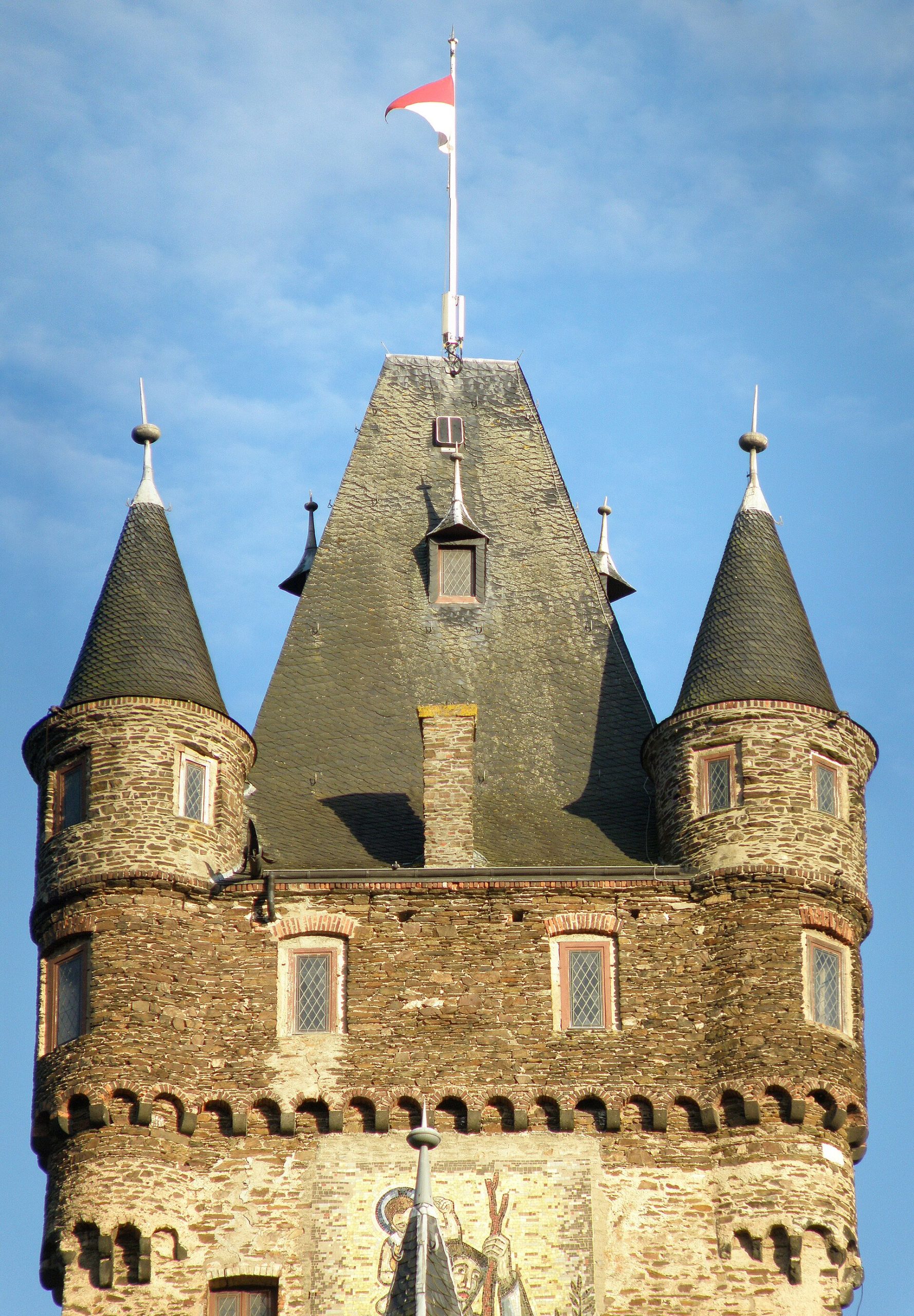
Part of the charm of Cochem lies in its silhouette, a lively crowd of towers and turrets of different shapes and heights, capped with steep conical and pointed roofs. Among them the octagonal tower stands out, an eight-sided shaft rising among the gables, one of several distinctive towers that give the castle its fairy-tale outline. This picturesque variety is very much a product of the romantic reconstruction, which delighted in exactly the kind of storybook profile that photographs so beautifully.
Towers in a castle were never merely decorative, of course. They served as lookouts, as strongpoints, as prisons, and as the last refuges of defence, and the great keep in particular was the heart of a fortress’s strength. But the sheer exuberance of Cochem’s roofline, the way its towers cluster and compete, owes as much to the nineteenth-century love of the medieval as to any military need, and it is none the worse for that.
Like most old castles, Cochem has gathered its share of legends, including the kind of tale of a witch or an imprisoned woman that clings to many a tower across Germany. Such stories, whether or not they hold any truth, are part of the atmosphere of a place like this, and the castle’s romantic rebuilders were happy to let them flourish. A fortress this picturesque seems almost to demand a legend or two, and Cochem obligingly provides them.
It is worth noticing how the reconstruction handled the castle’s outline. The rebuilders could have aimed for austere authenticity, but instead they leaned into romance, multiplying the picturesque towers and steep roofs to create a skyline that pleases the eye from every angle. The octagonal tower and its neighbours are as much a work of nineteenth-century stagecraft as of medieval engineering, and they are a large part of why Cochem photographs so unforgettably.
Tolls, Trade and the River Below
To understand why Cochem mattered, you have to picture the river as it once was, busy with boats and barges carrying the wine and goods of the region to distant markets. The Moselle was a commercial artery, and the castle on the rock was, among other things, a device for extracting wealth from that commerce. Ferries crossed the river, boats plied up and down it, and the lord of the castle took his cut of the traffic that passed beneath his walls.
River tolls were the lifeblood of many a Moselle and Rhine castle, and they explain the density of fortresses along these waterways. Each stretch of river might have its own toll station, its own castle, its own lord taking a share, so that goods moving any distance ran a gauntlet of charges. To the merchants it was a burden; to the lords it was a fortune, and Cochem’s long importance rested in large part on its command of this profitable stretch of the Moselle.
That economic role is easy to forget when you stand admiring the view, but it is the real foundation of the castle’s history. The wine terraces on the surrounding slopes, the boats on the river, the town’s prosperity, and the fortress on the height were all parts of a single system, and the castle existed to dominate and profit from it. The beauty came later. The tolls came first, and they paid for the walls.
The wine itself deserves a mention, for the Moselle is one of the world’s great white-wine regions, famous above all for its Riesling. The steep slate slopes around Cochem soak up the sun and lend the wine its distinctive character, and the trade in it has shaped the valley for two thousand years, since Roman times. The castle that taxed the wine boats was, in a sense, built on the back of the vine, and the two remain inseparable in the identity of the region.

The Night the French Came
For all its long importance, the medieval castle of Cochem met a sudden and violent end. In the late seventeenth century the armies of King Louis XIV of France swept through this part of Germany during the war remembered as the War of the Grand Alliance, or the Nine Years War. It was the same campaign that shattered Heidelberg and countless other strongholds, a deliberate policy of devastation meant to render the region defenceless and worthless to France’s enemies.
Cochem fell to the French, and in 1689 they destroyed it. The castle was set alight and its fortifications blown apart with gunpowder, reducing the proud imperial fortress to a smoking ruin. It was a catastrophe repeated up and down the Rhine and Moselle in those terrible years, as one castle after another was systematically wrecked, and Cochem, for all its age and status, was not spared. Seven centuries of history were undone in a matter of days.
What the French left behind was a shell, a jumble of broken walls and gutted towers standing forlorn above the town. The administrative role the castle had played was gone, and there was neither the will nor the money to rebuild. And so Cochem entered a long twilight, its ruins slowly crumbling on the rock, a melancholy landmark above the river, seemingly destined to share the fate of so many other castles and dissolve gently back into the hillside.
The destruction of Cochem was not an isolated act of war but part of a deliberate strategy of devastation that historians still discuss with a certain horror. The systematic burning of towns and castles across the Palatinate and the Moselle in those years left scars, physical and cultural, that took generations to heal, and it fixed an image of these ruined castles in the romantic imagination that endures to this day. Cochem’s shattering was one chapter in a much larger tragedy.

Two Centuries as a Ruin
For close to two hundred years after the French destroyed it, the castle of Cochem lay in ruins. The walls that had watched the river for seven centuries stood broken and open to the sky, colonised by weeds and ivy, their stones sometimes carried off for use elsewhere as ruins so often were. To the people of the town below, the shattered fortress on the height was simply part of the landscape, a picturesque wreck with no purpose beyond memory.
This long period as a ruin is easy to overlook, because the castle you see today looks so complete, but it is central to the story. For generation after generation, Cochem was not a functioning castle at all but a romantic remnant, the kind of ivy-clad ruin that the poets and painters of the age were learning to love. Had things gone only a little differently, it might have remained so, one more evocative shell among the many that line these valleys.
That it did not is down to a change in the spirit of the times. As the nineteenth century advanced, a powerful romantic enthusiasm for the Middle Ages took hold across Germany, and with it came a new desire not merely to admire old ruins but to restore them, to bring the medieval past back to life in stone. It was this impulse, arriving at just the right moment, that would rescue Cochem from its long decay and set it on the path to becoming the fairy-tale castle we know.
There is a certain irony in the fact that the very destruction which ended the medieval castle helped create the conditions for its romantic rebirth. Had Cochem never been ruined, it might have been quietly modernised or demolished like many an intact old fortress. Instead, as a dramatic ruin, it became exactly the kind of place the nineteenth century longed to rescue, and its long years of decay turned out to be the prelude to its most famous incarnation.
A Berlin Businessman’s Dream
The rescue of Cochem came from an unexpected quarter. In the later nineteenth century the ruined castle was bought by a wealthy businessman from Berlin, a man of means and romantic taste who set out to raise the fortress from its ruins and turn it into a splendid summer residence. Where others saw only a picturesque wreck, he saw the chance to realise a dream, and he had the money to make that dream a reality.
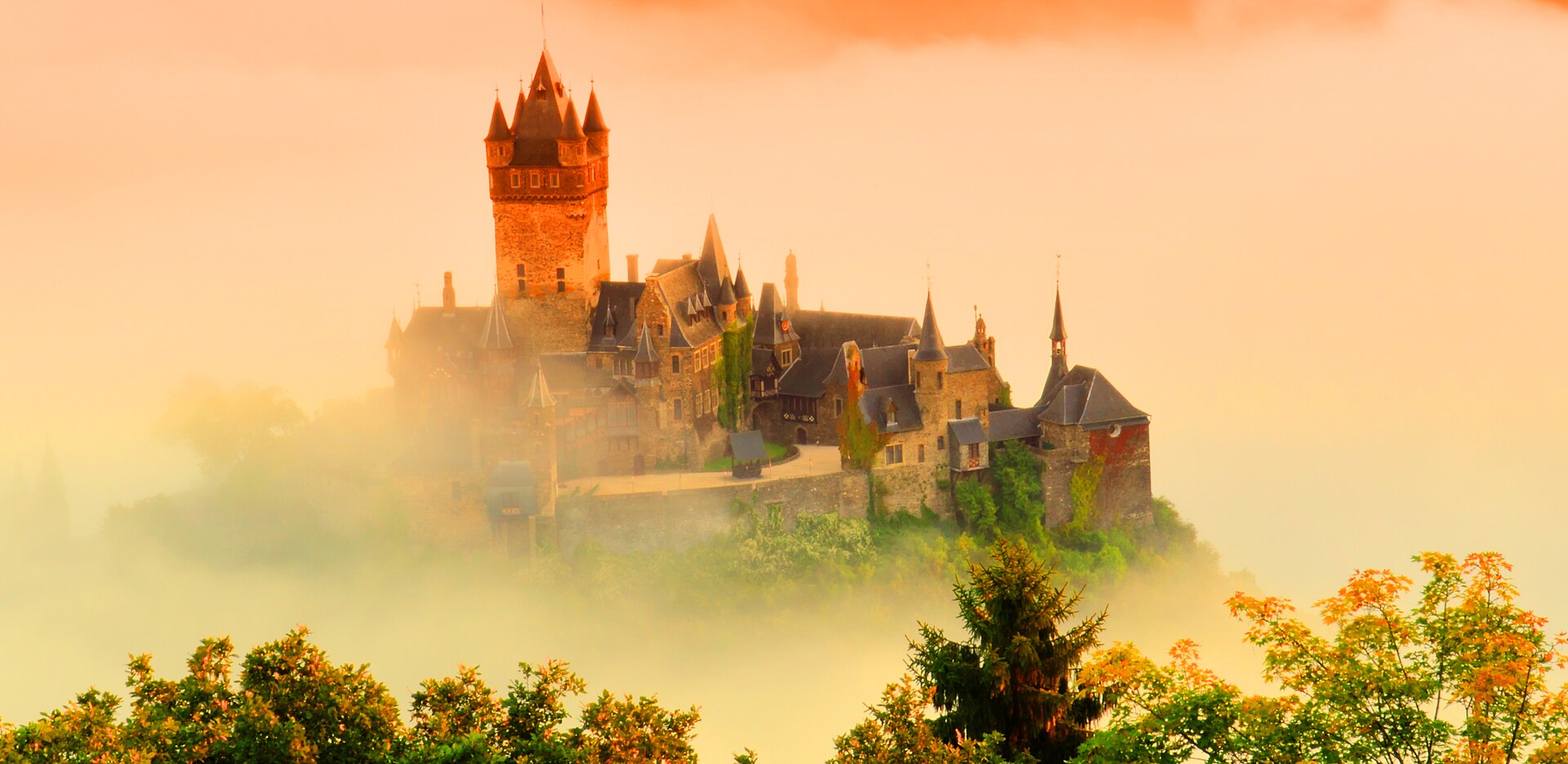
The reconstruction that followed, carried out in the 1870s, was an enormous undertaking. Working on the surviving medieval foundations and the fragments of the old walls, builders raised a whole new castle in the style of the age’s idea of the Middle Ages, complete with towers, halls, battlements and all the picturesque trappings of a romantic fortress. It was less a restoration in the strict sense than a re-imagining, a Victorian-era fantasy of what a great medieval castle should look like, built where a real one had stood.
The result was the fairy-tale castle that draws visitors today. Rising above its vineyards, complete and gleaming, Cochem became once more a landmark of the Moselle, though now as a private pleasure palace rather than a working fortress. That it exists at all is thanks to one man’s romantic vision and deep pockets, a reminder that some of the most beloved castles of Germany owe their present form not to the Middle Ages but to the nineteenth century’s passionate love affair with them.
Projects like this were only possible because of the new industrial wealth of the nineteenth century, which put fortunes into the hands of businessmen who could indulge tastes once reserved for princes. To buy a ruined imperial castle and raise it again as a private residence was a statement of both romantic feeling and social ambition, a way of buying into the glamour of a noble past. Cochem is a monument to that very nineteenth-century marriage of money and medievalism.

Rebuilt in the Romantic Taste
It is worth being clear about what the reconstruction of Cochem really was, because it shapes everything you see. This was not a careful archaeological restoration aiming to reproduce the castle exactly as it had been. It was a creative re-imagining, guided by the nineteenth-century taste for the Gothic and the picturesque, that freely added towers, gables, and decorative flourishes to produce the most romantic effect. The castle was rebuilt not as it was, but as the age thought it ought to have been.
This approach was typical of its time. Across Europe in the same decades, ruined castles were being rebuilt and even wholly invented in the medieval style, from the fantasy palaces of Bavaria to grand restorations along the Rhine. It was an age intoxicated by the Middle Ages, and its architects were happy to improve on history in the name of romance. Cochem is one of the finest and most complete examples of this enthusiasm, a whole castle conjured from a ruin to satisfy a dream.
Knowing this need not spoil the pleasure of the place; if anything it deepens it. When you look at Cochem you are seeing two ages at once, the medieval fortress in its foundations and its history, and the romantic nineteenth century in its towers and roofs and interiors. It is a monument to the enduring power of the castle as an idea, proof that the Middle Ages have never stopped being reinvented by the imaginations of those who came after.
The most famous cousin of this movement is surely the fairy-tale castle of Neuschwanstein in Bavaria, built from scratch in the same decades as a romantic fantasy of the Middle Ages. Cochem belongs to the same family of dreams, though it had the advantage of genuine medieval foundations and a real history to build upon. Seen alongside such projects, it takes its place as one of the great expressions of the nineteenth century’s inexhaustible appetite for the medieval.
Inside the Reimagined Castle
Step inside and the romantic vision continues into the rooms themselves. The interiors of Cochem were fitted out to match the castle’s medieval and Renaissance fantasy, with panelled halls, grand fireplaces, painted ceilings, and a wealth of furniture, armour, and decorative art gathered to furnish a nobleman’s dream of the past. Walking through them, you move through a nineteenth-century idea of how a great castle should feel within, as carefully composed as the towers outside.
The rooms are richly atmospheric. Suits of armour stand guard, hunting trophies and weapons line the walls, heavy oak furniture fills the halls, and the whole is arranged to evoke the life of a medieval and Renaissance lord. Whether or not every detail is historically exact, the effect is powerfully immersive, and it is easy to imagine feasts and councils unfolding in these spaces. The interiors are a large part of why a visit to Cochem is so enjoyable.
Because the castle is toured rather than wandered freely, a guide leads you through these rooms and tells the stories attached to them, weaving together the genuine medieval history and the romance of the reconstruction. It is a fitting way to experience a place that is itself a blend of history and imagination, and it lets the two ages of Cochem, the ancient and the romantic, speak to you together as you pass from hall to hall.
Collections of arms, armour and furniture like those at Cochem were assembled with enthusiasm in this period, as wealthy owners sought to fill their reborn castles with the trappings of the age they admired. Some pieces were genuinely old, others were skilful reproductions, and the distinction did not much trouble collectors bent on atmosphere. The result, at Cochem, is a set of interiors that feel gloriously of a piece, even if they belong more to the dream of the Middle Ages than to its reality.

A Fairy Tale by Floodlight
Today the Reichsburg Cochem is one of the most visited and most photographed castles in the Moselle valley, and it is easy to see why. Complete, romantic, and superbly situated above its pretty town and river, it is the very image of the fairy-tale German castle, and it draws travellers from around the world. Lit up at night above the lights of the town, it looks like something conjured from a dream, and the crowds who come to see it are rarely disappointed.
The castle is now owned by the town of Cochem itself, which cares for it and opens it to visitors, so that the fortress once held for emperors and archbishops belongs, in a sense, to the community at its feet. It hosts tours, events, and festivities through the season, and it remains the beating heart of the town’s identity and its appeal to visitors. The bond between castle and town, so old and so close, endures into the present in this new form.
For all that its present shape is young, the castle wears its layered history well. It stands as a monument both to the medieval world that first raised a fortress on this rock and to the romantic age that rebuilt it, a place where seven centuries of real history and a century and a half of loving fantasy meet on a single vine-clad hill. Few castles tell so neatly the whole long story of how the Middle Ages were lived, lost, and lovingly reimagined.
The castle has become such a familiar image that it turns up constantly in books, films and advertisements reaching for the idea of the perfect German castle. That fame, in turn, sustains the town, drawing the visitors whose interest keeps both castle and community thriving. In this way the ancient bond between fortress and town has found a modern form, with the castle once built to tax the valley now helping, through tourism, to support it.
Visiting Cochem
Cochem is one of the easiest and most rewarding castle visits in the region. The town lies on the Moselle between Trier and Koblenz, well served by road and by the railway that runs along the river, and the castle stands just above it, reached by a walk of some minutes up the hill from the old town, or by a shuttle for those who prefer not to climb. Many visitors also arrive by river cruise, drifting up the beautiful Moselle valley to the foot of the castle rock.
The interior is seen on a guided tour, which leads you through the furnished rooms, the halls, and the history of both the medieval fortress and its romantic reconstruction. Around the tour there is the pleasure of the courtyards and the terraces, with their sweeping views over the town, the river, and the vineyard-covered hills. Give yourself time to explore the town of Cochem too, with its old gates, riverside walks, and, of course, its famous Moselle wines.
If you would like to find it and plan your visit, here is the castle’s position above the town: 50.1436, 7.1667. Try to see it both by day, when the towers rise crisp against the vineyards, and by night, when it glows above the river like something from a story. The Reichsburg Cochem is a castle built twice, once by the Middle Ages and once by the romantic imagination, and standing beneath its towers you can enjoy the best of both. It is, quite simply, one of the loveliest sights on the Moselle.
The seasons each bring their own mood to the castle. In autumn the surrounding vineyards blaze gold and red and the wine festivals fill the town below; in winter the fortress can stand wrapped in mist or dusted with snow; and in the long light of summer evenings the towers glow warm above the river. Whenever you come, the interplay of castle, town, water and vine makes Cochem one of those places that stays in the memory long after the visit is over.

Castles Nearby
- Marksburg Castle, the Rhine fortress that was never destroyed
- Burg Eltz, the fairy-tale castle that is actually real
- Heidelberg Castle, Germany’s most romantic ruin
A Castle Built Twice
Most castles have a single life. Cochem has had two. For seven centuries it was a real medieval fortress, an imperial stronghold guarding the Moselle and its wine-trade, until a French army blew it apart and left it a ruin for the better part of two hundred years. Then, in an age that had fallen in love with the Middle Ages, a wealthy dreamer raised it again from its own broken stones, and it began its second life as the fairy-tale castle we see today.
That is why Cochem rewards a little knowing. Admire it purely for its beauty and it is one of the loveliest castles in Germany, a perfect storybook fortress above a perfect storybook town. But understand its story, the emperors and the tolls, the gunpowder and the long ruin, the Berlin fortune and the romantic reconstruction, and it becomes something richer: a lesson in how the past is not just inherited but reinvented, again and again, by those who come after.
So when you stand beneath its towers, looking out over the Moselle curving away between its vineyards, enjoy the fairy tale by all means. But remember that beneath the romance lie the real foundations of a very old and very real castle, and that what you are seeing is the meeting of two ages on one rock. Cochem is proof that a castle can be destroyed and still, in the end, live on, more beautiful in its second life than it ever was in its first.
You May Like
Mafra, the Palace a King Built From a Vow