There is a photograph of Burg Eltz that almost everyone has seen, even if they have never heard its name. A cluster of pale towers and steep grey roofs rising out of a sea of green forest, wreathed in morning mist, looking less like a real building than an illustration torn from a book of fairy tales. People see it and assume it must be invented, or at least heavily embellished. It is not. Burg Eltz stands, exactly like that, in a quiet fold of the hills near the Moselle in western Germany, and it has stood there for the better part of nine hundred years.
What makes it almost unbelievable is not just its beauty but its survival. Most of the great medieval castles you can visit today are ruins, or heavily rebuilt, or restored by later ages trying to imagine what the Middle Ages looked like. Eltz is the real thing, largely untouched, never destroyed, its rooms still full of the furniture, armour, paintings and treasures its owners gathered across the centuries. And those owners are the most remarkable part of the story, because the same family has held this castle for more than thirty generations, and holds it still.
To visit Eltz is to step inside a living inheritance rather than a museum. It is small, secretive, and impossibly picturesque, a castle that seems to have grown organically out of its rock like a strange stone plant. Come down the forest path with me and we will meet the family that never let it go, the feud that once threatened it, and the extraordinary run of good fortune that carried this fragile-looking fairy-tale castle unbroken through nine centuries of German history.

In This Article
- A Castle Out of a Dream
- The Walk That Ends in Wonder
- Wrapped in a Loop of River
- Hidden Away on Purpose
- A Tower of Houses on One Rock
- One Rock, Several Households
- Living on Top of One Another
- Eight Hundred Years, One Family
- The Treasure That Survived
- The Feud and the Counter-Castle
- Why It Was Never Destroyed
- The Castle on the Banknote
- Finding Burg Eltz
A Castle Out of a Dream
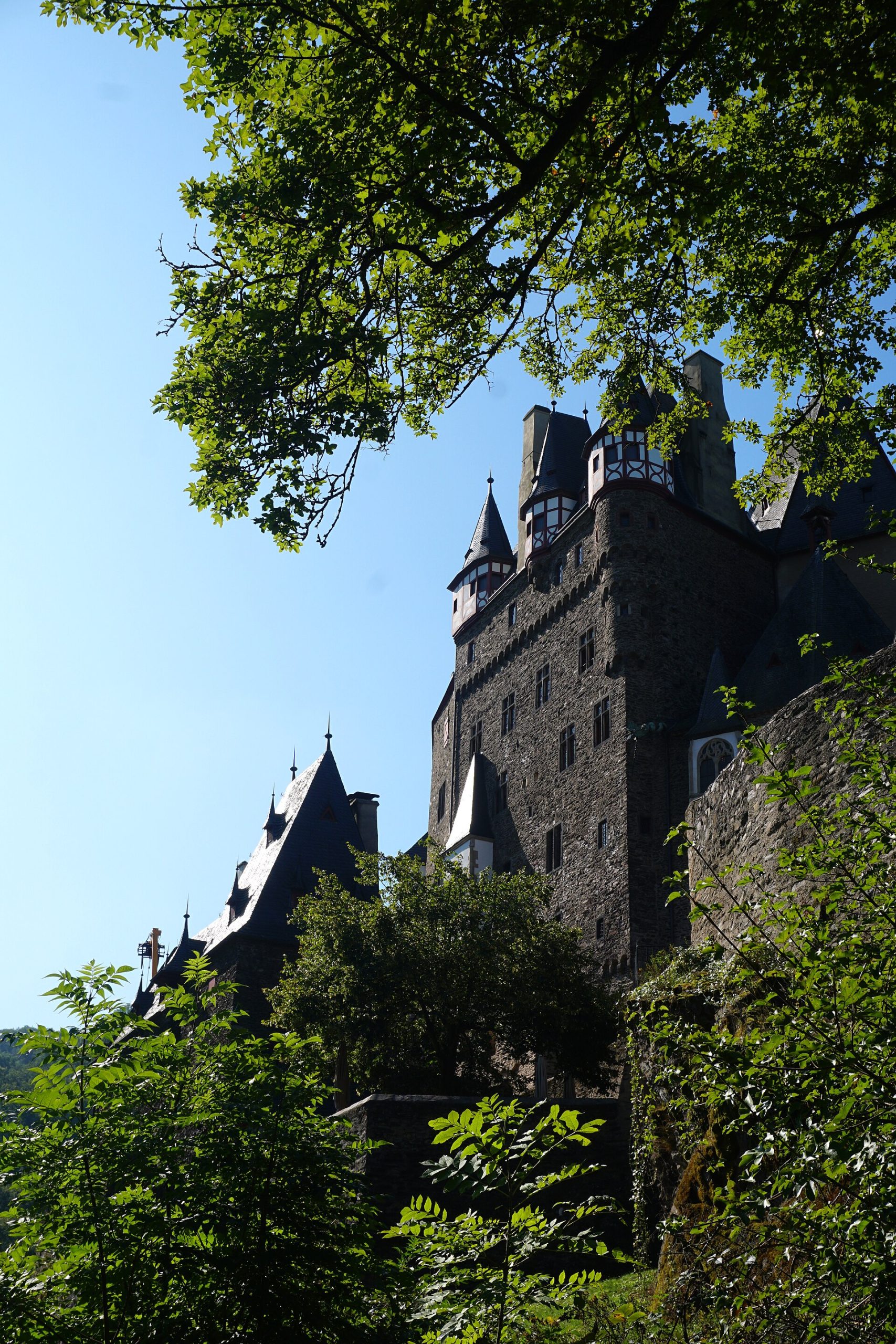
The first sight of Burg Eltz is one of those moments that stays with you. The castle does not sit on a bare hilltop, proud and visible for miles, the way most fortresses do. It hides. You come through the forest with no sense of what is ahead, and then the trees part and there it is below you, a tight huddle of towers packed impossibly close together, tall and narrow and crowned with steep roofs and pointed turrets. It looks less like a castle than like a small stone town that has been squeezed onto a single rock.
That crowded, vertical silhouette is Eltz’s signature, and it is the result of a very unusual history that we will come to. For now, simply take in the shape of it. Where a normal castle spreads out, Eltz reaches up, its buildings stacked and jostling for space, oriel windows and half-timbered gables leaning out over the drop. It is architecture that seems almost alive, grown rather than planned, and it is completely unlike the neat symmetrical palaces that came later.
The setting completes the spell. The castle stands on an oval spur of rock, enclosed on three sides by a little river and surrounded by steep wooded hills, so that it feels utterly cut off from the modern world. There are no roads sweeping up to a grand entrance, no car parks at its gates, no town crowding around it. To reach Eltz you must walk, and the walk is part of what makes the arrival feel like stepping through a doorway into an older time.
It is a castle built to a human scale rather than a monumental one. Where the great royal fortresses were designed to overawe, Eltz was designed to shelter a family, and everything about it feels correspondingly intimate. The towers are tall but slender, the rooms modest, the courtyard small. You do not crane your neck at Eltz so much as lean in toward it, and that closeness is a large part of why people fall in love with the place.
Part of the wonder is that Eltz does not announce itself the way famous places usually do. There are no vast approaches or triumphal gates preparing you for it, only a quiet forest and then, suddenly, the thing itself. That abruptness is disarming. You have no time to adjust your expectations before the castle is simply in front of you, and the effect is closer to stumbling on a secret than to arriving at a monument.

The Walk That Ends in Wonder
You cannot drive up to the door of Burg Eltz, and that is one of the best things about it. Visitors leave their cars at a distance and walk in, either down a forest path from the car park above or up along the valley of the little Elzbach stream from below. Either way the approach takes you through quiet woodland, and either way the castle stays hidden until the last moment, when it suddenly appears and stops everyone in their tracks.
This enforced walk changes the whole character of a visit. Instead of arriving in a rush, you slow down, you hear birdsong and running water, you feel the temperature drop under the trees. By the time the towers come into view you are already in a different frame of mind, ready to be enchanted rather than merely to tick off a sight. The castle earns its dramatic reveal precisely because you have had to work a little for it.
It is worth remembering that this same isolation once served a far more serious purpose. The remoteness that feels romantic to a modern visitor was, in the Middle Ages, a form of security. Tucked into its hidden valley, far from the main roads, Eltz was hard to find and harder to attack, and the forest that now shelters walkers once sheltered the castle itself. The path you stroll down for pleasure was, for centuries, part of what kept the place safe.
The seasons transform the walk completely. In spring and summer the forest is a cool green tunnel; in autumn it blazes with colour and the mists lie thick in the mornings; in the quiet of a winter day the bare branches let the castle show through long before you reach it. Regulars will tell you that no two visits look the same, and that the changing woodland is reason enough to come back more than once.

Wrapped in a Loop of River
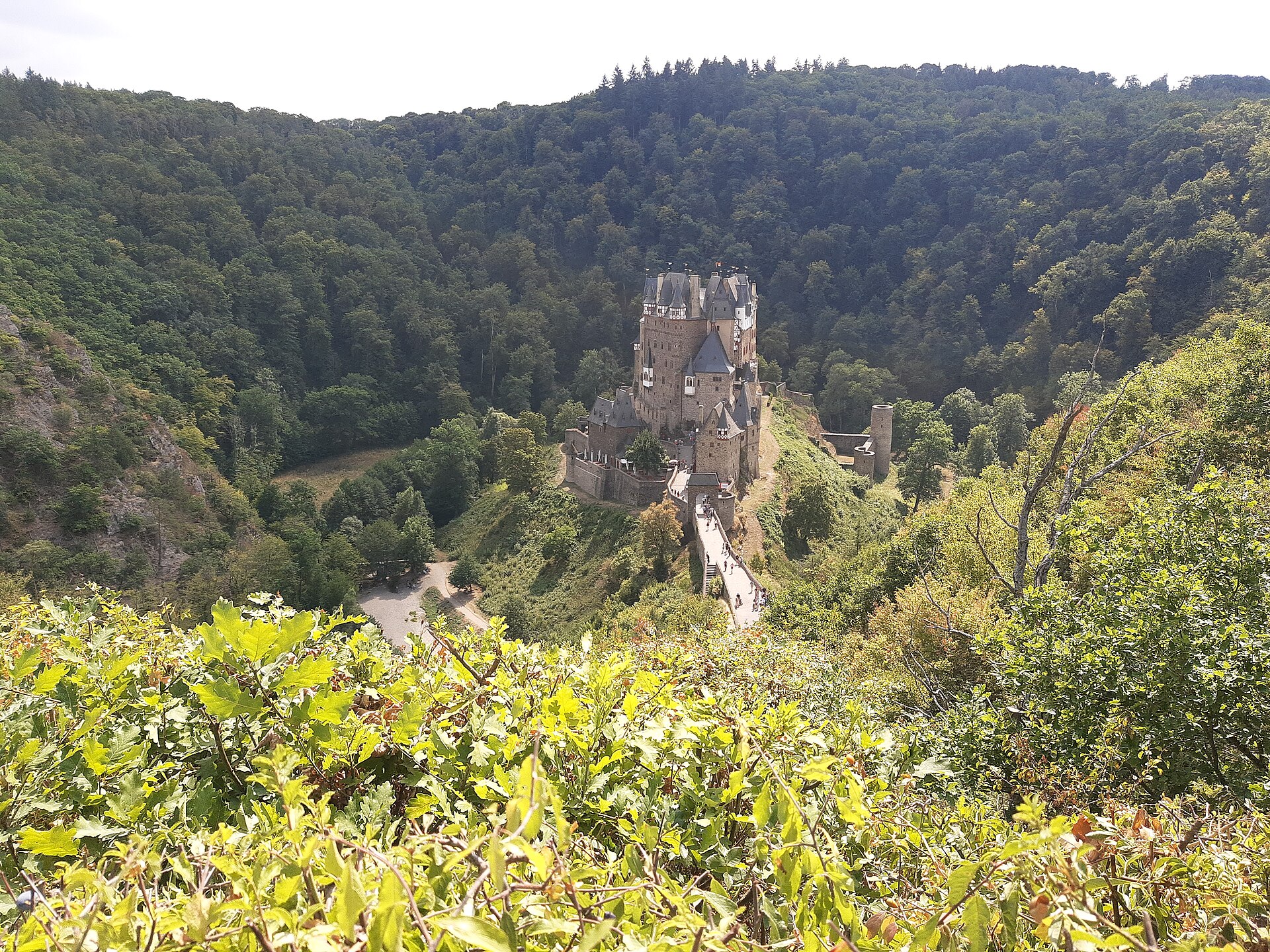
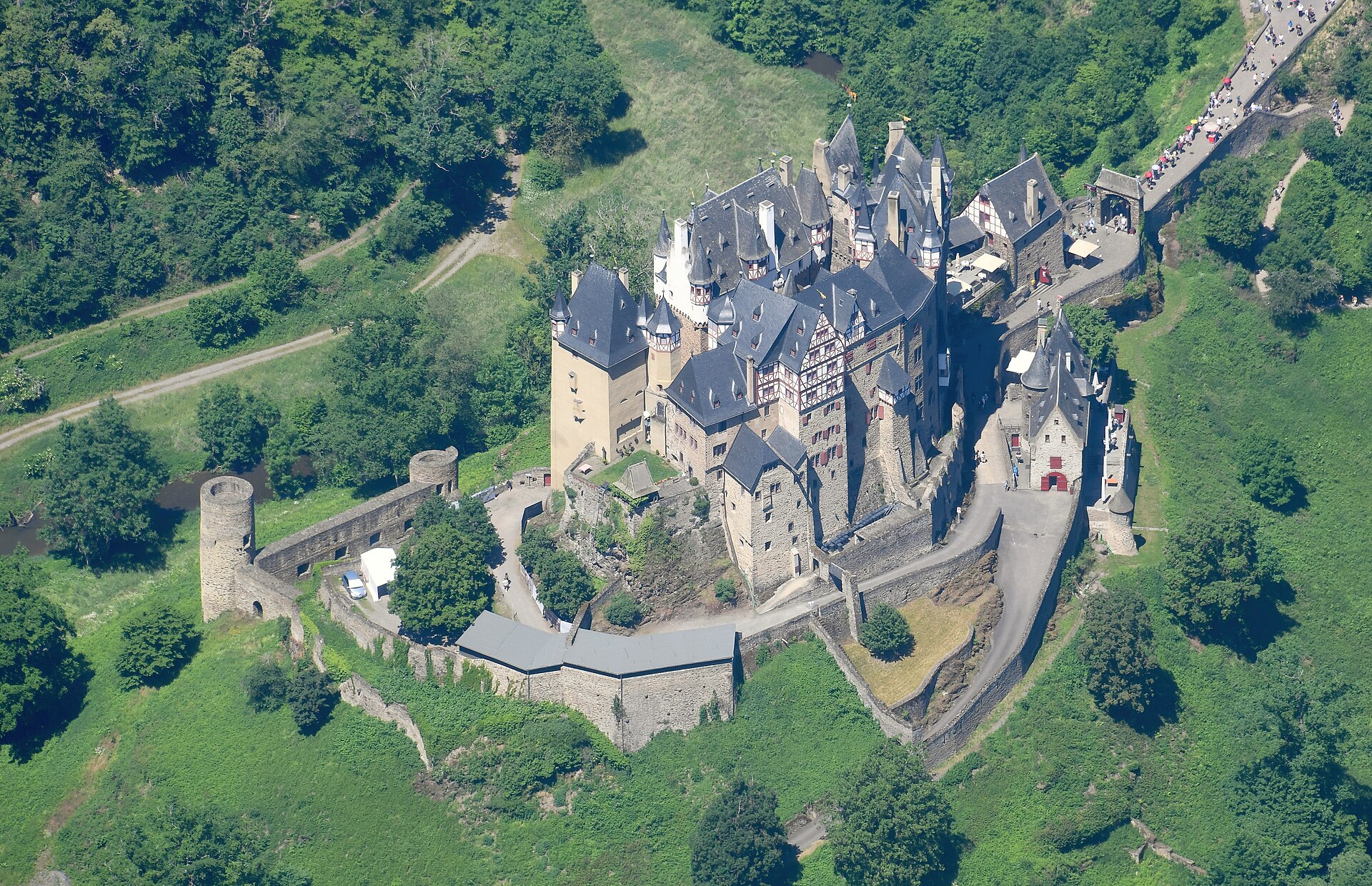
Seen from above, the genius of Eltz’s position becomes obvious. The castle sits on a tall egg-shaped rock that is almost completely encircled by the Elzbach, a small tributary that winds down through the hills toward the Moselle. The stream loops around three sides of the spur, so that the castle is protected on nearly every flank by water and steep ground, with only a narrow neck of rock connecting it to the hillside behind.
This is a classic defensive site, chosen with a soldier’s eye. An attacker approaching Eltz could not simply surround it and starve it out with ease; the terrain did much of the defensive work, funnelling any assault onto the one accessible side. The builders then piled their towers high on the limited footprint of the rock, which is exactly why the castle grew upward instead of outward. There was nowhere else to go but into the sky.
The rock also explains the castle’s odd, organic outline. Rather than imposing a neat plan on the landscape, the builders let the shape of the stone dictate the shape of the walls, so that Eltz follows the contours of its spur precisely, curving and stepping to match the rock beneath. The result is a building that seems to belong to its site as completely as a tree belongs to its roots, impossible to imagine anywhere else.
The little Elzbach that guards the castle also gave the family its name, or perhaps took its name from them; the two are so entwined that it hardly matters which came first. Castle, river and family share a single word, Eltz, a neat symbol of how completely the place and its people have belonged to one another across the centuries. Few families are so thoroughly identified with a single spot of ground.
Hidden Away on Purpose
The forest that surrounds Eltz is not just scenery. For most of the castle’s long life this deep, hilly woodland was its greatest protection, screening it from the wider world and making it a difficult prize to reach. The valley of the Elzbach was off the main routes of armies and traders, a quiet backwater where a strong castle could sit largely undisturbed while history stormed past a few valleys over.
That obscurity turned out to be the castle’s salvation. The great fortresses that guarded important roads, rivers and borders were the ones that got besieged, slighted and blown up, because they mattered strategically and whoever controlled them controlled something valuable. Eltz, tucked into its wooded fold, guarded nothing so vital, and so, again and again, the wars that wrecked its neighbours simply passed it by. Being unimportant, in the largest sense, was the luckiest thing that ever happened to it.
Today that same seclusion gives the castle its atmosphere. Standing among the trees, with no modern buildings in sight and only the sound of the stream and the wind, it is genuinely easy to forget which century you are in. Few historic sites manage to feel so untouched, and it is the forest, as much as the stone, that preserves the illusion. Eltz was hidden away on purpose, and the hiding has kept it whole.
There is a lesson here about what survives and what does not. We tend to assume that the mightiest and most important buildings are the ones most likely to last, but often the opposite is true. Importance draws armies, and armies bring destruction. Eltz endured precisely because it sat quietly out of the way, a reminder that in the turbulent history of Europe, obscurity could be a more reliable shield than any wall.

A Tower of Houses on One Rock
The strangest and most wonderful thing about Eltz is why it looks the way it does, and the answer lies in a peculiar medieval arrangement. Eltz is what the Germans call a Ganerbenburg, a castle owned jointly by several branches of the same family at the same time. Rather than one lord building one hall, several related households each built their own tall residence on the shared rock, crowding their separate homes together within a single ring of defences.
Imagine several branches of one family agreeing to live in the same tiny fortress, each wanting their own front door, their own hall, their own privacy, all on a rock barely large enough for one house. The only way to fit them was to build upward and to pack the buildings tightly together, which is exactly what happened. The towers of Eltz are really separate family houses, stacked and jammed against one another, sharing walls and courtyards out of sheer necessity.
This is why the castle has that extraordinary, teetering, many-towered look, like several buildings trying to occupy the same square of ground. What appears at first to be one fantastically complicated castle is in fact a small community of homes under one roofline. Once you understand that, the crowded silhouette makes perfect sense, and the castle becomes even more charming: a medieval solution to the very human problem of a large family that could not quite bring itself to split apart.
The arrangement also tells you something about medieval inheritance. When property passed to several heirs at once, a family could either divide the estate, weakening everyone, or find a way to hold it in common. The Ganerbenburg was the second solution made physical: keep the castle whole and undivided, but let each branch have its own quarters within it. Eltz is the most beautiful surviving example of a compromise that many medieval families were forced to make.

One Rock, Several Households
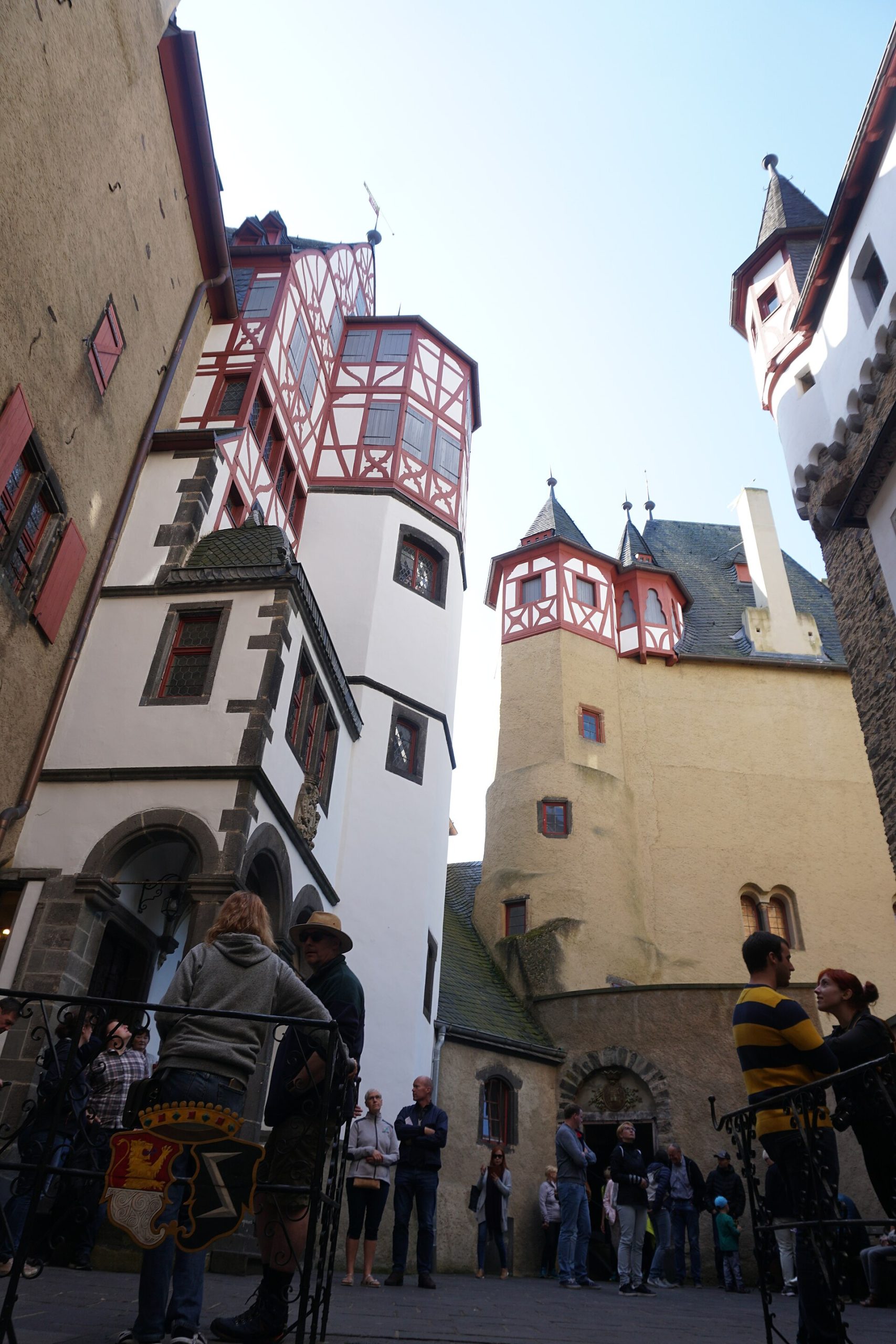
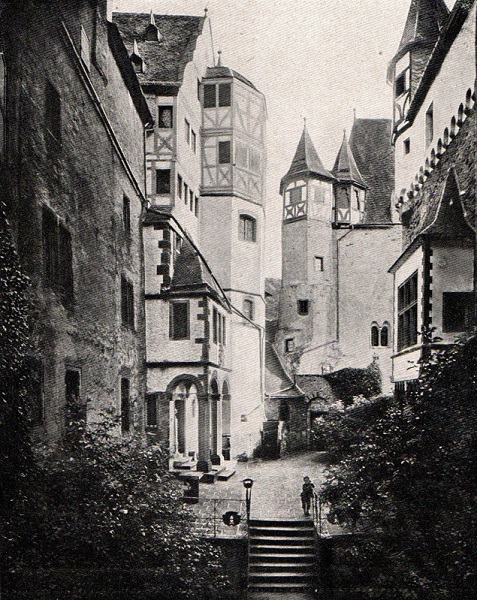
Step into the courtyard and the Ganerbenburg arrangement comes vividly to life. This narrow, irregular space is hemmed in on every side by the tall facades of the different family houses, their windows and doors and staircases all opening onto the same small yard. Standing here you are at the shared heart of what were once effectively separate homes, the one common ground where the branches of the family met.
The main houses that survive are associated with different lines of the family, and each has its own character and its own rooms, yet all of them open onto this single courtyard and shelter behind the same outer walls. It was a living arrangement that demanded cooperation, since decisions about the shared defences and the common spaces had to be agreed among households that were kin but also, inevitably, rivals. That so much of it survives intact is a small miracle of family diplomacy sustained across centuries.
There is something deeply human about the result. Great castles are usually monuments to a single will, one powerful lord imposing his vision on stone. Eltz is different. It is a monument to a family, to the compromises and accommodations of relatives learning to live on top of one another, and the courtyard is where you feel that most strongly. It is intimate rather than grand, and it is all the more moving for it.
In practice, rules and agreements governed how the co-heirs shared the castle, spelling out rights and duties in careful detail so that life on the crowded rock did not descend into constant quarrelling. These arrangements could last for generations, and the fact that Eltz never tore itself apart from within is as impressive, in its way, as the fact that it was never torn apart from without. Cooperation preserved it quite as much as good defences did.
Living on Top of One Another
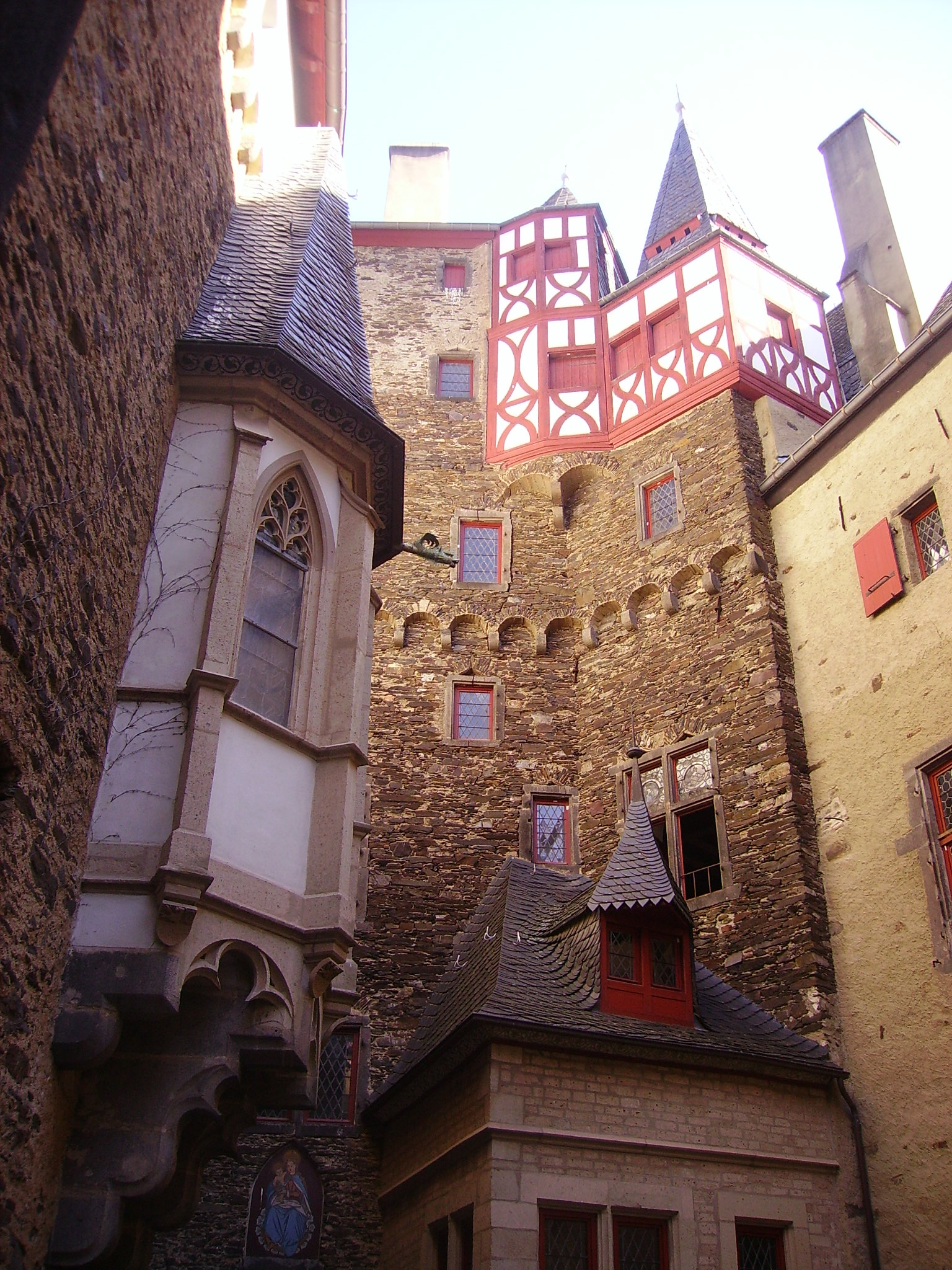
Look up in the courtyard and the walls seem almost alive with detail. Oriel windows jut out overhead, little turrets cling to corners, half-timbered upper storeys lean out above sturdy stone below, and decorative touches appear wherever the builders could find room for them. Every household wanted its own home to be handsome, and the competition for space and display has left the walls wonderfully busy, a patchwork of styles added across the generations.
Because the buildings went up over several centuries, they carry the fashions of different ages layered on top of one another. Sober Romanesque work at the base gives way to Gothic and later flourishes higher up, and the whole is stitched together by the shared necessity of the rock. There was no master plan and no single architect imposing order. Instead each generation added, adapted and embellished, and the accidental harmony of the result is part of the castle’s charm.
This organic quality is exactly what later ages found so romantic about Eltz. It has none of the cold symmetry of a planned palace and all the warmth of a place that grew to meet the needs of real people over a very long time. Every projecting window and crooked gable is a decision someone once made about how to fit a home onto an overcrowded rock, and the sum of all those decisions is one of the most beloved buildings in Germany.
Inside, the rooms preserve the atmosphere of a genuinely lived-in home rather than a showpiece. Low ceilings, wall paintings, worn furniture and the small comforts of daily life give the interiors a warmth that grander palaces rarely achieve. You come away remembering not vast state rooms but human-sized spaces where real families ate, slept and sheltered from the weather through eight centuries of winters.
Eight Hundred Years, One Family
The single most astonishing fact about Burg Eltz is not architectural but human. The same family has owned this castle continuously since the twelfth century, more than thirty generations in an unbroken line, and it belongs to them still. In an age when most great houses have passed through many hands, been sold, seized, or turned into state museums, this continuity is almost without parallel. The people who care for Eltz today are the direct descendants of the people who built it.
That continuity is written all through the castle. Because the family never lost possession, they never had reason to strip the place out or let it fall to ruin, and so the rooms are still filled with the accumulated belongings of centuries: furniture, weapons, paintings, tableware and everyday objects gathered by generation after generation of the same household. Walking through them, you are not looking at a curated reconstruction but at a real home that has simply kept everything.
Comparing an old photograph of the courtyard with the view in front of you today, the sheer stability of the place is striking. Where other castles have been transformed by war, neglect or restoration, Eltz has quietly stayed itself. The family’s long stewardship, patient and unbroken, is the reason a fragile medieval castle survives intact into the present, and it gives the whole place a warmth that no state-run monument can quite match.
It is worth pausing on the sheer arithmetic of this. More than thirty generations means a chain of parents and children stretching back past the printing press, past the discovery of the Americas, past the Reformation and the religious wars, all the way to the age of the crusades, every link of it centred on this one rock. To keep anything in a single family for so long, through all the accidents that break such chains, is extraordinary.
The Treasure That Survived
Because the family never left and the castle was never sacked, Eltz preserves something most medieval strongholds long ago lost: its treasure. In the vaulted treasury you can see hundreds of objects of gold, silver, ivory and glass, along with weapons, jewellery and curiosities collected by the family across the better part of a thousand years. It is one of the finest private treasuries in Europe, and it survives for the simple reason that no conqueror ever carried it off.
The collection ranges from the sacred to the whimsical, from finely worked drinking vessels and ceremonial arms to small ingenious ornaments that once delighted the household. Each piece is a fragment of the family’s long story, a wedding gift here, a spoil of office there, a treasured heirloom passed carefully down the generations. Together they make the treasury feel less like a display of wealth than like a physical memory of the family itself.
To stand among these objects is to grasp what continuity really means. Elsewhere, the movable riches of the Middle Ages were scattered long ago, melted down for coin or seized in war. Here they remain where they were gathered, in the very castle whose owners collected them, watched over by the descendants of the people who first brought them home. The treasury is the glittering proof of the same quiet fact that defines the whole castle: at Eltz, almost nothing was ever lost.
The treasury also quietly documents changing tastes and technologies across the centuries, from medieval devotional pieces to later works of astonishing craftsmanship in silver and gold. To walk along its cases is to travel through the history of European decorative art in miniature, all of it gathered by one family and all of it still in the place for which it was collected, which is rarer than any single object it contains.

The Feud and the Counter-Castle
For all its good fortune, Eltz did once come close to serious trouble. In the early fourteenth century the lords of Eltz found themselves at odds with a powerful and ambitious neighbour, the Archbishop and Elector of Trier, who was determined to bring the independent-minded knights of the region under his authority. The result was a long conflict remembered as the Eltz Feud, one of the sternest tests the castle ever faced.
Unable to storm the well-sited castle directly, the Archbishop resorted to a classic medieval tactic: he built a smaller siege castle on the high ground nearby, a counter-fortress from which his men could bombard and blockade Eltz. This intrusive little stronghold earned the nickname Trutzeltz, roughly the spite-Eltz or defiance-Eltz, and from it the besiegers harried the castle over a period of years, wearing down the defenders without ever quite taking the place by assault.
In the end the feud was settled not by the castle’s destruction but by negotiation and submission, and the lords of Eltz kept their home while acknowledging the Archbishop’s overlordship. It was the closest Eltz came to sharing the violent fate of so many other castles, and the fact that it emerged battered but standing set the pattern for its whole later history. Time and again, Eltz would find a way to survive its dangers rather than be broken by them.
The remains of the counter-castle, Trutzeltz, can still be traced on the height above, a reminder in stone of that dangerous chapter. It is a strange thing to see the ruin of the fortress built to break Eltz standing broken itself, while the castle it was meant to destroy survives complete below. Of the two rivals, it was the aggressor’s stronghold that crumbled, and the intended victim that endured, a small irony the centuries seem to have enjoyed.
Why It Was Never Destroyed
The great puzzle of Eltz is how a delicate medieval castle came through the wars of the following centuries unscathed, when so many mightier fortresses were reduced to rubble. Part of the answer, as we have seen, is its hidden and unimportant position. But part of it, too, was luck and good judgement at moments when the castle might easily have been lost.
The most dangerous period came in the late seventeenth century, when the armies of Louis XIV rampaged through this part of Germany, burning castles and towns across the Rhineland, including nearby Heidelberg. Eltz, remarkably, was spared. Family tradition holds that a member of the Eltz family serving in the French army helped protect the ancestral home from destruction, and whatever the exact truth, the castle escaped the fate of its neighbours at the very moment when it seemed most exposed.
After that narrow escape the greatest threats to old castles became not war but poverty and neglect, as families ran out of money to maintain vast and draughty medieval homes. Here again Eltz was fortunate. The family retained the means and the will to keep the castle in repair, and in the nineteenth century a careful, sympathetic restoration secured it for the future without stripping away its character. Where others fell to cannon, fire, or simple decay, Eltz was, at every turn, quietly preserved.
This pattern of narrow escapes is really the hidden spine of the whole Eltz story. Other castles have grander histories of siege and battle, but Eltz has something rarer, a history of survival, of dangers deflected and disasters avoided. It is not the drama of destruction that makes the place remarkable but the quiet, repeated fact of continuity, a castle that kept finding, at each moment of peril, a reason to go on standing.

The Castle on the Banknote
By the nineteenth century, Eltz had become something more than a family home; it had become an icon. The Romantic movement, which taught Europe to love wild scenery and medieval remains, fell hard for this misty fairy-tale castle in its forest valley. Painters came to capture it, among them the great English artist J. M. W. Turner, and their images helped spread its fame far beyond the quiet corner of Germany where it stands.
That fame reached its height in the twentieth century, when a view of Burg Eltz was chosen to appear on the German five hundred mark banknote, one of the highest-value notes in the country’s currency before the euro. For decades, millions of Germans carried a picture of this castle in their wallets, whether or not they knew its name, and the image became one of the most widely circulated pictures of any building in the country.
It is easy to see why Eltz, of all castles, was chosen for such honours. It is the castle that looks the way castles are supposed to look in our imaginations, the platonic ideal of the fairy-tale fortress, and yet it is entirely real. In an age of reproductions and inventions, Eltz offers the rare pleasure of a dream that turns out to exist, standing patiently in its valley, ready to be visited by anyone willing to make the walk.
The banknote fame had a happy side effect: it fixed Eltz in the national imagination as a treasure worth protecting, and helped ensure that the castle would be cherished rather than forgotten. Familiarity, in this case, bred affection. A building that millions of people had, in a sense, carried in their pockets was never going to be allowed to fall into ruin, and the humble five hundred mark note became an unlikely guardian of a medieval castle.
Finding Burg Eltz
Reaching Burg Eltz takes a little planning, and the effort is richly repaid. The castle lies in the hills between the Moselle and the Rhine, not far from the town of Koblenz, and most visitors drive to one of the car parks near the site and then walk in, either down the forest path or up along the stream. There is a shuttle for those who prefer not to walk the whole way, but even so the last stretch to the gate is on foot, and it is worth it.
The castle is open to visitors through the warmer months of the year, and the interiors can only be seen on a guided tour, which is the only way to view the furnished rooms and the famous treasury. The tour is well worth taking, because the inside of Eltz is every bit as remarkable as the outside, full of the genuine possessions of the family that has lived here for so long. Around the tour you are free to wander the courtyard and the surrounding paths, and photographers should come early or stay late for the mist and the low light that make the castle so magical.
If you would like to locate it and plan your route, here is the position of the castle in its hidden valley: 50.2058, 7.3369. Wear comfortable shoes, allow time for the walk in and out, and try, if you can, to arrive with the morning fog still lying in the trees. Burg Eltz has been enchanting visitors for centuries, and it remains one of the few places that fully lives up to the fairy tale. It really is as beautiful as the pictures. You simply have to walk down through the forest to believe it.
A visit pairs naturally with the wider region. The castle sits within easy reach of the Moselle valley, with its terraced vineyards and riverside towns, so many travellers fold Eltz into a longer journey through one of Germany’s loveliest wine countries. But even on its own, the castle justifies the detour, and a slow half-day spent walking in, touring the rooms and lingering in the courtyard is one of the most rewarding castle visits the country has to offer.

Castles Nearby
- Wartburg Castle, the most German of all castles
- Heidelberg Castle, Germany’s most romantic ruin
- Neuschwanstein, the fairy-tale castle of the Dream King
A Fairy Tale That Happens to Be True
Most fairy-tale castles are either genuinely old and mostly ruined, or beautifully whole and mostly invented, built in a later century by someone dreaming of the Middle Ages. Burg Eltz is the rare exception that is both authentically medieval and almost perfectly preserved, and that is what makes it feel like a small miracle. Nothing here was reconstructed to match a fantasy. The fantasy simply survived.
Behind that survival lies one quiet, extraordinary fact: a single family held on. They chose this hidden rock, they crowded their houses onto it, they weathered a feud and dodged the fires of war, and then, generation after generation, they refused to let the place go. The treasures in the vaults, the furniture in the rooms, the very completeness of the castle, all of it exists because the people of Eltz stayed when so many others left or were driven out.
So when you finally climb back up the forest path and the towers disappear behind the trees, carry this thought with you. You have not just seen a pretty castle. You have visited a nine-hundred-year-old home that is still a home, a living link to the medieval world unbroken by all the centuries in between. Of all the castles in Germany, Eltz is the one that most completely earns the word enchanting, because at Eltz the enchantment is real.
You May Like

Mafra, the Palace a King Built From a Vow