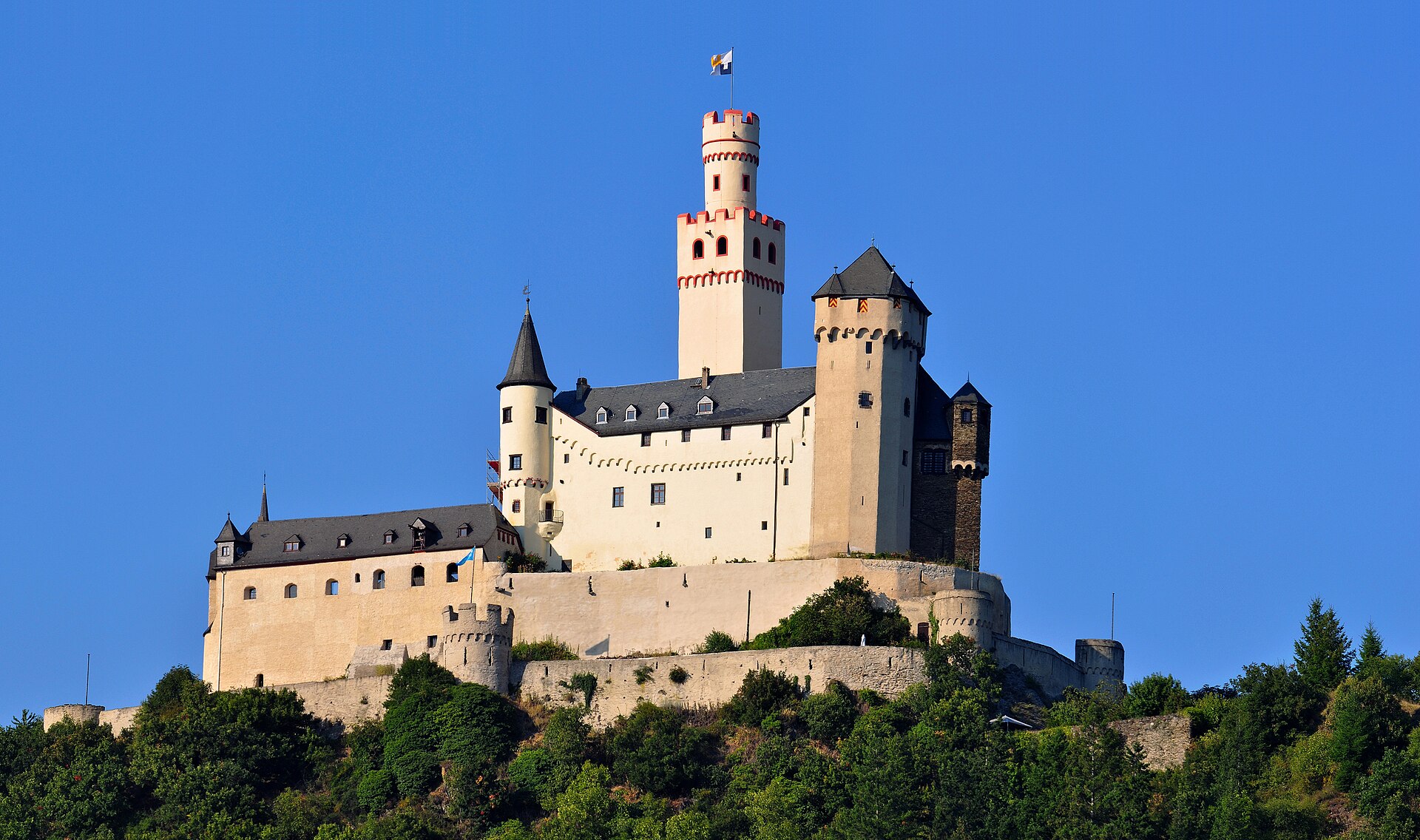
The Rhine gorge between Bingen and Koblenz is famous for its castles. There are dozens of them, perched on crags and vineyards above the river, one after another, a stone parade of the Middle Ages strung along one of Europe’s great waterways. Most of them are ruins, dramatic and picturesque, their walls broken by war and time. But among all of them there is exactly one that stands complete, unbroken, essentially as it was in the Middle Ages, and that castle is the Marksburg.
High on a steep cone of rock above the little town of Braubach, the Marksburg has the rare distinction of never having been destroyed. While the fortresses around it were stormed, blown up, and burned across the centuries, this one survived every threat, and so it offers something none of its neighbours can: the chance to walk through a genuine medieval hill castle that is still whole, from its drawbridge to its keep, its kitchens to its cannon. It is the real thing, not a ruin and not a reconstruction.
That completeness has made the Marksburg one of the most important castles in Germany, a kind of textbook of medieval fortress life preserved intact. It is looked after by an association devoted to Germany’s castles, and it teaches visitors more about how such places actually worked than a dozen grander ruins could. Climb the winding path with me and we will explore the one Rhine castle that time forgot to break, and discover why a modest fortress above Braubach matters so much.

In This Article
- A Sentinel Above the River
- The Town at Its Feet
- Up the Winding Way
- The Stair Cut From the Rock
- The Keep and the Last Refuge
- Guns Pointed at the Valley
- A Thousand Years of Armour
- Life Inside the Working Castle
- The Poison and the Cure
- The Castle That Was Never Taken
- Rescued and Preserved
- A Living Museum of the Middle Ages
- Visiting the Marksburg
A Sentinel Above the River
The Marksburg was built to watch the river, and the river is the key to understanding it. For centuries the Rhine was one of the busiest trade routes in Europe, a highway of barges and boats carrying goods between the great cities of the north and the passes to Italy in the south. Wherever there is a valuable route, there are those who wish to control it, and the castles of the Rhine gorge were, among other things, toll stations and strongpoints from which lords could tax and dominate the traffic passing below.
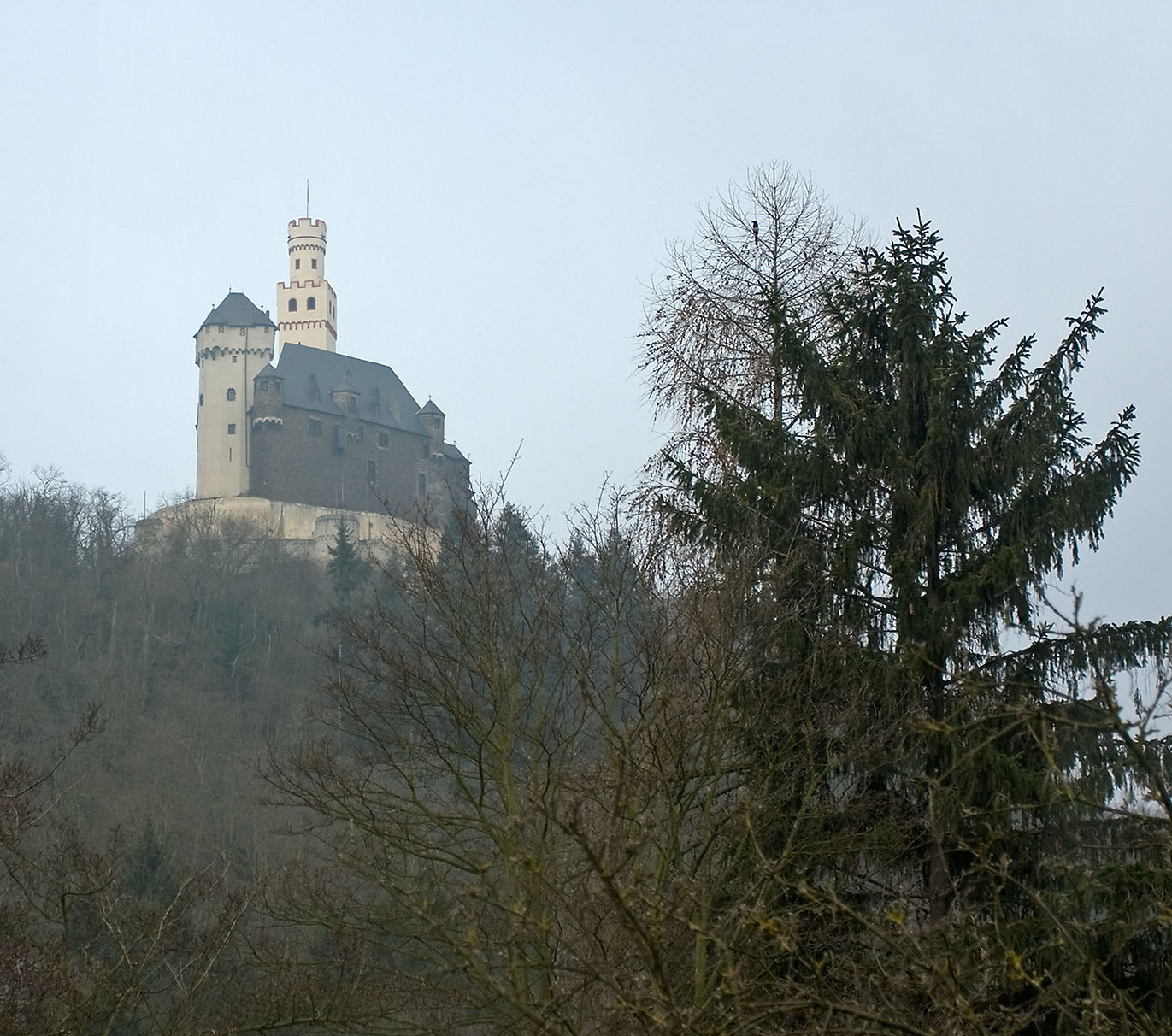
From its rock high above Braubach, the Marksburg commanded a stretch of that vital artery. Its position gave it a magnificent view up and down the valley, so that no vessel could pass unseen, and its height made it almost impossible to attack with any hope of success. An enemy would have to toil up a steep slope under fire, with no cover and no room to deploy in strength, a prospect grim enough to discourage all but the most determined assault.
This combination of a commanding view and a punishing approach is what kept the Marksburg safe when so many others fell. The castle did not need to be the largest or the strongest on the Rhine. It needed only to be too much trouble to take, and on its steep cone of rock above the river it was exactly that. The Rhine gave the castle its purpose, and the rock above the Rhine gave it its remarkable gift for survival.
The castles of the Rhine gorge were often built within sight of one another, so that a chain of fortresses controlled the whole valley between them. In such company the Marksburg was one link among many, but its particular strength of position marked it out. Where some of its neighbours guarded gentler slopes, the Marksburg sat on a rock so steep and commanding that it earned a reputation for near impregnability, and that reputation, as much as its walls, helped keep enemies at bay.

The Town at Its Feet
Directly below the castle lies the small town of Braubach, and the two have always belonged together. The Marksburg was not an isolated eagle’s nest but the fortified heart of a community, protecting the townspeople and the river trade while drawing its own strength from them. The relationship between castle and town was one of mutual dependence, the lord offering protection and the town offering labour, taxes, and a base of support.
Braubach itself is a pretty medieval town, once walled, with half-timbered houses clustered along narrow lanes beneath the castle rock. Walking up through it toward the Marksburg, you pass from the world of the townsfolk into the world of the lord, retracing a journey that ordinary people made for centuries when they climbed to the castle to seek justice, pay their dues, or take shelter in times of danger. The town is the natural starting point for any visit, and it sets the scene beautifully.
Seeing the castle rise directly above the rooftops is a reminder of how these two kinds of settlement fitted together in the Middle Ages. The Marksburg was not remote from daily life but loomed over it, a constant presence in the sky above Braubach, visible from every street and field. For the people below, the castle was both a promise of safety and a symbol of the power that ruled their lives, and it has watched over their descendants ever since.
Braubach also gave the region one of its industries, for the hills around were mined for their ores, and the wealth of the district helped sustain both town and castle. The prosperity of the valley was part of what made it worth defending, and the Marksburg presided over a working landscape of mines, fields and vineyards as much as over the river traffic. Castle, town and countryside formed a single economy, bound together beneath the fortress on the rock.
Up the Winding Way
To enter the Marksburg you must climb a road that twists back on itself again and again as it wraps around the rock, passing through a sequence of gates on the way up. This winding approach is not an accident of the terrain but a deliberate piece of defensive design. Every turn slowed an attacker, exposed him to fire from above, and forced him to fight his way through one gate after another, each of which could be held against him.
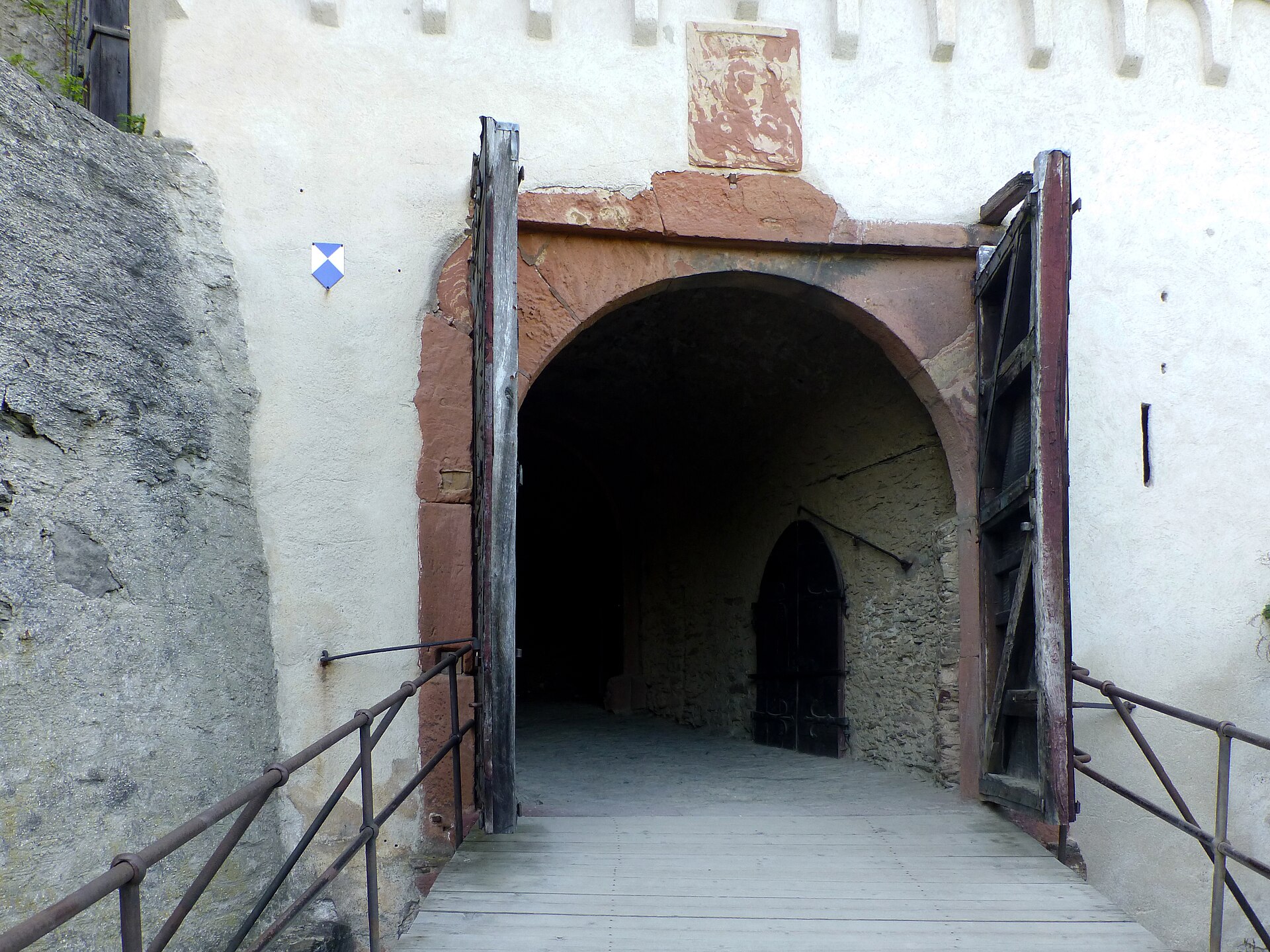
The gates themselves were formidable obstacles. A drawbridge could be raised to break the road entirely, and the passages were narrow enough that only a few men could press forward at once, straight into the waiting defenders. Anyone who managed to force one gate found another ahead, and above him at every step were walls and openings from which stones, arrows, and worse could rain down. The whole approach was a trap, designed so that the castle’s defenders always held the advantage.
Walking up it today, in peace, you can still read the intention in every twist and gateway. The Marksburg was built by people who understood exactly how a castle would be attacked and who shaped their defences to defeat that attack at every stage. It is this thoughtful, layered design, preserved intact, that makes the climb to the gate so instructive. You are not just approaching a castle; you are walking through a medieval mind’s idea of how to make a place impossible to take.
Notice, as you pass through, how each gate has its own character and its own defensive tricks, from the drawbridge to the narrow passages where attackers could be trapped and assailed from several sides at once. Medieval builders thought about these approaches with the care of chess players planning many moves ahead, and the Marksburg preserves their thinking in stone. Nowhere is the logic of castle defence laid out more clearly than on this climb.
The Stair Cut From the Rock
One of the most striking features of the Marksburg is a stairway carved directly into the living rock, known as the Knights Stair. Rather than building steps of dressed stone, the medieval masons simply cut them from the natural rock of the hill, so that the castle and its approaches merge into the mountain itself. The effect is powerful: the fortress does not sit on the rock so much as grow out of it, inseparable from the stone that carries it.
This kind of construction speaks to the sheer effort that went into building a castle on such a site. Every advantage the rock offered in defence had to be paid for in the labour of shaping it, hauling materials up the slope, and fitting walls to an awkward and irregular summit. The Knights Stair is a small monument to that labour, a place where you can see the raw rock and the human work upon it meeting in the same worn steps.
Climbing it, you follow in the footsteps of the garrison who used it for centuries, the men-at-arms and servants who trudged up and down as part of the daily business of the castle. Worn smooth by generations of boots, the rock-cut stair is one of those details that collapses the distance between past and present, letting you place your feet where medieval feet once fell and feel, for a moment, the ordinary reality of life in a working fortress.
Rock-cut features like this were prized because they could not be undermined or easily broken. A wall of laid stone could be battered down or tunnelled beneath, but steps and passages carved from the mountain itself were as solid as the hill. The Knights Stair is a reminder that the strongest parts of a castle were often those where the builders worked with the living rock rather than against it, borrowing the mountain’s own strength for their defences.

The Keep and the Last Refuge
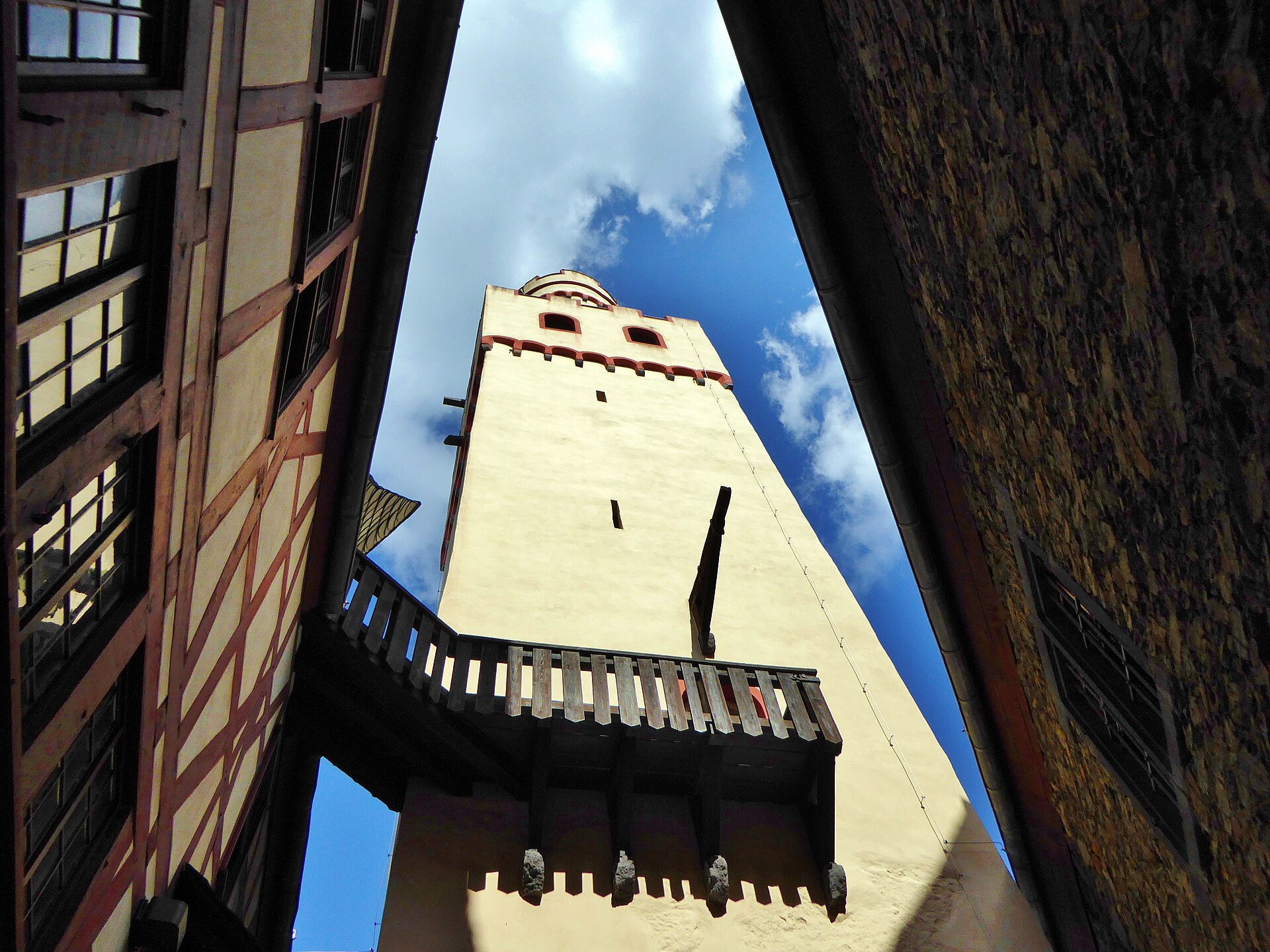
At the summit of the Marksburg stands its keep, the Bergfried, the tall square tower that dominates the whole castle. In a German hill castle the keep was the strongpoint of last resort, the tower into which the defenders would withdraw if the outer walls were breached, and from which they could hold out even after the rest of the castle had fallen. Its walls are immensely thick, its entrance set high above the ground and reached by a removable stair or bridge, so that it could be sealed off and defended on its own.
For most of the time, though, the keep served quieter purposes. Its height made it the perfect watchtower, from which sentries could scan the river and the roads for the first sign of trouble, and its lower levels often served for storage or as a prison. A tower like this was the beating heart of a castle’s defences, the visible symbol of the lord’s power and the ultimate guarantee of his safety, and its silhouette announced his authority to everyone in the valley below.
Climbing the Bergfried rewards you with the same view the watchmen once had, a sweeping panorama of the Rhine winding between its hills. Standing at the top, with the wind and the long prospect of the valley, it is easy to feel why this spot was chosen and held for so long. Whoever commanded this tower commanded a great stretch of the river, and the keep of the Marksburg still crowns its rock exactly as it has for centuries.
The keep also served as a powerful piece of psychology. Rising above every other building, visible from far up and down the river, it announced the presence and the strength of the castle to friend and foe alike. In an age when authority had to be seen to be believed, the tall square tower of the Marksburg was a statement written on the sky, telling everyone in the valley exactly who held the high ground and the power that came with it.
Guns Pointed at the Valley
The Marksburg is not frozen in a single moment of the Middle Ages. Like every castle that stayed in use, it changed with the times, and one of the clearest signs of that is its cannon battery. When gunpowder artillery transformed warfare, the old high walls that had protected against arrows and ladders became vulnerable to iron shot, and castles had to adapt or become useless. The Marksburg adapted, adding gun positions from which its own cannon could answer any attacker.
The battery you see, lined with guns pointed out over the valley, shows how a medieval fortress kept itself relevant into the age of gunpowder. Lower, thicker emplacements were built to carry cannon and to withstand them, and the castle’s defenders learned to fight with powder and shot as their ancestors had fought with crossbow and stone. This willingness to modernise was part of why the Marksburg remained a going concern for so long, rather than being abandoned as hopelessly out of date.
The array of cannon also makes vivid a truth that ruins often hide: that these castles were not romantic backdrops but serious military installations, kept in fighting trim by people whose lives might depend on them. Standing among the guns, looking out over the same valley they were meant to command, you get a strong sense of the Marksburg as a working weapon of its age, ready to deal death down the slope to anyone foolish enough to attack it.
It is worth remembering that adapting an old castle to gunpowder was expensive and difficult, and many fortresses were simply abandoned rather than modernised. That the Marksburg was updated rather than discarded shows how useful its position remained even as the technology of war changed around it. A castle that could carry cannon on a rock this steep was still a serious proposition, and the battery is the proof that the fortress kept earning its keep long after the age of knights.

A Thousand Years of Armour
Among the treasures the Marksburg holds is a remarkable collection of arms and armour, displayed within its halls and tracing the development of the fighting man across the centuries. From early mail to the fully articulated plate of the late Middle Ages, the collection lets you follow, suit by suit, how the medieval warrior was gradually encased in ever more sophisticated metal as weapons and tactics evolved around him.
Seen up close, the armour dispels a lot of myths. It is lighter and more flexible than most people imagine, cunningly jointed so that a trained man could move, mount a horse, and fight in it with surprising freedom. Each suit was a masterpiece of the armourer’s craft, shaped to deflect blows and distribute weight, and often fitted precisely to its owner. To stand before them is to appreciate the skill of the craftsmen as much as the courage of the men who wore their work into battle.
The collection turns the castle into a kind of school of medieval warfare, showing not just where knights lived but how they were equipped to fight. Set within the genuine rooms of a real fortress rather than the neutral galleries of a museum, the armour gains an extra power, letting you imagine the men who once clanked through these very halls. It is one more way in which the Marksburg brings the Middle Ages to life more vividly than a ruin ever could.
Displays like this also remind us how costly it was to equip a fighting man. A full harness of plate represented an enormous investment, the work of skilled specialists over many hours, and only the wealthy could afford the finest. The gap between a well-armoured knight and a common soldier in a padded coat was, in a very real sense, the gap between rich and poor made visible on the battlefield, and the collection lets you see that difference at a glance.

Life Inside the Working Castle
A castle was not only a fortress but a small, self-contained world that had to provide for all its own needs, and the Marksburg preserves the workaday spaces where that life went on. The smithy is a fine example. Here the castle’s blacksmith forged and repaired the endless ironwork a fortress required, from weapons and armour to hinges, tools, nails, and horseshoes, keeping the whole establishment supplied and in working order.
Alongside the forge, the castle held kitchens, cellars, storerooms and workshops, all the machinery of survival for a community that might have to feed and defend itself through a long siege or a hard winter. These humble rooms are, in their way, as fascinating as the grand ones, because they show how a castle actually functioned day to day. Someone had to cook, brew, mend, and haul, and the traces of that labour are everywhere in the Marksburg.
Because the castle survives complete, these ordinary spaces survive too, and they are what make a visit so richly educational. In a ruin you must imagine the smoke of the forge and the bustle of the kitchen; here you can stand in the actual rooms where these things happened. The Marksburg reminds you that behind every knight and lord stood a whole community of workers, and it honours their vanished labour by preserving the places where they toiled.
Water was a particular preoccupation, for a castle under siege lived or died by its supply. Wells sunk deep into the rock, or cisterns to catch the rain, were among the most vital features of any hill fortress, and their upkeep was a matter of survival. The practical rooms of the Marksburg, easy to overlook beside the armour and the cannon, are where the real business of enduring a siege was quietly arranged, long before any fighting began.

The Poison and the Cure
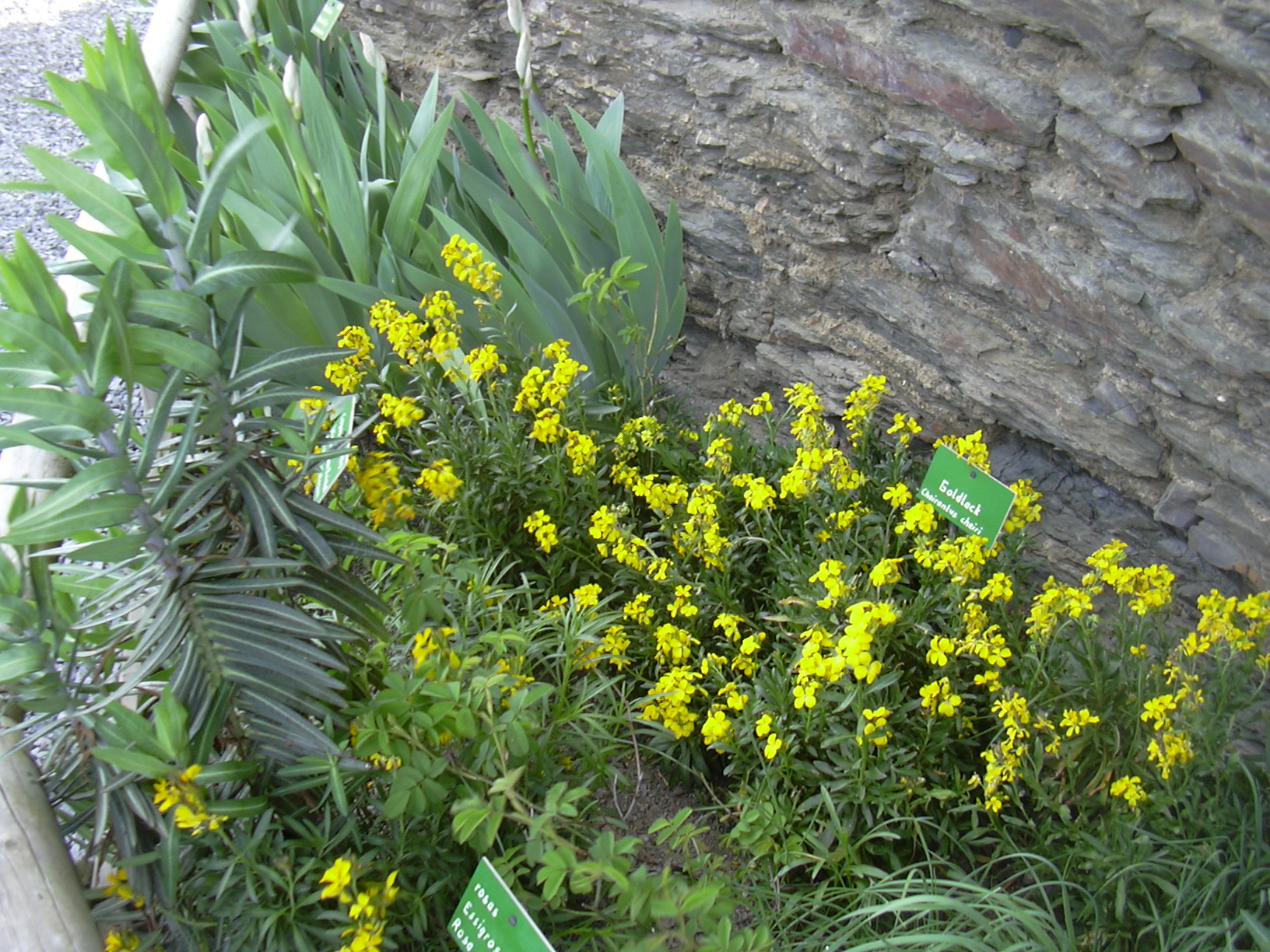
Tucked within the walls is one of the Marksburg’s most charming features, a reconstructed medieval herb garden planted with the kinds of herbs a castle household would have grown and used. In an age without pharmacies, the garden was the medicine cabinet, the kitchen store and the still-room all in one, supplying flavourings for food, remedies for illness, and ingredients for everything from dyes to disinfectants.
Many of the plants tell a double story, for the line between medicine and poison was often a fine one. The same herbs that could soothe a fever or ease a pain could, in stronger doses, kill, and the knowledge of how to use them was a serious and sometimes dangerous art. Wandering the neat beds, you are looking at the raw materials of medieval healing, folklore and household craft, a green library of practical wisdom that every well-run castle depended upon.
The garden also softens the martial character of the castle with a reminder of gentler necessities. Between the cannon and the armour, people here still had to be fed and physicked, and someone tended these beds with care through the turning seasons. It is a lovely, human corner of a formidable place, and it rounds out the picture of the Marksburg as a complete world, one that had to nourish and heal its people as well as defend them.
Gardens like this were usually the province of the women of the household and of those with knowledge of healing, whose skills were passed down and jealously guarded. In a world where a minor wound could turn deadly and a fever might carry off the strong, such practical knowledge was precious, and the herb garden was its living archive. To recreate one within the castle is to restore a whole dimension of medieval life that the martial ruins usually leave out.
The Castle That Was Never Taken
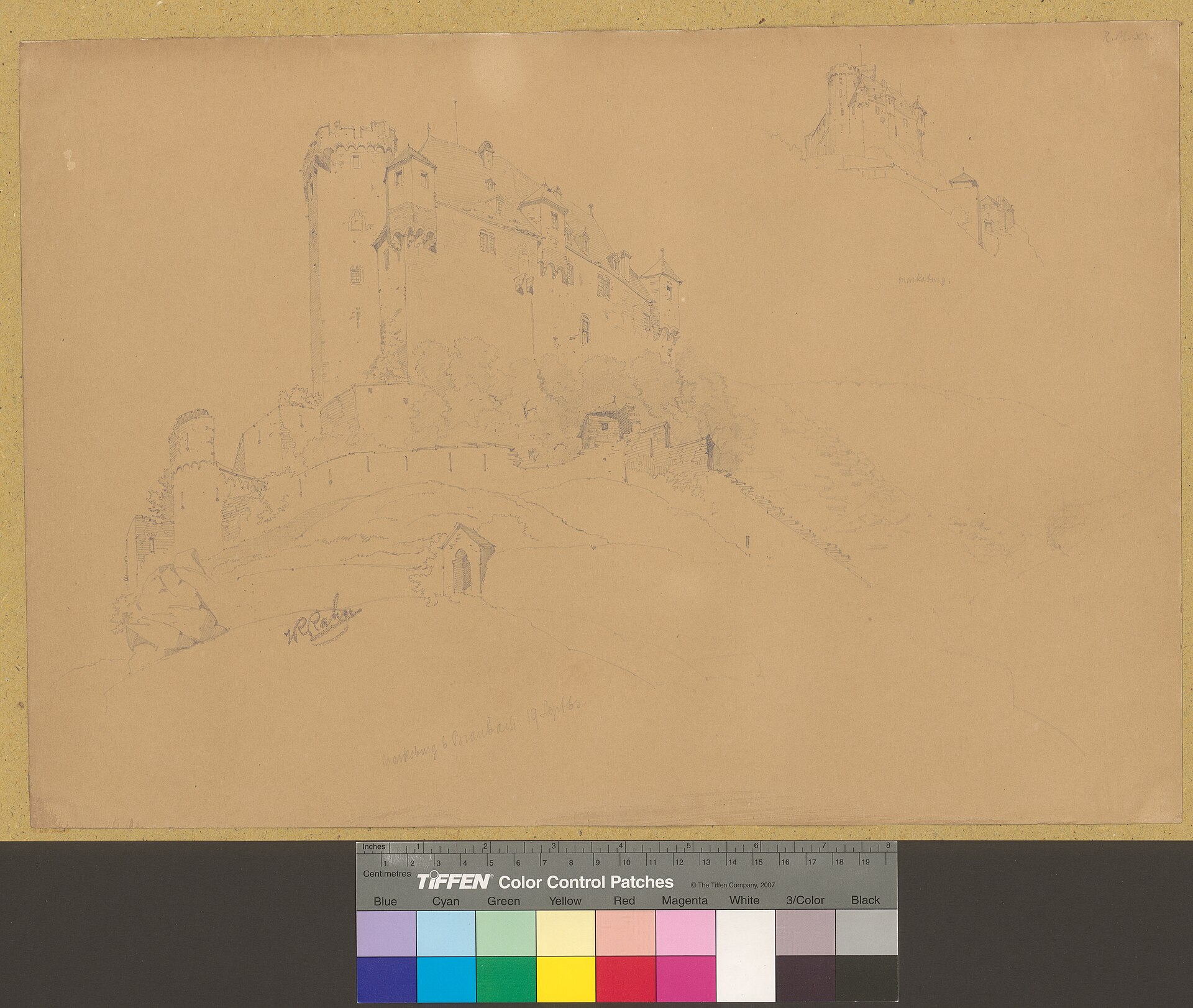
The single fact that sets the Marksburg apart from every other castle on the Rhine is that it was never destroyed. Across the long centuries of its existence, through the endless wars that battered this much-fought-over valley, the fortress came through essentially intact. Even in the great conflicts that reduced its neighbours to the romantic ruins tourists photograph today, the Marksburg endured, and it stands now as very nearly the only medieval hill castle on the Rhine to survive whole.
This survival was partly luck and partly design. The steep rock and the layered defences made the castle a daunting target, seldom worth the cost of a full assault, and at moments of danger its defenders and owners found ways to avoid the worst. During the wars that wrecked so much of the Rhineland, the Marksburg suffered damage but never the total destruction visited on other fortresses, and each time it was patched and carried on. Being strong, well-sited, and never quite important enough to be worth levelling proved a winning combination.
The result is a priceless survival. Where other castles offer broken walls and the work of the imagination, the Marksburg offers the thing itself, a complete medieval fortress that has never had to be guessed at or rebuilt from scratch. For anyone who wants to understand what these places were really like, that unbroken authenticity is beyond price, and it is the deepest reason the Marksburg holds such a special place among the castles of Germany.
It is worth stressing just how unusual this makes the Marksburg. The Rhine gorge was among the most heavily fortified and most fiercely contested stretches of country in Europe, and the wars that swept through it, above all in the seventeenth century, left a trail of shattered castles that has defined the valley’s romantic image ever since. For a single fortress to come through all of that essentially whole is a survival so rare that it turns an otherwise typical castle into a monument of the first importance.
Rescued and Preserved
By the end of the nineteenth century, even a survivor like the Marksburg needed help. The age of hill castles as functioning fortresses and residences had long passed, and many old castles were crumbling for want of a purpose and the money to maintain them. It was at this point that the Marksburg found a new and fitting role. Around the turn of the twentieth century it was acquired by an association dedicated to the preservation of Germany’s castles, which made the fortress its headquarters and set about caring for it.
That stewardship saved the Marksburg for the future and gave it a mission. Rather than being restored into a fantasy or converted into a hotel, the castle was preserved as an authentic example of medieval fortress architecture, its genuine fabric protected and its rooms furnished to show how such a place really worked. The association’s care is a large part of why the Marksburg today feels so honest, a castle looked after by people who value it precisely for its truth to the past.
Under this guardianship the Marksburg became not just a monument but a centre of knowledge, a place where the study and conservation of Germany’s many castles could be based. Its survival, once a matter of luck and strong walls, became a matter of deliberate care, and the fortress that had outlasted so many wars was at last made safe from the slower enemies of neglect and decay. It is, in a sense, a castle that found its true calling only after its fighting days were done.
The decision to keep the castle authentic rather than to dress it up was a far-sighted one. In the same era, other old buildings across Europe were being heavily rebuilt to match romantic ideas of the Middle Ages, often losing much of their real history in the process. The Marksburg was largely spared that fate, and the restraint of its guardians is a gift to everyone who visits, because it means that what you see is very largely what was truly there.

A Living Museum of the Middle Ages
Today the Marksburg is celebrated as one of the finest surviving examples of a medieval hill castle anywhere, and it forms part of the Upper Middle Rhine Valley, a stretch of river so rich in castles, towns and scenery that the whole landscape has been recognised as a World Heritage Site. Within that famous valley of ruins, the Marksburg holds a special place as the great exception, the castle that survived to show what the others once were.
What makes it so valuable is not grandeur but completeness. There are larger castles, richer palaces, and more dramatic ruins, but there are very few places where you can walk through an entire medieval fortress with its defences, halls, kitchens, workshops and gardens all still in place. The Marksburg is a working model of the medieval world, and it teaches by simply being itself, letting visitors see with their own eyes how the parts of a castle fitted together into a living whole.
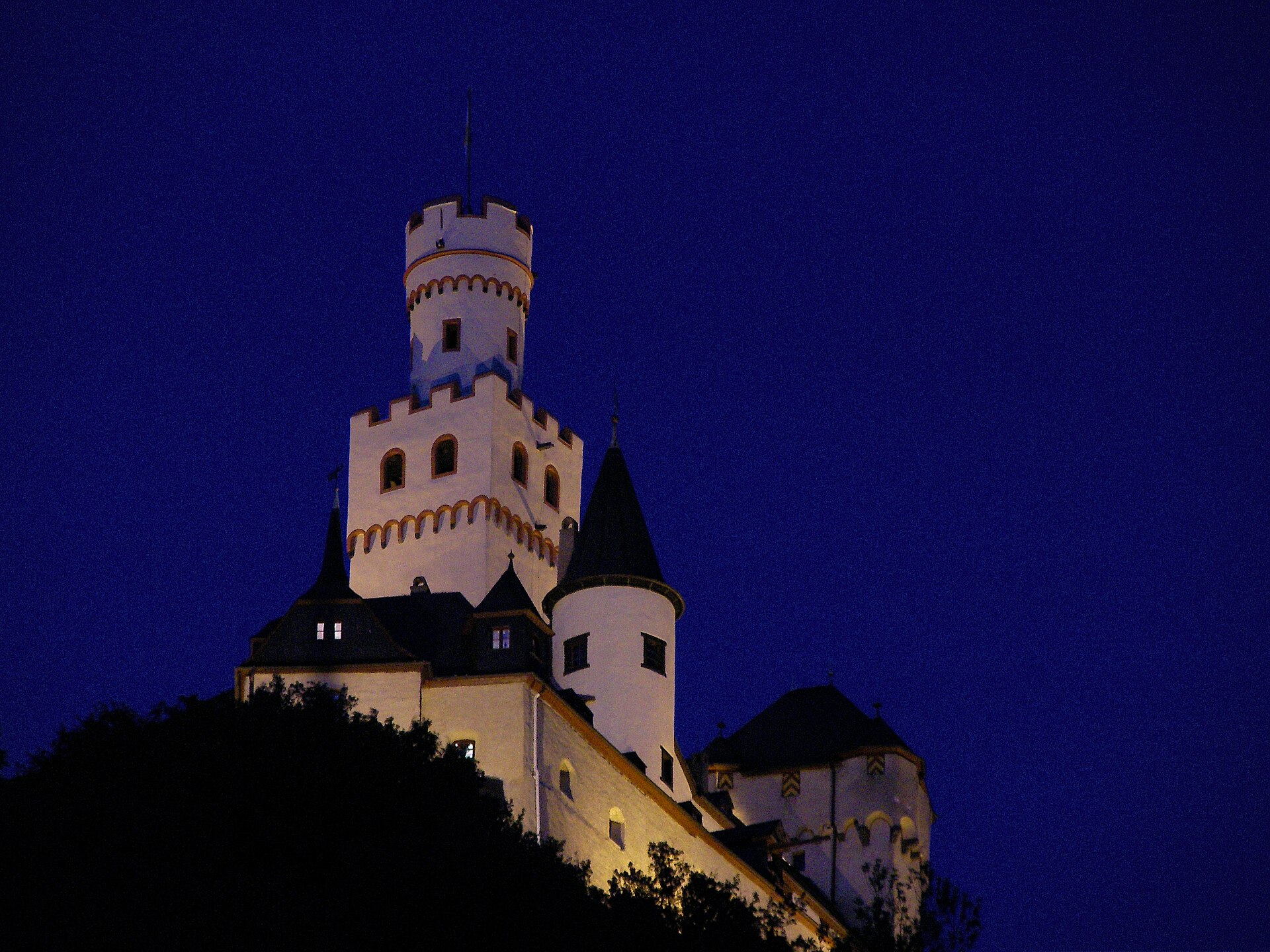
Lit up at night above the dark river, the Marksburg looks like the very idea of a castle made solid, and in a sense it is. It has become a symbol of medieval Germany, reproduced in countless images and studied by everyone who cares about how these places worked. That so much can rest on one modest fortress above Braubach is a measure of how rare true survival is, and of how much we can learn from the one Rhine castle that came through whole.
Generations of visitors, scholars and enthusiasts have come to the Marksburg to learn, and it has shaped the way people picture the medieval castle far beyond Germany’s borders. When films, books and games reach for an image of an authentic hill fortress, they often reach, knowingly or not, for something very like the Marksburg. Its completeness has made it not just a survival but a teacher, quietly informing the imagination of the whole modern world.
Visiting the Marksburg
The Marksburg is easy to reach and thoroughly rewarding to visit. It stands above the town of Braubach on the right bank of the Rhine, a short journey from Koblenz, and can be reached by road or by the railway that runs along the river, followed by a walk or a shuttle up to the castle. Many visitors combine it with a cruise along the Rhine gorge, which is one of the loveliest boat trips in Europe and gives a superb view of the castle from the water below.
Because the interior is a genuine medieval fortress rather than a set of open galleries, the castle is seen on a guided tour, which leads you through the gates, the rock-cut stair, the halls, the kitchen, the armour collection, the herb garden and the cannon battery in turn. The tour is the heart of the experience, and it is what makes the Marksburg so memorable, because it walks you through a complete castle in the order its own life once flowed. Wear sturdy shoes, as the ground is steep and uneven, and be ready for a climb.
If you would like to find it and plan your route, here is the castle’s position above Braubach: 50.2706, 7.6486. Give yourself time for the tour and for lingering on the terraces afterward, where the view along the Rhine is worth every step of the climb. Of all the castles on this storied river, the Marksburg is the one that lets you touch the Middle Ages unbroken, and that makes it, for anyone curious about how these places truly were, quite simply unmissable.
A visit here pairs naturally with the wider Rhine gorge, whose vine-clad slopes, riverside towns and crowd of other castles make it one of the most rewarding regions in Germany to explore. Seen against that backdrop of romantic ruins, the Marksburg stands out all the more sharply as the one that survived, and the contrast only deepens the pleasure of walking through a castle that never fell.
Castles Nearby
- Burg Eltz, the fairy-tale castle that is actually real
- Wartburg Castle, the most German of all castles
- Heidelberg Castle, Germany’s most romantic ruin
The One That Got Away From History
There is a lesson in the Marksburg that goes beyond its walls. All along the Rhine, the castles that mattered most, that guarded the richest tolls and the most important ground, are the ones that lie in ruins, because importance drew armies and armies brought destruction. The Marksburg survived not by being the greatest but by being strong enough, high enough, and just modest enough to slip through the centuries without ever being worth the cost of levelling.
That accident of survival has turned a once-ordinary fortress into something extraordinary. Where its neighbours offer broken walls and romantic melancholy, the Marksburg offers the rarest thing of all: the truth, a complete medieval castle you can walk through from drawbridge to keep, its rooms still furnished, its defences still bristling, its herb garden still green. It does not have to be imagined or reconstructed. It simply is.
So when you stand on its terrace, looking out over the river and the ruins of the castles that were not so lucky, spare a thought for how narrow the margin of survival can be. The Marksburg is the one that got away from history, the fortress that came through whole while all around it fell. Of all the castles on the Rhine, it is the one that lets you stop imagining the Middle Ages and simply walk into them.
You May Like

Mafra, the Palace a King Built From a Vow


One thought on “Marksburg Castle: The Rhine Fortress That Was Never Destroyed”