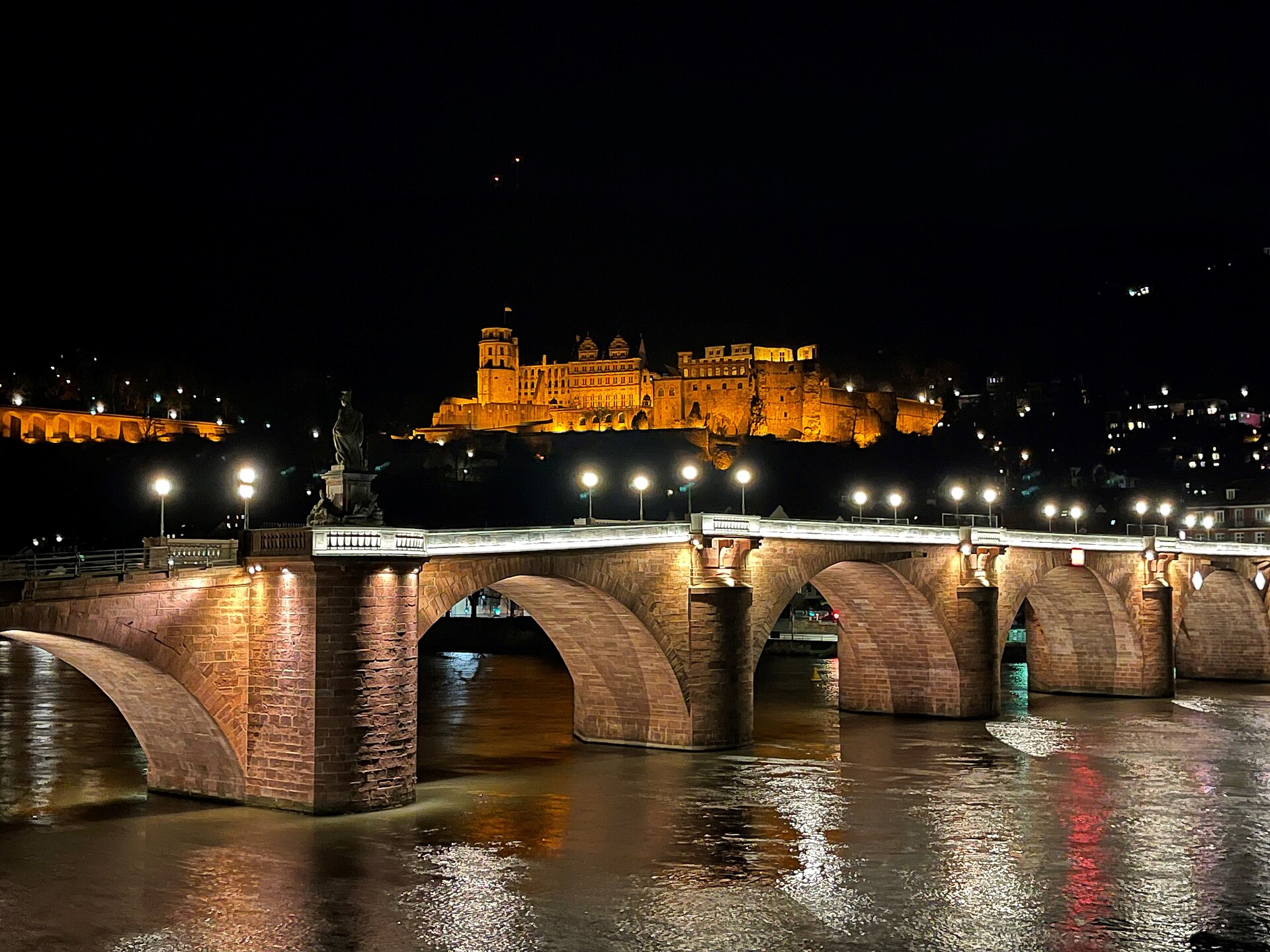
There is a particular moment that catches almost everyone who arrives in Heidelberg. You come around a bend, or you step onto the Old Bridge, and there it is above you: a great mass of pink-red sandstone clinging to the wooded slope of the Konigstuhl, half palace and half ruin, glowing against the green of the hillside. It does not look like a building so much as something that grew out of the mountain and was then partly reclaimed by it. People stop walking. They reach for their cameras. And almost none of them can quite explain why a broken castle should be so much more moving than a whole one.
Heidelberg Castle has been catching people this way for a very long time. Poets wrote about it, painters returned to it again and again, and travellers crossed half of Europe just to stand where you are standing now. It was once one of the grandest residences in the German-speaking world, the seat of the Electors Palatine, princes powerful enough to help choose the Holy Roman Emperor. Then war, fire, and lightning took it apart piece by piece, and instead of tidying the wreckage away, history left it standing as a kind of monument to its own loss.
That is really the secret of the place. This is not a castle that survived; it is a castle that was destroyed and then loved all the more for it. Walk with me through its courtyards and cellars and gardens, and you will meet Renaissance princes and drunken court jesters, French armies and English princesses, a wine barrel the size of a house and a garden that was called the eighth wonder of the world. By the end you may understand why so many people have decided that a ruin can be more beautiful than anything still intact.

In This Article
- Standing in the Great Courtyard
- A Fortress Sprawled Across the Hillside
- The Wing That Announced a New Age
- Kings and Electors Carved in Stone
- The Oldest Stones Still Standing
- The Gate Built for Love in a Single Night
- The Barrel That Could Drown a Village
- Centuries of Slow Decline
- When the French Came With Fire
- Three Nights a Year, the Castle Burns Again
- Gardens, Vineyards and a Prince’s Folly
- How a Ruin Became a Symbol of Romance
- Finding Your Own Way Up to the Castle
Standing in the Great Courtyard
The best place to begin is not outside, gazing up, but inside, in the courtyard where the whole story is written on the walls. Once you pass through the gates you find yourself in a wide gravel space surrounded on every side by facades, and the strange thing is that no two of them agree with each other. One wall is a severe medieval block with tiny windows. Next to it stands an exuberant Renaissance palace covered in statues and columns. Around the corner is something that looks almost French. It is as if several centuries were told to stand shoulder to shoulder and pose for a group photograph.
That disagreement is exactly what makes the courtyard so rewarding. Each of the great families who ruled here wanted to leave their own mark, and none of them felt much obligation to match what their ancestors had built. The result is a living timeline. You can stand in one spot and turn slowly on your heel and travel from the fourteenth century to the seventeenth, watching taste change from grim defensiveness to confident display, from a fortress that expected to be attacked to a palace that expected to be admired.
Spend a little time here before you go anywhere else. Look up at the empty window openings, some of them now framing nothing but sky. Notice how the sandstone has weathered to a warm rose colour that seems to hold the light. The courtyard is quiet in a way the outer terraces are not, and it is the one place where you can feel, all at once, both the grandeur the castle once had and the centuries of ruin that followed. Everything else you will see is really a longer explanation of what these walls are already telling you.
One practical tip: the courtyard is where guided tours gather and where the light changes most dramatically through the day, so it rewards a second visit. Come once when you arrive to get your bearings, and again toward closing time, when the tour groups have thinned and the low sun sets the sandstone glowing and you can hear your own footsteps on the gravel.

A Fortress Sprawled Across the Hillside
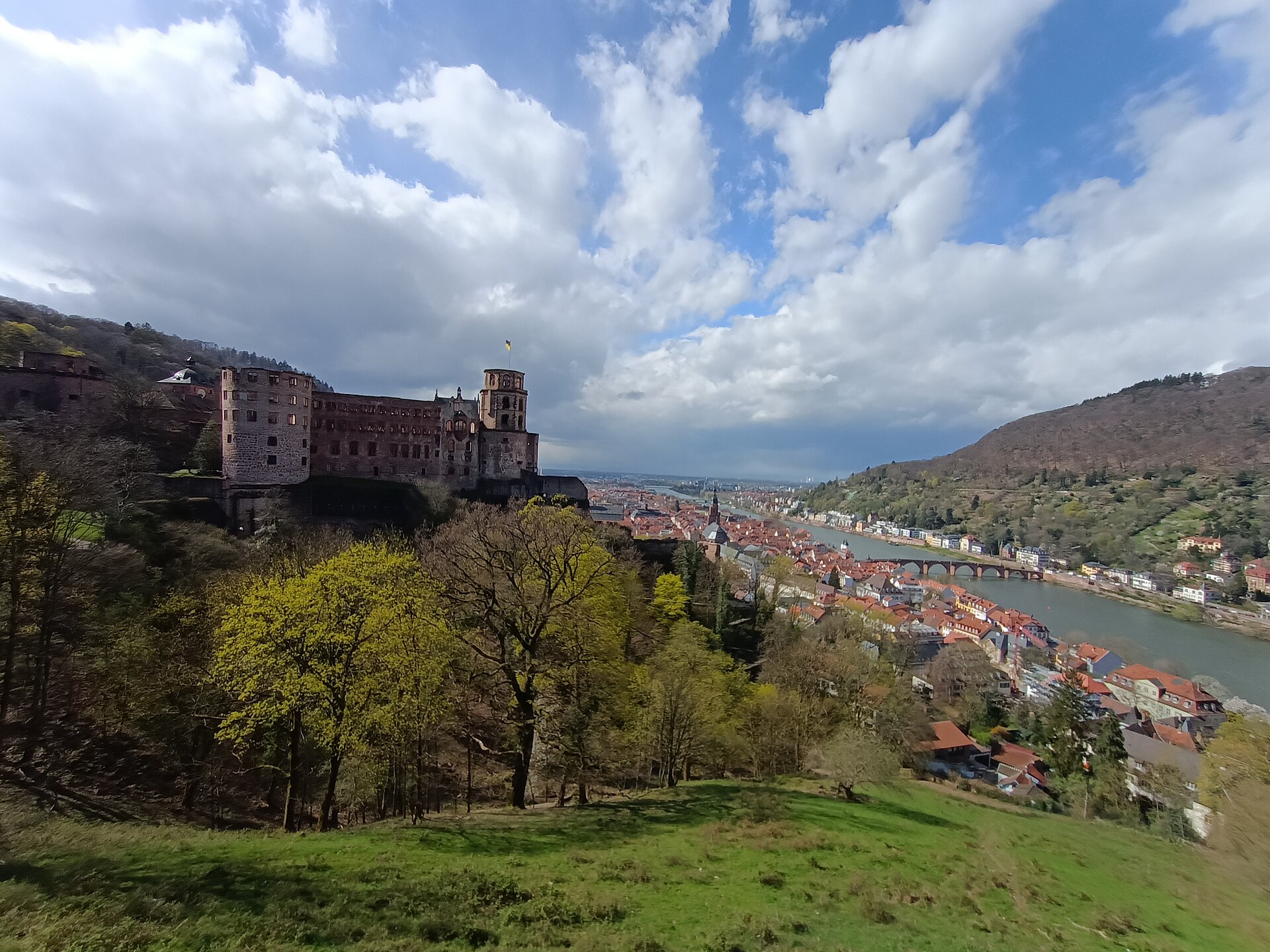
To understand Heidelberg Castle you have to let go of the neat picture-book idea of a castle as a single tidy building with four towers and a moat. What sits on this hillside is more like a small walled town that grew, tower by tower and wing by wing, across the better part of five hundred years. From above you can see how it rambles: thick outer walls and gun bastions on the downhill side, a cluster of palace buildings around the courtyard, and behind them the great terrace and the remains of the gardens climbing the slope.
The position was chosen with an eye to both safety and swagger. High enough on the Konigstuhl to command the valley and to be difficult to storm, but low enough to loom directly over the town and the river crossing, the castle announced who was in charge to anyone passing along the Neckar. Every merchant, pilgrim and soldier who came up the valley had to do so under its gaze. In an age when power had to be seen to be believed, a castle in this position was worth a great deal more than its walls.
As the centuries passed and gunpowder changed the rules of war, the builders kept adapting. Rounded artillery towers with walls many metres thick were bolted onto the older medieval core, designed to absorb cannon fire and to carry heavy guns of their own. Some of these towers still stand; one, as we will see, was blown apart and left in a single enormous fractured piece that has become one of the castle’s most photographed features. The sprawl you see from above is not untidiness. It is the physical record of a fortress trying, and eventually failing, to keep pace with the weapons ranged against it.
It is worth walking the full circuit of the outer walls if your legs allow it, because the scale only registers when you trace it on foot. From the great terrace on the valley side to the deep dry moat on the landward approach, the defences enclose a space large enough that garrisons, stables, kitchens and storerooms all had room to spread, a self-contained world braced against the outside.

The Wing That Announced a New Age
If you have to choose one facade to fall in love with, let it be this one. The Ottheinrich Building was raised in the late 1550s by Elector Ottheinrich, a huge, cultivated, spendthrift prince who ruled for only a few years but managed in that short time to change the face of the castle forever. He had travelled in Italy, he had seen what the Renaissance was doing to architecture there, and he came home determined to bring that new confidence to the banks of the Neckar.
The result was one of the first truly Renaissance palace fronts north of the Alps. Instead of the blank defensive walls of the medieval castle, Ottheinrich gave Heidelberg a facade that reads like a philosophical argument in stone. Rows of sculpted figures march across it: heroes from the ancient world, virtues and planets and biblical kings, arranged in careful order to show a prince who understood himself as the crown of a whole cosmic scheme. It was learning and power fused into a single dazzling surface, meant to be read as much as admired.
Even now, roofless and weathered, the building stops people in their tracks. The stonework has the softness that only centuries can give, and the statues gaze down with a patience that outlasted the man who commissioned them. Ottheinrich died deep in debt only a couple of years after the work was largely done, and he never enjoyed his masterpiece for long. But he had done something no siege could undo: he had turned a hillside fortress into a statement about the modern world, and that statement is still legible today.
Look closely and you will notice that the doorway at the centre of the facade is a later, more restrained insertion, added long after Ottheinrich’s death. Small details like this reward the patient visitor: across the whole castle, you can read the seams where one century’s work was grafted onto another’s, each generation adjusting, repairing and reinterpreting what it had inherited from the last.

Kings and Electors Carved in Stone
Where Ottheinrich reached for the ancient world, the prince who built the next great wing reached for his own family. The Friedrich Building went up in the first years of the seventeenth century for Elector Friedrich IV, and its facade is essentially a stone family album. Tier upon tier of statues show the rulers of the House of Wittelsbach and their Palatine ancestors, each in his niche, a dynasty presenting its own credentials to anyone who cared to look.
There was a reason for all this ancestor-parading. The Electors Palatine were among the most important princes in the Holy Roman Empire, entitled to take part in the election of the Emperor himself, and they were leaders of the Protestant cause in Germany at a moment when the religious temperature was rising fast. A facade crowded with distinguished forebears was not vanity for its own sake. It was a political argument, a way of saying that this family had always ruled here and always would, carved in a form that could not easily be contradicted.
The statues you see today are mostly copies, the weathered originals having been moved to shelter, but the effect is unchanged. Of all the palace wings this is the one that survived in the best condition, and its interior was restored well enough that you can visit rooms and the castle chapel within. Standing before it you are looking at the last great building phase before everything went wrong, the final confident gesture of a dynasty that had no idea how little time it had left.
Step inside where you can, for the Friedrich Building is one of the few places at Heidelberg where you can still get a sense of interior life rather than open sky. The restored rooms and the chapel give at least a hint of the vanished world of the court, the tapestried, candlelit magnificence that once filled wings now open to the weather and the pigeons.

The Oldest Stones Still Standing
Not everything at Heidelberg is Renaissance splendour. Tucked into a corner of the courtyard stands the oldest surviving palace building, raised around the year 1400 for King Ruprecht, the one member of this family who briefly wore the crown of the German kings. It is a plainer, sturdier thing than the showpieces around it, and that plainness is exactly why it is worth pausing over. This is the castle before it learned to show off.
Above the entrance you can still make out a carved wreath with two small figures, a detail that local legend attached to a story of a master builder’s children who fell to their deaths during construction, their likenesses set into the stone in memory. Whether or not there is any truth in it, the tale is a reminder that these buildings were raised by ordinary hands over many years, at real human cost, long before anyone thought of the place as picturesque.
The Ruprecht Building also anchors the whole site in time. When these walls went up, the great Renaissance wings were still more than a century in the future, and the castle was first and foremost a stronghold. Everything that came later, all the sculpture and swagger, was built outward from this modest core. Stand here and you are standing at the beginning of the story, at the seed from which the rest of Heidelberg Castle slowly, extravagantly grew.
There is a quiet pleasure in seeking out the oldest corners of any great building, and here the reward is a sense of scale in time. When you touch these walls you are touching the medieval castle that everything else was built to outshine, the humble beginning that the Renaissance princes never quite managed, or perhaps never wanted, to sweep entirely away.

The Gate Built for Love in a Single Night
Among all the grand architecture of Heidelberg, one of the most charming structures is also one of the smallest. Set into the gardens is the Elisabeth Gate, a delicate stone archway wreathed in carved leaves and cherubs, and the story attached to it is the kind that guides love to tell. It was built, they say, in a single night as a surprise birthday gift from Elector Friedrich V to his young English wife, Elizabeth Stuart, daughter of the King of England.
Their marriage in 1613 had been one of the great romantic and political events of the age, a union that briefly made Heidelberg one of the most glittering courts in Europe. Friedrich lavished attention on his bride, remodelling parts of the castle and its grounds in her honour, and the little gate that appeared as if by magic overnight was part of that courtship in stone. Whether it truly rose in one night hardly matters; the point of the tale is the tenderness behind it.
The romance did not end well. Friedrich accepted the crown of Bohemia in 1619, a reckless gamble that helped ignite the Thirty Years War and earned him the mocking title of the Winter King, because his reign lasted barely a season. He and Elizabeth lost everything and spent the rest of their lives in exile. The pretty gate remained behind in the garden, outliving the happiness it was built to celebrate, a small monument to a love story that history treated harshly.
The story of the Winter King and his queen rippled far beyond Heidelberg. Through their daughter Sophia the bloodline of this luckless couple would eventually reach the throne of Great Britain, so that today’s British royal family descends in part from the young prince who built a gate overnight for his bride and then gambled away a kingdom on the plains of Bohemia.

The Barrel That Could Drown a Village
Every great palace has a party piece, and Heidelberg’s is gloriously absurd. Down in the cellars stands the Great Tun, a wine barrel so vast that a dance floor was built on top of it. The version you see today can hold something on the order of two hundred and twenty thousand litres, built from the trunks of well over a hundred oak trees, and it dwarfs everyone who stands beside it. It is less a barrel than a small wooden building that happens to be full of wine.
The Electors did not build such a monster out of pure showmanship, though showmanship certainly came into it. Their subjects across the Palatinate paid part of their taxes in wine, and all of that tribute had to be stored somewhere. The Great Tun was the grand central reservoir of the prince’s cellar, a way of turning the region’s most famous product into a spectacle that impressed every visiting dignitary. Several tuns were built over the years, each one bigger than the last, as if the court were daring itself to go further.
Guarding the barrel, in legend at least, was Perkeo, the court jester, a small man from the Tyrol with a reputation for a truly heroic thirst. He was said to be able to empty enormous quantities of wine single-handed, and stories claim he died the one time he was persuaded to drink a glass of water instead. A carved figure of Perkeo still stands nearby, wine cup in hand, the unofficial patron saint of the cellar and proof that even a princely castle knew how to laugh at itself.
Climb the stairs onto the platform built above the Tun and you will understand why it became such an attraction. Generations of travellers have stood here, peered down at the vast curve of oak, and shaken their heads at the extravagance of it. The barrel has rarely been full in modern times, but as a monument to princely appetite and regional pride it has never been surpassed.

Centuries of Slow Decline
The ruin you see did not happen all at once. Heidelberg was unmade gradually, over more than a century and a half, by a run of misfortunes so relentless that it is hard not to feel the place was somehow marked. The first great blow came in 1537, when lightning struck the upper castle and touched off an explosion in the powder store, wrecking the older fortifications on the height above. Fire from the sky would return to Heidelberg more than once, as if determined to finish what it had begun.
Then came the Thirty Years War, the catastrophe that consumed the German lands for a generation after Friedrich V’s doomed grab for the Bohemian crown. Heidelberg was besieged and taken, its famous library, one of the greatest collections in Europe, carried off over the Alps to Rome as a prize. The town and castle changed hands, were fought over, occupied and plundered. By the time the war ended the Palatinate had been bled white, its population shattered, its capital a shadow of the brilliant court it had been a few decades earlier.
Even the recoveries were fragile. Each time the Electors patched and rebuilt, some new disaster seemed to undo the work. The castle that greeted the nineteenth-century travellers in photographs like this one was already a romantic wreck, admired precisely because it was broken. But the wounds that made it so had been inflicted slowly and painfully, blow after blow, and the worst of them was still to come at the hands of a French king who wanted the Palatinate for himself.
Reading the list of disasters end to end, it is tempting to speak of a curse, and plenty of romantic writers have done exactly that. The truth is more ordinary and in a way sadder: Heidelberg simply had the misfortune to sit at a strategic crossroads in an age of religious war, where any prize worth holding was also a prize worth destroying, and it paid the full price for its own importance.

When the French Came With Fire
The blow that truly broke Heidelberg came in the closing years of the seventeenth century, during the war that historians call the War of the Grand Alliance or the Nine Years War. Louis XIV of France pressed a claim to the Palatinate through a royal marriage, and when the claim was resisted he chose to make the region worthless to anyone else. French armies swept up the Rhine with orders to lay the country waste, and Heidelberg lay squarely in their path.
The castle was taken and, in 1689 and again in 1693, deliberately destroyed. This was not the accidental damage of a siege but calculated demolition. Walls were undermined, towers packed with gunpowder and blown apart, palace wings gutted by fire. One great round tower, the so-called Powder Tower, was split open by the charges laid within it, and a vast wedge of masonry toppled outward and settled at an angle where it still lies today, its shattered face turned to the valley. There is no more eloquent image of what was done here.
The Electors made attempts to rebuild in the decades that followed, but the heart had gone out of the project. A fresh lightning strike in 1764 set fire to the recently restored buildings and seemed to settle the question for good. The court eventually moved away to Mannheim, taking what could be salvaged, and Heidelberg Castle was left to the weather and the ivy. What the French had begun, fire and neglect completed. The great residence of the Electors Palatine had become, permanently, a ruin.
The leaning bulk of the shattered tower has become, over time, oddly beloved. Where you might expect visitors to mourn such deliberate ruin, most instead find themselves drawn to it, photographing the great fractured wedge of wall from every angle. It is destruction frozen at the moment of its happening, and there is a terrible fascination in seeing exactly what gunpowder can do to stone that had stood for centuries.

Three Nights a Year, the Castle Burns Again
For most of the year Heidelberg Castle stands quiet on its hill, but three times each summer it stages a spectacle that draws crowds along both banks of the Neckar. On these evenings the Castle Illumination lights the whole ruin in deep red, floodlit so that the sandstone seems to glow from within, and then fireworks burst above the towers while the Old Bridge is picked out in fire below. Tens of thousands of people gather to watch the mountain and its castle turn to flame.
The tradition has a poignant origin. The illuminations recall the real burning of the castle and town by French troops in the seventeenth century, and later celebrations of visits by princes, transformed over time into a festival of light. What was once a night of terror is now replayed every year as beauty, the memory of destruction turned into the region’s most beloved summer event. There is something very Heidelberg about that, a town that has learned to make its greatest catastrophe into a show.
If you can arrange your visit around one of these evenings, do. Find a spot on the far bank or up on the Philosophers’ Walk, where generations of poets have gone to look back at the castle, and watch the red light climb the hillside as darkness falls. It is worth remembering, as the fireworks fade, that you are watching a community perform its own history, taking the worst thing that ever happened here and answering it, once a year, with light.
Tickets and good vantage points go quickly on illumination nights, so it pays to plan ahead and arrive early. Locals have their favourite spots handed down over the years, and part of the fun is joining them, sitting on the riverbank in the warm dusk with a glass of the region’s wine, waiting with a growing crowd for the first red glow to bloom across the hillside above.

Gardens, Vineyards and a Prince’s Folly
Below and around the palace once lay one of the marvels of the age, a garden so ambitious that contemporaries called it the eighth wonder of the world. The Hortus Palatinus, the Palatine Garden, was laid out in the early seventeenth century for Friedrich V by the French engineer Salomon de Caus, who terraced the steep hillside into a sequence of formal parterres, grottoes, fountains and mechanical waterworks that astonished everyone who saw them.
It was a garden that tried to conquer the mountain itself. To create level terraces on such a slope was an engineering feat, and de Caus filled them with hydraulic marvels, musical fountains and moving statues driven by water, the cutting-edge technology of the day dressed up as princely delight. Like so much at Heidelberg it was a statement of power as much as pleasure, a way of showing that the Elector could bend even the landscape to his will. And like so much here, it was never truly finished, overtaken by the wars that swept Friedrich away.
Today the grand geometry has softened into gentle terraces and lawns, and the slopes around the castle have long been given over to the vines that made the Palatinate famous. Standing among them, with the ruin above and the valley below, you can still sense the old ambition. The prince who dreamed of a garden to rival the wonders of antiquity is centuries gone, but the terraces he carved into the hillside remain, quietly holding their shape beneath the trees.
Engravings of the Hortus Palatinus in its brief prime survive, and they are worth seeking out before or after a visit. They show a fantastical world of clipped hedges and cascading terraces that never quite existed in full, since the garden was overtaken by war before completion. In a sense it was always partly a dream on paper, which makes it a fitting companion to the half-finished, half-ruined castle above it.

How a Ruin Became a Symbol of Romance
Here is the strange twist in the story. The destruction that should have been the end of Heidelberg Castle turned out to be the making of its fame. As the eighteenth century gave way to the nineteenth, a new sensibility swept Europe, one that found in ruins not shame but poetry. And there, waiting on its hillside, half-collapsed and wrapped in ivy, was the perfect ruin, dramatic, ancient, heavy with history and framed by mountains and a river. The Romantics fell for it completely.
The poets and painters came in a steady stream. Goethe visited and sketched. The English painter Turner captured its towers dissolving in golden light. Writers made it a symbol of the transience of human ambition, the grandeur of the past softened and ennobled by decay. Later the American humorist Mark Twain climbed up to it and wrote about it at length, only half-joking that a ruin so beautifully placed almost justified the centuries of misfortune that had produced it.
That is why, when there was talk in the nineteenth century of restoring the castle to its former state, the idea was largely resisted. People had come to love Heidelberg precisely as a ruin, and to rebuild it whole would have been to destroy the very thing that made it moving. Only the Friedrich Building was substantially restored; the rest was stabilised and left as it stood. The castle you visit today is therefore a deliberate ruin, preserved in its broken beauty because that is what the world decided it wanted it to be.
The idea that broken things can be beautiful was genuinely new in its time, and Heidelberg became one of its great exemplars. To later generations raised on this notion it seems obvious, but it took the Romantic imagination to look at a bombed and burned-out palace and see not failure but a profound kind of poetry. This castle helped teach Europe how to feel that way.
Finding Your Own Way Up to the Castle
Getting up to the castle is part of the pleasure. The energetic can climb the Burgweg, a steep stepped path that rises directly from the old town and delivers you, a little breathless, straight into the world of the ruin. Those who would rather save their legs can take the funicular railway that runs up from the Kornmarkt, a short ride that continues, if you wish, all the way to the summit of the Konigstuhl high above. Either way the reward is the same: terraces with one of the finest views in Germany laid out beneath you.
Once you are up there, give yourself time. The palace wings and courtyard deserve an unhurried look, but so do the great terrace, the cellars with their monstrous barrel, the German Apothecary Museum housed within the walls, and the quiet corners of the gardens where the crowds thin out. The view over the red roofs of the old town, the bridge and the river winding away between the hills is worth lingering over at any hour, though it is loveliest in the low gold light of late afternoon.
When you are ready to find it on a map or set off toward it, here is the castle’s location on the hillside above the Neckar: 49.4106, 8.7156. Whether you arrive on foot, by rail, or simply by pausing on the Old Bridge to look up, Heidelberg rewards the approach. Few castles are so easy to reach and so hard to leave.
A word on timing: the castle grounds open early and the crowds build through the middle of the day, especially in summer, so an early start or a late-afternoon arrival will give you the terraces at their calmest. Combine the visit with a stroll across the Old Bridge and along the riverbank, and you will have seen Heidelberg from both of its two great vantage points, looking up at the castle and looking out from it.
Castles Nearby
- Hohenzollern Castle, the mountaintop seat of Prussia’s kings
- Neuschwanstein, the fairy-tale castle of the Dream King
Why Heidelberg Stays With You
Long after you have walked back down the hill, Heidelberg Castle tends to linger in the mind. Part of it is the sheer beauty of the setting, the rose-red stone against the green slope, the river and the bridge and the old town spread below. But part of it is something harder to name, a feeling that you have been in the presence of a place that has suffered a great deal and somehow become more beautiful for it rather than less.
That is the paradox the Romantics understood and that still works on every visitor today. A perfect palace would impress you and then let you go. A ruin like this one holds on, because it carries its whole history openly, the triumph and the disaster together, the Renaissance splendour and the French gunpowder and the lightning and the ivy all visible in the same view. It asks you to feel the passage of time in a way that intact grandeur never quite does.
So take your photograph from the Old Bridge, by all means, and join the crowds on the terrace. But before you leave, find a quiet corner of the courtyard and simply stand there for a moment among the broken walls. Heidelberg has been teaching people the strange consolations of ruin for two hundred years, and it is still, patiently, willing to teach you.
You May Like
Mafra, the Palace a King Built From a Vow


One thought on “Heidelberg Castle: Germany’s Most Romantic Ruin”