Some castles impress you with their size, others with their beauty. The Wartburg does something rarer: it makes you feel that you are standing at one of the places where a whole country was quietly decided. Perched on a steep wooded ridge above the town of Eisenach, in the green heart of Thuringia, it looks at first glance like a hundred other German hill castles, a long spine of towers and half-timbered gables riding the crest of a hill. Then you learn what happened inside it, and it stops looking ordinary at all.
Within these walls a landgrave’s court sang poetry that Wagner would turn into opera. A young Hungarian princess gave away her wealth to the poor and became one of the most beloved saints in Europe. And a hunted monk named Martin Luther, hiding under a false name and a growing beard, sat at a plain desk and translated the New Testament into German so vivid and so alive that it helped shape the language millions of people speak today. Few buildings anywhere can claim to have touched religion, music, and national identity all at once.
The Germans themselves have long felt this. They call the Wartburg the most German of all castles, and in the nineteenth century they made it a symbol of the nation they hoped to build. It is now protected as a World Heritage Site, but it wears its importance lightly. Come up the hill with me and we will walk its courtyards and halls, meet the singers and the saint and the fugitive, and try to understand how one castle on a Thuringian ridge came to hold so much of a country’s soul.

In This Article
- A Thousand Years on a Narrow Ridge
- Crossing the Drawbridge
- The Keep and the Cross
- The Finest Romanesque Palace in Germany
- The Hall Where Emperors Feasted
- The Contest of the Singers
- The Saint Who Gave Away Her Bread
- The Landgraves of Thuringia
- Everyday Life Behind the Walls
- A Fugitive Named Junker Jorg
- How a Castle Shaped a Language
- A Rallying Point for a Nation
- Finding the Wartburg Today
A Thousand Years on a Narrow Ridge
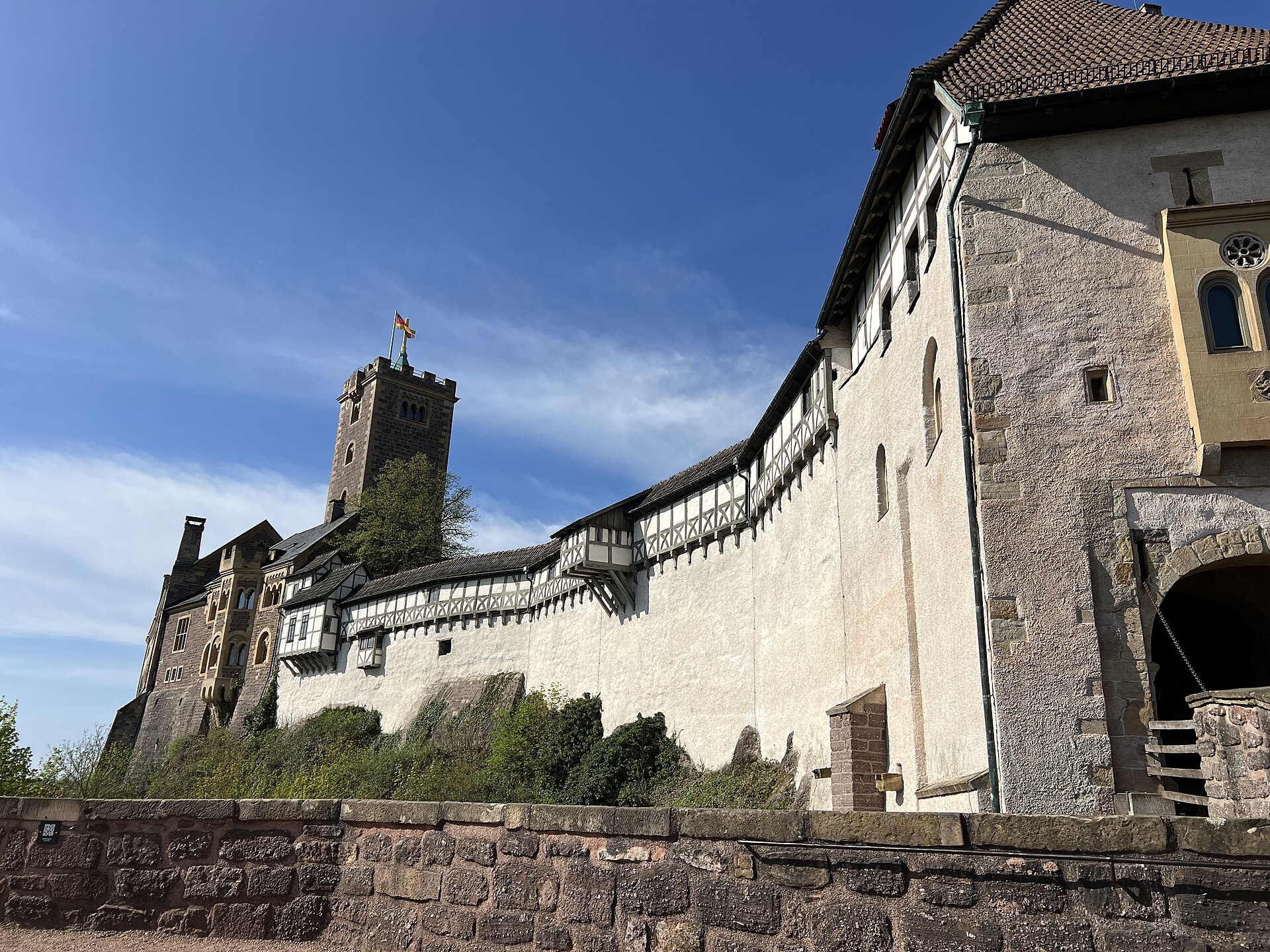
The first thing to grasp about the Wartburg is its shape, because the ridge dictated everything. There was no room here for a broad, four-square fortress with a spacious central court. Instead the builders had to string their castle out along a narrow crest of rock, one building behind another, like carriages of a train halted on a mountain track. You enter at one end and walk the length of the ridge, moving from the working outer castle to the grand inner one, with the ground falling away steeply on both sides the whole way.
That long, thin plan is why a visit feels like a procession. The oldest and most magnificent buildings sit toward the far end, protected by everything in front of them, so the castle reveals its treasures slowly. By the time you reach the great Romanesque palace at the heart of it, you have already passed through gates, courtyards, and towers, and the sense of arrival is all the stronger for the walk.
Legend says the castle was founded in the eleventh century by Ludwig the Springer, a Thuringian count who supposedly cried out, on first seeing the hill, Wait, mountain, you shall become my castle, and gave the place its name. The story is almost certainly too neat to be true, but it captures something real. From its earliest days the Wartburg was the stronghold of the Ludowingian landgraves of Thuringia, and for the next thousand years its narrow ridge would carry an astonishing amount of history.
It helps to think of the castle in two halves. The outer bailey, which you reach first, was the domain of daily work and defence; the inner castle beyond it, reached through a further gate, held the grand residential buildings of the landgraves. That division between working outer ward and lordly inner ward is common to many castles, but the ridge at Eisenach draws the line with unusual clarity, stretching the two zones out one behind the other along the crest.

Crossing the Drawbridge
Because the ridge falls away so sharply on either side, there is really only one way into the Wartburg, and that single approach could be defended with ease. You cross a drawbridge and pass beneath the gate tower into the outer bailey, and immediately the logic of the place makes sense. An attacker could not surround this castle or bring up siege engines on a broad front. He had to funnel his men onto the narrow neck of the ridge, straight into the teeth of the defences, where numbers counted for far less than they would on open ground.
The outer castle you first enter was the practical part, the zone of stables, storerooms, servants and craftsmen, everything a self-sufficient community needed to survive a long siege or a hard Thuringian winter. Half-timbered buildings crowd the walls, their upper storeys leaning out over the yard, and it is easy to picture the noise and bustle that once filled this space, the smoke and the smells, the horses and the hammering.
Keep this arrangement in mind as you walk, because it explains the whole mood of the castle. The Wartburg was never a delicate pleasure palace like the later Renaissance chateaux. It was a working fortress and a seat of government, built to hold a ridge and to shelter a dynasty, and even its most beautiful rooms sit behind walls that meant business. The romance came later. The rock and the gate came first.
Look up as you pass through the gate and you will notice the half-timbered upper storeys that give the Wartburg so much of its character. This blend of stone below and timber-framed building above is typically German, and it softens the fortress into something almost domestic. The effect is that the Wartburg manages to be at once a stronghold and a village, forbidding from a distance and strangely welcoming once you are within its walls.

The Keep and the Cross
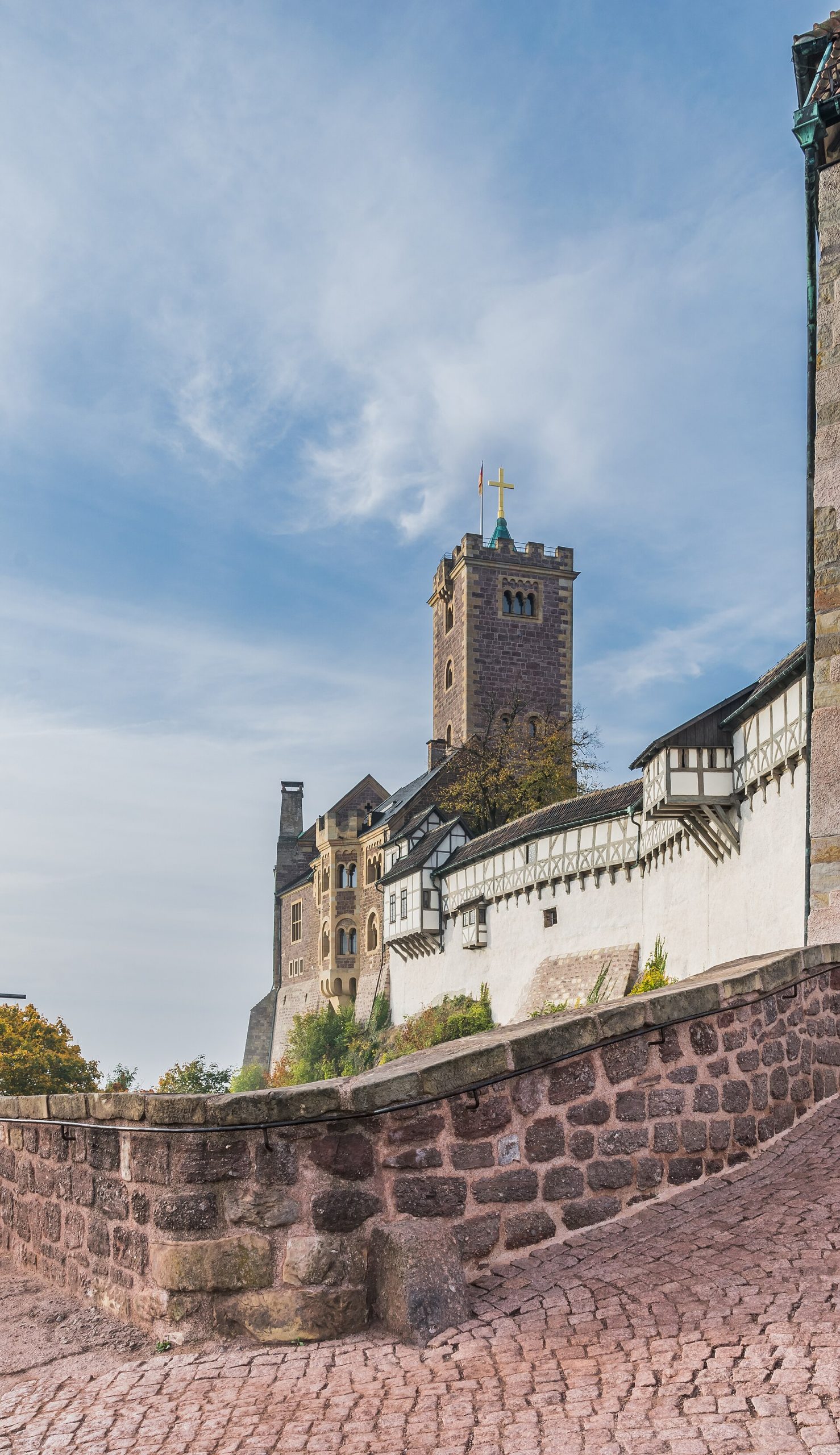
Rising above everything is the Bergfried, the great keep, the tallest and most commanding structure on the ridge. A keep like this was the castle’s last refuge and its clearest symbol of power, a tower into which the lord and his household could withdraw if the rest of the fortress fell. From its top the landgraves could see for miles across the forests of Thuringia, watching the roads and the weather and the approach of anyone who might mean them harm.
The tower you see today is not the medieval original but a nineteenth-century rebuilding, raised during the great restoration that saved the castle from decay. On its summit stands a large cross, added in a later age, that catches the light and can be seen from far off across the valley. To modern eyes it reads as a spiritual crown for a castle famous for its religious history, a reminder of the saint and the reformer whose stories are bound up with these stones.
Climb it if you have the breath, because the view is the whole point of the Wartburg’s position. Spread below you are the wooded hills that gave Thuringia its old name, the green heart of Germany, rolling away in every direction. It is not hard, standing up there in the wind, to understand why a castle on this spot mattered so much for so long. Whoever held the Wartburg held the high ground over one of the old crossroads of central Europe.
For centuries the keep also served as a grim place of confinement, its lower chambers used to hold prisoners far from help. A tower that lifted the lord toward the sky could just as easily bury an enemy in its base, and most medieval keeps combined those two functions without any sense of contradiction. Power in this age was vertical: the higher you stood, the safer you were, and the deeper you could cast those who crossed you.

The Finest Romanesque Palace in Germany
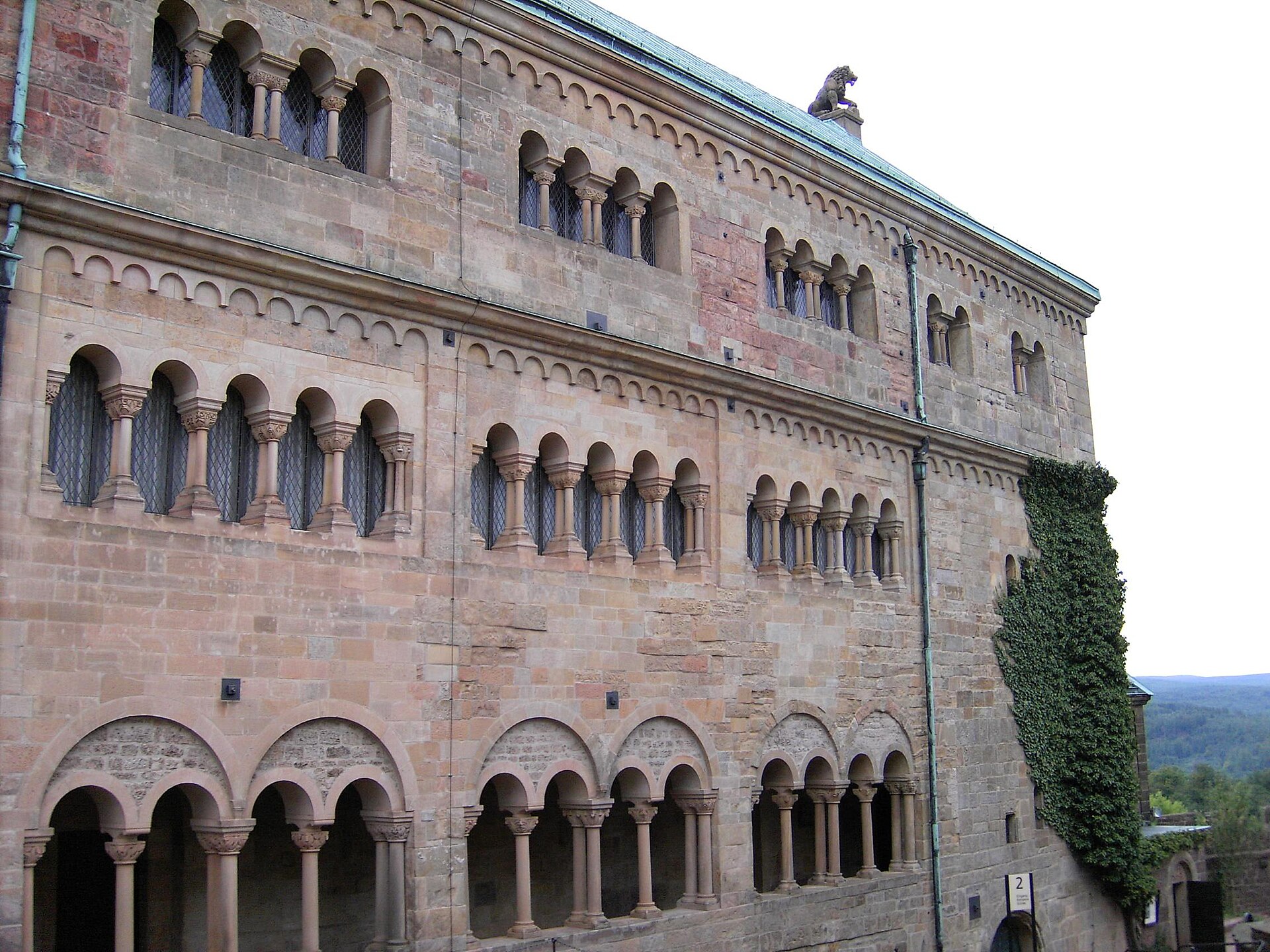
At the heart of the Wartburg stands its greatest treasure, the Palas, the palace hall block built in the twelfth century when the landgraves of Thuringia were at the height of their power. It is widely regarded as the best-preserved Romanesque secular building of its kind north of the Alps, and even the untrained eye can see that it belongs to a different order of ambition from the working buildings around it. Row upon row of rounded arches, slender columns and carved capitals give it the dignity of a church turned to worldly use.
Romanesque is the architecture of solidity and calm, of thick walls and rounded arches and a certain grave beauty, and the Palas has it in abundance. This was where the landgrave held court, received guests, dispensed justice and displayed his wealth. The scale of it tells you that the rulers of Thuringia were not minor provincial lords but princes of the Empire, wealthy and cultured, able to summon poets and knights and to entertain them in surroundings meant to impress.
Much of what you see has been carefully restored, for the Palas fell into serious decay over the centuries before it was rescued. But the bones are genuinely medieval, and walking through its arcaded galleries you are moving through spaces that were old when Luther arrived and ancient by the time the modern age began. The Palas is the reason connoisseurs of architecture make the pilgrimage to Eisenach. It is a survivor from a world that has almost entirely vanished.
Notice, as you move through it, how the decoration concentrates on the capitals of the columns, where carved leaves, beasts and faces reward a close look. Romanesque builders poured their invention into these small crowning stones, and each one is slightly different. In a building of such massive calm, the capitals are where the medieval imagination is allowed to play, and they repay the patience of anyone willing to slow down and study them.

The Hall Where Emperors Feasted
Climb to the upper floor of the Palas and you come to the Festsaal, the great hall, a long and lofty banqueting room that runs almost the full length of the building. This is the grandest interior in the castle, a space built for feasts and ceremonies, its roof carried on a forest of timbers and its walls glowing on bright days with light from the ranks of windows. Stand in the middle of it and you can almost hear the noise of a medieval court at table.
The hall as you see it owes much of its splendour to the nineteenth-century restoration, which sought not merely to repair the room but to make it worthy of the castle’s legend. It was here, in this reimagined magnificence, that later Germans staged concerts and celebrations, and the room became a stage for the nation’s sense of its own past. Richard Wagner, who knew Eisenach well, drew on the Wartburg’s atmosphere for his opera, and the great hall is exactly the kind of space his music conjures.
Whether filled with a medieval banquet or a modern concert, the Festsaal has always been about gathering people beneath one grand roof. Its scale was a statement in the twelfth century and remained one in the nineteenth. Few halls anywhere carry such a weight of association, and standing in it you feel the strange doubling that runs through the whole Wartburg, a genuinely old building lovingly dressed by a later age to look the way that age believed the Middle Ages should have looked.
The windows are worth a moment of their own. Ranged along the sunlit side of the hall, their rounded Romanesque arches frame views out over the Thuringian forest, so that even at a banquet the wild country beyond was never quite out of sight. In a castle so bound up with the land it commanded, that constant presence of the green hills through the windows feels entirely fitting.

The Contest of the Singers
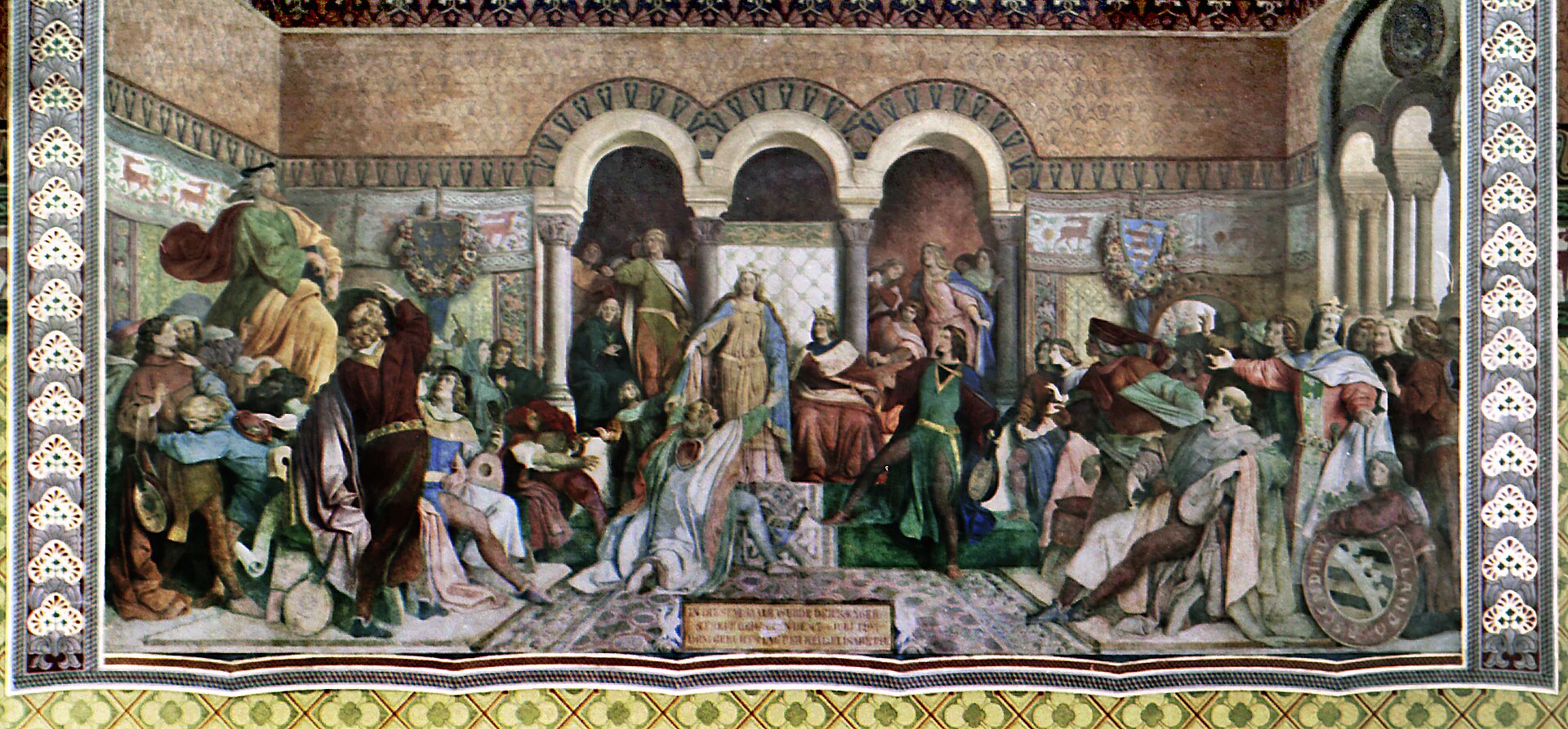
One of the Wartburg’s most enduring legends is the Sangerkrieg, the contest of the singers, said to have taken place here in the early thirteenth century. In the tale, the greatest minstrels of the age gathered at the court of the landgrave to compete in song, and the stakes were deadly: the loser was to forfeit his life. The contest grew so fierce that one singer, facing defeat, called for a famous magician to be fetched to save him, and the whole affair tipped over into sorcery and high drama.
Whether any such contest ever really happened is impossible to say, but the story took on a life of its own. The landgraves of Thuringia genuinely were great patrons of the medieval poets known as minnesingers, and the Wartburg genuinely was a centre of that courtly art, so the legend grew from real soil. Over the centuries it became one of the defining images of the German Middle Ages, a golden age of poetry and music enacted on this very ridge.
Its most famous afterlife came through Richard Wagner, who wove the singers contest into his opera Tannhauser, setting a climactic scene in the hall of the Wartburg itself. Through Wagner the legend reached audiences around the world, and many who have never heard of the landgraves of Thuringia know the image of rival singers competing in a castle hall. When you stand in the Hall of the Minstrels, you are standing inside a story that grew from this place and then travelled far beyond it.
There is a lesson in how the legend has been treated over the centuries. Each age has retold the singers contest to suit itself, medieval chroniclers as a moral drama, Romantic poets as a vision of a golden past, Wagner as grand opera. The Wartburg has a way of doing this to every story it touches, absorbing new meanings without ever losing the old ones, so that the same tale can be pious, patriotic and theatrical all at once.
The Saint Who Gave Away Her Bread
In the early thirteenth century the Wartburg became home to a young woman who would be remembered long after the landgraves were forgotten. Elizabeth, a princess of Hungary, was sent as a child to be betrothed to the heir of Thuringia, and she grew up within these walls. She married her landgrave and by all accounts loved him deeply, but what made her famous was not her rank. It was her extraordinary compassion for the poor and the sick at a time when such devotion was rare in a person of her station.
The stories told of her are tender and striking. She is said to have carried bread from the castle down to the hungry of Eisenach against the wishes of the court, and when challenged one day about what she was hiding in her cloak, the loaves were miraculously transformed into roses. When her husband died on his way to a crusade, Elizabeth left the comforts of the castle altogether, gave away her possessions, and devoted the rest of her short life to caring for the sick in a hospital she founded. She died at just twenty-four.
So powerful was her reputation for holiness that she was declared a saint only a few years after her death, and her cult spread across Europe with remarkable speed. The Wartburg has honoured her ever since, and in the great restoration a room was decorated with glittering mosaics telling her story. Of all the many people who have passed through this castle, few are loved as she is, the princess who traded a palace for a hospital and became a symbol of charity for the whole continent.
Elizabeth’s short life still speaks to visitors of every kind, believers and unbelievers alike. In an age that measured greatness by conquest and lineage, she measured it by kindness, and she is remembered when many a warrior landgrave is forgotten. Hospitals, charities and churches across Europe still bear her name, and the roses of her legend have become one of the gentlest symbols in the whole tradition of Christian sainthood.
The Landgraves of Thuringia
Behind the legends of singers and saints lies the solid history of the family that made the Wartburg the centre of a principality. The Ludowingian landgraves of Thuringia ruled a broad swathe of central Germany from this ridge, and for the better part of two centuries they were among the more powerful princes of the Holy Roman Empire. Their court drew poets and knights, their marriages tied them to royal houses, and their castle was the visible sign of their standing.
Government in the medieval sense happened here, in these courtyards and halls. Disputes were judged, taxes and dues were gathered, alliances were forged and quarrels settled. The Wartburg was not a museum piece but the working headquarters of a state, and the comings and goings that filled its yards, the messengers and petitioners and men-at-arms, were the ordinary business of ruling a large and important territory in the heart of Europe.
When the male line of the Ludowingians finally died out in the thirteenth century, Thuringia passed through inheritance and war to other hands, and in time the castle lost its role as a principal residence. That decline, paradoxically, is part of why so much medieval fabric survived. A castle that stays in constant use tends to be rebuilt with each new fashion. The Wartburg, sliding gently out of the front rank, kept more of its old self, waiting for a later age to rediscover it.
It is worth pausing on that irony, because it runs through the whole history of the castle. The Wartburg’s importance in the later centuries came not from continued power but from memory. Once it ceased to be a great seat of government, it began its slow transformation into a place of pilgrimage and symbol, valued less for what it did than for what had happened within it. Decline, at the Wartburg, was the beginning of a different kind of fame.

Everyday Life Behind the Walls
It is easy, amid the saints and singers, to forget that the Wartburg was also simply a place where people lived, day after day, through the long medieval centuries. The castle had to feed and warm and clean a sizeable household, and traces of that ordinary life survive among the grander monuments. Corners like the so-called Knights Bath remind us that even a fortress on a windswept ridge had to make some concession to comfort.
Life in a hilltop castle was not the perpetual banquet that films imagine. Water had to be hauled or collected, food stored against the winter, fires kept burning in cavernous rooms that never really warmed through. The great hall might blaze with light on a feast day, but for much of the year the Wartburg was a cold, hard place, and the people who kept it running, the cooks and grooms and servants whose names history did not record, worked without pause to keep the lord’s world turning.
Paying attention to these humbler spaces changes how you see the castle. The mosaics and the halls tell the story of the famous few, but the kitchens and passages and workaday rooms tell the story of the many. Both are the Wartburg. A castle is a machine for living as much as a monument to power, and the Wartburg kept a whole community alive on its ridge for century after century before it ever became a place of pilgrimage.

A Fugitive Named Junker Jorg
In May 1521 a covered wagon climbed the road to the Wartburg carrying the most wanted man in the Holy Roman Empire. Martin Luther had defied the Emperor and the Pope, refused to recant his writings, and been declared an outlaw whom anyone might kill without penalty. To save his life, his protector the Elector of Saxony had him seized in a staged ambush and spirited away in secret to this remote castle, where no one would think to look for him.
Here Luther lived for the better part of a year under a false identity, growing out his hair and beard and dressing as a minor nobleman, Junker Jorg, Squire George. He chafed at the confinement, complained of illness and of the boredom of hiding, and by his own account was tormented by the Devil, whom he claimed to have driven off on one occasion by hurling his inkwell at the wall. Guides still show visitors the spot where the ink is supposed to have stained the plaster, refreshed, it is said, by generations of helpful hands.
But Luther did not waste his exile. In a small, plain study in the castle he sat down to a task that would change the course of the German language, and it is to that room and that work, more than to any battle or any prince, that the Wartburg owes its deepest fame.
The secrecy of the whole episode is part of its drama. So few people knew where Luther had gone that rumours spread across Germany that he was dead, murdered by his enemies, and there was uproar in the towns and universities where his ideas had taken hold. All the while the supposed martyr was alive and well on his ridge, writing furiously under a false name, a fugitive hiding in plain sight at the heart of the country that was arguing over him.
How a Castle Shaped a Language
The work Luther did in his hidden study was deceptively simple to describe and immense in its effect. In the space of only about eleven weeks he translated the entire New Testament from the original Greek into German. Others had rendered the Bible into German before, but Luther did something different. He set out to translate not into the stiff, learned language of scholars but into the living speech of ordinary people, the German that a mother spoke to her children and a trader used in the market.
He famously said that to translate well one must look at how people actually speak and listen to the words in their mouths. The result was a German of extraordinary vigour and clarity, plain and forceful and unforgettable, and because it was printed and spread by the new technology of the press, it reached an enormous audience. Over the following years Luther went on to translate the Old Testament as well, and his complete Bible became one of the most influential books ever produced in the German lands.
Scholars have long argued that Luther’s Bible did more than any other single work to shape the modern German language, giving the scattered dialects of the region a common written standard to reach toward. A country that would not become a unified state for centuries found, in a translation made by a fugitive in a Thuringian castle, something of a shared voice. That is why the little study in the Wartburg is treated almost as a shrine. Few rooms of comparable modesty have had such consequences.
The little study where this happened is preserved much as tradition remembers it, a plain room with a writing table, a stove, and the famous stain on the wall. It is strikingly humble for a place of such importance, and that humility is part of its power. Visitors fall quiet when they enter, aware that in this modest space, with pen and paper and a stubborn will, one man set in motion changes that would ripple out across religion, language and politics for centuries.
A Rallying Point for a Nation
The Wartburg’s story did not end with the Middle Ages and the Reformation. In 1817, three centuries after Luther’s stay, hundreds of German students climbed this hill for a very different purpose. They came for the Wartburg Festival, a gathering of the student fraternities who dreamed of a free and united Germany at a time when the country was a patchwork of separate states. They chose the Wartburg deliberately, as a place already heavy with national meaning, and their meeting became a landmark in the long movement toward German unity.
That gathering fixed the castle’s modern role as a symbol of the nation. Over the following decades, as Germans debated and fought over what their country should be, the Wartburg stood as a kind of shorthand for their shared heritage, the castle of the minstrels and the saint and the reformer, the most German of all castles. It was in this spirit that the great nineteenth-century restoration was undertaken, an effort not just to repair a ruin but to give the nation a worthy monument to its own past.
That restoration is why the Wartburg looks as it does today, a medieval castle seen partly through nineteenth-century eyes, its old fabric completed and adorned to match the legend. Some purists have grumbled about it, but the result is undeniably powerful, and in 1999 the castle was recognised as a World Heritage Site precisely for the way it fuses genuine medieval substance with its extraordinary layers of cultural meaning. Few castles carry so much history, or wear it so openly.
The nineteenth-century rebuilders worked with real scholarship and real devotion, studying what remained and drawing on the art of the past to complete what time had destroyed. If they sometimes let their idea of the Middle Ages run ahead of the evidence, they also saved a decaying monument and gave it back to the nation in a form people could love. The Wartburg we visit is, in that sense, a collaboration across the centuries, medieval builders and Romantic restorers working on the same stones.

Finding the Wartburg Today
Reaching the Wartburg is straightforward and rewarding. The castle sits on its ridge just above Eisenach, an easy town to reach by train, and from the edge of the town a road and footpaths climb the hill to the gates. You can walk up through the forest, which is the loveliest way and takes perhaps half an hour at a steady pace, or take the shuttle service that runs for those who would rather save their energy for the castle itself. Donkeys once carried visitors up the slope, and the memory of that gentler age still clings to the place.
Once inside, the castle rewards a slow and curious visit. The guided tour of the interior is the only way to see the Palas, the great hall, the Elizabeth rooms with their mosaics, and above all Luther’s study, and it is well worth the time. Beyond the tour you can wander the courtyards, climb the keep for the view, and visit the collections that fill parts of the castle, taking in the layers of a building that has been fortress, court, refuge, and national symbol by turns.
If you would like to find it on a map or plan your climb, here is the castle’s position on its ridge above Eisenach: 50.9663, 10.3065. Give yourself a half-day at least, and try to arrive early or stay late to catch the light on the old stones. The Wartburg has been drawing pilgrims of one kind or another for the better part of a thousand years. It is not hard to see why they keep coming, or why so many of them leave feeling they have touched something close to the heart of Germany.
Try, if you can, to allow time for the walk up through the woods rather than taking the easiest route to the top. The approach on foot, with the castle appearing and disappearing between the trees as you climb, is the way visitors have come for centuries, and it sets the mood far better than arriving in a hurry. By the time you reach the gate you will have earned your first view of the ridge, and the castle will feel like a genuine destination rather than a stop on a schedule.

Castles Nearby
- Heidelberg Castle, Germany’s most romantic ruin
- Neuschwanstein, the fairy-tale castle of the Dream King
- Hohenzollern Castle, the mountaintop seat of Prussia’s kings
The Most German of Castles
There are grander castles than the Wartburg and more beautiful ones, but there may be none that has meant so much to so many. In its long, thin outline on the ridge above Eisenach, this one modest fortress managed to gather up an astonishing share of a nation’s story: the poetry of the minnesingers, the charity of a beloved saint, the words of a reformer who reshaped a language and a faith, and the hopes of students who dreamed of a country not yet born.
That is what stays with you as you walk back down the hill. Not the height of the towers or the age of the arches, but the sense of having stood in the rooms where these things happened, or were believed to have happened, which at the Wartburg often comes to much the same thing. History and legend are braided together here so tightly that no one can quite pull them apart, and the castle is the richer for it.
Go for the view and the architecture, by all means. But go, above all, for the feeling of standing at a crossroads of a country’s memory, in a place where song and sanctity and a single stubborn monk with an inkwell all left their mark on the same Thuringian rock. Of all the castles in Germany, the Wartburg is the one that feels least like a building and most like a story you can walk through.
You May Like
Mafra, the Palace a King Built From a Vow


2 thoughts on “Wartburg Castle: The Most German of All Castles”