On Peru’s desert coast near the modern city of Trujillo, two massive adobe mounds rise from the plain roughly half a kilometer apart. Spanish colonizers named them Huaca del Sol and Huaca de la Luna, the Temple of the Sun and the Temple of the Moon, and together they formed the religious and political heart of the valley that gave the Moche civilization its very name.
These are not twin monuments built to a single matching plan. One is a shattered ruin, deliberately torn apart by treasure hunters centuries ago. The other survived largely intact, buried under its own successive reconstructions, preserving some of the best painted murals anywhere in pre-Columbian South America.

Table of Contents
- Two Pyramids on the Desert Coast
- A City Between the Sun and the Moon
- Huaca del Sol and the Spanish Search for Gold
- Huaca de la Luna, Rebuilt Again and Again
- What Language Did the Builders Speak?
- The Decapitator God on the Walls
- Sacrifice in the Plaza
- El Nino and a Changing Climate
- Craft Workshops and Daily Life
- Excavation and Visiting Today
- Nearby Places to Explore
Two Pyramids on the Desert Coast
Both structures sit within the Moche Valley, a stretch of irrigated farmland squeezed between the Pacific Ocean and the arid foothills of the Andes. This valley lent its name to the wider Moche civilization, which flourished across Peru’s north coast roughly between the first and eighth centuries CE, and these two huacas functioned as its most important known religious and administrative center.

Huaca del Sol, larger of the two, was built primarily as a political and administrative structure, while Huaca de la Luna, smaller but architecturally more complex, served principally religious and ceremonial functions, a division of labor between the two monuments that archaeologists have pieced together gradually through decades of excavation.
The dry, almost rainless climate of Peru’s north coast has proven essential to preserving both monuments as well as they have survived, since adobe brick construction depends heavily on avoiding sustained moisture, a vulnerability that Spanish colonizers exploited deliberately at Huaca del Sol and that natural rainfall could just as easily have destroyed over centuries without human interference.
Archaeologists divide the broader Moche cultural sphere into northern and southern spheres based on regional variation in ceramics, architecture, and political organization, with the Moche Valley and its twin pyramids generally regarded as the most important known center within the southern sphere, distinct from northern centers closer to Sipan and the Lambayeque valley.
Comparing Huaca del Sol and Huaca de la Luna to other major Moche and Andean religious centers covered elsewhere in this series highlights just how varied ancient Andean architectural and artistic traditions could be, even among societies that shared broadly similar coastal desert environments and comparable levels of political and religious organization.
Ongoing debate among archaeologists over the precise nature of Moche political organization, whether it functioned as a unified state, a loose confederation, or something in between, continues to draw heavily on evidence from Huaca del Sol and Huaca de la Luna, given their scale and apparent importance relative to other known Moche centers along the coast.
A City Between the Sun and the Moon
The open plain separating the two pyramids was not empty ceremonial space but the site of an actual urban settlement, with residential compounds, workshops, and streets occupied by ordinary Moche families living and working in the shadow of both monuments simultaneously.
Excavations across this intervening zone have revealed a genuinely mixed community, including craft specialists producing ceramics and metalwork alongside farmers and laborers, giving archaeologists a rare window into daily Moche urban life rather than only the religious and elite culture usually emphasized at sites known primarily for their monumental architecture.
Population estimates for the combined urban zone surrounding the two huacas suggest a substantial settlement by ancient Andean standards, likely numbering in the thousands at its height, supported by an extensive irrigation system channeling water from the Moche River across the surrounding desert plain to sustain intensive agriculture.
Canal systems identified through survey work in the surrounding valley demonstrate a level of hydraulic engineering sophistication comparable to other major pre-Columbian Andean societies, allowing Moche farmers to convert an otherwise arid coastal desert into productive agricultural land capable of supporting the dense urban population clustered between the two huacas.
Household remains excavated within this urban zone include modest domestic structures quite different in scale and material from the monumental adobe platforms nearby, giving archaeologists a useful point of comparison between elite religious architecture and the more ordinary buildings occupied by the artisans and laborers who supported the valley’s ceremonial life.
Huaca del Sol and the Spanish Search for Gold
Huaca del Sol ranks among the largest adobe brick structures ever built in the Americas, estimated to contain well over one hundred million individual mud bricks arranged in a stepped, cross-shaped platform. Its scale alone would make it one of the most significant Moche monuments even in its current, badly damaged state.
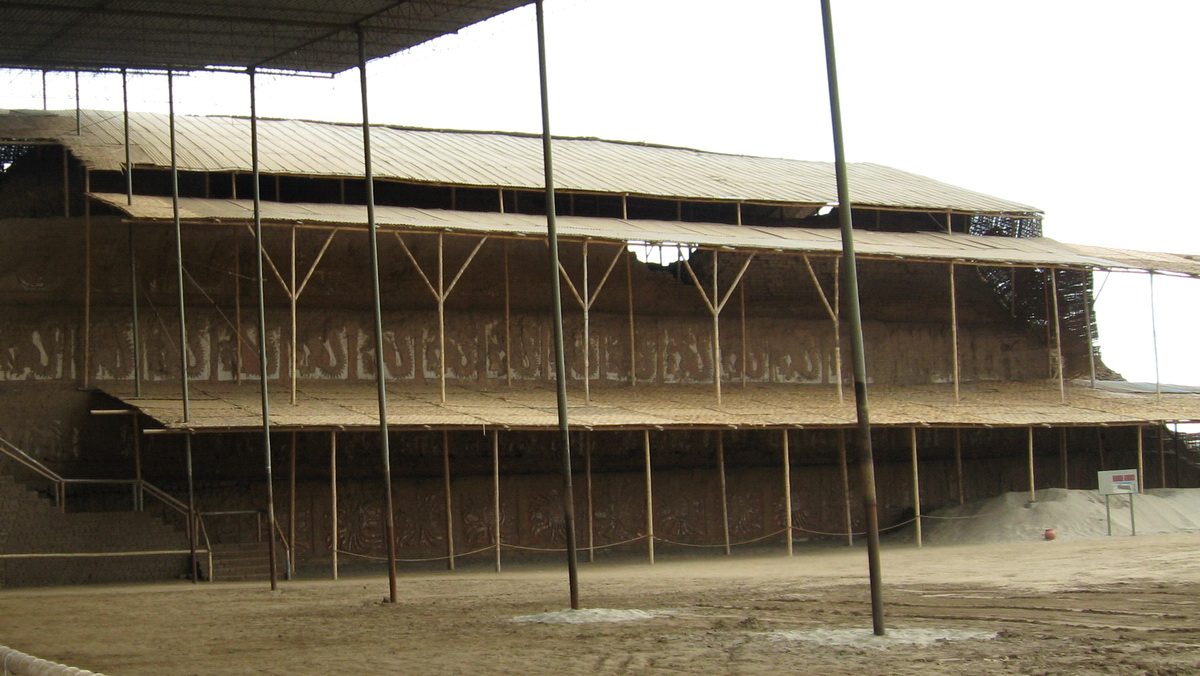
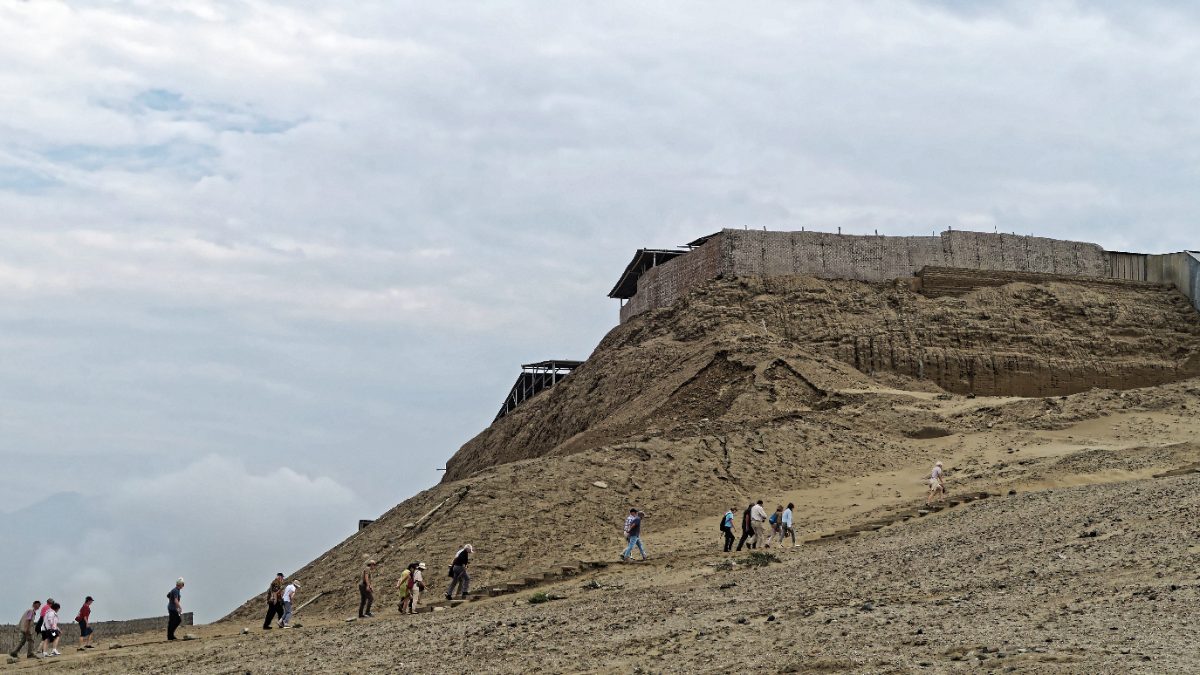
That damage dates to the early seventeenth century, when Spanish colonizers, convinced the pyramid concealed buried treasure, diverted the course of the nearby Moche River to wash directly through the structure, destroying an estimated two-thirds of the original monument in the process. What survives today represents only a fraction of the pyramid’s original form, and its unstable, eroded condition has kept large sections effectively off-limits to full excavation ever since.
Colonial documents describing the river diversion project note that the effort did yield some gold and looted artifacts, providing just enough reward to justify, in the eyes of the colonizers involved, the destruction of one of the largest pre-Columbian monuments on the entire Peruvian coast.
Modern engineers and archaeologists studying what remains of Huaca del Sol have had to work carefully around its unstable, partially collapsed sections, since the same seventeenth-century river diversion that destroyed much of the pyramid left the surviving portions considerably more vulnerable to further erosion than an undisturbed adobe monument would typically be.
Despite its ruined state, Huaca del Sol still retains enough of its original stepped form to convey a rough sense of its former scale, and ongoing stabilization work continues on a limited basis, aimed primarily at preventing further collapse rather than at large-scale excavation given the structure’s fragile condition.
Huaca de la Luna, Rebuilt Again and Again
Huaca de la Luna owes its remarkable preservation to a Moche architectural practice of periodic renewal, in which older temple platforms were deliberately buried intact beneath new construction rather than demolished, effectively sealing and protecting earlier structures, murals and all, within the growing mass of the monument.

Archaeologists have identified at least five major construction phases within Huaca de la Luna, each adding new platforms and plazas atop the last across several centuries of continuous use, a layered building history that has allowed excavators to study an unusually complete architectural and artistic sequence in a single location.
This tradition of building directly over earlier temples appears at other Moche sites as well, though rarely on the scale or with the same degree of preservation documented at Huaca de la Luna, making it one of the most important single sources for understanding how Moche religious architecture and iconography evolved across several centuries.
Each successive construction phase at Huaca de la Luna appears to have involved not just adding new platforms but also renewing the painted decoration on exposed surfaces, meaning the murals visible to visitors today represent a specific, relatively late layer in a much longer sequence of religious imagery built up and periodically refreshed over centuries.
What Language Did the Builders Speak?
As with other Moche sites in this series, no writing system has been identified for the people who built and used Huaca del Sol and Huaca de la Luna, leaving their spoken language a matter of informed inference rather than direct textual evidence.
Most scholars again point to Muchik, the coastal language documented by Spanish missionaries centuries later in the same general region, as the most plausible descendant or relative of whatever language the Moche builders of this valley actually spoke, though as elsewhere in this series that connection remains a reasonable hypothesis rather than a settled fact.
This absence of a deciphered script is a defining challenge across Moche archaeology generally, meaning nearly everything scholars understand about religious belief, political structure, and daily life at sites like Huaca del Sol and Huaca de la Luna comes from combining excavated physical evidence with the visual language preserved in painted ceramics and murals rather than from any surviving written account.
This is one of several reasons archaeologists studying Moche sites, including Huaca del Sol and Huaca de la Luna, place such heavy emphasis on iconographic analysis, treating the recurring imagery in ceramics and murals as the closest available substitute for the textual records that survive at literate civilizations like the Maya covered elsewhere in this series.
The Decapitator God on the Walls
Huaca de la Luna’s surviving murals are dominated by repeated depictions of a fanged, spider-like deity modern archaeologists call the Decapitator, sometimes referred to by the name Ai Apaec, closely associated with sacrifice, warfare, and the taking of human heads and blood as ritual offerings.

These painted friezes, rendered in vivid reds, yellows, and whites that have survived remarkably well thanks to the dry coastal climate and the protective effect of later construction phases, represent some of the most extensive and well-preserved examples of pre-Columbian Andean mural art known anywhere.
The Decapitator’s imagery frequently combines human, feline, and arachnid features, a hybrid iconography common across Moche religious art, and its repeated appearance across multiple construction phases at Huaca de la Luna suggests this figure held sustained, central importance in Moche religious life across generations rather than representing a passing artistic fashion.
Beyond the Decapitator, murals at Huaca de la Luna also depict processions of warriors, ranks of prisoners, and repeating geometric patterns that likely carried their own symbolic meanings tied to Moche cosmology, though the Decapitator remains the single most extensively studied and widely reproduced image from the site’s extensive painted program.
Pigments used in these murals were derived from locally available mineral sources, and analysis of the paint layers has helped conservators understand both the original artistic techniques employed by Moche muralists and the best modern methods for stabilizing and protecting these fragile painted surfaces against further deterioration.
Sacrifice in the Plaza
Excavations in the plazas surrounding Huaca de la Luna uncovered the remains of dozens of young men who appear to have been ritually sacrificed, their skeletons showing evidence of violent death and, in some cases, deliberate exposure to the elements consistent with imagery found in Moche art depicting captive warriors presented for ceremonial killing.
These findings gave direct physical confirmation to scenes long known only from painted ceramics and murals across the wider Moche world, much as the royal tomb at Sipan had done for elite burial customs, transforming what had been interpreted as possibly symbolic imagery into evidence of an actual, repeated ritual practice.
Isotopic and skeletal analysis of the sacrificed remains has allowed researchers to estimate the approximate age, health, and even likely geographic origin of many victims, suggesting captives may have been drawn from rival groups or distant communities rather than exclusively from the immediate Moche Valley population itself.
The plazas where these sacrifices occurred appear to have been used repeatedly over an extended period rather than during a single isolated event, with multiple stratified layers of sacrificial deposits documented by excavators, indicating this practice formed a recurring, institutionalized part of religious life at the site rather than an exceptional emergency measure.
Comparisons between the sacrificial evidence at Huaca de la Luna and the elite burial practices documented at Sipan, discussed elsewhere in this series, together paint a fuller picture of how Moche religious authority combined lavish reverence for powerful rulers with violent ritual demands placed on captives and, in some interpretations, on members of the broader Moche population itself during times of crisis.
El Nino and a Changing Climate
Some of the sacrificial episodes documented at Huaca de la Luna appear to correlate with periods of severe El Nino related flooding and drought, climatic disruptions that could devastate the irrigation-dependent agriculture underpinning Moche society and may have prompted elites to intensify ritual sacrifice in response to perceived divine displeasure.

Long-term climatic stress, including a series of particularly severe El Nino events, is one of several factors researchers cite in explaining the eventual decline of Moche political power in this valley, alongside social upheaval and shifting trade and political relationships across the wider north coast.
Sediment layers at the site preserve physical evidence of catastrophic flood events interspersed with the temple’s construction phases, giving archaeologists a direct stratigraphic record connecting specific climatic disasters to particular periods of ritual intensification documented in the surrounding sacrificial deposits.
Researchers studying this connection caution against oversimplifying the relationship between climate and ritual violence, noting that political, social, and religious factors specific to Moche society likely shaped how communities responded to environmental stress, rather than climate alone directly causing an automatic increase in sacrificial practice.
Paleoclimatic data drawn from ice cores and marine sediment records elsewhere along the Peruvian coast has helped researchers build an independent timeline of major El Nino events during the Moche period, allowing more precise correlation with the archaeological evidence recovered directly from the plazas surrounding Huaca de la Luna.
Craft Workshops and Daily Life
The urban zone between the two huacas has yielded evidence of specialized metalworking and ceramic production areas, indicating that skilled artisans lived and worked within sight of the monumental architecture they helped supply with ritual objects, ornaments, and painted vessels used throughout Moche religious and elite life.
This closeness between craft production and monumental religious architecture suggests a tightly integrated society in which artisan labor, elite ritual, and political administration were not separated across distant locations but concentrated within a single, densely occupied valley center.
Metalworking debris recovered from these workshop areas indicates local production of gold, silver, and copper ornaments similar in style and technique to pieces found in elite burials elsewhere in the Moche world, including the royal tomb at Sipan, suggesting shared craft traditions and possibly direct exchange of finished goods, raw materials, or skilled artisans between different Moche valley centers.
Ceramic workshops in particular have yielded molds used to mass-produce certain vessel forms, evidence that some Moche pottery production, especially for widely used ceremonial or utilitarian shapes, moved beyond purely individual craftsmanship toward something closer to standardized, semi-industrial output supporting the broader religious and administrative needs of the valley center.
Textile fragments recovered from workshop contexts, though less commonly preserved than ceramic or metal objects, indicate that weaving formed another significant craft specialization within the community, contributing to the elaborate garments and ceremonial regalia depicted so consistently in Moche painted and sculpted art.
Excavation and Visiting Today
Formal, sustained excavation and conservation at Huaca de la Luna began in earnest in the 1990s under Peruvian archaeologists including Santiago Uceda and Ricardo Morales, whose long-running project has steadily uncovered and stabilized the site’s painted facades while training generations of Peruvian archaeologists in the process.

Visitors today can walk through excavated sections of Huaca de la Luna and view its murals up close, while Huaca del Sol remains viewable mainly from a distance given its fragile, eroded state, a striking visual contrast between a monument nearly lost to looting and one saved by the very practice of burying its own history.

An on-site museum near Huaca de la Luna displays artifacts recovered during decades of excavation, along with detailed explanations of the site’s layered construction history, giving visitors context that the ruins alone, however visually striking, cannot fully convey without additional interpretation.
Ongoing conservation challenges at Huaca de la Luna include protecting exposed murals from the cumulative effects of visitor traffic, humidity fluctuations, and occasional heavy rains associated with severe El Nino events, the same climatic phenomenon that shaped the site’s ancient religious practices now posing a modern preservation concern for the archaeologists tasked with protecting it.
For visitors traveling along Peru’s north coast, Huaca del Sol and Huaca de la Luna pair naturally with a stop in Trujillo itself, a colonial city built partly from stone and material scavenged from the surrounding ancient ruins, before continuing on to Chan Chan and other Moche and Chimu sites within the same coastal region.
Nearby Places to Explore
Huaca del Sol and Huaca de la Luna connect closely to other Moche and Andean sites covered elsewhere in this series.
- Sipan’s Looted Royal Tomb Rewrote Moche History
- How the Wari Empire Ruled the Andes Long Before the Inca
- Kuelap, the Andean Fortress the Inca Struggled to Conquer
Closing Thoughts
Huaca del Sol and Huaca de la Luna together tell two very different stories about how the past survives into the present, one destroyed by greed centuries after it was built, the other preserved almost by accident through a religious practice of burying rather than demolishing what came before.
Standing between them today, on ground once occupied by the ordinary artisans and farmers who supported both monuments, offers a more complete picture of Moche civilization than either pyramid could provide alone, one where sacrifice, art, climate, and daily labor were all bound tightly together in a single valley on Peru’s desert coast.
You May Like
Mafra, the Palace a King Built From a Vow