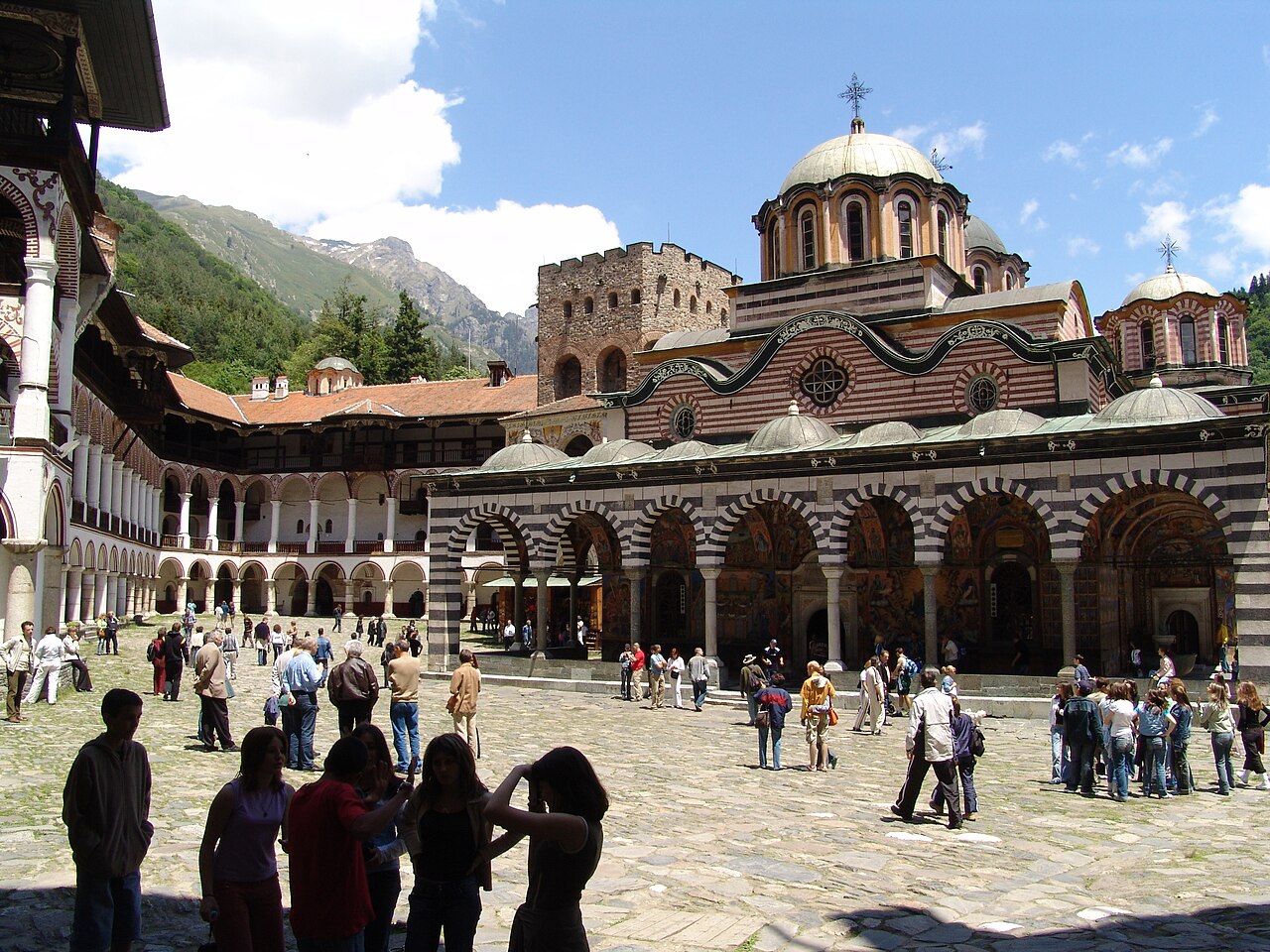
There is a moment, somewhere on the winding road up into the Rila Mountains, when the forest suddenly opens and the monastery appears all at once, white and striped and impossibly grand against a wall of green peaks. People who have made that drive often say the same thing: that they were not prepared for how it would feel. Rila is the largest and most beloved monastery in Bulgaria, and for a great many Bulgarians it is something more than a building. It is the place where their language, their faith, and their sense of themselves as a people were kept alive through centuries when all three were under threat.
To understand why a remote mountain monastery came to carry so much weight, you have to go back more than a thousand years, to a hermit who wanted nothing to do with the world at all.
A hermit who never meant to start anything
In the tenth century, a man named Ivan of Rila, known in English as John of Rila, withdrew into these mountains to live alone as a hermit. He was not trying to found an institution; by every account he was trying to escape one, seeking solitude, prayer, and a life stripped down to its barest essentials. He lived in a cave, ate what the forest gave him, and became known for a holiness that, ironically, made solitude impossible. Word spread, disciples came looking for him, and a community gathered nearby almost against his wishes.
After his death he was canonised, and he became the patron saint of the Bulgarian people, perhaps the most deeply loved figure in the whole of Bulgarian Orthodoxy. The monastery that grew up near his hermitage took his name and his memory as its foundation. From the very beginning, then, Rila was tied not to a king or a conquest but to a single quiet man who had only wanted to be left alone with God, which is part of why Bulgarians feel such tenderness toward it.
The keeper of a nation’s soul
Over the medieval centuries the monastery grew rich and influential, supported by Bulgarian rulers who understood the power of being associated with so holy a place. But its real significance emerged during the long, hard period of Ottoman rule, when Bulgaria as an independent state ceased to exist and the Orthodox faith became one of the few things that held the Bulgarian identity together. Through those centuries, Rila became a refuge, a school, and a treasury of Bulgarian culture.

Within its walls, monks copied manuscripts, preserved the Bulgarian language and its Cyrillic script, and kept alive a continuous thread of learning and worship when much of public life had been silenced. For ordinary Bulgarians, making the journey up to Rila was a way of touching something that was unmistakably and proudly their own. This is why, when Bulgarians speak of the monastery, they often reach for words about the nation rather than only about religion. Rila is woven into the story Bulgaria tells about how it survived.
Fire, ruin, and a rebuilding that became a movement
The monastery you visit today is largely the product of the nineteenth century, and that, too, is part of its meaning. In 1833 a devastating fire swept through the complex and destroyed much of it. What happened next says a great deal about the place. Bulgarians from every corner of the land contributed money, labour, and craftsmanship to rebuild it, and they did so during the very years when a broader national awakening was stirring, a movement to reclaim Bulgarian language, culture, and eventually independence.
The rebuilt monastery, with its bold black-and-white striped arches, its tiers of wooden balconies, and its riot of colourful frescoes, became a kind of statement of national revival rendered in stone and paint. To rebuild Rila so magnificently, at that particular moment, was to declare that the Bulgarian spirit had not died under foreign rule. The architecture itself, drawing on local building traditions, was a deliberate celebration of what was native and Bulgarian rather than imposed from outside.

What it means within Orthodox Christianity
Rila belongs firmly to the world of Eastern Orthodox Christianity, and specifically to the Bulgarian Orthodox Church, one of the ancient self-governing churches of the Orthodox communion. For an Orthodox Christian, a monastery like this is not a museum or merely a beautiful relic of the past but a living centre of prayer, where monks still keep the cycle of services that has continued, in one form or another, for over a thousand years. The relics of John of Rila, kept here, make it a place of genuine pilgrimage rather than only of sightseeing.
It is worth being clear about how this differs from the Western Christian places many readers may know better. This is not a Roman Catholic shrine with a pope and a single worldwide authority, nor a Protestant site shaped by the Reformation. Orthodoxy is organised as a family of independent national churches that share the same ancient faith and sacraments while governing themselves, and Rila is one of the great spiritual hearts of the Bulgarian branch of that family. The veneration of icons, the long sung liturgies, the deep reverence for saints and their relics, and the monastic ideal of withdrawal into prayer are all expressions of an Eastern Christian tradition that feels, to many Western visitors, both familiar and strikingly different.
Stepping inside
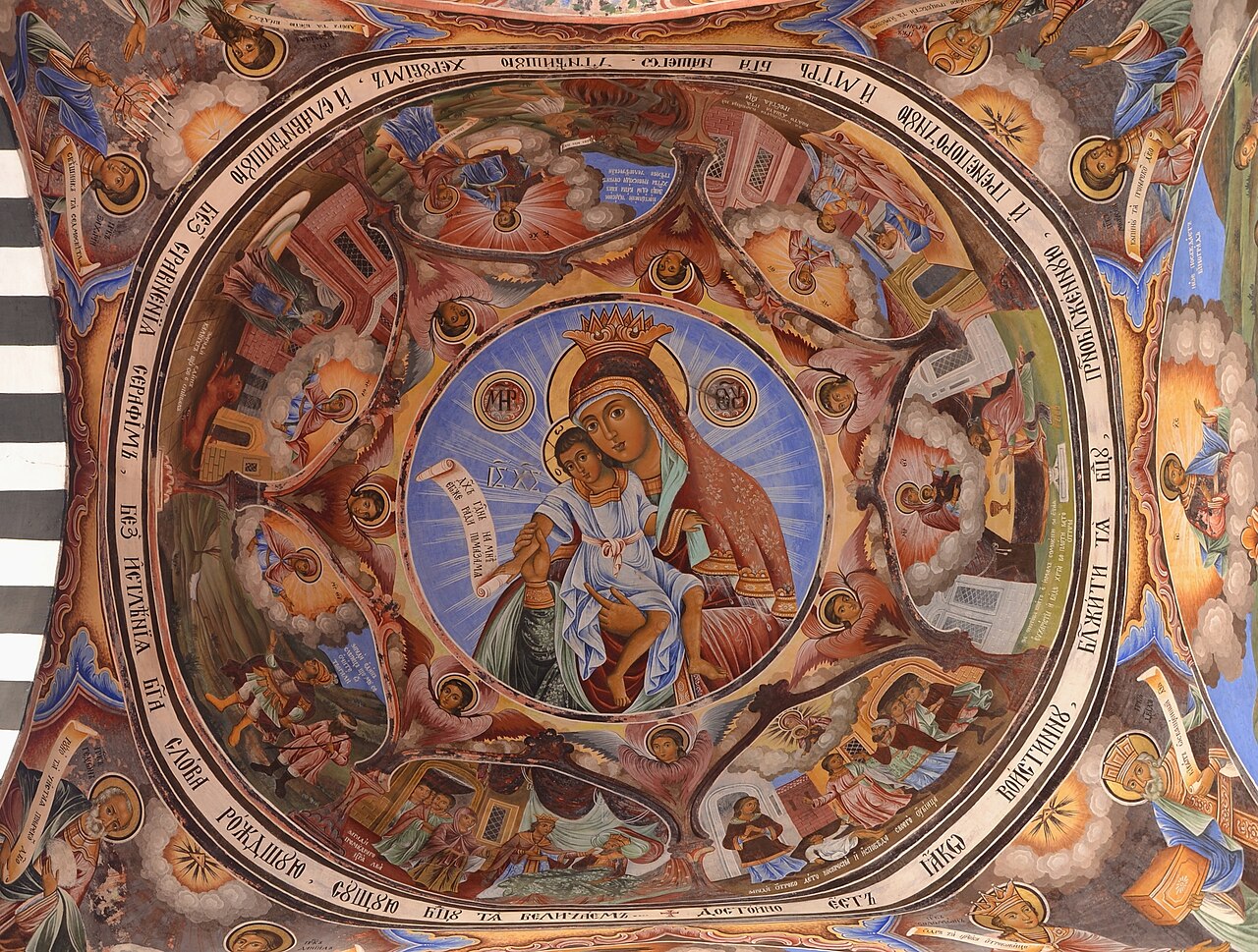
The first thing that strikes most visitors when they pass through the gate is the courtyard, which is far more theatrical than the plain fortress-like outer walls suggest. The inner facades rise in bands of red, white, and black, ringed by graceful arcades and layers of carved wooden balconies, so that the whole space feels like the inside of a great, ornate vessel open to the sky. At its centre stands the main church, dedicated to the Nativity of the Virgin, its porch covered in some of the most vivid religious frescoes in the Balkans.

Those frescoes reward slow looking. They were painted in the nineteenth century by some of the finest artists of the Bulgarian revival, and they teem with scenes of heaven and hell, saints and sinners, miracles and torments, rendered in colours that have stayed astonishingly bright. Beside the church rises a stout medieval stone tower, the oldest surviving part of the complex, a reminder of the centuries when a monastery in the mountains also had to be a place of defence. Around the courtyard, the monks’ quarters and the old kitchen, with its soot-blackened chimney soaring up through several storeys, give a sense of how this was once a self-sufficient world unto itself.
If you decide to go
Rila sits high in the mountains south of Sofia, and reaching it is part of the experience, a gradual climb out of the lowlands into cooler, pine-scented air. Many people come on a day trip from the capital, but those who can stay overnight, whether in the simple guest rooms within the monastery itself or in the small settlement nearby, often find the place transforms once the day-trippers have gone and the courtyard falls quiet. In the early morning, with mist still clinging to the peaks and the bell calling the monks to prayer, it is easy to feel why a hermit once thought these mountains were the closest thing on earth to heaven.
Whatever your own beliefs, it is hard to stand in that painted courtyard without sensing the weight of what it has carried: a faith kept alive, a language preserved, a national spirit that refused to be extinguished. The hermit who fled here a thousand years ago wanted only silence and God, and in a strange way the monastery that bears his name has spent the centuries since giving an entire people a place to find both.


