In the dry southern steppes of European Russia, where the land runs flat and treeless toward the Caspian Sea, lives a people unlike any other on the continent. Here, amid the burial mounds and grazing herds, rise the bright roofs of Buddhist temples, and prayer flags flutter in the hot steppe wind. This is the homeland of the Kalmyks, the only people of Europe whose traditional faith is Buddhism, and the westernmost branch of the great Mongol world.
The Kalmyks are a Mongolic people, descendants of nomads who rode west across the whole breadth of Asia to settle on the very edge of Europe. They brought with them their herds, their felt tents, their epic songs, and the Tibetan Buddhism of their distant eastern home. For four centuries they have lived on the steppe between the Volga and the Don, keeping alive on European soil a way of life and a religion born on the far side of a continent.
This article is part of our Folks series, in which we journey from people to people across the vast expanse of Russia and its neighbours. Here we follow the Kalmyks through the whole arc of their story, and to keep the path clear we will move through these stages in turn:
- Origins and the long ride west
- The name they carry and what it means
- Their language and its Mongol roots
- The homeland on the Caspian steppe
- The old nomadic way of life
- Society, clan, and the old order
- Religion, the Buddhism of Europe
- Traditions, epic, and song
- Crafts and the work of the nomads
- Food and the table of the steppe
- Festivals and the turning of the year
- History under the Russian state and a great tragedy
- The Kalmyks today
Origins and the Long Ride West

The story of the Kalmyks begins far to the east, in the grasslands of Central Asia and western Mongolia. They descend from the Oirats, the western Mongols, a confederation of nomadic tribes who had roamed the region since the days of the Mongol Empire. Fierce herders and horsemen, the Oirats were one of the great powers of the inner Asian steppe, rivals and sometimes rulers over vast territories.
The Oirats were never a single kingdom so much as a shifting alliance of proud tribes, and this looseness travelled west with them. It gave the Kalmyks their strength and their weakness alike: a fierce independence and skill in war, but also a tendency to division that outside powers would later learn to exploit.
In the early seventeenth century, pressed by conflicts with their neighbours and searching for new pastures, a large body of Oirat tribes began an extraordinary migration. They travelled thousands of miles westward, across the whole span of the Asian steppe, until they reached the lower Volga in the lands north of the Caspian Sea. There they found wide grasslands then only thinly settled, and there they stopped, becoming the people we now call the Kalmyks.
This migration was one of the last great movements of steppe nomads in history, a whole people crossing a continent with their herds and tents. On the Volga they built a powerful nomadic state, the Kalmyk Khanate, which for a time dominated the surrounding steppe and dealt as an equal with the Russian tsars, the Ottomans, and the peoples of the Caucasus and Central Asia.
The Kalmyks thus stand at the very end of a story that runs back to Genghis Khan and the world-conquering Mongols. They are a living remnant of that age of the horse and the open plain, carried by history to the western rim of the steppe world, where the grasslands of Asia finally give way to the settled lands of Europe.
The Name They Carry and What It Means

The people are known to the world as Kalmyks, but this was not originally their own name. It appears to have been given to them by their Turkic-speaking neighbours, and one common explanation holds that it meant something like those who remained or those who stayed behind, marking out the Oirat groups who moved west and settled from those who returned toward the east. Over time the name stuck and became the accepted term.
Among themselves, the Kalmyks long identified above all as Oirats, by their tribal and clan names, for the old nomadic world was organized by kinship and confederation rather than by a single national label. The great divisions of the people, such as the Torghuts, the Dörböts, and others, each had their own history, leaders, and pastures within the wider Kalmyk world.
The land they settled took its name from them, becoming Kalmykia, and today the people and their republic share the single name. In their own Mongolic tongue they call their homeland by their own words, but to the wider world it is the Republic of Kalmykia, the one corner of Europe where a Mongol people and a Mongol name are rooted in the soil.
So the name Kalmyk, like so many names of peoples, began as a label from outside and was gradually taken up as a badge of identity. Behind it lies the older, prouder word Oirat, linking this small European nation to the vast Mongol world of the eastern steppe from which it came.
It is worth remembering that names on the steppe were rarely fixed. A family might be known by its clan, its tribe, its leader, or the land it grazed, and outsiders added labels of their own. That the single word Kalmyk came to cover so varied a people is itself a sign of how the Russian and European world flattened the rich complexity of the steppe into one convenient name.
Their Language and Its Mongol Roots

The Kalmyk language belongs to the Mongolic family, closely related to the Mongolian spoken in Mongolia itself and descended from the speech of the western Oirats. To a Russian or European ear it is utterly foreign, sharing nothing with the Slavic or other languages around it, a small island of Mongol speech at the edge of Europe. It is the only Mongolic language native to the continent.
Like its relatives, Kalmyk builds words by adding strings of suffixes to a root, and it follows the sound harmony typical of the family, where the vowels within a word agree with one another. Its grammar and vocabulary preserve much of the old Oirat tongue, carrying words for the world of the herd, the tent, and the open plain that the people brought with them from the east.
The Kalmyks have a notable written tradition. In the seventeenth century a Buddhist monk created a special script for them, known as the Clear Script, designed to record their language and to translate Buddhist texts more precisely than earlier writing allowed. For centuries this elegant vertical script served Kalmyk religion and learning, a mark of their distinct cultural life.
In the modern era the language came to be written in the Cyrillic alphabet, with additional letters for its particular sounds. Like many minority tongues, Kalmyk today faces heavy pressure from Russian, and the number of fluent speakers has fallen, especially among the young. Reviving and preserving the language has become one of the central concerns of Kalmyk cultural life.
The Homeland on the Caspian Steppe
The homeland of the Kalmyks is the Republic of Kalmykia, a broad, flat land in the southern steppes of European Russia, lying between the lower Volga and the Don, and reaching toward the northwestern shore of the Caspian Sea. It is a country of wide horizons, where the land stretches away in every direction under an enormous sky, with few trees to break the view.
This is dry country, a steppe grading in places into semi-desert, with hot summers, cold winters, and little rain. In spring the grass turns green and, famously, the steppe erupts with wild tulips and other flowers; in the heat of summer it fades to dusty gold. Water is precious, the rivers few, and the land has always been better suited to grazing herds than to growing crops.
It was exactly this kind of open, grassy plain that the Oirat nomads sought when they rode west, for it matched the steppe world they knew in the east. On these grasslands they could pasture their horses, sheep, cattle, and camels in the old nomadic way, moving with the seasons in search of grass and water, as steppe peoples had done for thousands of years.
The capital of the republic is Elista, a small steppe city that has become the spiritual and cultural heart of the Kalmyk people. Here rise the largest Buddhist temples of Europe, their gilded roofs and white walls a startling sight amid the plains, marking Kalmykia as a unique meeting point of the European and the Asian, the steppe and the settled world.
Standing in Elista, a visitor can feel the strangeness and wonder of the place: Orthodox Russia lies just over the horizon, the Muslim Caucasus not far to the south, and yet here the air carries the sound of Tibetan chant and the sight of gilded stupas. Nowhere else in Europe do the worlds of the continent meet in quite this way.
The Old Nomadic Way of Life

For most of their history the Kalmyks were pastoral nomads, and their whole way of life turned on the herd. They kept horses, sheep, cattle, goats, and the two-humped Bactrian camels well suited to the dry steppe, moving with them across the grasslands in a yearly round from one pasture to the next. Wealth was counted in animals, and the herd gave food, clothing, transport, and trade goods alike.
Their home was the felt tent, a round, portable dwelling of wooden lattice walls covered with thick felt, warm in winter and cool in summer, and easily taken down and carried to the next camp. Inside, the tent was ordered by custom, with places for guests, for the family, and for the small household shrine. Whole communities of these tents formed the moving villages of the steppe.
The horse stood at the centre of Kalmyk life, as it did for all steppe nomads. Kalmyk men were superb riders from childhood, and their cavalry was famed and feared far beyond the steppe; Kalmyk horsemen served in the armies of the tsars and rode as far as Paris in the great European wars. To ride well, to know the herd, and to endure the open plain were the marks of a steppe man.
This nomadic world was shaped entirely by the rhythm of the seasons and the needs of the animals. Yet over the centuries, under the pressures of the surrounding settled states and later of the Russian government, many Kalmyks were gradually pushed toward a more settled life, until the old fully nomadic way, with its moving felt villages, at last faded into memory.
Society, Clan, and the Old Order
Kalmyk society was built on kinship and on the great tribal divisions inherited from the Oirat past. The people were split into large groups such as the Torghuts and the Dörböts, and within these into clans and lineages that traced descent from common ancestors. A person’s place in the world was defined by which clan and which group they belonged to, and these ties governed marriage, alliance, and loyalty.
At the head of this world stood a nobility of princes and lords, the leaders of the tribes and clans, who ruled over the common herders and warriors and who together made up the ruling class of the Kalmyk Khanate. Below them were the ordinary nomad families, and below these, in the old order, were dependents and servants. The Buddhist clergy formed another powerful group, holding both spiritual and worldly influence.
The extended family and the encampment were the units of daily life. Related households camped and moved together, sharing the labour of the herds and supporting one another through the hardships of the steppe. Hospitality was a sacred duty; a traveller arriving at a tent could expect food, shelter, and welcome, for in the open plain the bond of guest and host could mean the difference between life and death.
Over this native order lay, in time, the authority of the Russian state, which dealt first with the Kalmyk khans and princes and later drew the people ever more tightly under its own administration. Yet within their own communities, the old sense of clan, lineage, and tribal belonging remained strong, shaping Kalmyk identity long after the khanate itself was gone.
Religion, the Buddhism of Europe
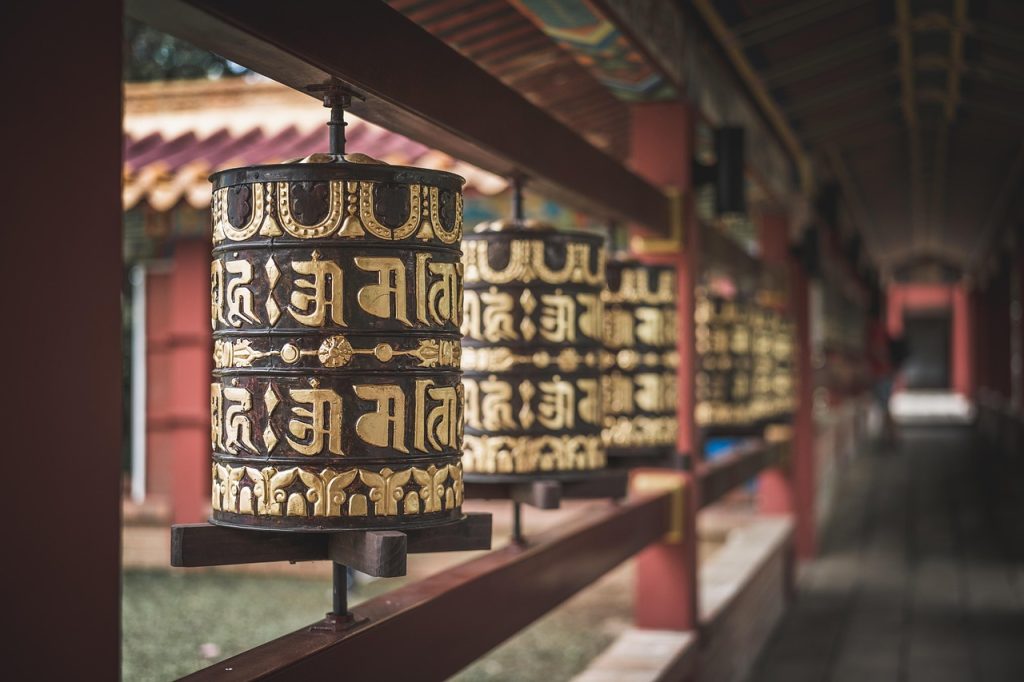
The most striking feature of the Kalmyks is their religion, for they are the one people of Europe whose traditional faith is Buddhism. They follow the Tibetan form of the religion, the same tradition found in Tibet and Mongolia, which the Oirats had adopted in their eastern homeland and carried with them on their long ride west. On the Caspian steppe, they kept this faith alive at the very edge of the Christian and Muslim worlds.
Buddhism shaped every part of Kalmyk life. Monasteries and temples, served by a large body of monks, were centres of learning, medicine, art, and authority as well as worship. The prayer wheel, the prayer flag, the chanting of sacred texts, and the veneration of the Dalai Lama and other high teachers all became part of the Kalmyk world, a piece of the Himalayan and Mongolian spiritual universe transplanted to Europe.
Alongside formal Buddhism lived older layers of belief carried from the steppe past, a world of spirits of the land, sky, and ancestors, of shamans, omens, and protective charms. As often happens, the new faith did not wholly erase the old; instead the two blended, so that Buddhist ritual and ancient steppe custom wound together into the living religion of the people.
The twentieth century brought terrible destruction to Kalmyk Buddhism, as temples were closed and demolished and monks persecuted under an official campaign against religion. Yet the faith survived in secret and in memory, and in recent decades it has undergone a powerful revival, with new temples rising in Elista and across the republic, once again making Kalmykia the Buddhist heart of Europe.
The rebuilding of the temples was more than a religious act; it was a reclaiming of identity after decades in which the state had tried to erase it. For a people who had lost so much to exile and repression, each new gilded roof rising over the steppe stood as proof that the faith carried west by their ancestors could not be destroyed.
Traditions, Epic, and Song

The Kalmyks carried a rich tradition of oral literature from their steppe past, told and sung across the generations. Greatest of all is a vast heroic epic shared across the Mongol world, a sweeping cycle of tales about a mighty ruler and his warriors, their battles, their horses, and their fabulous deeds. Reciting this epic was the work of specially trained bards, who could chant its many thousands of lines from memory.
Alongside the great epic were countless shorter tales, legends, proverbs, and riddles, a whole spoken literature that preserved the wisdom, humour, and memory of the people. Through these stories the young learned the values of the steppe, courage, loyalty, generosity, and skill, and the history of their clans and heroes was kept alive without the need for books.
Music and dance were central to Kalmyk celebration. Singers performed to the sound of traditional stringed instruments, and the Kalmyks are especially known for a vigorous, fast, and graceful style of dance in which the arms and upper body move with striking expressiveness. These dances, performed at every festival and gathering, remain one of the most vivid and beloved expressions of Kalmyk culture.
Traditional dress marked the people as distinctly Mongol amid their European surroundings. Festive costume included long robes, richly decorated for women, and distinctive hats, with ornaments of silver and coral. Woven and embroidered patterns, and the bright colours favoured for celebrations, gave Kalmyk clothing a look all its own, worn with pride at the great moments of communal life.
Crafts and the Work of the Nomads
The crafts of the Kalmyks were shaped by the nomadic life and by the materials the herds and the steppe provided. Felt, made by pounding and rolling wool, was one of the most important, used to cover the tents, to make rugs and mats, and to fashion warm clothing and boots. The making of good felt was a vital skill, and decorated felt pieces were a proud part of the household.
Leatherwork was another essential craft, for the herds gave hides in plenty. From leather the Kalmyks made harness and saddlery for their all-important horses, as well as vessels, straps, and clothing. The gear of the rider, beautifully worked and often decorated with metal fittings, reflected the central place of the horse in their world and the pride a man took in his mount.
Metalworking and silverwork produced the ornaments, jewellery, and fittings that adorned people, horses, and household goods. Silver set with coral and other stones decorated women’s costume and men’s belts and knives, while religious objects for the Buddhist shrines called forth fine work in metal and paint. The bright ritual art of the temples, with its images and banners, added another rich layer to Kalmyk craft.
Because the nomad had to carry all possessions from camp to camp, Kalmyk crafts favoured what was portable, useful, and durable, yet within these limits the people delighted in decoration and colour. Even the humblest tools and vessels might be worked with patterns, turning the practical goods of the steppe life into objects of beauty as well as use.
Food and the Table of the Steppe
The food of the Kalmyks was the food of pastoral nomads, built above all on the products of the herd: meat and milk. Mutton and lamb were the favoured meats, boiled or stewed and served in hearty portions, while beef, horse, and camel meat also had their place. Meat dishes, often simple and rich, were at the centre of the table, especially at feasts and for honoured guests.
Milk in all its forms was equally important. From the milk of their animals the Kalmyks made butter, soured milk drinks, cheeses, and other dairy foods that provided nourishment through the year. In the old days, fermented mare’s milk, the mildly alcoholic drink of the wider steppe world, was also known, a taste shared with the Mongol and Turkic nomads to the east.
The most famous Kalmyk food of all is their tea, a distinctive brew quite unlike ordinary tea. Made from pressed tea boiled with milk, salt, butter, and sometimes spices, it is a rich, savoury drink, almost a light soup, that warms and sustains against the harshness of the steppe climate. Kalmyk tea became so well known that it spread far beyond the people themselves.
A guest in a Kalmyk home is almost always met first with a bowl of this tea, offered as a sign of welcome. To share it is to be drawn, however briefly, into the warmth of the household and the long tradition of steppe hospitality that the drink embodies.
Filled dough dishes rounded out the cuisine, including boiled and steamed dumplings and pastries stuffed with meat, close cousins of similar dishes across the Mongol and Central Asian world. Simple, filling, and centred on the herd, Kalmyk food reflected a life lived on the open plain, where the animals gave nearly everything and every scrap was used with care.
Festivals and the Turning of the Year

The festivals of the Kalmyks follow the Buddhist calendar and the old rhythm of the nomadic year, blending religious observance with the celebration of the seasons. The temples mark the holy days of the Buddhist tradition with services, offerings, and gatherings, and these sacred occasions draw the community together in worship and festivity alike.
The greatest festival is the Kalmyk lunar new year, celebrated in late winter as the days begin to lengthen, a time of renewal, feasting, and the honouring of elders and ancestors. Like the new year of the wider Mongol and Buddhist world, it is marked with special foods, visits between households, blessings, and the joyful welcoming of the year to come.
Another beloved festival greets the arrival of spring and the return of warmth to the steppe, tied both to the Buddhist calendar and to the ancient joy of the nomad at the end of the hard winter. In this season the famous wild tulips carpet the plains, and the blossoming of the steppe has itself become a symbol of Kalmykia, celebrated as one of the natural wonders of the land.
Through all the festivals run the arts the Kalmyks love best: the fast, expressive dances, the songs and epic recitations, the horse games and displays of riding skill, and the sharing of meat, tea, and hospitality. In these gatherings the people renew their bonds of clan and community and reaffirm the double heritage, Buddhist and nomadic, that makes them unique in Europe.
History under the Russian State and a Great Tragedy

The relationship between the Kalmyks and Russia began as one between two powers, the nomad khanate and the expanding tsarist state, sometimes allied and sometimes at odds. Kalmyk cavalry served the tsars in many wars, while the Russian government steadily extended its influence over the khanate, limiting the power of the khans and drawing the steppe into its administration.
In the eighteenth century, chafing under growing Russian control, a large part of the Kalmyks made a fateful decision: to abandon the Volga and return east toward their ancestral lands. This great departure ended in disaster, as huge numbers died on the terrible journey across the winter steppe under attack from enemies along the way. Those who remained on the Volga became the ancestors of the modern Kalmyks, and the khanate itself was soon abolished.
The twentieth century brought the Kalmyks both a homeland and a catastrophe. An autonomous region was created for them under the Soviet order, giving their nation official form, but religion was crushed and the temples destroyed. Then, during the Second World War, the entire Kalmyk people were accused of disloyalty and deported en masse to Siberia and Central Asia, a brutal exile in which a great part of the nation perished from cold, hunger, and disease.
Only years later were the surviving Kalmyks allowed to return to their homeland and their republic restored. This deportation remains the central tragedy of their modern history, a wound that shaped the memory of every family. That the Kalmyks came back, rebuilt their republic, and revived their faith and culture is a testament to the endurance of a people who had already crossed a continent to reach their home.
The Kalmyks Today

Today the Kalmyks live mainly in the Republic of Kalmykia, with its capital at Elista, together with communities elsewhere in Russia and a scattering abroad. They number some official hundreds of thousands within their republic and beyond, a small nation that has survived migration, exile, and persecution to remain rooted on the European steppe, still proudly distinct in faith and heritage.
The revival of Buddhism has been one of the great themes of recent Kalmyk life. New temples, including one of the largest in Europe, have risen in Elista and across the republic, monks have been trained, and ties renewed with the wider Buddhist world. After the near-destruction of the twentieth century, the faith that the Oirats carried west has been restored to a central place in Kalmyk identity.
As with many smaller peoples of Russia, the Kalmyk language faces serious challenges, spoken fluently by fewer of the young than in the past and under constant pressure from Russian. Efforts to teach and revive it, along with the songs, dances, epic, and crafts of the people, are a major focus of cultural life, supported by schools, ensembles, and dedicated activists.
The story of the Kalmyks is among the most remarkable of all the peoples of Russia: a Mongol nation that rode across a continent, planted Buddhism on the shores of the Caspian, and endured a terrible exile to survive as the one Buddhist people of Europe. From this sunlit steppe of tulips and temples, our Folks journey rides on toward the next of the many nations who share the vast lands of Russia.