
Kula is one of the poetic districts of the Aegean, giving the impression that time has stopped with its architectural, ethnographic, archaeological, historical and visual values. The fact that primitive people’s footprints were found in Divlit near the Demir Köprü dam within the border of Katekekaumene (Yanık region) during the excavations in the region is proof that primitive people lived in this region. In addition, in the excavations carried out in B.C.
Marble reliefs and inscriptions dating back to 56 BC reveal that Kula and its surroundings were an important settlement area.
Meonya (Menye), which was founded around Kula in ancient times, was a settlement area between Mysien and Lydia, and the road passing through here started from Sardes-Salihli and passed through Menye-Sandal-Gölde. The settlement in Kula developed over time as a result of the loss of importance of the surrounding settlements. It is understood from the documents that Kula took its name from KULE, which means bastion.
Although many researchers have investigated the name of Kula, no definitive conclusion has been reached. According to a rumor, it is said that a rich person had a tower built here for his sick daughter because the air and water were good and healing, and this place developed over time and reached its current state.
While Kula was under the control of the Byzantines, its name was Opsikion. We understand this from the fact that it formed a diocese together with Maionia (menye), 20 km west of Kula. Kula fell into the hands of the Turks. After the Battle of Manzikert in 1071, in the second half of the 11th century, 1075-1076, it was observed that the Turkmen tribes spread to Kula and its surroundings in a short time. During the time of the Anatolian Seljuk Ruler Alaettin Keykubat, Kula and its surroundings were completely taken over by the Turks. 1233
During the marriage of Devlet Hatun, the daughter of Süleyman Şah, the bey of Kula Germiyan, who was affiliated with the Germiyanoğulları principality during the Kula Anatolian principalities, with Yıldırım Beyazıt, the son of the Ottoman sultan Murat I, in 1381, she gave Kütahya and its surroundings, which belonged to the principality, to the Ottomans as a dowry, and Süleyman Şah retreated to Kula, made it the capital and lived here, during the reign of Süleyman Shah. It is observed that construction and cultural activities are increasing in Kula.
Gürhane Madrasa can be cited among these. Kula, which came under the rule of the Ottomans after the death of Süleyman Shah, was transferred to the Germiyanoğulları principality as a result of the former lands of the Anatolian Principalities being given to them by Timur in 1402. However, after a while, after the death of Germiyanoğlu Bey Yakup Bey in 1428, it came under the Ottoman administration again and joined the Ottoman administration as a district of Kütahya Province.
It remained connected to Kütahya until 1896, and after this date it was connected to Manisa.
PRIMITIVE FOOTPRINTS:
In the Kula region, which was named Katakekaumene (Yanık Region) by the famous historian Strabo and where the youngest volcano cones and lava flows of Asia Minor are located, he traveled around the region 2000 years ago; Primitive human footprints have been found. Primitive human footprints can be seen next to the Divlit Tepe cone, one of the 68 volcano cones in the region.
In addition to primitive human footprints, animal footprints, traces of loads carried by primitive people and traces of primitive people sitting on the ground are also found here. The length of the steps of the primitive people whose footprints were found was 75-80 cm. is up to Fossil primitive human footprints are 41-42 shoe sizes in size. Two of the tracks belong to two primitive people who walked side by side. They walked down the hill.
There is also a trace of a small child, who walked in the opposite direction towards the hill. After the traces were formed, basaltic slags emerged from the Divlit Hill volcano and created a cover over them, ensuring their protection; It is used in briquette production and construction works.
In 1968, when this cover layer was excavated from the field with a bulldozer, footprints were revealed.
Staff from the General Directorate of Mineral Research and Exploration realized that these footprints, which were sometimes removed from the field and smuggled abroad to museums, and sometimes taken to houses as souvenirs by the surrounding villages, could not be preserved in the field for a long time, and removed approximately 60 of them; They were transported and exhibited by the same general directorate (to the Natural History Museum).
Samples taken from volcanic lava near primitive human footprints were determined to be 20,000 years old in laboratory age measurements. Considering that the measurements have a margin of error of ± 5,000 years at most, it turns out that these traces are at most 25,000 years old and the newest is 15,000 years old.
Strabon also reported, as a result of his research 2,000 years ago, that the volcanoes in the Kula region began to erupt 15-16 thousand years ago and continued to burn for 2,000 years.
These traces seen near the Divlit Hill cone show us that primitive people of the Old Stone Age lived within the borders of Katakekaumene (Kula and its surroundings). Since it is known that primitive people lived in flocks in caves and tree holes in this period, and considering the suitability of Yanık Region for this environment, it should not be considered a prophecy to say that these were the living areas of primitive human communities.
Primitive human footprints are located near the Divlit Tepe cone, one of the volcano cones belonging to the 3rd and newest volcanic period. Approximately 2,000 years ago, the Divlit Hill cone first emitted fine-grained ash and tuffs and then went into a period of silence and extinguished. These fine-grained volcanic products scattered into the environment later turned into a thick layer of mud under the influence of rain.
Meanwhile, the primitive people living in the region walked barefoot on this mud by a very beautiful coincidence. Shortly after, the volcano became active again, and this time the black colored basaltic slag it ejected covered the footprints on the mud, creating a cover approximately 5-10 meters thick, ensuring the preservation of these valuable traces until today.
As a result of the research, it was understood that primitive people lived around Kula, as well as Antalya, Isparta, Samsun, Burdur, Gaziantep regions. As a result of the research conducted in Kula, B.C. Marble reliefs and inscriptions indicating the year 56 were found. The following is written on one of these reliefs:
Abdi Mamluk, who created a prayer specific to Güneş Platez, Mentlamus and King Men, commands to recite this prayer in order to introduce the majesty and power of “Demas, Jupiter”. The emir in this relief, depicting the god “Lunus” or Men, dates back to 256 BC, according to the Suluktler. It shows the year 56.
B.C. The fact that a few coins were found that were minted in the 1st century and introduced Kula to neighboring countries confirms the above date. Thus, Kula’s M.O. It is understood that it existed in the L. century. In ancient times, Kula was a part of Meonya (Menye). Meonya occupied a place between Mysien and Lydia.
An important traffic route since ancient times; Sardes would start from Salihli and pass through Menye-Sandal-Gölde, go to Gediz and then upwards, towards Uşak. The capital, Maionia, was located on the site of present-day Menye. It shows that Kula and its surroundings are a very old settlement area and have been the scene of many historical events.
Grave ruins and brick fragments seen in the Musalca location of Kula are signs of the existence of an ancient Lydian city here.
Apart from our country, there are primitive human fossil footprints in four places in the world: France, Italy and Hungary. In order to protect these valuable footprints near the Divlit hill volcano cone, they were declared a protected area by the Turkish Historical Society, General Directorate of Antiquities, and all kinds of activities were banned.
To go to Kula, located on the Izmir-Ankara E 23 highway, you can take the buses going from Ankara to Izmir or from Izmir to Ankara. Manisa – Kula is 124 km, Izmir – Kula is 120 km. If you want to come to Kula from Manisa, you need to take the Turgutlu-Salihli buses or Manisa-Salihli buses, which depart from Manisa Garage every 20 minutes, and transfer from there to Kula.
Kula minibuses operate between Kula and Salihli. Minibuses are available every 15 minutes.
According to the information of Manisa Museum Directorate officials, its history predates the city of Sardes. As evidence of this, findings and gravestones found in the region are used, based on the information of Manisa museum officials.
You May Like
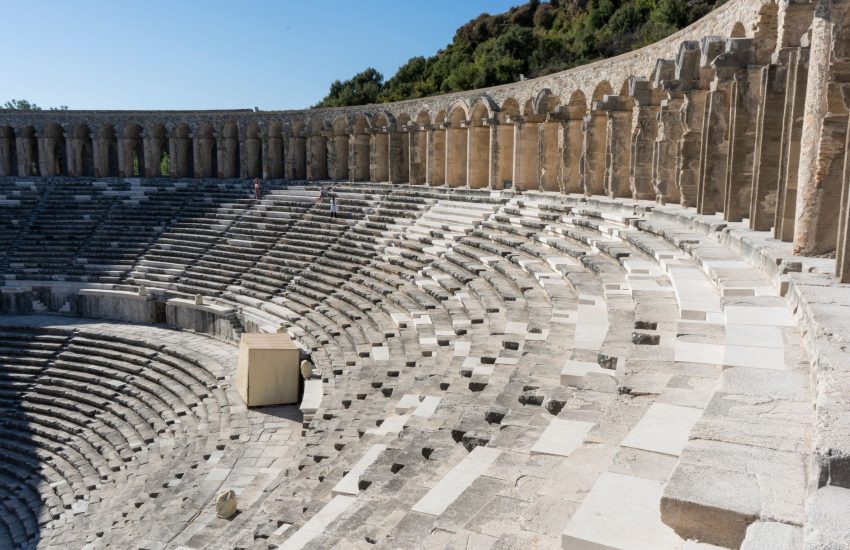
Aspendos Ancient Theater Travel Guide