Ghost Town Kayakoy
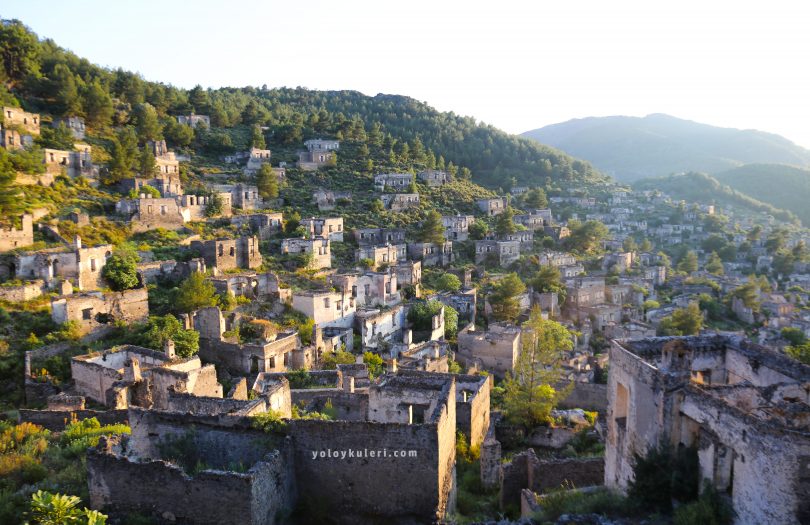
Kayaköy is among the most interesting tourism centers in our country with its architectural structure, narrow streets and churches. The village continues its loneliness by sharing the “Fireflies” at night and the symbol of the village “Blue Crow” during the day.
Kayaköy, where Turks and Greeks once lived together, is a settlement spread over the slope of a 65-meter-high hill between Fethiye and Ölüdeniz and the plain called “Kaya Pit” in front of it. Studies show that Kayaköy was founded on ancient Karmillassos. The rock tombs in the mountains of Antikragos have survived until today. Kayaköy was founded on the remains of the Lycian civilization by the Greeks living in the region in the 11th century according to some sources and in the 14th century according to some sources. Kayaköy, which is also mentioned in Evliya Çelebi’s travel book and is called Levissi in Greek, continued its life as a rich city until the beginning of the 20th century. The village, which has a population of 6,500 people, has become the largest social and commercial center of the region with its churches, pharmacy, hospital and physicians, schools, post office and craft workshops. In the village, where there is also a printing house, the only newspaper of the region has started to be published.
1922 Year in Turkey and Greece signed between the governments of “exchange agreement” in accordance with the Turks living in Western Thrace and Greeks living in Kayaköy were forced to migrate as a mutual. Turks who came to the region settled in the plain in front of Kayaköy and other cities instead of the houses on the slope because they could not adapt to the environment and living conditions.
The “Panayia Pirgietissa” church in the lower quarter of the city and the “Taksiyarhis” church in the upper neighborhood are among the important architectural examples that survive. On the other hand, as about 2 thousand stone houses, chapels, various workshops, schools, hospital buildings, libraries and other purpose buildings could not resist physical conditions, the village took on the appearance of a ghost. However, the stone walls of almost all houses, corner hearths, quarries, spiral toilets, cisterns, pebble pavements, stone roads, streets and squares still show the cultural richness of the city.
You May Like
Aspendos Ancient Theater Travel Guide