High on a hill above the old city of Hyderabad, in southern India, stands a palace whose very name means Mirror of the Sky. Falaknuma Palace seems to float above the crowded streets below, a vision of white stone, Italianate arches, and shaded terraces looking out over one of India’s great cities. It was built by a nobleman, coveted by a king, and filled with such treasures that it became a byword for the almost unimaginable wealth of the princely state of Hyderabad.
For Hyderabad was ruled by the Nizams, a dynasty so rich that one of them was reckoned, in his day, among the wealthiest people on earth. Falaknuma became one of their palaces, a place to house royal guests and to display the splendour of a court awash in jewels, gold, and jade. Its dining hall holds what is said to be the longest table in the world; its staircase is guarded by marble figures; its rooms glitter with chandeliers gathered from across Europe.
After the age of the Nizams passed, the palace slipped into neglect, its treasures shadowed by dust, until a great restoration brought it back to life as one of the most extraordinary luxury hotels in the world. To arrive today, drawn up the hill in a horse-drawn carriage and showered with rose petals, is to step into the vanished world of the Nizams. In the sections that follow you will get to know the palace, its builders, its royal owners, and the fabulous wealth it still evokes.

In This Article
- The Mirror of the Sky
- The Nobleman Who Built It
- A Palace Shaped Like a Scorpion
- How the Nizam Came to Own It
- The Fabulous Wealth of the Nizams
- European Grandeur in the Deccan
- The Marble Staircase and Its Silent Watchers
- The Longest Dining Table in the World
- Chandeliers, Jade, and a Library Fit for a King
- Years of Silence
- A Palace Reborn as a Grand Hotel
- The Palace on Film
- Visiting Falaknuma Today
The Mirror of the Sky
Falaknuma Palace occupies one of the finest positions in Hyderabad, set high on a hill so that it commands sweeping views over the city spread out below. The name, drawn from Urdu and Persian, is often translated as Mirror of the Sky or Like the Sky, and standing on its terraces, with the clouds seemingly close overhead and the city far beneath, you understand at once how it earned so poetic a title.

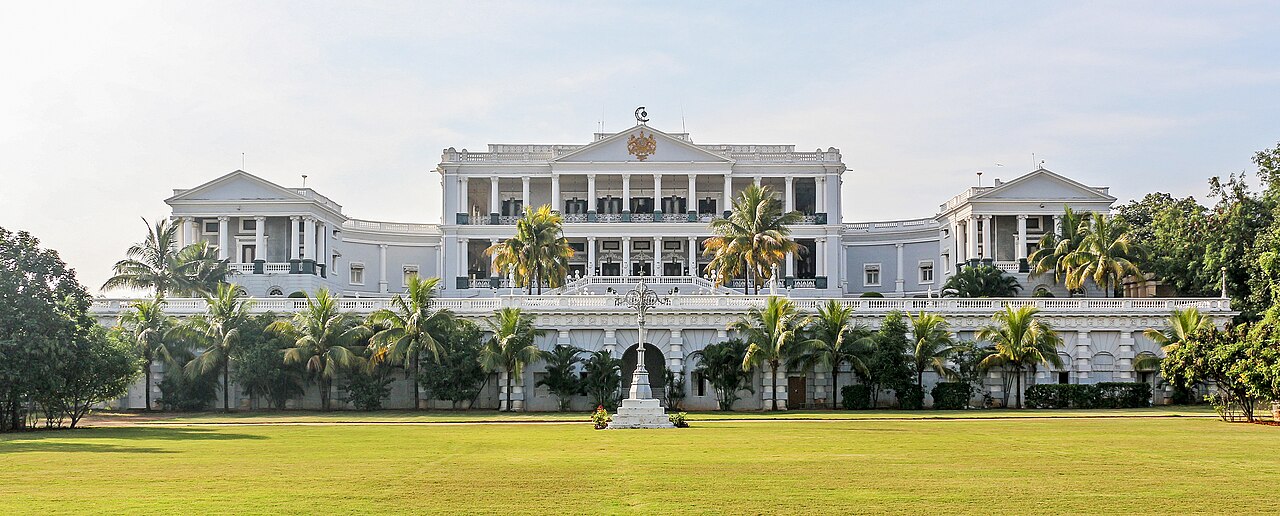
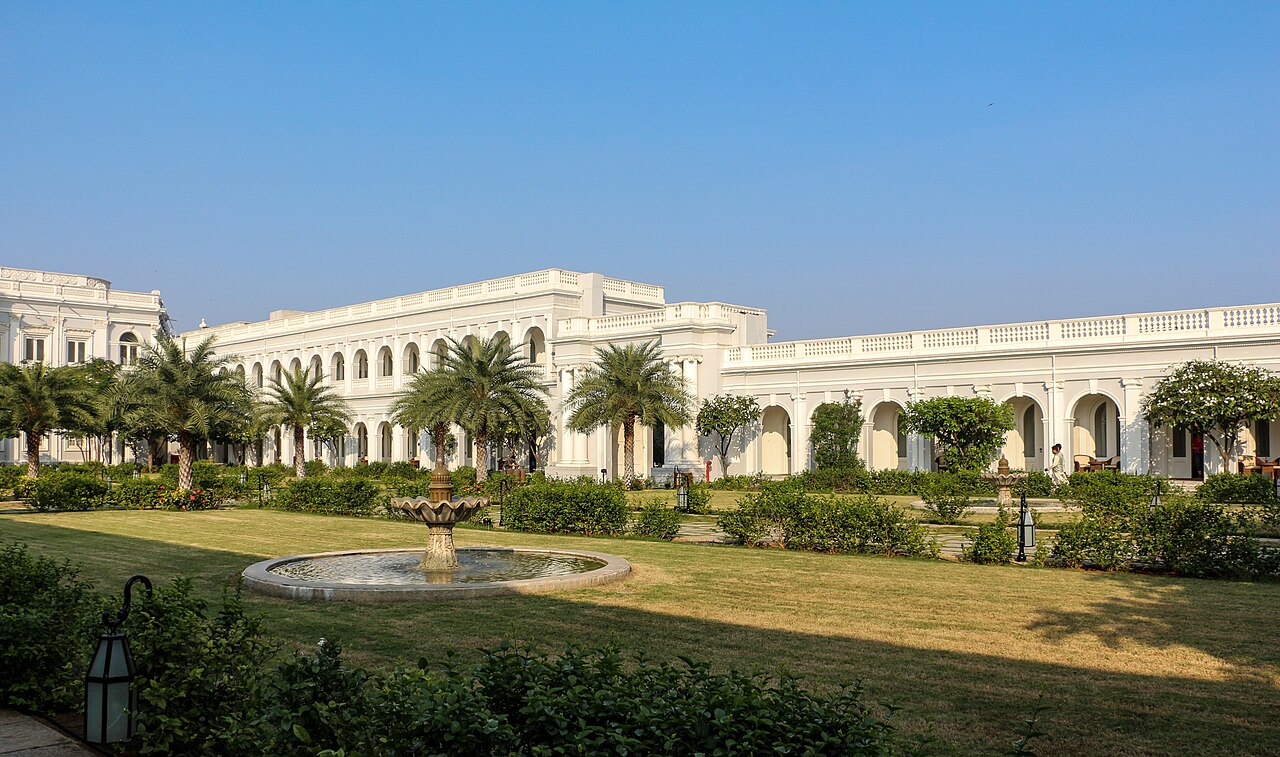
The palace presents itself as a long, elegant building of white stone, its facades marked by Italianate arches, columns, and porticoes, its rooflines and terraces designed to catch the light and the breeze. It has the air less of a fortress than of a grand European villa transported to the Deccan, a place built for beauty, comfort, and display rather than for defence, reflecting the confidence of the wealthy world that made it.
To reach it, visitors traditionally ascend the hill and arrive at the palace much as royal guests once did, and the sense of rising above the ordinary city toward a place set apart is part of the experience. The approach, the gates, the gardens, and the first sight of the white facade all serve to build anticipation, preparing the visitor for the splendour within.
From its terraces the whole story of Hyderabad seems laid out below: the old city, the domes and minarets, the sprawl of a great southern metropolis. The palace was built to look out over all this, a private eyrie for the powerful and the rich, and that commanding relationship with the city remains one of the most memorable things about it. Falaknuma truly does seem to hold up a mirror between the earth and the sky.
There is a reason the palace was set so high. In the days before it was built, the hill was prized precisely for its air and its outlook, a place to escape the heat and press of the old city, and Falaknuma made the most of every advantage the site offered, turning a commanding hill into the pedestal for a jewel.
The Nobleman Who Built It
Falaknuma was not built by the Nizam himself but by one of the great nobles of his court, a member of the illustrious Paigah family, which stood at the very summit of Hyderabad’s aristocracy. The Paigahs were nobles of enormous wealth and prestige, closely tied to the ruling dynasty by marriage and service, and they maintained their own palaces, estates, and even military forces in the service of the Nizam.
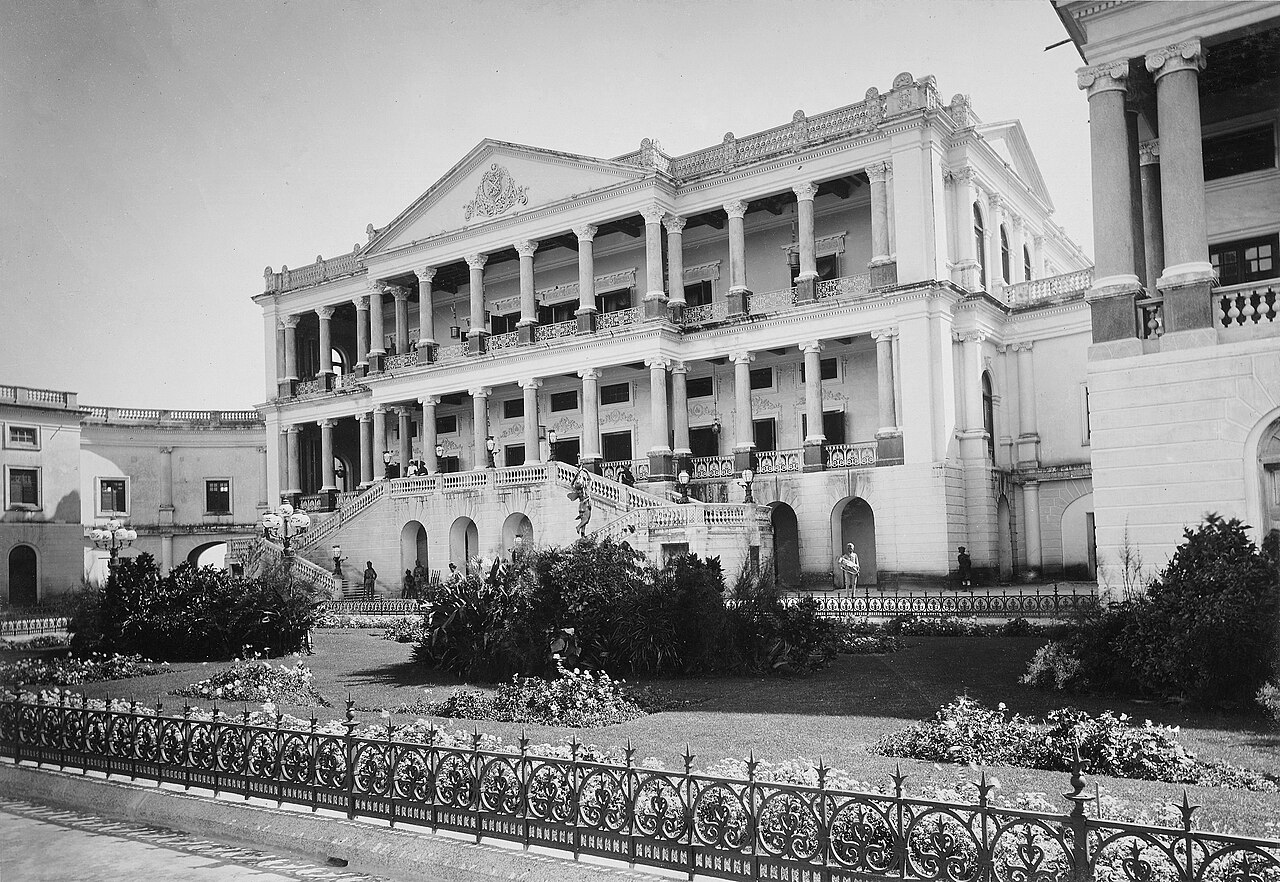
The builder of Falaknuma was a leading figure of this family, a nobleman who served as prime minister of the state and who set out to create a palace worthy of his rank and his cultivated tastes. He conceived a residence that would combine the latest European fashions in architecture and comfort with the grandeur expected of Hyderabad’s highest nobility, sparing no expense in its construction and furnishing.
The project was a labour of years and of vast sums, as the finest materials and craftsmanship were brought together to realise the vision. The result was a palace that outshone many royal residences, so splendid that it would eventually draw the attention, and the desire, of the ruler himself. In building it, the nobleman created not merely a home but one of the wonders of the princely world.
That so magnificent a palace should have been built by a courtier rather than the sovereign says much about the wealth and standing of Hyderabad’s great families. The Paigahs and their peers lived on a scale that rivalled kings, and Falaknuma is among the most dazzling monuments to that aristocratic splendour, the creation of a nobleman with the means and the taste to build like royalty.
The builder did not, in the end, enjoy his creation for long, and the palace soon passed into other hands, a turn of fortune that only adds to its romance.
A Palace Shaped Like a Scorpion
One of the most intriguing facts about Falaknuma is the shape of its plan. The palace was laid out, famously, in the form of a scorpion, with the main building as the body and two long wings stretching out like the creature’s outspread pincers, an unusual and deliberate design that gives the complex its distinctive footprint. It is a plan best appreciated from above, and one that has fascinated visitors ever since.
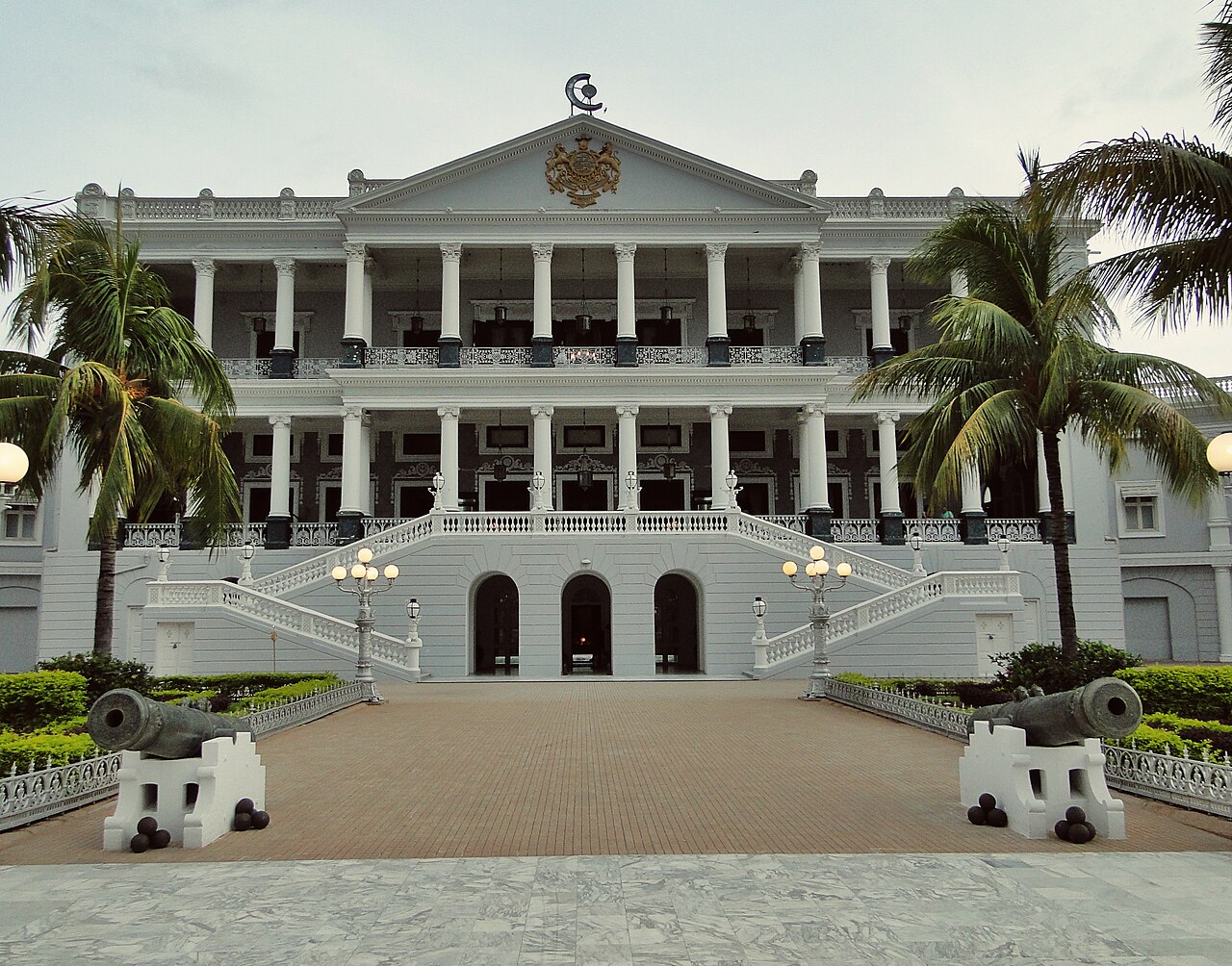
The palace was built over the closing years of the nineteenth century, taking the better part of a decade to complete, and its construction drew on European design and expertise, blended with local craftsmanship and materials. Italian marble, fine stone, and the best available materials were used throughout, and the building rose in a style that fused Italian and other European influences into a coherent and luxurious whole.
The scorpion plan was not merely a whim; it allowed the wings to house different functions and to provide the long ranges of rooms a great palace required, while giving the whole a striking and memorable form. The two outstretched wings frame courtyards and gardens, and the arrangement helped bring light and air into the many rooms of a building designed for the comfort of its occupants in the warm southern climate.
Whatever the practical logic, the scorpion shape has become part of the palace’s legend, one of those distinctive details that fix a building in the imagination. Together with its hilltop setting and its glittering interiors, the unusual plan helps make Falaknuma one of the most individual of India’s great palaces, a place that is as intriguing in its conception as it is dazzling in its detail.
Seen from the air, the resemblance is unmistakable, and it has made Falaknuma a favourite subject for those who love the curiosities of architecture. Whether the shape was chosen for symbolic reasons or simply grew from the practical arrangement of the wings, it lends the palace a mystery that suits its hilltop drama.
How the Nizam Came to Own It
The story of how Falaknuma passed from its noble builder to the Nizam of Hyderabad is one of the palace’s most famous tales. According to the enduring account, the reigning Nizam was so taken with the palace, and enjoyed a stay there so much, that the building came into royal hands, its owner effectively presenting or ceding it to his sovereign, so that the courtier’s masterpiece became a possession of the crown.

Whatever the precise details, the palace became a royal residence and, above all, a royal guest house, the place where the Nizam lodged his most distinguished visitors. Its incomparable luxury made it the ideal setting to impress the guests of the state, from Indian royalty to visiting dignitaries from around the world, who were housed amid its treasures and entertained at its famous table.
To be received at Falaknuma was to experience the hospitality of one of the richest courts on earth at its most lavish. The palace’s role as a guest house meant that its splendour was deployed in the service of the Nizam’s prestige, a showcase of Hyderabad’s wealth and refinement designed to leave every visitor in no doubt of the grandeur of the state and its ruler.
This transformation, from a nobleman’s private dream into a royal palace of hospitality, gave Falaknuma its place at the very centre of Hyderabad’s courtly life. It became bound up with the image of the Nizams themselves, and the treasures gathered within it, the chandeliers, the jade, the great dining table, all served the single purpose of expressing the almost limitless wealth and dignity of the rulers of Hyderabad.
The Fabulous Wealth of the Nizams
To understand Falaknuma, you must grasp the extraordinary wealth of the dynasty that came to own it. The Nizams ruled Hyderabad, one of the largest and richest of the princely states of India, and their fortune was the stuff of legend. One of them was reputed, in his time, to be among the richest people in the entire world, his treasuries overflowing with gold, jewels, and precious stones.
The wealth of Hyderabad rested on a large and prosperous state, and above all on its association with fabulous treasures, including some of the most famous diamonds and jewels in history. Stories abounded of the Nizam’s riches: of gems used as paperweights, of trucks and rooms filled with treasure, of a private hoard so vast that its full extent was never really known. Some of these tales were exaggerated, but the underlying reality was staggering enough.
This immense wealth found expression in palaces, jewels, and a court of great splendour, and Falaknuma was one of its jewels. The treasures gathered in the palace, the imported chandeliers, the collections of jade and crystal, the gold and silver furnishings, were the natural adornments of a dynasty for whom such luxury was simply the appropriate expression of their standing in the world.
The Nizams’ wealth also carried a certain poignancy, for it belonged to an age that was passing. When the princely states were absorbed into independent India in the middle of the twentieth century, the political power of such rulers came to an end, and though great fortunes lingered, the world of unchallenged princely splendour that Falaknuma embodied was drawing to a close. The palace stands as one of its most glittering monuments.
Perhaps the most famous emblem of this wealth was the association of the Nizams with legendary diamonds, including stones counted among the greatest ever found. Whether or not every story of gems used as trinkets is literally true, the reputation itself tells you how the Nizams were seen by the world: as rulers whose riches lay almost beyond counting, in a state whose name was a synonym for treasure.
European Grandeur in the Deccan
Architecturally, Falaknuma is a confident exercise in European styles adapted to an Indian setting and climate. Its design draws on Italian and other Western influences, with classical arches, columns, and porticoes, grand staircases, and a general air of a great European palace or villa, executed in gleaming white stone and marble that give it a bright, airy elegance.
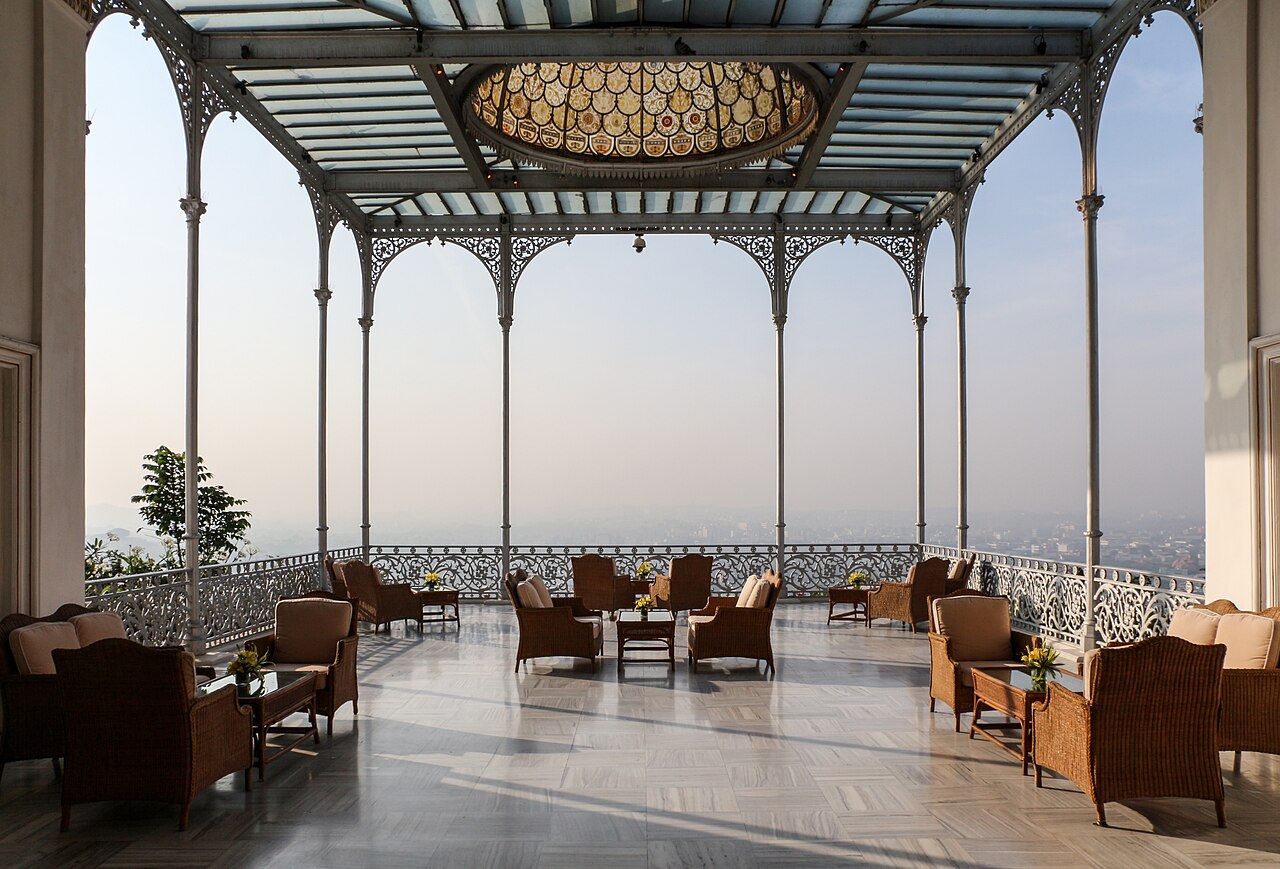
Yet the palace is thoroughly at home on its Deccan hilltop. Its terraces, courtyards, and shaded arcades are well suited to the warm climate, and the whole is arranged to make the most of its commanding views and the movement of air. The blend of European grandeur with sensitivity to its setting is characteristic of the cosmopolitan tastes of Hyderabad’s elite, who looked outward to the wider world while remaining rooted in their own.
Inside, the European character continues in the arrangement and decoration of the rooms, from state and reception halls to private apartments, many of them richly ornamented with fine plasterwork, painted and frescoed ceilings, and imported fittings. The interiors were designed to impress and to comfort, combining the formality of a palace with the refinements of a luxurious modern residence of its day.
The overall effect is of a building that belongs to the confident, cosmopolitan world of the late nineteenth century, when the wealthy of India, like the wealthy everywhere, embraced European fashions in architecture and decoration. Falaknuma is one of the finest expressions of that taste in India, a palace where the grandeur of Europe was recreated on an Indian hilltop and filled with treasures worthy of a king.
The Marble Staircase and Its Silent Watchers
Among the most celebrated features of the palace is its grand marble staircase, a sweeping ascent of gleaming white stone that is one of the great set pieces of Falaknuma. Rising in graceful flights, balustraded and immaculate, the staircase forms the ceremonial heart of the entrance, drawing visitors upward into the splendour of the state rooms above.

What makes the staircase unforgettable is the company that lines it. Along its course stand marble statues and, famously, figures that seem to watch over those who climb, so that the ascent becomes a kind of procession attended by silent stone companions. The effect is at once grand and slightly theatrical, exactly the sort of dramatic flourish that a palace built to dazzle its guests required.
The use of fine marble throughout this part of the palace speaks of the resources poured into its construction. Imported and worked at great expense, the marble gives the entrance and staircase a cool, luminous quality, a sense of stepping into a realm of purity and light after the heat and colour of the city below. It is a deliberate piece of theatre, staged to overwhelm arriving guests.
For today’s visitors, the marble staircase remains one of the highlights of Falaknuma, a favourite subject for photographs and a vivid reminder of the palace’s purpose as a stage for grand hospitality. To ascend it is to follow in the footsteps of the royal guests of the Nizams, drawn upward into a world of chandeliers, frescoes, and treasures, past the silent marble watchers who have guarded the way for well over a century.
It is the kind of set piece that fixes itself in the memory, so that visitors who recall little else of the palace remember the long white ascent and its silent marble attendants.
The Longest Dining Table in the World
If Falaknuma is famous for one thing above all, it is its dining hall, home to what is celebrated as the longest dining table in the world. This vast table, seating scores of guests along its enormous length, is one of the palace’s signature marvels, a piece of furniture that has become legendary in its own right and that captures the sheer scale of hospitality the Nizams could command.
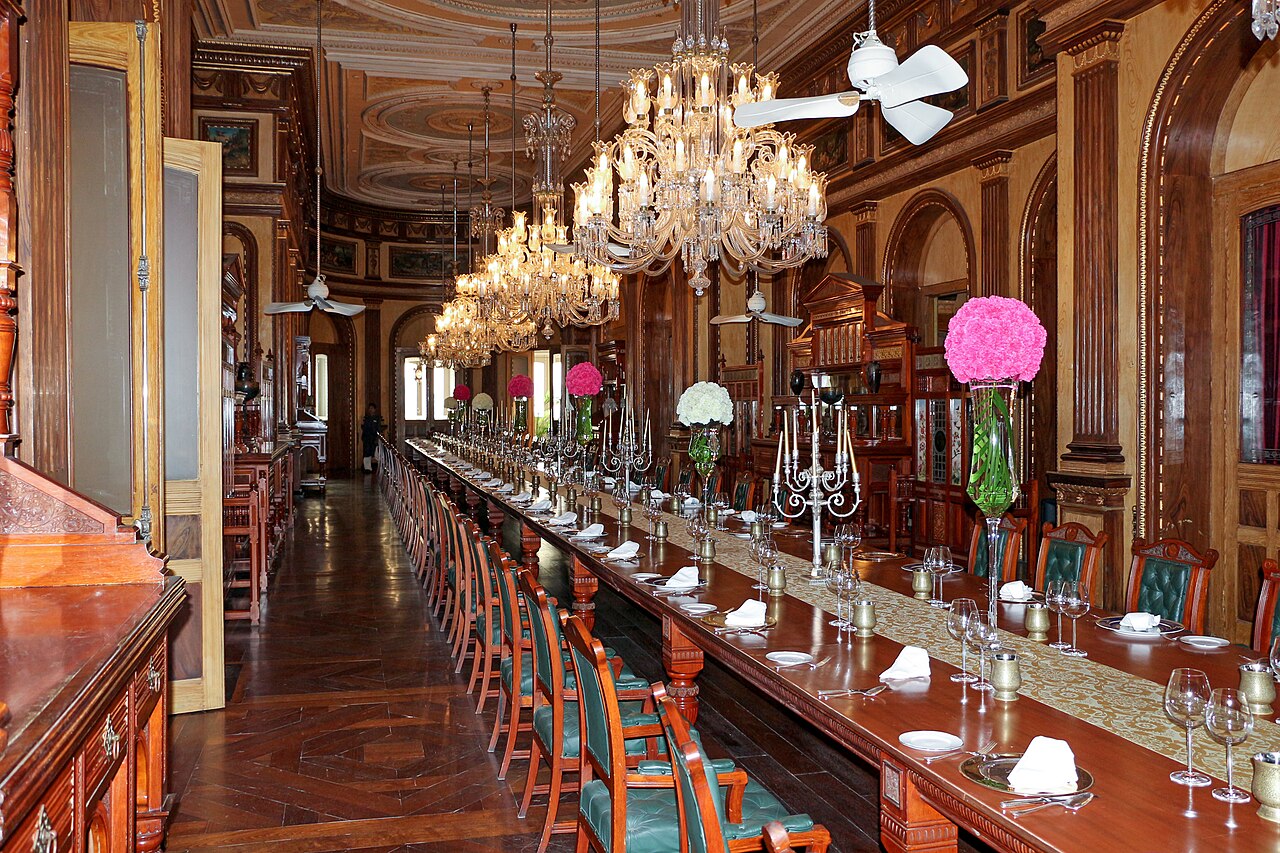
Seating on the order of a hundred people or more, the great table stretches down a long and richly appointed hall, and it was here that the most important banquets of the palace were held. Every detail of these feasts was calibrated for magnificence, from the finest tableware to the ceremony of the service, and to dine at the Nizam’s table was to experience luxury on a truly royal scale.
The table is more than a curiosity; it is a symbol of the palace’s role as a place of grand entertainment. The Nizams and their noble predecessors used Falaknuma to host and impress, and the ability to seat so many distinguished guests at a single magnificent table was a powerful statement of wealth, organisation, and hospitality, a theatre of dining unmatched almost anywhere.
For visitors today, the great dining hall and its table remain among the most impressive sights of the palace. Standing at one end and looking down the seemingly endless expanse of polished wood, set beneath fine ceilings and lit by chandeliers, you grasp immediately the scale on which the Nizams entertained, and understand why the longest dining table in the world has become one of the enduring legends of Falaknuma.
Guides delight in the details of how such a table was managed, from the discreet system used to signal the kitchens to the precise choreography of the servants who attended each guest. Dining here was not merely a meal but a performance, and the sheer logistics of feeding so many in such style were themselves part of the spectacle the Nizams offered their guests.
Chandeliers, Jade, and a Library Fit for a King
Beyond its architecture, Falaknuma is famous for the treasures that fill it, and chief among them are its chandeliers. The palace is renowned for a remarkable collection of chandeliers, gathered from Europe and hung throughout its grand rooms, so that its ceilings glitter with cascades of crystal and glass. In the great halls, these chandeliers create an atmosphere of dazzling, glittering luxury.

The palace also housed rich collections of other treasures, from jade and crystal to fine furnishings, paintings, and objets d’art, reflecting the refined and acquisitive tastes of its owners. The Nizams and the nobles who preceded them gathered beautiful things from around the world, and Falaknuma became a showcase for this accumulated wealth of art and craftsmanship.
Among the most admired rooms is the library, a magnificent chamber said to have been modelled on the great library of a famous castle, with fine woodwork, galleries, and shelves of precious books. It speaks of the cultivated side of the palace’s owners, for whom learning and the possession of a great library were as much marks of status as jewels and gold, and it remains one of Falaknuma’s most beautiful spaces.
Together these treasures made Falaknuma not just a palace but a repository of luxury and culture, a place where the visitor moved from one dazzling room to the next amid chandeliers, jade, books, and art. Much care has gone into preserving and restoring these interiors, so that the modern visitor can still experience something of the overwhelming richness that once greeted the royal guests of the Nizams.
Wandering from room to room, the visitor is struck less by any single object than by the cumulative effect of so much beauty gathered in one place. It is the density of splendour, chandelier after chandelier, treasure after treasure, that overwhelms, exactly as it was meant to.
Years of Silence
The glittering life of Falaknuma could not last forever. With the great political changes of the middle of the twentieth century, when the princely states were merged into independent India and the power of rulers like the Nizams came to an end, the world that had sustained such palaces began to fade. Falaknuma, no longer needed as a royal guest house, gradually fell quiet.
For a long period the palace stood little used, its grand rooms shuttered, its treasures shadowed, and its fabric slowly suffering the effects of time and neglect. The fate was a common one for the great palaces of the princely era, many of which found themselves without a role in the new India and struggled to survive the loss of the wealth and purpose that had created them.
Yet Falaknuma was too magnificent to be forgotten. Even in its years of silence it retained its treasures and its extraordinary character, waiting, in effect, for a new purpose that could justify the enormous cost of its upkeep and restoration. The challenge was to find a way to bring so vast and luxurious a palace back to life in a changed world.
That period of decline, though sad, was not the end of the story. It set the stage for one of the great palace restorations of modern India, a revival that would return Falaknuma to something like its former glory and open its doors, for the first time, to guests who were not the personal invitees of a Nizam. The silence, in the end, was only an interlude.
It is sobering to think how close such a place can come to being lost, and how much depends, in the end, on someone deciding that beauty on this scale is worth the enormous effort of saving.
A Palace Reborn as a Grand Hotel
Falaknuma’s revival came through a great restoration that transformed the neglected palace into one of the most spectacular luxury hotels in the world. The project, undertaken with enormous care over many years and associated with a leading Indian hotel group and with a member of the Nizam’s family who championed the work, sought to bring the palace back to its original splendour while adapting it for its new life.

The restoration was painstaking, addressing everything from the fabric of the building to the priceless furnishings, chandeliers, frescoes, and fittings, with specialists labouring to clean, repair, and revive the interiors. The aim was not to modernise the palace out of recognition but to recover its historic magnificence, so that guests could experience it much as the royal visitors of the Nizams once had.
Today Falaknuma operates as a heritage hotel, and to stay there is to be treated, however briefly, as a guest of the Nizams. Visitors are traditionally welcomed with royal flourishes, drawn up to the palace and received amid the splendour of its halls, dining beneath its chandeliers and sleeping in its restored apartments. The palace has found, in luxury hospitality, a role that fits its original purpose remarkably well.
This rebirth has ensured the survival of one of India’s great palaces. Rather than crumbling into ruin, Falaknuma has been given a future, its treasures preserved and its rooms alive once more with guests and ceremony. The restoration stands as a model of how a great historic palace can be saved by finding it a new purpose worthy of its magnificence, keeping the world of the Nizams alive for new generations to experience.
The care taken extended to the smallest things, down to the cleaning of thousands of pieces of crystal and the revival of frescoes and fabrics that had faded in the long years of disuse. It was less a renovation than a resurrection, and the result is that a palace which might easily have been lost instead shines again, as complete and as dazzling as memory and craftsmanship could make it.
The Palace on Film
The splendour of Falaknuma, its glittering chandeliers, its endless dining table, its marble staircase, and its hilltop views, is best appreciated in motion, and the short film below offers a tour that brings the palace and its story to life. Watching it alongside the images in this article helps convey the atmosphere of a place built to overwhelm the senses.

If you are considering a visit to Hyderabad, or dreaming of a stay at the palace, a video like this is a fine way to prepare, letting you recognise the great rooms and treasures and understand the history of the Nizams and the nobles who created Falaknuma. It sets the palace in the context of Hyderabad’s fabulous wealth and courtly splendour.
And if a visit lies beyond your plans for now, the film lets you tour the Mirror of the Sky from afar. Let it play, and picture yourself ascending the marble staircase, dining beneath the chandeliers, and looking out over Hyderabad from the terraces of one of the most magnificent palaces of the princely age.
Visiting Falaknuma Today
For travellers to Hyderabad, Falaknuma Palace is one of the great sights of the city, though experiencing it fully is bound up with its life as a luxury hotel. Guests who stay at the palace enjoy its restored rooms and its royal hospitality, while others may be able to visit certain parts, dine, or take a tour, depending on the arrangements in place, so it is worth checking current options in advance.

However you come to it, the palace rewards attention to its highlights: the grand marble staircase with its statues, the world-famous dining hall and its enormous table, the glittering chandeliers, the beautiful library, and the sweeping views over the city from its hilltop terraces. Each of these captures a different facet of the extraordinary world the Nizams inhabited.
Because Falaknuma is a working luxury hotel occupying a priceless historic palace, visitors should treat it with the appropriate respect, following the guidance of the staff and appreciating that they are moving through a carefully preserved treasure. The sense of stepping into a living piece of the princely past is precisely what makes a visit so memorable.
However you experience it, Falaknuma offers a rare chance to enter the world of the Nizams, among the richest rulers the world has known, and to see the splendour in which they and their guests once lived. To ascend its staircase and dine beneath its chandeliers is to touch, for a moment, the fabulous, vanished magnificence of princely Hyderabad, preserved on its hilltop as a mirror not only of the sky but of a golden age.
Palaces Nearby
If the splendour of the Nizams has captured you, these two other palaces of India’s princely states make a natural next stop.
- Laxmi Vilas Palace, the Baroda Home Larger Than Buckingham Palace — the vast Indo-Saracenic seat of the Gaekwads of Baroda.
- Umaid Bhawan, the Golden Jodhpur Palace Built to Feed a Famine — the golden Art Deco palace of the maharajas of Jodhpur.
You May Like
Konopiste the Bohemian Castle of a Doomed Archduke