In the Gujarati city of Vadodara, once known as Baroda, stands a palace so vast that it is often called the largest private residence ever built, a sprawling Indo-Saracenic fantasy several times the size of Buckingham Palace, set in grounds so large they contain their own golf course. This is Laxmi Vilas Palace, the home of the Gaekwads, the ruling dynasty of the old princely state of Baroda, and it remains, remarkably, a private royal home to this day.
The palace is a riot of domes, arches, towers, and courtyards, a building in which the traditions of Hindu, Mughal, and Gothic architecture were fused into a single extravagant whole by its designers. Inside, it glitters with Venetian mosaic, Belgian stained glass, Italian marble, and the works of India’s most celebrated painters, the treasures of a maharaja who was at once one of the richest princes of India and one of its most enlightened reformers.
For the man who built it, Maharaja Sayajirao Gaekwad III, was no mere collector of splendour. He was a ruler famous for his reforms in education and social welfare, a patron whose support reached figures who would shape modern India. His palace is thus a monument not only to wealth but to a particular vision of princely rule. In the sections that follow you will get to know the palace, its remarkable builder, and the dynasty that lives within it still.

In This Article
- A Palace on an Almost Unbelievable Scale
- The Reforming Maharaja
- The Gaekwads and the State of Baroda
- Building a Masterpiece of Indo-Saracenic Design
- Larger Than Buckingham Palace
- Domes, Arches, and a Fusion of Worlds
- The Durbar Hall and Its Jewelled Light
- Marble, Mosaics, and the Painter of Princes
- Gardens, a Golf Course, and a Royal Domain
- A Palace That Is Still a Home
- The Legacy of an Enlightened Court
- The Palace on Film
- Visiting Laxmi Vilas Today
A Palace on an Almost Unbelievable Scale
The first thing anyone learns about Laxmi Vilas Palace is its sheer size. It is routinely described as one of the largest private residences ever constructed, a building and estate so extensive that comparisons to famous royal palaces of Europe fall short, with the grounds running to hundreds of acres and encompassing gardens, outbuildings, and even a golf course laid out within the royal domain.

Approaching it, you see a long, elaborate facade bristling with domes, cupolas, arches, and towers, a skyline of such complexity that the eye struggles to take it all in. The building sprawls across its site rather than rising in a single mass, a whole architectural world of wings, courts, and pavilions, designed to house not just a family but an entire court and its functions in appropriate magnificence.
The scale is not accidental but expressive. The Gaekwads were among the most important princely rulers of India, and the palace was built to proclaim their wealth, power, and cultivation on a level with the greatest houses anywhere. In an age when India’s princes competed to build ever more magnificent residences, Laxmi Vilas set a standard of size and splendour that few could match.
Yet for all its vastness, the palace is a coherent creation, unified by its distinctive style and by the vision of its builder. It is not a mere pile of rooms but a carefully conceived work of architecture, and part of the wonder of Laxmi Vilas is that something so enormous should also be so richly detailed, every dome and arch and window worked with care. To stand before it is to feel the confidence of a great princely age.
It is a building best approached slowly, allowing the eye to travel over its restless skyline and to register, detail by detail, the ambition of what was attempted here.
The Reforming Maharaja
The palace was built by Maharaja Sayajirao Gaekwad III, one of the most remarkable of all India’s princely rulers. Raised to the throne of Baroda and educated with great care, he grew into a ruler celebrated not merely for his wealth and splendour but for his progressive and reforming vision, a prince who used his power to modernise his state and improve the lives of his people.

Sayajirao III was famous for his commitment to education and social reform. He promoted schooling, including for the poor and marginalised, worked against social evils of his day, and sought to build modern institutions in his state, from libraries to systems of administration. He is remembered as an enlightened ruler who believed that the wealth and authority of a prince carried a duty to advance his people.
Among the most celebrated aspects of his legacy is his support for education across social boundaries, which touched the lives of individuals who would go on to shape modern India. His patronage helped open opportunities that the rigid social order of the time would otherwise have denied, and this reforming spirit is part of what sets his memory apart from that of many other princes.
Laxmi Vilas, then, is the palace of a ruler who combined magnificence with a genuine seriousness of purpose. Its splendour expressed his standing, but the man who commissioned it was more than a lover of luxury; he was a builder of schools and institutions as well as of palaces. Understanding Sayajirao III as reformer as well as patron is essential to understanding the spirit in which his great house was created.
What makes his story so compelling is the contrast it holds. Here was a man who could command a palace larger than the seat of kings, and who nonetheless spent his energy on schools, libraries, and the uplift of the least powerful in his state. The two sides were not, to him, in tension: the grandeur was the outward sign of a state that took itself seriously, and the reforms were what that seriousness was ultimately for.
The Gaekwads and the State of Baroda
The palace is the seat of the Gaekwad dynasty, the rulers of Baroda, which was one of the major princely states of India. The Gaekwads rose to prominence in the eighteenth century amid the wider Maratha world, carving out a powerful and prosperous state in western India, and they ruled Baroda through the following centuries as one of the leading princely houses of the subcontinent.
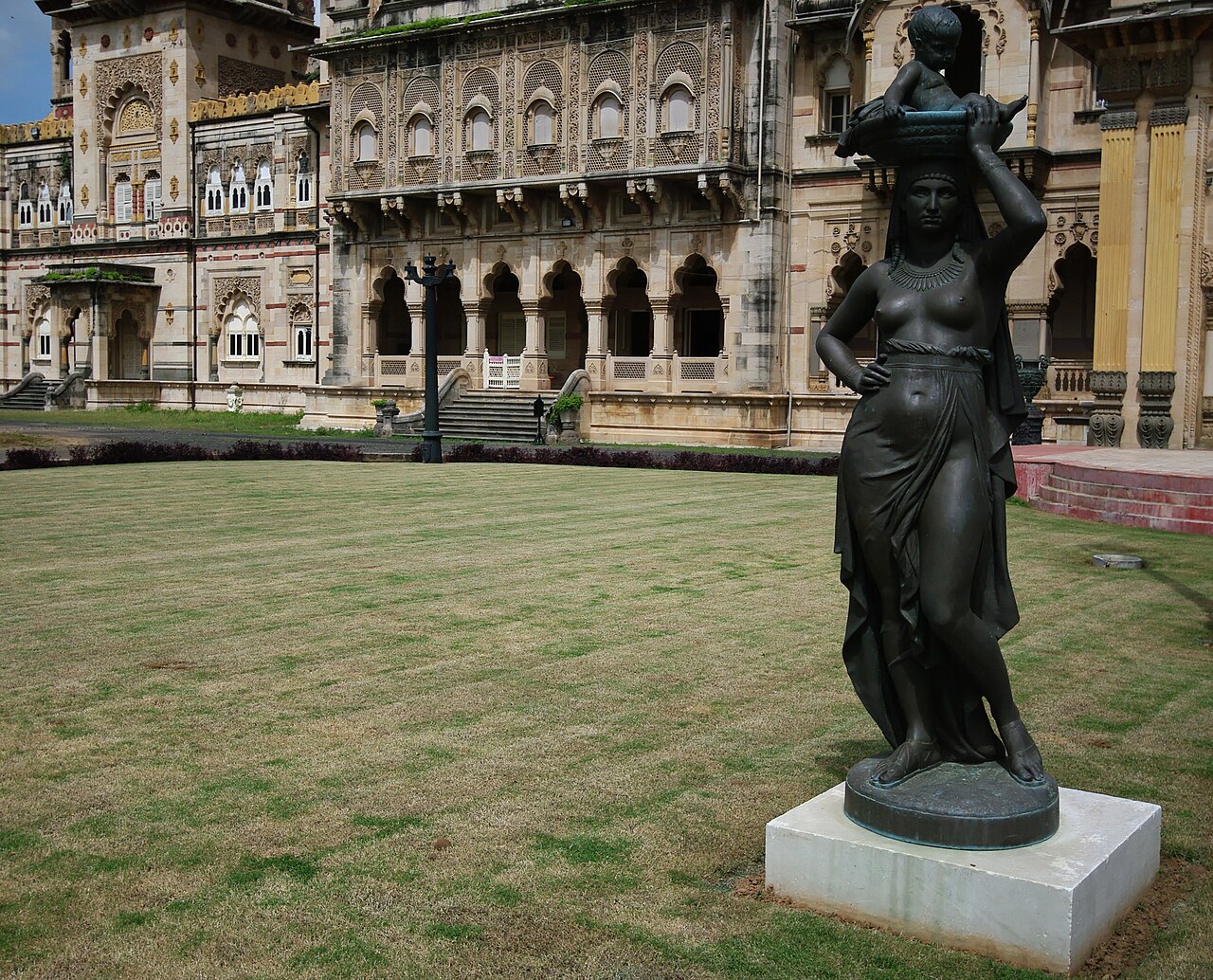
Baroda under the Gaekwads became known for its wealth, its relatively progressive administration, and its cultural patronage. The state ranked among the most important in India, its ruler entitled to high honours, and its capital a centre of art, learning, and industry. The dynasty accumulated great treasures, including some of the most famous jewels in India, and lived in a style befitting their eminence.
The building of Laxmi Vilas was an expression of this dynastic grandeur, a residence worthy of a house that stood among the foremost of India’s princes. It replaced older palaces and gave the Gaekwads a home of unmatched scale and modernity for its time, a fitting stage for the ceremonial and private life of one of the great ruling families of the land.
When the princely states were integrated into independent India in the middle of the twentieth century, the Gaekwads, like other rulers, lost their sovereign power, but their connection to Baroda and to Laxmi Vilas endured. The family remains closely associated with the city and the palace, and the dynasty’s long history gives the building a continuity that many former royal residences, now mere museums, have lost.
The wealth of the Gaekwads was legendary in its own right, bound up with famous jewels and treasures, and it placed Baroda firmly among the handful of princely states whose rulers were counted among the richest and most eminent in all of India.
Building a Masterpiece of Indo-Saracenic Design
Laxmi Vilas was built in the later nineteenth century, and its creation involved the leading architectural talents available for such work in British India. It was designed by an English architect associated with the great public buildings of the era, and after his death the work was carried forward and completed by another distinguished architect, so that the palace represents the combined vision of more than one master.

The style they created is Indo-Saracenic, the distinctive revival architecture of the period that fused Indian, Islamic, and European Gothic elements into a single eclectic manner. Domes and chhatris drawn from Indian and Mughal tradition sit alongside pointed arches, towers, and details of European origin, all combined with a freedom and exuberance that make the building endlessly rich to look at.
The construction was a major undertaking, drawing on fine materials from India and abroad, from marble and stone to imported glass, mosaic, and fittings. The cost was enormous for its day, reflecting both the scale of the building and the quality of its craftsmanship, and the result was a palace that stood among the most ambitious architectural projects of princely India.
The building’s design is notable for combining this exuberant style with modern conveniences and a thoughtful plan suited to the life of a great court. It was not a backward-looking pastiche but a confident, contemporary creation, using the latest techniques and comforts of its age within its historicist skin. In this it perfectly expressed the outlook of its builder, a prince who looked both to tradition and to modern progress.
The involvement of more than one architect, with the design passing from its first author to another who completed it, was not unusual for so large a project, and it speaks to the years of effort the palace demanded. What is striking is how unified the result nonetheless appears, a single grand conception carried through to a coherent and dazzling whole.
Larger Than Buckingham Palace
The most repeated boast about Laxmi Vilas is its comparison with Buckingham Palace, for the Baroda residence is often said to be several times larger than the London royal palace, a claim that captures the extraordinary ambition of the project. Whether or not every such comparison is exact, the palace is genuinely vast, one of the largest private homes ever built anywhere in the world.
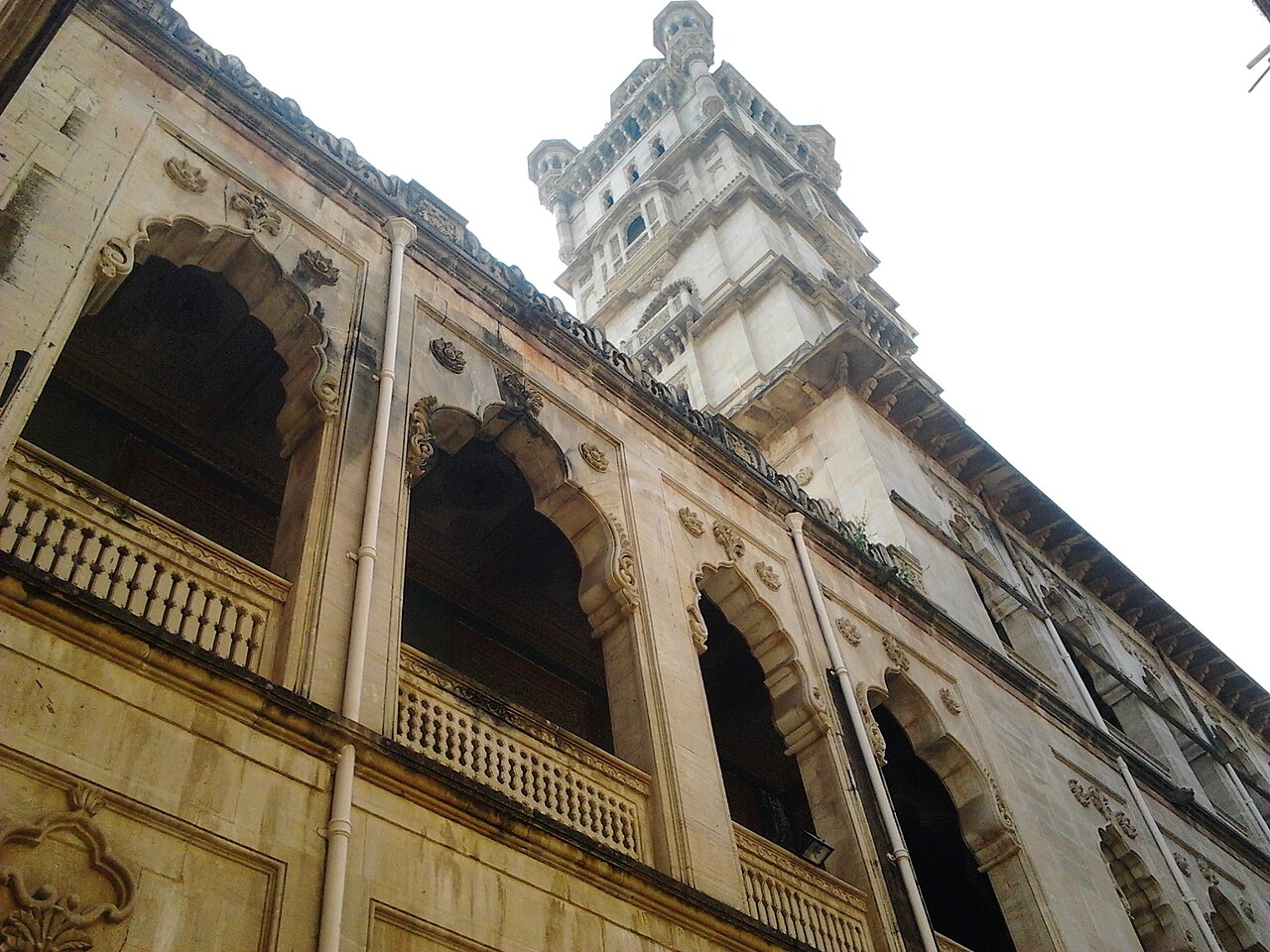
This scale encompasses not just the main palace building but a whole estate, with extensive grounds, gardens, and subsidiary structures spread over a large area. The domain famously includes a golf course, a reminder that the maharajas embraced the pastimes of their age, and other facilities that made the estate a self-contained world for the royal family and their establishment.
Such size served a purpose beyond mere display. A great princely court required space for ceremony, for administration, for the royal household and its many members and servants, for guests, and for the arts and pleasures of aristocratic life. Laxmi Vilas provided all of this on a grand scale, a complete setting for the life of one of India’s foremost ruling families.
For the visitor and the observer, the size of Laxmi Vilas remains one of its most astonishing features. In an age when even the grandest new houses are modest by comparison, the palace stands as a monument to a time when a single family could build and inhabit a residence larger than the seats of kings, a scale of private grandeur that the modern world has left behind.
Numbers, though, only go so far. What the scale really means becomes clear when you try simply to walk the length of the building, or to take in the estate from a single vantage point and fail. Laxmi Vilas is a place that resists being grasped all at once, and that refusal to be taken in at a glance is itself part of its grandeur.
Domes, Arches, and a Fusion of Worlds
The architectural style of Laxmi Vilas rewards close attention, for it is one of the great examples of the Indo-Saracenic manner. This style, popular in the later part of the nineteenth century, deliberately combined elements from India’s own traditions, both Hindu and Islamic, with the forms of European architecture, especially the Gothic, to create buildings that were at once modern, monumental, and rooted in the subcontinent.
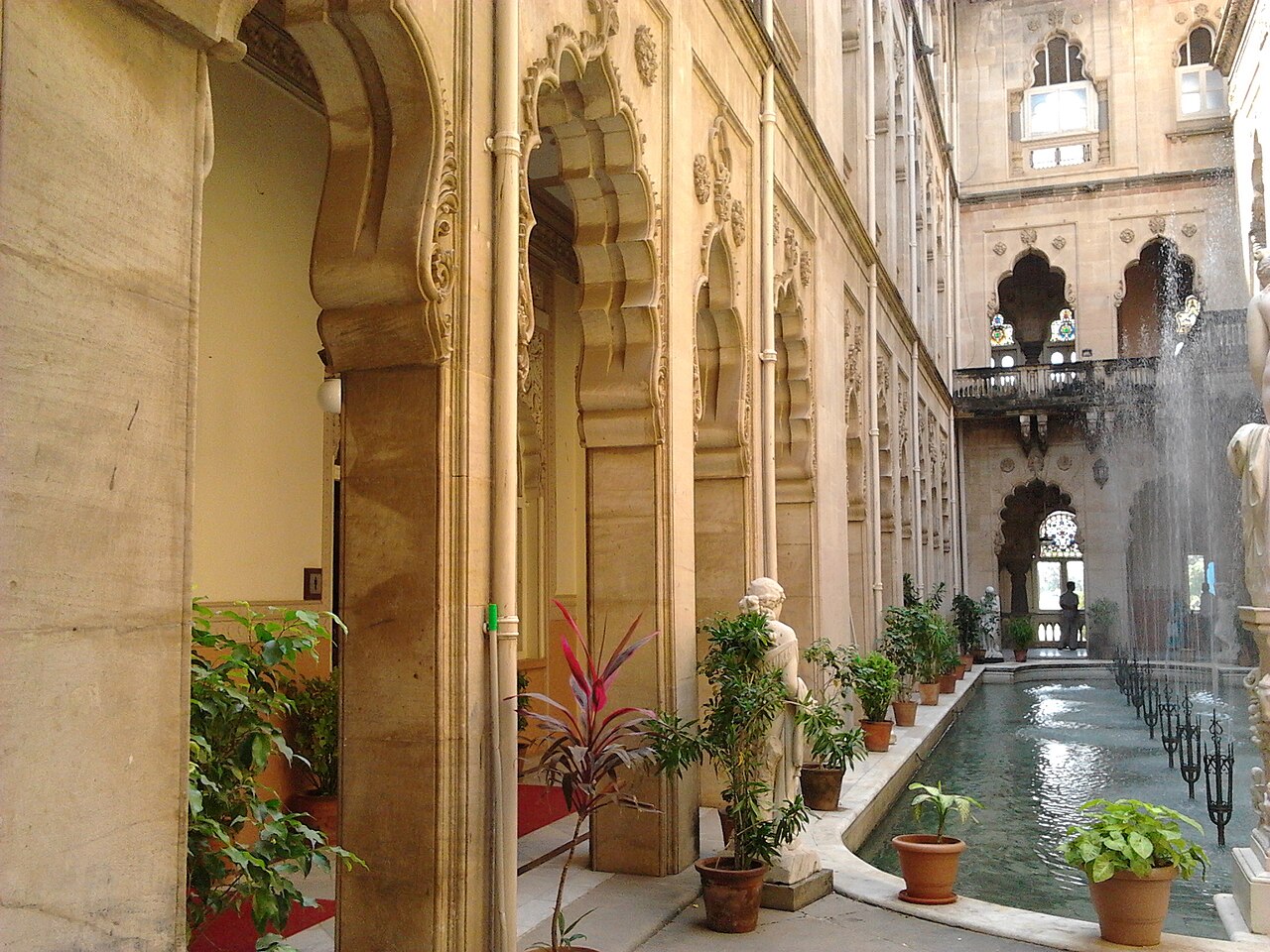
At Laxmi Vilas this fusion is carried out with tremendous verve. Bulbous domes and delicate pavilions of Mughal inspiration rise beside pointed arches and traceried windows of Gothic character; Indian carving and ornament mingle with European structural forms; and the whole is composed with an eye for silhouette and richness that makes the building endlessly picturesque from every angle.
The style suited the moment and the patron perfectly. For a princely ruler who was both proudly Indian and engaged with the modern, Western-influenced world, an architecture that blended the two was ideal, expressing continuity with tradition while embracing contemporary grandeur. Laxmi Vilas thus stands as a statement of identity as well as of wealth, a building that is unmistakably of its place and time.
The materials reinforce the effect. Fine stone and marble, richly carved, give the exterior its texture, while inside, mosaic, stained glass, and imported finishes create interiors of great splendour. The Indo-Saracenic style, at its best, produced buildings of extraordinary romance, and Laxmi Vilas, with its skyline of domes and towers, is among the most romantic and accomplished of them all.
Critics of the style have sometimes called it a mere jumble of borrowed motifs, but at Laxmi Vilas the effect is anything but incoherent. The disparate elements are held together by a consistent richness and a sure sense of composition, so that domes, arches, and towers read as parts of a single confident language rather than a quarrel of styles.
The Durbar Hall and Its Jewelled Light
The ceremonial heart of the palace is its Durbar Hall, the great audience chamber where the maharaja held court and where state occasions and cultural events took place. It is among the most magnificent rooms in the palace, a space designed to overwhelm with colour, light, and richness, fit for the ceremonies of one of India’s leading princely houses.

The hall is renowned for its decoration. Its floor is laid with intricate Venetian mosaic, a shimmering expanse of coloured tesserae, while its windows glow with stained glass, filling the room with jewelled light. Chandeliers hang from the ceiling, and the walls and details are richly worked, so that the whole chamber becomes a symphony of pattern and colour, a setting worthy of a maharaja in state.
The Durbar Hall served as more than a throne room; it was also a place for concerts and cultural performances, reflecting the Gaekwads’ patronage of the arts. Music and other entertainments filled the space on great occasions, and the hall’s fine acoustics and splendid setting made it an ideal stage for the artistic life that flourished under the palace’s cultivated rulers.
For visitors today, the Durbar Hall is one of the highlights of any tour of the palace, a room that concentrates the splendour of Laxmi Vilas into a single dazzling space. To stand on its mosaic floor, beneath its stained glass and chandeliers, is to grasp immediately the magnificence in which the Gaekwads lived and ruled, and the extraordinary quality of the craftsmanship lavished upon their home.
Standing in the hall, it is worth pausing to consider how such a room was meant to work upon those who entered it. The coloured light, the gleaming floor, the height and richness of the space were all calculated to place the maharaja at the centre of a setting that felt almost otherworldly, so that to be received here was to feel the full weight of Baroda’s dignity and wealth.
Marble, Mosaics, and the Painter of Princes
Beyond the Durbar Hall, the interiors of Laxmi Vilas continue the theme of luxury and refinement. Italian marble, fine woodwork, imported fittings, and rich decoration fill the rooms, from grand halls to private apartments, creating an environment of comfort and splendour that reflected the wealth and taste of the Gaekwads and the standards of the great princely houses of the age.

The palace is also famous for its art. The Gaekwads were notable patrons, and their collection includes works by celebrated artists, among them the great painter often called the artist who portrayed the gods and princes of India in a European style, whose works helped define the visual imagination of modern India. Such treasures, displayed within the palace and its associated museum, add a rich cultural dimension to the splendour of the building.
On the grounds stands a museum housing part of the royal collection, including paintings and artefacts gathered by the dynasty, so that the artistic patronage of the Gaekwads can be appreciated alongside the architecture of their home. This blend of building and collection makes a visit to Laxmi Vilas an encounter with the cultural as well as the material achievements of the princely state.
Everywhere the interiors reflect the meeting of Indian and European taste that characterised the cultivated princely courts. Fine European craftsmanship serves Indian ceremony; Western painting hangs alongside Indian tradition; imported luxury furnishes a thoroughly Indian palace. The result is an environment of great richness and interest, in which every room repays attention and the whole speaks of a family that valued beauty and culture as much as power.
The presence of such paintings within the palace ties the Gaekwads to one of the great chapters of modern Indian art, and reminds us that these princes saw themselves as custodians of culture as much as of territory. To collect and display such works was, for them, part of what it meant to rule well.
Gardens, a Golf Course, and a Royal Domain
The grounds of Laxmi Vilas are as remarkable as the palace itself, extending over a vast area and forming a self-contained royal domain. Landscaped gardens surround the building, laid out with lawns, trees, and water, providing a green setting for the great house and spaces for the leisure and pleasure of the royal family, in the tradition of the garden estates of princely India.
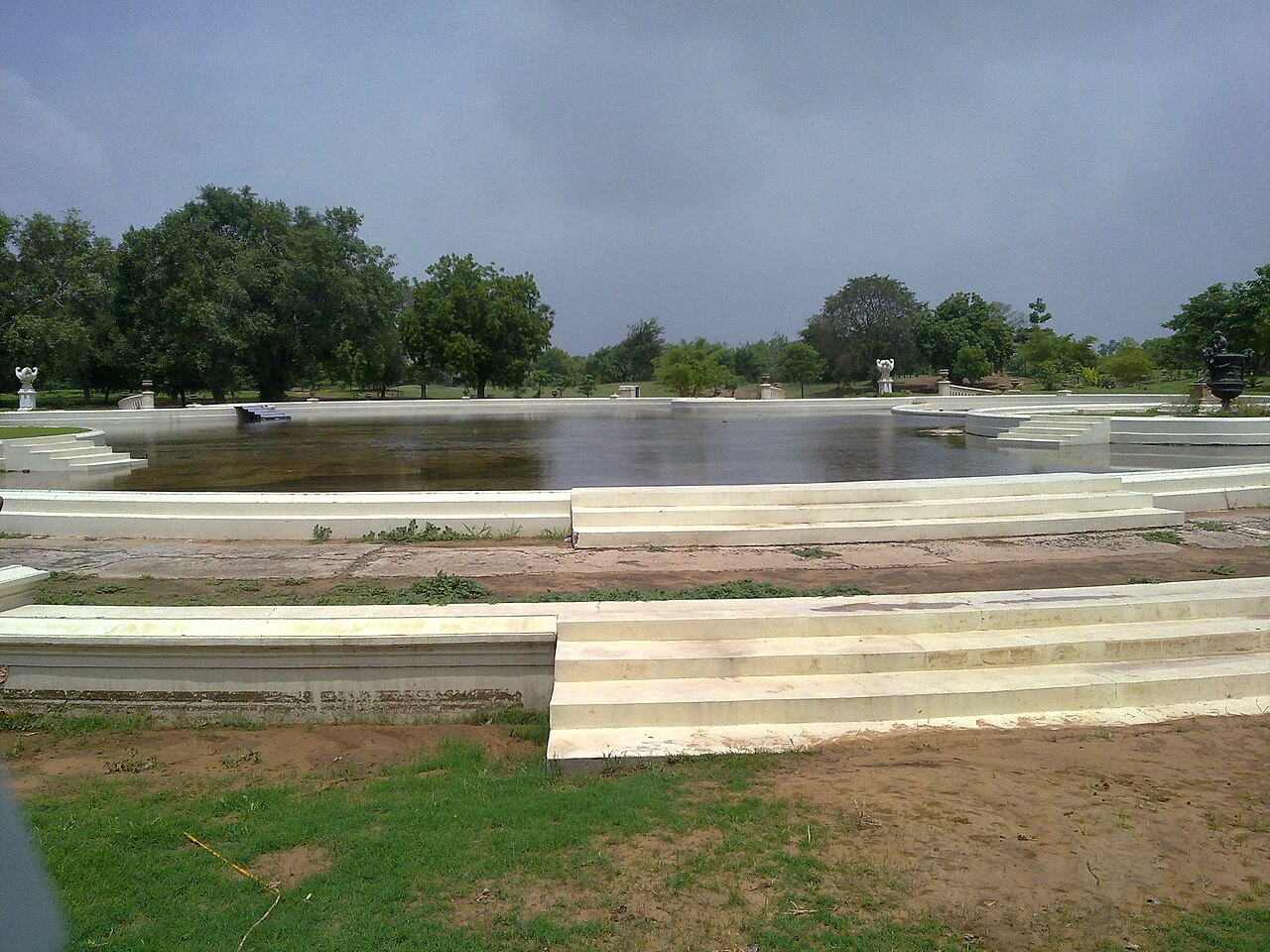
Most famously, the estate includes a golf course, a striking sign of the way India’s maharajas embraced the sports and pastimes of the modern, cosmopolitan world. The presence of such a facility within a private royal estate underlines the extraordinary scale of the grounds and the lifestyle of a dynasty that could accommodate an entire course within the bounds of their home.
The domain also contains other structures associated with the royal establishment, from the museum housing the family’s art collection to buildings connected with the life and administration of the court. In its heyday the estate would have hummed with the activity of a great household, a small world unto itself gathered around the palace at its centre.
This combination of vast gardens, sporting facilities, museums, and subsidiary buildings gives Laxmi Vilas the character of a princely city as much as a single house. It reflects the completeness with which the Gaekwads built their world, providing within their own grounds for ceremony, culture, leisure, and daily life, all on a scale that few private families anywhere have ever commanded.
In their heyday the grounds would also have housed the animals of the royal stables and menagerie, including the elephants that played their part in the ceremonies of an Indian court, adding yet another dimension to the small world contained within the estate walls.
A Palace That Is Still a Home
Perhaps the most extraordinary thing about Laxmi Vilas is that it remains a private residence of the Gaekwad family. Unlike so many great palaces that have become museums or hotels emptied of their original owners, Laxmi Vilas is still lived in by the descendants of the dynasty that built it, a rare survival of a royal home that has never ceased to be exactly that.

This continuity gives the palace a special character. It is not a preserved relic but a living house, maintained and inhabited by the family whose ancestors created it, so that the traditions and memory of the Gaekwads remain woven into its daily life. Parts of the palace are opened to visitors, but it remains, at its heart, the private domain of a royal family with deep roots in the place.
Maintaining so vast a residence is an enormous undertaking, and the family has adapted to the demands of the modern world, opening parts of the estate to the public and putting some of its spaces to new uses while continuing to live within it. This blend of private home and partial public access allows the palace to survive and to share its splendour without losing its essential nature.
For the visitor, the knowledge that Laxmi Vilas is still a family home adds a rare intimacy to the experience. This is not a dead monument but a living link to the princely past, inhabited by the heirs of its builders, a place where history is not merely remembered but continues to be lived. Few of the world’s great palaces can make the same claim.
There is something quietly moving in the continuity. In a century that swept away so many thrones and turned so many palaces into ticketed monuments, the survival of Laxmi Vilas as a lived-in family home is a reminder that not every royal story ends in a glass case, and that heritage can sometimes be kept alive simply by continuing to live it.
The Legacy of an Enlightened Court
The story of Laxmi Vilas is inseparable from the legacy of the reforming rulers who built and inhabited it, above all its founder, whose vision extended far beyond the splendour of his home. The palace stands as the seat of a court that combined magnificence with a genuine commitment to progress, education, and the welfare of its people, giving it a significance beyond mere grandeur.
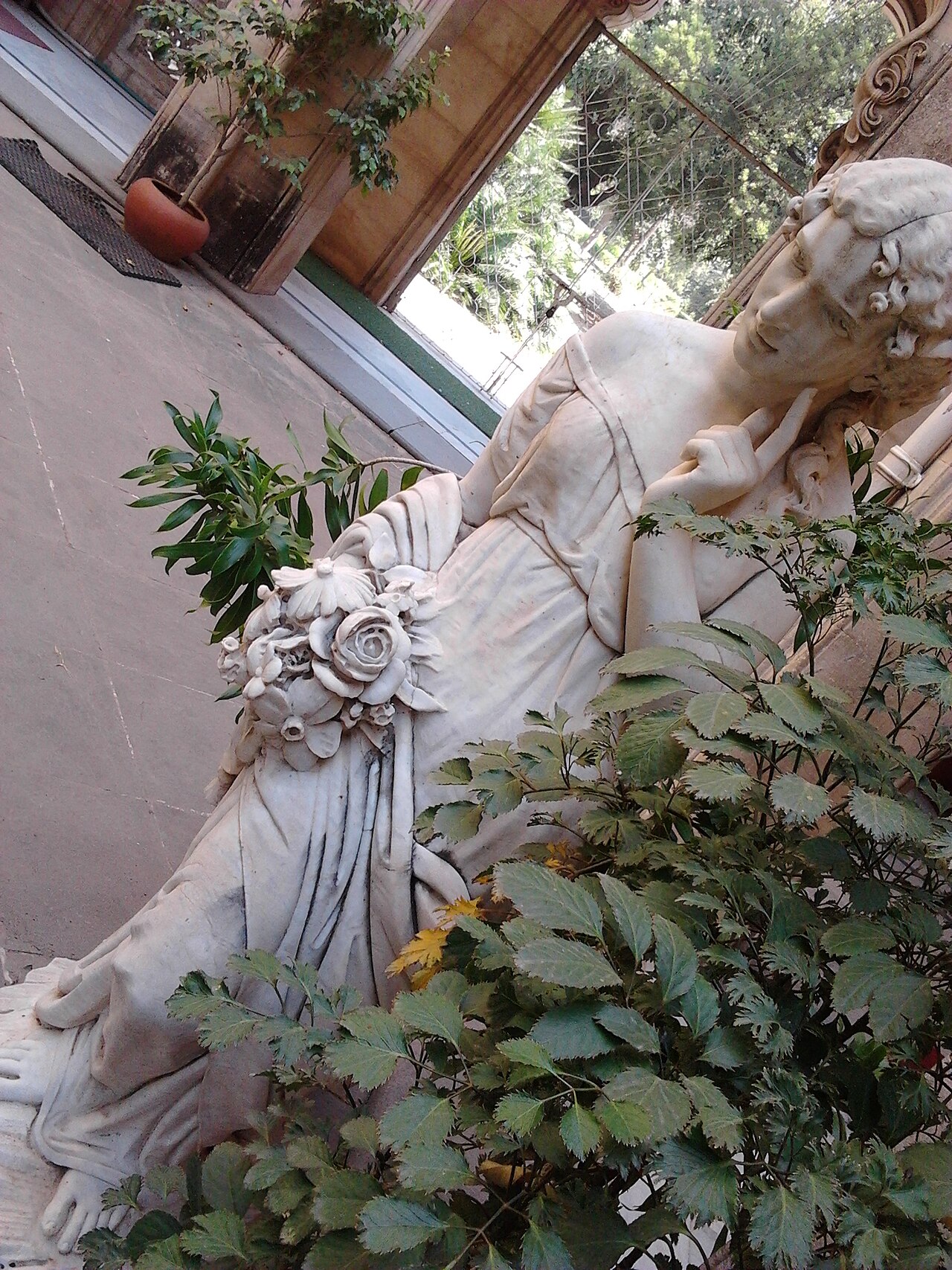
Baroda under its great maharaja became known as one of the more forward-looking of the princely states, a place where reforms in education and society were pursued with unusual seriousness. The patronage that flowed from this court touched the arts, learning, and the lives of individuals across social boundaries, and its influence extended into the wider currents of modern Indian history.
This reforming legacy lends the palace a moral as well as an aesthetic interest. It reminds us that the princely age, for all its inequalities, also produced rulers who used their wealth and authority to build institutions and open opportunities, and that a palace like Laxmi Vilas could be the centre not only of luxury but of enlightened patronage and reform.
To appreciate Laxmi Vilas fully, then, is to see it as the expression of a particular kind of princely rule, one that married splendour with responsibility. The domes and mosaics and vast grounds are the visible face of a court that also cared about schools and social change, and that combination gives the palace a depth and dignity that mere size and richness alone could never provide.
In that sense the palace is best read not as a boast but as a promise kept: the outward magnificence of a court that took its duties as seriously as its splendour.
The Palace on Film
The scale and splendour of Laxmi Vilas, its endless domes and towers, its jewelled Durbar Hall, its vast grounds, are best appreciated in motion, and the short film below offers a tour that conveys the size and richness of the palace far better than still images alone. Watching it alongside this article helps bring the great house to life.

If you are planning a visit to Vadodara, a video like this is a fine way to prepare, helping you grasp the layout of so enormous a building and to recognise its highlights, from the Durbar Hall to the art collection and the grounds. It also sets the palace in the context of the Gaekwads and their remarkable state.
And if a visit lies beyond your plans for now, the film lets you tour one of the world’s largest private homes from afar. Let it play, and picture yourself walking through the domed halls of Laxmi Vilas, across the mosaic floor of the Durbar Hall, and out into grounds so vast they hold a golf course, in the palace of the maharajas of Baroda.
Visiting Laxmi Vilas Today
For travellers to Gujarat, Laxmi Vilas Palace is the great sight of Vadodara and one of the most impressive palaces in all of India. Because it remains a private residence of the royal family, access is managed accordingly, but parts of the palace and grounds are opened to visitors, and tours allow you to experience the Durbar Hall, the art collection, and the extraordinary architecture, so it is worth checking current arrangements before you go.

A visit rewards attention to the palace’s highlights: the dazzling Durbar Hall with its mosaics and stained glass, the richly decorated interiors, the collection of art including works by celebrated Indian painters, and the sheer scale of the building and its grounds. Audio guides and tours help make sense of so vast and complex a place and bring its history to life.
As at any lived-in historic home, visitors should treat the palace with respect, following the guidance about which areas may be seen and photographed, and appreciating that they are guests in what is still a family residence. That living quality is part of what makes a visit so special, an encounter with a royal past that has never entirely become the past.
However you come to it, Laxmi Vilas offers a rare experience: a chance to enter one of the largest and most splendid private palaces ever built, still inhabited by the dynasty that raised it, and to touch the world of the maharajas of Baroda, a court that combined breathtaking magnificence with a genuinely enlightened vision. Few palaces anywhere unite scale, beauty, and living history so completely.
Palaces Nearby
If the grandeur of the Gaekwads has drawn you in, these two other palaces of India’s princely states make a natural next stop.
- Falaknuma Palace and the Fabulous Riches of the Nizams of Hyderabad — the hilltop palace of Hyderabad’s fabulously rich Nizams.
- Umaid Bhawan, the Golden Jodhpur Palace Built to Feed a Famine — the golden Art Deco palace of the maharajas of Jodhpur.
You May Like
Konopiste the Bohemian Castle of a Doomed Archduke