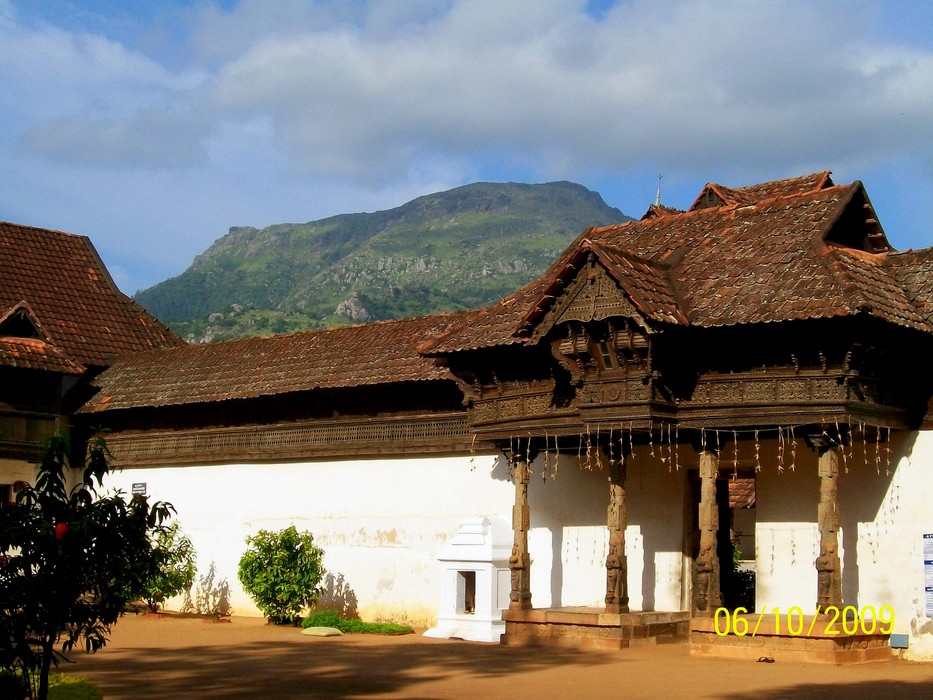
In the far south of India, where the state of Tamil Nadu meets the green hills of the old Travancore country, stands a palace built almost entirely of wood. Padmanabhapuram Palace is the largest wooden palace complex in Asia, a sprawling, low-slung world of carved teak and rosewood, sloping tiled roofs, cool dark halls, and floors polished to a black mirror shine. To step inside is to enter a masterpiece of traditional Kerala craftsmanship, and the former seat of one of India’s most distinctive kingdoms.
This was the capital palace of Travancore, a kingdom of the south-western coast whose rulers did something remarkable: they dedicated their entire realm to a deity and governed, in their own words, merely as his servants. The palace reflects that spirit, combining royal grandeur with an almost monastic restraint, its beauty lying not in gold and jewels but in the perfection of its woodwork, the play of light through mica windows, and the sheer craft of every carved beam and pillar.
Cool in the tropical heat, quiet, and endlessly intricate, Padmanabhapuram is unlike the marble and sandstone palaces of the north. It is a palace you feel in the grain of the wood beneath your hand and the coolness of the polished floor beneath your feet. In the sections that follow you will get to know the palace, the kingdom that built it, and the extraordinary artistry that makes it one of the wonders of southern India.
In This Article
- The Great Wooden Palace of the South
- The Kingdom of Travancore
- A King Who Ruled as a Servant of God
- A Masterpiece of Kerala Woodcraft
- The Council Chamber and Its Coloured Light
- The Mother’s Palace and the Oldest Rooms
- The Secret of the Mirror-Black Floors
- The Hall of Dance and the King’s Tall Mansion
- A Dining Hall to Feed Thousands
- Murals, Mirrors, and Treasures
- When the Capital Moved Away
- The Palace on Film
- Visiting Padmanabhapuram Today
The Great Wooden Palace of the South
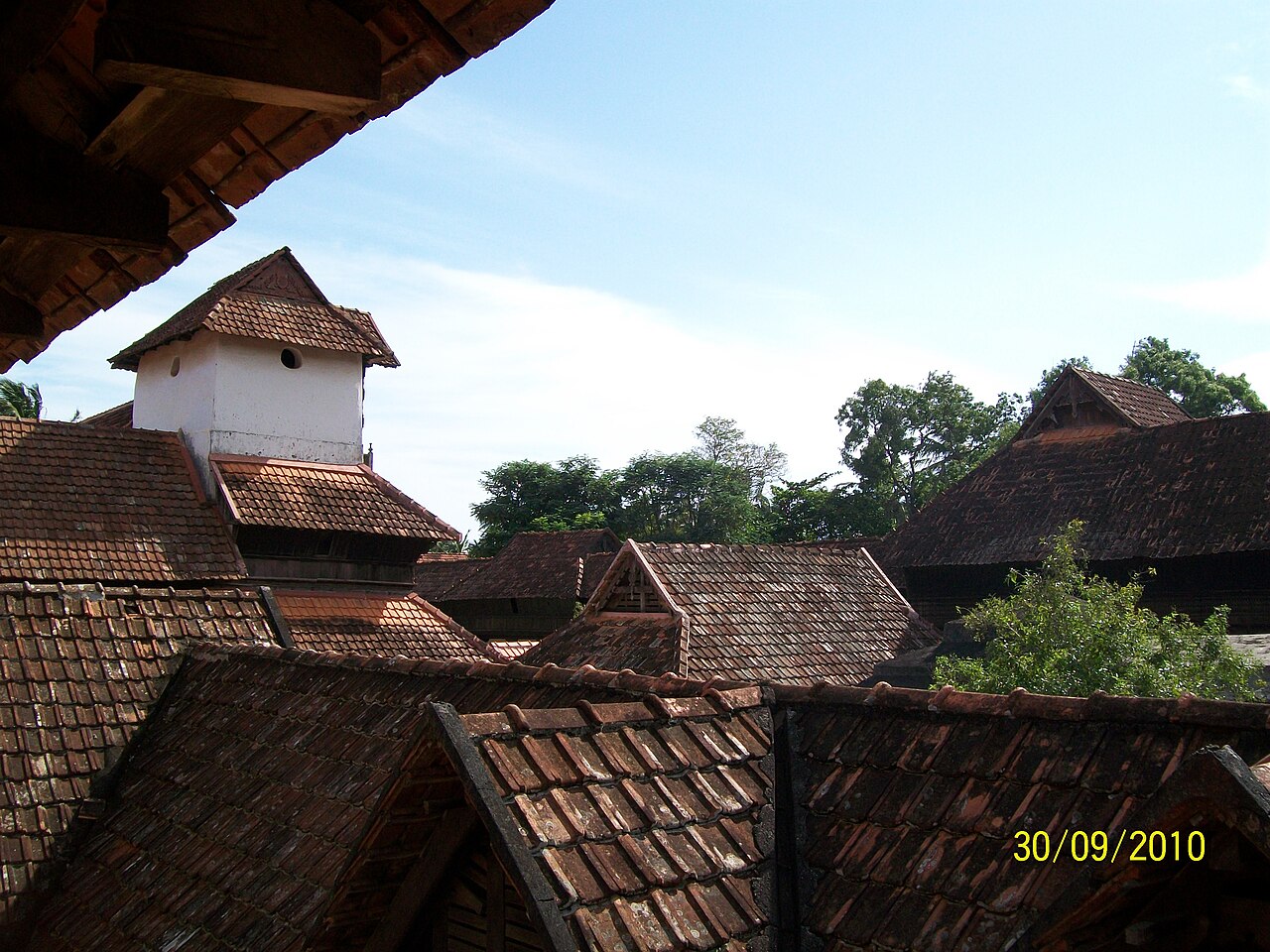
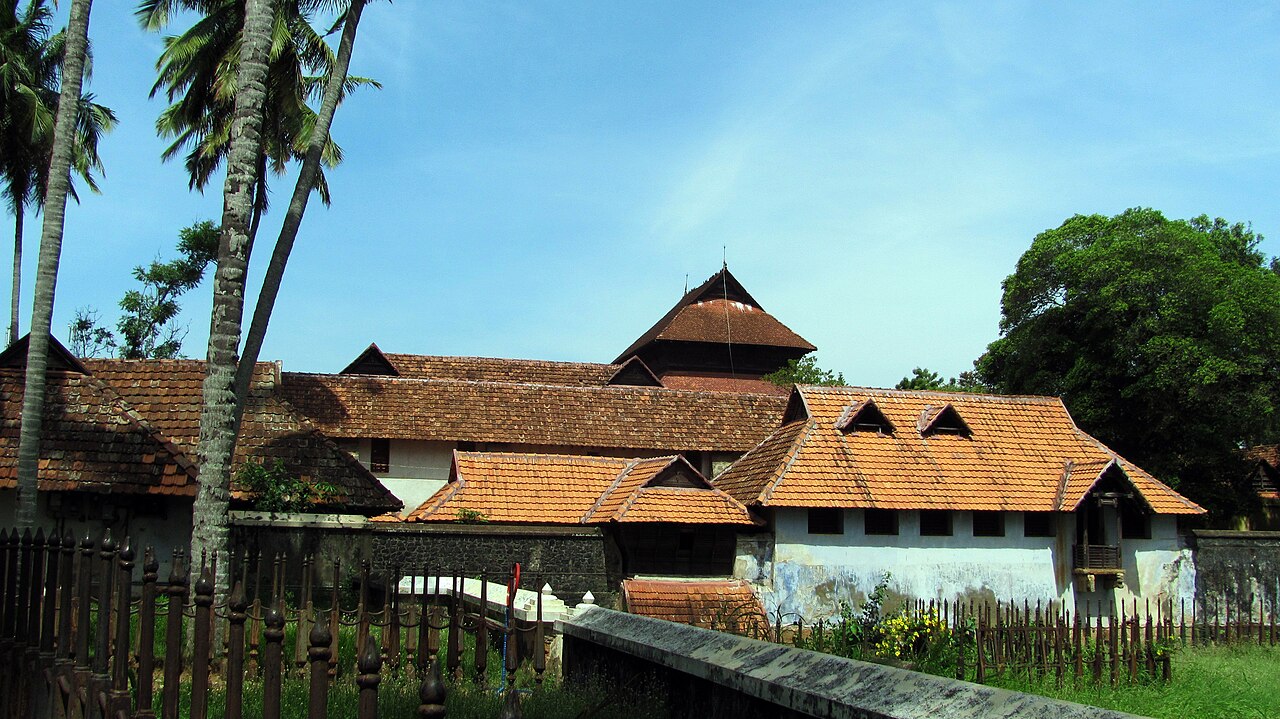
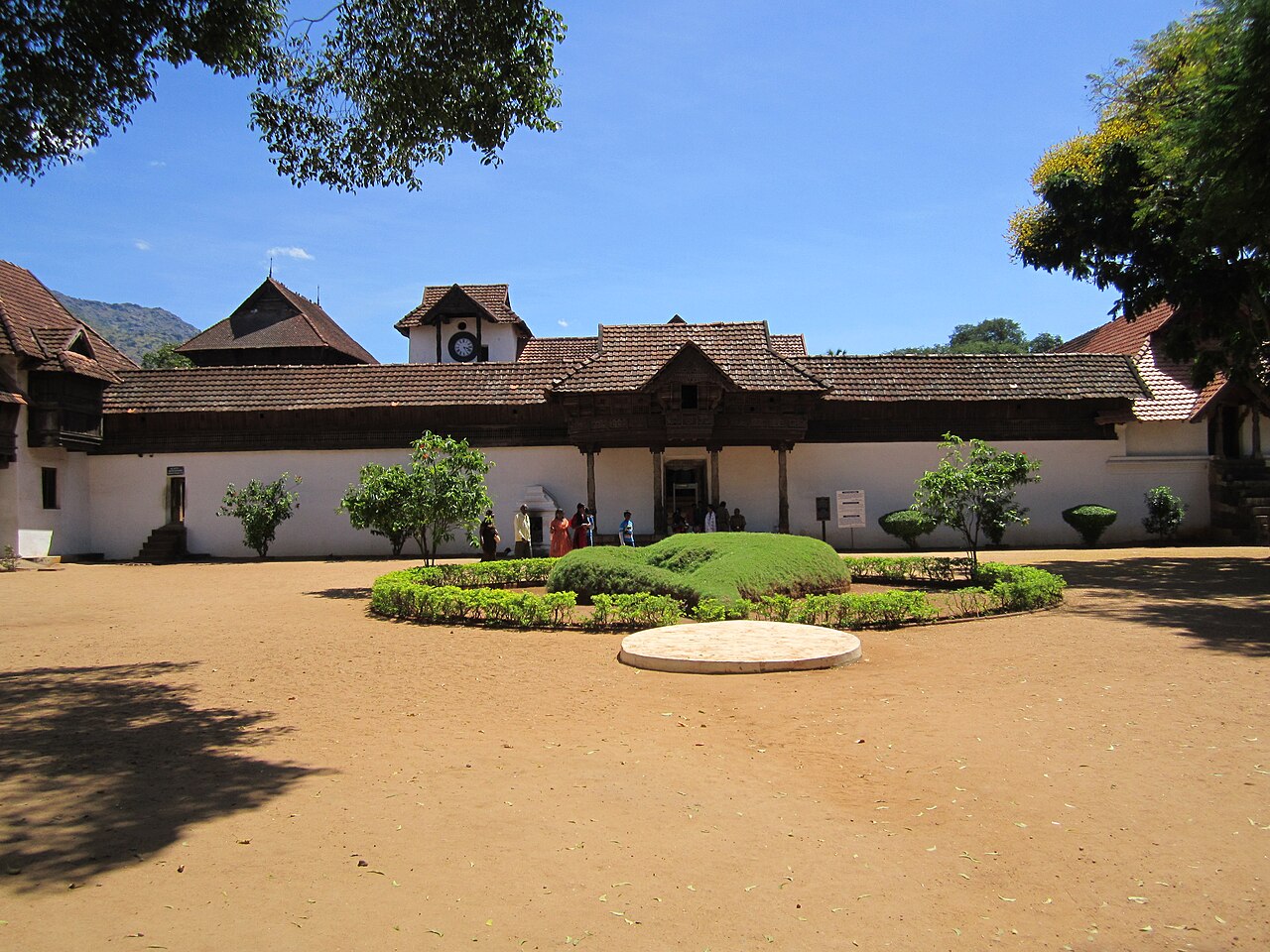
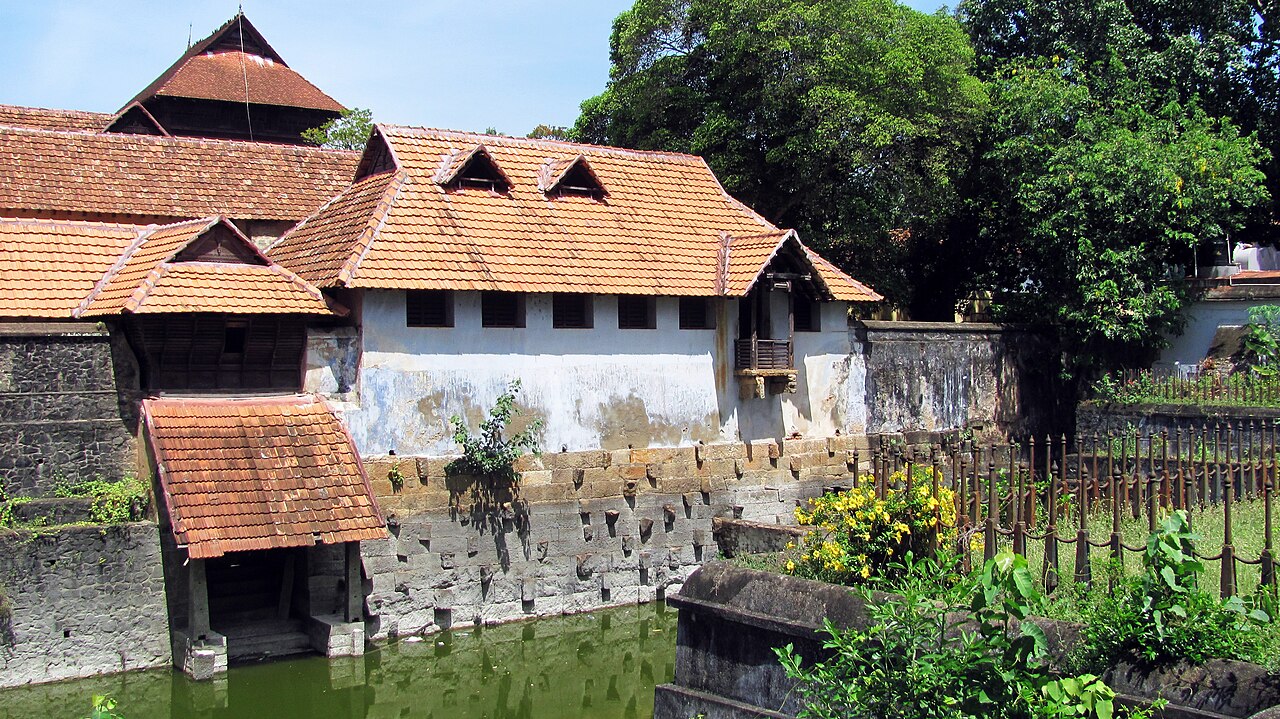
The first thing that surprises visitors to Padmanabhapuram is how little it resembles the popular image of an Indian palace. There are no soaring domes, no marble facades, no glittering mirror halls. Instead there is wood: a vast, rambling complex of timber buildings with steep, sloping tiled roofs, set behind fortified walls, low and horizontal rather than tall and imposing, blending into the green landscape of the far south.
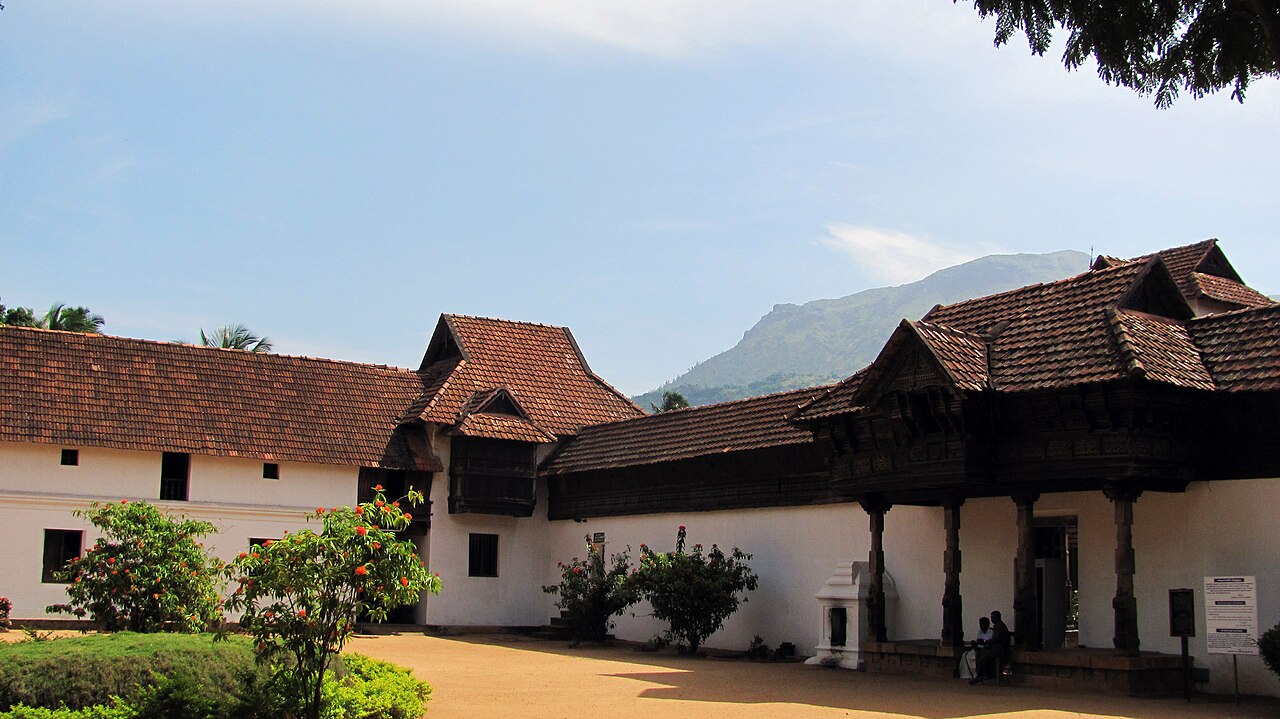
This is architecture perfectly suited to its climate. The sloping roofs shed the heavy monsoon rains; the wooden lattices and mica windows filter the fierce sunlight into a cool, dim glow; the open courtyards and shaded verandas allow the air to move. The palace does not fight the tropical environment but works with it, creating interiors that remain remarkably cool and comfortable even in the heat of a southern day.
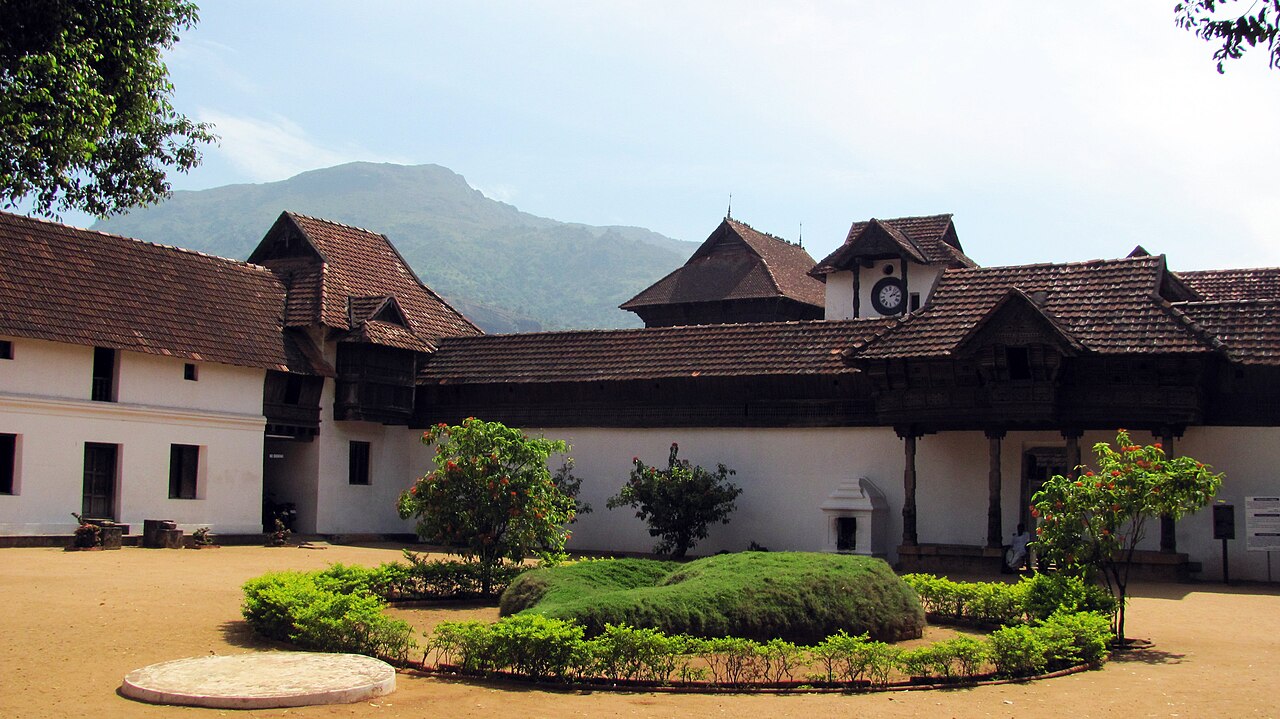
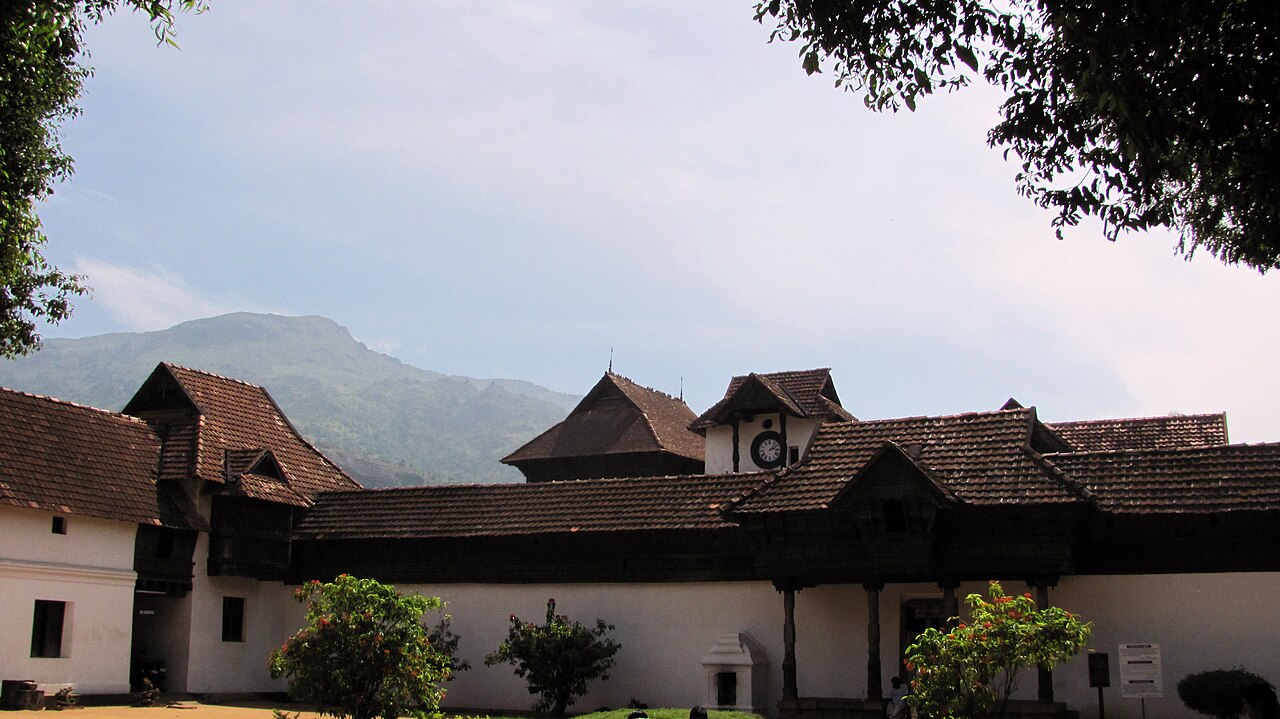
Inside, the complex unfolds as a maze of halls, chambers, courtyards, and corridors, connected in the organic, additive way of traditional Kerala architecture. Buildings of different periods and purposes cluster together, so that moving through the palace is a journey of discovery, from council chambers to dining halls, from the king’s tall mansion to the oldest and most sacred quarters.
Everywhere the eye is drawn to the woodwork, for this is above all a palace of carved timber. Beams, pillars, ceilings, screens, and furniture are worked with extraordinary skill, and the whole building is a showcase of the woodcarver’s art. To appreciate Padmanabhapuram is to slow down and look closely, for its splendour lies not in scale or opulence but in the patient, loving craftsmanship of every surface.
First-time visitors often remark that the palace feels less like a fortress of power than like an enormous, beautifully made home, and in a sense that is exactly what it was.
The Kingdom of Travancore
Padmanabhapuram was the capital of Travancore, a kingdom that occupied the south-western tip of the Indian subcontinent, taking in parts of what are now the states of Kerala and Tamil Nadu. Though the palace itself lies today in Tamil Nadu, it remains owned and maintained by Kerala, a legacy of the old kingdom whose heart it once was, and it is deeply bound up with the history and identity of the region.
The kingdom rose to prominence above all under a great ruler of the eighteenth century, a warrior king who consolidated and expanded Travancore into a powerful and well-organised state. He is remembered as the founder of the modern kingdom, a formidable military and political figure who reshaped the realm and left a lasting mark on its institutions and its capital palace, which he greatly extended.
Travancore was known for its distinctive culture, its temples, its traditions of art and learning, and later for a relatively progressive record in matters such as education. It occupied an important place among the states of southern India, and its rulers maintained a court and a ceremonial life of considerable refinement, centred for a long period on the palace at Padmanabhapuram.
The palace, then, is not merely a beautiful building but the historic seat of a whole kingdom, the place from which Travancore was governed during a formative era. To understand it is to understand something of the history of the far south of India, a region with its own languages, traditions, and royal heritage, distinct from the more familiar stories of the north.
The great king is remembered not only as a conqueror but as an organiser, who put the kingdom’s affairs on a firmer footing and gave Travancore an administrative strength that outlasted him. The palace he enlarged became the physical expression of that consolidated state, a capital worthy of a kingdom newly made whole.
A King Who Ruled as a Servant of God
One of the most striking things about Travancore is the extraordinary relationship its rulers established with their deity. The great king who shaped the modern kingdom formally dedicated his entire realm to the god Padmanabha, a form of Vishnu, and thereafter the rulers of Travancore governed not as sovereigns in their own right but as the servants of the deity, taking the title that proclaimed them the servant of Padmanabha.

This was a remarkable act of political and religious symbolism. By surrendering the kingdom to the god and ruling in his name, the king placed the whole enterprise of government under a sacred umbrella, casting himself and his successors as stewards rather than owners of the realm. The very name of the palace and its associated town, Padmanabhapuram, honours this dedication, meaning the city of Padmanabha.
The idea gave the monarchy a distinctive character, blending kingship with devotion in a way that shaped the ethos of the court. The rulers’ identity as servants of the deity was not a mere formula but a governing principle, expressed in ceremony, in the layout and sacred spaces of the palace, and in the close relationship between the throne and the great temple dedicated to the same god.
This spirit helps explain the character of Padmanabhapuram Palace itself. For all its scale and craftsmanship, it is a building marked by a certain restraint and seriousness, its splendour turned toward beauty and devotion rather than mere display. The palace of servants of a god was never going to be a riot of ostentation; it is instead a place of quiet, crafted dignity, fitting for rulers who saw themselves as stewards of a sacred trust.
Something of that humility still clings to the place. Where other dynasties built palaces to shout their own glory, the servants of Padmanabha built one that seems, for all its size, to whisper. The restraint is deliberate, and once you know the story behind it, the quiet dignity of the wooden halls reads less as modesty of means than as a kind of devotion made visible.
A Masterpiece of Kerala Woodcraft
Padmanabhapuram is the supreme surviving example of the traditional wooden architecture of Kerala, a building tradition quite distinct from the stone architecture of much of India. In this style, timber, above all fine hardwoods such as teak and rosewood, is the principal material, worked by master carpenters into structures of great sophistication, with intricately jointed frames, carved detail, and steeply pitched roofs.
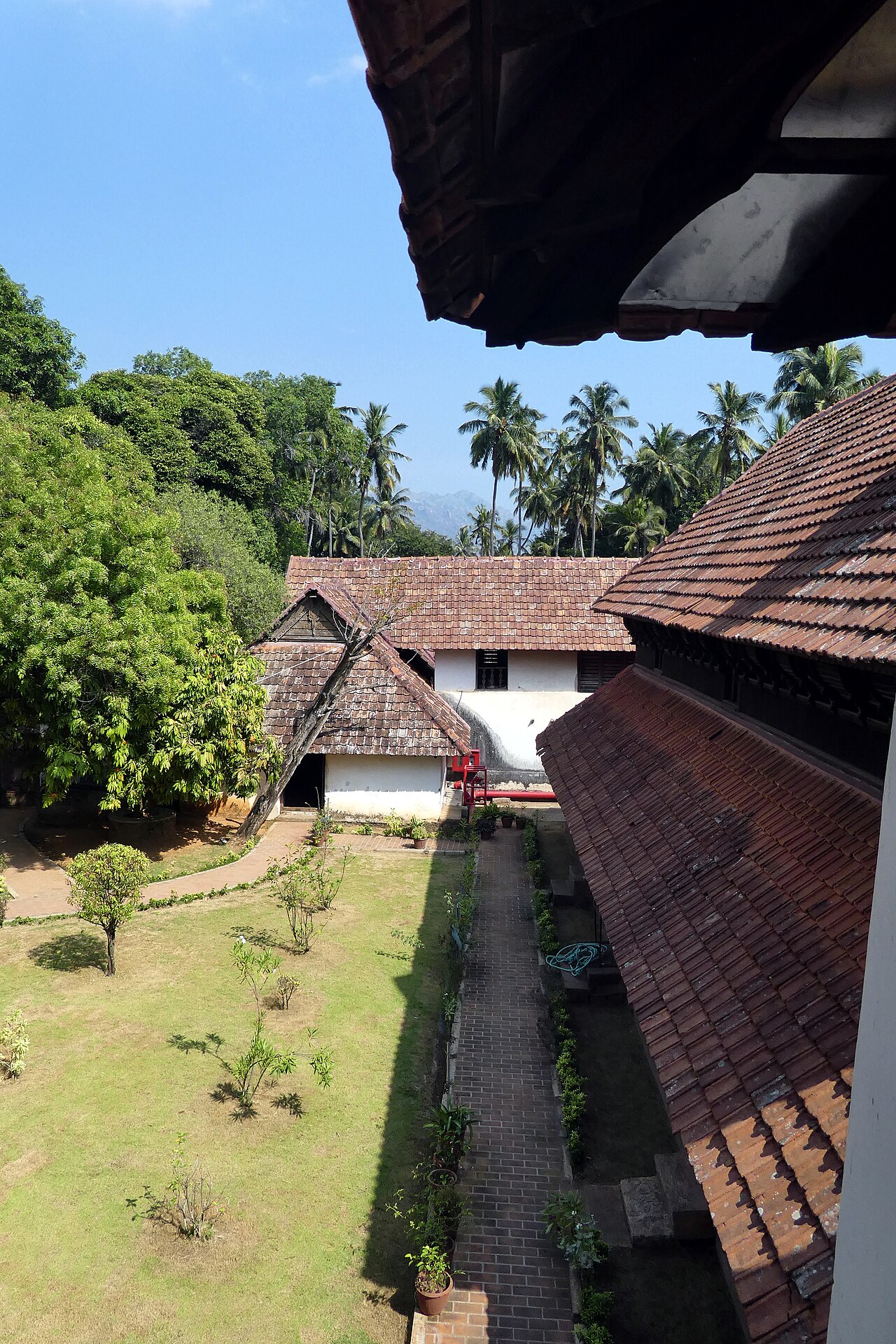
The sloping roofs are one of the defining features, designed to cope with the region’s heavy monsoon rains and covered with tiles or, traditionally, other materials, their broad eaves shading and protecting the walls below. The result is a distinctive silhouette of layered, descending roofs, quite unlike the flat roofs and domes of drier regions, and perfectly adapted to the wet, tropical climate of the south-west coast.
Within this framework, the woodcarvers lavished their skill on every element. Ceilings are coffered and carved, pillars are shaped and ornamented, screens and windows are worked into delicate lattices, and doorways and furniture are richly decorated. Among the marvels of the palace is a carved wooden ceiling displaying a great array of different flowers, each one distinct, a tour de force of the carver’s art.
The use of wood gives the palace a warmth and intimacy that stone can rarely match. The timber glows in the filtered light, the carving invites close inspection, and the whole building feels crafted by hand rather than assembled from quarried blocks. Padmanabhapuram is, in this sense, a monument to a whole tradition of craftsmanship, the finest expression of the woodworking genius of Kerala.
The choice of wood was not a limitation but a tradition perfectly matched to its place, where fine hardwoods were abundant, skilled carpenters plentiful, and the wet climate rewarded roofs that could shed the rain. In Kerala, the carpenter was an artist of the highest rank, and Padmanabhapuram is the grandest surviving canvas for that art.
The Council Chamber and Its Coloured Light
Among the most beautiful rooms in the palace is the council chamber, the hall where the king met his advisers and conducted the business of the kingdom. It is celebrated as one of the finest spaces at Padmanabhapuram, a room whose atmosphere and craftsmanship together create an effect of remarkable serenity and beauty, a fitting setting for the deliberations of the court.
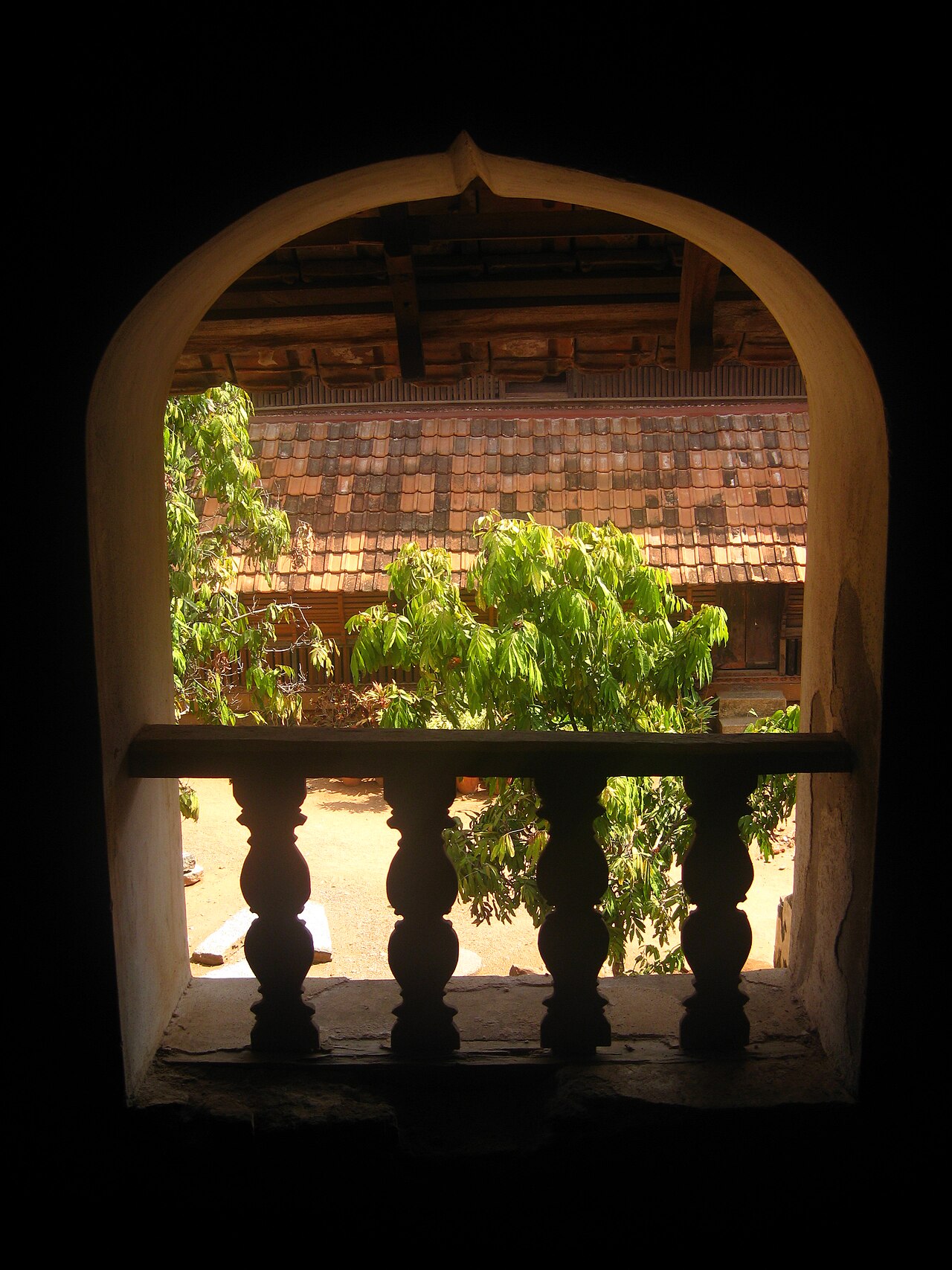
The chamber is famous above all for its windows, which are glazed not with clear glass but with coloured mica, so that the daylight entering the room is transformed into soft, tinted glows. This coloured light, filtering through the mica panes, bathes the dark polished interior in a gentle, shifting illumination, giving the chamber a jewel-like, contemplative quality quite unlike the harsh glare outside.
The room’s other surfaces match the beauty of its light. The floor is finished in the palace’s characteristic glossy black, the walls and ceiling are of fine dark wood, and the whole is worked with the care lavished throughout the complex. Cool, dim, and richly crafted, the council chamber is a place designed to concentrate the mind and to dignify the serious work of governing the kingdom.
For visitors, the council chamber is often the highlight of a tour, a space where the genius of the palace’s builders is felt most intensely. To stand in its coloured light, on its mirror-black floor, surrounded by dark carved wood, is to experience the particular magic of Padmanabhapuram, an architecture of coolness, shadow, and filtered light that soothes and impresses in equal measure.
There is a lesson in the room about how architecture can shape mood. Nothing in it is loud, yet the effect is unforgettable, achieved entirely through light, shadow, and the warmth of worked wood. It is the kind of space that quiets the voice and slows the step, exactly as a chamber for grave deliberation should.
The Mother’s Palace and the Oldest Rooms
Tucked within the complex is one of its oldest and most atmospheric parts, a building traditionally associated with the queen mother and often called the mother’s palace. Dating from an early period in the palace’s long development, it preserves some of the most ancient and evocative spaces in the whole complex, a window onto the earliest layers of Padmanabhapuram’s history.
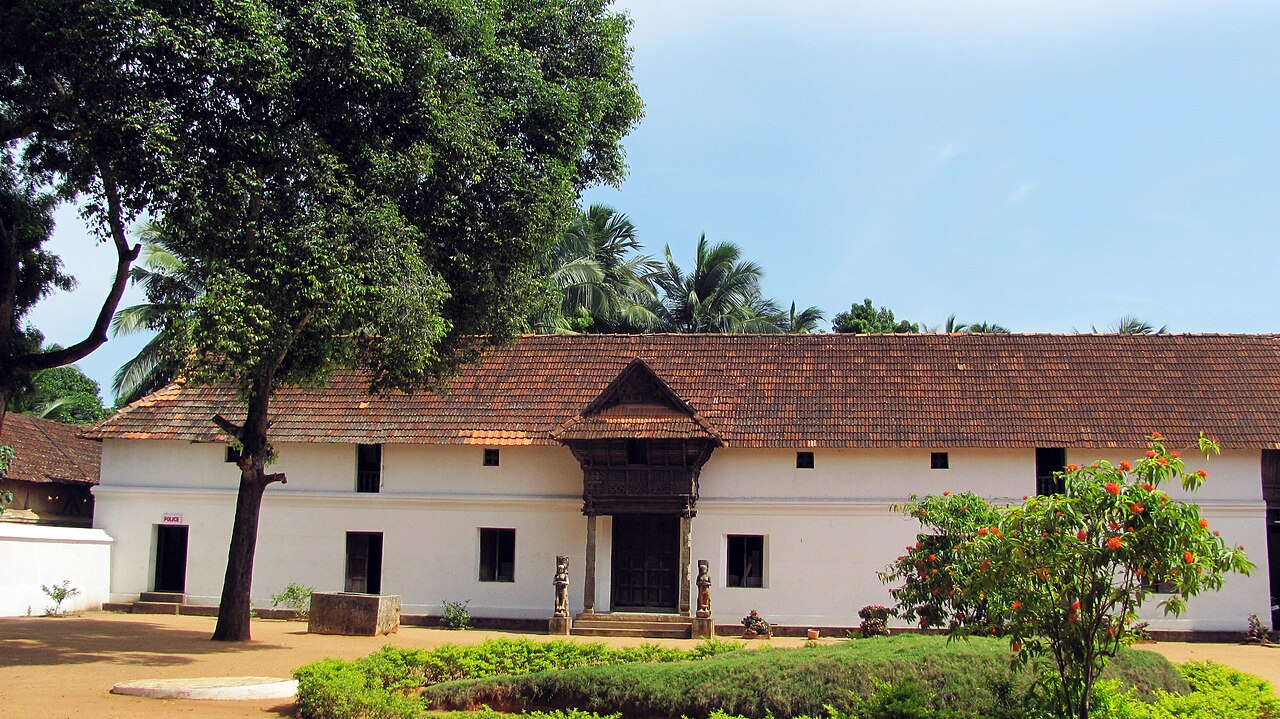
This older quarter is treasured for its craftsmanship, including a carved wooden ceiling of great beauty and rooms that convey the intimate, domestic side of royal life. Here the scale is smaller and the mood more private than in the grand public halls, a reminder that the palace was a home and a household as well as a seat of government, with quarters for the women of the royal family and the life that centred on them.
The survival of these older sections gives the palace a remarkable depth in time. Padmanabhapuram was not built all at once but grew over generations, with successive rulers adding and extending, so that the complex today contains buildings of different ages woven together. The oldest quarters let the visitor sense that long history, the accumulated life of a palace that served the kingdom for centuries.
Moving from these ancient, intimate rooms to the grander halls elsewhere, one feels the palace as a living organism that grew and changed with the kingdom it served. The mother’s palace and the other early quarters anchor the whole complex in its origins, and their fine woodwork shows that the artistry for which Padmanabhapuram is famous was present from its earliest days.
It is humbling to stand in rooms so old and so simple and to realise that the whole vast complex grew outward from beginnings like these, a single household expanding, over generations, into the capital of a kingdom.
The Secret of the Mirror-Black Floors
One of the most memorable features of Padmanabhapuram is its floors, which in many rooms have a deep, glossy black finish so smooth and reflective that they resemble polished stone or dark glass. These floors are one of the palace’s signature marvels, and the traditional method by which they were made is a much-admired example of the ingenuity of the builders.
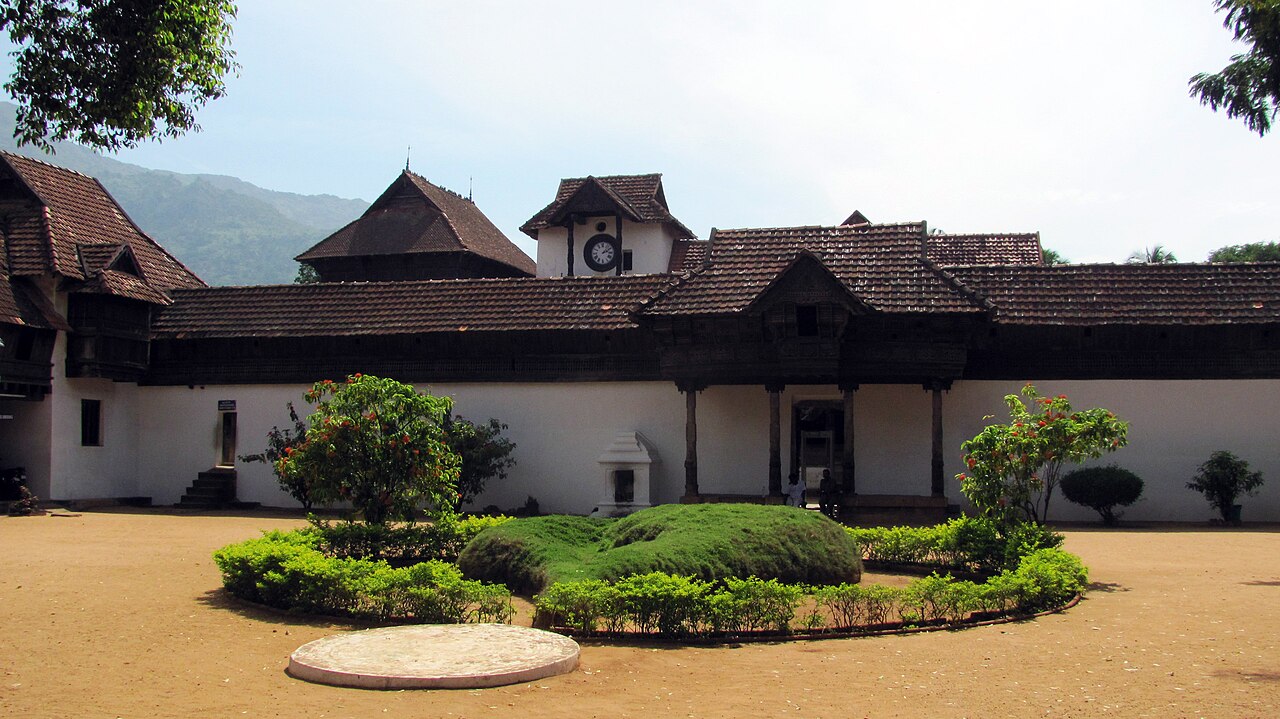
The gleaming black surface was created not from marble or tile but from a special traditional mixture, said to combine such humble ingredients as burnt coconut shells, lime, egg whites, plant juices, and river sand, worked and polished by hand into a hard, lustrous finish. The exact recipes were the closely held knowledge of skilled craftsmen, and the results have lasted for centuries, still cool and shining underfoot.
These floors are not merely beautiful but practical, cool to the touch in the tropical heat and durable enough to survive generations of use. Their dark, reflective surfaces catch and multiply the filtered light of the mica windows and the glow of the wooden interiors, deepening the palace’s atmosphere of cool, shadowed elegance and adding to the sense of stepping into a world apart.
For many visitors, the floors are among the most surprising delights of the palace, a reminder that its splendour lies in craftsmanship and ingenuity rather than in costly materials. That so rich an effect could be achieved from such simple ingredients, and endure so long, speaks to the sophistication of the traditional builders, and the mirror-black floors remain one of the abiding memories of a visit to Padmanabhapuram.
Guides love to recite the ingredients, and visitors love to disbelieve them, running a hand across the cool, glassy surface and marvelling that egg white and burnt shell and river sand could ever be coaxed into something so like polished stone. That wonder is part of the pleasure of the palace.
The Hall of Dance and the King’s Tall Mansion
Among the many buildings of the complex are structures devoted to particular functions, and two are especially memorable. One is the hall used for performances, a theatre or dance hall where the traditional arts of the region were staged for the court, its structure designed to serve the music and dance that were an important part of royal cultural life. Its granite pillars and fine proportions make it one of the notable spaces of the palace.
The other is the tall mansion that rises above much of the low-lying complex, a multi-storeyed building that served as the king’s own quarters and as a place for treasure and important functions. Rising several storeys, it stands out amid the horizontal sprawl of the palace, and its upper rooms, including spaces associated with worship and with the king’s private life, are among the most richly decorated in the whole complex.
This tall building is famous for the murals that adorn some of its rooms, painted in the distinctive style of the region, as well as for its fine woodwork and its role at the heart of the palace’s most important activities. From its upper floors the king could look out over his palace and its surroundings, and within it were kept the things most precious to the kingdom.
Together these buildings show the range of life the palace accommodated, from the cultural splendour of dance and music to the private and sacred activities of the king in his tall mansion. Each structure was crafted for its purpose with the same care, and exploring them one by one reveals the completeness of Padmanabhapuram as a setting for every aspect of royal life, ceremonial, cultural, private, and devotional.
A Dining Hall to Feed Thousands
One of the most astonishing spaces in the palace is its great dining hall, an enormous long room built to feed vast numbers of people at once. In keeping with a tradition of hospitality and charity, the palace hosted large communal meals, and the dining hall was constructed on a scale to accommodate great numbers of diners seated together, a striking expression of the generosity expected of a righteous king.
The hall is a long, double-storeyed structure, its great length lined to seat rows of people along the floor in the traditional manner, and it could serve thousands over the course of a feast. Such mass feeding was bound up with religious and charitable custom, the feeding of many being regarded as a sacred duty and a mark of a just ruler, and the scale of the hall shows how seriously this obligation was taken.
To stand in the empty dining hall today, imagining it filled with rows of seated diners and the bustle of a great communal meal, is to sense the social and religious life that the palace supported. It was not only a seat of government and a royal home but a centre of hospitality, where the king’s duty to feed and care for people was enacted on a grand scale.
The dining hall thus adds another dimension to the palace’s meaning. Alongside the council chamber where the kingdom was governed and the tall mansion where the king lived and worshipped, the great hall of feeding speaks of the ruler’s responsibility toward his people and toward the sacred. It is a reminder that at Padmanabhapuram, kingship, devotion, and charity were woven together into a single way of life.
The idea that a king should feed his people, quite literally, at his own table sits at the heart of a very old understanding of just rule in the region. The dining hall makes that idea concrete: an enormous room whose entire purpose was generosity, built with the same care as the chambers of state.
Murals, Mirrors, and Treasures
Beyond its architecture, Padmanabhapuram holds a wealth of art and treasures. The palace is famous for its murals, wall paintings in the rich, distinctive style of the region, which adorn certain rooms, especially in the king’s tall mansion, depicting deities and sacred themes in glowing colours. These murals are among the finest examples of the traditional painting of the south and are treasured for their beauty and their spiritual content.
The palace also contains a variety of objects that speak of the court’s life and its contacts with the wider world. Among the curiosities often pointed out to visitors are fine pieces of furniture, imported items such as a large mirror and chairs of foreign origin, and objects of daily and ceremonial use, showing that the kingdom, for all its distinctive local character, was connected to trade and influences from far away.
There are also remarkable individual pieces, from carved and decorated furniture to a bed or cot said to be made from a single block of medicinal wood, and the sacred and ceremonial objects associated with the palace’s worship. Together these treasures give a vivid sense of the material culture of the court, the things among which the rulers of Travancore lived, worshipped, and governed.
Much of this heritage is displayed today as the palace functions as a museum, allowing visitors to see not only the buildings but the objects and art that filled them. This combination of magnificent architecture and rich collections makes Padmanabhapuram a place where the whole world of the old Travancore court can be encountered, from the grandeur of its halls to the intimate detail of its treasures.
Seen together, the murals, the imported curiosities, and the sacred objects tell a subtle story: a kingdom rooted in its own deep traditions yet open to the wider world, devout yet worldly, local yet connected. That balance is one of the quiet fascinations of Padmanabhapuram.
When the Capital Moved Away
For a long period Padmanabhapuram served as the capital of Travancore, the centre from which the kingdom was governed, but in time the seat of government moved. The capital was shifted to Thiruvananthapuram, the city also known as Trivandrum, further along the coast and home to the great temple of the same deity to whom the kingdom was dedicated, and the focus of royal life moved with it.
This shift might have doomed the old palace to neglect, as happens to so many former capitals, but Padmanabhapuram was too important and too beloved to be abandoned. It remained a treasured royal property and a monument of the kingdom’s heritage, cared for rather than left to decay, so that its extraordinary buildings and craftsmanship survived the loss of its role as capital.
The move to the new capital reflected the changing needs and priorities of the kingdom, and the deep connection between the throne and the temple of the deity to whom Travancore was dedicated. Yet the old palace retained its aura and its significance, a link to the earlier history of the kingdom and a masterpiece of the region’s architecture that continued to be valued long after the court had gone.
Today, remarkably, the palace lies within the state of Tamil Nadu but is owned and maintained by the neighbouring state of Kerala, the successor to much of the old Travancore country, a unique arrangement that reflects the palace’s history. This careful stewardship has ensured that Padmanabhapuram survives in fine condition, a preserved treasure of a kingdom whose capital moved away but whose greatest palace endures.
In the end the move probably helped preserve it. Spared the constant rebuilding that a working capital attracts, the old palace was allowed to remain much as it had been, so that what survives is a remarkably intact picture of a Kerala royal complex at its height.
The Palace on Film
So much of Padmanabhapuram’s magic lies in things that are hard to capture in still images: the cool dimness of its halls, the coloured glow of its mica windows, the sheen of its black floors, the intricacy of its endless woodwork. The short film below offers a tour that conveys these qualities and brings the wooden palace to life, complementing the images and descriptions in this article.
If you are planning to visit this corner of southern India, a video like this is a fine way to prepare, helping you recognise the palace’s celebrated spaces, from the council chamber to the dining hall and the tall mansion, and to understand the history of Travancore and its unusual devotion to its deity. It sets the palace in its cultural and regional context.
And if a visit lies beyond your plans, the film lets you wander the great wooden palace from afar. Let it play, and imagine yourself moving barefoot across the cool black floors, through halls of carved teak and rosewood, in the largest wooden palace in Asia and the ancient heart of the kingdom of Travancore.
Visiting Padmanabhapuram Today
For travellers exploring the far south of India, Padmanabhapuram Palace is one of the great sights of the region, easily reached from the coastal towns and cities nearby and well worth the journey. The palace is open to visitors as a museum, and touring its halls, courtyards, and chambers is a memorable experience, quite different from visiting the stone palaces of other parts of India.

Because the palace is a treasure of traditional woodwork, visitors are asked to treat it with care, and it is customary to explore parts of it barefoot, in keeping with local practice, which also lets you feel the famous cool floors underfoot. Guided tours and knowledgeable staff help visitors appreciate the significance of the various buildings and the stories and techniques behind them, greatly enriching the experience.
Take your time with the highlights: the council chamber with its coloured mica light, the great dining hall, the tall mansion with its murals, the oldest quarters, and the astonishing woodwork throughout. Each rewards close attention, and the palace as a whole rewards an unhurried visit, allowing its atmosphere of cool, crafted serenity to work upon you.
However you come to it, Padmanabhapuram offers a rare and beautiful experience: the chance to walk through the largest wooden palace in Asia, the ancient capital of a kingdom whose rulers governed as servants of their god. To move through its shadowed, carved interiors is to encounter a masterpiece of craftsmanship and a distinctive vision of kingship, preserved in teak and rosewood in the green land of the far south.
Palaces Nearby
If the wooden splendour of Travancore has drawn you in, these two other palaces of the Indian south make a natural next stop.
- Thirumalai Nayakkar Mahal, the Hall of Giant Pillars in Madurai — the Nayak palace of colossal columns and rafterless domes.
- Chowmahalla, the Grand Durbar Palace of the Nizams of Hyderabad — the ceremonial seat of the Nizams and their chandelier-lit durbar hall.
You May Like

Vaduz Castle, the Hilltop Home of Liechtenstein’s Reigning Prince