Rhodiapolis, located on a hill near Sarıcasu village in Antalya’s Kumluca district, is considered a city founded by the Rhodesians due to its name. It is one of the few Rhodes colonies in the region, such as Gagai, Phaselis, Korydalla and Olympos, which are located very close to it. According to Theopompos, Rhodiapolis takes its name from Mopsos’ daughter Rhodos. The settlement, whose name we learned from Hekataios, developed after it was colonized by the Rhodesians. All cities in the region are members of the Lycian Union. It is stated that they are “Lycian” on the coins of Rhodiapolis and Gagai.
The most famous person of the city is Opramoas. This person, who lived during the reign of Antonius Pius (AD 138-161), was Lycia’s richest man and most famous philanthropist, Euergetes. Opramoas, II. He is the son of Apollonios. His mother, Aglais, also known as Aristokila, is from Korydalla. Hermaios and III. He has two brothers named Apollonios. The first task undertaken by Opramoas in the Lycian Union was archiphylakia. Following his early service, he was honored four times. In the honors that occurred between 114 and 131 AD, Opramoas received a bronze statue, a gold-plated icon and a gold wreath. It was decided that Opramoas, who proved his generosity in 131-132, would be honored with annual honors by the Lycian League. There is almost no city in all of Lycia that Opramoas did not help. Another feature of Opramoas is hidden in Hadrian’s memoirs. Hadrian explains that “the secret reports of the Lycian merchant Opramoas, who knew Asian events in detail, were ridiculed by Palma.”
Rhodiapolis has no ruins that reflect the period before the 7th century BC, except for a rock tomb with an inscription in Lycian language. The earliest known ruins in the city are classical age rock tombs. Except for the rock tomb with inscriptions in Lycian language and the Hellenistic tower to the north of the theater, it gives the impression of a Roman city that adheres to its traditions. However, the majority of the ruins are Byzantine age structures, most of which have been destroyed.

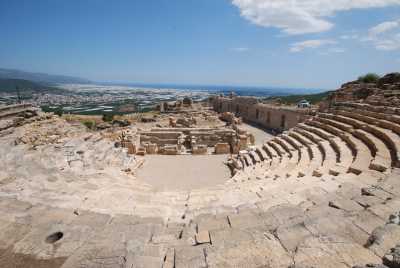
Important ruins; theatres, baths, agora-stoa, sebasteion, temples, churches, cisterns, cenotaphs, necropolises and residences. The most striking feature of the city is the large number of buildings built from small stones with or without mortar and still standing. These are of different sizes and most of them are houses belonging to private individuals. There is a small theater with a Greek plan in the city center. The cavea of the south-facing theater, which is thought to have a capacity of approximately 1500 people, is mostly leaning on the hillside, and there are six kuneus/kerkides between seven stairs in the cavea. The diameter of the fully circular orchestra is 10.52 meters. The upper part of the stage building, which extends on the east-west axis, was completely destroyed, and only the ground floor could be preserved. Five doors open from the proskene façade. The mausoleum, whose walls are completely filled with inscriptions and consists of sixty-four documents listing all of Opramoas’ official relationships, is located in the southwest of the theatre, behind the stage building. In the city center, the agora and the stoa form a unity, and the stoa constitutes the covered part of the agora in the west. At the top of the theatre, towards the west, there is a church with only its apse preserved. The last public structure on the eastern border of the settlement is a Roman bath. The bath has the characteristics of an Anatolian bath-gymnasion with its general planning. The necropolis of Rhodiapolis is concentrated in the east, southeast and north of the city. The most interesting remains of the necropolis areas, the majority of which consist of sarcophagi from the Roman period, are the rock tombs with inscriptions in Lycian language.
Rhodiapolis is among the “Ancient Cities of the Lycian Civilization” (2009) recommended to the UNESCO World Heritage List.

Source: “Rhodiapolis”, Antalya from Past to Today [II. Volume], Antalya Provincial Directorate of Culture and Tourism, 2012, Antalya, p. 208-209
Places to Visit in Antalya
Source: Antalya Provincial Culture and Tourism Directorate