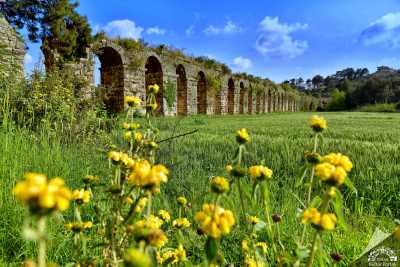
Side, the most important port city of Pamphylia in ancient times, was founded on a 350-400 meters wide peninsula located seven kilometers southwest of Manavgat district of Antalya. The name of the city means “pomegranate” in the Luwian language.
Side became a settlement center in the 7th century BC. In the 6th century BC, it came under the rule of the Lydian Kingdom, together with all of Pamphylia; After the collapse of the Lydian Kingdom in 547-546 BC, it came under the rule of the Persians. During this period, the city preserved its freedom to some extent and minted coins in its own name. Side, which opened its doors to the Macedonian king without any resistance during Alexander the Great’s Anatolian campaign (334 BC), later became one of the major coinage centers founded by Alexander. Side, which constantly changed hands among the Hellenistic period kingdoms after the death of Alexander, came under the rule of the Ptolemies in the 3rd century BC, and then the Seleucids in 215-189 BC. When the Seleucids were defeated in the war against the Romans, Pamphylia and Side were given to the Kingdom of Pergamon according to the Peace of Apameia signed in 188 BC. However, Side regained its independence after a while and experienced one of its brightest periods in history.
General Directorate of Promotion Archive
Henry VII, who ascended to the Syrian throne in 138 BC and was later nicknamed “Sidetes”. The fact that Antiochus was sent to Side to study in his youth is an indication of how important the city was as a cultural center in the Eastern Mediterranean. However, this bright period of the city did not last long. Piracy, which started in the Pisidia and mountainous Cilicia regions in the 1st century BC, spread to Pamphylia and therefore to Side, and the people of Side, who could not cope with the pirates, had to open their ports and markets to them. Finally, in 78 BC, when the Roman Consul Publius Servilius cleared the region from pirates, Side was annexed to the Roman Empire, like the other cities of Pamphylia.
After 25 BC, Augustus turned the Pamphylia region into a province governed directly by an official subordinate to him. After this date, Side became a city of this province affiliated with Rome. Side, which had a bright period in the 2nd and 3rd centuries AD, appeared to be a Christian city that became impoverished in the 4th century. The city, which experienced its third and last heyday in the 5th and 6th centuries, became the capital of the Eastern Pamphylia Metropolitanate. Byzantine Emperor Konstantinos Porfirogennetos (913-959) refers to the city, which was weakened by Arab raids in the 9th and 10th centuries, as a “nest of pirates” in his work “De Thematibus”. Arab geographer Idrisi calls Side “Burned Antalya” and states that its people were settled in “New Antalya”, two days away. It was known as a trade and port city. Selimiye village was founded on the ruins of Side by Cretan immigrants in the early 20th century.
General Directorate of Promotion Archive

Side, like other Pamphylia cities, extends along a monumental street that starts from the main gate of the city. The main street, starting from the “Great Gate” in the northeast, proceeds in an almost straight line, except for the curve in front of the theater, and ends with a large square near the temples. The second largest street of the city extends from the “Big Gate” to the south of the city. Both streets have columns, and on both sides there are porticoes with Corinthian capitals and a row of shops behind them.
General Directorate of Promotion Archive
Today, in Side, there are ruins of many historical buildings starting from the entrance of the ruins. The ancient theatre, fountains, waterway, hospital, streets with columns, baths and temples are just some of them. In the Side Museum, located in an ancient bath building (Agora Bath), most of it is unearthed from excavations in the city; Artifacts from the Hellenistic, Roman and Byzantine periods are exhibited.
The Temple of Apollo is located at the end of the city’s colonnaded street and right at the entrance of the ancient harbour. This temple, identified with Side, was built in the name of the chief god and chief goddess of Side, together with the Temple of Athena next to it, during the period known as the Roman Peace.
General Directorate of Promotion Archive

The most magnificent structure of Side worth seeing is the Side Ancient Theatre, which amazes with its three-storey stage building and decorations. Located south of the agora, where the peninsula narrows, the theater continues the Hellenistic tradition in terms of plan, but was technically built in the Roman tradition. It is the only example in Anatolia in terms of architecture, especially since some of the seating rows are placed on an artificial slope created by a system of arches and vaults.
The stage building of the theater, which dates back to the 2nd century AD, has three floors. Antonine period baroque features can be seen in its decorations. There is a Dionysus Frieze on the podium of the first floor. In the frieze, the life of Dionysus, the god of wine and the ruler of the theatre, is told chronologically from west to east and ends with the depiction of Gigantomakhia at the eastern end. The facade of the stage building is greatly enlivened with architectural decorations and sculptures. In the 3rd century AD, the orchestra was surrounded by a high wall and turned into an arena; In the 5th century AD, the theater, with chapels built inside, was used as a sacred place.
Source: Antalya Provincial Directorate of Culture and Tourism.
Places to Visit in Antalya
Source: Antalya Provincial Culture and Tourism Directorate


One thought on “Side Antik Kenti – Travel Guide – Antalya”